Showing posts with label transportation. Show all posts

Monday, October 5, 2026

Week Without Driving Diary (III)

view of Washington Ave SE with cars and trees
A very walkable block!

(10/5/2026) For most of its one mile length, Washington Avenue SE is the very model of a walkable residential street. It's a little out of my way, but on such a pleasant day as this, it's a nice way to walk from my home to my church or my office. It has houses close to the street, fronted by windows and doors not blank walls, and such trees that survived the 2020 derecho provide a comforting canopy. It's not long on destinations for a purposeful walk, but there is an elementary school and another church along my way. For those challenged by circumstance or (as in my case) curiosity to participate in Week Without Driving, streets like these make such a project thinkable. On the other hand, I didn't meet anyone else walking down this street this mid-morning.

America Walks rates Cedar Rapids's walkability higher than the national average, which suggests walking is available for people who can't or prefer not to drive ("How Many Americans Live in Walkable Neighborhoods?" 2025).

NATIONALIOWA
CEDAR RAPIDS
Least Walkable22.90%26.30%13.90%
Below Avg36.60%47.20%27.50%
Average29.80%22.20%46.50%
Most Walkable10.70%4.30%12.20%


Monday, October 5 (sunny, 73F)


Bused/walked to: Ground Transportation Center, St. Paul's United Methodist Church
Biked to: Dairy Queen #4 [replaced car trip], CeMar Trail

City employees are getting into the swing of Week Without Driving. Haley Sevening and Trevor Sippel were at the Ground Transportation Center at 7:00 this morning with coffee, juice, doughnuts, bagels, bananas, and apples. By the time I got there on the #2 bus a hair past 8, most of it had been gratefully consumed, but I did score a banana and some coffee.
Haley Sevening, Trevor Sippel, a bus rider, and the last doughnut

They reported crowds heaviest early in their shift--all buses arrive about 7:00, 7:30, and 8:00, and depart 15 minutes later--and judged that most morning riders were staying downtown rather than transferring to a different bus.

Days like this are less of a challenge to non-drivers than those featuring bitter cold, excessive heat, rain, or snow. Most bus stops in residential areas consist merely of a sign:
4th Avenue at 12th Street SE

I can see why someone wouldn't want a full-fledged shelter on their parkway, but a lot of stops could be more comfortable and dignified than they are.
My bike and handy freezer bag at Dairy Queen

This afternoon I went on two short bike rides. The first was to the Dairy Queen, which can be a challenge without a car, even though it's less than a mile from my house. Today the weather was near-perfect for ice cream transport in a freezer bag (see above), though the interface of 16th Street and 1st Avenue remains tricky in any weather.
CeMar Trail from Mt. Cavalry Cemetery

Later in the afternoon, I rode over to take pictures of the CeMar Trail, which was supposed to open officially today, but a rainy September intervened.

More Week Without Driving coverage coming! Check back daily!! And if you're in town, take advantage of free transit rides, and/or a $5 credit on rental of a Veo bicycle or scooter with code CARFREE26.

Tuesday, October 6 (sunny, 78F)


Bused/walked to: Craftd coffee shop, Bentley Watch Repair
historic Smulekoff building, 333 1st St SE
Smulekoff Building, home of Craftd

I got around town by bus today, until I didn't. I began taking the #2 bus from the stop a block from my house to the Ground Transportation Center, which is across the street from Craftd, where I was meeting a friend for coffee. I walked around Downtown while I waited for John, including going across the river and by the Mott and Chelsea buildings, which hold a weird fascination for me. While we were having coffee, I got a phone call from Bentley Watch Repair in suburban Hiawatha to say that the watch I'd left there awhile ago was ready to pick up. So after our coffee, I took the #5 bus to the Twixt Town transfer point, where I met the Northeast Circulator, which dropped me practically at the doorstep of the watch shop. The trip took about 40 minutes, as opposed to maybe a ten minute trip in a private car, but otherwise, so far, so good.

What I was going to say today, before my unplanned trip to Hiawatha, was that the bus works well for me because both my house and my major destinations are close to the center of town. Conversely, the farther you are from downtown, even if you're near a bus route, the less functional the bus is, because of the infrequency of buses and the circuitous routes. (This is not a hard and fast rule. John lives at the Roosevelt Apartments downtown, and occasionally needs to go to Mercy Medical Center, which is less than a mile away, but because of the way the routes are laid out there is no bus route that serves that trip.)

So when I left the watch shop after my brief business, I was prepared for less than ideal transit choices. I could wait nearly an hour for the next circulator, or walk a few blocks and get the inbound #6 bus towards Downtown Cedar Rapids, which was due in about 40 or 45 minutes. Happily, the Hiawatha Public Library was nearby and is always a good place to kill time. Then I went to the bus stop on the #6 route, and waited. Cedar Rapids uses the TransLoc app to track buses, so I was able to follow the bus's progress on my phone. When the bus was only two minutes away, it suddenly detoured onto I-380, around my stop and two other stops. If this was a planned detour, there was no notice at the bus stop. Presently TransLoc informed me that the next bus was due, not in two minutes, but in 58. Because I am both retired (lots of free time) and able bodied (can walk), I walked the nearly four miles home (with a little relief from the #5 bus on 1st Avenue).

So, no big deal, and my step counting app is very happy today. But what if I were frail? What if I'd had children with me? What if I were counting on the bus to get to work on time? What if it had been raining? What if I were taking this week's challenge to Try Transit? You'd never get me near a bus again.

Speaking of the frail elderly, people with children, and anyone walking in the rain...
sidewalk impeded by overgrown bush
...this greeted me when I debarked from the #5 for the last half-mile's walk home. It took me less than a second to step around the obstruction, but the point of this week is to remember that not everyone can do that.

On today's War on Cars podcast, hosts Sarah Goodyear and Doug Gordon interviewed Nora Leerhsen, acting president of the Chicago Transit Authority. It was a wonderful, serious discussion of running a transit system in America's third largest city, and keeping constantly at the forefront of her mind the people for whom she's working. The pull quote: "When you take a transit vehicle with strangers, there's an inherent trust you're giving to one another, and that trust in each other is so essential to the health of our larger society and our democracy. When we start to send messages that that shared space is not a place to be, you're going to see our institutions and our societal structures start to dismantle. I believe in CTA, not just for Chicago, but really for our country."

Wednesday, October 7 (partly cloudy, 77F)

Bused/walked to: Gravitate Coworking Space
Walked to: Healthiest State Lunch at Greene Square
group of walkers gathering in pocket park, mural in background
Healthy state residents gather at MedQ Park

While Haley and Travis--remember them from Monday?--took their Try Transit act up the road this noon hour to the Twixt Town Road transfer station, I joined the Healthiest State Walk group downtown. I first did this walk in 2022, back in the olden days when our town was observing Move More Week instead of Week Without Driving.
group of people walking in front of a building and parking garage
walking down 1st Street SE, October 2022

This year we started from two different places, MedQ Park and the McGrath Amphitheater. I was part of the MedQ group, led once again by Phil Wasta, executive director of the MedQuarter. 
Phil Wasta speaking to a group of people
Phil Wasta explains the rules

MedQ Park is only three blocks from our destination, but healthy people walk a mile, so that's what we did. On the way, we crossed seven streets; five of the intersections were four-way stops or traffic lights, while at two points we had to move quickly through the gaps. The drivers were always courteous, even though lunch hours are short. Also, there is strength in numbers, which number was about two dozen in our case, making us hard to ignore.

The sandwiches and sides, once again provided by Craftd, were great and made for a convivial lunch. (Unlike last year, the McGrath group got there ahead of us, and most of them were already gone by the time we got there--not very convivial!) The women nearest me had both driven to the walk site due to time constraints, which I am in no position to judge. One of them suggested that the expectations of Week Without Driving might deter some people, and that a Week With Driving might encourage people to leave their rec rooms in search of company.

Actually, Week Without Driving is not about discipline so much as mindfulness. I'm about 24 hours from needing to drive, so I will drive tomorrow, but I'll pause to think about what I would do if I weren't in such a fortunate position.
partly paved trail, trees in background
In other news, the trail through New Bohemia is taking shape

I returned to New Bohemia after lunch, writing at Gravitate Coworking Space. Then, since today was at least as nice as yesterday, I walked home instead of taking the bus.

John Simmerman's Active Towns interview this week is with ironman Bob Babbitt, who among other things talked about sports programs for people with physical handicaps. Remember that any town that is good for people with handicapping conditions to navigate is good for everyone!

Thursday, October 8 (partly cloudy, 74F)

Bused/walked to: Kismet Coffee and Bloom, St. Paul's United Methodist Church
Biked to: Ground Transportation Center
Drove to😒: Eastern Iowa Arts Academy, CSPS Hall
crowd of high school students at the display table
After school with city staff at the Try Transit table

I've made as far as day four, but now there's been driving in my Week Without Driving. Tonight I was a volunteer bartender at Revival Theater Company's performance of 1776. 
"1776" poster

I could have taken the #2 bus there in time for the start of my 6:30 p.m. shift, but the buses stop running at 8:00. I could have walked home--it's only two miles from my house--or biked, since my bike has lights. I could have asked someone for a ride. (Jane has a night class tonight, but it would have concluded.) I could have called a cab or a rideshare. (Yes, we have rideshare in this small city.) I wasn't drawn to any of those means of 10:15 p.m. transport, even though a more adventurous trip home would make for a more interesting blog. Maybe next year?

I compounded the situation by driving to my late afternoon guitar lesson. My teacher has moved his lessons from a house down my street to the former Arthur Elementary School now occupied by the Eastern Iowa Arts Academy. It's located only two blocks off 1st Avenue, so easily attainable at that hour by the #5 bus--I've done it--but with only 90 minutes between the end of my lesson and the start of my bartender shift to get home and get dinner, I didn't want to spend too much time waiting for a bus and then walking home from the stop. So I drove there, too.

I did take the bus to coffee this morning. Then later, on the bus ride home, the #5 passed the remains of a serious looking car crash on 1st Avenue East just above 10th Street. A crumpled sport utility vehicle was in the westbound lane, surrounded by three police SUVs. It was hard to figure out how it got into the position it did, unless it was towed there. It reminds us that auto driving is not only not possible for a lot of us, but it's dangerous for both drivers and non-drivers. Two wide streets meet in this intersection, but it's in the MedQuarter district and blocks away from Coe College and Downtown. (We were one block away on our Healthiest State Walk yesterday.) Traffic is further complicated by a construction project which closed one lane of 1st Avenue from 10th Street to above 12th Street. It's not hard to imagine a pedestrian getting caught in that intersection when the wreck occurred.

Another way our societal dependence on motor vehicles endangers all of our community is the practice of putting highways through towns, severing communities. On this week's Bottom-Up Shorts from Strong Towns, Norm Van Eeden Petersman interviewed Kim Mitchell, a consulting planner with Allendale Strong, a group that formed to defend the Shreveport, Louisiana neighborhood of Allendale from repeated incursions by the Louisiana Department of Transportation (cf. also Cortright 2026). 
passengers exiting and boarding the bus
boarding and unboarding the #5

Friday, October 9 (morning thunderstorms, 76F)

cartoon depicting shoes walking down a road in the rain
(Source: clipart.com)

Biked to: Coe College, Parlor City

Late in our city's third annual observation of Week Without Driving came our first-ever rain. It started right before sunrise and continued through the peak commuting times. It was pretty much over by 8:30, and completely over by 9:00. There was lightning and thunder, but so very occasionally that it was difficult to say whether or not we were experiencing a thunderstorm. The weather apps said it would end soon, so being a retired man of leisure I waited it out before riding to my college office. I wore a raincoat to keep the splatter from the streets off my shirt.

So, a short rain did not cause me to drive. Had I needed to, I could have walked or cycled with proper rain gear. The bus would not have helped. Coe is served by two bus routes: the #5 heading downtown is the one that comes closer to my house, but the stop is five-plus blocks away across busy 1st Avenue, and is unsheltered, so even assuming I successfully dodged the traffic, by the time the bus arrived I would be wetter than if I just walked. Same goes if I take the #2, which stops a block from my house, but four blocks from campus.

Cycling UK (Armstrong n.d.) offers this guide to rainy day cycling. They do their best to be encouraging and reassuring. If there's one thing we can guarantee for a British winter it's rain... and a British summer, autumn and spring for that matter. Many people are put off riding in the wet, but there's no reason not to cycle in the rain (bold type in original). They advise wearing (1) a rain cape, not a jacket like mine, but one that offers both more coverage and folds up easily when and if the weather gets dry; (2) waterproof cycling shoes and gloves to keep feet and hands dry; and (3) something to protect your eyes, like a peaked hat or glasses with clear lenses. Bring a change of clothes. Use your lights. Avoid puddles. Interestingly, their first two recommendations relate to maintenance: clean the slop off your bike after you ride in the rain, and learn to change your tire because some of that slop might be pointy. The very thought of changing an inner tube in the rain puts me off a bit. I've been lucky so far!
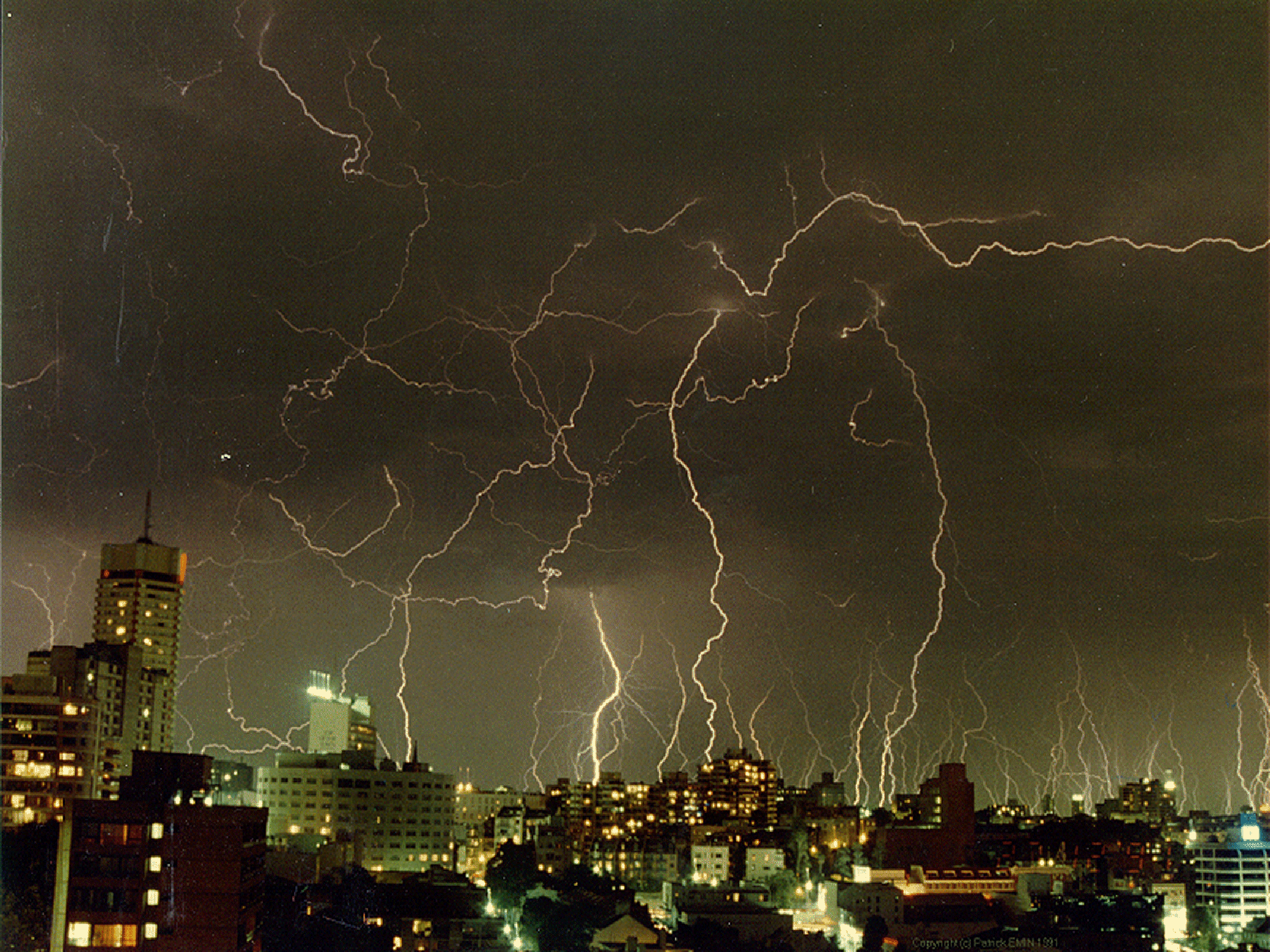
lightning over cityscape
(Wikimedia commons)

The folks at Cycling UK don't say anything about thunder and lightning, or how heavy the rain can be and still allow for safe riding, possibly because they're in Britain not the U.S. Midwest. Biology Insights (2026) warns: "Riding a bicycle is genuinely dangerous, and no amount of riding skill or rubber tires makes it otherwise." 365 Cycles (2025) titles their post "How to Ride Safely through Late-Summer Thunderstorms" but begins by noting lightning strikes are "rare but deadly," heavy rainstorms are "traction and visibility killers," and strong winds and flash floods are also potentially catastrophic (cf. also Atanasov 2021). Maybe that's where I phone a friend for a ride if for some reason I can't wait it out. But, depending on the severity of the storm, even driving can be dangerous (DriveSafe Online Staff 2024).

outdoor patio at Parlor City bar, some people visible
A sunny afternoon led to the patio at Parlor City...


people gathered on sidewalk in front of Cider Stroll table
...and Cider Stroll in Czech Village and New Bohemia!

Saturday, October 10 (mostly sunny, 83F)

Biked to:

Coffeeneuring begins!

SEE ALSO: "Week Without Driving (II)," 29 September 2025

America Walks Week Without Driving Page: Week Without Driving - America Walks

City Week Without Driving Page: Welcome to the City of Cedar Rapids, Iowa

Disability Rights Washington page: Home page - Disability Rights Washington

Kai Hall, "We're Organizing the 2026 Week Without Driving," Greater Greater Washington, 26 September 2026

Rocco Pendola, "America Chose Cars Over Quality Of Life," How It Works (and Why It Doesn't), 13 September 2026

Friday, February 6, 2026

10th anniversary post: Mass Transit


line of passengers waiting to board city bus
boarding the #7 to the southwest side, September 2025

(2/6/2026) My friend Randy turns 65 today, which makes him eligible for a senior pass entitling him to a lifetime of free rides on Cedar Rapids transit. He is an experienced bus rider, but not so much in his only-recently-adopted home of Cedar Rapids, so I wish him well on the adventures ahead of him.

author's bus pass
Sample transit pass. Any resemblance to actual persons,
living or dead, is purely coincidental.

Ten years ago this month, Cedar Rapids transit was going through an intensive self-examination. The Corridor Metropolitan Planning Organization (Corridor MPO) hosted the first of two public open houses at the Ground Transportation Center. We saw pictures of bus shelters, and a demonstration of the new RideCRT app. We saw route maps that showed four of the twelve routes had averaged more than 2500 riders per week over the previous five years; three more averaged 1500-2500 riders per week, with the remaining five coming in under 1500. (The #2 line averaged less than 1000 riders per week.)

My comments back then envisioned a dramatically different system, aimed at increasing ridership within what I imagined was an emerging urban core: shrinking the coverage area to the innermost 25 percent of the city, making routes direct along major thoroughfares, and trying out express routes from downtown to important locations on the periphery. I still think this would be a very good system, but it would be getting far ahead of where the city and its people are right now.
three people discussing mass transit in front of display boards
Transit open house, February 2016

These days, the transit operation is not dramatically different, but continues to try new ways of making optimal use of limited resources. In the last ten years, low-ridership routes 4 and 9 have been eliminated; routes 20 and 30 have been instituted as circulator routes for the adjacent towns of Marion and Hiawatha, respectively; and a truncated route 5 now runs every 15 minutes up and down 1st Avenue East. Some bus stops have been removed in order to speed travel (cf. Vejendla 2026). Weekday service now extends into the evenings, with the last stops made about 8:00 p.m. And the RideCRT app has been replaced by TransLoc, which I confess I'm still getting used to.

[Thanks to data supplied by the Corridor MPO, we can see that ridership in fiscal year 2024 had returned to the 4000+ per day typical of the 2010s. Route #5 leads all with more than 5300 riders per week--good call!--followed by west side Route #8 the only other route topping 2500. Six routes average 1500-2000 per week, two routes and the Marion circulator come in between 1000 and 1500, and the Northeast/Hiawatha circulator has less than 1000.]

So, for Randy, and anyone else of a certain age who's thinking of taking advantage of our city's bus system, here are some pointers from an experienced user:
  • The transit system works best the closer you are to the center of town, specifically the Ground Transportation Center (400 1st Street SE). My house is 1.9 miles away, Randy's is under a mile. It also helps to be close to 1st Avenue East, which sees buses running each way every 15 minutes. Being close by makes connections easier, and missing the bus less costly. Relying on the bus on the periphery is more difficult; the routes (except for #5) are circuitous, routes that far out are widely separated, and missing the bus is catastrophic when it only comes once an hour.
  • The transit system works best when your destination is along the same route on which you start. The attractions of New Bohemia, a little over two miles from my house, are easy to get to on the #2 line. The Oakland Road Hy-Vee is about the same distance in the opposite direction, but would be a long slog on multiple routes. If you're planning to go to multiple places in different parts of town, getting to those places by bus is going to be a time-consuming, logistical challenge.
  • There are some covered bus stops, but not many. The one on C Street in Czech Village has an uncovered bench. The one nearest to my house is just a sign. I hope the adjacent homeowner isn't worried about a weirdo blogger lurking on their sidewalk, and appreciates my efforts to stay off their lawn by the sign until the bus arrives.
  • Bus arrivals are pretty reliable, given they must contend with all the car traffic and stop for trains. I'm getting used to TransLoc, which shows bus locations and estimates when they'll arrive at a given stop. For example, as I write I see the #2 bus which runs by my house has just turned onto Mount Vernon Road at 19th Street. 
TransLoc display showing bus locations

It will be at the stop nearest my house in about 14 minutes.
TransLoc display showing expected bus arrival time

Transit is an app which will allow you to plan your trips, but I find any maps app, like Apple Maps on my iPhone, works just as well.

Apple Maps display showing suggested transit directions

  • All bus routes leave the GTC at 15 minutes past each hour, and they all return at about the top of the next hour, so depending on where you are on the route, you can make a decent ballpark estimate of when the bus will arrive near you. Some routes run more frequently, particularly during peak hours during the school year, but nothing makes me feel like a newb more than anticipating a bus that wasn't going to come.
  • Boarding is pretty uncomplicated, especially if you possess a pass. If you don't, individual rides are $1 (cash only with no change given), and all-day passes $2, so if you're going to ride more than once in a day just ask the driver for a pass. Crowded buses are rare, but they happen, particularly if someone has a wheelchair (takes three seats near the front), a stroller, or a dog. Iowans live in a sparsely populated state--the same population as the City of Chicago, in an area the size of the entire State of Illinois--so are neither used nor inclined to share seats. Even so, riding the bus is way more sociable than solo driving (Ramirez 2026).
  • Buses can accommodate up to two bicycles, which can be handy. I have seen people pop bikes on and off the bus, and have practiced it myself, but have a powerful mental block against doing it in real time.
  • Once you arrive at your destination, thank your driver, and debark. That's it. No searching or paying for a parking space. You've arrived. (Just keep an eye on the time so you don't miss your return trip.)
This is an urbanist blog, and your humble blogger cherishes urbanist dreams of viable, reliable public transit, even in small cities like mine. We could have it, says one study, for less than half of what we spend annually on highways (Brey 2026). Such a "moonshot" may not be the most fiscally sustainable approach (cf. Marohn 2025), but it would surely be an improvement over our current moonshot against immigration (Ray and Sanchez 2026).

ORIGINAL POST: "Mass Transit, Here and There," 17 February 2016

CEDAR RAPIDS CITY BUSES WEBSITE: Bus Routes

Wednesday, October 29, 2025

Book review: Life After Cars


Life After Cars cover
Goodyear, Sarah; Gordon, Doug; and Naparstek, Aaron. Life After Cars: Freeing Ourselves from the Tyranny of the Automobile. Penguin Random House, 2025, xix + 282 pp.

You could say it's the opposite of freedom. At this point, we are not driving cars. Cars are driving us. And we're headed for an existential crash. (2025: xii)

(10/29/2025) Like every American younger than 80 years of age, I have lived all my life with cars. When I was a mere tot, my mom used to take my sister and me for rides around town after lunch. Later, a car became my preferred way of getting to school, and once I got my drivers' license, a ready and able way to get anywhere I wanted to go.

In a country where most adults drive to get almost everywhere, our towns have been designed around making driving convenient and parking readily accessible. It's how our world has looked since before we were born, and we've heard its attributes celebrated in advertising and entertainment media. Only with effort can the substantial social costs of all these cars and all this driving become apparent, and it takes even more effort to imagine a different way of designing places.

Life After Cars is a handy survey of all those social costs of driving. I have long been a fan of The War on Cars, a slightly edgy but erudite podcast out of New York City that began in 2018 as a three-way collaboration between journalist-activists Sarah Goodyear, Doug Gordon, and Aaron Naperstek. I don't remember how I found out about it, but it can't have been too long after the podcast began. Somewhere on the road to 160 episodes, Naparstek, who also founded the website Streetsblog, withdrew from the podcast, though he is listed as a co-author of the book.

The title of the book is overstated, of course, even though it is not as contentious as the (ironically intended) title of the podcast. Motor vehicles are here to stay, and they know that. What the authors actually seek is "[a] world where those who truly need to use cars and trucks--workers delivering heavy loads, residents of rural areas, some people with mobility disabilities--can do so without competing for space and resources with people whose use of personal motor vehicles is unnecessary, wasteful, and inefficient," and walking, public transit, and cycling are accepted as part of the mobility mix (pp. 225-226).

The social costs of motor vehicles are mostly explored across five chapters in Part II, "How Cars Ruin Everything." Cars make force children to choose between their personal safety and exploring their world (ch. 3); cause a host of environmental, noise, and other public health problems (ch. 4); kill more and more people each year (ch. 5); create social isolation and all the problems attendant to it, not to mention making enemies of our fellow drivers (ch. 6); and create extra burdens for people who are poor, physically handicapped, or otherwise socially marginalized (ch. 7). A lot of these phenomena are explored in more detail elsewhere--they cite a lot of recently published books, many of whose authors they've had on their podcast--but rarely are they presented in one place in such a convenient way.

Are these social costs of driving "worth it?" Have we as a society, somewhere along the line, collective decided that some collateral damage was acceptable given the benefits car provide us? The authors argue otherwise in Part I, "How We Got Here." They spend a lot of Chapter 1 in the pre-World War II era, when cars had to fight for space on streets with pedestrians, streetcars, and so forth. They credit cars' ultimate victories, on the streets and in the halls of government, to powerful and ruthless business interests. Today, with fewer and fewer people around who remember a non-autocentric world, it's easy to see cyclists and other advocates of transportation alternatives as threats, because whatever our ideals, we have to get to work in the world cars have made.

The authors try to end on a hopeful note in Part III, "How We Get Free," although they frequently revert back to Part II world, as in their critique of city-supplied free parking (pp. 162-172). They hail academic studies of the effects of cars, and while noting the difficulties officials have faced even where (Ghent, Paris, e.g.) some space has been reclaimed, argue that politicians can look past the loud objectors to a quieter supportive majority; citizens can make themselves heard; and people in some cases can be proactive, as with tactical urbanism (pp, 205-214). 

They have faith, backed up by some experience, that once we are able to provide space for alternatives to cars, people will enjoy and defend it. The trick is overcoming the fears of chaos that are easy to gin up. 

It's a beautiful world, this one. A quieter, greener world that is more sustainable both environmentally and economically. It's also a happier world, where people are more likely to let their children roam free, to know and trust their neighbors, or to have spontaneous interactions with friends they bump into on a sidewalk. This is what life after cars could look like. (226)

I'm not sure I share their optimism, but they do lay out the choice urgently before us. The fantasy world of SUV commercials, in which we zip confidently through empty city streets or about the scenic wilderness, is just that--a fantasy. The reality, however, of traffic-choked suburban stroads was constructed to serve those fantasies as well as the economic needs of auto manufacturers. Reclaiming our streets will be strenuous, even if everyone reads this book, just because of how our towns have built those streets for the last 80 years. 

Life After Cars sticker on sticker-slathered guitar case
Promotional sticker is appropriate for guitar case placement

Life After Cars webpage (Penguin Random House)

The War on Cars webpage (Patreon)

"Week Without Driving Diary (II)," Holy Mountain, 29 September 2025

Thursday, October 9, 2025

10th anniversary post: Collins Road


Lindale Mall is dangerous to access for pedestrians or cyclists

(10/9/2025) What is our collective responsibility to people who have made rational (in their minds) decisions based on previous bad policies? How much money should be spent mitigating the badness, as opposed to putting money into areas with better infrastructure?

Ten years ago, I was bothered, to say the least, by news (Smith 2015, cited below) that the city was planning a major project widening Collins Road by Lindale Mall. The proposal included raising Collins in order to extend Lindale Drive underneath it and into the mall parking lot. The total cost was projected to be $15.4 million, of which the City of Cedar Rapids was providing 20 percent, with the rest funded by state and federal grants. According to a comment by the Corridor MPO's redoubtable transportation planner, Brandon Whyte, about 10 percent of the total project cost would go to making Lindale Drive a "complete street" with eight-foot sidewalks on both sides.

t-intersection, mall in background
Lindale Drive at frontage road, 2012
(Google Maps screenshot)

dead end, mall in background
Lindale Drive dead end, 2024
(Google Maps screenshot)

My strong objections to the "complete streets" aspect of the project were informed by Jeff Speck in Walkable City: How Downtown Can Save America, One Step at a Time (Farrar Straus Giroux, 2012). In Step 10, entitled "Pick Your Winners," Speck argues:

Most mayors, city managers, and municipal planners feel a responsibility to their entire city. As a result, they tend to sprinkle the walkability fairy dust indiscriminately. They are also optimists--they wouldn't be in government otherwise--so they want to believe that they can someday attain a city that is universally excellent. This is lovely, but it is counterproductive. By trying to be universally excellent, most cities end up universally mediocre. Walkability is likely only in those places where all the best of what a city has to offer is focused in one area. Concentration, not dispersion, is the elixir of urbanity. (2012: 259, emphasis mine)

(See also Doyon 2015.)

Still, the city officials quoted in the Gazette article made valid points. When Gary Peterson of the city's Public Works Department said the project would provide "pedestrians and bicyclists an inviting option in one of the city's principal commercial centers where few options now are in place for them," he was not wrong. The only non-car option at present is the #5 city bus, which stops on 1st Avenue in front of the mall on its inbound trip, though I've frequently seen people get off a few minutes earlier on the outbound trip and then sprint across 1st Avenue (average daily traffic count 18,700) to the mall or McDonald's. I do not recommend this.

The Grant Wood Trail passes about three-quarters of a mile north of Collins Road. Riding south on Lindale Drive towards the mall is not bad, but getting across Collins to the mall would be is an ordeal. People also live around here; besides trail riders, there are a number of relatively inexpensive apartments and town homes north of Collins, along Lindale Drive, Park Place, and Northland Drive. 

entrance to Lindale Manor mobile home court
Lindale Manor mobile home court, 400 Lindale Drive, Marion
(Google Maps screenshot)

Could the residents' lives be made less car-dependent? Yes. Should that be a priority for city spending? I still wonder.

In 2018-19, Collins Road was widened as planned, eliminating the frontage road, and sidewalks were extended along Lindale Drive and Collins Road itself. But Collins Road was not raised, and Lindale Drive was not extended underneath.

Collins Road before: four lanes, thin medium, no sidewalk
Collins Road at Lindale Mall entrance, 2012
(Google Maps screenshot)

Collins Road looking west into the sun
Collins Road at Lindale Mall entrance. 2024 (Google Maps screenshot):
The road is wider, the sidewalk is new. 
Note the sun is in the faces of westbound drivers

(It is possibly relevant here that a Hy-Vee supermarket on the south side of Collins, just west of the mall, has closed since I wrote that piece in 2015.) Your best option to access the mall on foot, bicycle, or wheelchair is a surface crossing with a traffic light about a quarter-mile to the west. Actually, I would say your best option is not to access the mall at all, but such snarkiness is not helpful in city planning.

Over the years, traffic on this stretch Collins Road has declined from about 27,500 (2013) to 25,000 (2017) to 24,000 (2021). On the service drive with the traffic light I referenced, it's declined from 5950 (2013) to 5300 (2017) to 4800 (2021). 

Crossing Collins Road to get to the mall: sidewalks, traffic lights, a lot of traffic
Looking across Collins Road at Lindale Mall entrance
(Google Maps screenshot)

Given there's going to be a lot of turning going on as well, safe crossing at this intersection is far from given, even when the drivers on Collins don't have the sun in their eyes.

Now that the (very expensive) widening of Collins Road has happened, the chance to piggy-back some active mobility access to the mall has probably passed. I still think that complete streets money for Lindale Drive was better spent elsewhere, making good walkable places great instead of making awful (even moreso after Collins was widened) walkable places less awful. But I'm less confident in that opinion than I was ten years ago.

ORIGINAL POST: "Collins Road: Oy Veh," 26 October 2015

GAZETTE ARTICLE: Rick Smith, "Major Work for Prime Destinations," Cedar Rapids Gazette, 15 October 2015, 1A, 9A

Monday, September 29, 2025

Week Without Driving Diary (II)


This is a contentious season for mobility issues, as indeed it has been for practically everything else. Earlier this month, Kea Wilson of Streetsblog USA reported that the U.S. Department of Transportation is rescinding grants for multimodal projects, including in Albuquerque, New Mexico; Bloomington-Normal, Illinois; and in the Naugatuck Valley area of Connecticut. Two of the applicants were specifically told the program was reallocating its grants to "projects that promote vehicular travel," which is consistent with the trend under Secretary Sean Duffy to shift away from previous goals of sustainability and equity (Wilson 2025, Ionescu 2025). 

Despite this sad pass to which we've come, the City of Cedar Rapids is back to celebrate National Week Without Driving, promoted by America Walks and Disability Rights Washington. While these organizations are not against other goals like physical fitness or sustainability, their focus is firmly on equity: Thirty percent of Washington residents are nondrivers--disabled people who can't drive, people who can't afford a vehicle or gas, have suspended licenses or lack documentation to get a license, people who are too young to drive, choose not to drive or who have aged out of driving. But nondrivers are largely invisible... ("How Would You Get Around" 2025).

Monday, September 29 (sunny, 87F)

Small crowd of people around the display table
City staff handing out bagels and coffee to morning commuters

Biked to: Ground Transportation Center, St. Paul's United Methodist Church, Next Page Books

Yes, some people who are unable to drive, including When Driving Is Not an Option author Anna Zivarts, are able to get around by bicycle!

I started my morning with a "second breakfast" of a bagel and small coffee from Panera at the Ground Transportation Center, courtesy of the Cedar Rapids Department of Community Development and the Corridor Metropolitan Planning Organization. (They did events like this last year, too, but I somehow missed them. How is that possible? What is this blog for anyhow?) The GTC is the transfer point for all routes except the Marion and Northeast circulators, and those riders whose attention we were able to get were pleasantly surprised. Buses provide a critical route to work or school for those whose mobility is limited, and because of the system's coverage orientation (Walker 2008) they are never going to be self-funding.

I arrived at the station about 8:00 a.m., which meant I navigated into downtown during the 10 minutes where the morning traffic is likely to be at its most intense. Nothing untoward happened, but I was conscious of being agile and knowledgeable enough to minimize encounters with cars. The most awkward moment was when I turned left in what appeared to be a brief break in opposing traffic, only to have the car I was turning behind slow way down to turn into a parking spot just around the corner (that probably shouldn't be a parking spot that close to the intersection)--unexpected but not dangerous. In all, I rode about eight miles to three places.

Bicycles are not only lighter and slower than cars, they are much easier to steal. When I stopped late in the morning at Next Page Books, Cedar Rapids' oldest independent bookstore, I locked my bike to a large post to which another bicycle was already locked. That bike immediately began emitting meek little beeps, which may have been intended to deter theft?

Passengers in line to board bus
Passengers boarding the #7 bus

David Zipper's newsletter this morning discussed autonomous vehicles, which when fully ripe will contribute somehow to mobility. But there is a dangerous potential for "robotaxis," Zipper argues, to become so pleasant that everyone will spend more time in cars: The resulting spike in car traffic would be catastrophic for cities with limited street space. Crushing gridlock could exasperate residents, hobble employers, and cripple bus service. Mobility hubs, like one currently planned for Waco, Texas, haven't proven effective at changing travel habits. He concludes that since more than 90 percent of transit riders arrive at the station on foot, I sometimes wonder if cities and transit agencies should simply shift the resources... toward building high-quality sidewalk networks. Cedar Rapids, to its credit, had a huge push for sidewalk construction about a decade ago, though there are still places where they're needed. 

Tuesday, September 30 (sunny, high 87F)

passengers boarding city bus in front of brick apartment building
Boarding the #5 to downtown Cedar Rapids at the Twixt Town Road transfer point.
The Northeast Circulator is in foreground; the Marion Circulator is in front of the 
apartment building across the street.

Bused to: (1) Trims Barbershop and Uptown Coffee, (2) Helen G. Nassif YMCA and Benz Beverage Depot [replaced at least one car trip]

Life and the transit system took me to Marion today. Google estimates the 4.5 miles from my home take about 11 minutes by car; the bus trip was about three times that, including the five blocks' walk to the stop.

green plastic bench, parking lot, office building
Bus stop on 1st Avenue at 19th Street SE

I should probably consult Jarret Walker or someone about how much longer the bus can take versus a car trip and still attract ridership, but 3:1 is if I recall correctly pretty typical of Washington, D.C. Getting to Marion starts with the #5 bus, which runs up and down 1st Avenue every 15 minutes, making it Cedar Rapids' best bus line. The transfer point has moved over the years since the advent of the circulator a few years ago from Lindale Mall to the edge of the mall parking lot to where it is now, in front of an apartment building on Twixt Town Road. (Twixt Town Road, named by a poetically inclined city employee ages ago, runs along the border between Cedar Rapids and Marion.) The circulator got me to Uptown Marion ahead of my appointment, so I got to hang out in their remodeled City Square Park on a lovely morning. 
benches, plantings, building
City Square, Marion

(It even has public restrooms!)

After the stop by City Square, the Marion circulator ranges far and wide over the town. For that reason I expect it's not practical for anyone above maybe 15th Street unless they're desperate. I expect that's a dilemma for any transit system, even one that's committed to coverage: how to balance convenient access to all the places people live with how much inconvenience we expect them to endure to get where they're going. But for me today, with the "right" trip planned, and a flexible schedule, the bus was great. There were 19 riders headed downtown on my return trip, so it was right for others as well.

Jean-Paul Sartre (1905-1980)
Jean-Paul Sartre, author of The Critique of Dialectical Reason
 (Swiped from algundiaenalgunaparte.com)

On my afternoon ride downtown on the #2, we participated in what Jean-Paul Sartre called a "group-in-fusion," when a gentleman in a wheelchair had to maneuver around a woman with a walker. I wound up holding her walker while he got situated. Then, back on route #5 for the outbound trip, it happened again when a number of the 20-plus riders moved seats to make room for another rider and his wheelchair. "Yay, team bus riders," one lady said. On a day when President Trump proposed to use cities as military training grounds, our city's residents were taking care of each other.

Gil Penalosa's Cities for Everyone webinar today featured Phil Ginsburg, general manager of parks for the city of San Francisco. San Francisco aims to provide a park within a 10-minute walk for everyone in the city, including rerouting car traffic from Golden Gate Park and along the Pacific coast to improve safe access--not directly related to transportation alternatives, but definitely sharing the same goals of equity (cf. Hartlaub 2025).

Wednesday, October 1 (sunny, high 84F)


Biked to: Vault Coworking Space

Walked to: (1) Healthiest State Lunch at Greene Square, (2) Wellington Heights neighborhood

Today's official observance of Week Without Driving was the Healthiest State Walk, which originated from three locations and ended with lunch on the lawn at Greene Square. I joined a group that originated at the Cedar Rapids History Center on 2nd Avenue, which for me entailed walking an additional mile or so north from the Wendler (formerly Geonetric) Building where I'm coworking today. My route to the meetup point was highly unpleasant, up 6th and 7th Streets and dealing with a lot of medical and Interstate 380 vehicular traffic that wasn't expecting to have to deal with me. That included but was not limited to a woman on 7th Street signaling for a right turn at 6th Avenue who went through the intersection without turning--she was turning right into a parking lot past the street, not onto the street itself--and was not going to yield to the blogger in the crosswalk. Were I not fit and agile, I would never have attempted this walk.

The Healthiest State Walk proper and the lunch (catered by Craftd) were quite convivial; my group's walk was led by MedQuarter executive director Phil Wasta. Greene Square is a great space when it's activated. Betsy Borchardt from the City brought her dog to the park, who provided some drama as she squirmed to get at a nearby squirrel. Sadly or happily, depending on your perspective, her natural drive was denied.

Group of walkers, trees, photographer
Walking to lunch at Greene Square

In the evening, I went back out to do some door-to-door canvassing in the Wellington Heights neighborhood about a proposed restroom in Redmond Park. This effort is not directly related to Week Without Driving, but is aiming at the same goal of inclusive communities.

The latest Active Towns podcast episode arrived today. Host John Simmerman interviewed triathlete-turned-real estate mogul Michael Lovato, a resident of Boulder, Colorado. They describe Boulder as a haven for active people, which can include professional athletes but also people who want to stay physically fit and those who want to remain active through physical decline--all reasons to make it feasible to live well without driving!

Thursday, October 2 (sunny, high 86F)

Bused to: Helen G. Nassif YMCA, Lightworks Cafe [replaced car trip even though I...]
Drove ðŸ˜’ to: CSPS Hall
singer Rook Wilde with guitar on stage (behind four speakers) at CSPS Hall
As Rook Wilde took the stage at CSPS Hall tonight,
it was already dark outside

I made it to Thursday of the Week Without Driving without driving, but I saw this event on my calendar and knew it would break the skein. CSPS Hall, an eclectic arts venue where I frequently volunteer, is a hair over two miles from my house. I've frequently bicycled there during the day, and it's a mere three blocks from the #2 bus line stop by the Linn County Public Health building. But I'm not a confident night cyclist in a town that doesn't expect me, and the last city bus leaves the station at 7:15 p.m. With tonight's concert expected to go past 9:00, I opted to drive my car. I'm grateful I have that option available.

CSPS's one non-driving staff member, photographer Charles Black, lives in an apartment six blocks away, so he and his camera rely on an e-bike. He's going to be moving soon, though, due to the city's zoning-related demands on his current landlord. Happily he found an abode even closer--now he'll be only four blocks from CSPS Hall!
bicycle with air pump attached to the rear tire
A new month reminds me to check my bike tires!

The Community Development folk were back at the Ground Transportation Center this afternoon, with treats for afternoon commuters, particularly high school students who use the city bus to get to and from school. They were planning to serve ice cream, but weren't sure about the logistics, particularly on another unseasonably warm day. I didn't get down there, but I wonder how it went?

Elsewhere, Cleveland-based blogger Angie Schmitt wrote today about an Ohio legislator's claim that traffic deaths are over-hyped. He told Schmitt's group that 1,300 annual traffic deaths in a state with a population over 11 million amounted to a very tiny risk. Yet, as Schmitt argues:
The thing is, these odds add up over time. Most people... live for 60 or 80 years if they're lucky. Risks compound... If we were to take those tiny fractions and add them up year after year, guess what? They start getting bigger. In the U.S., using 2022 data, the odds of being killed in a car crash over a lifetime are 1 in 93. More than 1 in 100 Americans can expect to die in a car crash over the course of their lifetimes.

Traffic safety, by this mathy logic, is a concern for everyone, not merely collateral damage from our (enjoyment of? attempts to accommodate to? assertion of individuality in?) car-dependent city design. That Ohio legislator was wrong to diminish the issue of traffic safety, but for many of us, he only said the quiet part out loud. 

The same can be said for non-drivers, whether they are that way from necessity or choice: they are people with legitimate stakes in how we roll, not mere statistical anomalies in what James Howard Kunstler once called "the era of happy motoring."

Friday, October 3 (sunny, high 88F)

Biked to: Coe College, Bricks Bar and Grill
bike at bike rack, pergola, brick building
My bike parked at Coe. The pergola at right honors the late Professor Dan Lehn.
I spent my day at my office at Coe College, from where I mostly retired a year and a half ago, then met some friends for happy hour at Bricks downtown.
Entrance to Bricks
Entrance to Bricks

Bricks has been in town longer than I have (1989), but is still going strong under the management of the Fun Not Fancy group. It is located where the main bike trail crosses 2nd Avenue SE, and though they hosted the after party for Bike to Work Week 2014, they haven't visibly appealed to cyclists as much as other bars along the trail have.
bikes at rack, with mural and art museum in background
City bike rack outside Bricks, with my bike and my friend Chris's bike

In all, I rode about four miles to three places.

This year the city added to the commemoration of Week Without Driving a commuter bike ride in the style of Bike to Work Week. That happened today, riding downtown mostly on the Cedar Valley Nature Trail from McCloud Place on the northeast side in the morning, and back in the late afternoon. The same ride in May drew a small handful of riders, but everyone we can get into the spirit of this idea represents a step forward.

Rick Reilly's column in today's Washington Post demands greater regulation of e-bikes. The same technology that enables Charles to get his camera to and from CSPS Hall, and extends the possibility of bicycle rides, can be ridden aggressively and dangerously.  He cites a number of examples from his home state of California as well as suburban Chicago. Reilly recommends requiring drivers' licenses to drive any motorized vehicle, as well as fines and community service for violators. All this requires enforcement, however, and for a variety of good and bad reasons police presence on the streets has diminished nationwide. Accommodating non-drivers, especially those who are especially vulnerable, in our transportation system won't work unless the streets, and sidewalks and bike lanes, are safe.

Saturday, October 4 (sunny, high 86F)

Rode to: Bruegger's Bagels [replaced car trip]
Drove ðŸ˜’ to: Zoey's Pizza
bicycle parked in front of Bruegger's Bagels
My bike in front of Bruegger's Bagels

A day after parts of Montana got socked with a foot of snow, we are still having summerlike temperatures, threatening but so far not breaking daily record highs. We have set a seasonal record with nine straight highs in the 80s.

I dodged a drive this morning because my list of errands stopped at one: to pick up bagels for Sunday breakfast. Bruegger's, the national bagel chain, has two Cedar Rapids locations, one only about two miles from our house. Mt. Vernon Rd. SE is a notorious stroad, but Bruegger's is on the north (our) side of the stroad, so I can get there by side streets. Once there, I spotted former mayor Ron Corbett among the diners. They offer free coffee if you order ahead through the app, and I managed to get that home in my drink holder without spilling too much. A four-mile bike ride with a dark roasted reward reminds me that Coffeeneuring starts in about a week; check the hashtag on your favorite social medium for more information, or you can live vicariously through the ride-by-ride coverage on Holy Mountain.

Saturday night I drove us out to dinner. We could have tried adhering to the letter of Week Without Driving--at the very least, Jane could have driven instead of me--but we didn't. The dining options within walking distance on a hot evening were not enticing, which carries a lesson for us all. Those of us who can drive sometimes drive because we don't feel like not driving.

Greater Greater Washington today posted an article by disability advocate Kelly Mack, who writes a blog on Substack called Rolling With It and uses a power wheelchair to get around Washington, D.C. She praises the improvements in mobility (transit buses with ramps, Metrorail elevators, more accessible taxis, sidewalks in good repair) during the 2000s. "I could access: work, medical appointments, stores for errands, and the many leisure activities I enjoyed, like visiting restaurants, theaters, and museums." Lately, though, she's "noticed a steady decline in the quality of accessible transportation options," with widespread broken elevators at Metro stations, erratic bus service, unplowed sidewalk ramps, and such. She refers to a "transportation time tax" for disabled citizens whereby "Every piece of the transportation puzzle adds up to subtract time and energy from my life." As an advocate, she meets frequently with government officials on these very subjects, but finds only lip service, which she calls the "uh... hm factor." Mack, unlike me, can't drive herself when other options are too inconvenient or strenuous. It would be good to have a disability advocate, and I know they're out there, do some audits as part of next year's Week Without Driving in Cedar Rapids.

Week Without Driving is a good experience, if only for raising awareness. I found it not difficult to manage, with only a couple defections, because I'm [a] agile enough to walk places, [b] retired so I can roll with the bus's schedule, and [c] able to fall back on driving when all else fails. It would be more interesting to read about the regular experience of someone who literally can't drive.

City of Cedar Rapids Week Without Driving page

LAST YEAR: "Week Without Driving Diary," 30 September  

Week Without Driving Diary (III)

A very walkable block! (10/5/2026)  For most of its one mile length, Washington Avenue SE is the very model of a walkable residential street...