Showing posts with label community. Show all posts

Sunday, November 22, 2026

The Value of Incidental Contacts


Incidental contacts can happen on sidewalks,
but only if there are people going places

Places like the Stroget [in Copenhagen] carry an increasingly urgent message about the role of public life in cities. For thousands of years, city life naturally led people toward casual contact with people outside of our circle of intimates. In the absence of refrigeration, television, drive-thru, and the Internet, our forbears had no choice but to come together every day to trade, to talk, to learn, and to socialize on the street. This was the purpose of the city. (Montgomery 2013: 153)

(11/22/2026) One of the advantages of traditional development is it facilitates incidental contacts. These are people you encounter solely because they're walking, waiting, or sitting in the same place you are. The city sidewalks described by Jane Jacobs, like the third places described by Ray Oldenburg, "bring together people who do not know each other in an intimate, private social fashion and in most cases do not care to know each other in that fashion" (Jacobs 1961: 72).

Imagine several degrees of human interaction:

  1. intimates: family members and close friends 
  2. associates: other coworkers, close-by neighbors, fellow members of clubs and religious groups
  3. incidental contacts: people encountered unintentionally
  4. strangers: everyone else in the world
If you walk in a place for the first time, everyone will be a stranger. I think about getting off the commuter train in Chicago, a town I visit about once a year, in a crowd of thousands of people. They are strangers to me, and almost certainly always will be. But after walking in a place a few times--unless it's super-crowded, like Union Station in rush hour--or stopping in a coffeehouse or bar, certain faces will start to be familiar to you, and yours to them.

In a town where nearly all trips outside the home require a car, nearly everyone you meet will be someone with whom you choose to associate rather intensely, and everyone else will be strangers. Incidental contacts require some informal space where people gather. And gather they will!
We are an associating species whose nature is to share space just as we share experiences; few hermits are produced in any human culture. A habitat that discourages association, one in which people withdraw to privacy as turtles into their shells, denies community and leaves people lonely in the midst of many. (Oldenburg 1989: 203)
Organizations, close friends, and family--those that comprise the first two groups--have claims on us that we must limit in the interest of personal privacy. We literally can't be everyone's friend.
A good city street neighborhood achieves a marvel of balance between its people's determination to have essential privacy and their simultaneous wishes for differing degrees of contact, enjoyment or help from the people around. (Jacobs 1961: 77-78)
Jane Jacobs
Jane Jacobs (1916-2006)

Too much privacy, as I can attest from various times in my life, makes you lonely, fearful, and stagnant.
In city areas that lack a natural and casual public life, it is common for residents to isolate themselves from each other to a fantastic degree. (Jacobs 1961: 85)

In classic urbanist texts, Jane Jacobs analyzes outdoor gathering places ("sidewalks" in chapter 3) and Ray Oldenburg at indoor places ("third places" especially in chapter 11), but their logic is the same. (Note that it's not just enough to lay down a sidewalk; there must be reasons to use it, such as stores to which people can walk, cf. Jacobs 1961: 82.) Informal gathering places must be facilitated and encouraged, as well as done right; moreover, they are responses to market failures, because a purely profit motive will not provide them. 
If there is any point at all to a third place, it is that it offers so much more than just a cup of coffee or a glass of beer... The patrons have company and conversation; a restroom should they need it; and overall, a homey and comfortable place to relax. (Oldenburg 1989: 229)
Both Jacobs and Oldenburg make the same point about racial and other forms of segregation: without informal gathering places where we have low stakes contact, we don't build the social trust that enables truly integrated social relationships.
The tolerance, the room for great differences among neighbors... are possible and normal only when streets of great cities have built in equipment allowing strangers to dwell in peace together on civilized but essentially dignified and reserved terms. (Jacobs 1961: 95; cf. also Oldenburg 1989: 221)
In a well-designed city or part of a city, incidental contacts have space to occur, and they serve as the ground out of which grow more formal organizations, mutual aid, personal friendships, and social trust.
Formal public organizations in cities require an informal public life underlying them, mediating between them and the privacy of the people in the city. (Jacobs 1961: 75)

This is, I hasten to add, not a lesson on how to make friends or form interest groups. Those can happen all sorts of ways. But a city where people regularly encounter other people in incidental contacts, the likelihood of those things happening is raised.

Thinking about the phenomenon this way helps me understand why I am so out of sorts with so much of how Cedar Rapids is developing these days.

  • Core neighborhoods are being built as "drive-to urbanism." In other words, if I want some amenity, I will get in my car and drive to a commercial attraction that provides it. We can drive to old bars, new bars, athletic clubs, restaurants, and trails, all of which are disconnected from residential neighborhoods, even if they do happen to adjoin them. 
  • Our casino, which opens to the public this week, is one such big attraction. Whatever its merits as an attraction, it was built on land close to the center of town, that might have been better as a walkable residential neighborhood with small commercial spaces.
I can walk to the center of my city in less than 30 minutes, and there have been days I have done that and encountered exactly zero people along the way. We are missing something valuable.

SOURCES
    Jane Jacobs, The Death and Life of Great American Cities (Modern Library, [1961] 2011)
    Charles Montgomery, Happy City: Transforming Our Lives Through Urban Design. (Farrar Straus Giroux, 2013)
    Ray Oldenburg, The Great Good Place (Da Capo, [1989] 1999)

Friday, November 6, 2026

10th Anniversary Post: The Election and Our Common Life


Four people including author on television set
Your humble blogger with KGAN reporters on election night 2016
(from Eric Wylie's Facebook page)

(11/6/2026) A recent New Yorker cartoon shows two toddlers discussing the election. One says to the other, "This is the most important election of our lifetime." It's a play on what has become a cliche about every single election I can remember, and I can remember a lot of them.

Hindsight is 20/20, to quote another cliche, but if I had to pick the most important election of my lifetime, it would either be 1980 (Reagan vs. Carter) or 2016 (Trump's first election). In 2016, Trump seemingly did everything wrong--vulgarity, scandal, trash talking women and veterans, making fun of the handicapped, weak command of policy issues--yet to the wonderment of all, he got enough support in enough states to get elected President. In doing so, he legitimized a surly undercurrent in America that must have been there all along, but only came to full flower when he did.

That surly undercurrent is still with us, despite the Democrats' thunderous national victory in the 2026 offyear election, and it's not going away soon, and maybe not ever. After the 2020 election, my post suggested Trump was behind us, and it was time to heal from the trauma and come together as a nation. Written barely a week before Trump-inspired insurgents trashed the U.S. Capitol, I was overly optimistic if not hopelessly naive.

refrigerator decorated with pictures including Donald Trump
Who's on your fridge?
We are in a different place now, but how different? Democratic candidates currently lead the vote count in U.S. House races--counting is ongoing in many places--by 11.6 percentage points, which will translate into a gain of at least 40 seats, and maybe more. (In 2018, in Trump's first midterm, the Democrats' national advantage was a little over eight points; in 2020, when I was ready to heal, the House Democrats led by only three points nationally, and actually lost 13 seats.) Here in Iowa, where the Democratic Party's pulse has been barely detectable for over a decade, Democrats picked up three U.S. House seats, flipped the Senate seat currently held by Republican Joni Ernst as well as the governor and attorney general, and gained seats in the state House.

President Trump has been soundly smacked, but it's less clear that the common life he rejected has been reaffirmed by the voters. That remains to be hashed out by the numbers people and those who frame issues. 

If we were doing natural science here, we could run the 2026 elections over and over again in our lab--wouldn't that be fun?!?--to test the strength of different factors on the eventual outcome. How much impact did the shaky economy have on election results? Vice President J.D. Vance said that the quagmire in Iran was what doomed Republicans, and it certainly played a large role, not in the way that Vietnam or Iraq II did, but because Iran's ability to interrupt energy supply chains rippled through the American economy in a way that negatively affected nearly everyone. What if Trump, whose true genius is saying and doing things to keep the spotlight on himself, had this time listened to military advisers and held off on invasion?

It would be good to know whether the 2026 outcome resulted entirely from Trump's economic mismanagement, or whether the President and his allies also suffered from their rejection of American (and world) common life. The last Real Clear Polling averages showed approval of Trump's immigration policy at 43 percent against 54 percent disapproval. (Approval on the economy and inflation was much lower.) Real Clear Politics didn't report evaluations of things like corruption/character, equality, and education; but in New York Times surveys of battleground states, those factors showed up much lower among voter concerns than the economy. Would enough voters have tolerated Trump's staggering corruption, use of immigration personnel as shock troops, and denigration of science and government management, as long as their pocketbooks were okay?

sign in field, church in background
Roadside sign, August 2026
(Google Maps screenshot)

The good news for our common life is that American democracy lives another day. The electoral wave was large enough to swamp all the electoral shenanigans the Republicans had tried or planned to try (cf. ProPublica 2026, Bock Clark 2026). The mid-decade redistricting may have spread Republican support in places like Texas so thinly that it made their candidates more vulnerable. It's an open question whether this evil playbook gets reopened in a more typical election year.

Let's talk in 2030, when Democrats hold a national trifecta and there are problems. Let's say they're economic problems. There won't be a lot for the government to work with: Between grift and wars and building monuments to himself and ICE, Trump has bled America pretty nearly dry. In a competitive political environment, will the important election of 2016 be truly behind us?

SEE ALSO:

Adrian Carrasquillo, "Latino Fury: How Anti-ICE Fervor Helped Democrats Take Back Congress," The Bulwark, 4 November 2026

Lyz Lenz, "Is Iowa a Blue State Now?" Men Yell at Me, 4 November 2026

Angie Schmitt, "Let's Put This Embarrassing Period in Our Politics Behind Us," Love of Place, 4 November 2026

"2026 General Election Turnout" (University of Florida Election Lab)

Monday, July 6, 2026

Book review: Palaces for the People


Eric Klinenberg speaking on stage in front of a drum set
Eric Klinenberg at CNU34
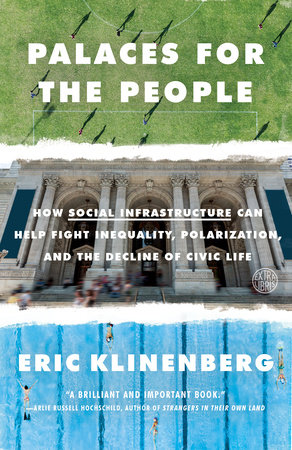
Twenty-first century social infrastructures are already reviving civic life in nations across the planet: public plazas in low-lying cities that double as massive water storage systems during extreme weather events; massive levees and berms that masquerade as bike paths and parks. Americans should have all these things. (Klinenberg 2018: 293)

Eric Klinenberg, Palaces for the People: How Social Infrastructure Can Help Fight Inequality, Polarization, and the Decline of Civic Life (Broadway, 2018), 293 pp.

(7/3/2026) There is supposed to be a theory of human evolution where we humans have since hunter-gatherer days differed in our response to strangers. Some see strangers as inherently dangerous, a threat to our precarious food supply; others see strangers as bringing welcome variety, so we could trade lunches or at least hear new jokes. Both of these perspectives are adaptive--some strangers are dangerous--but decades of auto-centric development has left us with a lack of places to encounter strangers in low-stakes, non-threatening ways. The results include an epidemic of loneliness, physical unfitness, and vulnerability to violent crime, homelessness and climate catastrophes. 

Eight years after the publication of Palaces for the People, Eric Klinenberg began his keynote address to the Congress for the New Urbanism in Bentonville, Arkansas, last month, with the question: What has happened to the fabric that supports community life? He urged his listeners to "make every project you do work as social infrastructure," whether it's a playground or something less obviously connected, like flood control. We should also fund public libraries, a lot more than we currently are.

Klinenberg grew up in Chicago, and was just about to start graduate school when the deadly 1995 heat wave struck the city. The factors that affected who survived and who didn't, and the factors affecting the geographic distribution of mortality, inspired his field research, and eventually his first book, Heat Wave (University of Chicago Press, 2002). He continues to ask: If sudden natural disasters, as well as the slow corrosive effects of loneliness and despair, have predictable effects, "What conditions in the places we inhabit make it more likely that people will develop strong or supportive relationships and what conditions make it more likely that people will grow isolated and alone?" (2018: 6)

short bookshelves, carpeting, fake fireplace in background
Social infrastructure: The Union (young adult room), 
Cedar Rapids Public Library

Social infrastructure is defined as "the physical places and organizations that shape the way people interact," creating the context for individual-level relationships of all levels of intensity. It can take many forms--public institutions, open spaces, privately-owned establishments--but the common element is "people are welcome to congregate and linger" (16). His first example is public libraries (ch. 1), which "do all kinds of unexpected things for surprisingly large numbers of people... by providing free access to the widest possible variety of cultural materials to people of all ages, from all ethnicities and groups" (37). He describes his visits to the New Lots and Seward Park branches in New York City, where he sees the elderly, teenagers, the unhoused, and immigrants in places where they can find meaning and encounter other people. 

Chalkboard, The Union (young adult room)
Chalkboard in The Union:
The youth have something to say

Chapter two argues social infrastructure is useful for improving public safety, where outcomes of long-term policies in Philadelphia "suggest that place-based interventions (fixing up vacant and abandoned properties, planting trees and grass) are far more likely to succeed than people-based projects" like tougher criminal sentencing and cracking down on petty crime (70).

Chapter three starts at elementary school, spends most of its time at college, and then goes back to the library. Any of these places can serve as community gathering spaces, but that doesn't happen automatically; they also can fail by putting up barriers or designing for institutional efficiency.

playground behind locked gate
School playgrounds can be community gathering spaces,
but only if they're unlocked

One big social change since the publication of this book is that the number of people living on the streets has increased by 50 percent, which may affect the real or perceived ability of the community to gather in these types of spaces.

Chapter four focuses on the public health impacts (opioid addiction, food deserts, isolation especially among the elderly and poor) of glaring failures of social infrastructure. Chapter five highlights the role of sports facilities and teams in bringing together people of different backgrounds, which might be a major reason racists fought so strenuously to keep beaches and pools segregated (and why "boys in girls' sports" is such a potent argument today). The epilogue points out the limits of social media, and other billionaires' moonshots, in doing what simple contact can achieve.

Chapter six on climate change is an extension of the argument. Incredibly, as I write this eight years after this book was published, with heat domes over much of the northern hemisphere, widespread fires and flash flooding, the crew in charge of the American national government still insists there's nothing to see here. Even in 2018, it was undeniable that (a) the climate is changing, (b) its effects fall most heavily on those at the margins of society, and (c) we're going to have to build or rebuild a lot of our infrastructure in order to prepare for this. 

grassy area with wide sidewalks, buildings in background
Social infrastructure: The McGrath Amphitheatre,
park and concert venue and flood protection

Klinenberg makes the case for making the new physical infrastructure work as social infrastructure as well, as had been planned along the FDR Drive in New York City:

The berms would block and absorb storm surges when necessary, but their everyday function, as parklands and recreational areas for inhabitants of an especially gray and unpleasant part of an especially gray city, is at least equally as important.... Deployable walls, camouflaged as a series of murals that hang from strong hinges on the ugly underside of the FDR Drive, are another key part of the proposal. Most of the time, the structures, which will be designed by local artists, operate as decorative ceiling panels that enhance the experience of walking beneath the highway, which, lacking good alternatives, thousands of residents do each day. (2018: 202)

Klinenberg makes a strong argument for urbanist design. Loneliness and all its ill effects, physical fitness, political polarization, and vulnerability to crime and climate can all be traced to the lack of social infrastructure. In his 2026 talk, he said that if communities design, build, maintain and program it, democracy and civil society will benefit, and there exists a "palpable sense of possibility" in this moment in history, especially among the young. We surely can do with more public libraries, playgrounds, and plazas (with shade for sure!), if they're done right. The alternative, as he said in Bentonville, is "we are all more likely to hunker down in private places."

Palaces for the People cover
(Source: crownpublishing.com)

Pete Saunders, "Preparing for the Climate Migrants," Corner Side Yard, 2 July 2026

Angie Schmitt, "Ross Chapin on How the 'Pocket Neighborhood' Can Address Loneliness," Love of Place, 24 June 2026

Wednesday, April 1, 2026

10th anniversary post: The tragedy of the commons (life)

Litter on grass and street
Litter is a plague on our cities

(4/1/2026) Ten years ago this month, I wrote about a fellow who used the grassy median on our street as his dog's toilet. "Neither the man nor his dog cleans up afterwards," I noted. It served as a homely example of Garret Hardin's belief that people had incentives to over-use common property, such as a village green for grazing sheep, or a grassy median on Blake Boulevard. Hardin believed, though, that people could be educated to the existence of common and long-term interests, enough to change their behavior. Back in 2016, I was, to say the least, impatient at the pace of that enlightenment:

I can't speak for other cultures, but our culture has a strong individualistic strain with a vocabulary to match. Daily advertisers pitch convenience to us as if it were an absolute good, while an oil company offers us "a full tank of freedom." We have yet to develop an equivalent vocabulary to talk about community, or a way to discuss balancing individual and community interests. This needs to happen soon if we're going to live together in this world.

In March, Addison Del Mastro published an essay in The Deleted Scenes in which he responded to another essay by Chris Arnade. Arnade argues that Americans of good heart are forced into private spaces because public spaces in the U.S. are so disordered. He traces this to America's distinctively individualistic culture: 

The U.S. has a different model that emphasizes individuality over the communal, with our thick culture focused not on being a good citizen first, but finding our true self and exploring that, and hopefully making a lot of money along the way--Koreans are citizens, we are entrepreneurs. That is one of our greatest strengths, and has served us well economically and artistically.... Yet a result of the American model is a wider distribution of behavior, including fatter extremes, with a far larger amount of people prone to antisocial tendencies... If our elevated levels of addiction and mental illness are consequences of our culture of individuality, as I believe they are, then we have a moral responsibility to take them off the streets and care for them--for those broken by our celebration of freedom... and more importantly for the working people navigating around them. (Arnade 2026)

Addison Del Mastro,
blogger at The Deleted Scenes

Addison Del Mastro, while mostly agreeing with Arnade, is concerned that too much emphasis on public order makes public places "blandly conformist."

When we visited Japan, I liked how orderly and polite everything was, but it also felt a bit... oppressive. There really is a part of the American in me that would rather have a disorderly public sphere than have my right to behave disruptively constrained. Now, I don't behave disruptively, I just kind of find it emotionally claustrophobic to be somewhere I can't if I wanted to.... And I think I prefer the American you-do-you approach, where you feel like nobody's really watching or keeping tabs, over the conformist approach of a place like Japan. (You can't even take photographs in stores; everything feels very ritualized and rule-bound, and I chafe against the more than I appreciate the calm and order it brings.) (Del Mastro and NickS (WA) 2026)

Del Mastro concludes this piece by quoting an extended commentary on his position by a third Substacker, NickS (WA). Nick is glad he doesn't have to fear being beaten up for being "visibly weird," but wonders if our tolerance should extend as much as it does to, say, loud motorcycle engines. For my part, from earliest memory I have been obsessed with rule following--can't really say why without extensive psychotherapy, but maybe my spindly physique has something to do with it--but I want to be able to disobey rules when they don't make sense, like crossing streets in the middle of the block when there are no cars around. At the same time, I would like to see less ungoverned reckless driving, sexual harassment, bullying, loud noises, littering, &c.

portrait of Benjamin Constant
Benjamin Constant (1767-1830)

By coincidence, my Political Philosophy class recently read an essay on liberty by the French politician Benjamin Constant (1767-1830) called "Ancient and Modern Liberty." In 1819, Constant described modern liberty as rooted in individual autonomy. In large societies with complex economies, he explained, the social influence of most people, even those with multiple forms of privilege, approaches zero, because your one voice amounts to a tiny fraction of the whole society. So the most you can hope for is maximizing autonomy over your own life, while the government is likely to be constrained by the high cost of controlling a large number of people.

In ancient times, by contrast, the small communities on the knife-edge of existence had a lot of incentive to stick together and work together. (Consider the micromanaging style of the ancient Israelite laws detailed in the first five books of the Bible.) Ancient liberty allowed individuals a lot of voice in community decisions, said Constant, but once the decision was made everyone had to abide by it. Solidarity and conformity were seen as vital to the existence of the group, constantly threatened by famine and disease and external attacks. Constant concluded that ancient liberty, with its stress on connections between everyone, has its attractive qualities, but attempts to reintroduce it in modern society would be bound to fail, for both logistical and cultural reasons.

Who's Your City by Richard Florida cover

Back to modern times and modern liberty: Richard Florida and colleagues have argued for years that an "open culture premium" was a significant part of the phenomenon of rising property values associated with higher proportions of GLBTQ+ and artistic types (cf. Florida and Mellander 2007). A community open enough to tolerate nonconforming expressions, it seems, is open enough to encourage the sorts of innovation that create wealth (pp. 9-10). Recent research by the Brookings Institution finds a similarly positive relationship between immigration levels and metro economic performance (Haskins and Parilla 2026). These make a strong case for the existence of a general community interest in the broadest possible reach of modern liberty. Maximum freedom generates maximum good ideas, which in turn generate community wealth. (Note the enormous proportion of American gross domestic product (GDP) that occurs in counties that support Democratic presidential candidates.) On the other end of the spectrum, the current campaign against a 30-year-old Islamic school in Homewood, Alabama, (Draper 2026) does not speak well for that community's future participation in the global economy.

Beyond a reasonable point, rules don't produce order. They produce anxiety, and stifle creativity. They are expensive and labor-intensive to enforce. They produce pretexts for cracking down on unpopular groups, like immigrants, especially under the current administration. "Libertarianism for me, authoritarianism for you" is a pretty common running through Project 2025, the blueprint for much of what the current administration has been doing, both its raft of deportations and its raft of pardons.

So we're not authoritarians here. At the same time, though, individual freedom only works if it is tempered by a sense of being part of something greater than yourself: a community, if you will, an ongoing project that you joined some time ago and, that will continue long after you're gone, and which has some power to obligate you to other-regarding behavior. We don't have to be Japan or Korea, but we have a lot to do to make our public spaces scenes of collective joy. That is probably another post.

ORIGINAL POST: "The Tragedy of the Commons (Life)," 21 April 2016

Monday, March 30, 2026

Maple Syrup Time Again!


person following directions to condiments
Follow the signs to the 2026 Maple Syrup Festival!

(3/30/2026) More than 3,000 people made their way just outside of town to the Indian Creek Nature Center last weekend for the annual Maple Syrup Festival. Saturday featured a chilly wind which might have put a few people off, but by Sunday we were back to an unusual run of warm days this late winter/early spring. Long winter or mild one, it's a sure sign of spring when the sap has been running and it's time to gather at the Nature Center to eat last year's syrup.

pancake eaters entering Nature Center
Entering the Nature Center

Keeping the lines moving, and extra pancakes available for those going back for seconds--or thirds, for who's counting or judging when the syrup is genuine?--must be a strenuous logistical feat. And then there are the ticket takers, those clearing tables and washing dishes, and those in the field finding places for all the cars. Obviously the staff rely on a large number of volunteers (200+ in 2026, according to the Nature Center's Facebook page). Those of us who have only been on the outside, even after all these years, can only imagine and admire.
outdoor griddles and volunteers
Volunteers kept the pancake train rolling

My family went over Sunday morning. There was plenty of sunshine for those who chose to eat outdoors...
picnic tables with people eating under a sunny sky
Some took their syrup al fresco

...and plenty of music for those who chose the auditorium.
Mike Maas on guitar and vocals, John Korkie on drums
Inside Mike Maas, John Korkie, and Carlis Faurot (not pictured)
provided music
three pancakes and two sausages in a puddle of syrup, coffee cup in background
First round

After all those pancakes, the day and the trails beckoned:

trail curving through woods
Many people walked off their excess calories in the woods

fallen tree with polypore style fungus
Fungus holds still, unlike birds

These are without doubt perilous times for our country and our world, and so also for our communities. There is time for prophecy and protest, as indeed we had done the day before, along with about eight million of our closest friends. But there's also time for celebration of the joys of nature, and company, and the true community treasure that is the Nature Center.

humble blogger's humble son making weird face
The ability of the staff and volunteers to make all this work
year after year is simply... stunning!

The Nature Center thanks the event's sponsors: Alliant Energy, Cedar Rapids Bank and Trust, Central Iowa Power Cooperative, The Gazette, LUCC Local Union Community Charities, McGrath Auto, and Solum Lang Architects LLC--and so do I!

SEE ALSO: "The Sweet Science of Maple Syrup," Indian Creek Nature Center, 26 March 2026

LAST YEAR'S POST: "Nature Therapy, With Homemade Syrup," 30 March 2025


Thursday, January 1, 2026

Can Politics Be Christian?

Christian Century magazine, Nov 24 issue
November 2024 issue

But as it is, they deserve a better country, that is, a heavenly one. Therefore God is not ashamed to be called their God; indeed, he has prepared a city for them.--HEBREWS 11:16

(1/01/2026) I ran across this back issue of Christian Century this week, thanks to Jerry from our mens' group who is a subscriber. Christian Century was founded in 1884 in Iowa, and reflects the liberal theology and politics associated with mainline Protestant denominations. The theme of the November 2024 issue, published at the time of our last presidential election, was certainly provocative!

What would it mean for politics to be "Christian?" Christianity comes in multitudinous forms, and The Holy Bible contains a wide variety of texts written by various people in various times and circumstances. The phrase could refer to a formal 18th century style establishment, where Christians have certain legal and financial advantages over other people, or even assertive policy actions that reflect preference Christian interests over those of others. President Trump's Christmas Day bombing of Nigeria was framed as protecting Nigerian Christians, and Immigration and Customs Enforcement (ICE) posted a social media video (AI generated, of course) of Santa Claus handcuffing an immigrant. (See Anh 2025 and Richardson 2025 for more on the Trump administration, and Goldford 2012, cited below, for why the U.S. has never been an explicitly Christian nation.)

creche scene: donkey, Mary, Jesus, Joseph, cat
Jesus may not have been born in a manger,
but for sure he never voted

Alternatively, Christian politics could look to Jesus as a model for policy making and advocacy. It's not unconstitutional for people to be motivated by faith to pursue specific policy goals. However, doing what Jesus would have done is less easy than it sounds, as the historical Jesus was extremely marginal in the (autocratic) Roman Empire, and the New Testament has very little to say about how to exercise political power.

The first featured article in that issue of Christian Century, "Wisdom from Augustine in an Election Year," by Calvin College philosopher James K.A. Smith, begins, not with definitions, but by recounting his own experience as an immigrant who came to feel "invested as a member of this flawed but noble project that we call the American experiment, which welcomed me and enabled me to forge a meaningful life" (p. 42). Observing that many Christians are ambivalent about liberal democracy, while many Americans are ambivalent about Christianity, he draws on St. Augustine of Hippo (354-430) to describe a sort of tension that requires negotiation. 

Augustine writing at a desk
Augustine of Hippo
(from athanasiuscm.org)

Augustine called his time the saeculum, in which humans live on Earth, and God's promised kingdom, whatever that may be, has not yet come. We're still in it. "We ought not to want to live ahead of time with only the saints and the righteous," he wrote a Roman official named Boniface in 418 (quoted on p. 44); instead, we in the 21st century, just like those of the 5th, are charged to live in our communities with everyone else. 

How we live in our communities matters, though. In The City of God (c. 426), his most famous work, Augustine argues all earthly communities consist of both the City of Man, whose highest values are self-love and domination, and the City of God, whose highest values are love of God and neighbor. (Those values may do for a working definition of Christian politics.) Thus there is ongoing tension, which must resolved through negotiation among all (permixtum). Smith concludes that "citizens of the city of God are called, as an expression of loving their neighbors, to contribute to the common good by collaborating in the messiness of the permixtum" (p. 45). 

For Smith, Christian politics a la Augustine would not be theocracy: What currently passes for Christian politics is a sub-Christian syncretism that prays to a vaguely moralistic god who plays favorites, a deity of our making whom we trot out to license nationalism and self-interest... little more than Jesufied renditions of the libido dominandi (p. 46). (Does that ever sound familiar!) Instead, he looks to reaffirmed "institutions and practices of liberal democracy," informed by "more robust Christian political witness."

What might such a Christ-haunted, biblically saturated politics look like? Well, it looks like a lot like the civil rights movement: unapologetically biblical, rooted in the practices of the church, and speaking to the public in the cadences of the prophets.... The witnesses and martyrs of that beloved community learned to long for a better country, as the author of Hebrews puts it (Heb. 11:16), but they also imagined that this country could look more like it. That is the posture of an Augustinian politics (p. 46)

A Christian politics that is not about moral judgment and exclusion, but about building a better world for all our neighbors, looks more like what Russell Arben Fox (2025) called "universal leftism" than what the loudest voices in contemporary American Christianity are saying. It also looks a lot like urbanism! (See also Lenz 2023.)

Christian Century's other writers provide more suggestions and examples in the same issue:

  • Jeannine Marie Pitas ("Bridging the Ideological Divide") describes places where people of vastly different perspectives can meet, sometimes non-partisan (charity work) but often multipolar discussion groups where people actively listen to each other. 
  • Tony Tian-Ren Lin ("Can We Save Democracy in the United States?"), who came to the U.S. from Chiang Kai-shek's Taiwan via militarized Argentina, urges immigrants and refugees to use their experiences as well as their "voices and votes" to remind Americans not to give into easy authoritarian answers. 
  • Annalise Deal ("Cecil Williams Kept His Ear to the Ground") eulogizes the decades-long ministry of an activist San Francisco pastor (who I'm pretty sure knew my Uncle Clare).

Beloved readers, I too long for an American politics that is all-inclusive, committed both to vigorous meaningful conversations about our common life, and to sustaining even the poorest and meanest among us. Having "nice" conversations that avoid fundamental issues may avoid giving offense, but won't serve to maintain relationships, much less build communities. 

Path leading to '2026' depicted as rising sun
Source: spiritpunktransmissions.substack.com/

After this last year, though, I confess I don't know where to start. As someone whose career has been focused on the U.S. Constitution for decades, and whose future (however long) will have all the vulnerabilities of senior citizenry, America since the publication of the November 2024 Christian Century has been distressing to watch. At the same time, I'm afraid of not being taken seriously. I'm afraid of being played. I don't like tension, and despite my avid reading of Parker J. Palmer, I don't think I'm very good at holding it. I'm afraid of too quickly becoming impatient with what sound like pat answers.

Maybe a good resolution for urbanists and other community builders for the New Year would be at least to be attentive and open to opportunities to have those conversations.

PRINT SOURCE: Dennis J. Goldford, The Constitution of Religious Freedom: God, Politics and the First Amendment (Baylor University Press, 2012)


"Who Would Jesus Bomb" by Jordan Smart (3:12)

Friday, June 27, 2025

Eight things that make me proud in Cedar Rapids


orange letters spelling out Cedar Rapids on lawn in front of large memorial bldg
Cedar Rapids sign, taken from the 3rd Avenue Bridge

(6/27/2025) Our big orange photo op is not one of them. I don't hate it, but I don't love it. Many other towns have already done it, so it's not exactly original, and writing your name on everything seems more like a sign of insecurity rather than pride. ("Gulf of America," anyone?) 

Do these photo ops age well? There's this one in New Bohemia from the ill-fated NewBo Evolve festival. It's still there, seven years later...

NewBo advertising sign in snow
NewBo sign, 1300 block of 3rd Avenue SE
...and I took this picture of it in a snowstorm in January 2024, so maybe they do?

But I'm not here to complain about the sign. Really, I don't hate it. I'm here because my inability to appreciate its wonderfulness has led me to contemplate the things about Cedar Rapids that do make me proud. These are the things I show visitors and new students. I was going to list five, but I'm up to eight, and might have gone further, but I should get this written, and anyway what I missed might inspire you to make your own list!

musical trio in courtyard near entrance to CSPS Hall
Blake Shaw performs in CSPS courtyard,
October 2020

1. Arts and theater scene. Whether your art of choice is visual, musical, or theatrical, there's just a lot going on here. CSPS Hall, where I volunteer, has been showcasing eclectic music and art since 1993, and has been an anchor for growth in New Bohemia. The Cherry Building has regular exhibits of art by residents of its studios. There are several theater groups, and our local colleges feature all manner of fine arts productions. This is all on top of the Cedar Rapids Museum of Art, the Eastern Iowa Symphony, and Theater Cedar Rapids. There's a lot to appreciate here, most of it accessibly priced and presented. City of Cedar Rapids arts and culture page 

cyclists on paved trail, trees on both sides
Group ride on the Cedar River Trail, May 2023

2. Bike/trails network. What Cedar Rapids has in common with the host cities for the last three Congresses for the New Urbanism is our bicycle network is progressing, and is just a few connections away from being fully functional. On my side of town, the CeMar Trail will create a direct, paved route from the core of Cedar Rapids to the center of Marion. The Cherokee Trail, when completed, will go from downtown all across the west side. Our separated bike lanes downtown were the first or second in the state, depending on who you're asking. Linn County Trails Association page 

Cedar Rapids Gazette offices
Gazette offices, downtown Cedar Rapids
(two blocks from their old offices)

3. Cedar Rapids Gazette. With limited resources, the Gazette is a solid local daily (at least online) paper that is locally owned, a rarity in a town this size. They do not shy away from exploring, in both news and opinion sections, aspects of issues that don't fit the lines coming from the Statehouse or Chamber of Commerce. And their offices remain downtown, which goes far with me.

people and Clifford at library entrance
Clifford the Big Red Dog helped open the new
main library in August 2013

4. Cedar Rapids Public Library. I got my library card as soon as I moved to town, and have been a satisfied patron ever since. I always find something worth reading in their vast collection. The main library has endured the 2008 flood, at the time the most costly disaster ever suffered by a U.S. library; the expectation they will be a refuge for the increasing unhoused population; and a state government that is suspicious of its efforts to serve a diverse population. A new facility under construction will provide expanded services to the west side.

lavishly decorated coffee shop with seated customers
Interior, Craftd Coffee, downtown CR

5. Coffee. For whatever reason back in the 1990s, the big chains were late in colonizing our town, allowing a rich variety of local shops to emerge. The big boys are here now, but the locals are holding on, mostly in the core of Cedar Rapids as well as Marion and Hiawatha. They are places to sit a spell, enjoy free or cheap refills, and see friends old and new. I have my favorites, but the whole of the coffee scene is even more than its parts.

brick round barn with bikers
The Round Barn, longtime home of the 
Indian Creek Nature Center

6. Indian Creek Nature Center and city parks. More than fifty years ago, someone had the vision to establish a place on the outskirts of town where adults and children could learn about nature while in nature, the community could celebrate the joys of homemade maple syrup, and the staff could model sustainable land conservation. To this add Bever and Ellis Parks, the oldest and best of our mixed-use parks, which include natural areas as well as playgrounds and swimming pools.

crowd outside brick grocery store
Cultivate Hope Corner Store grand opening, 2022

7. Matthew 25. There are a lot of social service organizations around town, but this one, begun in 2006 by pastor brothers Clint Twedt-Ball and Courtney Ball, is distinctive. From the start they had the goal of working with the neighbors rather than merely working in the neighborhood (in their case, the Taylor and Time-Check neighborhoods on the near west side). They were forced to pivot by the 2008 flood, and have continued to change over the years in response to new challenges. They opened the Cultivate Hope Corner Store in 2022. With Clint's departure this year, leadership is passing to a new generation.

food trucks lined up in front of NewBo City Market building
Ready for Food Truck Tuesday
at New Bo City Market, May 2024

8. New Bo City Market. Since its inception in 2012 it's been more of a food court than a market, but it's a food court unlike any other around, with a variety of ethnic offerings not found elsewhere in town. Some shopkeepers have been able to make the jump from a market stall to their own shop, proving the market's worth as an incubator as well. Their Friday night concert series is a summer tradition now. A capital campaign is underway to expand the size of the facility, including a grocery store, dental clinic, and meeting space.

Wednesday, June 4, 2025

10th anniversary post: Laudato si'

Pope Francis
Pope Francis, who died earlier this year

One of them, an expert in the law, asked [Jesus] a question to test him: "Teacher, which commandment in the law is the greatest?" Jesus said to him, "'You shall love the Lord your God with all your heart and with all your soul and with all your mind.' This is the greatest and first commandment. And a second is like it: 'You shall love your neighbor as yourself." On these two commandments hang all the Law and the Prophets." (Matthew 22: 35-40)

Way back in 2005, when Benedict XVI became Pope after the death of John Paul II, I expressed ambivalence to a friend about the new Pope's reputation for orthodoxy. The friend responded something to the effect that the Roman Catholic Church has its own imperatives, and since I'm not Catholic (true), it's really not my business.

I don't remember much from Benedict's eight-year papacy, but the emergence of his successor as a world leader of the first rank showed something I at least was not seeing in Benedict. Ten summers ago I eagerly devoured Laudato si' (Praise Be to You), Francis's second and best known encyclical, and later would read The Name of God is Mercy (Random House, 2016), which accompanied his declaration of 2016 as an International Jubilee of Mercy.


The revolutionary nature of Francis's papacy can certainly be overstated, as indeed can Benedict's orthodoxy. What made Francis such a consequential figure for Catholics and non-Catholics alike was not a shift in doctrine but a shift in emphasis, away from rules and towards caring. He spent many of the early sections leading up to a declaration that God has a "loving plan in which every creature has its own value and significance" (para 76). Each human has a duty of care to every other human and to the natural world. None of his recent predecessors, whom he cites along the way, would have disagreed with that proposition, but by centering it in his ministry Pope Francis became such a consequential figure.

Pope Francis also centered the quality of mercy in his ministry; in calling for a Jubilee of Mercy, Francis argued that mercy is the paramount value of the Christian faith, and the major way in which God's followers manifest God in the world. 

(In my home state of Iowa this week, we're seeing quite a different approach from Republican U.S. Senator Joni Ernst, who invoked her "Lord and Savior Jesus Christ" while advocating massive cuts in Medicaid, the federal health care program for poor people (Henderson 2025, Alfaro 2025).)

Becoming Pope brings the opportunity to speak globally as the leader of a substantial body of Christians. No other Christian has a similar position; the fragmented and fractious Protestants have a collective action problem, as for that matter do Muslims. Unfortunately, for many years the loudest Protestant (and Muslim) voices have been angry and prejudiced and clannish, hardly a good witness for a merciful God. (Hence we have Senator Ernst, as mentioned above, or Vice President J.D. Vance claiming that St. Augustine advocated caring less about people not in your immediate family.) 

What Francis was able to do as Pope was to be that good witness for Christianity, often loudly. This is not to be naive about the institutional failings of the Catholic Church, with which Pope Francis struggled, not always successfully. But the overarching message of his papacy was a constant challenge to treat each other well, not overlooking how we design our places. Indeed, among his statements in Laudato si' was this urbanist nugget:

Many cars, used by one or more people, circulate in cities, causing traffic congestion, raising the level of pollution, and consuming enormous quantities of non-renewable energy. This makes it necessary to build more roads and parking areas which spoil the urban landscape. (para 153)
Subtract Francis's voice from the last 12 years, and who is filling that role, so prominently and consistently and persistently?

So, from this non-Catholic, thank you to Pope Francis for twelve years of world leadership, and much joy in whatever the afterlife brings.

Pope Leo XIV
Pope Leo XIV (Wikimedia commons)

To the new Pope, Leo XIV, you have big shoes to fill, as I don't need to tell you. May your ministry, in spite of all administrative demands, continue to center love and mercy in your message to the world! And may your hometown White Sox return to winning ways soon.

SEE ALSO: Willemien Otten, "A New Pope, A New Dawn," Sightings, 29 May 2025

Sunday, March 30, 2025

Nature therapy, with homemade syrup

chalkboard sign welcoming all to the Nature Center

(3/30/2025) 2025 has been miserable in a lot of ways, but this weekend the good people of Cedar Rapids could take comfort in a long-standing community tradition: the spring Maple Syrup Festival at Indian Creek Nature Center. Saturday was overcast but unseasonably warm--we might have beaten the normal high temperature by 20 degrees. The Nature Center announced on social media Sunday the total attendance over the two days was close to 3000, about 10 percent above last year.

Skies over the Nature Center grounds: If you look
very closely, you can see a kite in the sky

Saturday mid-morning the crowd was sizable but easily managed. The parking lot was very full, with cars spilling out onto Otis Road.

Parking lot full of cars, seen across a field of prairie grass
Parking lot, Indian Creek Nature Center

There was less competition for parking spaces farther away, for those willing to walk. I parked just off Mount Vernon Road, which netted me a pleasant walk in via the Sac and Fox Trail...
forest with some downed trees
Trees along the trail, including derecho damage

...as well as sighting two unusual birds as I drew near. (I tried to identify them with the resources at the Nature Center, and guess they may have been red-breasted nuthatches. Many people know birds better than I do, but they weren't with me, so as far as anyone knows they were red-breasted nuthatches.)
Volunteers from the Carpenters' Union served pancakes and sausage

I sat in the main room next to a couple I recognized from events at Coe College; a lively young family of five presently joined us. Elsewhere in the room there were people from church, one of my sons' former teachers, my former physician (now retired), two former attendees of Corridor Urbanism meetings, and many many people I don't know. 

Justin Voss with cups of juice and milk
Volunteer Justin Voss kept us supplied with juice, milk, and coffee

For this morning, anyway, we all were comforted by comfort food and surrounded by nature. Maybe not everything will be okay, and things certainly will never be perfect, but for the moment we were together and all was very very good.

Plate with partially eaten pancakes and sausage, cup of coffee, pitcher of syrup
Obligatory food porn picture

Sheila Stevens playing guitar in front of picture window
Music by Sheila Stevens: I caught covers of Kacey
Musgraves and Starship

bird feeders outside picture windows
After lunch, looking through the picture windows 
at the Bird Sanctuary

SEE ALSO: 

"Making Sweet Connections to Nature," Indian Creek Nature Center, 26 March 2025

"Stopping By Woods on a Snowy Day," Holy Mountain, 24 March 2024

"Maple Syrup Festival 2016," Holy Mountain, 19 March 2016 [last one at the old Round Barn location]

Indian Creek Nature Center with snow, 2024
Last year, there was snow!


The Value of Incidental Contacts

  Incidental contacts can happen on sidewalks, but only if there are people going places Places like the Stroget [in Copenhagen] carry an in...