Showing posts with label new urbanism. Show all posts

Saturday, September 5, 2026

10th Anniversary Post: Paying Attention to the Suburban Development Behind the Curtain


highway with big box stores on either side
(Google Maps screenshot)

(9/5/2026) Ten years ago, we in the United States were engaged in a presidential election campaign that would bring us the first of two presidential terms for Donald Trump. That was not the outcome I anticipated back in September 2016, but I certainly noticed the surly tone of American politics. The presidential debates occurred against the backdrop of rising Cedar River levels.

The grass-roots efforts by hundreds of Cedar Rapidians this past weekend to protect their fellow citizens' homes and businesses speak to the best potential of our common life. The candidates just don't. Clinton is no visionary, and has a fondness for national programs that will at best nibble at the edges of problems, though the few moments in the debate where the public had a chance to be illuminated were hers.... Trump, whose campaign has been a toxic stew of racial innuendo, vacuous comments, and personal insults, has nothing to recommend himself to anyone who cares about our common life.

After four years of Trump and a terrifying pandemic, I thought Joe Biden had a chance to lower the national temperature and to provide some healing and space for our best instincts to become more visible. Alas, I was wrong again, though I think that was what he was largely trying to do. 

Meanwhile, the public mood of the American public continues to be anxious and defensive. The Pew Research Center summary of a year's worth of public opinion surveys concludes "Americans are in a sour mood" (Smith, Cooperman and Deane 2026). Nearly three in five think America's "best days are behind us," with people under 50 way more pessimistic than their elders. More people expect the future economy to be stronger, and political divisions narrower than was the case three years ago, but those hopeful folks remain decidedly in the minority. The tone of other responses depends on the question, but majorities expect the U.S. economy to be weaker, the U.S. to be a more dangerous place to live, and the U.S. to be less important in the world. More people say the increased use of artificial intelligence has them "more concerned than worried," led by an upsurge in worried young people (McClain and Park 2026). 

More problematically, there has not been across-the-board revulsion at President Trump's efforts to corrupt the 2026 off-year elections (Marley and Binday 2026, ProPublica 2026, Marley and Sanchez 2026). For many Republicans, the imperative to keep the Democrats from winning office outweighs their concern for the integrity of the political system.

The reasons for all this angst are varied. A more partisan media universe highlights conflict. As income inequality rises, fewer people are "middle class," defined as between 2/3 and double the median income, and the earnings gap between college graduates and those with lower educational attainment has increased ("The United States at 250" 2026). Data from New York City show wealth increasingly concentrated among the people at the very tippy top (Shapiro 2026). The percentage of people who know all or most of their neighbors has declined, and with that the percentage of people who trust them has declined even more (Silver and Hatfield 2025). Even if you don't know the exact statistics, people are generally aware enough of these phenomena that they feel less of a stake in the society.

We might be sitting, right now, in the wealthiest society ever on Earth. And yet, many people are disconnected from areas of opportunity, or losers in a winner-take-all economy, or waiting for their jobs to be obsoleted by artificial intelligence, or find their lives upended by yet another climate disaster, or unable to do the simplest errand without getting in a car and fighting traffic. The way we have developed promises us freedom and convenience, but is making us anxious and surly.

ORIGINAL POST: "Paying Attention to the Suburban Development Behind the Curtain," 26 September 2016

Monday, July 13, 2026

Post No. 650: Blogging as a vocation, or whatever this is

bicycle at rack in front of ivy covered brick building
Hickok Hall at Coe College, where your humble
and mostly retired blogger wrote this post

I've been out of full-time teaching for two years now, which has left me with more time to read and write. This is a good thing! I write a lot--journals, songs, letters, blog posts. I seem to need to write, and I am grateful to you for reading and responding.

Blogging on Holy Mountain is what passes for work in my life these days, judging from the time I spend doing it as well as thinking about it when I'm not doing it. Sometimes, like now for example, I return to the academic building where I've had an office since 1990 to do this work. 

What keeps me going, besides an apparent compulsion to write out my thoughts, is the sense that this is a meaningful way for me to contribute to important discussions about the state of our world. The rewards are when I write myself into a better understanding of things and/or when my writing stimulates thoughtful responses from others. I don't need money, but I do occasionally think about moving to a hotter platform like Substack.

Last week in Christian Century, Texas pastor Mike Gaventa wrote about a "crisis of vocation" in the mainline Protestant church. Actually, the phrase he used was "vocational theology," which focuses on the language we use to talk about vocation, but he had plenty to say about vocation itself. His article rang some bells, even though (a) he used vocation in its typical sense of a chosen career, and (b) he was writing specifically about careers in the church. 

Gaventa begins by quoting theologian Frederick Buechner, who wrote in 1973 that "the place God calls you do is the place where your deep gladness and the world's deep hunger meet." He suggests this fundamental truth might be amended by: 

  1. distinguishing the call from "market-based assumptions about value and social status"
  2. seeking "the well-being and best interests of the whole body," often in opposition to the status quo
  3. enabling "the doing of gladless work," of which his repeated example is cleaning toilets
  4. continued personal discernment, "because God is never done making any of us"
Is it possible to find work that is personally meaningful, but also brings you into community with God and your fellow human beings? (It would be good if it also had decent pay and benefits.) All work, even messy work, has dignity under those conditions.  In the 2023 Wim Wenders movie Perfect Days, Koji Yakusho plays a man who cleans public toilets in Tokyo. At first he seems to have a well-ordered life and a beatific attitude that is almost godlike, though in time we find there is dissatisfaction and loneliness and a backstory. Of course, when is there not? 
Perfect Days trailer (1:44)

While at graduate school in the 1980s, I regularly participated in the Wesley Foundation at the university, and for a while served on the church's Pastor-Parish Relations Committee. I remember that the associate pastor in charge of the day-to-day operations of the Wesley Foundation had in her job description the charge to help students identify a sense of mission in their chosen careers. I've often thought about that since, that any career can be a vocation if you consider how you might use your work to serve God. I've also thought, during my career as a college faculty member, that institutions under financial stress must make compromises to sustain themselves, which sometimes call the mission itself into question. I've wondered, in times of high levels of doubt, whether it might be better to make money however you can, and seek a vocation in your off hours.

Well, now I'm in a position where all my hours are off hours. There's a version of retirement in the mass media that makes it sounds like second childhood. But it's not hard to conceive of an alternate version that is a vocation or something much like it, focused on community not financial gain and involving continued personal discernment. And, at least on campus, the skilled and reliable Nick cleans the toilets!

Top posts of the 2020s

Pandemic hearts, April 2020

  1. "The Hearts of Cedar Rapids," 11 April 2020
  2. "Black Friday Parking 2021," 26 November 2021
  3. "The Kind of President Joe Biden Could Be," 3 July 2020
  4. "Hy-Vee is a Symptom of a Deeper Problem," 23 May 2024
  5. "Eight Things That Make Me Proud in Cedar Rapids," 27 June 2025
  6. "What Should Go into Brewed Awakenings?" 31 July 2020
  7. "Move More Week Diary," 10 October 2022
  8. "Even a Pretty MedQuarter Isn't Right," 12 September 2023
  9. "More New Less Bo?" 4 July 2022
  10. "Project 2025 and Our Common Life," 19 August 2024

As yet undiscovered posts of the 2020s

drummer and guitarist performing in log cabin
Mike Maas, John Korkie, and Carlis Faurot (not pictured)
perform at Maple Syrup Festival

SEE ALSO: "Blogging in a World Gone Backwards," 20 June 2025

Monday, July 6, 2026

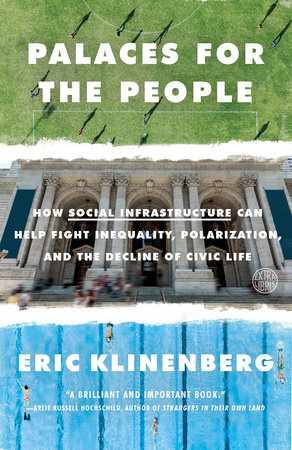
Book review: Palaces for the People


Eric Klinenberg speaking on stage in front of a drum set
Eric Klinenberg at CNU34
Twenty-first century social infrastructures are already reviving civic life in nations across the planet: public plazas in low-lying cities that double as massive water storage systems during extreme weather events; massive levees and berms that masquerade as bike paths and parks. Americans should have all these things. (Klinenberg 2018: 293)

Eric Klinenberg, Palaces for the People: How Social Infrastructure Can Help Fight Inequality, Polarization, and the Decline of Civic Life (Broadway, 2018), 293 pp.

(7/3/2026) There is supposed to be a theory of human evolution where we humans have since hunter-gatherer days differed in our response to strangers. Some see strangers as inherently dangerous, a threat to our precarious food supply; others see strangers as bringing welcome variety, so we could trade lunches or at least hear new jokes. Both of these perspectives are adaptive--some strangers are dangerous--but decades of auto-centric development has left us with a lack of places to encounter strangers in low-stakes, non-threatening ways. The results include an epidemic of loneliness, physical unfitness, and vulnerability to violent crime, homelessness and climate catastrophes. 

Eight years after the publication of Palaces for the People, Eric Klinenberg began his keynote address to the Congress for the New Urbanism in Bentonville, Arkansas, last month, with the question: What has happened to the fabric that supports community life? He urged his listeners to "make every project you do work as social infrastructure," whether it's a playground or something less obviously connected, like flood control. We should also fund public libraries, a lot more than we currently are.

Klinenberg grew up in Chicago, and was just about to start graduate school when the deadly 1995 heat wave struck the city. The factors that affected who survived and who didn't, and the factors affecting the geographic distribution of mortality, inspired his field research, and eventually his first book, Heat Wave (University of Chicago Press, 2002). He continues to ask: If sudden natural disasters, as well as the slow corrosive effects of loneliness and despair, have predictable effects, "What conditions in the places we inhabit make it more likely that people will develop strong or supportive relationships and what conditions make it more likely that people will grow isolated and alone?" (2018: 6)

short bookshelves, carpeting, fake fireplace in background
Social infrastructure: The Union (young adult room), 
Cedar Rapids Public Library

Social infrastructure is defined as "the physical places and organizations that shape the way people interact," creating the context for individual-level relationships of all levels of intensity. It can take many forms--public institutions, open spaces, privately-owned establishments--but the common element is "people are welcome to congregate and linger" (16). His first example is public libraries (ch. 1), which "do all kinds of unexpected things for surprisingly large numbers of people... by providing free access to the widest possible variety of cultural materials to people of all ages, from all ethnicities and groups" (37). He describes his visits to the New Lots and Seward Park branches in New York City, where he sees the elderly, teenagers, the unhoused, and immigrants in places where they can find meaning and encounter other people. 

Chalkboard, The Union (young adult room)
Chalkboard in The Union:
The youth have something to say

Chapter two argues social infrastructure is useful for improving public safety, where outcomes of long-term policies in Philadelphia "suggest that place-based interventions (fixing up vacant and abandoned properties, planting trees and grass) are far more likely to succeed than people-based projects" like tougher criminal sentencing and cracking down on petty crime (70).

Chapter three starts at elementary school, spends most of its time at college, and then goes back to the library. Any of these places can serve as community gathering spaces, but that doesn't happen automatically; they also can fail by putting up barriers or designing for institutional efficiency.

playground behind locked gate
School playgrounds can be community gathering spaces,
but only if they're unlocked

One big social change since the publication of this book is that the number of people living on the streets has increased by 50 percent, which may affect the real or perceived ability of the community to gather in these types of spaces.

Chapter four focuses on the public health impacts (opioid addiction, food deserts, isolation especially among the elderly and poor) of glaring failures of social infrastructure. Chapter five highlights the role of sports facilities and teams in bringing together people of different backgrounds, which might be a major reason racists fought so strenuously to keep beaches and pools segregated (and why "boys in girls' sports" is such a potent argument today). The epilogue points out the limits of social media, and other billionaires' moonshots, in doing what simple contact can achieve.

Chapter six on climate change is an extension of the argument. Incredibly, as I write this eight years after this book was published, with heat domes over much of the northern hemisphere, widespread fires and flash flooding, the crew in charge of the American national government still insists there's nothing to see here. Even in 2018, it was undeniable that (a) the climate is changing, (b) its effects fall most heavily on those at the margins of society, and (c) we're going to have to build or rebuild a lot of our infrastructure in order to prepare for this. 

grassy area with wide sidewalks, buildings in background
Social infrastructure: The McGrath Amphitheatre,
park and concert venue and flood protection

Klinenberg makes the case for making the new physical infrastructure work as social infrastructure as well, as had been planned along the FDR Drive in New York City:

The berms would block and absorb storm surges when necessary, but their everyday function, as parklands and recreational areas for inhabitants of an especially gray and unpleasant part of an especially gray city, is at least equally as important.... Deployable walls, camouflaged as a series of murals that hang from strong hinges on the ugly underside of the FDR Drive, are another key part of the proposal. Most of the time, the structures, which will be designed by local artists, operate as decorative ceiling panels that enhance the experience of walking beneath the highway, which, lacking good alternatives, thousands of residents do each day. (2018: 202)

Klinenberg makes a strong argument for urbanist design. Loneliness and all its ill effects, physical fitness, political polarization, and vulnerability to crime and climate can all be traced to the lack of social infrastructure. In his 2026 talk, he said that if communities design, build, maintain and program it, democracy and civil society will benefit, and there exists a "palpable sense of possibility" in this moment in history, especially among the young. We surely can do with more public libraries, playgrounds, and plazas (with shade for sure!), if they're done right. The alternative, as he said in Bentonville, is "we are all more likely to hunker down in private places."

Palaces for the People cover
(Source: crownpublishing.com)

Pete Saunders, "Preparing for the Climate Migrants," Corner Side Yard, 2 July 2026

Angie Schmitt, "Ross Chapin on How the 'Pocket Neighborhood' Can Address Loneliness," Love of Place, 24 June 2026

Thursday, June 18, 2026

Book review: The Space Between


The Space Between book cover
Source: bakeracademic.com

Eric O. Jacobsen, The Space Between: A Christian Engagement with the Built Environment (Baker Academic, 2012), 297 pp.

If Jesus's "dwelling among us" means that he lives as we typically do, he would most likely be living in a subdivision at least a few miles from where he might interact with people in a quasi public setting--like a shopping mall or a grocery store. In this case, Jesus would need to own and operate some kind of automobile simply to have the kind of diverse interaction with people that we see him having in the Gospels... Rather than asking, "What would Jesus drive?" I want to ask, "Why must Jesus drive?" (Jacobsen 2012, pp. 207-208)

(6/18/2026) I first read Eric O. Jacobsen's The Space Between in 2015, after hearing him interviewed by Chuck Marohn on the Strong Towns podcast. (That interview is here, and a subsequent appearance is here.) Dr. Jacobsen, who has been senior pastor of First Presbyterian Church (ECO) in Tacoma, Washington, since 2007, offers a good introduction to urbanist ideas from a communitarian perspective that is accessible to any reader. It is even more pertinent for his fellow Christians, for whom urbanism is presented as how we live our earthly lives as God intends.

While I've employed his ideas frequently since then, particularly when I would write about the religious architecture awards that used to appear annually in Faith and Form, I have never done a systematic review of this outstanding book. I am rectifying that now.

Dr. Eric O. Jacobsen
Dr. Eric O. Jacobsen (from fpctacoma.org)

Jacobsen begins by asserting the core importance of the built environment, which he defines as "the physical location and features of the places where you live, work, worship, and play and the way that the various places in your day relate to one another" (pp. 11-12). We should notice these features, he argues, not just move mindlessly through them on our way to some place from some other place. We should ask ourselves: "Who thought this space through, and what can you discern about their values as you interact with it?" (11). How people and stuff interact in a particular place over time--what he calls enacted space (17)--matters for our experience of community. It matters to a unified kingdom approach to Christian life, in which every human activity, not just the churchy stuff, "can be done in a way that is God-honoring" (21).

Before we get to the urbanism in Parts II and III, Jacobsen presents a sort of theology of the individual in Part I, "Orientation," albeit includes some good pictures of streets by way of example. We are human bodies (ch. 1) in specific places (ch. 2), and are meant to be in loving community with others, not autonomous individuals (ch. 3). Community means "the actual human community in which she has found herself" (89), including both voluntary (church, club, friend group) and geographic (anyone in your immediate proximity) communities, but it's the latter community is too easy to neglect.

The boundedness of place has been an important element in relational development. We know one another more deeply when proximity forces us to interact on a regular basis. The contemporary ease by which we can move from one place to another has tended to pull us further apart from one another, rather than bring us closer. (57-58)

People are bound to fall short of our ideal vision of community because of human sinfulness, so community requires grace. It also requires time, because "we cannot buy community" and "we cannot even build community" (100), because community only happens after sustained engagement. And it requires wisdom, the embedded sort of wisdom that evolved institutions contain, not sudden bursts of seemingly rational efforts to remake those institutions. Hence, urbanism good, modernism not so much (ch. 4, esp. pp. 109-118). Missoula, Montana, was saved from modernist overhauling because it was unable to afford it, and now it's glad it stayed the way it was (pp. 90-92).

outdoor dining tables in front of two story brick building
This traditional block of downtown Bentonville, Arkansas, is chock full
of "thresholds" connecting buildings with the outdoors

Part II, "Participation," gets into how the built environment affects our lives and life choices. Families become more isolated, both from relatives and from neighbors (ch. 5). Churches (ch. 7) used to be embedded in their surrounding neighborhoods, with doors open to the street, and sometimes served as community monuments; today's insular churches are set away from the street, accessible by large parking lots.

Chapter 6, "Politics," talks about how all this matters for the public realm, beginning with the ongoing skirmishes between Jane Jacobs and Robert Moses in 1960s New York City. Jacobs stood for civic virtue as opposed to top-down power for power's sake. "Civic virtue can be thought of as a measure of a person's care for the public realm combined with the local knowledge, organizational skills, and courage necessary to effect positive change in that realm" (159). Any of those four aspects is difficult to muster when the built environment is as dependent on automotive transportation as much of America is today. In this context, he discusses the problems of functional zoning, urban renewal, and visionaries like Le Corbusier. He approvingly quotes from the theoretical final chapter of Jane Jacobs's Death and Life of Great American Cities, in which she argues that cities are problems of "organized complexity," much like human bodies. 
This tells us much about how Jacobs understands transformation to take place among people and practices in the city. She sees in ordinary cities a form that is basically good and assumes the ability of residents to enact a kind of self-repair. The city and its neighborhoods occasionally need outsider intervention to fulfill this potential, but for the most part what they need is less rather than more government intervention. (173)

Modernist architect Rem Koolhaas is introduced as a foil to Jacobs, though I have to admit I like the Seattle Public Library. 

pedestrians walking past storefronts
Hudson Street, New York City,
where Jane Jacobs lived between 1947 and 1968

In Part III, "Engagement," Jacobsen uses a theological model called critical correlation to analyze our relationship with the built environment. I'm not a theologian, but I feel I was able to follow the argument. He reframes discussions of sustainability away from voluntary abstinence to seeking to achieve good goals for all (ch. 9): human thriving, environmental stewardship, and social justice. These goals can and do conflict in application (see the graphic from Scott Campbell on p. 236), but they are all served by joint efforts by urban communities rather than individual withdrawal. A sense of place (ch. 10) where one belongs is inextricable from one where strangers can become known--in this context he gives a good capsulation of Ray Oldenburg's third place paradigm (pp. 245-246)--which too turns out to be an obligation for Christians and Jews (cf. Deuteronomy 10:17-19, Exodus 23:9ff.). The chapter concludes with a discussion, from several points of view, of the role of beauty in our places.

Jacobsen's book provides an introduction to urbanist ideas for Christians and Jews, rooted in the familiar language of the Bible. For non-religious urbanists, he points to the possibility of cooperation, giving a view of religion that is different from that propounded by the loudest Christian voices out there. For everyone, he provides a second look at our surroundings that we may have taken for granted all our lives, and to consider why auto-dependency may not be serving us well.

three lanes of cars on a one-way street
Jackson Boulevard, Chicago


Wednesday, May 13, 2026

CNU 34 Diary: Northwest Arkansas

people walking towards building topped by a smiling yellow ball
Hi from the town with the big friendly ball!
Which smiles as it watches, and floats above all

Wednesday, May 13, 2026

I don't know what it must have felt like for a medieval peasant to visit Rome, but I am in a similar position at the 34th annual Congress for the New Urbanism. Wal-Mart, the enormous conglomerate where many Americans shop, is headquartered here, the longtime home of founder Sam Walton. The Waltons and their fellow townspeople have used all the money we've sent here over the years to build a place that--surprise!--looks nothing like a Wal-Mart.

Jane and I arrived about 6:00 this evening after an all-day drive from Iowa. I psyched myself up on the way listening to John Simmerman's Active Towns interview with Michael Bruntlett about bike infrastructure development in China.

The conference had already kicked off yesterday, and today featured a day of panels and activities in Fayetteville, about 25 miles south of here. That included the keynote address by economist Raj Chetty. However, I am used to traveling to the conference on Wednesday, and did not make the necessary adjustments. Coe College has just finished its spring semester, and I only got my grades in Monday; I'm not sure I could have gotten here sooner, but next year I'll try to adjust myself to the conference schedule.

We're staying at the 21C Museum Hotel on A Street, which is closed to traffic. We spent the evening walking around downtown, which is exactly as advertised, if more pricey than a simple Arkansas country town. 

cars and stores on downtown street
Main Street, downtown Bentonville

There are a ton of bicyclists of all ages, maybe particularly on a night like tonight, which was incredibly lovely.
glass building with trail zigzagging up the side
People even ride up the Ledger building!
The streets are narrow, and cars drive slowly, and they yield to pedestrians. The public library is spacious and well-stocked, including a copy of Paved Paradise by Henry Grabar. 

book stacks and people
Children's section, Bentonville Public Library
The chess club was hosting a large number of matches in the park by the county courthouse. We found, for the second year in a row, some outdoor dining to start our visit to the host city.

outdoor dining tables in front of two story brick building
Al fresco dining at Tavola Trattoria

Tomorrow, I will start the serious business of this conference. First, I need to find where, among numerous sites scattered across several Northwest Arkansas towns, I check in and get my name badge.

row of vehicles all sticking out from their parking spots
Bentonville, like all towns, suffers from vehicle gigantism

Thursday, May 14, 2026


Urbanists wait for the venue to be opened
The strain of a multi-venue conference showed early today. Fayetteville got breakfast at the Graduate Hotel and information on where to get badges; Bentonville got neither of these. We waited outside the locked First Baptist Church, pelted by canned Christian pop, until 9:15. (The first round of panels began at 9:30.) Once in, I was directed to another building a block away to get my badge. All in a day's adventure, though. 

The highlight of the morning was meeting Lydia Fletcher, whose firm is in charge of public relations for the conference. She needed to get in to get set up, and told me how she would accomplish that by talking to people, what they would say and how she would respond. And lo, it came to pass exactly as she had foretold. She apologized for not getting me in as well, but I was okay just to watch a truly badass woman at work. She also recommended Ozark Mountain Bagels for breakfast, which proved to be very good.

This afternoon I went on a bike tour of the city. I knew it was a serious bike tour because John Simmerman was making a video for Active Towns, my first CNU bike tour to receive his imprimatur since Charlotte in 2023.
speaker David Wright recorded for video by John Simmerman
John Simmerman recording David Wright of
the City of Bentonville
Our tour took us on the Razorback Greenway, which runs through the Walmart campus.
Walmart campus, Bentonville
It is truly a beautifully landscaped campus. The trail runs through rather than around it, because corporate hoped to encourage 10 percent of their employees to ride to work. I had a real medieval-punk-at-St.-Peter's-Basilica moment. It's hard to connect all this beauty and philanthropy to the footprint of Walmart stores around the country.
vast parking lot, Marion IA
Marion IA Walmart, Black Friday 2024
Other highlights from the tour:
pink metal art that look like pigs' ears
These speech bubbles on the A Street Promenade (which opened in
October 2025) are among 322 works of art in the public
realm of Bentonville
Town Branch Apartments, 300 SE D Street
Town Branch, mixed use trail oriented development:
oriented to the trail not the street
construction site, 500 block of SW 8th Street
Under construction: Future AI-focused university at
the former Walmart campus site

outdoor semi-sheltered coffeeshop in a forest
Coffeeshop in the woods;
Airship Coffee at Coler
I also attended a panel on transect-based zoning featuring the planning directors of Bentonville and Rogers, and a main stage talk, "Building Places People Love," featuring veteran urbanists Matthew Lister (Gehl-Americas) and Carol Coletta (Bloomberg Center for Public Innovation). At the book sale run by Underbrush Books, I bought Palaces for the People by Eric Klinenberg (Broadway, 2018), who's speaking tomorrow, and Building the Cycling City by Melissa and Chris Bruntlett (Island, 2018). And Jane and I briefly stopped by the reception honoring the imminent publication of Art of the New Urbanism volume 2 (Wiley, 2026). 


Friday, May 15, 2026

people milling about at event space
Closing party at the Momentary
There are still some things going on tomorrow, but the curtain rang down on CNU 34 this evening in the form of the closing party at the Momentary, a contemporary art museum that also boasts an event space, the RODE House.

This morning, we had the closing keynote, presented by Eric Klinenberg of New York University, author of Palaces for the People, which I'd just bought yesterday.
Eric Klinenberg on stage with microphone
Eric Klinenberg at First Baptist Church,
resisting the temptation to perform a drum solo
He talked about the value of playgrounds as a lead-in to advocating consideration of social aspects of infrastructure projects. He's not the only one to notice that America (and much of the West) is in a very dark place right now. As much as we need to modernize water management in an era of routine torrential rains, we also need places that bring people together in order to build community life. Otherwise, we are more likely to "hunker down" in private spaces, which exacerbates social tensions. For example, in addition to pipes that can be overwhelmed by even a couple of inches of rain if they come too quickly, we can benefit from "softscape" like parks and community gardens to "hold" the water until the pipes are ready for it, as well as revitalizing the civic culture while they do it.

He concluded by urging practitioners to "make every project you do work as social infrastructure."
Crossing SE D Street on our walk:
Note the grassy median on 8th Street,
not unlike Mount Vernon Road in Cedar Rapids
From there I went on a walking tour of SW-SE 8th Street led by people from Toole Design, the City of Bentonville, and Walmart. 8th Street has in a very short time become a ferocious stroad, which despite separated bike lanes and sidewalks is not a very comfortable or pleasant place to be. They discussed further infrastructure initiatives, like a new Gateway Park west of I Street with "iconic" bridges across 8th; various ways of reducing conflicts at the intersection with Walton Boulevard; and a "greenway hub" of arts spaces, small shops and cafes across from the Momentary along SE G Street. The tour ended at the Walmart campus, where I was yesterday.
cyclists and walkers on cement path going under bridge
The Razorback Greenway runs through the Walmart campus
I also attended the Chapters Networking Breakfast this morning, where I sat with members of the Minnesota and Wisconsin chapters. Minneapolis will be next year's host city!

Saturday, May 16, 2026

people walking on closed street between farmers' market tables
Fayetteville Farmers Market
To wrap up this year's CNU, a number of speakers presented ideas and fielded questions at the Fayetteville Town Center, just off the square where the Saturday farmers' market was going on. The local urbanism dial was set on MAX.
Joe Minocozzi at the podium
Joe Minocozzi at Fayetteville Town Center

I happened by just as Joe Minocozzi was beginning his presentation. Minocozzi is the founder of Urban3, an Asheville-based consulting firm that helps cities understand and take control of their finances. He's best known for promoting the measurement of taxable-value-per-acre, which puts efficient productivity ahead of sheer size in terms of value to the city. I've used the concept to analyze local issues, such as here and here and here. Today's was an excellent, accessible introduction to the idea, with detailed application to Northwest Arkansas. After the talk, I ran into some friends who love Minocozzi's work, and we commiserated about how difficult it is to get people in and out of local government to accept it. Is it mathphobia? Entitlement? Exceptionalism? I'm going back to a city that is over the moon about our new data centers and the casino.

This conference was a novel approach to CNU. It will be interesting to read and hear people's reflections on regional urbanism, and how it will affect our meeting in Minnesota next year. Since I spent most of my time in Bentonville, I can say that I love a lot of what they've done, but will have trouble drawing many lessons for Cedar Rapids. Bentonville reminds me more of Naperville, Illinois, where I went to college and spent some time after that. Naperville is an upper-middle class exurb, very wealthy, very clean, without a lot of the problems that bedevil cities. Everyone faces limitations at some level, but Bentonville, like Naperville, can do a lot before they hit those limitation. And they can afford to be bolder because mistakes will be less catastrophic.

At the same time, Bentonville had to seek new ways of doing things because of growth pressures, and because Walmart demanded action when it was having trouble competing for talent with places like Seattle and the San Francisco Bay area. Cedar Rapids, whose 2025 Census estimate is exactly 193 souls larger than its 2020 population, faces neither growth pressures nor a sense of urgency to change our way of doing things. 
Ashleigh Walton
Ashleigh Walton, incoming CNU president

LAST YEAR'S POST: "CNU Diary 2025: Weekend in New England," 11 June 2025

SEE ALSO: 
Robert Steuteville, "Urbanists in the Land of Walmart," Public Square: A CNU Journal, 15 May 2026

Wednesday, April 22, 2026

My urbanist journey

subdivision map with roads colored in
As a child, I loved to color maps,
or copy the ones in the phone book with tracing paper

I
(4/22/2026) My urbanist journey began when I taught a first-year course on place at Coe College in 2008. Or maybe it was earlier? I have loved maps since I was tiny (see above). But it was teaching a course at Coe on the Sense of Place that led me to a semester-long study on sabbatical in spring semester 2013....
tables, books, people
temporary downtown library

...where I kept running across books on the topic of urban design.
Suburban Nation book cover

I had found my people! I began a blog to sort out all these new (to me) ideas...

front page of Holy Mountain blog

...and here we are! On Holy Mountain, I pay a lot of attention to design issues, both in my hometown of Cedar Rapids, Iowa, and in places where I travel, particularly where I'm able to spend a good deal of time in one place, like Washington, D.C. (spring 2018)...
street with cars, trees, and row houses
Our street, February 2018

...and Belgrade, Serbia (May2022).
Street scene: Vojvode Dragomira, May 2022
Our street, May 2022

II
Urbanism is a movement of architects, planners, and others that has its roots in a number of ideas that came together as the Congress for the New Urbanism in 1993. I joined CNU in 2020, and have been a member of Strong Towns since whenever they started having memberships.
slide advertising upcoming conference
Coming next month! Watch this space for live coverage!!

The thread that runs through all of the ideas that comprise urbanism is a critique of auto-centric development, which took off in this country after World War II.
Memorial Boulevard, Providence RI
Memorial Boulevard runs through downtown Providence RI

Sprawl occurs when a metropolitan area relies on low-density housing developments, located far from place to work, connected by vast networks of highways. Atlanta, Houston and Los Angeles are famous for their sprawled layout and awful traffic, but it's plenty visible even in older cities like Chicago, and certainly has occurred in Cedar Rapids albeit on a smaller scale.
Collins Road NE (Google Earth)
Collins Road NE, Cedar Rapids

One year I sorted out the main urbanist critiques this way (relevant questions are from a list at Alden 2015):
    1. Community: sprawl separates people and makes it harder to be neighbors to each other (Jacobs 1962, Jacobson 2012)--how do we built stronger social networks?
    2. Lifestyle: sprawl forces people to drive wherever they're going, and to spend a lot of time in traffic--can we improve walkability so that people have more time and transportation choices (Speck 2012)?
    3. Environmental: sprawl wastes energy resources, pollutes air and water, and contributes substantially to global climate change--how can we sustain our society at lower environmental cost? (Hester 2006)
    4. Financial: sprawl makes cities poor, because they can never collect enough tax revenue to pay for all the infrastructure it requires, and it makes individuals poor, because regardless of means they are forced to pay for expensive transportation--how do we make municipal finances more stable? (Marohn 2020)
vast shopping plaza parking lot with some cars
Northland Square on Black Friday 2025

New urbanism's response begins with traditional neighborhoods, which form the basis of communities that are (Duany et al. 2010, ch 4; Calthorpe and Fulton 2001, chs 1 & 2, Hester 2006):
    1. walkable and human-scaled: safe for bikes and pedestrians, interesting (signs of human activity), comfortable (creating a sense of enclosure with street trees and buildings), with meaningful destinations (Speck 2012) 
    2. diverse in population: American writ small, with people from every economic class, race, gender and sexual preference, religion, ethnicity, you name it
    3. varied in uses: residences, shops, offices and schools close to each other... sometimes in mixed-use buildings
    4. supplied with public spaces that serve as community centers and landmarks, attract different kinds of people, and foster a sense of commonality
St. Paul's United Methodist Church
St. Paul's United Methodist Church was built in 1914
in the Wellington Heights neighborhood

III

Like all municipalities, Cedar Rapids contains examples of both good and bad urban design. There are no perfect places, but people in every community need to understand opportunities and constraints in setting their goals.

Good urbanism in Cedar Rapids
wayfinding sign along paved trail
Connecting the bike trails network

wide sidewalk on K Avenue NE
More sidewalks

children on park playground
Parks

small storefronts in brick buildings
Redeveloped core


cones on street preparing for changing traffic pattern
One way to two way conversions

Bad urbanism in Cedar Rapids

multiple cars on four lane street-road hybrid
Stroads

shuttered McDonald's, with shuttered grocery in background
Lack of basic commerce in the core

parking lots with medical offices in distance
MedQuarter

Cedar Crossing casino under construction
Casino

I-380 seen across bar parking lot
I-380 slices through the core
(Google Earth screenshot)


SEE ALSO:
"The Urbanism CLEF," 4 February 2016
"Urbanism Review," 22 August 2017

PRINT REFERENCES:
Peter Calthorpe and William Fulton, The Regional City: Planning for the End of Sprawl (Island,   2001)
Andres Duany, Elizabeth Plater-Zyberk, and Jeff Speck, Suburban Nation: The Rise of Sprawl         and the Decline of the ,American Dream (North Point, 2010)
Randolph T. Hester, Design for Ecological Democracy (MIT Press, 2006)
Jane Jacobs, The Death and Life of Great American Cities (Random House, [1961] 1993)... reviewed by Dave Alden here 
Eric O. Jacobson, The Space Between: A Christian Engagement with the Built         Environment (Baker Academic, 2012)
Jeff Speck, Walkable City: How Downtown Can Save America, One Step at a Time (Farrar   Straus and Giroux, 2011)... reviewed by Dave Alden here 

Coffeeneuring Challenge 2026

  The leaves say: It's time for Coffeeneuring! What's the secret to our success? I say it's the autumn appeal of low-key two-whe...