Showing posts with label Aristotle. Show all posts

Tuesday, April 2, 2024

My speech to the graduates

George Caleb Bingham, Canvassing for a Vote 1852
Canvassing for a Vote by William Bingham (1852)

In early April, I was invited by Coe's chapter of Phi Kappa Phi honor society to address their annual induction ceremony and banquet, on a topic of my choice. Of course, it was going to have something to do with urbanism. The motto of Phi Kappa Phi is "Let the love of learning rule humanity."

A complete community constituted out of several villages, once it reaches the limit of total self-sufficiency, practically speaking, is a city-state (polis). It comes to be for the sake of living, but it remains for the sake of living well.... Hence, though an impulse toward this sort of community exists by nature in everyone, whoever first established one was responsible for the greatest of goods.--ARISTOTLE, The Politics, 1252b25, 1253a30 

Have you ever noticed how you feel different in different places? Maybe it's because of the things that are there to do, or the people you're with. Or maybe it's different qualities of the places themselves.

About 15 years ago, I began teaching a first-year seminar called A Sense of Place. The more I taught the course, the more I read about the phenomenon of place, and the more I encountered a vocabulary of sorts describing how places are put together and why that matters:

  • blocks of buildings that are built to the street are more welcoming than when they're stuck behind swaths of parking lots
  • buildings with first-story windows are more welcoming than when they present blank walls (like garages)
  • buildings that look timeless or historic are more welcoming than buildings that look like they were thrown up yesterday and might not be here tomorrow--and if they actually are historic, they can provide familiarity
  • wide streets with fast cars are less productive than narrow streets with slow cars
  • in general, areas built to human scale--in other words, accessible to people walking--are more welcoming and more productive than areas built to auto-scale

Now, my 20s were by far the most mobile, peripatetic decade of my life, and perhaps you are about to find that, too, to be the case. It can take awhile to find your place in the world, and you can be, as I often was, thrown back on yourself, working through temporary jobs and temporary leases and friends of convenience. But I hope that even amidst the unsettledness, you will take time to notice the place (or places) where you find yourself. I hope that you will come to understand the attributes of good places, to appreciate them, and even to look for them. 

All that will make you a deeper, more informed consumer of places. But I'm not here to advocate consumerism, even the deeper variety. I'm here to advocate citizenship.

We hear a lot about citizenship these days, but rarely in a way that guides our ways in life. Maybe citizenship comes up in the context of the convoluted set of rules that automatically winnow us in because we were born in the United States, while winnowing out immigrants who have to figure out this system while also navigating the turbulence of their own lives. At most, maybe we're asked to stand for the national anthem or get teary when someone mentions the troops.

Well, you should stand for the national anthem, and you should at least appreciate when people commit a large chunk of their lives to service. But there's more to citizenship than that...

bust of Aristotle
Aristotle (384-322 BCE)

One of the earliest, and still one of the best, discussions of citizenship is in Book III of Aristotle's The Politics. Aristotle starts by rejecting definitions of "citizenship" based on residence or legal status; he eventually works round to the idea that "citizen" is not something that one is but something that one does. 

Comparing a community to a ship under sail, Aristotle argues that a citizen--like an oarsman, or a lookout, or a captain--contributes their distinctive skills to the collective effort, but what unites them all is their concern for the well-being of the community--because it is in a strong community that we live our best lives. "A good citizen," says Aristotle, "must have the knowledge and ability both to be ruled and to rule, and this is the virtue of a citizen, to know the rule of free people from both sides" (1277b15). Sometimes you make decisions, sometimes you act on decisions made by others, but both ways you are responsible to a group of people who aren't you, in a place common to you all.

And why do you do this? Why would you do this? Because this is what makes your life better, what makes your life worth living. Aristotle's whole Politics begins with the claim that communities are formed for "the good life"--a quality of life that people are unable to attain on their own, or even in small like-minded groups. 

In the diversity of a large community with all the different skills and ideas and possibilities, our world is broadened in delightful and surprising ways. People who turn their backs on these possibilities, out of fear or narrowness or egoism, miss out on a lot of what life has to offer. "Anyone who cannot form a community with others," concludes Aristotle, "or who does not need to because he is self-sufficient, is no part of a city-state--he is either a beast or a god" (1253a25).

Jose Antonio Vargas

Jose Antonio Vargas (from joseantoniovargas.com)

Depending on which first-year seminar you had, you might have read Jose Antonio Vargas's book Dear America [Dey Street, 2018]. Starting with the subtitle, "Notes of an Undocumented Citizen," Vargas expresses Aristotle's idea of citizenship as a life of participation in community: Citizenship is showing up. Citizenship is using your voice while making sure you hear other people around you. Citizenship is how you live your life. Citizenship is resilience (Vargas 2018: 199-200).

And all that participation and resilience occur in a place. The citizen not only understands and appreciates the qualities of their place, they contribute to making that place better for everyone around them. Maybe you'll teach, or coach basketball, or join a church, or help plant a community garden, or be a regular at a nearby bar or coffeehouse. When you escape the bubble of self-concern that politicians and corporations are always trying to put you in, when you are part of a diverse community, when you worry less about the price of toys or not being able to find a parking place, you will be on the way to the good life.

[I realize what I'm saying here sounds like a challenge, or even a reproof. But I really mean it to be an invitation--to a much richer life than you get from consumption, or achieving individual autonomy, or following "the rules"... whatever they are.]

I feel the need to say this tonight, because as we all know, the siren song of individualism is strong. Sometimes it's born of our own impatience and frustration, but a lot of times it's being used to sell something... some thing we don't need and maybe shouldn't have. In this world we are surrounded by messages telling us we will be happier when we think more about ourselves, because we deserve a better lifestyle--more fun, hipper clothes, better-tasting beer, all with free parking for my new car which by the way is guaranteed to turn the heads of my sourest neighbors. 

Sometimes all we have to do is vote for the candidate who promises to take what we deserve away from whoever has it now, and give it to us, the people who should have had it all along. But more often than not, a product is being sold, or a collection of products, like the homebuyers with their "must-haves" on the cable network HGTV. We are consumers! In a market system! Our job as consumers is to demand! Everything we have, everywhere we go, should have the attributes that we demand. Supplying is the job of the rest of the world.

Jesus and Satan looking at rocks
Detail from The Temptations of Jesus (1481-1482)
by Sandro Botticelli (c. 1445-1510)

Rugged individualism-with-cool-new-stuff is an attractive illusion now, and probably always will be with us in some form. Even Jesus had to deal with it.... It's a strange story, about the one Christians believe is the Son of God, but it appears in two of the four gospels [Matthew 4:1-11, Luke 4:1-13] and is mentioned in a third [Mark 1:12-13], so it must be important. Before Jesus begins his earthly ministry, he is driven out to the wilderness where he fasts for 40 days--that's Bible-speak for "a really long time"--and is tempted by Satan. Satan invites Jesus to turn stones into bread, to accept power over all the kingdoms of the world, and to throw himself off a high place to see if angels would catch him. Each time Satan tempts him, Jesus refuses, with a well-chosen verse from the Torah thrown in for good measure. Eventually the Devil gives up.

A story like this has a lot of dimensions, and a lot of potential meanings. I think it is intended to show Jesus's essential humanity--that while on earth he dealt with the same fears, the same needs, the same desires we all do. The political philosopher Thomas Hobbes (1588-1679) called them "gain, glory and security," the three reasons humans are inclined to "invade" or act violently towards one another. In the wilderness, Satan offered Jesus ways--corrupt ways, but ways--to satisfy those needs. In each temptation, Satan was inviting Jesus to fulfill his own desires, to relieve his own suffering, to enjoy himself for once, and in all things to think of himself first.

Just like Jesus, we get hungry. The challenge is when we get so hungry, or frightened, or frustrated, that we act to the detriment of others.

Moreover, a lot of the time, your ability to act for the greater good is constrained by public policy decisions made long ago. (Try living car-free in Cedar Rapids!)

For example...

  • For decades American towns have been marred by traffic engineering efforts to move motor vehicles through them faster, turning livable places into "auto sewers" (cf. Marohn 2021). Interstates have been built through what were once thriving neighborhoods--think I-94 in Chicago or Minneapolis, or I-380 here for that matter--where mostly nonwhite residents lacked the political power to protect themselves or their places. Elsewhere, widened city streets encourage vehicles to go faster, resulting in higher numbers of pedestrian deaths. And traffic still is terrible.
  • Franchise chain operations proliferate, often abetted by local policy favors (cf. Mitchell 2006), though there's plenty of documentation that locally-owned small businesses keep more money in the community. I understand the attraction to local public officials of big projects with "game-changing" impacts, and the attachment people have to brands like Red Robin or Starbucks, yet those places don't build our communities the way local business does.
  • Do you hunger to look good at a low low price? Last week a nearby church showed the 2015 documentary The True Cost, which depicts the heavy environmental, social and health costs borne by people around the world--particularly in textile-producing places like Bangladesh, Haiti and Vietnam--by so-called "fast fashion" sold in stores like H & M. The low prices we pay at these stores come at substantial cost to others.

Even when structures force our hand, as educated people, we at least have the obligation as well as the ability to think about changing policy when we can, and in the meantime about the consequences of our decisions beyond our narrow desires. 

So what am I selling here, self-denial and privation? Good heavens, no, I'm not as sad a sack as all that. As an introvert, I'm not opposed to autonomy, either. But as educated people, we know that autonomy is not ultimately fulfilling, any more than stuff or privilege is. As both Aristotle and the authors of the gospels knew, the good life is unthinkable outside of community. What brings people the most joy, the most inspiration, and all the skills we ourselves don't possess is... other people. Other people! And that includes family, friends, neighbors, random encounters with strangers--everyone who populates our community. 

I hope you will find pleasure in your lives, that you will find plenty of enjoyment and amusement and love and security and rest. I hope, if you drive, you'll have some place convenient to park your car. But as a professor, for a few more weeks at least, I'm here to profess something, and what I'm professing is this: Don't settle for going through life as a consumer. Be a citizen. 

SEE ALSO: 

"Young People of Today, Embrace Walkable Urbanism!" 22 April 2022

"Jesus in the Polis?" 16 August 2013

2022 homily on the temptations of Christ by Pope Francis

Monday, July 3, 2023

10th Anniversary Post: Neighbors


The complete community, formed from several villages, is a city-state (polis), which comes to be for the sake of living, but it remains in existence for the sake of living well.

--ARISTOTLE, The Politics, Book I chapter 2 (1252b27-30)

You can learn a lot about people when you find out what they mean by the word "we."

--PARKER J. PALMER

July 2013 was not only the last month in which I posted in double digits (10), it was the month in which I received, from Jane Addams via Judith Unger, the felicitous phrase "our common life" to describe what I was writing, as the blog began to coalesce around the theme of community.

Ten years ago this month, I recorded my first encounters with Ray Oldenburg, Parker J. Palmer, and Donald Shoup--quite the month for both mind and heart! Each of them has something to say about our common life, from the third places that bring us together to the parking lots that push us farther apart.

Lake Michigan at sunset
Lake Michigan at sunset, Chicago 2013

I also wrote about the need for quiet spaces in the midst of the city. We need to be engaged, but we also need to rest and relax. In chapter 6 of Happy City: Transforming Our Lives Through Urban Design [Farrar Straus and Giroux, 2013], Charles Montgomery describes a residency in New York's East Village, in which a day of epiphanies was followed by a sleepless night:

The city found its way inside from my very first night. Shortly after turning out the light, I heard laughter on the street. Then singing. Then, as the hours wore on, the singing devolved into sustained, college-grade hollering, then quarreling, and, finally, the choking gurgle of what could only have been full-force vomiting--right beneath my window.... The place began to wear me down.... I would walk in and feel a simultaneous mix of claustrophobia and loneliness. (2013: 124-125)

He concludes: What we need are places that help us moderate our interactions with strangers without having to retreat entirely (2013: 128).  I'd found two or three such places in Chicago.

Parable of the Good Samaritan, by Balthasar von Cortbemde
Parable of the Good Samaritan, by Balthasar von Cortbemde (1647)

Early in July 2013, I posted some reflections on Jesus's parable of the Good Samaritan. By elevating love-of-neighbor to equality with love-of-God as the greatest commandment(s), and then giving a long complex answer to the lawyer's question "Who is my neighbor?" Jesus makes common life a sacred calling. Our circle of care is as wide as we are able to see.

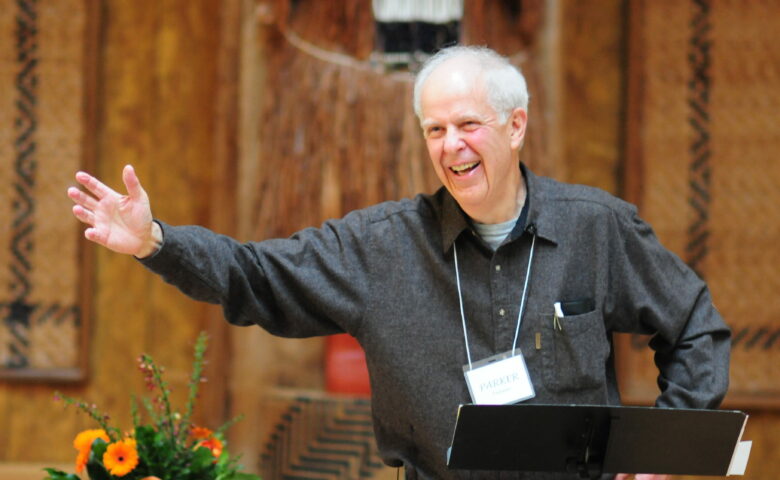
Parker J. Palmer
Parker J. Palmer (from couragerenewal.org)

At the end of that post, I asked if neighborly care was a practical as well as moral imperative. I was still asking that question two weeks later when I posted about Palmer's joint appearance in Cedar Rapids with the singer Carrie Newcomer. Ten years later, I've come to the conviction that it is both of those. Palmer argues that when evils befall us in this life, as they inevitably do, our hearts can be broken open (to compassion for and community with others) or broken apart (withdrawing into anger and alienation). It's the first way that enables life to go on in the face of depression, illness, loss, and injury. 

We not only have a moral duty to care for those around us, but doing so is part of the civic engagement that makes us more fully human. By caring for our neighbors, we enable ourselves to live well.

SEE ALSO: Parker J. Palmer, Healing the Heart of Democracy: The Courage to Create a Politics Worthy of the Human Spirit (Jossey-Bass, 2014)

Lyz Lenz, "We All Need Somebody Somewhere," Men Yell at Me, 5 July 2023

Friday, August 16, 2013

Jesus in the polis?


(Aristotle with Plato in a painting by Raphael, from Wikipedia)

One of the joys of teaching ancient political theory is the love of Plato, Aristotle and their ilk for the polis (which translates more or less as "city"). At times it gets a little extreme, as in the 5th book of Plato's Republic where the character of Socrates posits a city of complete justice in which all traces of individualism, including private property and the family, are eliminated. (Was that a serious proposal or merely a thought experiment? Plato's readers have differed for almost 2400 years. Aristotle seems to have thought he was serious. I strongly believe he was not.)

Another problem with getting too far down with the ancients is that, in order to allow the citizens to devote themselves to public life, both Plato and Aristotle assume they will be supported by a platoon of unenfranchised manual laborers and slaves. From an American perspective this is impossibly elitist, though the alternative for ancient Greece was not political equality but aristocracy. "Democratic" Athens represents for us an unacceptable attempt to solve the ever-present obstacle to the participatory ideal: How do we find time to participate in public life to the extent that, say, Benjamin Barber expects us to, when we've got jobs and families and home repairs and stuff to attend to?

So, granted we're not going to find the blueprint of life in Aristotle's The Politics, and certainly not in Plato's Republic. We can still appreciate their appreciation for humans-in-community. Aristotle begins The Politics by arguing that early human beings formed cities in order to achieve a good life. Life's basic functions like eating and procreating could be done in smaller-scale associations (families, farm villages) but to move beyond a rudimentary life, and to live according to reason and not day-to-day survival, required a city (1:2). The city had to be large enough to include all the functions that made for a good life, but small enough that the citizens would all know each other; Plato in The Laws estimated the ideal population at 5040 citizens, though as noted above this would not include women or workers, or children (Book V). Human beings were intended by nature to live the sort of life that community afforded, said Aristotle; hence, political life defined what it meant to be fully human ("teleology"). Anyone who could exist outside of a city, he concluded, was either a god or a beast (1:2). In the city, citizens were engaged in a common project, to wit, the achievement of the good life.

Aristotle wrote, or was compiled, in the last half of the fourth century BCE; he died in 322. By then, the self-governing polis that he and Plato had idealized, and that had dominated Greek life for four centuries, was pretty well spent. The Macedonian empire of Alexander the Great heralded a long, long period of history dominated by autocratic rule and centralized governments. Athenian democracy, limited as it seems from our perspective, was gone forever. Citizens became subjects.

Post-Aristotle, ancient political thought turned sharply inward (with the notable exceptions of Polybius and Cicero). The central question turned from "How shall we create the best city?" to "How shall we live in a state that may crush us like bugs if it notices us at all?" Three prominent groups that emerged were the Cynics, the Stoics and the Epicureans. (Here I rely heavily on Donald Kagan, The Great Dialogue, chapter 11.)
  • The Cynics renounced material goods, and attacked all social values and established institutions, often in shocking ways. The most famous Cynic was probably Diogenes, who lived in a bathtub, survived by begging, and is reputed to have carried a lamp in broad daylight in search of a true man which he never seemed to find. With the state making subjects of people, the only autonomous response was withdrawal-with-anger from the whole thing. 
  • The Stoics sought the happiness of the individual. This meant living in harmony with nature, which in turn required the avoidance of passion and anger, and as much as possible living peaceably with one's fellow humans. They believed in a religious/natural law that governed the whole world, and to which the laws of the state must conform, but if the state was going to go and be evil there was probably not much you could do about it. Aristotle famously concluded that "the good man is a good citizen only in a good state" (Politics 3:4); some Stoics dabbled in politics, but in the absence of true citizenship mostly focused on being good people and didn't sweat the state too much. 
  • Finally, the Epicureans focused on lives of pleasure and avoiding pain, with the additional interesting teaching that the universe was governed by a force called "swerve" that caused atoms to interact in a wholly random way. Think "Hakuna Matata."

It was into this world that, more than three centuries after the death of Aristotle, Jesus was born. The founding texts of Christianity are the 27 books of the New Testament, written between approximately 50 and 150 CE. Jesus, the apostles, and the writers of the New Testament lived entirely within the bounds of the Roman Empire. Paul was a Roman citizen (Acts 22:25), but all it seems to have gotten him was a trial before Caesar before he was executed. These were people with zero political influence, subjects all, whose animating passion was religious. Not surprisingly, then, the New Testament has very very little to say directly in the way of political thought.

In terms of their orientation to politics, John the Baptist seems to me something of a Cynic. The Gospel of Matthew portrays him living alone in the wilderness. "John wore clothing of camel's hair with a leather belt around his waist, and his food was locusts and wild honey" (Matthew 3:4). Not only did he eschew material goods he was unsparing of the social institutions of his day, calling on all who came to him to repent and prepare for the kingdom of heaven. And when religious leaders came to check him out, he would have made Diogenes proud: "You brood of vipers! Who warned you to flee from the wrath to come?" (3:7b). Then he threatens them with Jesus's unquenchable fire.

The apostle Paul comes across as a Stoic, particularly in Romans 13, which begins, "Let every person be subject to the governing authorities..." The first seven verses commend getting along with the positive view of the state and its agents, even though Paul found himself in conflict with public officials, getting arrested on several occasions for disturbing the peace by preaching the gospel. Later in chapter 13, he reminds his readers that "you know what time it is," meaning the urgency of living and preaching a Christian life pushed politics, the pursuit of pleasure (take that, Epicureans!), and other individual/earthly concerns to the far back burner. Then he goes back to individual ethics, which dominate the letter. Be good, let government go its own way... sounds like a Stoic to me.

Jesus is Stoic flavored with Cynic. He's no Epicurean, though he didn't eschew earthly pleasures, a fact that did not go unnoticed by his critics. "The Son of Man has come eating and drinking," Jesus noted, "and you say, 'Look, a glutton and a drunkard, a friend of tax collectors and sinners!'" (Luke 7:34) Through the gospel accounts of his life, besides performing miracles of healing and feeding, Jesus mostly teaches a positive but individual ethic, focused far more on good interaction with others rather than following rules of conduct. Examples abound, including the parables of the Good Samaritan and the sheep and the goats; after listing all the generous acts of the sheep, the king concludes, "Truly I tell you, just as you did it to one of the least of these who are members of my family, you did it to me" (Matthew 25:40).

(Jesus healing the man with the withered hand,
 from the Codex Egberti, c. 980 via Wikipedia)

Jesus's ministry was itinerant, maybe super-duper-itinerant (Matthew 8:20), and once underway he was not attached to any place. The only city he specifically mentions is Jerusalem, while on his journey to arrest and the cross: "Jerusalem, Jerusalem, the city that kills the prophets and stones those who are sent to it! How often have I desired to gather your children together as a hen gathers her brood under her wings, and you were not willing!" (Matthew 23:37) Even here it's unclear whether he's envisioning Jerusalem as the could-have-been good polis or just noting it's the headquarters of the hostile. His only statement on government is the Stoical admonition to pay taxes (Luke 20:25), which in context seems dismissive. "The state? Whatever. Let's feed the hungry and prepare for the kingdom of God." Towards the religious authorities, though, he's a Cynic: openly and frequently critical, even contemptuous. They are the butts of the story of the Good Samaritan. In a dramatic in-your-face miracle, he heals a man with a withered hand after challenging a group of religious leaders to express disapproval of his doing so on the sabbath day (Mark 3:1-6). Even more dramatically, he clears the temple of buyers, sellers and money changers (Mark 11: 15-19); in John's version (2:15) he makes a whip out of cords with which to attack them. He frequently makes comments like "Isaiah prophesied rightly about you hypocrites..." (Mark 7:6a)

The New Testament focus on individual ethical behavior, while Stoically ignoring or Cynically challenging civic institutions, reflects a time when the state was remote and oppressive. Within a few centuries this presented a challenge, because by 400 Christians were running the Roman Empire. After the empire's collapse in 476, the states of Europe continued to be predominantly Christian, at least in terms of political control. Today, Americans no longer live with an established church, but political power is widespread--short of the ideal, to be sure, but far more widespread than either Jesus or Plato ever saw--and most people are Christians. What does Christianity have to do with the state now that we are part of it? Augustine (354-430) saw government as a temporary necessity to deal with human selfish behavior, but our true destiny was the City of God. He and his contemporaries, writes historian Michael Grant (History of Rome, Scribner's, 1978, pp. 460-461), demeaned the state and civil service. Aquinas (1225-1274), influenced somewhat by reading Aristotle, allowed for a more positive role for government in seeking the common good. But what is the common good? Morality? Relief of suffering? Material well-being? Charity? The diversity of beliefs on this question is illustrated by the plasticity of the Great Commission: "Go therefore and make disciples of all nations, baptizing them in the name of the Father and of the Son and of the Holy Spirit, and teaching them to obey everything that I have commanded you" (Matthew 28:19-20). It's been used by states to justify everything from social welfare legislation to the Spanish Inquisition.

Today's New Urbanists are pointing us back to the polis, which takes the forms of economically strong metropolitan regions with thriving local neighborhoods. The five-minute walk, building civic sites, and diversity of housing designs are considerations that never entered the minds of the people who wrote the Bible. But they are oriented to ancient concerns of building and maintaining communities in which all people have the opportunity to live the best lives possible. This is our challenge today, in the face of rampant materialism and individualism, and indeed to repair the damage done by their excesses. That in turn may explain why these days I get more excited reading classical political thought than I do reading the Bible.


SOME ACCESSIBLE THOUGH TIME-WORN SOURCES ON ANCIENT GREEK POLITICAL THOUGHT

Harry V. Jaffa, "Aristotle," in Leo Strauss and Joseph Cropsey (eds), History of Political Philosophy. Chicago: Rand McNally, 1972.

Donald Kagan, The Great Dialogue: History of Greek Political Thought from Homer to Polybius. New York: Free Press, 1965.

Brian R. Nelson, Western Political Thought: From Socrates to the Age of Ideology. Englewood Cliffs, NJ: Prentice-Hall, 2nd ed, 1996.

George H. Sabine, A History of Political Theory. New York: Holt Rinehart Winston, 3rd ed, 1961.

T.A. Sinclair, A History of Greek Political Thought. London: Routledge and Kegan Paul, 1951.


P.S.: I think this post owes a substantial debt to Professor Howard Mueller, who taught the religion classes I took at North Central College. I remember that he spent considerable time on the Stoics, Cynics, et al., and that I completely bombed the exam question on them. Enough of the lesson must have stuck in my subconscious that when I came to that section of Kagan's book bells went off and associations were made.


Week Without Driving Diary (III)

A very walkable block! (10/5/2026)  For most of its one mile length, Washington Avenue SE is the very model of a walkable residential street...