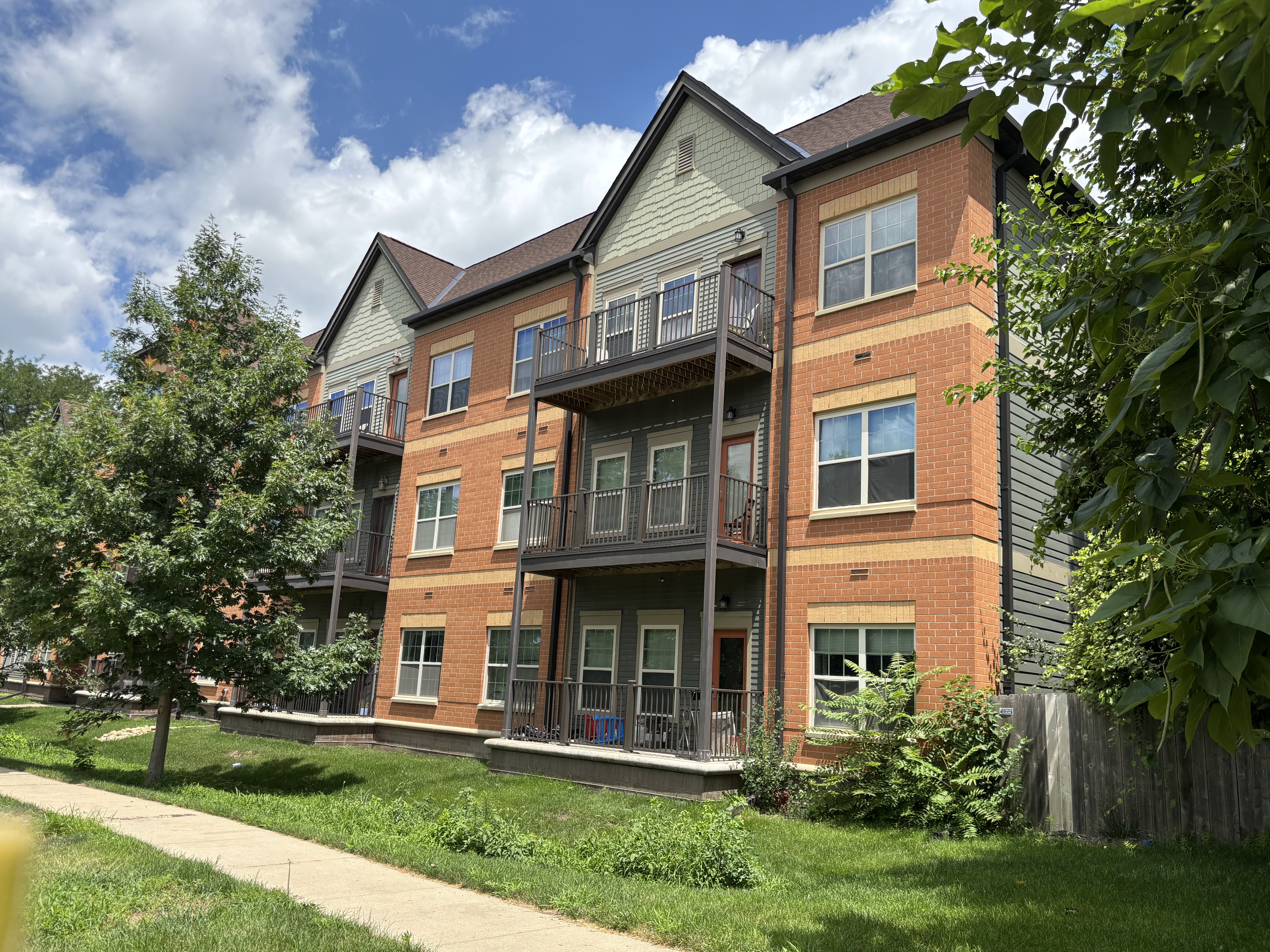
(9/21/2026) Cedar Rapids' new west side branch library opened this weekend. I was deterred from Saturday's opening ceremonies by pelting rain, but Jane and I got ourselves there Sunday afternoon for a guided tour. The 40,000 square foot facility replaces the Ladd Library, which had been located in a former Target on Williams Boulevard.
The tours started in the staff areas, which having been library staff in the 1970s and 1980s was mildly interesting and reassuring to us...
Staff lounge
...but I was mainly there for the placemaking details, which would be in the public facing areas. A pretty decent number of people were using the library already.
Children's area, with whimsical indoor landscaping: Trees light up, hanging lights are shaped like moths
The Busse Branch struck me as a smaller version of the downtown library, capable of providing a variety of services to west side and other metro residents.
The Allsop Auditorium, like downtown's Beems Auditorium, can host speakers, films, and chair yoga classes
The meeting room, like the auditorium, is named for the Allsop family, whose gift honors Bob Allsop, who found the Ladd Library to be a lifeline ("Welcome to the Busse Branch" 6-7)
The Opportunity Center, a popular feature of the Ladd Library, will have small group classes, and individuals can get help with job searches and other technical stuff.
Opportunity Center
Other features highlight the edge-of-town location. There are reading circles for sitting in the light either inside or outside.
Outside the windows is an outdoor reading "room" and, soon, the Bloomhall Discovery Garden
All the windows are fitted with frits to deter bird strikes.
Frits are those dot things
The landscaping is in process...
Should look great by next summer
...but clearly the intent is to make both the facility and the grounds physically attractive.
The library is located well away from downtown, but its neighborhood is hardly suburban. Closest by are trailers and small apartments.
Excellent library access!
Beyond the immediate neighbors, access is mostly going to be by car. It's not far in any direction to the great tangle of stroads comprised of Wiley, Williams, Edgewood, and 16th. Three bus lines (8, 10, 12) run close by, and for cyclists the Edgewood Trail runs along Wiley Boulevard.
Adult non-fiction shelves
Young adult area
Reading nook
This is a great addition to the Cedar Rapids Public Library, and I anticipate it will provide great service to a wide variety of patrons. It is named for the Lavern T. and Audrey Busse Foundation, and is the second library in town to be named Busse. (Mt. Mercy University also has a Busse Library.)
The lives we should all be living: "Texas Two-Step," a movie on the Hallmark Channel, offers romance and country music in a small town third place (swiped from hallmarkchannel.com)
(6/16/2026) In my last post, I noted the reputation of the 1990s TV series Friends has as a contributor to the "back to the city" trend earlier in this century, and wondered not only whether that trend has ebbed, but where today's friends are leading. Hannah Nuss, an entrepreneur and speaker at the recent EntreFest put on by NewBoCo, suggested we might spend some quality time pondering an infamous theme of made-for-TV romance movies: the young woman in the big city returning to her small town roots and finding true love and entrepreneurial happiness.
Hannah Nuss presents at EntreFest (Outrageous laptop borrowed from Robbie Nesmith)
Nuss, of Denver, Iowa, is founder of a shop and a publishing company, both of which are called Local. She cited small town/rural advantages such as low startup costs, low rents, "super-low" cost of living, neighborly culture, and a small enough population that word of mouth spreads faster. She argues that the death of rural Iowa is a "false narrative people accept," and that "entrepreneurship is here" along with the happy endings of all those romance movies where the heroine chooses love over the big city.
Delaney Howell-Goth on stage at the Englert Theater
Also at EntreFest last week, two other female entrepreneurs from small towns touted advantages for business and economic development. Marketer Delaney Howell-Groth (AgCulture Marketing), who farms with her husband near Rhodes, Iowa, said women entrepreneurs are already active enough to create more than half of all jobs created in small towns. Even more people could be shown the way--or the way back, if they've already left--if there were a supportive entrepreneurial ecosystem providing access to resources, training, and knowledge, which is what the conference she started, She Creates Rural, aims to be.
Stephanie Grutz presents at EntreFest
A third business owner, Stephanie Grutz, mostly talked about her personal journey, but has just moved the headquarters of her healthcare businesses from Dubuque to Peosta, in part because she lives there, but also because she wants rural residents to have access to the types of therapies more commonly found in larger cities.
The river that ran through these three presentations was the contrast between an overwhelming big city full of action and people and wealth and the perception (illusion?) of economic opportunity, against a small arena with less wealth and fewer people, but a less frantic pace, and a chance for stable and "deep relationships" with the people you do encounter. A smaller, less crowded stage allows a person to be impactful and known.
Both the movie plot and the death-of-rural paradigm rely on stereotypes, of course, which however exaggerated also reflect some important truths. Lyz Lenz (2026) sees the same phenomenon at work in the popularity of Ballerina Farm, a Utah farm, store, and social media phenomenon created by Hannah Neeleman, a self-styled "trad wife." Lyz notes that the women interviewed by The New York Times "don't want to be Hannah Neeleman, exactly. What they want is a glimpse at an easier life." She continues:
They all seem very aware of what must go on behind the scenes to raise and school all those children while building a business empire and staying thin and breaking bread. But it's that idea of something simple and easier.... A nice husband, a bit of land, some chickens, and some kids? Isn't that so much easier than this modern world, where you sit at a computer and create value for a company that is actively plotting to sell your flesh to AI?
Of course the trad wives and romance movies are selling fantasy, just like Friends, whose characters had an unbelievable Upper East Side lifestyle considering they worked at a coffeeshop.
If the rural young are hearing messages that they must leave to thrive, as our speakers suggested, those messages are landing for a reason. I'm not from a small town, but I'm from a state where small town representatives have run the government for years. And the messages they are bringing from their towns to the state in legislation and executive action pulsate with resentment. They snarl at immigrants, they snarl at transgendered people, they snarl at people who are concerned about the environment. If you are a young person who is different, or seeks a different truth, or whose mind is not slammed shut, these sorts of messages are not encouraging you to do anything but flee.
Back to reality: In a world with only two alternatives, corporate big city overstimulation or quiet old white small town, choosing either is going to be painful, because you'll be required to give up something you value. But are there really only two alternatives? More Americans live in suburbs than any other type of place. I grew up in the western suburbs of Chicago, with great schools and a big public library. Does no one dream of living in a suburb? When I go back, everything's different and no one knows me. Maybe not.
Prince Street, 2018: Boston's North End neighborhood is urban without being noisy and frantic
It may be that in the contrast of extremes can be found there's a combination of attributes many Americans desire in their places but have difficulty finding: walkable neighborhoods, deep relationships, a variety of economic opportunities, and a variety of people with interesting perspectives. A few small towns seem to have achieved this, as have a few urban neighborhoods. But the more we as a country rely on cars to get us anywhere, and low prices at big-box stores to get us by, those places will continue to be hard to find, or to build.
Water Street, 2013: Decorah is small but has a great commercial street an easy walk from residential areas
Small towns that can apply urbanism, and celebrate diversity and inclusion, may find themselves the objects of a lot of people's desires. And that, along with the positive examples and mentoring offered by people like our three speakers, would do wonders for their entrepreneurial ecosystems. And "big" cities that create some real neighborhoods will find they too can ride out whatever fantasies the media are selling us, even if their residents aren't handsome cowboys running Christmas tree farms.
Some of us have to live with the consequences of another legislative session
(5/7/2026) Iowa's public approval of President Donald Trump has dipped to 42 percent in 2026, according to the World Population Review; that puts us only slightly above the national average, and in the middle of the pack of states. That's pretty remarkable, given that our politics have flowed bright red since the 2014 cycle. We can't even gerrymander our congressional districts to help Republicans, because they already hold all four U.S. House seats. Yet early polling--which should be read tentatively, as the election of 2026 is six long months away--shows Democrats with a legitimate shot at the governorship, as well as one or more U.S. House seats, and if that's the case, they might capture a house of the state legislature for the first time in over a decade.
That might account for the particular intensity of the legislative session just concluded. Members of the Democratic minority reported a chaotic closing weekend. My senator, Liz Bennett, reported on the final Saturday morning:
In 12 years, this is the worst and most disorganized I've seen the Iowa legislature. Over 24 hours in this building, here overnight, HOURS between votes, and some of the mot important bills haven't even been agreed upon yet. The majority party (who is in control of the entire government) should've adjourned last night, allowed people to rest while their leadership got things together, and called legislators back when they were ready.
Another senator, Art Staed, a member of Corridor Urbanism back in the day, told KCRG-TV:
This Session was under Republican leadership only, Republicans fighting amongst themselves while the rest of the Capitol suffered. Iowans also suffered with very little public input into these final bills.... Drafters were making mistakes which caused delays. I am absolutely certain we will need to correct some of these poorly thought-out bills next Session (which doesn't begin until January 2027). Why on earth were we working on all of those policy bills that late in Session? Should have been focused on the budget and key areas only.
Once legislators were back on the floor, one Republican bill sponsor cited the source of his information as "AI."
Republicans seemed especially eager to consolidate their policy gains and remind their supporters that their hatred for other people remains as unbridled as ever. A more constructive approach might have been to show that they recognize and care about economic, health, and environmental problems affecting the state, especially the parts of the state where their support is strongest. But maybe it's too late for that.
This is what they did this year at the Capitol (more coverage and longer lists at Barton 2026, Opsahl and Draisey 2026):
Clear public good
water quality initiatives [definitely a problem, though questions about adequacy and whether a restart is better than pursuing previous policy cf. Dorman 2026]
funds for pediatric cancer research, requiring radon mitigation systems in new homes
better access to subacute mental health care
Helping their friends
tax exemption for nuclear power companies
shifts money from school districts to charter schools
omnibus agriculture bill including tax relief and increased support
bans Chinese, Russian, or North Korean ownership of health care facilities
looser training requirements for foster parents, regulations on homeschooling
allows health care practitioners and organizations to opt out of procedures for reasons of conscience
state officials can carry firearms anywhere on Capitol grounds
Sticking it to people they don't like
"three strikes" minimum sentences for prior criminal offenders
forbids local governments from enacting civil rights protections beyond what's in Iowa code, or issuing identification cards, or having revenue growth above 2 percent
limits access to abortion drug mifepristone
restrictions on WIC and SNAP benefits
requiring universities invest in state innovation programs
English proficiency required for truck drivers
Limits lawsuits against farmers for greenhouse gas emissions
removes availability of HPV vaccine to minors without parental approval
restricts access to bail
At the end of this session, we're at the same place when I wrote this last year, or when I wrote this in 2019. Iowa faces persistently low economic growth, despite cutting taxes every year. Incidence of cancer is increasing. Population is growing slowly, but in most of the state it's shrinking. Educated young people are leaving the state. Add on global issues like climate change, economic inequality, and control of new technology. Yet year after year, session after session, our Republican-dominated legislature pulls this grandstanding.
Maybe electing some Democrats will focus everyone's minds. Maybe it won't. It could be that, as Jonathan V. Last argues on a national level in The Bulwark this week, American politics has become so "enshittified" that any policy action to improve the "user experience" has become politically impossible. It could be argued that any party with a 33-17 edge in the state Senate and a 67-33 edge in the state House, 16 years in control of the governorship, along with control of almost every executive position, is doing something right. And yet things don't get better.
Vivian Gornick, The Odd Woman and the City: A Memoir (Farrar, Straus and Giroux, 2015), 173 pp.
He strikes a match and holds it to his cigarette.
"I'm not the right person for this life," I say.
"Who is?" he says, exhaling in my direction. (36)
(11/14/2025) Ten years ago this month, I reflected on the defeat of a local referendum to raise the library tax, and read Vivian Gornick's celebration of life in New York City, while the world around me was showing gun violence, terror attacks, and anti-Muslim sentiment. This month, Cedar Rapids voted down bonds that would have funded public school capital projects ("Cedar Rapids Schools Thank" 2025), and a white nationalist cadre is fueling the Trump administration's tear-gas attacks on American cities and their terror campaign against immigrants (cf. Schulze 2025, Carrasquillo 2025). Seemed about time I revisited Vivian Gornick.
Ready to read, at Brewhemia in New Bohemia
On second reading, her segmented essay proved to contain so much more than I'd caught the first time through. She indeed celebrates the life around her in her long-time hometown, but out of need more than pleasure. Like Thomas Merton, her days have included both dark nights and promising dawns. Parker Palmer (2011: 36-38) would describe hers as a "heart broken open," with love born from pain.
As I reread The Odd Woman and the City, I found myself underlining and circling, marking passages with abandon. It's worth noting that I almost never do this. Some people do. U.S. President John Adams engaged in a running dialogue with whatever he was reading, at least once scrawling "Fool! Fool!!" at some work that displeased him. I wasn't arguing with her, though, just trying to keep up with the numerous dimensions in her reflections, as she jumped around in time, and roped in exemplars from street people to other writers. There is so much I wanted to show you in this book that I didn't discuss in 2015. It would probably be easier on you, me, and Gornick, though, if you just read it.
"The City" is, after all, only part of the title. "The Odd Woman" is Gornick herself, which she announces early (p. 4), but without telling us why or how. In time she tells us that, growing up in the Bronx, she and her friends were already walkers, and what she saw as she walked up and down the streets of Manhattan showed her what she anticipated would be her life (p. 11, p. 51). But it was not to be, despite advanced degrees, relationships, and jobs. She simply could not--would not?--fit in anywhere. Her longtime friend Leonard tells her:
"Fifty years ago you entered a closet marked 'marriage.' In the closet was a double set of clothes, so stiff they could stand up by themselves. A woman stepped into a dress called 'wife' and the man stepped into a suit called 'husband.' And that was it. They disappeared inside the clothes. Today, we don't pass. We're standing here naked. That's all." (36)
Freedom from traditional roles had become freedom from any role, intolerable because "no one wanted freedom" (p. 121), an insight she attributes to Henry James. She identifies with Mary Barfoot, the main character in George Gissing's novel The Odd Woman; Rose, the mother in the musical Gypsy; and John Dylan, an actor whose stroke left him with a speech impediment that he used to disturbing effect in a public reading of a work by Samuel Beckett.
Gornick's oddness, and her "inability to make peace with" herself (p. 19), is survivable only in the city. Walking becomes a sort of therapy once "nothing turned out as expected" (p. 14), but it is even more than that. It is her connection to people: Leonard, with whom she converses so intently that time becomes unreal (p. 17); the active residents of Manhattan's West Side, which she prefers to the "calmer, cleaner, more spacious" East Side (p. 94); and even the men in line at a soup kitchen, who remind her of journalist's line about "ruined faces worthy of Michelangelo" (p. 152). "It's the voices I can't do without" (p. 173), like the three she samples in rapid succession on pp. 37-38, but she is also comforted by all the nearby presences as she goes to bed at night (p. 21).
Frank O'Hara (1926-1966)
Along the way we meet her mother, ex-lovers, other friends, and any number of writers on these themes, including the poet Charles Reznikoff (p. 38), the novelist Isabel Bolton (p. 79; see also Bloom 2016), and Frank O'Hara, who wrote: I can't even enjoy a blade of grass unless I know there's a subway handy, or a record store or some other sign that people don't totally regret life (p. 42). Once you allow for the possibility of oddness, it's everywhere.
Gornick is still with us at 90; she turned 80 the year The Odd Woman and the City was published. In old age, she seems satisfied she's figured out what her problem is. But it continues to be the people of her city who make the "odd" life satisfying. She concludes:
I am home, having dinner at my table, looking out at the city. My mind flashes on all who crossed my path today. I hear their voices, I see their gestures, I start filling in lives for them. Soon they are company, great company. I think to myself, I'd rather be here with you tonight than with anyone else I know. Well, almost anyone else I know. I look up at the great clock on my wall, the one that gives the date as well as the hour. It's time to call Leonard. (175)
Cedar Rapids undertook a number of ambitious street initiatives in the 2010s, including adding bike lanes and converting signalized intersections to four-way stops. Perhaps the most ambitious was converting most of our one-way streets back to two-way. This undid efforts from the late 1950s through the 1960s, intended to relieve traffic congestion. As in most places where this had been undertaken, urban neighborhoods wound up paying the price in lost property value and increased danger, while suburbanites found they didn't really want to go downtown that much anyway.
3rd Ave SE: Downtown on a rainy January day in 2013
Returning to two-way streets comes recommended by urbanists, based in part on the experience of cities like Savannah, Georgia, which saw a dramatic recovery along East Broad Street once it had been reconverted (Speck 2012: 179-180). Along with Jeff Speck, who consulted with the City of Cedar Rapids on urbanist projects throughout the decade, I quoted Seattle-based David Sucher, author of City Comforts: If one's goal is to move as many cars as possible through a neighborhood, the couplet [of one-way streets] works well. But if the goal is to create comfortable shopping districts, make streets two-way (2003: 86).
If the impacts on commercial districts are bad, imagine what one-way streets do to residential neighborhoods, whose residents find themselves living on a speedway meant for others, on which they can only approach their homes from one direction.
3rd Avenue SE in the one-way era, July 2014
Ten years ago, the city stated the following goals for the initiative:
make the streets accessible and easier to navigate
improve opportunities to walk or bike
increase visibility of downtown businesses
slow traffic
I added my own measurable outcome--The conversion will be a success if it facilitates transformation of the city center into a 24-hour downtown, with a successful commercial enterprises, permanent residents and cultural attractions all contributing to a vibrant place--
which seems in retrospect to be quite the high if desirable bar. I blame my hot-headed youth. It's safe to say that hasn't happened, nor have the three most prominent opposing views come to pass (traffic congestion, traffic crashes, mass confusion).
1500 block of 3rd Avenue SE: conversion in process, October 2019
By this point, most of our one-way streets have been reconverted, the major exceptions being 15th and 16th Avenues SW, and 3rd and L Streets SW. 13th Street/College Drive/Oakland Road is still one-way between 2nd Avenue SW and H Avenue NE, and a few one-way blocks remain here and there on other streets as well, but our one-way street mileage today is a tiny percentage of what it was in 2010.
3rd Avenue SW is now two-way, L Street is still one-way
Measuring the impact of all these changes is tricky, partly because I have some but not very much data, and partly because there are other moving parts (many more bike lanes and sidewalks in town, construction projects necessitating extended closure of streets near the river, diminished use of offices post-COVID, closing of two blocks of 2nd Avenue SW for Physicians Clinic of Iowa, no discernable influx of population into the city) affecting the use of streets. So the assessments that follow are tentative.
My overall assessment is cautiously positive. I see no significant negative impacts at all, while positive changes to the affected blocks are less-than-revolutionary. Given that one-way streets are inherently confusing, I believe the first objective to be a slam dunk, but the others are subtle or require data I don't have.
Changes in daily traffic counts are interesting, but don't give us a lot to go on. The first round of reconversions, between 2015 and 2017, occurred on 2nd and 3rd Avenues SE/SW, 4th and 5th Avenues SE, and 7th and 8th Streets SE. On 7th and 8th--which remain one-way close to the Interstate entrance--traffic counts away from the Interstate remain roughly the same. On 2nd and 3rd, traffic counts have declined, but the biggest declines occurred well before the conversion, possibly due to changes in the downtown work/shopping scene. Also, 2nd Avenue SE no longer is continuous, since two blocks were closed early in the 2010s to make room for the new Physicians Clinic of Iowa campus. No data are available for 4th and 5th Avenues. (Profuse thanks to the Iowa Department of Transportation for sending along historic traffic count maps.)
Speck argues that the most profound negative land use effects of one-way streets are found on the streets leading into downtown, "since most people do most of their shopping on the evening path home" (2012: 178). So we could look for changes on 2nd and 4th Avenues SE, 3rd Avenue SW, and on Center Point Road NE.
All of the former one-way sections of these streets began in residential neighborhoods, typically with older single-family housing. Of the four streets, the neighborhood on 3rd Avenue SW is the most transformed, because it was most impacted by the flood. 2nd Avenue has seen a dramatic decrease in traffic because of the two block closure between 12th and 10th Streets, but there's been no new building in the mostly empty 1200 block.
Start of the converted section, 1800 block of 2nd Ave SE
Each street must pass through an empty quarter before it reaches downtown: 2nd and 4th Avenues go through the MedQuarter, Center Point Road becomes Coe Road between Coe College and St. Luke's Hospital, and 3rd Avenue passes underneath I-380. Such commercial development as there is on the far side of the empty quarter remains pretty much untouched.
2nd Avenue enters the MedQuarter (PCI building is at the end of the block)
Only at 3rd Street and below has 3rd Avenue seen a lot of investment as the Kingston Village area has emerged post-flood. (Coe Road at this writing is still one-way below A Avenue NE.) 2nd Avenue has held its own close to downtown, with a mix of offices and restaurants, but a surprising amount of vacancies as well. 4th Avenue has seen very little change. And we don't have anything like a "24-hour downtown."
Before the conversion: 200 block of 2nd Avenue SE, August 2017 (Google Earth screenshot)
After the conversion: 200 block of 2nd Avenue SE, this week
So, no dramatic change from the reconverted one-way streets, except for what's explainable by post-flood recovery, MedQuarter expansion, and post-pandemic declines in downtown office occupancy. Cedar Rapids, unlike, say, Providence or Charlotte, has not seen an influx of population that would force more transformation.
I still support the reconversions, for simplicity's sake, because it creates opportunity for future development, and for safety. A three-lane one-way street carrying 8400 cars through a residential neighborhood is not good for the quality of life of the people living there. A three-lane one-way street carrying half that many would be even less safe, because there would be more room for speeding.
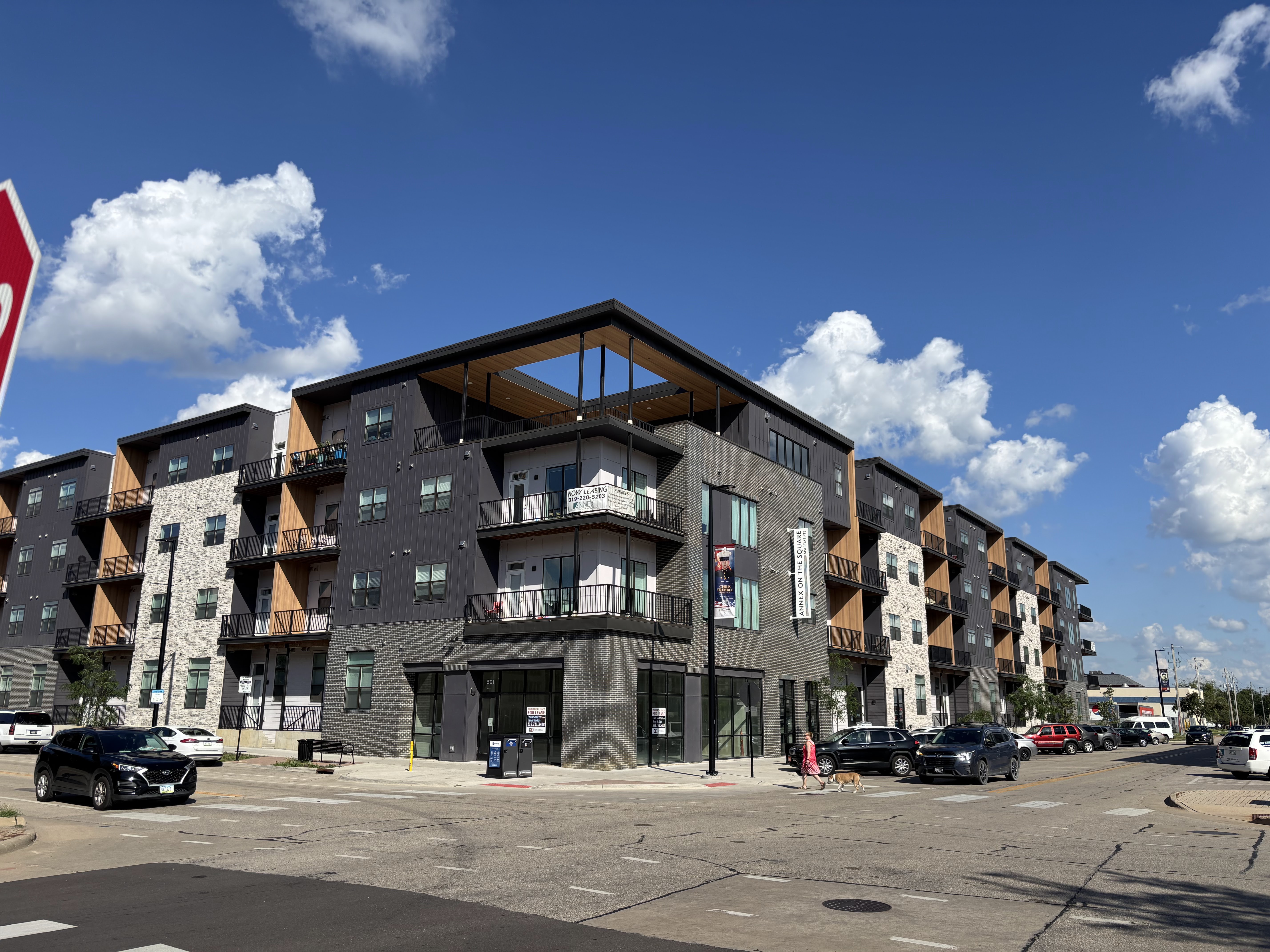
Apartments across from Greene Square, part of a surge of building in the core of Cedar Rapids
Ten years ago this month, I hosted two events featuring Charles Marohn, founder and CEO of Strong Towns: an evening public event at the Iowa City Public Library, and a meeting of the Corridor Metropolitan Planning Organization the next morning in Ely. Remarkably, I wrote nothing about those events and took no pictures; all I did was post a link to the video on Iowa City's website, which link has, alas, now expired. (A subsequent Iowa City appearance by Chuck, in 2019, can be found here:)
I did take pictures in July 2015, lots of them, of churches in the Oak Hill Jackson neighborhood. The idea was that there were a number of houses of worship remaining from the era when the core of Cedar Rapids was bustling and dense, and that when--as I anticipated--urbanism returned bustle and density to the city center, these religious institutions would be ready to support the new arrivals and be the basis for renewed community.
Since that post, three more churches have been started in Oak Hill Jackson, and I have acquired editions of Polk's Directory for 1953 and 1998 that show changes in the property uses as well as in the surrounding areas.
New Churches
Veritas is a non-denominational church that hosts a coffeehouse on weekdays
In 1953 this building was Nash Finch wholesale grocers (the folks who operated the Econo Foods and Sun Mart chains). There was a Sinclair station on the other side of 3rd. In 1998 there was no listing for the church's current address, while Cedar Valley Habitat for Humanity occupied the building across the street that is now their ReStore. The oldest Google Earth photo, from 2012, shows the Intermec company occupying this building.
This congregation was started in 2020, and is affiliated with the conservative Presbyterian Church of America. They hold services in the theater at CSPS Hall, a historic Czech and Slovak community center dating from the 1890s. In 1953, this block of 3rd Street had, besides CSPS, six single-family households, one duplex, and 11 businesses, as well as the Salvation Army at 1119-1123 (now Parlor City). In 1998, there were two households and five businesses sharing the block with CSPS.
This congregation, along with the ROC (Recovering Our City) Center, is using the building that ten years ago was occupied by Oak Hill Jackson Community Church. The sign above the door actually says "Refuge City Church," which testifies to the versatility of the abbreviation "RCC." In 1953 this was St. George Syrian Orthodox Church, which built the church in 1914; they moved to Cottage Grove Avenue SE in 1992. In the 1998 Polk's Directory there was no listing on 10th Street SE between 12th and 15th Avenues.
This venerable church was built in 1869, and occupies the same block as the also-historic YWCA, opposite Greene Square Park. "First Pres" is the first of the oldline Third Avenue Churches; now, with the departure of First Christian Church and People's Church (Unitarian Universalist) in the 2010s, it is also the only mainline church on the southeast side below 10th Street.
Built in 1904, this church long served the working class neighborhood around the Sinclair meatpacking plant. In 1953 just that block of 5th Street had 14 households containing 47 residents, as well as two vacant houses and the Sisters of Mercy at 1230 5th. In 1998, the block still had seven occupied residences, but all the older houses in the area were bought up and leveled after the 2008 flood.
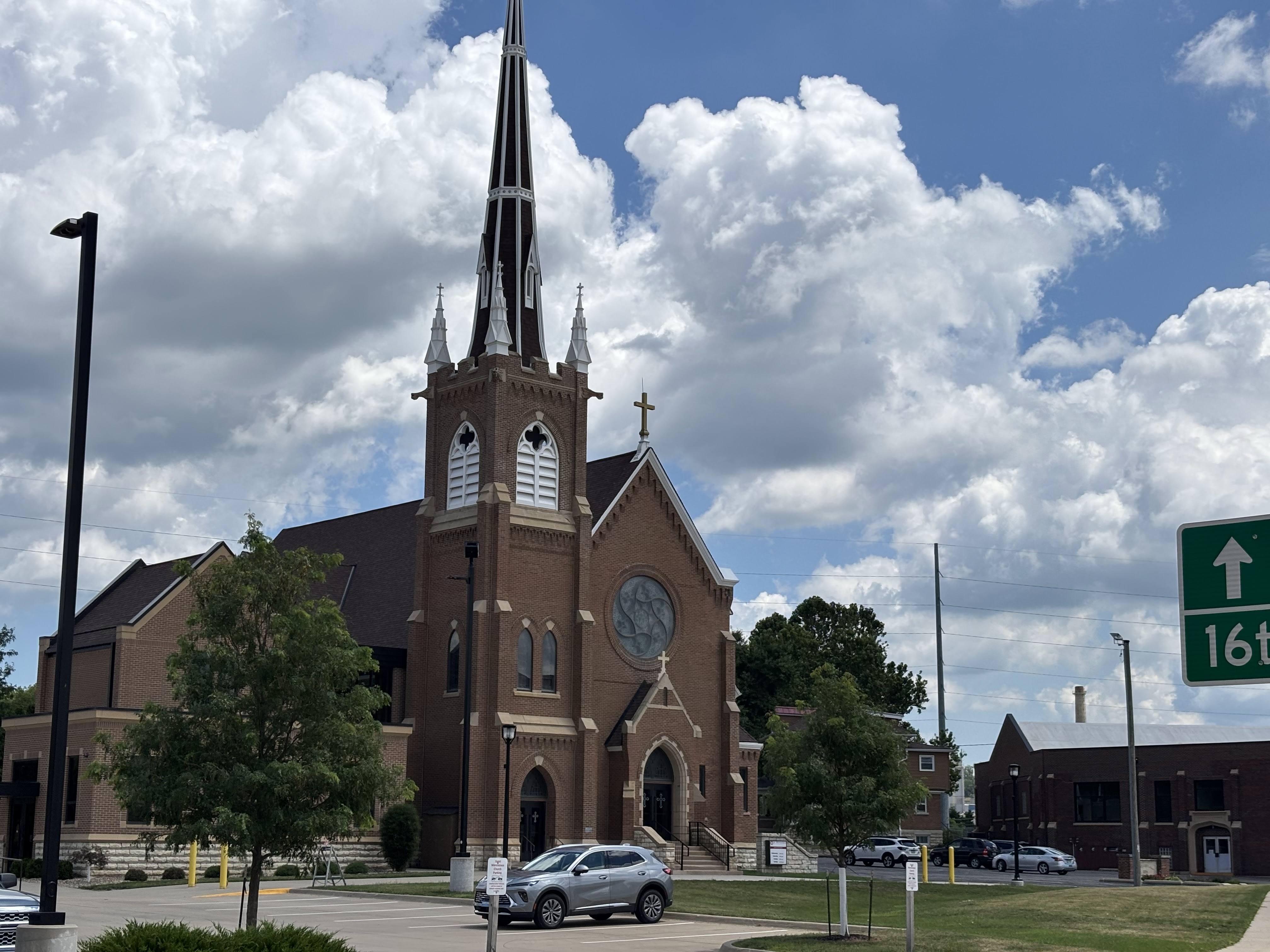
Built in 1931, Bethel AME Church has, like St. Wenceslaus, has continued its ministry after losing many of its closest neighbors. In 1953, the 500 block of 6th Street had seven single-family homes and two duplexes with a total population of 45. By 1998 it was down to two single-family homes, two vacant apartments at 514 6th, and four residences "not verified." Today there is just a vacant lot between Bethel and 5th Avenue.
This church was built by Hus Presbyterian Church in 1915; Hus moved to Schaeffer Drive SW in 1973, and then closed in 2021. The 9th Avenue block had seven single-family homes and four duplexes in 1953, with a total of 68 residents. By 1998, the New Jerusalem congregation was established in the building, and the block listed five single-family homes and two duplexes.
This church was built in 1965, but it's not clear that it's still in operation. Their Facebook page last updated 2022, and they're no longer listed on American Baptist Churches website. The banner still appears on the building, and the lawn is cut, but a sign on the door says "Mask required to enter," which surely is a vestige of the coronavirus pandemic of 2020-21.
In 1953, this address was the home of John D. Malbrue, a factory worker for Collins Radio, and his family of five. The block had 13 homes for 45 people, as well as a grocery store at 1000 7th. In 1998, the block had three homes, the church, and a social service organization called Options; 1000 7th was vacant. (Today 1000 7th is the site of the charming Sacred Cow tavern.)
A handsome "Church of Christ" sign has been added to the exterior since 2015, but the charming garden I noticed is gone. Its web and Facebook links are to churches in Texas. In 1953, the building contained the grocery store of William W. Krejci; the block had 10 single-family homes and five duplexes, with a total population of 68. The 1998 Polk's Directory lists the Church of Christ, nine homes, and two "not verified." It's still a well-settled block.
Mt. Zion moved to the edge of town after the 2008 flood, after nearly a century in the neighborhood. Its location is now part of a parking lot for the MedQuarter. Before the move, that block of 8th Street, which once was home to 56 people besides the church and a funeral home, was down to the church and one vacant property.
Church of Jesus Christ of the Apostolic, 916 10th St SE
In 1953 this address was the house owned by Mrs. Francis Leksa. It is now part of an apartment complex constructed post-flood.
Plenty of churches remain nearby: Harris Oak Hill Apartments
Holy Ghost Missionary Baptist Church, 1003 6th St SE
There is no listing for this address in the 1953 Polk's Directory, but 1001 6th was the home and store of grocer Milo Grubhoffer. What was probably the church building was for some time post-flood used for storage by the nonprofit Feed Iowa First. Something new is being constructed in its place even as we speak.
Construction at former Holy Ghost site
Ten years on, the church scene in Oak Hill Jackson is different, but similar. In the meantime, there's been a lot of building.
New Bo Lofts addition, across from St. Wenceslaus
Loftus Lofts, in the heart of New Bohemia
Will all this new construction be populated? Will the new residents find, or even look for, community in their neighborhood churches? Do the churches even want to play the role of community rebuilder, or are they focused on their present membership? To answer these questions, we would need data, which I famously don't have.
ORIGINAL POST (with more pictures): "CR Churches," 20 July 2015