Showing posts with label gay rights. Show all posts

Sunday, June 8, 2025

Film review: "1946: The Mistranslation That Shifted Culture"

Coming soon: Day by day reports from the Congress for the New Urbanism. Check back often... don't miss a paragraph!

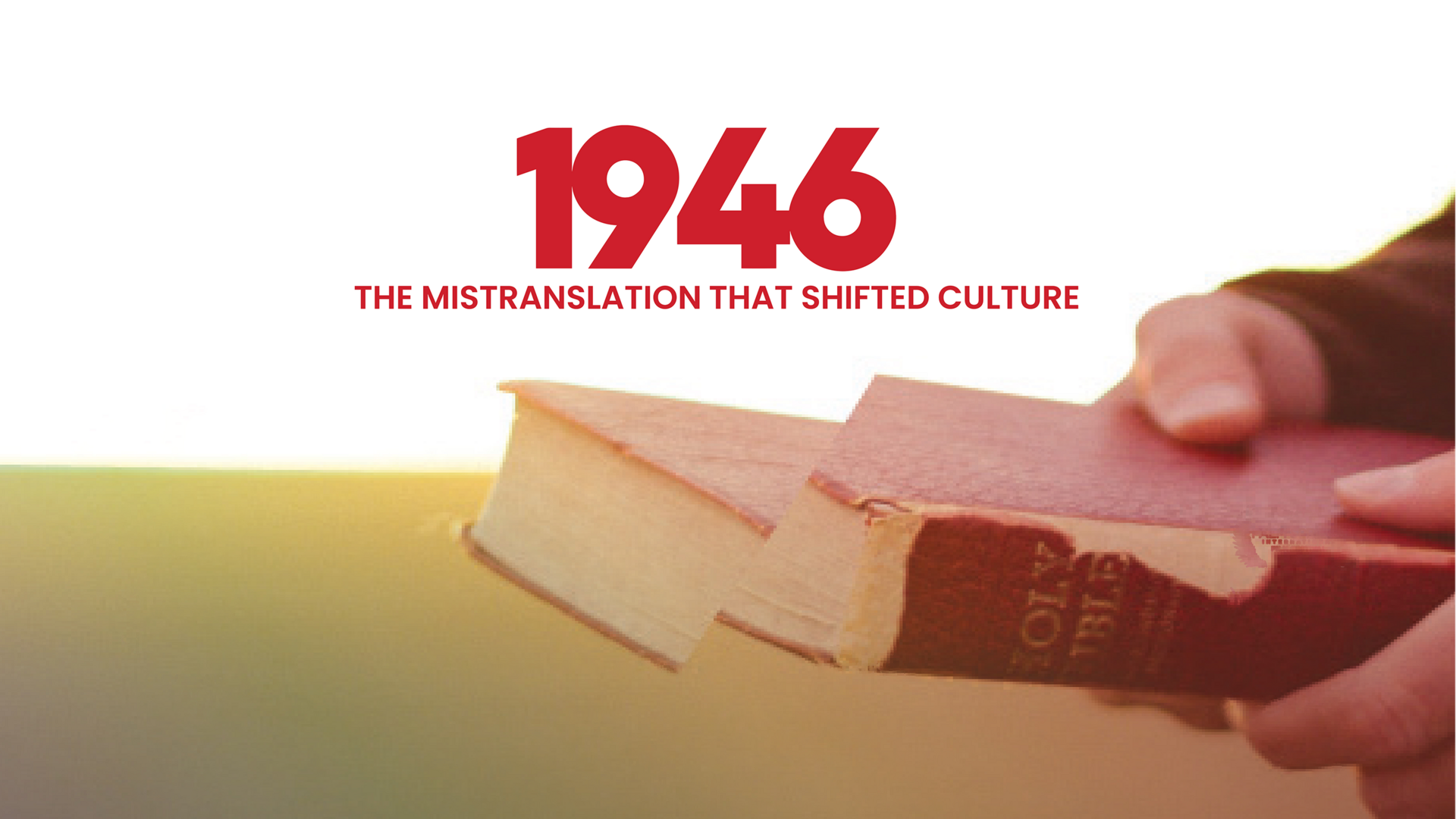
1946 poster
Source: lgbtq.yale.edu

1946, a documentary film made in 2022 by Sharon "Rocky" Roggio, refers to the fateful decision by the committee producing the Revised Standard Version of the Bible to render two Greek words in I Corinthians 6:9 as the single word "homosexuals," thus including gays and lesbians with "the immoral, nor idolators, nor adulterers" and others as the "unrighteous [who] will not inherit the kingdom of God." I saw her film at St. Stephen's Lutheran Church in Cedar Rapids.
film on screen above decorated wall
Watching "1946" at St. Stephen's Cburch

1946 is not about the translation itself, the origins of which remain mysterious even in the committee's archives at Yale University, but about those of us who live in its aftermath. We meet Roggio herself, a lesbian who struggles to maintain her family relationship even as her father becomes a prominent anti-gay preacher; Kathy Baldock, whose dogged research provides the basis for the film's argument; Ed Oxford, a gay theology scholar who works with her; and Davis S., whose 1959 letter documented the committee's error, prior to a long career as a pastor in the United Church of Canada. Each suffers some impacts from the dominant theological interpretation.

Their inquiries are supported throughout the film by a number of biblical scholars, most memorably Rabbi Steven Greenberg, author of Wrestling with God and Men: Homosexuality in the Jewish Tradition (Wisconsin, 2004), whose reflection on the phrase "Fuck you" I will be pondering for a long time.

By the time (1969) the RSV committee, spurred by Davis S.'s criticism, voted to change their translation from "homosexuals" to "sexual perverts," the horse was out of the barn. Other versions of the Bible, like the New International Version and the Living Bible, continued to follow the RSV's use of "homosexuals," and today are in much wider use than the RSV and its successor versions. In fact, according to the film, the Living Bible added five more references to "homosexuals" that don't appear in the RSV.

My third grade presentation Bible, Revised Standard Version

The scholars walk us through the context that is often lost when people quote other Biblical passages that have been used to condemn homosexuality: the destruction of Sodom in Genesis 19 with its echo in Judges 19, a series of verses in Leviticus 18 and 20 known as "the clobber verses," Romans 1:26-27. They argue that the verses condemn sexual exploitation and/or decadent living, not to same-sex relationships.

The personal focus of the film, even as it works through the minutiae of biblical translation and interpretation, is essential. As I wrote concerning Pope Francis a few days ago, so much changes when we make the subject people rather than rules. 1946 clearly shows the damage done by biblical interpretation that casts out gays and lesbians. I don't know, however, that they make the case that the committee "shifted culture" with their decision. As another viewer at St. Stephen's--it was Jonathan Ice, in case you happen to know him--noted, "Homophobia was not invented in 1946." 

But the committee's chosen language was certainly handy in the 1970s when the burgeoning gay rights movement met with backlash. It was 1972, for example, when the United Methodist Church added a statement that homosexuality was "incompatible" with Christian teaching to its Book of Discipline. The 1970s saw the emergence of the Moral Majority, Christian Broadcasting Network, National Christian Action Coalition, and other organizations that the Republican Party led by Ronald Reagan skillfully wove into its electoral coalition. They had the RSV language to draw on, but orthodox Christians and political opportunists probably could have made just as much hay with previous constructions.

I don't know, either, how many minds will be changed by 1946. Textual criticism of the Bible has been suspect in a lot of believers' eyes since its emergence in the latter half of the 19th century. However, I think Sharon Roggio's careful presentation provides a path to reconciliation for those who are increasingly troubled by what they've been taught the Bible says. It surely provides assurance to Christians, like young Sharon and young Ed Oxford, who feel cast out of the presence of God by their sexuality.

So, what did English-language Bibles say before 1946? Fortunately, I have a small collection of my family's pre-RSV Bibles. Here's how they render I Corinthians 6:9-10.

Both my mom and my mother-in-law received presentation Bibles in the King James Version:

Know ye not that the unrighteous shall not inherit the kingdom of God? Be not deceived: neither fornicators, nor idolaters, nor adulterers, nor effeminate, nor abusers of themselves with mankind. Nor thieves, nor covetous, nor drunkards, nor revilers, nor extortioners, shall inherit the kingdom of God.

My dad received the Standard American edition of the Revised Version (1901), which varied only slightly from the original King James Version but with possible significance:

Or know ye not that the unrighteous shall not inherit the kingdom of God? Be not deceived: neither fornicators, nor idolaters, nor adulterers, nor effeminate, nor abusers of themselves with men...

My copy of The Bible: An American Translation (1935) was formerly owned by my Uncle Ralph and Aunt Margaret:

Do you not know that wrongdoers will not have any share in God's kingdom? Do not let anyone mislead you. People who are immoral or idolaters or adulterers or sensual or given to unnatural vice or thieves or greedy--drunkards, abusive people, robbers--will not have any share in God's kingdom.

The oldest non-KJV translation I found at my church's library was A New Translation by James Moffatt (1935 edition):

What! Do you not know that the wicked will not inherit the Realm of God? Make no mistake about it, neither the immoral nor idolaters nor adulterers nor catamites nor sodomites nor thieves nor the lustful nor the drunken nor the abusive nor robbers will inherit the Realm of God.

"Catamites" are, it turns out, the victims of homosexual pedophiles. Based on the scholarship in 1946, that is a worse translation of the Greek than the RSV.  

Whatever the translation you're consulting, if you want to find the whole population of gays and lesbians on those lists, you'll find them, however uncharitable your quest. As for the "clobber verses," Leviticus spends at least as much time on menstruating women than it arguably does on homosexual men (not lesbians, interestingly). "If a man lies with a woman during her period, and uncovers her nakedness, he has laid bare her flow, and she has laid bare her flow of blood; both of them shall be cut off from their people" (Lev. 20:18, NRSV). Any attempt to make that the foundation of a doctrinal schism, such as the United Methodists lately have experienced, would be ridiculous. If we as a society can get used to the idea that some of us menstruate, we can get used to the idea of same-sex relationships.

SEE ALSO: "Film Review: Stonewall Uprising," 28 June 2015

"1946" official website: 1946 | The Mistranslation that Shifted a Culture

Movie trailer (1:22):


Monday, March 13, 2023

Another rainy day in New York City


6th Avenue outside West 4th Street station

"Are you local?" asked the man at the coffee shop. "No," I said. "Do you work locally?" he asked. "No," I said, "I'm from Iowa." "Where is that?" he asked. From an array of potential responses, I chose, "Central US."

When I left for New York City on this long weekend, I knew (1) my best opportunity to immerse myself in Greenwich Village would be Monday, and (2) the weather forecast for Monday called for rain all day, so (3) I would be able to test out the urbanist maxim that walkable areas work in all kinds of weather because if your destination's close enough the weather simply doesn't matter.

6th Avenue at 9th Street

Reader, the maxim is true. (It helped that Monday was somewhere between light rain and drizzle, not the bouncing-off-the-pavement precipitation we often get in the "Central US.") Everywhere I walked in the West Village I encountered other walkers, some with children, many with dogs, as well as cyclists (mostly e-bikes). Life goes on, even in the rain, and it can go on just fine without a car if the design is supportive.

Hudson St approaching Perry St

The West Village, besides being spectacularly walkable, is spectacularly historic. Inexcusably, neither of our guidebooks mentions Jane Jacobs, who lived at 555 Hudson Street while writing her ur-urbanist classic The Death and Life of Great American Cities. 

555 Hudson Street

Her home is now a realty office, possibly some revenge for Robert Moses, but at least it's not a Dunkin' Donuts. 

plaque by the big front window

If your children are too young to appreciate Death and Life, they could start on this...

...available along with much else for all ages at the Tenement Museum, not far away on the Lower East Side, and whose side hustle may be one of the greatest bookstores I've ever been in.

The West Village is also the spiritual birthplace of gay rights. 

Stonewall Inn, 53 Christopher Street

Across Christopher Street from the Stonewall is Christopher Park...

where the gay rights movement is commemorated. 

Scant blocks away is Julius'...

159 West 10th Street
(Note that other than the main drags, streets are about 16 feet wide)

...where a few years before Stonewall, patrons invited reporters and police to witness their illegal imbibing, which events became known as "sipins."

Now that gays can congregate freely in bars and even receive packages by FedEx, it can be easy to remember that freedom was neither automatic nor easy.

The West Village also has considerable artistic heritage. The realtors in Jane Jacobs's house work within a 5-minute walk to folk music history...

Woody Guthrie lived at 74 Charles Street

theater...
Lucille Lortel Theater, 121 Christopher Street
theater history...

Playwrights Sidewalk on Christopher Street

jazz...

Village Vanguard Jazz Club, 178 7th Avenue S
(2010 photo of younger humble blogger with humble son Robbie)

and film!
IFC Center, 323 6th Avenue

There is also 94 Charles Street, for hipster baseball card collectors:


And there's 25 Charles Street...
...where my friend Mark Dunn lived in the 90s while trying to make a go of playwrighting.

Farther east, Cafe Wha?...
115 MacDougal Street
...is featured on the cover of Rhino's Troubadours of the Folk Era collection.

Sitting in the coffeeshop on a "slow" Monday (free WiFi, restroom, steady entrance of customers, $4.75 for a 12 ounce drip coffee)...
787 Coffee, 208 West 10th St

...I feel comfortable and at home here. I don't even want to go back to my hotel in Midtown! 

Is it amazing that all this ferment is happening in a relatively tiny geographical space? Yes, it is, but then again, no, it isn't. It's really only when people live with each other, encountering each other on a daily basis while negotiating space and difference, that such sparks fly and magic happens. When people retreat to enclaves, we get commercialized values and the politics of fear.

While I've been in New York, presidential candidate Ron DeSantis has been in Iowa, and word just came that President Biden is opening more of the Arctic for oil extraction. The West Village shows us that we can live well without either one.

Jefferson Market Library and Garden, 10 Greenwich Avenue

I suppose if I did live here, and visited Iowa, I would be blown away by all the personal space available, the cheap real estate and acres of free parking--all that chafes at me now--and the free refills. The grass is always greener... Would I then be encouraged to vote for Ron DeSantis to make America Florida (or, more attainably, Iowa)? 


SEE ALSO: Mike Katz and Crispin Scott, The Rock and Roll Explorer Guide to New York City (Globe Pequot, 2018)

Sunday, September 22, 2019

LGBTQ Presidential Forum


people gathered in auditorium facing stage festooned with flags
Crowds gather for the LGBTQ Forum in Cedar Rapids

(9/22/2019) Look at where we are! Can you believe it??

The first thing to be noted about the LGBTQ Presidential Forum, featuring ten Democratic presidential candidates, is its historic character. Such a forum, dedicated to discussion of issues affecting the queer community, and in which candidates competed on allegiance to that community, was unthinkable even twelve years ago. In 2007-08, within the memory of even my first-year college students, the only candidate who supported gay marriage was the marginal Democrat Dennis Kucinich. Things have changed very fast for the better in this area--after years of spadework, of course, as with most overnight sensations.

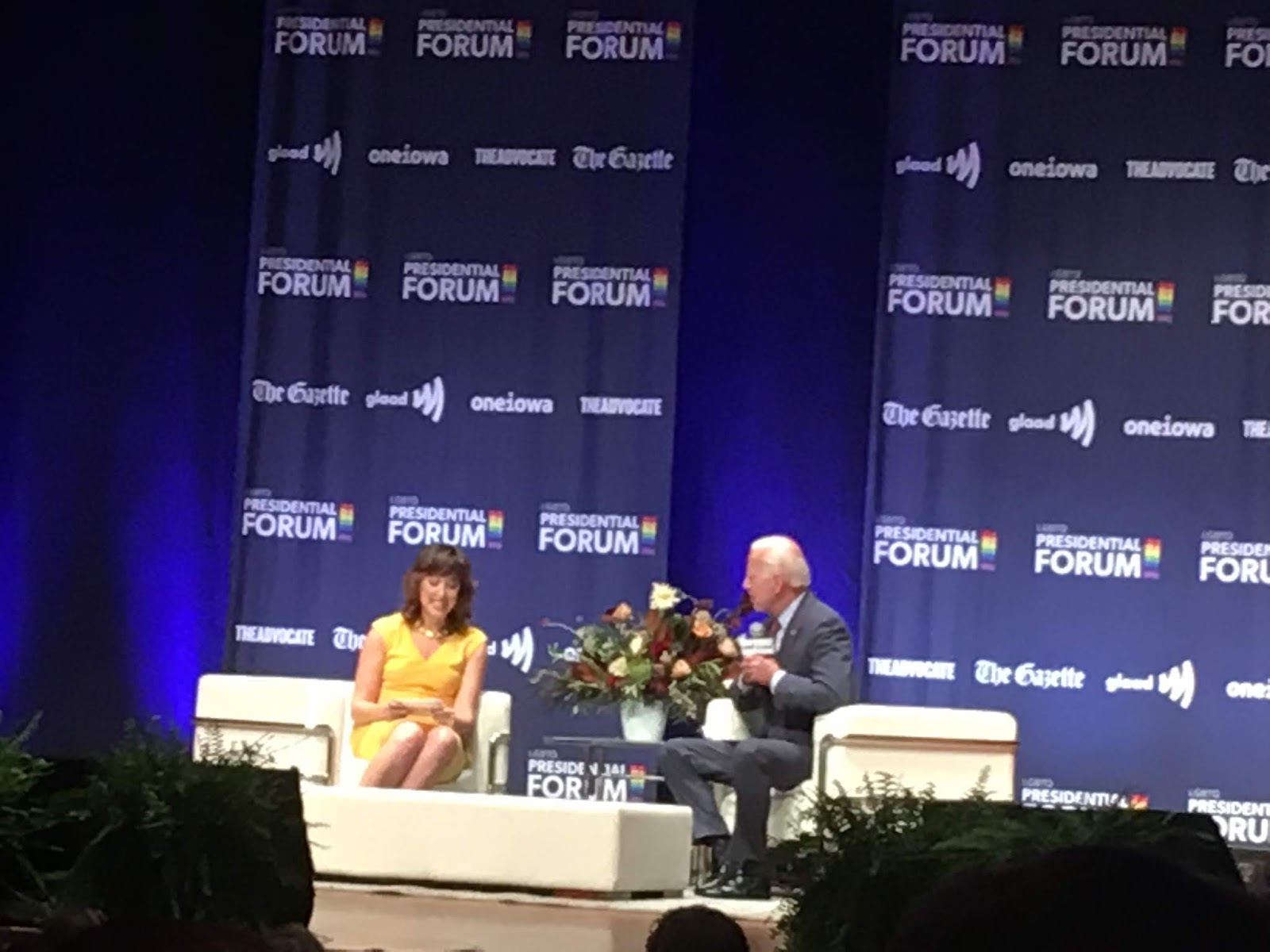
The LGBTQ Presidential Forum was co-sponsored by The Advocate, The Cedar Rapids Gazette, One Iowa, and GLAAD, and was broadcast nationally by NBC.

We should also celebrate that the forum was more substantive than it could have been. Given how quickly the Democratic field, along with most of America, have come to broad agreement on gay rights, the discussion could easily have devolved into competing empty declarations support, a 21st century version of "Well, I hate the Romans a lot!" That the forum encouraged more informative expressions from the candidates was thanks to some of the questions, which got past the surface to inquire about violence against transgendered people, state religious exemptions laws, human rights advocacy in foreign policy, and other policy issues of particular interest.

The candidates, who included all of the leading contenders except Senator Bernie Sanders, were interviewed serially. 
Lyz Lenz of the Gazette interviews Joe Biden
They all answered a common question ("What would you do [for these communities] in your first 100 days?") and then two or three other questions from a rotating set of interviewers. This prevented give-and-take between the candidates, for better or worse. It also meant the candidates had to make a good first impression, or else.

The evening was punctuated by appearances by celebrities, including Angelica Ross who served as host. It took 15 minutes for Marianne Williamson, the first of the candidates, to get to the stage. I thought this tended to diminish both the candidates and the gravity of the electoral decision before us; perhaps the younger people in the crowd, who have actually heard of these celebrities, appreciated their contributions to the evening's program, but I found Ms. Ross in particular rather irritating as well as unnecessary.
See the source image
Angelica Ross (Creative Commons via Wikipedia)
Besides that cavil, I have two reservations about the event:

First, a single-issue event such as this forum or the climate forum in Washington tends to define Presidents as people who deliver the goods (or not) to a series of constituencies. Anyone, even Donald Trump, can make promises. Moreover, narrow foci neglect issues of presidential management, which include the need to set priorities, allocate the budget, respond to new or complex information, and negotiate with political opponents. There was, in spite of the quality of some of the questions, a lot of box-ticking--we really do, as it turns out, hate the Romans a lot--and allegiance-proclaiming. Candidates used their opening statements to show that they had been in front of the social change in favor of gay rights: Cory Booker raised a pride flag at the Newark City Hall in 2006, Kamala Harris performed a gay marriage in 2004, Joe Sestak served with gays on a navy ship in the 1990s, and Joe Biden had been on the side of gays since he was a boy, which was a very long time ago indeed. So, we're all for gays and lesbians. Now, "when do we get our debate on reproductive rights?" someone asked after the forum. 

[This is not to defend the Kennedy-Nixon style of debates we've also seen this summer, which bring their own set of problems. But the single-issue forums absolutely beg for logrolling.]

Which leads me to my second reservation, which is that the value the sponsors and the audience placed on allegiance to the advocates' positions left little room to discuss tactics. I understand the frustration and impatience of many in the audience, but we also need to plan how to get to (and sustain) the inclusive world we want. The venerable "100 days" frame, which apparently cannot be killed no matter how many presidents it's inflicted on, puts the emphasis on immediate satisfaction. Sometimes it takes incremental steps to get to a goal--Don't Ask Don't Tell is wrong now, but in 1994 it was a huge step forward--and sometimes it takes negotiation. I don't have much good to say about Mike Pence, but I do believe in redemption, and sometimes people can see things in new ways if they're shown a positive vision. I'm not saying Pence is one of those people, but obsessing about whether Biden gets along with him or should be calling him "a good guy" is setting too pure a standard for politics.

The trick is to push forward, while leaving the door open for future allies to come around. "Evolution" should be encouraged, not permitted to become a "snarl" word. Because, faithful readers, your humble blogger has "evolved" on these issues. It was awhile ago, before the youngsters in the audience were born, but nonetheless, I was raised with a traditional view of sexuality, and it took some exposure and some gentle persuasion to get where I am. Our common life needs everybody, not just the pure.

Grace King and Molly Duffy, "Crowd at Coe Welcomes LGBTQ Discussion," Cedar Rapids Gazette, 21 September 2019
James Q. Lynch and Rod Boshart, "LGBTQ Forum Brings Marginalized Issues Into Mainstream of 2020 Presidential Campaign," Cedar Rapids Gazette, 22 September 2019

The video:


Tuesday, March 5, 2019

United Methodism's awful no good very bad week

https://upload.wikimedia.org/wikipedia/commons/thumb/5/59/Gc2008_min_high_ed.jpg/300px-Gc2008_min_high_ed.jpg 

Agape does not begin by discriminating between worthy and unworthy people. It begins by loving others for their sakes.... Agape is loving seeking to preserve and create community.
--MARTIN LUTHER KING JR.

My church and my country
Could use a little mercy now
--MARY GAUTHIER
The United Methodist Church, to which I belong and have belonged for most of my life, and in which at least three of my close relatives have served as pastors, tightened its rules against homosexuality at a special General Conference last week in St. Louis. Now comes time for this venerable organization to decide whether it wants to or even can be part of our common life.

A majority (53 percent) of the delegates at the General Conference voted to adopt the "Traditional Plan" reaffirming the church's teaching that homosexuality is "incompatible with Christian teaching" as well as barring ordination of "self-avowed, practicing" gays and lesbians and same-sex marriages. These provisions, part of the United Methodist Book of Discipline since 1972, have of late been honored in the breach by a number of American Methodist bodies. Thus the Traditional Plan also calls for stricter enforcement and stricter penalties for church officials who disobey. Two other plans, produced over two years by a committee called the Commission on a Way Forward, would have allowed regional and local United Methodist bodies to decide their own courses on these issues, and had substantial support among American delegates, but were rejected in favor of the Traditional Plan.

The Traditional Plan must undergo review by the denomination's judicial board, which in fact forced several revisions during the course of the conference. That decision is expected some time next month.

Even if the Traditional Plan fails at the judicial board stage, and leaving aside the legitimacy issues such a decision would raise, the majority at the General Conference has laid down a marker in the ongoing culture wars. They have done what they could, legislatively, without regard for what comes next for the church, an accumulating pile of research on the nature of sexuality--no, it's not a "choice"--and most egregiously, the real live people in and out of United Methodism who have been certified, yet again, as second-class citizens at best.

American churches in the mainline tradition have been struggling with homosexuality for decades. Century-old understandings the churches have taken for granted suddenly got challenged by liberation movements, research in psychology, and an increasingly public presence of gays, lesbians, &c. which meant many Christians were finding to their surprise that friends, co-workers, and their own children were gay and thus in violation of church teaching. Many Christians in this position--alas, not all of them--began to advocate for change, and change began to happen. After internal discussions that surely were heated and painful, denominations opened ordination and marriage to gays and lesbians, usually with options for local churches to include or exclude as they saw fit: the United Church of Christ in 2005, the Evangelical Lutheran Church in America in 2009, the Episcopal Church in 2009-15, the Presbyterian Church (USA) in 2011-14.

But these decisions led some congregants, attached to the church's traditional teaching, to break away from the denomination. The North American Lutheran Church, for example, was formed in 2010 after the ELCA adopted its GLBT-inclusive policies. In Cedar Rapids, St. Mark's Lutheran Church left the ELCA over the same issue, though it is not affiliated with the NALC.

Like all great literature the Bible can be read from multiple perspectives, and this is not the venue for debating its lessons with regard to homosexuality. Nor am I equipped to advise mainline denominations how to address decades of declining membership. What this blog has consistently done is affirm the basic value of inclusion in a diverse community (starting here and here, and more recently here). It is the only way to treat people that is guaranteed to be fair, and it has advantages for the includers as well: You get to draw on a broader base of talent, and you don't waste resources enforcing exclusion. Imagine the hungry people who won't get fed, the disasters UMCOR won't be able to get to, the people who won't hear the Word of God because the church is spending scarce resources effing prosecuting lesbian pastors for the effing crime of preaching-while-lesbian. Or pursuing investigations of bishops who aren't committed to rooting out their gay pastors. And what of the state of our souls? Do we really want to define our relationship to God in terms of the exclusion of gays and lesbians?

The United States of America, not to mention the world, have a whole lot of people who are going to be forced by life in the 21st century to figure out how to live together. The best case scenario is we figure out how to be the sort of inclusive "beloved community" envisioned by Martin Luther King. Religious people, in all their many guises, have a lot to offer such a community ("After Hours," Proppe 2016). As Strong Towns founder Chuck Marohn (2015) explained after an interview with theologian John Dominic Crossan:
As we go through this transition – I’ve called it contraction for lack of a better description – we’re going to need each other. We’re going to have to work together in a close and personal way. We’re going to have to resist those who would pit us against each other and/or exploit us to maintain their own privileged position. I’m a Christian and, while I’ve dedicated myself to reading about, understanding and being accepting of other faiths (including non-belief), it is easiest for me to talk about how we help each other using the words of the Christian bible.
Blessed are the merciful for they will be shown mercy. Blessed are those who hunger and thirst for righteousness for they will be filled. Love one another as I have loved you.
These are impossibly difficult teachings to live, especially (and perversely) in times of plenty. However, as we continue to slide into more difficult times, it is going to take people with very strong principles of peace and justice to help us find that that soft landing we need. That’s not a dollars and sense issue, and it’s not even a topic I have any special insight or leadership on. I just sense that it’s important to where we are headed.
Of course, religious people can also choose away from our common life by withdrawing into their private spiritual enclaves (see Thomson-DeVaux 2017). But community, not purity, is the work of this time.

In my personal religious life, I've been part of United Methodist congregations that have welcomed Queer people into their midst. Even so they weren't fully welcomed, since they couldn't legally marry or serve as pastors. But there was always the hope that, as people of good will, we would eventually rectify this. The General Conference decision last week changes everything, showing that "eventually" is unlikely ever to come. The demographics of the global church--growing in the developed world, shrinking and aging in most of the U.S.--suggest that last week's vote is likely as close as advocates for full inclusion are ever going to come.

So what is left for the Christian urbanist, who sees working out our common life as God's task for us here and now? Or the congregation (or conference) who values all of their members and hopes to grow? It seems the time for waiting and hoping has passed, probably a long time ago, and that the General Conference's action has thrown down a challenge to action of our own. That action might be separation, as a last resort. (Intriguingly, the brief time I was not a Methodist ended because that church was obsessed with playing at culture wars. Now they've long since worked all that out, and maybe if we'd stayed we could have been part of that.) Maybe we can find some creative response that will be authentically welcoming and inclusive. But for the sake of the common life, the time for  action is here.

SEE ALSO:
Alex Bollinger, "Methodist Churches Nationwide Are Publicly Rebelling Against the Denomination's Anti-LGBTQ Stance," LGBTQ Nation, 7 March 2019
Commission on a Way Forward, "Report to the General Conference," February 2018
"Fault Lines in United Methodism," Sightings: Reflections on Religion and Public Life, 4 March 2019
James C. Howell, "Grieving, But Not Leaving, the United Methodist Church," Red Letter Christians, 3 March 2019
Jeremy Smith, "The Traditional Plan Turned #UMCGC into a Fyre Festival," Hacking Christianity, 26 February 2019

Tuesday, February 5, 2019

Green Book and wedding cakes

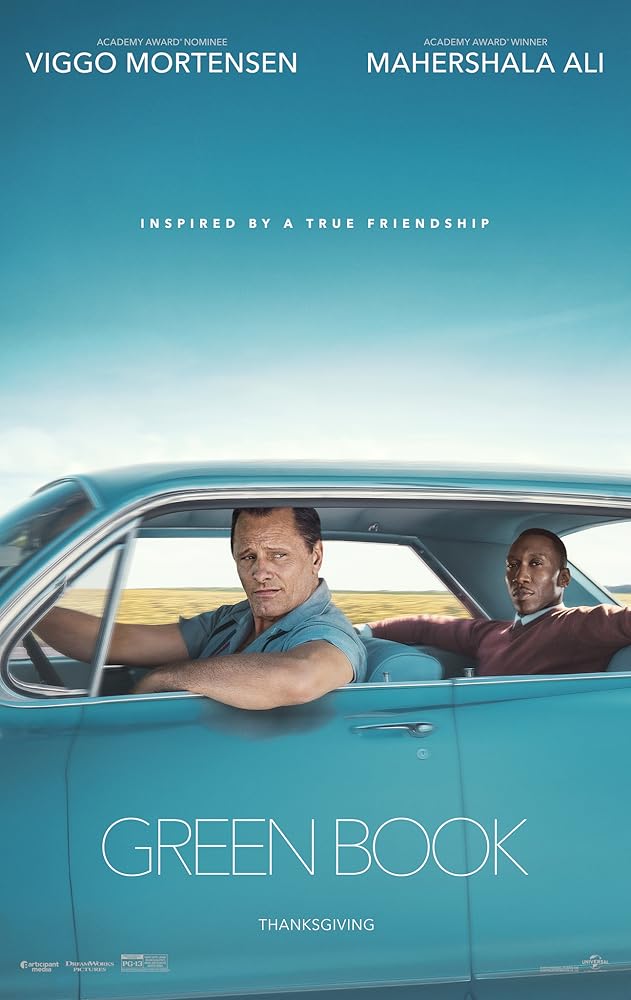
Viggo Mortensen and Mahershala Ali in Green Book (2018)
Poster (Source: imdb.com)
While the rest of America was watching the Super Bowl, my wife and I played rebels and went to a movie instead. We saw “Green Book,” directed by Peter Farrelly, which tells the based-on-a-true-story of a 1962 concert tour of the southern U.S. by black pianist Don Shirley. Mahershala Ali stars as Dr. Shirley, Viggo Mortensen plays the parochial white New Yorker who serves as Shirley’s muscleman-driver, and Linda Cardellini plays Mortensen’s wife.

Green book
Example of green book, from New York Public Library
via history.com

The Green Book referenced in the title, which as book qua book actually doesn’t factor that centrally to the plot, was a publication intended to guide black travelers around segregated America, listing places where they could shop, eat, lodge, and so forth. Many of those places depicted in the film were rather low on the amenities scale, but blacks who looked for better accommodations were putting their lives on the line. In the course of the movie Dr. Shirley was physically assaulted twice when he found himself in whites-only facilities; other occasions were merely awkward.

Mahershala Ali in Green Book (2018)
Listed in the Green Book, low on the amenities scale (Source: imdb.org)
Segregation in 1950s-60s America was by no means confined to the South. The State of Iowa, which comprises about 54,000 square miles, as of 1953 included exactly twelve places where African-Americans of that day could lodge; that year entrepreneur Cecil Reed found no place his family could stay between Cedar Rapids and Denver ("Sepia Motel" 2018, Fannon 2013). The scarcity and sketchiness of public accommodations open to blacks surely informed the public accommodations provision of the 1964 Civil Rights Act which bars discrimination on the basis of race. As with segregated schools, segregated accommodations were separate but not close to equal.
Page showing Cedar Rapids's lone entry in the 1940 Green Book
Fast forward to this decade, where a number of businesses small and large are claiming exemptions from civil rights laws protecting gays and lesbians, based on the Constitution’s guarantee of free religious exercise. In a widely-known case, the Supreme Court last June upheld a Colorado bakery owner’s religious freedom claim against the State of Colorado after the baker refused to bake a cake for a gay couple’s wedding. Four years earlier, the Court found the Hobby Lobby Corporation entitled to claim religious exemption from providing their employees insurance plan(s) under the Affordable Care Act that included contraception coverage.

I’ve been making the case on this blog that inclusion of all, on an equal basis, is a fundamental aspect of community; in our common life, there can be no second-class citizens. You can’t exclude people based on their race, religion, gender, sexual orientation, &c., &c. If you believe religiously, as people did not too long ago, that blacks are not entitled to the same access to opportunities as whites, that religious belief is twisted but protected, but can’t be applied in the public square. Exclusion from the benefits of society is fundamentally wrong.

But, pragmatically, gays getting married, or women seeking contraception, are not today in the position of blacks circa 1962. There surely are multiple bakeries in Lakewood, Colorado (pop. 147,000) that would do a cake for a gay couple; insurance companies at the time of the Hobby Lobby case seemed eager to find a work-around to keep the corporation’s hands clean. Without denying that we’re not close to full equality of all people, both gay marriage and contraception are part of the mainstream national culture today. No Green Book is necessary for anyone to find the services they need.

Viggo Mortensen and Mahershala Ali in Green Book (2018)
Outside Hawkins' Mens' Store, where things aren't going to go well (Source: imdb.org)
There still is, of course, the problem of humiliation when one finds that “we don’t serve your kind.” Ali’s character in “Green Book,” Dr. Shirley, repeatedly encounters situations where establishments that don’t display a “Whites Only” sign nonetheless serve only whites, or serve blacks but don’t allow them to use dressing rooms, eat in the actual restaurant, and so forth. It seems at the very least establishments that claim religious based exemptions from serving certain types of people make that publicly known. Then everyone would know in advance who could get served, and could make their purchasing and job application decisions accordingly. (Note: There is a bar in Cedar Rapids I won't patronize because until recently they displayed a prominent sign banning do-rags. I don't wear do-rags, but I also choose not to be associated with what smells like racism.)

I'm coming from a position of privilege on every dimension, so I'm trying to speak cautiously here. (Unfortunately, Blogger does not offer a "Cautious" font.) I think exclusion is exclusion, and it's wrong. Paint it with religion, and it's still exclusion, and it's still wrong. The conditions faced by black Americans well into my lifetime were intolerably wrong, and the provisions of the Civil Rights Act were way overdue. Could it be that the contemporary situations I referenced are... tolerably wrong?

Sunday, June 28, 2015

Film review: "Stonewall Uprising"


Friday's Supreme Court decision in Obergefell v. Hodges ruling state marriage laws cannot discriminate against same-sex couples added a special poignancy to today's screening of "Stonewall Uprising" in the Whipple Auditorium of the Cedar Rapids Public Library. The film, first aired as part of the PBS series American Experience in 2011, portrays the pivotal events at the Stonewall Inn in New York City that began 46 years ago today.

The filmmakers do their best with a paucity of archival material. Stonewall was by all accounts unplanned, and its significance appeared only in retrospect. (In 2015 The events were downplayed in New York City media at the time, and hardly reached news elsewhere. I was a young news junkie in 1969, but never heard of Stonewall until years later. I also didn't know that I was, according to the film, living in the only state in the Union (Illinois) that did not criminalize gay sex.) It is now clear that the road to Obergefell, not to mention ending the exclusion of gays from military service, began at a dive in New York's Greenwich Village.

The first two-thirds of the 82-minute documentary is spent establishing the context. It is important to remember, in these heady days for gay rights, that not too long ago the environment was very, very different. A variety of first-person recollections, mostly from gays and lesbians but including one government official (Ed Koch) and one police officer, vividly paint this picture. Homosexuality was considered an acquired preference, a mental illness and a menace to society; the choices for gays were limited to learning to act "normal," being tortured by medical "remedies," or meeting furtively in dangerous places. Exclusion from society is not only psychically damaging, it can be physically dangerous.

The last half hour discusses the events themselves, and their aftermath. Police had stepped up raids and other enforcement mechanisms, because--well, because there was a mayoral election campaign, and the incumbent administration was looking to score political points. (The film does not neglect the awful and terrifying position in which the police found themselves, and really, I think someone could do a documentary on how police officers get stuck being the enforcers of bad public policy.) The main theme, though, is that after years of being pushed around and chased and beaten up, something snapped among the gays in the bar and eventually in the surrounding neighborhood, leading to several days of clashes and vandalism.

Finally, the film makes the case for the pivotal importance of Stonewall. Between the protests, and the city's first gay pride parade exactly one year later, there was a flurry of organization that built upon the shared outrage they had discovered in June 1969. They leave off at the parade in 1970, but the arc that led to wholesale change in American public opinion and law is clearly implied. Divisiveness can stoke political passions, and may continue to do so for a long time (see Hudak, cited below); this tide that turned in 1969 appears unlikely to recede.

By 2015 it seems obvious, or should, that wherever possible inclusion is better than exclusion: it makes communities stronger, it allows us to put our energies into building things other than walls, it is consistent with the American constitutional value of individual rights--and for what it's worth, the Christian gospel as well--and it allows gays and lesbians (or whoever we're talking about) to live within the constructs of society. We progress toward this goal, but sometimes we get sanguine and then we forget. Films like "Stonewall Uprising" help us remember where we've been, where we're going, and why we're going there.

OTHER STUFF

Robert Barnes, "Supreme Court Rules Gay Couples Nationwide Have a Right to Marry," Washington Post, 26 June 2015

Harry Enten, "The GOP May Regret Its Lasting Battle Against Gay Marriage," FiveThirtyEight, 30 June 2015

John Hudak, "On Obamacare & Same Sex Marriage, the GOP Wins Big," FixGov, Brookings Institution, 26 June 2015

David Ignatius, "Resisting the Gay Marriage Ruling Would Be a Losing Battle for the GOP," Washington Post, 1 July 2015

Jacob Lupfer, "Tears of Joy, Tears of Sorrow, and Little Empathetic Listening," Century Blog, 30 June 2015

"Stonewall Uprising," American Experience, Public Broadcasting System (2011)

Saturday, March 1, 2014

Strength through diversity

(William of Rubruck, swiped from medievalists.net)

Arizona's Republican governor, Jan Brewer, this week vetoed a bill that would have allowed commercial establishments to refuse service to gays and lesbians. The veto was urged by the Arizona Chamber of Commerce, which feared the potential economic consequences if tourists and businesses carried through on threats to boycott the state if the bill became law (which is not to suggest that was their only consideration). The last two Republican presidential candidates, Mitt Romney and John McCain, also weighed in against it. Former Bush press secretary Ari Fleischer suggested "This bill instinctively struck people as a violation of individual liberty... The notion that because of your orientation or your religion that you can be denied food service because of someone else's sincere religious belief went too far" (Quoted in Adam Nagourney, "Arizona Bill Stirred Alarm in the G.O.P," New York Times, 28 February 2014, A11, A16).

Brewer won election in 2010 riding a wave of resentment against a variety of groups. The famous crackdown on illegal immigration was accompanied by other laws aimed at non-Anglos, including restricting the official use of languages other than English and the teaching of Mexican-American "ethnic studies" in public schools. (Yet another bill, ending state recognition of "birthright citizenship," was ultimately defeated by the Arizona Senate in 2011.) She is now having trouble reining in these emotionally satisfying but contentious moves. Wednesday she chided her fellow Republicans in the legislature for focusing on hot-button issues instead of her budget and administrative agenda (See Fernanda Santos, "Day After Veto, Arizona Takes Up Abortion Clinics," New York Times, 28 February 2014, A16).

To conservative consultant Nelson Warfield, quoted in Nagourney's column, supporters of the latest Arizona effort were doomed by how the issue was framed. "It became about human rights and human dignity and not religious conscience. As soon as it shifted from a debate about religious conscience to a respect for human dignity, it was a loser." The rhetorical use of religious freedom must be taken seriously, as this is a core American value... even when it's used as a tool for 'in' groups to use against 'out' groups. If the essence of free expression is "freedom for the thought we hate," don't we have to tolerate intolerance? Taking the thought to action, does that mean there is a religion-based right to discriminate?

I like rights, but am concerned that their assertion stops conversations. Sometimes there are conversations that should be stopped, like whether blacks should have the right to vote (1965), but a lot of times we wind up asserting and counter-asserting when we should be discussing. This applies today to a wide swath of issues related to meaningful inclusion a.k.a. the accommodation of diversity.

The importance of inclusion to excluded groups can't be difficult to see. The pursuit of happiness proclaimed as an inalienable right in the Declaration of Independence is an empty promise unless there is full access to the benefits and opportunities of membership in society. Suffrage is pretty close to universal in America today, but many people live in ghettos physically cut off from economic opportunity. Many people materially suffer because, in the words of Greg Brown, "the color of your skin or who you choose to love" don't match the ideal of the established in group. Now if one crotchety baker doesn't want to make me a wedding cake, I can always go to another baker, but if this is systematically happening it's clear I am not a full and equal member of society. And that feeling matters too.

There are also advantages to society as a whole for accommodating diversity. William of Rubruck, pictured at the top of this post, was a Dutch monk whose 1253 journey to the Mongol Empire made the remarkable discovery that the Khan's strategy for holding his great empire together and maintaining its strength was to tolerate and even encourage a variety of languages, customs and religions.

  1. First, you draw on a broader base of talent. The victory of the basketball team from Texas Western over the all-white team from Kentucky in the 1966 NCAA championships was a pretty clear message (and not the first, either) that racist societies that excluded talent were handicapping themselves. This is borne out by Richard Florida's "gay-bohemian index" correlating with local housing values: communities that value diversity are more energetic and ultimately more successful. 
  2. Secondly, you don't spend scarce resources keeping people separated or away. Keeping gated communities gated, and "gated communities of the mind" safe from new ideas, sucks up energy and resources that could be better spent innovating solutions and improving quality of life.

To torment an old metaphor, this is the "salad bowl" vision of diversity, not the "melting pot." The melting pot concept dates from the 19th century, the idea being that America could draw immigrants from far and wide but they had to learn how to be Americans before they could fully play (and we who were already here would be the judge of that). Maybe it's because I like food better than candles, but I see advantages to a society that celebrates difference and draws on a variety of flavor contributions to one based on conformity.

Which brings us to the question I was stuck on last July: "Are there practical consequences for drawing the circle too small? If some part of a city or metropolitan area isn't flourishing, does that materially impact the rest of it? If Detroit is dying, does that affect Grosse Pointe? Does it [harm] the rest of Cedar Rapids if people in Wellington Heights or the Taylor Area aren't thriving?"

Where I'm stuck, and would like some help from the blogosphere, is what the advantages are for the currently-enclaved to leave their enclaves and join the rest of us. Maybe they should want to, but why would they want to? I have some thoughts on this, but they're not fully formed, and anyhow this post has gone on long enough, so I think I'll let this question hang.

Tuesday, February 11, 2014

A quick thought about Michael Sam


  (Missouri's Michael Sam, swiped from autostraddle.com)

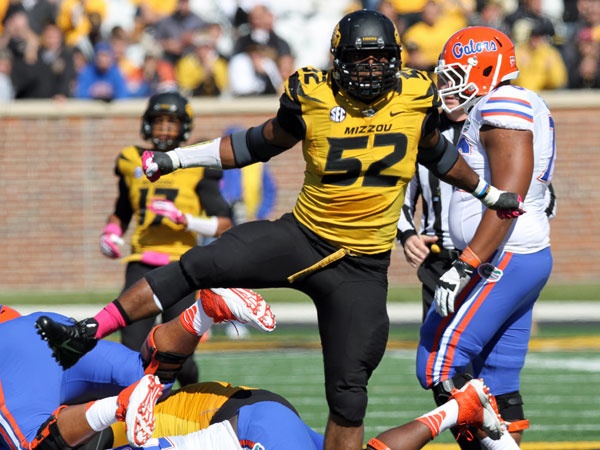
Michael Sam is, by all accounts, an extremely talented defensive lineman from the University of Missouri who is set to enter the National Football League (NFL) draft. Though his Tiger teammates had known for quite some time, he has just "come out" and would be the first openly gay NFL player. I saw a lot of coverage of this issue last night over the heads of my dinner companions, because the TV was on in the restaurant and I have the problem of being completely unable to ignore a television.

(I remember a member of the 1970s San Francisco 49ers, David Kopay, was gay. Did he come out after his retirement?)

As the TV reported reactions from his former teammates, the NFL players' union, and current NFL coaches that it seemed to me that the coverage was driven only in part by the novelty factor which must be endured by the "first" anything (although Janet Yellen being the first woman to chair the Federal Reserve Board is getting a lot less attention). Isn't there something of an expectation that professional athletes will be anti-gay? That stereotype was never openly stated but was nonetheless there in spirit.

Dealing with diversity is one of the core challenges of living together in the 21st century. Some of us need to get over our stereotypes of and prejudice against homosexuals. Some of us need to get over our stereotypes of and prejudice against professional athletes.

SEE ALSO: L.Z. Granderson, "Michael Sam a Novelty? Not Really," ESPN.com, 10 February 2014, http://espn.go.com/nfl/story/_/id/10429956/michael-sam-novelty-not-really

Friday, June 28, 2013

Jesus wept


When former Arkansas governor and presidential candidate Mike Huckabee heard this week that the U.S. Supreme Court had struck down the 1996 Defense of Marriage Act as unconstitutional, he says his first thought was "Jesus wept."
Dear Friends,
My immediate thoughts on the SCOTUS ruling that determined that same sex marriage is okay: "Jesus wept." Five people in robes said they are bigger than the voters of California and Congress combined. And bigger than God. May He forgive us all.

The quotation referred to John 11:35, which happens to be the shortest verse in the Bible. It is the bases for a lovely round by the American composer William Billings (1746-1800) and here performed by the Hastings College Choir:


In the passage from the Gospel of John, Jesus weeps at the death of his close friend Lazarus. Weeping doesn't necessarily make sense, given that Jesus then proceeds to raise Lazarus from the dead, but  we can infer that Jesus was weeping at the human condition.* Yes, there is much joy in life, but there is sadness, too: death, separation, disease, suffering, blighted potential. We are dust, and to dust we shall return, and even with the promise of the resurrection that's still enough cause to weep sometimes. If we expand our scope from the verse to its context, it's clearly not about rule-breaking, it's about compassion. 

And if we expand our scope from the story to the whole gospel of John (or any other gospel), we find pretty much the same thing. Jesus's statements, and his actions, commend to us "positive morality" i.e. actively doing good to others. There are few commands not to do things, and for that matter very little condemnation... with the notable exception of the powerful religious leaders. The point is that Jesus is not weeping because a traditional rule is broken. He broke a few himself, harvesting food and healing on the Sabbath, and regularly challenged the religious hierarchy of his day. Jesus is not weeping at the inclusion of an excluded group. He included, relentlessly and radically, dining with tax collectors and conversing with the Samaritan woman at the well. If Jesus wept at the DOMA decision, he was weeping, along with so many others, tears of joy.

*-I can't remember to whom I owe this insight. I thought it might be my Pastor Gayle Wilcox, who preached on the death of Lazarus March 3, but upon re-listening I realize she had a different message. It's a good sermon anyway.

Coffeeneuring Challenge 2026

  The leaves say: It's time for Coffeeneuring! What's the secret to our success? I say it's the autumn appeal of low-key two-whe...