Showing posts with label Congress for the New Urbanism. Show all posts

Wednesday, May 13, 2026

CNU 34 Diary: Northwest Arkansas

people walking towards building topped by a smiling yellow ball
Hi from the town with the big friendly ball!
Which smiles as it watches, and floats above all

Wednesday, May 13, 2026

I don't know what it must have felt like for a medieval peasant to visit Rome, but I am in a similar position at the 34th annual Congress for the New Urbanism. Wal-Mart, the enormous conglomerate where many Americans shop, is headquartered here, the longtime home of founder Sam Walton. The Waltons and their fellow townspeople have used all the money we've sent here over the years to build a place that--surprise!--looks nothing like a Wal-Mart.

Jane and I arrived about 6:00 this evening after an all-day drive from Iowa. I psyched myself up on the way listening to John Simmerman's Active Towns interview with Michael Bruntlett about bike infrastructure development in China.

The conference had already kicked off yesterday, and today featured a day of panels and activities in Fayetteville, about 25 miles south of here. That included the keynote address by economist Raj Chetty. However, I am used to traveling to the conference on Wednesday, and did not make the necessary adjustments. Coe College has just finished its spring semester, and I only got my grades in Monday; I'm not sure I could have gotten here sooner, but next year I'll try to adjust myself to the conference schedule.

We're staying at the 21C Museum Hotel on A Street, which is closed to traffic. We spent the evening walking around downtown, which is exactly as advertised, if more pricey than a simple Arkansas country town. 

cars and stores on downtown street
Main Street, downtown Bentonville

There are a ton of bicyclists of all ages, maybe particularly on a night like tonight, which was incredibly lovely.
glass building with trail zigzagging up the side
People even ride up the Ledger building!
The streets are narrow, and cars drive slowly, and they yield to pedestrians. The public library is spacious and well-stocked, including a copy of Paved Paradise by Henry Grabar. 

book stacks and people
Children's section, Bentonville Public Library
The chess club was hosting a large number of matches in the park by the county courthouse. We found, for the second year in a row, some outdoor dining to start our visit to the host city.

outdoor dining tables in front of two story brick building
Al fresco dining at Tavola Trattoria

Tomorrow, I will start the serious business of this conference. First, I need to find where, among numerous sites scattered across several Northwest Arkansas towns, I check in and get my name badge.

row of vehicles all sticking out from their parking spots
Bentonville, like all towns, suffers from vehicle gigantism

Thursday, May 14, 2026


Urbanists wait for the venue to be opened
The strain of a multi-venue conference showed early today. Fayetteville got breakfast at the Graduate Hotel and information on where to get badges; Bentonville got neither of these. We waited outside the locked First Baptist Church, pelted by canned Christian pop, until 9:15. (The first round of panels began at 9:30.) Once in, I was directed to another building a block away to get my badge. All in a day's adventure, though. 

The highlight of the morning was meeting Lydia Fletcher, whose firm is in charge of public relations for the conference. She needed to get in to get set up, and told me how she would accomplish that by talking to people, what they would say and how she would respond. And lo, it came to pass exactly as she had foretold. She apologized for not getting me in as well, but I was okay just to watch a truly badass woman at work. She also recommended Ozark Mountain Bagels for breakfast, which proved to be very good.

This afternoon I went on a bike tour of the city. I knew it was a serious bike tour because John Simmerman was making a video for Active Towns, my first CNU bike tour to receive his imprimatur since Charlotte in 2023.
speaker David Wright recorded for video by John Simmerman
John Simmerman recording David Wright of
the City of Bentonville
Our tour took us on the Razorback Greenway, which runs through the Walmart campus.
Walmart campus, Bentonville
It is truly a beautifully landscaped campus. The trail runs through rather than around it, because corporate hoped to encourage 10 percent of their employees to ride to work. I had a real medieval-punk-at-St.-Peter's-Basilica moment. It's hard to connect all this beauty and philanthropy to the footprint of Walmart stores around the country.
vast parking lot, Marion IA
Marion IA Walmart, Black Friday 2024
Other highlights from the tour:
pink metal art that look like pigs' ears
These speech bubbles on the A Street Promenade (which opened in
October 2025) are among 322 works of art in the public
realm of Bentonville
Town Branch Apartments, 300 SE D Street
Town Branch, mixed use trail oriented development:
oriented to the trail not the street
construction site, 500 block of SW 8th Street
Under construction: Future AI-focused university at
the former Walmart campus site

outdoor semi-sheltered coffeeshop in a forest
Coffeeshop in the woods;
Airship Coffee at Coler
I also attended a panel on transect-based zoning featuring the planning directors of Bentonville and Rogers, and a main stage talk, "Building Places People Love," featuring veteran urbanists Matthew Lister (Gehl-Americas) and Carol Coletta (Bloomberg Center for Public Innovation). At the book sale run by Underbrush Books, I bought Palaces for the People by Eric Klinenberg (Broadway, 2018), who's speaking tomorrow, and Building the Cycling City by Melissa and Chris Bruntlett (Island, 2018). And Jane and I briefly stopped by the reception honoring the imminent publication of Art of the New Urbanism volume 2 (Wiley, 2026). 


Friday, May 15, 2026

people milling about at event space
Closing party at the Momentary
There are still some things going on tomorrow, but the curtain rang down on CNU 34 this evening in the form of the closing party at the Momentary, a contemporary art museum that also boasts an event space, the RODE House.

This morning, we had the closing keynote, presented by Eric Klinenberg of New York University, author of Palaces for the People, which I'd just bought yesterday.
Eric Klinenberg on stage with microphone
Eric Klinenberg at First Baptist Church,
resisting the temptation to perform a drum solo
He talked about the value of playgrounds as a lead-in to advocating consideration of social aspects of infrastructure projects. He's not the only one to notice that America (and much of the West) is in a very dark place right now. As much as we need to modernize water management in an era of routine torrential rains, we also need places that bring people together in order to build community life. Otherwise, we are more likely to "hunker down" in private spaces, which exacerbates social tensions. For example, in addition to pipes that can be overwhelmed by even a couple of inches of rain if they come too quickly, we can benefit from "softscape" like parks and community gardens to "hold" the water until the pipes are ready for it, as well as revitalizing the civic culture while they do it.

He concluded by urging practitioners to "make every project you do work as social infrastructure."
Crossing SE D Street on our walk:
Note the grassy median on 8th Street,
not unlike Mount Vernon Road in Cedar Rapids
From there I went on a walking tour of SW-SE 8th Street led by people from Toole Design, the City of Bentonville, and Walmart. 8th Street has in a very short time become a ferocious stroad, which despite separated bike lanes and sidewalks is not a very comfortable or pleasant place to be. They discussed further infrastructure initiatives, like a new Gateway Park west of I Street with "iconic" bridges across 8th; various ways of reducing conflicts at the intersection with Walton Boulevard; and a "greenway hub" of arts spaces, small shops and cafes across from the Momentary along SE G Street. The tour ended at the Walmart campus, where I was yesterday.
cyclists and walkers on cement path going under bridge
The Razorback Greenway runs through the Walmart campus
I also attended the Chapters Networking Breakfast this morning, where I sat with members of the Minnesota and Wisconsin chapters. Minneapolis will be next year's host city!

Saturday, May 16, 2026

people walking on closed street between farmers' market tables
Fayetteville Farmers Market
To wrap up this year's CNU, a number of speakers presented ideas and fielded questions at the Fayetteville Town Center, just off the square where the Saturday farmers' market was going on. The local urbanism dial was set on MAX.
Joe Minocozzi at the podium
Joe Minocozzi at Fayetteville Town Center

I happened by just as Joe Minocozzi was beginning his presentation. Minocozzi is the founder of Urban3, an Asheville-based consulting firm that helps cities understand and take control of their finances. He's best known for promoting the measurement of taxable-value-per-acre, which puts efficient productivity ahead of sheer size in terms of value to the city. I've used the concept to analyze local issues, such as here and here and here. Today's was an excellent, accessible introduction to the idea, with detailed application to Northwest Arkansas. After the talk, I ran into some friends who love Minocozzi's work, and we commiserated about how difficult it is to get people in and out of local government to accept it. Is it mathphobia? Entitlement? Exceptionalism? I'm going back to a city that is over the moon about our new data centers and the casino.

This conference was a novel approach to CNU. It will be interesting to read and hear people's reflections on regional urbanism, and how it will affect our meeting in Minnesota next year. Since I spent most of my time in Bentonville, I can say that I love a lot of what they've done, but will have trouble drawing many lessons for Cedar Rapids. Bentonville reminds me more of Naperville, Illinois, where I went to college and spent some time after that. Naperville is an upper-middle class exurb, very wealthy, very clean, without a lot of the problems that bedevil cities. Everyone faces limitations at some level, but Bentonville, like Naperville, can do a lot before they hit those limitation. And they can afford to be bolder because mistakes will be less catastrophic.

At the same time, Bentonville had to seek new ways of doing things because of growth pressures, and because Walmart demanded action when it was having trouble competing for talent with places like Seattle and the San Francisco Bay area. Cedar Rapids, whose 2025 Census estimate is exactly 193 souls larger than its 2020 population, faces neither growth pressures nor a sense of urgency to change our way of doing things. 
Ashleigh Walton
Ashleigh Walton, incoming CNU president

LAST YEAR'S POST: "CNU Diary 2025: Weekend in New England," 11 June 2025

SEE ALSO: 
Robert Steuteville, "Urbanists in the Land of Walmart," Public Square: A CNU Journal, 15 May 2026

Wednesday, June 11, 2025

CNU Diary 2025: Weekend in New England

street banner commemorating CNU
This way to the party!

Wednesday, June 11

The 33rd Congress for the New Urbanism is underway, this year in Providence, Rhode Island, which makes three new cities for me in three years! Jane and I flew in this afternoon, took transit downtown to our hotel, and joined the assembled Urbanists briefly at the Opening Party at 195 District Park before retreating for a quiet dinner.

The bus was express between the airport and downtown, or as express as could be during rush hour. I had dutifully downloaded the RIPTA Wave app and put money on it, but found it very difficult to use on the bus. The QR code for my "virtual card" kept disappearing! Eventually the driver waved me on. As someone who has used transit in a variety of cities, I think it should be a lot more intuitive to use.

Not an auspicious start to the conference, but fortunately I don't believe in omens.

chaotic scene at 195 District Park
Oodles of urbanists!

The Congress Tavern, 62 Orange Street
The Congress Tavern (est 1933): Dinner al fresco on a quiet street


Thursday, June 12

CNU President Mallory Baches, screen showing CNU charter
CNU President Mallory Baches rang in the conference 
by recalling its first principles

Today's walking tour celebrated the extensive work in downtown (a.k.a. Downcity) Providence done by Cornish Associates. Since 1999 they have rehabilitated 17 buildings, creating 438 apartments, while retaining about 275,000 square feet of commercial space.
people touring a vacant apartment, with a lot of light from a big window
Inside #312, the only vacant unit out of 97
at 239 Westminster Street (built 1873, rehabbed 2005)
replica department store display with table and place settings
Lobby display honors its past as a department store

Green roof at 239 Westminster Street,
"the centerpiece of our downtown portfolio"

186 Union Street, apartments with first floor retail
186 Union Street, another in the Cornish portfolio


80 Washington Street, with historic sign

Nightingale building, 100 Mathewson Street
The Nightingale, 100 Mathewson Street, occupies most of a city block
 and includes 143 apartments and a Japanese deli on the first floor

As a result, downtown Providence has some great streets.
shops along 200 block of Westminster Street
200 block of Westminster Street

To think this could all have been bulldozed 60 years for "urban renewal." Happily for us, Providence in the 1960s lacked the money needed to execute their plan!
In Downcity branded hand fan
One of Downcity's many fans!

At the end of the tour, Cornish founder Buff Chace wondered if there really could ever be a playbook for new/small developers such as they used to be. He described their developments proceeding with a lot of "Band-Aids and glue," and while outside financial capital and historic tax credits certainly easier to get, city politics may be no easier to navigate. They are currently being sued by the City of Providence over a deal with a previous mayor to tax their apartments at a lower rate than the standard commercial property tax charged to all downtown properties.

The day began with the keynote address, shared by architect Carl Elefante of Quinn Evans and Shin-pei Tsay, who heads the City of Boston's Office of New Urban Mechanics. They struck the optimistic notes the Congress needed, while reminding us of the continued challenges before us. Elefante proclaimed a "relevance revolution" in the 21st century, where "every problem and solution is related to urban form.... We have to accomplish it, or we're going to have problems." Tsay noted the recent creation of her position was in response to the complexity of city policy making in the face of climate, economic, public trust, and justice challenges. 
slide from Tsay's presentation showing complexity of urban problems
slide from Tsay's presentation

Moderator Matt Lambert, chair of the CNU Board of Directors, tried to steer the conversation towards the chosen theme of metropolitan coherence, while quoting "a guy in a blue blazer" at last night's cocktail party: CNU has never been about grand slams; it's about bunts and singles.

I also attended a panel on walkable redesign presented by Celeste Frye and Melissa Lee of Public Works Partners. They discussed projects from three different towns in New York. I found myself in a small group with urbanists from New Mexico and Texas, who marveled that they were able to work so productively with the state Department of Transportation. I wonder if they were able to sell their projects to the public because the public already felt pressed by an influx of population. Neither Cedar Rapids nor Santa Fe is so pressed, and San Antonio accommodates their new residents by sprawling.

In the evening we attended a reception honoring the publication of The Art of the New Urbanism...
Victor Dover at podium, picture of people cavorting on a lawn
Victor Dover speaks before a picture from the book

...before Jane and I headed to another quiet dinner in lieu of the CNU pub crawl.

Friday, June 13

This is my third in-person CNU, and at each one I've done a bike ride. This year's ride was unusual because it was less about infratstructure than about development, specifically development in Olneyville, a historically poor neighborhood of Providence that long ago hosted a vibrant milling industry.
neighborhood and ward map of Providence
Olneyville is the darker part of Ward 15;
the conference is in the lighter part of Ward 1

The tour was hosted by Kurt Teichert...
Kurt Teichert
...senior lecturer at Brown University's Institute for Environment and Society. Maybe two dozen of us rode along.

Because of the tour's focus, we spent a lot of time on streets. Hence it was the most awkward of the three rides, in terms of interactions with motor vehicles. We did sample the lovely Greenway along the Woonasquatucket River.
trail sign among trees by Riverside Park
trail sign by Riverside Park

Recently constructed, one of the trail's objectives was to connect nondriving Olneyville residents to jobs downtown, though (just like Charlotte) that final step is still in process.
bikers in red bus and green bike lanes
on-street bike and bus lanes, downtown

Providence Mall, with bike ramp at left
awkwardly twisty ramp by Providence Mall
building under construction, bikers taking pictures
redevelopment of former steel factories

view of river from trail across grass and trees
Woonasquatucket River from trail

Woonasquatucket River Trail by Donigian Park
Woonasquatucket Greenway by Donigian Park
(formerly dubbed "Needle Park" but has benefited
from infusion of investment in the area)
The Greenway occasionally is linked by regular streets, creating some awkward intersections.
Delaine Street at Manton Avenue

Development in Olneyville has not created large-scale gentrification, but there are nonetheless contested spaces, such as the Atlantic Mills Space, which currently hosts artists and small businesses, as well as meetings of the Olneyville Neighborhood Association...
The Atlantic Mills, 120 Manton Ave
The Atlantic Mills (built 1863), 120 Manton Ave

..., but maybe not for much longer as we heard from the president of the tenants' union.
tenant protest signs in windows at The Atlantic Mills


grassy park with blue dam at edge
dam at Riverside Park has a fish ladder,
sadly rendered inoperable by 2024 storm

small gray houses with slant roofs
affordable housing constructed on Sheridan Street
by the Greenway

interior room, Center for Resilience, 249 Menton Avenue
interior, Center for Resilience, 249 Menton Avenue,
serves as Olneyville community center

Joslin Playground, 60 Kossuth Street
soccer game, Joslin Playground, 60 Kossuth Street

Once back from the bike trip, I checked out Bolt Coffee...
Bolt Coffee, 61 Washington Street
Bolt Coffee is in another Cornish development

...where I met one of my fellow bikers who is from Detroit. I bought The Nature of Our Cities (Mariner, 2024) and The Art of the New Urbanism (Wiley, 2025, mentioned above) at the Symposium Books shop--expect reviews soon!--and attended a panel on entrepreneurship featuring four owners of small consultancies, hosted by Mike Lydon, author of Tactical Urbanism. Then I heard Jonathan F.P. Rose, author of The Well-Tempered City (Harper Wave,2016), give the day's closing keynote.
Jonathan F.P. Rose speaking to CNU

Rose has something of the futurist about him, and his call for innovations and "big vision" to prepare us for the future had some jargon to it. He called at a couple junctures for systems of mutual aid and mutual support to emerge as insurance and federal assistance are exhausted.
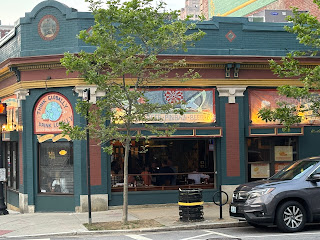
exterior, Trinity Brewhouse
Trinity Brewhouse: We were seated just inside
that window

In the evening we went to a meetup at Trinity Brewhouse cohosted by CNU Midwest, CNU Michigan, and CNU Ontario. We met a bunch of people from Ohio, so it was good I had Jane (who lived her first 22 years in the Buckeye State) with me.

Saturday, June 14

No Kings Day protestors in front of the Rhode Island State House
No Kings Day protest at Rhode Island State House,
looking from Smith Street

Today America's narcissistic and very anti-urbanist President hosted a military parade down Pennsylvania Avenue in Washington, D.C., at a cost of nearly $50 million, not counting streets that will have to be repaired, inconvenience to residents, and the military's embarrassment at being dragged into a political stunt. This, along with the assassination of a Minnesota legislator and her spouse last night, the assault on U.S. Senator Alex Padilla (D-CA) by a Cabinet member's security detail, and masked marauders preying on Hispanic workers, make it look like the day of "might makes right" has arrived in America.

Happily, hundreds of No Kings Day protests were organized around the country, including one at the Rhode Island State House, a short (though not easy) walk north of the conference site. We milled about among the crowd, which must have numbered in the thousands, and which was cheerful and peaceful throughout. Americans are going to be a long time repairing the damage Trumpism has done to our communities, but I'm encouraged by the spirit I saw today.
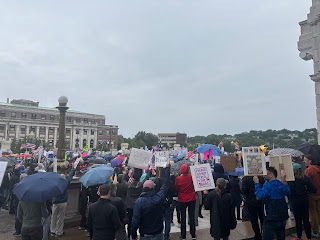
No Kings Day protestors
View of the crowd from next to the State House

Speaking of restoring communities, I started my day at the morning main stage talk shared by Erin Barnes of Main Street America and Mindy Fullilove, a social psychologist and author of Main Street: How a City's Heart Connects Us All (New Village, 2020). Both acknowledged widespread public pain, while commending creative community-building efforts of all kinds. Then I attended a panel reporting on efforts in New Orleans to reconnect Claiborne Street, part of which was yawmped by I-10 back in the day, resulting in damage to the mostly black community, public health, and history.

Jennifer Hurley with microphone on stage
Jennifer Hurley, incoming CNU board chair, at the closing session

The conference rang down with a late afternoon closing session looking back on this gathering, and looking forward to next year, when CNU34 will be held at various sites around Northwest Arkansas. That region includes Bentonville, home of Wal-Mart; Fayetteville, home of the University of Arkansas; and I trust Springdale, home of the Northwest Arkansas Naturals baseball team. It should be an unusual CNU: representatives from that local committee noted that it's not a traditional city, and is heavily auto-dependent. (Their promotional video showed three giant parking lots in the first minute!) So despite impressive rates of population growth, they invite some urbanist wisdom. Of course, Holy Mountain will be on the scene with all the news as it happens.


SEE ALSO: 
Addison Del Mastro, "Participating in the City or Consuming It?" The Deleted Scenes, 16 June 2025
Robert Steuteville, "Landmark Plan Guides Downtown Revival," Public Square: A CNU Journal, 5 June 2025

LAST YEAR: "CNU Diary 2024: Restorative Urbanism," 15 May 2024

The Value of Incidental Contacts

  Incidental contacts can happen on sidewalks, but only if there are people going places Places like the Stroget [in Copenhagen] carry an in...