 |
| $185,000 bought this house five blocks from me |
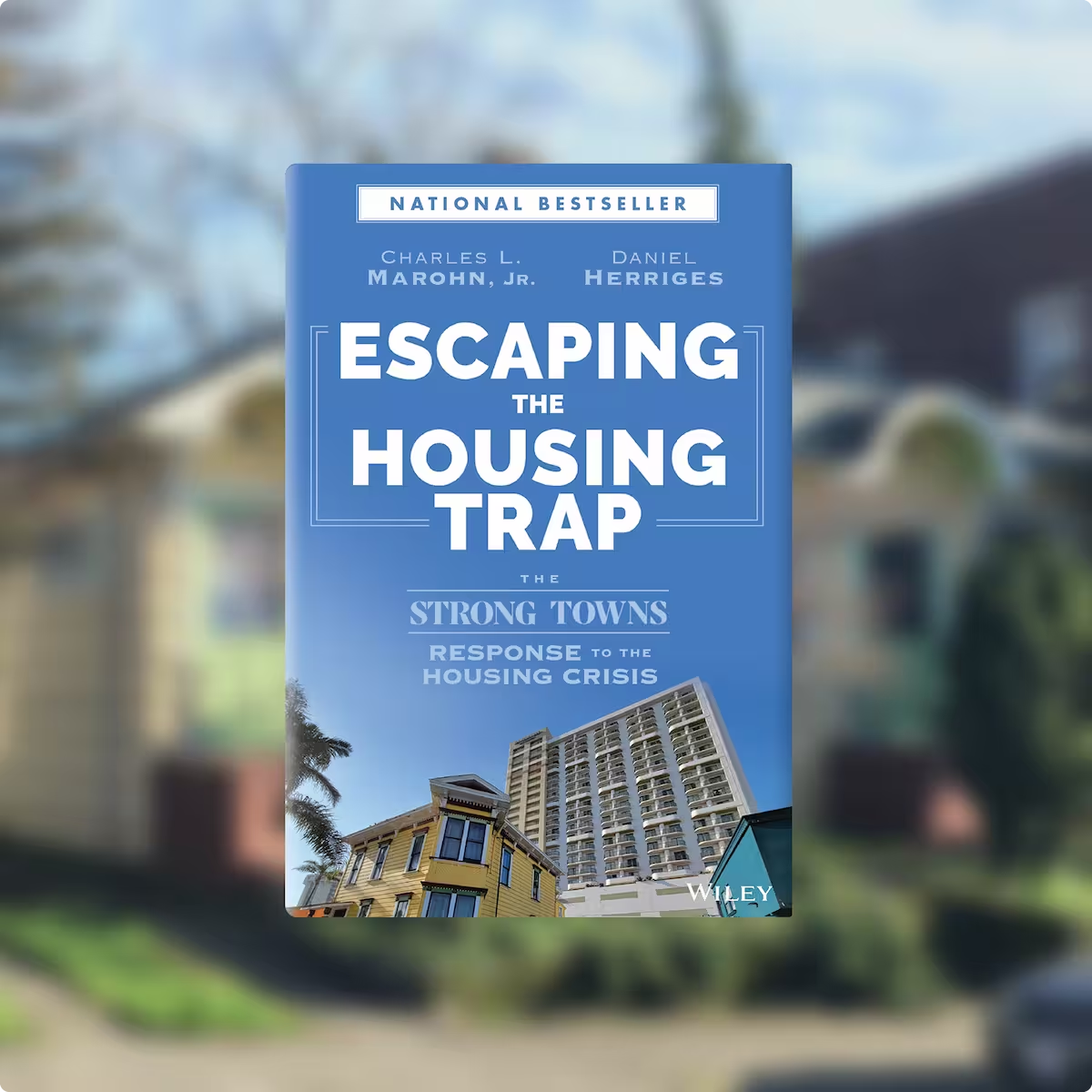
Charles L. Marohn Jr. and Daniel Herriges, Escaping the Housing Trap: The Strong Towns Response to the Housing Crisis. Hoboken NJ: Wiley, 2024.
(8/25/2026) This fall I'm part of a local group that has decided to take on the housing crisis in our town. There's one in every town, of course, and the precise nature of the crisis varies all over the place, with Cedar Rapids somewhere in the middle of that spectrum. Our group will benefit greatly from people like the authors of this book who have thought seriously about problems in housing, can explain their origins and nature in everyday language, and are optimistic about our ability to improve the situation in our communities. At least it has motivated me to read this third in a series of Strong Towns books! (See links to previous reviews below.)
The most recent measure of the Case-Shiller Index of U.S. home prices was 331.020 in May 2026, which means that, taking into account overall inflation as well as typical seasonal variation, the average home price this year is more than 3.3 times what it was in January 2000. Housing prices been rising steadily since early 2012. Rising home prices are good, say Charles Marohn and Daniel Herriges, for three types of people: individual homeowners, for whom the value of their house is a major investment; governments at all levels, which can tax the increasing value and/or economic activity that it produces; and investors in funds that have great piles of money tied up in housing. As a result, though they say "they want housing to become more affordable," they want/need it to happen "without prices going down" (p. 6). Part I of Escaping the Housing Trap describes how housing has become a major investment--perhaps the major investment for most Americans: a perfect storm of zoning and construction standards, suburban development, and innovative financial instruments, with government backstopping when it all goes blooey. "In the 2020s, national too-big-to-fail banks seek long-term mortgages from fragile homeowners" so "there will always be a coordinated effort to reinflate the housing market. There must be; if the housing market fails, the financial system fails" (p. 70).
They also do a good job of explaining why all the new buildings have empty retail space: cutting rent so businesses can afford to move in would negatively impact the value of the building. It's more financially advantageous to keep the space vacant than to rent it at what the market will bear (p. 68).
 |
Commercial space in New Bohemia and Czech Village has been filling up,
even first floor retail in this "three-over-one"...
|
 |
...but time will tell how long it takes this newcomer
to fill its retail space |
Part II looks at how the housing system affects those outside of it: renters, including those who would like to own their own homes, those in unstable housing situations, and those who are stuck in houses that are too much for them. Zoning and the financial system work together to prevent construction of missing middle housing that could be more widely affordable and a good investment (ch. 5, on zoning lockdown), and opposition to new construction is political powerful in towns across the country (ch. 6, on the NIMBY phenomenon). But even well-intentioned policies to expand access to housing fail to make a dent. They run up against the same obstacles that individuals in the housing marketplace have met: "The very same problems that bedevil the effort to get abundant, affordable market-rate housing to exist are going to make it hard to deliver affordable social housing at any sort of scale" (p. 145).
 |
| $100,000 will get you four blocks from me |
By now they have our attention, and we're anxious to hear what might be able to break the housing logjam in any sustainable, scalable way. Bring on Part III!!
It does not disappoint, unless you're looking for a slam-dunk solution, which they (and the Strong Towns organization) avoid like the plague. They do propose a new approach to housing, because any existing approach leads to one or more of the following intolerable outcomes: inability to provide much affordable housing, lowering existing property values, vulnerability to capital flows especially outflows, and/or adding to already-high local government liabilities (pp. 153-156). They recommend an approach that (1) focuses on "the people who aren't well-served by today's limited housing offerings," by (2) filling "the demand for low-cost, affordable units" with "the resources that are available locally" (p. 156). That means, while "no neighborhood can be exempt from change" (pp. 156-158), at the same time "no neighborhood should experience radical change" (pp. 158-159).
There are a lot of supporting ideas in the remaining pages, centering around enabling and relying upon a "swarm" of small developers who don't need economies of scale to succeed (ch. 10), and shifting the financial paradigm by insisting that every development be self-sustaining (ch. 11). That means gradually "thickening" existing neighborhoods: more "starter" homes on smaller lots, and more small multi-family units ("missing middle housing"). They key to the approach is not plug-and-play what worked in, say, South Bend, Indiana (pp. 167ff.), but to take small steps cautiously and flexibly.
Their argument is hopeful, accessible, reasonable, and done with integrity. There are surely weaknesses in it, but in the final analysis we must and can do better than keeping on with an approach that is spectacularly failing, even in relatively low-cost cities like Cedar Rapids.
 |
| (Source: strongtowns.org) |
SEE ALSO:
"Book Review: Confessions of a Recovering Engineer," 8 December 2021
"Strong Towns' Bottom-Up Revolution (V)," 5 April 2020 [with links to earlier essays in the series]
Joe Cortright, "Why America Can't Make Up Its Mind About Housing," City Observatory, 16 May 2017
Shane Phillips, The Affordable City: Strategies for Putting Housing Within Reach (and Keeping it There) (Island, 2020)
Pete Saunders, "It's Not an Affordability Crisis; It's a Misalignment Problem," Corner Side Yard, 19 August 2026
Angie Schmitt, "Without Changing Our Retail Model, We're Never Going to Get Walkable Cities/ Neighborhoods," Love of Place, 24 August 2026


