Bus, one of a number of games from Perplext that come in two-inch tall boxes, is a fast-playing affair with an approach to public transit that is unlike any city I've ever visited. The prophet Jarrett Walker calls these systems flexible transit, as opposed to fixed lines. Buses on fixed lines, in places like Cedar Rapids or New York or St. Petersburg or Washington, follow the same routes all the time, and it's up to the riders to figure out the best paths to their destinations.
Example of a fixed line in St. Petersburg, Florida: The Sun Runner runs the same loop, over and over again
With flex routes, on the other hand:
You can summon a flexible service just as you would summon a taxi, and a van or small bus will come to you, or at least very close to you. Unlike a taxi, though, it may still pick up other people during your trip, and there are usually restrictions on where you can use a flexible service to go. (Jarrett Walker, Human Transit: How Clearer Thinking about Public Transit Can Enrich Our Communities and Our Lives [Washington: Island Press, revised edition, 2024], p. 49)
The buses in Bus are not like Uber or paratransit, in that there are specific stops where they pick up and drop off passengers. What differentiates them from fixed route systems is that where they go from each stop depends on the optimal arrangement of passengers' chosen destinations.
This approach can help the transit vehicle avoid time-wasting maneuvers such as driving into alleys and cul-de-sacs. The path of the vehicle may still be meandering, but it is less so than if it was going to people's doors. (2024: 53)
Flexible systems work at low densities, like outer-ring suburbs and rural areas, where demand for transit is very low.
The productivity of flexible services is usually under five boardings per hour, and most estimates of the theoretical maximum put it below ten.... The low maximum capacity means that if too many people want to use the service, the transit authority has to deploy more vehicles and drivers, which raises the cost of operations. The only alternative is to make the service less flexible, by turning it back into something like a fixed line. (2024: 52)
Ready for a game of Bus?
In the game of Bus, the secret is the town is very small, with service covering four square blocks, and only 15 potential passengers. There are three places for passengers to board (the white circles marked "BUS" in the picture above), and six possible destinations (the colored circles). So, there's no wandering around county backroads, but routes need to be improvised by players, and re-imagined every time they pick up another passenger. I think that could potentially frustrate a real live passenger, but the competition between buses--the green contraptions shown in the picture below--encourages efficient routes and timely dropoffs.
Bus game in progress
Playing the Game
Passengers come in pairs, are picked up at the bus stop and then taken to their color-coded destinations. Each passenger card has, in addition to its pair of passengers, a number indicating the "speed limit," the maximum number of spaces the player can move with each turn. For example, the top card shown in the picture above--the one that's shown right-side-up--has a blue passenger who wants to be taken to the blue dot on the grid, and an orange passenger who wants to be taken to the orange dot. The larger number "3" means the player driving those passengers can move three spaces (or less) with each turn. The smaller number "3" above it is the number of points the card is worth at the end of the game.
Drivers can pick up passenger cards any time they stop at a bus stop, as both buses are in the picture above. The most I've had at one time is two cards' worth (four passengers). Since routes are flexible, picking up a second pair of passengers can affect the optimal order in which they're dropped off. The key, says the website, is "absolute efficiency," not feeling sorry for a passenger you've been toting around for a while. By the way, it doesn't specifically state this in the rules, but when I play the buses must drop off passengers on the side of the street with the colored dot indicating the destination. No reckless running across these streets, as I've seen people do in real life, even on stroads like 1st Avenue East by Lindale Mall.
The game ends when one player completes five passenger cards. Then points are totaled. I tend to try to get cards with high speed limits, and ignore the points, to my later disadvantage, I'm sure. In my experience, games can be completed in less than 15 minutes.
Evaluation
I'm not sure this is the best training module for an actual bus driver, but it does get a person thinking about public transportation, albeit a rather esoteric (in my experience) kind of system. For some smaller towns, this might even inspire a better way to do transit!
The variable "speed limits" will amuse anyone who's ever driven or ridden a bus. Except for Bus Rapid Transit routes, buses move at the speed of traffic, and stop when the other vehicles do as well as to pick up additional passengers. Maybe the variable speeds during the game illustrate how a huge issue for efficient transit is our society's over-reliance on private vehicles?
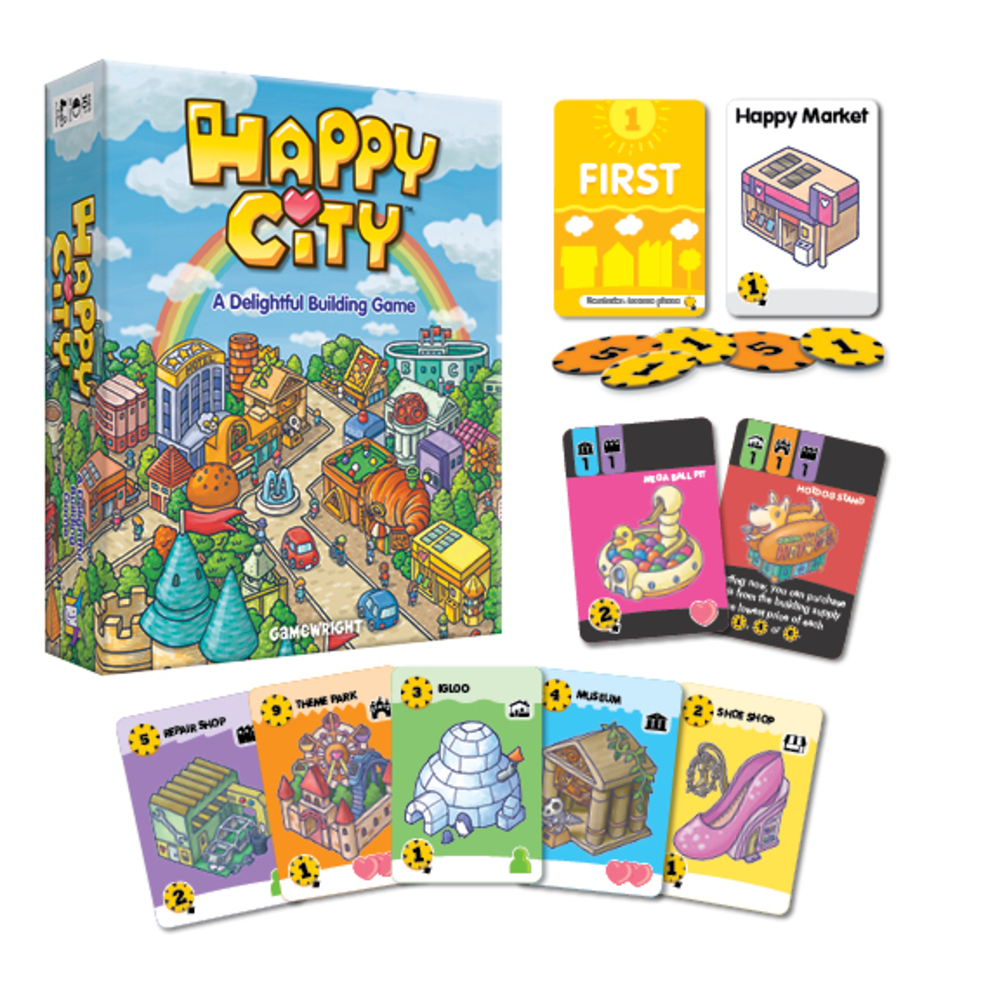
Having spent fall semester teaching from Happy City by Charles Montgomery, I can not imagine a more appropriate Christmas present than Happy City, a new game for ages 10 and up from Gamewright. Thanks to my wife Jane--who has also used Happy City in a class--for this astutely-chosen gift!
Happy City has no relationship to Montgomery's book. He is not mentioned in the game materials or on the website, so I assume the coincidental titles are exactly that... coincidental. Even so it practically begs for comparison, which I am about to undertake. Keep in mind, though, this card game is aimed at children; if you're cruising the Internet looking for someone slagging a children's card game, you should definitely check out Yu-Gi-Oh: The Abridged Series on YouTube. You will not find that tone here.
On the other hand, the book Happy City, while accessibly-written, is a book for adults who have a tolerance for complexity and counterintuitive research findings. It would be hard for the most brilliant designer to translate Montgomery's argument into a game for the whole family intended to be played in under 30 minutes.
Playing Happy City
Happy City is a game for 2-5 players. Play goes in order of how recently each player has in their actual life traveled to another city. Each player starts with a mildly-profitable store, and from that attempts to build a city with high population and high citizen happiness. Each building is represented by a card; the game ends after one player's city has ten cards. The winner is the one with the highest overall score, determined by multiplying the population score and the happiness score.
Source: gamewright.com/product/happy-city
The key to building your happy city is to maintain a positive flow of income, so that you can buy the features that will bring in people and/or make them happy and/or add to the city's income. The buildings come in several categories. Players are encouraged to draw from a mix of categories, though they may not use more than one of the same kind of card. Some examples:
Happy Market: 1 coin of income (paid at the beginning of each round of turns)
house: cost 1 coin, 1 population point
apartment complex: cost 3 coins, 2 population points
high-rise: cost 6 coins, 3 population points
library: cost 2 coins, 1 happiness point
repair shop: cost 5 coins, 1 population point, 2 coins of income
restaurant: cost 5 coins, 1 happiness point, 2 coins of income
casino: cost 7 coins, 2 happiness points, 2 coins of income
ski resort: cost 8 coins, 3 happiness points
steelworks: cost 1 coin, -1 (yes, -1) happiness point, 1 coin of income
I'd give our library at least two happiness points!
In time, with the right mix of card/building types, players can pick from a selection of bonus building cards (e.g. Superhero Central, Happywood Studios, Unicorn Ranch), which amp up both population and happiness scores. An expert version of the game has more bonus buildings and more complicated scoring.
Evaluation
Happy City does a very good job of modeling a number of factors related to city development. The primary importance of income, making it a prerequisite to any actual building, is a good way to put fiscal realities at the forefront of our considerations. The folks at Strong Towns will be gratified that all income in the game is locally-generated. We are not relying on federal or state grants to grow our cities.
Calculating the final score by multiplying happiness by population is a good way to model the interaction of those two factors. A small number of people experiencing a lot of happiness is an enclave or an exclusive club. A large number of people experiencing low happiness are existing in a place, not citizens of it. A large number of people experiencing a lot of happiness is a happy city.
Casino, Las Vegas NV
A third good point is, even though the city is developing in a centrally planned non-organic way, at least the planner/player is responding to values that have been established externally (presumably, in the economic market or political arena) rather than by themselves. Players are not Robert Owen or Le Corbusier or Marshal Tito constructing our own utopias, but working with preferences expressed by others. Last time I played, I added a casino to my city, not because I believe they're in any way productive, but because I needed the income and the happiness points. (For the record, I think the game vastly overrates casinos and sports stadiums on both counts.)
The biggest difference between Happy City and Happy City is how each understands happiness. The game's high happiness scores for leisure and entertainment facilities suggests the authors equate happiness with personal fun and pleasure. Montgomery's book goes into considerable detail in questioning that sort of premise, describing in chapter 2 a more long-term feeling of well-being, and later arguing that extrinsic motivators like fun things to buy or visit are overrated by people as sources of happiness. It's intrinsic motivators like health and social connection that endure and contribute to feelings of well-being. As Mitchell Reardon, a senior planner at Montgomery's firm, told the Shared Space podcast in March 2021:
We are social creatures, yet for decades city planning has sought to divide us. We're just trying to knit this back together, and COVID has really underlined how critical that connection is.
Shared streets, like at Washington's Wharf, are essential to experiencing that place
Urbanists like Montgomery spend less time on the commercial and industrial features of a town than on whether or not they're connected. In Walkable City [Farrar Straus and Giroux, 2011], three of Jeff Speck's four components of walkability deal with the experience of the walk--does it feel safe? comfortable? interesting?--and only one with the walk's destination. Jane Jacobs spends the first three chapters of her landmark The Rise and Fall of Great American Cities [Modern Library, (1961) 2011] talking about sidewalks. In part two, she articulates the prerequisites for urban success--mixed primary uses, small blocks, some older buildings, and concentrated population--none of which have to do with what specifically goes on those blocks or in those buildings. Toronto-based 880 Cities, which aims to make cities "great" for 8-year-olds and 80-year-olds, focuses their efforts on "your community's streets and public spaces." And so on.
Street musician on pedestrian-only Knez Mihailova, Belgrade
Montgomery devotes the middle third of his book to assembling neuroscience research and lived experience on how happiness can be designed. Creating spaces for informal gathering, often out of infrastructure previously devoted to cars, attracts people and helps build social connection and trust (Montgomery 2013, ch. 7). He quotes Jan Gehl: What is most attractive, what attracts people to stop and linger and look, will invariably be other people. Activity in human life is the greatest attraction in cities (p. 150). In a society where so many people drive to work yet experience daily unhappiness doing so (pp. 179-181), anything to enhance the opportunities to cycle or walk will improve the city's happiness. So will anything to help those on public transit, "the most miserable commuters of all" (p. 193). Finally, opportunities for refuge and experience of nature will relieve stress and restore our souls (ch. 6).
Boyson Trail, Marion IA
These aren't simple push-button interventions, either. They require a lot of trial and revision, and attention to different people's lived experiences in different places. That makes sense; after all, cities are "problems of organized complexity" (Jacobs [1961] 2011, ch. 22). It follows that any attempt to model all the complexity at the level of a two-dimensional board game is going to fall short, so let us not cavil at Happy City, which after all is a fun and quick play, and which gets a lot of the city right.
Just let's don't confuse amenities with happiness.
SOURCE: Charles Montgomery, Happy City: Transforming Our Lives Through Urban Design. New York: Farrar Straus Giroux, 2013.
Strange intersection north of Coe College campus. Is a roundabout the solution?
Construction of roundabouts is "exploding" around the State of Iowa, according to Steve Gent, who is director of traffic and safety for the Iowa Department of Transportation (Morelli 2017). Cedar Rapids recently got into the game with a redesigned intersection of Kirkwood Boulevard and 76th Avenue SW, and will soon get two more on Johnson Avenue SW. All these roundabouts come with many promises of improved traffic performance, and much public angst about the introduction of this unfamiliar traffic feature. Our task today is to decide when roundabouts might be a positive addition, and where they might be overdone.
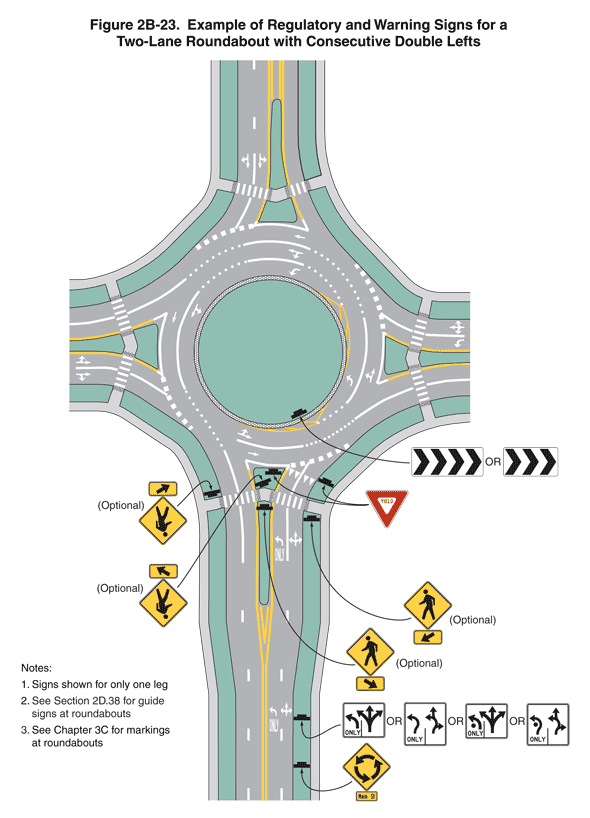
Roundabout schematic (Source: U.S. Dept of Transportation)
A roundabout is a circular intersection characterized by small diameters (relative to traffic circles like Columbus Circle and DuPont Circle in Washington, D.C.); curvature designed to slow speeds; a center island around which traffic turns; and the requirement for entering drivers to yield to those already in the circle (USDOT 2000: 5). Conceptual or real operation can be seen in the videos listed below. Benefits of roundabouts include:
improved traffic flow despite slower traffic speeds, because vehicles are moving at a slow steady pace instead of alternating stopping and going fast;
less pollution, at least at the intersection site, because the cars keep moving;
improved safety because there are fewer contact points and all cars are going in the same direction;
lower year-to-year costs than a traditional signal because those require electricity and maintenance (though construction costs are higher).
St. Paul, MN: Intersection of Charles and Albert Sts is more properly called a "neighborhood traffic circle"
The disadvantages of roundabouts stem from their unfamiliarity in much of this country, outside of the Northeast. Drivers' uncertainty can create more problems than the feature is designed to solve, particularly in a two-lane roundabout where the required lane changes seem to guarantee mass confusion (see second diagram here). Tom Vanderbilt argues that's a feature, not a bug:
With a roundabout, only a fool would blindly sail into the scrum at full speed [as opposed to the common maneuver of speeding through a yellow light]. Drivers [entering a roundabout] must adjust their speed, scan for openings, negotiate the merge. This requires more workload, which increases stress, which heightens the feeling of danger. This is not in itself a bad thing, because intersections are, after all, dangerous places. [From the previous page: 50 percent of all road crashes occur at intersections.] The system that makes us more aware of this is actually the safer one. (2008: 179)
Cultural hostility to change, whether it involves sidewalks or LED light bulbs or the metric system, gets magnified when it hits us where we live, and a lot of us live in our cars. Elected officials are understandably chary of triggering this hostility. Additionally, there is the cost of conversion, estimated at $1.2 million (Morelli 2017), which is about four times the cost of installing a set of traffic signals, and way more expensive than a four-way stop. Finally, there is disagreement over whether bicyclists and pedestrians benefit from this design.
Newly-built intersection of 5th St and 16th Av SW includes a roundabout:
anticipation of future traffic, or vanity feature?
Roundabouts and traffic circles are commended as traffic calming measures in David Sucher's manual for city-building. He explains:
[Roundabouts are] not so much to slow down traffic but to allow movement through intersections without having to stop.... A slow but steady pace would achieve the same overall time from origin to destination but without the mental aggravation of continual acceleration, braking, stopping, and then accelerating again. (2003: 79; see also Vanderbilt 2008: 124)
He cautions, however:
The traffic circle is not manna. Some drivers loathe them and will change their route to avoid them, which may serve to decrease traffic on one block, only to divert it to another, increasing traffic there. (2003: 78)
The main trick with roundabouts is to keep traffic flowing without creating disconnection between the parts of the city on either side. From this we might conclude that roundabouts are indicated where traffic volume is great enough to overwhelm a four-way stop; the volume of turning traffic would require a separate turning light, making the overall light cycle painfully long; and pedestrian and bicycle traffic is manageable. There should be regular breaks in the traffic, so that new entrants can merge easily--unlike Chevy Chase's experience in "National Lampoon's European Vacation!"--pedestrians can get through the intersection in a timely fashion, and cyclists can cycle.
[The Iowa Drivers Manual (cited below) recommends "Generally, cyclists should walk their bicycles across the pedestrian crosswalk using the same rules as pedestrians," though it allows that "Experienced cyclists may navigate roundabouts like motorists." If the traffic feature in an area with significant bicycle traffic depends on cyclists getting out of the way, it is doomed to failure. The idea of urban design is that it accommodates and channels normal human behavior, rather than presuming that one set of travelers is voluntarily going to withdraw from the scene.]
Pair of roundabouts on U.S. 30 south of Mt. Vernon (Google maps)
On roads roundabouts can be focused on traffic flow. One successful roundabout near Cedar Rapids is at the intersection of U.S. 30 and S.R. 1 in Mt. Vernon. It used to be a four-way stop, featuring long backups at most times of the day. With the roundabout we sail right through, though I confess I haven't tried it during rush hour. There's another roundabout to the west where U.S. 30 intersects 10th Street. When I drive through, it seems unnecessary because of the lack of traffic off 10th Street. I understand that traffic occurs mainly at school drop-off and pick-up times, and that there had been a substantial number of crashes there. I don't know that the roundabout was the best solution--maybe cars needing to go east on U.S. 30 could have been guided to S.R. 1--but I don't know that it wasn't. A student from Mt. Vernon reports that every member of the City Council who voted for the roundabouts was defeated at the next election, which speaks to the fraught political climate around this issue. The American Society of Civil Engineers reports the outcome eventually got happy; they quote Justin Campbell, a transportation engineer on the project: Now that the roundabouts are finished and working, people are happy. The cars are moving (Wilcox 2016).
Other than the ones on U.S. 30, the Linn County roundabout that gets the most use is unquestionably the one west of downtown ("Uptown") Marion, at the intersection of 7th Avenue, 7th Street, and 6th Avenues. (An indication of the current rage for roundabouts is that an Internet search for "Marion roundabout" finds stories from Illinois, Indiana and Kansas as well as Iowa.) It opened November 2016 as part of Marion's Central Corridor Project, intended to divert through traffic off 7th Avenue onto 6th and allow 7th to become the hub of a walkable urban district (Kasparie 2016). It is no longer possible to go through the intersection southbound on 7th Street, or westbound on 6th Avenue, though it's not clear how many people were previously doing this.
Traffic moved briskly through the roundabout this morning while I observed it from 7:45-8:30 a.m. Most people drove with confidence, even though the feature is barely a year and a half old. There occasionally appeared to me to be hesitation entering the circle, but nothing that delayed traffic more than a few seconds. Only one driver was yielding to traffic entering the circle, and two drivers--both talking on phones--were observably erratic.
Most traffic this morning was headed west along 7th Avenue i.e. towards Cedar Rapids, and I saw the only mild backups on westbound 7th approaching the roundabout, a string of six and a string of seven cars behind semi-trucks that had had to stop before entering the circle. There was more traffic on 7th Avenue than on 8th Avenue, so no evidence that traffic was diverting away from the roundabout. I'd heard reports from a local student that backups occasionally occurred when a line of cars proceeded north on 7th Street and had to stop at 8th Avenue...
...but I never saw more than one car going in that direction this morning. Country Kitchen Cafe was doing a brisk business on the southwest edge of the circle...
...though I'd be interested to compare their before-and-after numbers. Very few pedestrians or cyclists came through while I was observing. The cyclist used the sidewalks and surprised a driver when he turned left across 7th Street. Few eastbound cars bypassed the commercial area on 7th Avenue by diverting to 6th Avenue, but 6th isn't yet complete around Uptown. Overall, I'd say traffic was moving, quite likely better than it did when the intersection was governed by a set of traffic lights.
So, bottom line: Should the complex intersection north of Coe (pictured at top) be redone as a roundabout? It would certainly facilitate conversion of the streets to two-way, and would seem not to stand in the way either of better development of the area, or of increased pedestrian activity. Here would be something that's broken, and a roundabout would be one, perhaps the best, way to fix it.
Are there "antifragile" ways to develop this city-owned property?
(8/8/2016) My friend and fellow Corridor Urbanist Ben Kaplan has just written about ongoing downtown development in our town, specifically the question of how to plan parking capacity when great changes in cars may be just a few years in the offing. Ben notes the winning developer's proposal for a city owned lot on 3rd Avenue and 1st Street includes a 744 space parking garage; the other two finalists included garages with 365 and 552 spaces, respectively. "But what if," asks Ben, "we're on the cusp of a world where we rarely, if ever, park our cars ourselves?"
"Basically, by 2030," he goes on, "it's reasonable to assume that most of the cars on the road will have some level of automation. What does a world where most cars can drive [and park] themselves look like?" Well, for one thing, all those garages and parking lots would still have all the negatives identified by the prophet Donald Shoup (chunks of unproductive and unattractive space, missing teeth on the street, generally killing the urban buzz) with none of the positives (individual convenience, sends a message that people from away are welcome).
Meanwhile, the Strong Towns Book Club, in its discussion of book 3 in philosopher Nassim Nicholas Taleb's provocative Antifragile (Random House, 2012), asks: How would a local government use the barbell strategy (embracing both extreme risk aversion on one side and extreme risk taking on the other while shunning everything in the middle)? As applied to the parking dilemma, how does a city struggle to balance the expectations of drivers with the needs of productive places and the people who use them, when fast-paced technological change may soon upend the basic realities on which such assessments are built?
Taleb in book 3 builds on his concept of antifragility, the idea that success means more than riding out the bad stuff (mere "robustness" or "resilience"); it should mean becoming stronger from adversity. He introduces us in chapter 9 to two lovable characters, each of whom stands for an important aspect of the antifragile life. "Fat Tony" DiBenedetto has a strong antipathy toward "the empty suit" (p. 145) and "believed that nerds, administrators, and, mostly, bankers were the ultimate suckers" (p. 147) because they master the details that are essentially superfluous while missing the big important things. The restlessly curious Nero Tulip recognizes some stuff doesn't make sense even when intellectuals purport to explain it, and so "a system built on illusions of understanding probability is bound to collapse" (p. 147). Both men made money from the financial collapse of 2008 because they recognized the pretense behind all the smart people saying they had things under control, so they had made investments that bet against the smart people's predictions.
Fat Tony and Nero teach us that we, individually or collectively, don't know as much as we think we do, and so life choices and public policies that assume much knowledge of the future are attended by great downside risks when the inevitable unexpected events develop. The antifragile path, we learn in chapter 11, is rather to let go of detailed predictions based on statistical metrics (which with their false precision are "just air" [p.150]) and focus on avoiding the major downside risks that could lead to collapse. This frees the individual to take occasional flyers on high risk activities that have the potential for major payoffs. Uniformly medium risk still carries the chance of complete failure, so go for "a dual strategy composed of extremes, without the corruption of the middle"--the barbell metaphor--"somehow they all result in favorable asymmetries" (p. 162).
So how do we "barbell" our downtowns? The presence of autonomous cars on the time horizon can in this sense be a blessing to city officials and business leaders, because it frees all of us from any idea how this is going to play out, like knowing how many parking spaces we're going to need. Let go, say Fat Tony and Nero, of the models showing how downtown is going to develop in the next 15-30 years, because they're all surely wrong in some important way or other. Focus instead on the worst that can happen--what would constitute catastrophic failure?--and avoid that outcome(s).
For cities catastrophic failure would either be financial insolvency or being saddled with a large amount of useless space, which are probably correlative anyway. In the specific case of Cedar Rapids we could add massive property damage from another flood on the scale of 2008. So you don't want to invest so much in infrastructure that you can't afford to maintain, and you don't want to take a form that can't adapt to changing circumstances and fashions. I think that if we develop with too little parking--stop laughing! and follow my argument here--such a mistake would not be catastrophic; things would work themselves out because the rising value of parking space would impel some developer to invest in creating more of it. If instead we choose too much parking, that has great downside risk: it winds up being expensive to someone, which ultimately means the municipality once the businesses fail or flee. An excess of space devoted to parking means vast emptinesses at street level, which severely handicaps the area's ability to attract residents, businesses and visitors.
In positing near-term major change in people's behavior, Ben complicates the scenario by asking what happens if we miraculously get the parking right for 2016 but in 15 years it turns out to be way too much? That would lead to failure if all that parking can't be inexpensively converted to some more productive use. So just as we should construct buildings that can be converted to a succession of uses--this...
not this...
...we should design at least some of those parking facilities for flexible use, too. Could, for example, a parking garage with excess capacity be made to shrink from the outside in, so there could be shops on the street side? Approaching it like that seems to me to be the city's essential interest, while we leave the details up to the market.
Nassim Nicholas Taleb (swiped from fooledbyrandomness.com)
(5/31/2016) Nassim N. Taleb argues that individuals and systems might merely survive chaos, but if they're properly prepared they can actually thrive in it. He calls this characteristic antifragility, which can be thought of as one step beyond resilience (or Taleb's preferred term, "robustness.") Fragile people are destroyed by chaos, robust people ride it out, but antifragile people come out stronger. The same classification can be applied to businesses, governments, scientific research and any number of other contexts (see Table 1, pp. 23-27). In chapter 2 he presents a wide range of examples including body-building, obsessive love, mass riots, ideas and their critics. The book was published long before the U.S. presidential election, but Donald J. Trump, whose support increases the more virulently he is criticized, seems to be a distinctively antifragile candidate. (Hillary Clinton might be, too.)
In Book I Taleb argues that antifragility not only exists, but that to develop it is in most contexts a desirable goal, because prospering is better than mere survival. He further argues that because specific crisis events are random and therefore unpredictable (see pp. 66-70), the best way to prepare for chaos--to develop antifragility--is to be subject to the right amount of stressors over time. Stress provokes progress by requiring innovative responses:
I hold--it is beyond speculation, rather a conviction--that innovation and sophistication spark from initial situations of necessity, in ways that go far beyond the satisfaction of such necessity... Naturally, there are classical thoughts on the subject, with a Latin saying that sophistication is born out of hunger (artificia docuit fames). (pp. 41-42)
Too little stress makes one fragile, albeit too much stress without time to recover can be fatal. In other words, whoever first said "What doesn't kill me makes me stronger"--Taleb tells me it was Friedrich Nietzsche (1844-1900)--was onto something.
Finally, in chapter 4 ("What Kills Me Makes Others Stronger"), Taleb argues that groups and systems are strengthened--made more anti-fragile--when individuals fail. "[E]rrors and their consequences are information," says Taleb. "For complex systems" like societies and economies "are, well, all about information" (p. 57). Those individual failures can serve as negative examples for the rest of the group, and anyhow the survivors are likely to be stronger than those who perish:
Restaurants are fragile; they compete with each other, but the collective of local restaurants is antifragile for that very reason. Had restaurants been individually robust, hence immortal, the overall business would be either stagnant or weak, and would deliver nothing better than cafeteria food--and I mean Soviet-style cafeteria food, Further, it would be marred with systemic shortages, with, once in a while, a complete crisis and government bailout. All that quality, stability, and reliability are owed to the fragility of the restaurant itself. (pp. 65-66)
Applying this powerful concept to governments, Strong Towns asks: We often assume that regional planning is good; people working together. I tend to see regional planning as an attempt to simplify (dumb down) complex systems into merely complicated system. Would we all benefit -- as in airline crashes or restaurant startups -- from having cities behave more independently and competitively? What would need to change to optimize this approach?
I've argued elsewhere that metropolitan governance needs to be made stronger, not weaker. I follow the logic of Peter Calthorpe and William Fulton (The Regional City, Island, 2001, esp part I) who argue that competition among municipalities has often served to diminish the quality of the whole region, particularly for people who can't afford to ride the waves of exurban development. Even the well-off suffer the effects of the suburban model such as traffic congestion and air and water pollution.
If we are starting a metropolitan area we might well decide to let a hundred municipalities bloom with a garden variety of policy mixes and see what happens. In 2016, however, American metropolises find themselves with older central cities and first-ring suburbs existing alongside edge cities with wealthy residents and cheap real estate. Letting things rip... well, that's what we've mostly been doing for the last 100 years. Chicago is already in competition with the well-heeled edge city of Naperville, and close-in suburbs like Bedford Park and Rosemont that lure businesses with subsidies and low tax rates. Chicago is competing more effectively of late, but too many people are still left behind without resources or opportunity in areas where law enforcement and school systems are over-stressed.
So the obstacle to antifragility is not regions per se, or planning per se, but regional planning that tries to suppress competition among municipalities in order to guarantee good outcomes for everyone. Does this occur? I can well imagine that it does, because even though "something deep in your soul likes a certain measure of randomness and disorder" (Taleb 63), the human drive to create order is also strong. When people have market power, they often try to use some of it to purchase some security for themselves and then to avoid inheritance taxes so they can pass it on to their descendants. Individuals and towns can use political power the same way, manipulating the regulatory function to try to preserve their advantages. Any number of posts on the Strong Towns site have shown that national policy can have a distorting effect as well (see also Calthorpe and Fulton ch 5). Stronger regional government, though, would be better-positioned to respond to general as opposed to narrow interests. The answer to bad planning is not no planning: As Andres Duany and colleagues argue, "better policy and better planning can produce better cities" as long as urban leaders "borrow a page from the suburban developers' handbook and look at their communities from the outside in, through the eyes of a customer who is comparison-shopping" (Suburban Nation, North Point, 2000, p. 154).
Regional planning can be antifragile when it is empowered to address the quality of the system as a whole: when building codes, transportation, and so forth enable competition between businesses and municipalities, while ensuring opportunity for everyone. Calthorpe and Fulton again: Each community and neighborhood "will need to develop its own vision of community and the built environment" but also "will have to find a way to tap into the emerging Regional City" and to "progress toward greater diversity, more walkable environments, and a more compact urban form"(p. 195). The metropolitan system can prosper when competition among municipalities means more than zero-sum poaching of each other's businesses and well-off residents, and when every individual is positioned to benefit from the success of the region. Someone--probably government--needs to have authority to defend those without political or market power--like natural spaces, and the poor and working class. Of course, planners should allow for the possibility of failure, but the act of failing should not be catastrophic for the people of the town, nor mean that individuals are trapped in poverty for endless generations. Recognize that the failure of a restaurant or a bank has many fewer negative consequences for the citizen than the failure of a town.