Showing posts with label scooters. Show all posts

Friday, July 16, 2021

Solving the scooter problem


Scooters are everywhere they shouldn't be. Perhaps you've heard?

 I

Why are the scooters among us? Rental scooters and bicycles are one way for cities to reinvigorate their downtown areas. Cedar Rapids, like most American cities, saw their downtown areas transformed in the second half of the 20th century from town centers into clusters of offices. Analysis by Costar shows the percentage of real estate devoted to offices in major American cities varies from less than a third in Nashville, San Diego, and St. Petersburg to two-thirds or more in Chicago, Pittsburgh, San Francisco, and Washington. In downtown Boston, offices occupy a staggering 83 percent of real estate (Badger and Bui 2021).

Offices provide a lot of use maybe 10 hours a day, five days a week, and hardly anything the rest of the time. (Think Cedar Rapids before the flood.) This might be a net-win for property tax collection, but wastes prime city space. Monocultures are not resilient, as we saw during the pandemic; as professionals shifted to work-from-home, it exposed cities' vulnerabilities to shifts in worker behavior. Services like restaurants that were dependent on a stream of office workers suffered. "Single-use office districts--that's not a formula for success," Philadelphia's Paul Levy told The New York Times (Badger and Bui 2021).

What cities, including Cedar Rapids and even Boston, have been trying to do for most of this century is to diversify the economies of their core areas to create 24-hour downtowns. Studies cited by Jeff Speck (2012: 17-35) show advantages of walkable urban neighborhoods over other development types: attractiveness of street life to mobile professionals, financial and health benefits of walking to individuals, more money stays in the local economy, more job creation, productivity and innovation. A substantial residential population can support ongoing economic activity, besides making the area look active and interesting rather than empty. Jane Jacobs (1962: 198) makes this part of her first condition for a vibrant city:

The district, and indeed as many of its internal parts as possible, must serve more than one primary function; preferably more than two. These must insure the presence of people who go outdoors on different schedules and are in the place for different purposes, but who are able to use many facilities in common....

For a humble example of the economic effects of people spread through time of day, I [offer] a city sidewalk scene: the ballet of Hudson Street. The continuity of this movement... depends on an economic foundation of basic mixed uses. The workers from the laboratories, meat-packing plants, warehouses, plus those from a bewildering variety of small manufacturers, printers and other little industries and offices, give all the eating places and much of the other commerce support at midday....  The enterprises we [together] are capable of supporting, mutually, draw out onto the sidewalk by evening many more residents than would emerge if the place were moribund. And, in a modest way, they attract still another crowd [who are] people who want a change from [other] neighborhoods.... This attraction exposes our commerce to a still larger and more diverse population, and this in turn has permitted a still further growth and range of commerce living on all three kinds of population in varying proportions: a shop down the street selling prints, a store that rents diving equipment, a dispensary of first-rate pizza, a pleasant coffee house.

In Cedar Rapids, census tract 19, which includes downtown, grew only 1 percent from 2010-2016, but vigorous construction in adjacent tracts accompanied 19.3 percent growth in tract 22 (Kingston Village) and 7.6 percent growth in tract 27 (New Bohemia and Oakhill Jackson) (density.website). We're getting there.

II

Part of reinvigorating downtown areas is providing transportation alternatives to cars. If all the people we need in our downtown and Main Street District came in their own cars, the congestion would choke all the fun away before it began, and we'd take up even more space for parking than we already do; more room for parking means less room for fun and/or economic productivity. Like bicycles and buses, scooters are a sustainable, resilient transportation alternative. City Observatory's study of Portland's scooter program found scooters were not only frequently used, but they had positive effects on traffic congestion and air quality, not to mention providing people downtown with an alternative to cars. (Scooter riders were also paying about ten times as much per mile as car drivers.)

3rd Av SE: 4 bikes and 8 scooters clustered around a bike rack

These are important considerations, but they're small consolation when you're being run off the sidewalk by an aggressive scooterer, or you have to step around, or push a stroller around, or maneuver a walker around, a carelessly discarded scooter. No wonder people want to see them gone. Yet, given their benefits, we should not be too hasty.

III

So what do we know for sure? Cedar Rapids's bike and scooter share program is run through a contract with Veoride. Veoride's website offers encouragement and general instructions like "Ride in the bike lane or vehicle lane unless local laws say otherwise" and "A bike rack is the safest place to park." Also, "The furniture zone of the sidewalk (where benches, lamps & the tree lines are) is a safe and visible place to park." 

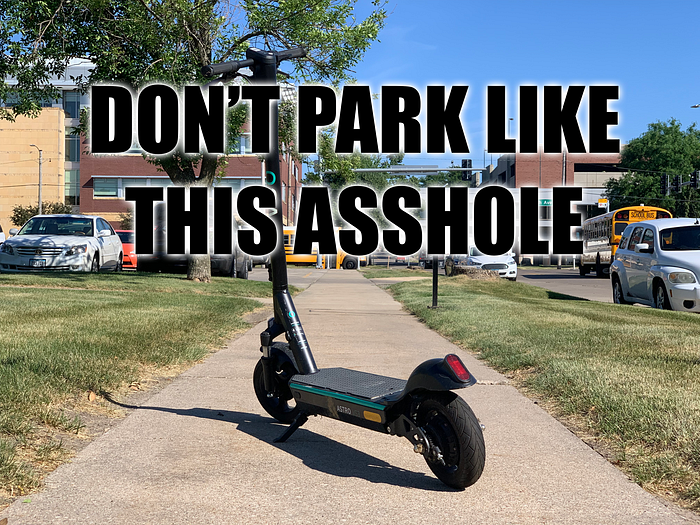
Scooter in the furniture zone. Note the adjacent capacity for parking cars

The map with designated parking zones are only on the Veo app, not the website. This includes the service boundary, where you are allowed to park ("forced parking zones"), no parking zones, no ride zones, reduced speed zones, zones with special rewards for parking there,  It also says that "you have to take and submit a parking photo to end your trip..." That means the user is responsible for showing Veoride that they have stored the scooter in a safe and responsible way.

On Thursday morning, I walked 16 blocks of Cedar Rapids's downtown area, from 1st to 5th Street and 1st to 5th Avenue SE. I saw 29 Veoride bikes and 80 Veoride scooters that were not in use.

  • Of the bikes, 18 (62.1%) were parked at a bike rack, 11 (37.9%) were in the furniture zone: 100% legal/proper
  • Of the scooters, 32 (40%) were parked at a bike rack, 33 (41.3%) were in the furniture zone, 11 (13.8%) were on the sidewalk to some degree, 2 (2.5%) were down an alley, and 1 (1.3%) was in a parking lot. Two of those left on the sidewalk were in cutout areas that were not usable for walking, so I'm saying: 85.2% legal/proper
  • There were 40 bike racks, some city-owned and some privately-owned but publicly-accessible. Of these, 16 (40%) were in use.
  • I didn't count car parking spaces. There are many, many of them, not nearly all in use. No one parking a car has any excuse for not parking it properly. And yet people do.
Counted as improperly placed, but not really a problem 
even to the most infirm walker

A skeptic notes that Veoride has added staff to manage the bikes, so the problem now seems less dire  than it is, and that I really should do this survey on a Saturday night. Or maybe go to Redmond Park, or New Bohemia, or some place on the west side where they're more higgledy-piggledy. That would be interesting to do. However, it suggests the problem is confined to specific times and places, which makes management i.e. mitigation more of a viable option.
Counted as being in the furniture zone, which it mostly is.
Better where it is than on the rack, though, which would put it right where people walk!

IV

So how do we live with scooters, enjoying their advantages while minimizing the inconveniences? Scooter return is a classic example of an externality i.e. there is a cost to the transaction that is not borne by the user or by Veoride, but by innocent bystanders who have to navigate around improperly left scooters. The policy text I use in my introductory American government class, Public Policy by Michael E. Kraft and Scott R. Furlong (2020: 107-111), lists five general ways of addressing any externality: direct government management of the situation, regulating individual behavior, providing incentives to individuals, market mechanisms that account for externalities, and persuasion.

Government management: More Veoride or city staff could be in charge of returning vehicles to their proper spaces. Or rental could be done from a central location with an actual staff person, rather than a credit card. The bike program came with a lot of new racks, painted a prominent shade of green, but these might need to be moved around to make docking the vehicles more convenient.

Regulation: The rules for proper scooter return are on the app. They could be more strictly enforced, either through fines when the user does not provide the proper picture, or through police guidance. If the police are involved, though, I would hope they would not focus on scooters but address aggressive or unsafe vehicle use in general. 

Incentives: Free rides for people who successfully return a scooter or bike a certain number of times without fail.

Market mechanisms: Require a deposit for rental that would be used to cover loss or damage to the scooter, including the cost of transporting it to a proper location? Allow users to buy stock in Veoride's Cedar Rapids operation, which would understandably increase or decrease in value based on the overall performance of city riders at returning their vehicles?

Persuasion: Social media or other outreach explaining and re-explaining how to return a scooter properly, and stressing the importance of proper scooter return. As I understand the whole nudge thing, it is better to stress the number of people who do it right rather than the inconvenience to children and the elderly who have a sidewalk blocked.

These are some ideas off the top of my head. They assume that there are benefits both to having a local scooter rental program, and to having sidewalks, doorways, &c. clear for people to walk. If your attitude is, "Drivers are normal, scooters are different therefore bad eww eww eww get rid of them," then you  already know what you're going to do.


SEE ALSO:

"The Crisis of Authority and Our Common Life," 19 June 2021

"Here Come the Scooters!" 8 July 2019

Ben Kaplan wrote "The Scooter Problem" in 2021 and "The Scooters Are Good" in 2018

George Kevin Jordan, "Can a New Kickstand Help Curb the E-Scooter Domino Effect?" Greater Greater Washington, 9 August 2021

BOOKS CITED

Jane Jacobs, The Death and Life of Great American Cities (Modern Library, [1961] 2011)

Michael E. Kraft and Scott R. Furlong, Public Policy: Politics, Analysis, and Alternatives (Sage CQ Press, 7th edition, 2020)

Jeff Speck, Walkable City: How Downtown Can Save America, One Step at a Time (Farrar Straus and Giruox, 2012)

Saturday, June 19, 2021

The crisis of authority and our common life

 What does this...

badly parked scooter
Scooter on sidewalk in Iowa

...have to do with this?

National Guard going apeshit in Oregon

This week, Corridor Urbanism co-founder Ben Kaplan published a blog post about the local controversy over motorized scooters. It's a good piece, which explains the conflicting and complementary interests involved, while gently calling out both those who heedlessly ride-and-dump their scooters and those motorists who claim an absolute right to unobstructed driving. We can accommodate the different interests, Ben argues, and become "a city of quiet streets, with strong local businesses, where we invest in our neighborhoods, and create locally."

I think we can recognize that there have been issues with the scooters, most of which is the bad behavior of a minority of scooter users, and a lack of cultural norms surrounding how they’re supposed to be used, while also realizing that the scooters can be a huge asset to our community.... We can learn, as a community, to park them properly, ride them in the bike lanes, and signal our turns. We can build rules and a culture around scooting that make scooting less annoying. We can build more bike lanes, so scooting is safer and more practical. We can scoot boldly into a brighter future, carried by the soft hum of an electric motor.

Ben sees the main obstacle to this happy resolution being cultural resistance to change, which is hard to argue with. We live in a state where bike lanes were weird just ten years ago, where demand for COVID-19 vaccines is so low we decline the vaccine shipments, and where passenger rail is a sign of creeping Eurocommunism. But beyond that, I worry about how "we can learn, as a community," to do anything. "How can I," asked the Ethiopian eunuch in Acts 8:31, "unless someone guides me?"

Who is going to guide that boy away from scootering on the sidewalk, or tell that driver not to be aggressive in pedestrian areas (or the dog-walker to leash and pick up after their dog, or would-be DJs to turn down the music, or explosives enthusiasts to cool off the nightly fireworks, or...)?

Americans' obsession with individualism makes me skeptical that we're amenable to being guided towards norms. "If somebody had the swine flu right now, I would have them cough on me," bleated radio provocateur Glenn Beck in 2009. "I would do the exact opposite of what the homeland security says" (McNeil 2009). Republicans were then a third less likely than Democrats to say they would get the vaccine, and flu deaths by state that year rose with the percentage of Republicans (Kristof 2020, citing Baum 2011). That was eleven years before mask wearing became such a big deal.

It doesn't help that authority in America is in tatters. A new report from Pro Publica finds only ten confirmed cases of police officers being disciplined in several dozen documented incidents of excessive actions against protesters in 2020 (Simon 2021). One officer who punched a protestor six or eight times in six seconds received a written reprimand. Two fired Atlanta officers were subsequently reinstated. Weirdest of all, the National Guard, Minnesota State Patrol, and the Minneapolis Police Department all denied employing the officers who fired paint balls at someone's home.

The State of Iowa, predictably, backs the blue in a way that furthers rather than repairs the cultural rift. You don't build community by threatening people with fines and imprisonment. You build community by building public trust, and by taking accountability for your actions. For a short-term political jones, we and others across our nation have abandoned the tough but necessary work of building communities. In this environment, "the scooter problem" is not just an annoying blot on our day; it's a symptom of our collective inability even to be a community.

Monday, July 8, 2019

Here come the scooters!


Source: Veoride.com
Electric-assist scooters will go "on trial" next month in Cedar Rapids, with a rental concession run by Veoride, the same firm that runs the bike share program. The timing is set to coincide with the start of fall classes at Coe College and Mount Mercy University. Thirty scooters will be available for a two-month period. The fees will be the same as for the bikes: $1 to unlock plus 15 cents per minute, with discounts for those who qualify for local, state or federal assistance programs.

If the bikes, which I've ridden a few times, are any indication, the scooters will be serviceable and durable if not glamorous. From the Veoride website:
Each VeoRide scooter features 10-inch wheels with a proprietary, shock-absorbent tire and comes equipped with a built-in sensor to detect road conditions and automatically engage the motor and braking system to slow the vehicle and protect the rider. The swappable battery located in the deck of the scooter creates a lower center of gravity, the motor positioned at the rear provides greater stability and keeps the vehicle from lurching forward, while the mountain-bike type suspension ensures a smooth ride. The speedometer lets riders know how fast they are traveling, and VeoRide can program and adjust scooter speed to meet a community’s standards.
Atlantic writer Robinson Meyer offers these additional tips, which you may not need, but for which I will be grateful if I ever find myself on one of these things: 
It’s best ridden with one leg on the platform and the other hanging off the side for emergency braking, or fleeing. For a classic scooter, all propulsion has to come from either gravity or the rider’s body, pushing off the ground with his foot. An e-scooter only needs you to push off when coming out of a stop. (After that, the engine takes over.) The push-off/scoot-forward/hit-the-throttle movement is the only real coordination required.
Meyer recommends riding in the bike lanes: Sidewalks are small, and are reserved for pedestrians, poor dears. Roads are big and have lots of space for us Big Scooter Adults. [SEE ALSO: Benjamin Schneider, "What Happened When I Rented an E-Scooter for (Almost) a Month," City Lab, 1 July 2019]


Bird reached agreement with Kansas City after starting there with a "guerilla drop"
(swiped from kansascity.com)
Scooter programs come highly recommended. Corridor Urbanism co-founder Ben Kaplan was nothing short of ecstatic after trying them out in Kansas City last year. They are amazing, he wrote. Every city should have them. All the good things you have heard about the scooters are true. He went on: They are cheap, fun, and useful. For one trip, I went two and a half freaking miles and it was delightful.

Meyer of the Atlantic says his three-mile commute to work in Washington, D.C. "had never gone so fast" as when he finally tried it by scooter. His main concern is that scooters are too "socially conspicuous" to endure, and will soon join the ranks of transition lenses, cargo shorts, and Camelbacks which "have never escaped their dorkiness." Ben replies: Are they dorky? Hell yeah. Will you care once you're on one? Hell no.

See the source image
Jenny Durkan, mayor of Seattle
Nevertheless, we must ask ourselves, are we doomed? If you're like me, you ask yourself this question all the time, anyway, so let's consider whether electronic scooter rental in Cedar Rapids--or your town, if you're not fortunate enough to live in the city SmartAsset rated #6 Best City of Living the American Dream--will exacerbate or mitigate this doom.

Concerns about scooter invasions fall into two categories: danger to the riders themselves, and danger or at least inconvenience to everyone else. Seattle mayor Jenny Durkan, before changing her position in May 2019, had long been opposed to scooter rentals in her city. She explained in an interiew:
It's so funny, every mayor who's got them says don't take them.... [E]very city that has scooters has had significant traumatic injuries. And one trauma doc was quoted as saying it's like we forgot everything about seatbelts, helmets, and other safety equipment. So, look, I know that some people think that scooters are fun. I think the danger of them, and the demonstrated danger of them and the liability of the City--cities now are paying out millions of dollars in judgments for people who are hurt, because you're the City saying here use a scooter. (Trumm 2018)
Nashville, Tennessee is suspending their pilot scooter program, which featured 4,000-odd scooters being rented by seven companies. The immediate stimulus was the death of a 26-year-old man last month; he was struck by a car while riding a scooter with double the legal maximum of alcohol in his blood, but complaints had been building for awhile (Short 2019).

Then there's the impact on everybody else. In April, an 81-year-old man was killed in a Paris suburb when he was hit by a scooter; Paris, too, is considering fewer scooters and more regulations (Prigent 2019). Also this month, in Oregon, the Multnomah County Sheriff's office found 57 rental e-scooters in the Willamette River near Portland. A Chicago friend and community activist of many years standing expressed exasperation on Facebook: Are there no rules of the road for the damn scooters? Her friends sympathized: Does not appear so.... Apparently not.... None. About 10 years ago when they first came out people were riding them and they were getting tickets. The city passed the law: no scooters. Now they are legal because I can rent them. One of them hashtagged "#rahmsrevenge," referring to the unpopular former mayor, Rahm Emmanuel, whose administration introduced the rental program.

Californians interviewed by the New York Times complained about scooters scattered willy-nilly on the sidewalks and blocking handicapped ramps, and sidewalk-riders terrifying the disabled and elderly (Bowles and Streitfeld 2018). As they did in Kansas City, Bird, LimeBike, and Spin began renting out scooters in Los Angeles, San Francisco and Santa Monica without consulting with the governments or the neighbors. "They just appeared," said a San Francisco official. "I don't know who comes up with these ideas or where these people come from."

Scooter safety tips, from Veoride.com
Is riding scooters dangerous? Maybe, if you're inexperienced, or drunk, but evidence from Kansas City Tacoma and Portland found relatively few injuries. Nashvilleans on scooters go to Vanderbilt Medical Center with injuries from crashes one or two times per day, but in the first three months of this year 7,859 motor vehicle crashes caused 2,145 injuries and 15 deaths (Short 2019). (See also Cortright 2019). As Chuck Marohn of Strong Towns Tweeted:
Some citizen complaints about scooters may be a response to their novelty. In Cedar Rapids, the scooters aren't here yet, but electric assist bike rentals began in May. Local TV station KCRG ran an arguably overblown story about rental bikes not being returned to rental stations, even though that is not required. (Riders are only instructed to lock the bike to end the ride, and to leave the bike in an upright position in a place that does not impede pedestrian or vehicle traffic, or access to private property.) The report quoted a downtown worker: I walk through Redmond Park every day to and from work and usually at the night time is when I'll see a bike or two there (emphasis mine). And, lest we forget, bike lanes freaked us out when they were introduced in 2013.

Alert the media! Dockless car blocking a driveway in New Bohemia

Wellington Heights: Where do the scooters go in this picture?
A huge part of the problem, to the extent there is a problem, is that Cedar Rapids, like most towns, has for decades built transportation infrastructure with one goal in mind: the speedy movement of motor vehicles. The realities of the 21st century, along with demand from some members of the public, have caused our city to adopt a complete streets policy, but accommodating multiple modes of transport with a network built for cars is no easy matter.


Education, and informational videos like this one, will help reduce accidents due to user error, and encourage cooperative mixing:


But when problems arise with the introduction of scooters in Cedar Rapids, and there will be problems, the people who watch this video will not be the ones causing them. The public will exaggerate the problems because we're used to cars and we're not used to scooters, but the problems will be real, because aggressiveness and opportunism are part of the human experience. The 21st century is requiring more sharing of space, even in spacious and sparsely-populated Iowa, which means there will inevitably more encounters with assholes using a variety of modes of transport.

Is enforcement the answer? I often hear complaints that cyclists and pedestrians aren't subject to law enforcement the way motor vehicles are. This is bunkum; anyone with eyes can see motor vehicle violations on a daily basis that aren't penalized, either. (For the tragic side of this, see Shill 2020.) The fact is, our streets are pretty much anarchic, and I have to admit for the most part it works. Should the police reallocate their resources to provide more traffic enforcement? If so, I pray it's done in an even-handed way, and not in a way that targets scooter riders, or young people, or poor minorities.

I am a transportation omnivore: I drive, cycle, walk, and take the bus. I would like to continue to do all those things without the fear of being struck by an errant scooterist, or (in my car) striking the scooterist. And if scooters as great as Ben says they are, then I want a chance to add them to my transportational toolbox.

Week Without Driving Diary (III)

A very walkable block! (10/5/2026)  For most of its one mile length, Washington Avenue SE is the very model of a walkable residential street...