Showing posts with label gentrification. Show all posts

Monday, March 11, 2024

10th Anniversary Post: The Gentrification Conundrum Revisited

Census tract 27: Row houses built in 2017 with appraised
values of $400,000+

(3/11/2024) Ten years ago this month, Holy Mountain looked at gentrification, the value of diversity, minimum wage laws, the city's new strategic plan Envision CR, as well as Indian Creek Nature Center's annual Maple Syrup Festival--which happens again in a couple weeks! We will be there to cover every sticky bite, of course.

The piece on gentrification, driven by the middle class's return to cities, surveyed an array of literature both pro and anti. (For other surveys of that array, see Cortright 2014a, Cortright 2014b, and Kaplan 2015.) It also introduced me to Chicago artist Theora Kvitka, whose cartoon I got permission to use at the top of the post.

Gentrification at its worst involves under-invested urban neighborhoods receiving a sudden influx of middle class residents that dislocate the people already living there, who are often working class people of color. (In Alyssa Cole's novel When No One is Watching [Temple Hill, 2020], the newly-arrived whites in a New York City neighborhood not only displace the black residents and yuppify their stores, they capture the blacks and use them for scientific experiments.) But as Joe Cortright has argued, the alternative to gentrification for most neighborhoods has not been humble stability but concentrated high poverty. So, the goal for policy makers should be to encourage investment without blowing up places where people are already living.

I wrote in 2014:

For the older neighborhoods in Cedar Rapids, such as Wellington Heights and the Taylor Area, I've advocated "gentle gentrification," of which I'll admit I have only the very vaguest concept. But this much is certain: We don't build diverse communities by pricing people out of the homes they own. It's difficult enough to overcome habits of class prejudice and segregation without adding a financial hit.

Cedar Rapids is not New York City or D.C. or Denver, but we too have seen changes. Data from the U.S. Census Bureau's American Communities Survey bear out some of those impressions, and although it's not clear how much of these changes are due to movement in and out, there are new poor areas developing at the edges of town.

Several census tracts exist mostly in core neighborhoods, although they do not correspond exactly to neighborhood boundaries.

map of census tracts in Cedar Rapids
Census tracts in the center of Cedar Rapids
(Sources: census.gov)

Data are from the 2000 U.S. Census, and the American Community Survey's five-year estimates published in 2014 and 2022 (so the data center on 2012 and 2020). See table at bottom of post for raw numbers. Note that none of these tracts became whiter between 2000 and 2020.

HARD HIT: Population DOWN, Income DOWN, Poverty UP

Census tract 19: Downtown, with portions of Mound View and Wellington Heights

Population -22.5%, Median Family Income +6.9%, Poverty Rate +69.3%

There's been some condo development downtown, with more under construction, which may account for the jump in income since 2010 (though to keep pace with inflation since 2000, median income would have to be about $47000). There are also some rooming houses in the MedQuarter, and some older housing stock in the neighborhoods in areas that remain poor. The low poverty rate from 2000 relative to today surprises me, because what housing stock we've lost was rickety (around Coe College, for example).

Of the six tracts studied here, this tract has diversified the most, going from 80.2 percent white (not Hispanic or Latino) in 2000 to 62.7 percent in 2018-22.

GENTRIFICATION COMING? Population DOWN, Income STEADY, Poverty UP or DOWN

Census tract 12: including Time-Check

Population -46.7%, Median Family Income +84.7%, Poverty Rate +114.9%

Census tract 26: including Czech Village 

Population -30.2%, Median Family Income +171.4%, Poverty Rate -33.8%

These areas lost much of their housing after the flood, with the city buying out property owners and leveling the houses between C Street SW/Ellis Boulevard NW and the Cedar River. Now that flood protection is being built on the west side of the river, expect construction to begin in earnest. It will be interesting to watch this over the next several years. Note the contrast with nearby tract #22 to the north in terms of economics away from the river.
 
These were the two whitest tracts in 2000, with over 92 percent white (not Hispanic or Latino). Tract #12 remains 87.5 percent white, while tract #26 has diversified somewhat to 77.8 percent white.

GENTRIFICATION STARTED? Population and Income STEADY, Poverty UP

Census tract 22: most of the Taylor Area including Kingston

Population -6.2%, Median Family Income +35.4%, Poverty Rate +124.1%

Kingston Yard four story brick building next to sidewalk
Coming to tract #22: apartment/condo development at Kingston Yard

This area has almost made back the population lost to flood displacement. The jump in income results from burgeoning condo development near the Cedar River, which before the flood was mostly older shops with some housing. (Note, however, incomes still lag inflation, which was +50 percent nationally from 2000-2020.) Because of the flood, this area was mostly vacant in 2010-14, so any displacement had already happened before the new residents arrived. The high poverty rate is probably located in the blocks farther from the river; its persistence is striking, suggesting that area has not shared in the prosperity brought by recent development. Why it is so much higher than 2000, I do not know.

Census tract #22 has diversified considerably, from 86.5 percent white (not Hispanic or Latino) in 2000 to 63.6 percent in 2018-2022.

LOOKS LIKE GENTRIFICATION: Population STEADY, Incomes UP, Poverty DOWN

Census tract 17: including most of Wellington Heights

Population -3.4%, Median Family Income +107.3%, Poverty Rate -45.0%

Census tract 27: most of Oak Hill Jackson including New Bohemia

Population +5.8%, Median Family Income +113.9%, Poverty Rate -10.6%

Wellington Heights, largely untouched by the 2008 flood, has seen some housing investment since 2010, but I still can't explain that phenomenal jump in income or decline in poverty. The eastern border of Wellington Heights is 19th Street SE, but the census tract extends another half-mile farther to Forest Drive, taking in a considerable portion of a well-to-do area (including the home base of Holy Mountain). Maybe that explains the numbers, or maybe it is indeed an indicator of gentrification of the older area.

Oak Hill Jackson has made back the population lost to flood displacement, and a little extra, though the U.S. as a whole gained nearly 18 percent during this period. The surge in income results both from burgeoning condo development near the Cedar River and middle class influx into the working class area farther in. Of the four neighborhoods this looks the most like stereotypical displacement accompanying gentrification, although the poverty rate remains high so not all the poor have been displaced. 

Census tract #27 was the most racially diverse of the six tracts in both 2000 (65.9 percent white not Hispanic or Latino) and 2020 (59.8 percent white). Tract #17 has diversified from 78.6 percent to 67.7 percent white.
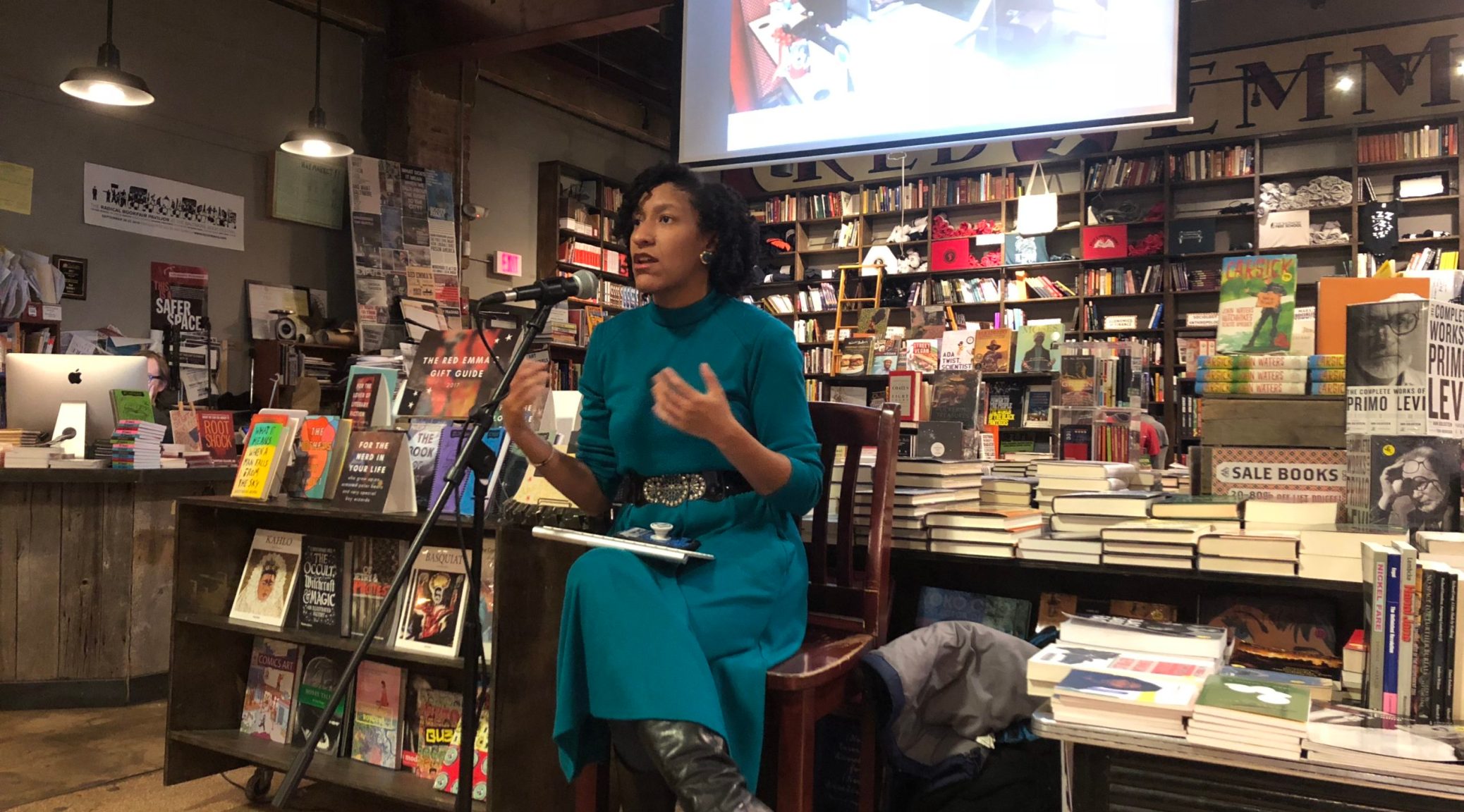
Kristen Jeffers seated, speaking at a bookstore
Kristen Jeffers speaking (from theblackurbanist.com)

Planner Kristen Jeffers, who blogs at The Black Urbanist, just produced an hour-long video called "Six Ways to Defy Gentrification." She describes gentrification, with decidedly negative connotations, as both an economic process ("typically accompanied by displacement") and a cultural process by which neighborhoods become more "respectable" (because previous residents were considered "unwealthy or unworthy" or both). Three of the six pieces of advice, directed at those experiencing gentrification from a less powerful perspective, are:

  1. have faith in yourself (30:00): "you are worthy, you are valid, no matter what your rent is"
  2. ground yourself by cultivating your art (32:00), particularly cultures and folkways like music, fabric or other visual art, gardening, teaching, &c., as well as cultivating your community and your resources
  3. ground yourself through finding every way to make life convenient for yourself (33:45) by inhabiting your neighborhood: walking to the local grocery store, doctor's office, school, &c.

For gentrifiers, she commends:

  1. care about the people around you (41:00), "be that person" who contributes to a diverse community by working and playing together
  2. infrastructure (42:55), including public transportation and pedestrian plazas, but particularly housing that is affordable/accessible for everyone
  3. access (46:15) for people with mobility needs, including everyone in those conversations

Cedar Rapids is growing slowly enough that we ought to be able to manage gentle gentrification, increasing investments in core neighborhoods without dislocating existing residents. I think everybody ought to live as close to the city center as they can, and that services ought to be available within a reasonable distance that makes walking, wheeling, cycling, and public transit viable alternatives. I also think there should be room for everyone, and that the fate of those with fewer resources and/or socially marginalized is the concern of everyone. I see things we're doing right--two-way streets, park development, zoning reform, a flurry of apartment and condo construction in the core--and things we're doing wrong--drive-to urbanism and big "game-changer" projects that don't serve everyday needs or leave room for everyday lives. Could we be doing all this better?

SEE ALSO: 

Pete Saunders, "Rethinking the Affordable Housing Crisis, Part III," The Corner Side Yard, 6 March 2024
Steven Thomson, "As 'Gentrification' Turns 50, Tracing Its Nebulous History," Curbed, 5 November 2014

DATA:

POPULATION


TRACT          2000          2012         2020
     00-20
12TimeCh 3215 1362 1715 -46.70%
17Wellingtn 7137 6598 6891 -3.40%
19Downtwn 3359 2850 2603 -22.50%
22Kingston 2779 2259 2606 -6.20%
26CzechV 3012 2725 2101 -30.20%
27OHJ 1797 1591 1902 5.80%

POVERTY       


TRACT         2000
        2012
        2020
    00-20


12TimeCh 0.087 0.179 0.187 114.90%


17Wellingtn 0.149 0.103 0.082 -45%


19Downtwn 0.225 0.375 0.381 69.30%


22Kingston 0.116 0.293 0.26 124.10%


26CzechV 0.154 0.174 0.102 -33.80%


27OHJ 0.282 0.368 0.252 -10.60%


MEDIAN FAMILY INCOME


TRACT                   2000        2012            2020            00-20
12TimeCh            40451        38365          74722          84.7%
17Wellingtn          55613        72639        115293        107.3%
19Downtwn          31182        28188          33333            6.9%
22Kingston           37946        33304          51364          35.4%
26CzechV             42703        58100          73185          71.4%
27OHJ                  27115        40543          58004        113.9%

Tuesday, May 23, 2023

Community Land Trusts and the future of housing

cartoon picture of five multi-colored houses
(Source: clipartpanda.com)

Community land trusts are typically described as an answer to gentrification-fueled displacement: In the words of M. Nolan Gray (2022: 172), "How can we enjoy the benefits [increased investment, better services] of this type of neighborhood change, without all the costs [rents and real estate taxes becoming unaffordable for current residents]?" In theory, I think the same approach could be used in places needing to increase affordable housing stock in the absence of a strong push from gentrification (Cedar Rapids, northeast Iowa), but I think it would be more difficult. CLTs, at least the ones I've read about, survive by capturing some of the increased investment brought by gentrification; in the absence of such an influx, the CLT would have to be funded by private grants and/or government funding.

In 2019, there were 225 CLTs in the United States, containing 20,000 rental units and 15,000 privately-owned homes (Fannie Mae). Usually, cities use some of the additional tax revenue generated by gentrification to provide seed money for the trust, which acquires property that may or may not have existing housing. The trust uses its property to build or rehab housing, which it then sells to low- or moderate-income buyers, while the trust retains ownership of the land. Part of the deal is that the new home owners can sell their house only to another low- or moderate-income buyer. Cities can also give CLTs first-crack at city-owned land, like the swath of vacant property along the Cedar River in Cedar Rapids created by buyouts after the 2008 flood.

large field of grass with trees in the background
Used to be a working class neighborhood:
view from 17th Avenue SW, soon to be developed

(I don't know if Cedar Rapids has contemplated a CLT; I certainly haven't heard of such an effort.)

sign on construction site
NewBo Lofts, 16th Avenue SE

Other models are for cities to reserve a portion of tax-increment financing to subsidize affordable housing (for the Portland OR case see Cortright 2019), or funding a non-profit community development commission (CDC) to raise public and private money to fund housing. San Francisco's Mission Economic Development Agency was founded in 1973 for business development but got into real estate 2014 to combat displacement of low/moderate-income Latinos. The agency acquired 400 units when San Francisco sold off public housing, and since ahs been deriving income from developer fees as well as grants (Abello 2018). 

large group of people ceremonial ribbon cutting
Ribbon cutting at 2828 16th St (source: medasf.org)

The Greater Cedar Rapids Community Foundation sounds like a CDC, though they don't call themselves one, and their major initiatives at this time don't include housing.

Capturing a share of the increased valuation of real estate in one of these ways is seen as more effective than achieving affordable housing via incentives to or mandates on developers (known as inclusionary housing; the cite I have is Hamilton 2019 from the libertarian Mercatus Center, but I think this point of view is pretty widespread).

Community land trusts have received positive press in Houston (Kimble 2020) and Oakland (Reynolds 2018). Reynolds quotes Steve King, the executive director of Oakland CLT, to the effect they've done good things but it's been a drop in the societal bucket: Certainly we have had a significant impact for the folks we've already worked with, but in terms of us impacting the ownership and control of land in Oakland, we have a long way to go.

bungalow
house available through OakCLT

I have seen citations for, but not reviewed, research that suggests:

  • the success of CLTs (and CDCs) varies widely based on funding base and effective management (Nathaniel S. Wright, "Transforming Neighborhoods: Explaining Effectiveness in Community-Based Development Organizations," Journal of Urban Affairs 40:6 (2018), 805-823)
  • CDCs are criticized for working within rather than challenging the economic status quo (Mark C. Chupp, "The Long-Term Impact of CDCs on Urban Neighborhoods: Case Studies of Cleveland's Broadway-Slavic Village and Tremont Neighborhoods," Community Development 37:4 (2006), 3-52; Neal Pierce, "An Urban Agenda for the President," Journal of Urban Affairs 15 (1993), 457-467)
  • CLTs have received the same criticism (James DeFilippis, Brian Stromberg, and Olivia R. Williams, "W(h)ither the Community in Community Land Trusts," Journal of Urban Affairs 40:6 (2018), 755-769)

Other research I've seen cited but haven't read:

Jeffrey S. Lowe and Emily Thaden, "Deepening Stewardship: Resident Engagement in Community Land Trusts," Urban Geography 37:4 (2015), 611-628

Myungshik Choi, Shannon Van Zandt and David Matarrita-Cascante, "Can Community Land Trusts Slow Gentrification?" Journal of Urban Affairs 40:3 (2017), 394-411

SOURCES

M. Nolan Gray, Arbitrary Lines: How Zoning Broke the American City and How to Fix It (Island, 2022)

Allan Mallach, The Divided City: Poverty and Prosperity in Urban America (Island, 2018) [I haven't read it... among other comments on housing, he criticizes CDCs for achieving results in high-poverty areas but not in less concentrated areas where poor people can connect to better jobs and schools]

On gentrification in Texas: Yichen Su, "Gentrification Transforming Neighborhoods in Big Texas Cities" (Q4 2019), https://dallasfed.org/research/swe/2019/swe1904/swe1904b

OTHER THINGS I'VE WRITTEN: 

"What We Can Do About Housing," 18 March 2022 [based on talk by Jenny Schuetz, author of Fixer Upper: How to Repair America's Broken Housing Systems (Brookings, 2022)]

"Housing Policy," 1 July 2021 [more general overview by issues of (1) affordability/supply, (2) connections, (3) gentrification/stability]

Tuesday, July 26, 2022

Bridge of Lions reopened: What's on the other side?

crowd of people standing behind red plastic ribbon
July 22, 2022: cutting the ribbon on the Czech Village side

(7/26/2022) City officials, business owners, and neighbors gathered last week to celebrate the reopening of the Bridge of Lions over the Cedar River, which connects the New Bohemia and Czech Village neighborhoods via 16th Avenue South. It was closed for nearly a year while flood protections were added on both sides of the river. Just this month, the cherry was added to the sundae in the form of gateway arches on each end of the bridge.

Large entrance sign over street
Entrance to Czech Village, July 11, 2022

The arches tell you the name of the neighborhood as you enter. The reverse side of the Czech Village arch says "Gateway to New Bohemia," and the reverse side of the New Bohemia arch says "Gateway to Czech Village." That should settle that, in a way that only a quality branding operation can do.

The speeches ahead of last week's ribbon cutting focused on the flood protection rather than the arches. Gates on each end of the bridge are on rollers which can roll across the road to connect to the flood wall on the other side. They are 14 feet high, providing protection to the volume of the catastrophic 2008 Cedar River flood. For the record, the gates are 67 feet long, four and a half feet thick, and weight 61,200 pounds. 

Concrete structure with attached mechanism
Roller gate on the New Bohemia side, as seen from the street

The total cost was $12 million, paid by the U.S. Army Corps of Engineers. The Corps in 2018 reversed their earlier decision not to fund flood protection on the west side of the river, possibly because a Republican administration was concerned about a vulnerable Republican member of the U.S. House, but that need not detain us here.

street approaching bridge, with Road Closed signs
April 2020: Bridge closed
Street with barricade and construction equipment
May 2020: Construction begins
Street with barricades and construction equipment
July 2020: Construction continues

Speakers included Mayor Tiffany O'Donnell... 

Woman at podium on sidewalk with American flag
Mayor O'Donnell addresses the gathering

as well as City Manager Jeff Pomeranz from the City of Cedar Rapids, Lt. Col. John M. Fernas from the U.S. Army Corps of Engineers, and Monica Vernon, Director of the Czech Village/New Bohemia Main Street District.

There even was royalty:
Row of young people in ethnic costume
Czech Village queen, prince and princesses.
One of the princesses had to be rushed to the hospital with heat prostration

Ribbons were cut on both ends of the bridge, for symmetry's sake....
Crowd of people behind cut red plastic ribbon
New Bohemia side

...and seldom was heard a discouraging word.

Achieving flood protection for Czech Village and New Bohemia was a prodigious achievement--technically, politically, and financially. These investments of time and energy have clearly created a turning point for this area. Our question here is: turning point to what?

1. Investment. There has already been a lot of momentum on both sides of the river. One of the speakers at the ribbon cutting noted that the number of businesses in the District has more than tripled to 250 in recent years. There remains plenty of space, and unused capacity in existing buildings. Flood protection will encourage construction, and I imagine will make property insurance a lot simpler.

Assuming the increased flow of dollars to be inevitable, the future depends upon what kind of investment comes. Will the current dominance of locally-owned businesses continue, or will chains move in? That matters to how much money stays in the community. Will bars, restaurants, and shops continue to cater to occasional shoppers from outside the neighborhood ("drive-to urbanism"), or will there be places for residents to satisfy everyday needs? Housing construction is underway in New Bohemia, and is planned for Czech Village and the New Bo Extension, so we can hope for a critical mass of local residents, but as Oak Hill Jackson Neighborhood Association president Dorothy De Souza Guerdes points out, nothing has resulted from construction so far.

Vacant lot with trees at edge
Loftus Lumber site in New Bohemia:
City is trying to juice some mixed-use construction

2. Connection. Growth in the District is likely to affect adjacent neighborhoods, Oak Hill Jackson on the New Bohemia side and Hayes Park on the west side. These connections are not certain to happen--at present the District and its neighbors are leading rather parallel lives--but as activity and especially population increase there's bound to be some spillover.

Increased investment in historically underserved neighborhoods is known by the snarl word gentrification. But neighborhood investment surely is desirable, because areas of concentrated poverty are bad for everyone but particularly the residents. Yet it comes, infamously, with risk of widespread displacement of current residents. Growth that includes and provides opportunities for current residents is good. Growth that pushes current residents aside so well-off newcomers can take advantage of the primo location is not good, and where done with public funding is outright scandalous. This could go either way in coming years.

Small houses, big trees
Oak Hill Jackson has a lot of older housing as well as
post-flood construction

3. Broader social impacts. I'm in no position to measure the return-on-investment for the federal funds. Some level of benefit is highly likely, but in these inflationary days, we are surely aware that the government can't fund every good thing. What are the opportunity costs of putting their money into Cedar Rapids? Don't know. Can't say.

From the town's perspective, dense development near the center of town saves on infrastructure construction and maintenance costs, and makes efficient public transportation service possible. Should the school district follow the movement of people into the core, they could save on bus expenses because students around Czech Village and New Bohemia would be within walking distance of their school(s).

The environmental impact of development in the District depends on how many short car trips can be replaced by walking or cycling. Not only has the city just passed a climate action plan, but the world has had enough signs of climate change this summer to alarm all but the hardest-core denialists. A residential population walking to nearby stores would have a substantial positive impact on the environment, not to mention their own physical fitness. Conversely, if the District continues to rely on "drive-to" urbanism, while residents drive out of the neighborhood to get groceries and go to school and work, we'll continue to contribute to environmental degradation, including the possibility of future flooding. 

Large memorial plaque with inscription
Memorial to "the mayor of 2nd Street" in New Bohemia

Change is inevitable; as Addison Del Mastro writes: We owe it to ourselves and to the future to keep building where we live, to keep iterating, to see people as a resource, and to see growth not like cancer but like childbirth: something painful and beautiful at the same time, something that takes away some things while opening up many more. The development that's about to happen can and should do honor to those like Edward Kuba whose visions built the neighborhoods. 

What has been happening in Czech Village and particularly in New Bohemia doesn't look like "iterating," or course. To be sure our hands were forced by the flood and the need to forestall future floods. But it's good to remember that good change happens incrementally rather than relying on big wins and "game-changers." And that good change is inclusive, not a scrum where only the strong survive. The city can't dictate how change will roll out, but neither can it sit back and assume good change will happen automatically.

Let's continue to celebrate the efforts that have brought the District back. A lot of people worked really really hard to get us here. What happens next will make all the difference.

concrete lion by river, bridge in backgound
One of the lions overlooks his river

NOTE: The Czech Village/New Bohemia Action Plan contains a vast array of concepts, which roughly divide between placemaking (wayfinding, parks, streets and other amenities) and housing. Of particular interest to this discussion:

  • The Greenway Park (p. 53), a large multi-purpose park southeast of Czech Village and potentially easy to access by surrounding neighborhoods across C Street SW
  • The Community Arts Trail (p. 66), a pedestrian/bike walkway on the south side of 10th Avenue from the river past the Cherry Building to 6th Street, highlighted by public art installations.
  • Infill housing (pp. 69ff.) in both Czech Village and New Bohemia as well as the New Bo Extension, anticipated once the various amenities are in place, and which "would bring a wide range of prospective residents and visitors into the districts."

SEE ALSO:

"More New, Less Bo?" 4 July 2022

"The Future of Downtown Cedar Rapids," 24 June 2022

"Where Are the Metro's Destinations Heading?" 28 July 2021

"Bridging the Bridge," 26 June 2019

Thursday, July 1, 2021

Housing Policy

More like this? Rooming houses in the MedQuarter district

(7/01/2021) The Cedar Rapids Gazette headline Sunday ("41K in Iowa Fear Eviction as Moratorium Nears Its End") is overblown, but the reality is scary enough. According to the U.S. Census Bureau Housing Pulse Survey, about 11000 Iowans say they're very likely to be evicted from rental housing in the next two months, 21000 say they're somewhat likely to be evicted, and 9000 say they're somewhat likely to be foreclosed on property they own. Even 11000 is a lot of homeless people, relative to available housing stock in our state. Similar results are posted for other states. How about 1.2 million for a national figure? All told about 7 million renters owe accumulated back rent that has been estimated in a range of $11-53 million, according to Mary Cunningham of the Urban Institute (Urban Institute 2021, slides 16 & 19).

Despite a surge in construction both of single-family and multi-family dwellings in the last couple of years, the United States remains about 3.8 million units short of where it needs to be, and existing housing has accumulated $45 billion worth of needed repairs, according to the annual report just published by the Harvard Joint Center for Housing Studies (Sisson 2021). Rapidly rising home prices (Nicholson, Merrill, and Sam 2021) have helped existing owners while creating obstacles for first-time homebuyers and renters; other issues include racial and generational inequities and lack of housing near jobs.

The Census Bureau and Harvard Center reports testify to the persistence of housing issues in America, as well as to their complexity. Those challenges can be sorted into three or four buckets: affordability (supply of housing at the right price points); connections to jobs and the larger city, and the avoidance of concentrations of poverty; and stability amidst threats of job loss or displacement through gentrification. The physical condition of existing housing might be a fourth set of issues.

1. Affordability/Supply

Nationally, the home price-to-median income ratio is rising; currently it's 4.4, though that contains a wide range of differences. San Jose, California, leads the country with a ratio of 10.9, and cities like that face a different set of problems than cities like Cedar Rapids, where it's about 3 metro-wide, or Iowa City where it's about 4 (Hermann 2018). Everywhere the market for for-sale homes is "red hot," said Daniel T. McCue of Harvard at the report's June 16 rollout, with demand overwhelming supply as millennials enter the market, resulting in higher real prices than any time this century. 

Rental prices are also up nationwide as well, with well over half of those making less than $50,000 a year paying more than a third of their income on rent, meaning they're one setback away from eviction. Rental vacancies have increased in high-rent urban areas, though that seems to have peaked. Sociologist Matthew Desmond, author of Evicted [Crown, 2016] showed a chart at a Bipartisan Policy Council webinar showing that median rents have doubled in the last twenty years while incomes are steady: 

BPC webinar screen capture
I can't get this chart out of my head...

In locations like Cedar Rapids, discussions of housing affordability focus on people at the low end of the pay scale, those with disabilities, and those with criminal records. A 2017 forum noted federal funding Section 8 vouchers don't come close to covering all those eligible, local resources for those experiencing homelessness are limited, and non-profits like Habitat for Humanity have limited production capacity. Those landlords who do accept Section 8 vouchers are subject to extra mandates and inspections, and might could use funding to help them with repairs and updates. Beyond this, there might still be different kinds of issues higher on the income scale; unlike in San Jose, teachers and firefighters in Cedar Rapids can afford homes, but do they face different financial issues once they've bought them?

Urbanists have long advocated making accessory dwelling units (sometimes called "coach houses" or "granny flats") legal; Chicago enacted a three-year trial run this year with impressive response so far. Narrower streets would allow more land to be put to productive use (Merrefield 2021)--among many other benefits. Cambridge, Massachusetts passed an Affordable Housing Overlay ordinance in 2020 that loosened zoning restrictions on construction citywide (Gibbs 2021).

Shane Phillips argues increasing supply while maintaining affordability and stability requires some form of government intervention in the housing market:

A well-regulated private housing market can serve a large portion of our population, and tenant protections paired with rental housing preservation can assist even more. But there will always be people who are left behind by these efforts—sometimes temporarily, sometimes permanently. Acting through the collective will of our local, state, and federal governments, we have a responsibility to provide support to those who need it and to live up to our professed belief that housing is a human right. This may take the form of rental assistance, publicly subsidized housing construction and acquisition, and a host of other programs (2020: 33).

Awareness of policy consequences is important: Cities can avoid San Francisco's infamous tenant protections that are blamed for constraining supply, but prices--and displacement--have also risen in less restrictive cities like in Texas and Washington even though housing supply has increased (Phillips 2020: 24-28).

Anthony Simpkins of Neighborhood Housing Services of Chicago told an Urban Institute panel that rental housing won't close the racial wealth gap, but homeownership policies will.

Affordable rental housing does not generate generational wealth. It's never going to close the racial wealth gap.... Today, in a high-cost city like the City of Chicago, a homeowner can pay less for their mortgage than they pay for rent. But when you look at the rules and regulations [related to affordable housing policy], they all skew towards supporting rental housing. There's very little room and very little ability to use these resources to build and expand homeownership among people of color.... It's all about access to capital (Urban Institute 2021, at about 59:48)]

2. Connection

A great deal of the new construction is in the suburbs and in non-metro areas, where it's easier to develop by the batch, and where zoning favors single family homes. You can also get more home for the money, although the savings can get eaten up by transportation costs; in metropolitan Chicago, for example, the closer a median-income household is to the city center, the less their total housing-plus-transportation costs. (See also the interactive maps at the Center for Neighborhood Technology website, including total driving costs by location, housing + transportation affordability index, and access to jobs by transit.) 

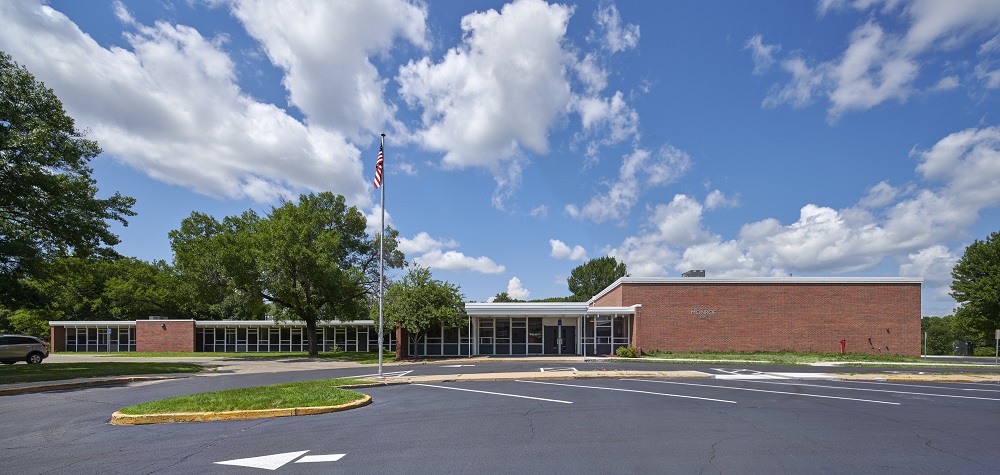
Monroe Place
Apartments in the former Monroe School rent for $695 a month,
but the Walk Score is 34

Residential concentrations of poverty are problematic for children, who do less well in life than those raised in more socioeconomically mixed areas (Chetty, Hendren and Katz 2016). They are problematic for adults, who have less access to economic opportunity as well as lower life expectancy (Ludwig 2014). Distance from affordable housing to jobs creates the transportation nightmares particularly for the poor and near-poor that Steven Higashide (2019: 92) calls "mobility redlining." 

Simpkins talked about "building communities that have been left behind" as an essential part of remedying the racial wealth gap (Urban Institute 2021, at about 1:01:50). Most areas of concentrated poverty have not gentrified since the 1970s, but in fact have gotten worse off (Cortright et al. 2014). Can cities provide incentives to locate jobs that pay well near low-income areas, and discourage large corporate campuses in remote locations? Or to encourage developers to build affordable housing near areas of economic growth? 

Options for cities include zoning reform that allows a greater variety of housing in a given area (Cortright 2017); Inglewood, California is planning zoning changes to allow more housing and commercial space near Metro rail stops (Sharp 2021). (See this post from 2017 for more on these issues.)

Welllington Heights 4plex
This four-plex is four blocks from my house.

So is this two-plex. If they were even closer, would I be less wealthy?

Cities can reform zoning codes to allow the production of small fourplex apartment buildings ("missing middle" housing) in residential neighborhoods (Holeywell 2016, McGlinchy 2017). Access to capital can provide "ladders" for those with very low income, as well as attracting middle class people to disinvested neighborhoods (Simpkins, in Urban Institute 2021). The national government can revisit the mortgage interest income tax deduction (Quednau 2017), as its value for most filers was eliminated by the 2017 tax act. 

Local transit connections can be improved almost everywhere, and certainly could be in my city. Dharna Noor (2021) points out "investing in public transit isn't just a good idea for the climate and commute times. It's also a good way to ensure everyone has access to opportunity, including the opportunity to relax. Imagine if access to parks and lakes weren't limited to those who can afford to buy, maintain, and park their cars. That could go far in improving access for exploited, poor communities who are disproportionately harmed by highway pollution." 

But is a ridership model compatible with where Cedar Rapids is currently building affordable housing (Pioneer Avenue, Johnson Avenue, Blairs Ferry Road, e.g.)? I would think not.

3. Stability and Gentrification

As land values rise, and incomes do not, evictions have soared: Desmond cited a figure of seven evictions per minute nationally in 2016 (Bipartisan Policy Council 2021). Annually there are more than a million more evictions than there had been foreclosures at the height of the housing crisis, with many associated bad effects on individual lives. Black [and Latinx] renters have about twice as high a rate of evictions as white renters. Evicted renters bounce from place to place because (quoting Desmond) they "are already living at the bottom of the market, in places they can't afford."

Stagnant incomes are one cause of housing instability; another is gentrification. Gentrification occurs where some circumstance has changed raising the potential value of housing far above its actual price (known as a "rent gap"). Recently middle-class demand for urban living has risen as amenities have improved, crime has decreased, and frankly fashions have changed. Gentrification can be good for places, and the people that live in them; at best it improves economic opportunity, public services and facilities, and the tax base. At worst it raises costs for those who stay, and drives others to less connected and less-well-off places (Florida 2015b; see this post from 2016 for a more detailed review of the debate). (For an argument that a focus on gentrification misidentifies the cause of problems with affordability and stability, see McMillan 2021.)

As rents go up, or property taxes rise on homes, some residents are forced to move to more affordable areas. Shane Phillips recounts one California experience: "A $5 billion stadium was proposed in Inglewood and rents and home values skyrocketed nearly overnight; even if the city had allowed for infinite development to meet the growing demand, thousands of households would be displaced before relief ever arrived. These changes were entirely outside the control of local residents, and yet they were the ones to suffer the consequences" (2020: 13). 

The Heart of the City cover

Alexander Garvin's book about downtown areas discusses the displacement of people along the way to prosperity: "Increasing demand led to increasing rents and the inevitable gentrification. The rental tenants, who had pioneered loft living and could not afford to remain in the area, were replaced by occupants who demanded and received better fixtures and services for their higher rents. But condominium occupants either remained in a much-improved neighborhood or profited from selling their residences at the appreciated value" (2019: 37). Increasing housing supply might mitigate gentrification "if the citywide housing supply is increasing faster than population growth" (2019: 159), but resurgent value of districts like Cincinnati's Over the Rhine seems to depend to a frustrating extent on getting rid of the "undesirable people" (2019: 134). Either way, as places gentrify, their former residents are going somewhere, and where they go should not be a matter of indifference to policy makers.

Rising values create incentives for property owners like MidCity Financial Corporation in Maryland to convert low-income housing developments into mixed-income mixed-use (Milloy 2021). At the Harvard report rollout, Gary Anthony of the National League of Cities argued that construction of one- and two-bedroom apartments is not an answer for families who have been priced out of their single-family homes, and advocated for "race-specific anti-displacement policy."

Cities could improve access to transportation and other amenities more broadly, to reduce the value premium on accessible places (Florida 2015a). Washington, D.C. is redeveloping a closed hospital in the Congress Heights neighborhood with affordable housing as well as an entertainment facility anticipated to create jobs (Steuteville 2021). Other options include inclusionary zoning requiring developers to include below-market-rate housing (S. Williams et al. 2016, Kaplan 2014); improving housing choices by loosening zoning restrictions in order to provide more options like living above your shop (Marohn 2015); limiting increases on property taxes (T. Williams 2014); and mitigating culture clashes by facilitating communication between the recently-arrived and long-term residents (Saunders 2016).

Conclusion

Shane Phillips argues for balancing the many interests involved in housing policy: 

We must design pro-housing policies that target development where it will benefit the most people (such as where housing costs are highest or job concentration is greatest) and that discourage it where it may do the most harm (such as on sites where dense concentrations of renters already live, especially in lower-income communities and communities of color). 
We must design pro-tenant policies that protect renters living in affordable homes while ensuring that development remains a profitable venture on sites where tenants aren’t threatened and it can do the most good. 
We must increase spending on rental assistance and affordable housing construction, and complementary zoning reforms and renter protections must be in place to make sure those funds are spent effectively (2020:42-43).

But he makes an exception to all that balancing by prioritizing affordability, even though, for many current owners, increased supply threatens the value of their property. It is an inescapable fact that home equity represents the major if not the only source of retirement savings. "Owning a home is integral to financial security for most families in the United States, and rising home values continue to give the government cover for skimping on retirement programs such as Social Security and pensions," but "ever-growing property values are completely incompatible with long-term housing affordability" (2020: 61). So, at the fundamental level, focus on broad affordability and the many social and quality-of-life benefits that would bring, and figure out some other way for people to accrue wealth.

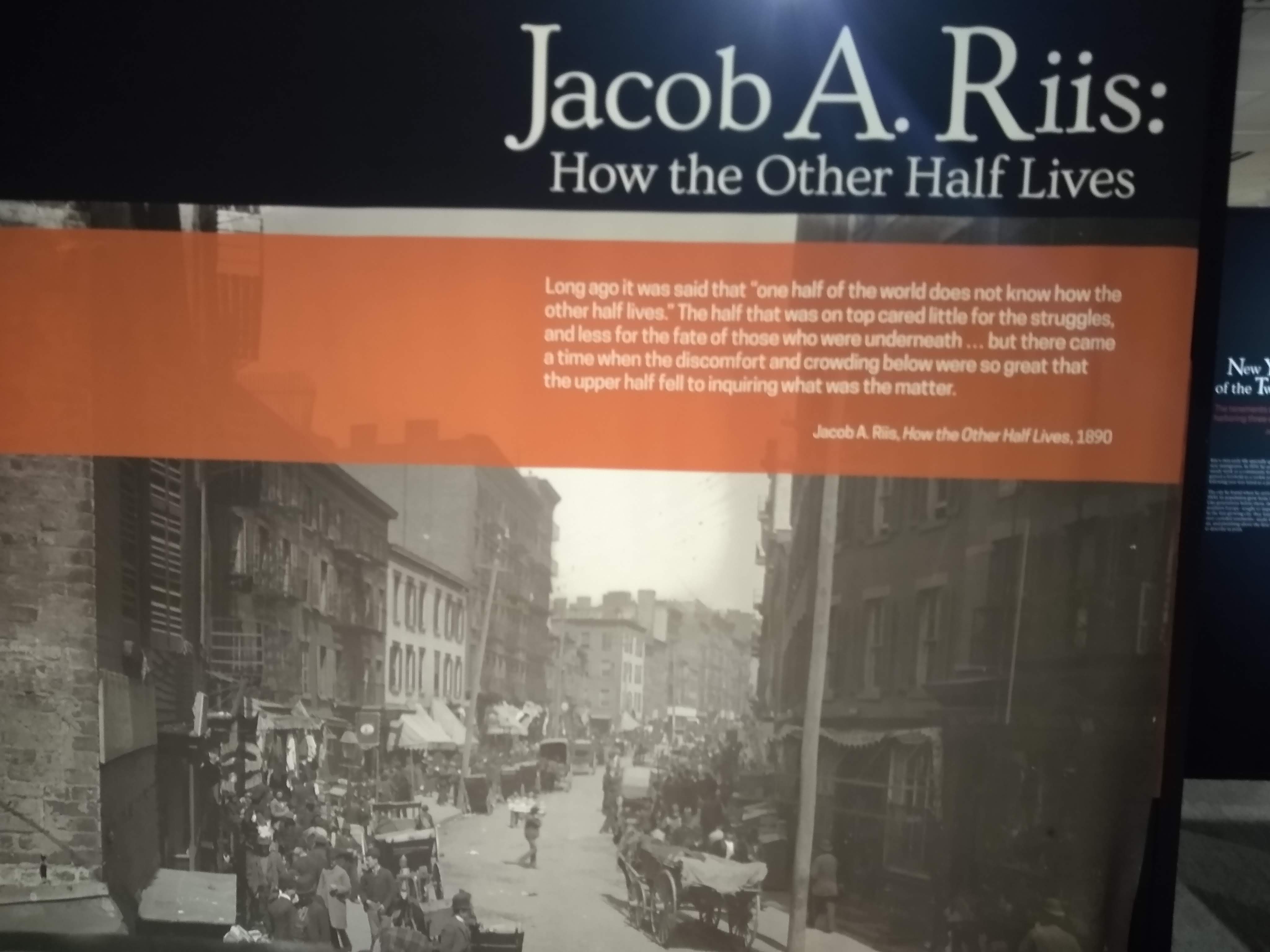
In the 19th century, Jacob Riis depicted squalid housing conditions in New York City.
An exhibit of his photographs is now at the National Czech and Slovak Museum and Library
in Cedar Rapids.

SEE ALSO

Bipartisan Policy Council, "Eviction Prevention Now and After COVID-19" [webinar], 23 June 2021 #harvardhousingreport

Alexander Garvin, The Heart of the City: Creating Vibrant Downtowns for a New Century (Island, 2019)

Annie Gowen, "She Wanted to Stay. Her Landlord Wanted Her Out," Washington Post, 28 June 2021

Steven Higashide, Better Buses, Better Cities: How to Plan, Run, and Win the Fight for Effective Transit (Island, 2019)

Norman Van Eeden Petersman, "Could You Move in Next Door?" Strong Towns, 23 June 2021

Shane Phillips, The Affordable City: Strategies for Putting Housing Within Reach (And Keeping It There) (Island, 2020)

Prevention Institute, "Healthy Development Without Displacement: Realizing the Vision of Healthy Communities for All," July 2017

Urban Institute, "Stable Housing is a Critical First Step Toward Racial Equity" [webinar], 29 June 2021 #liveaturban

Tuesday, August 29, 2017

Three futures for Mound View

Mound View neighborhood as seen from Clark Field at Coe College
When Imagine Mound View, Corridor Urbanism's street fair-cum-tactical urbanism event, occurs in early September, it will bring people to one of Cedar Rapids' most historic, walkable and centrally-located neighborhoods. The event is intended to highlight the potential of this area, and to promote principles consistent with prosperity, inclusion and resilience. But what will actually happen in Mound View over the next 25-100 years will result from the uncoordinated decisions and actions of many people and institutions, much of them taken in an environment currently unpredictable.
The Tic Toc, 17th St and E Av: once a renowned neighborhood gathering place,
awaits a new life in better times
Mound View is the historic name of a working-class neighborhood on Cedar Rapids' northeast side. Its official boundaries are 1st Avenue, 20th Street/Prairie Drive, K Avenue and Oakland Road/College Drive. These are mostly intuitive boundaries, but K and Oakland don't really demarcate anything, so it may make more sense to include the area between Mount Mercy University and the interstate in our mental map. This corresponds to the city's land use map, where it is all designated "urban-medium intensity" while nearby areas on the northeast side are designated "urban-low intensity." On the other side of the interstate is Cedar Lake, a former industrial site being reclaimed by a very hopeful group of people.
Oakland Road approaching G Av. Mound View's streets are an interesting mix of residential,
commercial and light-industrial uses


Mound View grew up around small factories and stores, as well as St. Luke's Hospital and Coe College, welcoming Mount Mercy Junior College (now Mount Mercy University) in 1928. The family of the future artist Grant Wood moved here in 1901; he attended the old Polk School and spent his young winters sledding down the steep hill in the 1800 block of B Avenue. (The Mound View Neighborhood Association offers an online walking tour of Wood-related sites.)

Grant Wood lived on 14th St early in the 20th century
Mound View retains a lot of advantages of traditional urban form: mixed residential and commercial uses (with some light industrial), a street grid, sidewalks, older styles of houses with porches, a large park, and several gathering places. The two colleges are less than a mile apart, and both have a large number of events and facilities open to the public. Garfield Elementary School and Franklin Middle School are within walking distance. A biking/walking trail was recently constructed that connects on both ends to an emerging county trails network. This stretch of the trail...


...passes through the Imagine Mound View location, and will be the site of e-bike and skateboard demonstrations as well as a pop-up coffee shop.

From that location, the walking distances to:
 Daniels Park splash pad 5 minutes
 Dick's Tap and Shake 5 minutes
 Dairy Queen 6 minutes
 J.M. O'Malley's 6 minutes
 Garfield Elementary School 8 minutes
 Hennessey Recreation Center at Mount Mercy 11 minutes
 Clark Racquet Center at Coe College 12 minutes
 Franklin Field 12 minutes
 Hy-Vee (supermarket) 13 minutes
 Regis Middle School 16 minutes
 Franklin Middle School 16 minutes
 McLeod Run Trail Park 17 minutes
 Brewed Awakenings Coffeehouse 19 minutes
 Cedar Lake 21 minutes
 Brucemore National Historic Site 25 minutes
 Shaver Park (disc golf course) 28 minutes
 U.S. Cellular Center 33 minutes
 Cedar Rapids Public Library 36 minutes
 City of Cedar Rapids 37 minutes

As was the case in a lot of core urban neighborhoods, the last part of the 20th century was not kind to Mound View. Center Point and Oakland Roads were re-designed as one-way, multi-lane throughways. A lot of the factories closed or downsized, as did many of the small stores. (The last grocery store in the area, Hy-Vee, was saved from closing by a $1 million renovation grant from the City of Cedar Rapids in 2000.)

As industrial jobs disappeared, people left the area, and what had been single-family housing became vacant or was converted to short-term rentals. A lot of new construction along 1st and A  Avenues used suburban-style large parking lots separating the buildings from the street. Coe College bought and knocked down a couple blocks' worth of housing in the middle of the last decade in preparation for an anticipated expansion. Polk School, which began to experiment with a "year-round" schedule in the late 1990s, was closed and converted to an alternative education center about ten years later.
Polk's playgrounds and basketball courts remain important neighborhood resources
The location and design advantages of Mound View co-exist with very low real estate prices, suggesting there is a rent gap here which could attract future investment. That is in fact what drew the attention of Corridor Urbanism. But investment doesn't occur automatically, nor when it does occur is it always benign.

Future 1: Deterioration of assets. Cedar Rapids is not New York or San Francisco. Regional land prices are low, and there are no mountains or oceans to block physical expansion. Construction of the Highway 100 extension has just opened up many acres at the edge of the city for development. As long as energy prices remain low, there may not be the incentives for private investors in older areas of the city. The remarkable emergence of New Bohemia since 2008 is inspiring to the other core neighborhoods, but probably not specifically replicable. The colleges have heavily invested in their campuses, but neither is flush enough to fund neighborhood development, nor is the city. The school district's radical proposal to close all existing elementary schools and build new ones means their investment in this area is likely to decrease rather than increase. In the absence of private investment, existing long-term homeowners will continue to hold on, but they won't live forever, and "generational replacement" (social science euphemism) would likely bring dramatic disinvestment to this area within 25 years.

Future 2: Gentrification with displacement. On the other hand, it's possible that developers will see a potential market in upscale housing here: college or MedQuarter employees, or fitness enthusiasts attracted to the trails and college-based facilities. Mound View could see a surge in condo construction such as New Bohemia and Kingston Village have experienced, and/or new home construction replacing "tear-downs." An increase in property values would be welcome, and a fair amount of housing stock certainly is dilapitated, but would likely price many existing homeowners and renters out of the area. Peter Moskowitz's recent How to Kill a City (Public Affairs Press, 2017) provides some particularly egregious examples from other parts of the country of government's use of incentives and condemnations in ways that facilitate displacement.

For this reason, I take a strong stand against rebranding Mound View as the College District. I know the colleges are substantial assets just waiting for the neighborhood to leverage them. But rebranding shows lack of respect, not only for the neighborhood's history, but for long-term residents as well.

Future 3: Gentrification, gently. The best outcome for Mound View will result from investment that improves the neighborhood while allowing it to remain true to its current assets including its people. The city has begun addressing obstacles to walkability: adding bike lanes to key streets, improving trails and, in the next couple years will be converting Oakland and Center Point Roads back to two-way albeit only above H Avenue. I'd like to see improved connection to Cedar Lake, either by making H Avenue less dangerous for cyclists and pedestrians where it meets the interstate, or better yet by punching through a connection around E Avenue. The strange intersection north of Coe College could be improved as well, slowing cars but accommodating multiple directions, while improving connection through Coe College to the MedQuarter and downtown with a sidewalk along Coe Road.
Center Point Road was blocked in the late 1960s;
the two segments are one-way streets, in opposite directions

What it looks like on a map
The worst of the housing stock should be replaced, but there should still be places for low-income people to live. People should be able to walk to school, shopping and work. Corner stores, small shops and bars would provide public gathering places as well as jobs. New housing construction should fit well with existing stock as well as their streets. Allowing accessory dwelling units would provide a non-disruptive way of increasing density. The school district should commit to keeping a school within walking distance of Mound View children; Coe College should be encouraged to do something with its empty land. 

A lot of what's needed to mitigate the negative effects of gentrification requires policy decisions at the state or national level [see Richard Florida, The New Urban Crisis, Basic Books, 2017, pp 191-215] but strong expectations established by both city government and neighborhood residents couldn't hurt. If we know what we want, and understand the trade-offs involved, we might get it.


THANKS to Imagine Mound View sponsors:
Legion Arts
Acme Electric
Benchmark Construction
Coe College
Dick's Tap and Shake Room
King's Material
Mount Mercy University
Valenta Plumbing and Heating

NOTES:
For earlier posts on the theme of gentrification, click on the link under "labels" in the right column.

City Data report on Mound View.

SEE ALSO: Phillip Platz, "Urbanism Advocacy Group Stages Festival in Cedar Rapids' 'Next New Bo'," Corridor Urbanism, 25 August 2017

10th Anniversary Post: Linn County's First Bicycle Boulevard

  Marion portion of Linn County Trails and Bikeways Map (downloaded from linncountytrails.org) (8/18/2026)  Linn County's first designat...