Monday, March 30, 2026

Book Review: Shade


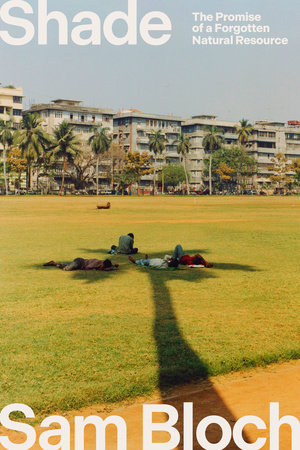
cover of Shade
Bloch, Sam. Shade: The Promise of a Forgotten Natural Resource. Penguin Random House, 2025, xviii + 309 pp.

(3/30/2026) Decades ago, when I was still in my insouciant youth, I went on a canoe trip somewhere in the Midwest. When we came to the end of the trip, I reached up to scratch my head, and it (my head) was hot to the touch from being in the sun so long. If my dermatologist is reading this, she now realizes why we are so often in each other's company! I have learned, over the years, to wear hats, and to seek shade.

Shade trees aren't always there when you need them, though. An incredibly violent derecho in August 2020 smashed through 75 percent of my county's tree cover. Humans have long done their own share of tree removal, whether to make room for buildings or roads, to remove shelter for unhoused people or cover for criminals, or simply to allow more natural light to reach interior spaces. (Los Angeles's Pershing Square, the story of which is told on pages 101-104, has suffered from every one of these initiatives.) As the climate changes, however, we may find shade to be a missing ingredient in surviving heat waves and affording our utility bills, not to mention keeping our tempers (p. 118).

city square bordered by buildings, no trees
Republic Square, Belgrade 2022:
"The horse" is where you find shade during the day
city park with paths and plenteous mature trees
Cuburski Park, Belgrade 2022:
green play space for apartment dwellers of all ages

Environmental journalist Sam Bloch takes us all over the world to see places where people suffer for want of shade, and where people are improvising ways to restore lost shade. He starts us in the natural world, where lost shade means no shelter from the sun, which is essential to animals from chinook salmon to chimpanzees. Humans, too, can only tolerate so much time in the hot sun, as we see its effects on our system and our mood from a little accessible neuroscience. "Shade soothes the senses.... Coolness never feels better than when we are warm" (14). The earliest cities, like Ur in the Middle East, were oases of shade, thanks to closely packed houses and carefully aligned streets (ch 2). The quest for cool relied on trees, fabric overhangs, and beginning in 1902, air conditioners. But while air conditioning achieved miraculous short term effects on human health, in the long term it has encouraged inefficient architecture, dramatically increased energy use, spewed enough hot air to raise outdoor temperatures, and decreased our resilience to heat (ch 3). Escaping the heat involves increasing the heat--an ongoing dilemma for our species.

Part II surveys the damage from inadequate shade, nimbly switching from human stories to the physiology of heat to climate data. In chapter four we meet the most vulnerable: those (often migrants) who do outdoor work on farms or construction sites; those with heart conditions or mobility issues; people in the military; and the unhoused. We also learn why the effects of thermal alliesthesia (heatstroke) are worse in the sunshine: the sun acts as "a microwave, shooting heat energy straight into our flesh" (p. 77). Wealthy neighborhoods are generally better-supplied with shade than are poor neighborhoods, and so are better prepared for warming summer temperatures. In Los Angeles (ch. 5), Watts residents are six times as likely as Westsiders to be hospitalized during a heatwave (p. 109), because it can be around ten degrees warmer in the poorer area (p. 106). "You can see L.A.'s shady divide from outer space," says Bloch (p. 98). This goes even moreso for freakish weather like the "heat dome" that struck the Pacific Northwest in late June 2021 (or the Southwest this month). Portland, Oregon hit 116 degrees on June 28, 2021, but there was a 25 degree variation across neighborhoods (p. 132).

Part III examines ways of adapting to climate change. Passive architecture (ch. 7) has significant disadvantages that might outweigh its advantages; the same goes for geoengineering (ch. 9). (What happens when Elon Musk decides to do to the climate what he did to the federal government?) Innovative shade (ch. 8) can be structurally inadequate, like Los Angeles's bus signs, or politically unpopular, like Barcelona's massive street tree program; more happily, Singapore has reduced temperatures on city streets, and Australia has seen skin cancer rates decline with each generation.

Bloch has tried to take a complex problem and break it down into digestible parts, including both symptoms and solutions. The parts don't always cohere into a theme, but even as separate essays the chapters work. Shade from trees can help lower street temperatures that are already rising, as well as mitigate the additional harmful effects of direct sunlight. But he isn't sanguine that such a huge and complex problem requires anything other than huge and complex solutions, involving "collective planning, management, and action" (p. 229). 

We need at once to coordinate action through inclusive conversation, probably with a preferential option to poverty-stricken areas; provide hope for collective rationality rather than leaving people to their own devices that will likely make the community worse off; and find a sustained source of resources for all this--all while democracy is teetering throughout the West.

city square, mostly trees
Greene Square, Cedar Rapids, 2012
(Google Maps screenshot)

same location as above, hardly any trees
Greene Square, Cedar Rapids, 2024
(Google Maps screenshot)

I think this post calls for a follow-up this summer with local shade audits. Watch this space!

SEE ALSO: Fenit Nirappil, "Inactivity in a Warming World Could Spur Hundreds of Thousands of Deaths," Washington Post, 16 March 2026 

Maple Syrup Time Again!


person following directions to condiments
Follow the signs to the 2026 Maple Syrup Festival!

(3/30/2026) More than 3,000 people made their way just outside of town to the Indian Creek Nature Center last weekend for the annual Maple Syrup Festival. Saturday featured a chilly wind which might have put a few people off, but by Sunday we were back to an unusual run of warm days this late winter/early spring. Long winter or mild one, it's a sure sign of spring when the sap has been running and it's time to gather at the Nature Center to eat last year's syrup.

pancake eaters entering Nature Center
Entering the Nature Center

Keeping the lines moving, and extra pancakes available for those going back for seconds--or thirds, for who's counting or judging when the syrup is genuine?--must be a strenuous logistical feat. And then there are the ticket takers, those clearing tables and washing dishes, and those in the field finding places for all the cars. Obviously the staff rely on a large number of volunteers (200+ in 2026, according to the Nature Center's Facebook page). Those of us who have only been on the outside, even after all these years, can only imagine and admire.
outdoor griddles and volunteers
Volunteers kept the pancake train rolling

My family went over Sunday morning. There was plenty of sunshine for those who chose to eat outdoors...
picnic tables with people eating under a sunny sky
Some took their syrup al fresco

...and plenty of music for those who chose the auditorium.
Mike Maas on guitar and vocals, John Korkie on drums
Inside Mike Maas, John Korkie, and Carlis Faurot (not pictured)
provided music
three pancakes and two sausages in a puddle of syrup, coffee cup in background
First round

After all those pancakes, the day and the trails beckoned:

trail curving through woods
Many people walked off their excess calories in the woods

fallen tree with polypore style fungus
Fungus holds still, unlike birds

These are without doubt perilous times for our country and our world, and so also for our communities. There is time for prophecy and protest, as indeed we had done the day before, along with about eight million of our closest friends. But there's also time for celebration of the joys of nature, and company, and the true community treasure that is the Nature Center.

humble blogger's humble son making weird face
The ability of the staff and volunteers to make all this work
year after year is simply... stunning!

The Nature Center thanks the event's sponsors: Alliant Energy, Cedar Rapids Bank and Trust, Central Iowa Power Cooperative, The Gazette, LUCC Local Union Community Charities, McGrath Auto, and Solum Lang Architects LLC--and so do I!

SEE ALSO: "The Sweet Science of Maple Syrup," Indian Creek Nature Center, 26 March 2026

LAST YEAR'S POST: "Nature Therapy, With Homemade Syrup," 30 March 2025


Monday, March 16, 2026

PCI Pays Property Tax. A Lot of It, Actually.


2nd Avenue dead ends at PCI
Was dead-ending 2nd Avenue a mistake, 
given the property tax volcano that is PCI?

(Truth in blogging disclosure: Your author is a frequent visitor to the Physicians Clinic of Iowa medical mall, including Forefront Dermatology, PCI Labs, and PCI Urology. He is grateful for the care he receives. He pays $29,637 per acre in property taxes on his house.)

(3/16/2026) A few days ago, I was in a discussion of the city's (lamentable, I still say) decision to close two blocks of 2nd Avenue SE to traffic to accommodate construction of a new Physicians Clinic of Iowa facility. An outgrowth of that discussion led me to the city assessor's site where I found, much to my surprise, that PCI, far from being an untaxed nonprofit, actually pays an impressive amount of property tax, even on a per acre basis.

Here, for comparison's sake, are 2024 tax data for some properties I've researched in previous posts:

Propertysize (acres)2024 Valuation2024 Tax Paid2024 Pay/Acre
GREAT AMERICA BUILDING
1.05$20,585,000$755,780$719,790
SKOGMAN REALTY
0.455,500,000257,006571,124
PULLMAN LOFTS
0.3053,837,10074,502244,269
RAYGUN/CROSBY'S
0.3863,070,30082,218213,000
TARGET (NE)15.4511,036,300419,74627,168
TARGET (SW)15.9111,797,200402,99825,330
WALMART (NE)17.979,613,600327,95418,250
WALMART (SW)
23.8912,350,000421,99617,664

Moving to the medical district, here are the major landholders:

Propertysize (acres)2024 Valuation2024 Tax Paid2024 Pay/Acre
COE COLLEGE22.36$51,770,50000
MERCY HOSPITAL
15.6194,083,700$58,812$3,942
ST LUKE'S HOSPITAL
15.524100,807,70097,5806,286
PHYSICIANS CLINIC OF IOWA
9.40378,771,5002,894,632307,940
Entrance to PCI Medical Pavilion I,
where 2nd Avenue SE used to be
(swiped from pciofiowa.com)

(NOTE: I am not going to swear by these exact numbers, because unlike the firms in the first table, these institutions all contain multiple properties, and I may have missed some or double-counted others. So don't sweat the specific numbers; the rough magnitudes are what matter.)

The one that is not like the others, which Sesame Street has taught us to seek, is PCI. Its property tax bill is comparable to some of the most valuable land in the city, at least among the parcels I've haphazardly picked. I have no explanation for this, and if you have one, I would be grateful to learn it.

PCI entrance in 2012
PCI former location on 8th Street SE
(Google Maps screenshot from 2012)

One can't blame the City of Cedar Rapids for paying attention back in 2010 or so when PCI threatened to move to Hiawatha. On the other hand...

My ongoing rants at the MedQuarter center on its lack of walkability, and the broken connection between Downtown and the neighborhoods. Those are the fundamental problems, not the tax treatment of different payers. Closing 2nd Avenue messed with the city's street grid, and the style of development in the MedQuarter prevents more compatible development, as well as making even the core of the city car-dependent.

SEE ALSO: Sarah Davis, "The Question Every City Should Be Asking," Strong Towns, 4 August 2021


Monday, March 2, 2026

10th anniversary post: Cedar Rapids named Blue Zones community

Celebrating at the Nassif YMCA, March 2016

(3/02/2026) When Cedar Rapids was named a Blue Zones community ten years ago, it was only the 15th town to be so certified. Less than two years later, however, the city's contract with the Blue Zones Project ended, and we switched to being a Healthy Hometown Powered by Wellmark. Today, the Healthy Hometown program no longer seems to exist: the link on the city webpage is dead, but there remains a list of healthy policy initiatives. A Wellbeing Advisory Committee formed in 2016 was disbanded in April 2025; its principles are now "engrained" in the city, they say.

Blue Zones still exists, just not in Cedar Rapids. It is a nonprofit organization that grew out of research by Dan Buettner, who wrote an article for National Geographic in 2000 about long lives of good health enjoyed by the residents of Okinawa. That led him to research other areas with unusually good health outcomes, and in 2009 he published a book. The Blue Zones: 9 Lessons for Living Longer from the People Who've Lived the Longest (National Geographic). That same year, the first of many Blue Zones projects was launched in Albert Lea, Minnesota. The first project in Iowa was at Spencer, which achieved measurable improvements in health, diet, and insurance claims.

Blue Zones recommendations that relate to eating well, exercising, and remaining socially engaged are inherently appealing, even I'd guess for people who aren't about to change their habits in real life. They certainly seem intuitively correct. But, lo and behold, in 2024 Freakonomics highlighted research by Oxford University research fellow Saul Newman, using birth records to argue that the claims for long lives in the Blue Zones were based on fraud, poor record-keeping, and maybe confirmation bias. Those superhealthy Okinawans, for example, eat lots of Spam (TM), are disproportionately obese, and have high rates of suicide. Very, very few if any of them have lived past age 110 (Dubner 2024).

This skepticism has not slowed Blue Zones down, however. Their website provides multiple pages of advice, programs, and success stories. Their media coverage continues positive: This month's issue of Prevention includes recipes for "Blue Zones style eating," including creamy white bean and tomato soup ("prioritize protein from plants"), guacamole and bean tacos ("load up on legumes"), and spanakopita pasta ("make goat and sheep milk go-tos"). The recipes come from the "places around the globe where people live the longest" ("The Blues Bites" 2026).

Longevity is becoming big business. Last month Byteseu reported from the Global Wellness Summit in Dubai, India, where there were a weird variety of gadgets and subscriptions available to the superaged-wannabe. The sponsor organization estimated the size of the worldwide wellness industry at $6.8 trillion annually (Sharma 2026). All Blue Zones wants you to do is walk instead of taking a car, eat more local unprocessed food, and play cards with your friends. That seems relatively harmless, even quite helpful, however exaggerated the original data might have been.

When Cedar Rapids disbanded its Wellness Advisory Committee last spring, it declared the battle won. That's wishful thinking: the battle for public health is ongoing, and needs to be put at the forefront of all policy making. (What does pinning our economic hopes on data centers and a casino say about Cedar Rapids' commitment to wellness?) Byteseu writer Sanjukta Sharma cites Mumbai professor De. Srinivas Goli who says for most people the goal is not buying the secret to partying past 110, but "managing the triple burden of earning money, battling a disease through robust accessible public health systems, and basic elderly care." As Iowa tries to protect Monsanto from liability for the effects of its pesticides, who in government is working to reduce the effects of externalities on our health?

ORIGINAL POST: "Cedar Rapids Named Blue Zones Community," 9 March 2016

PRINT SOURCE: "The Blues Bites," Prevention (March 2026): 82-89

10th anniversary post: The tragedy of the commons (life)

Litter is a plague on our cities (4/1/2026)  Ten years ago this month, I wrote about a fellow who used the grassy median on our street as hi...