Showing posts with label Peter Calthorpe. Show all posts

Monday, July 1, 2024

Could 1st Avenue East be a Grand Boulevard?

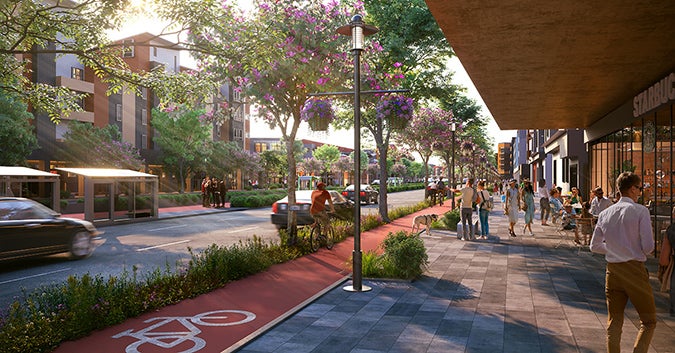
busy street with apartments, trolley, bike lanes, pedestrians and a dog
Is the world ready for 1st Avenue E to look like this?
(Swiped from hdrinc.com; used without permission)

(7/01/2024) The closure this month of the 1st Avenue Hy-Vee and Via Sofia's Restaurant has drawn attention to the perennial low performance of this historic street that slices between the Mound View and Wellington Heights neighborhoods. Without these two anchors, 1st Avenue might now be said to be in a state of crisis.

empty restaurant building with "coming soon" sign
1125: Via Sofia's has closed, but new tenants are coming, possibly soon

Perhaps co-incidentally, the City of Cedar Rapids is undertaking to create a plan for 1st Avenue East from 12th Street (location of Via Sofia's) to 17th Street (one block above Hy-Vee). The street was developed over a hundred years ago, and still bears the signs of being a neighborhood market street. Unfortunately, since then, the surrounding area has been emptied of population, especially below 14th Street, while 1st Avenue has been widened to a five-lane highway that carries 17,000 cars per day through this stretch. Auto-oriented development has not been good for a street built for walkable neighborhoods: The population within a walkable distance has declined, while the cars whizzing through have trouble finding places to park.

Here is an extreme but real example: The side of 2nd Avenue pictured below...

vacant lots on 2nd Ave
1246 2nd Ave SE: vacant church next to vacant lots

...had 71 people living on it between 12th and 13th Streets in 1953, according to Polk's City Directory. Today that number is zero. Extend that story over the whole area between 15th and 5th Streets SE and you can see what happened to neighborhood retail. 

1st Avenue near downtown is worth the city's attention. Even in its current forlorn state, it's outperforming the big box stores on the edge of town.

FINANCIAL PERFORMANCE, 2020-24

(compare to NE side Wal-Mart taxable value $534,981/acre)

NAME

ADDRESS

ACR

ES

TOTAL TAX VALUE 2020

VALUE PER ACRE 2020

TAXES EST

 2020

TOTAL TAX VALUE 2024

VALUE PER ACRE 2024

Cafe Allez & 237

111 13th St SE

0.193

248,200

1,286,010

9,328

207,800

1,076,684

Via Sofia’s

1119 1st Av SE

0.193

398,500

2,064,767

14,977

413,200

2,140,933

Wendy’s

1314 1st Av NE

0.771

1,424,100

1,847,082

49,996

1,454,300

1,886,252

Poppa& Tommyz + apt

1323 1st Av SE

0.289

384,000

1,328,720

13,118

387,000

1,339,100

Arby’s

1417 1st Av SE

0.386

654,200

1,694,819

22,967

720,300

1,866,062

College Commons + apts

1420 1st Av NE

0.874

3,301,000

3,776,888

98,747

4,143,700

4,741,076

McDonalds (closed)

1530 1st Av NE

1.200

1,329,000

1,107,500

46,658

1,090,300

908,583

Finding a formula that works for 1st Avenue near downtown would definitely help sustain the adjacent neighborhoods; if it continues to deteriorate, it will drag them down and create a desolate zone in the core of the city.

Grand Boulevards

face shot of Peter Calthorpe
Peter Calthorpe (swiped from hdrinc.com)

Last month, at the Congress for the New Urbanism, keynote speaker Peter Calthorpe described his idea of grand boulevards, and this might be a solution for 1st Avenue. Grand boulevards are commercial corridors developed with multifamily residential units and served (at least eventually) by public transit. He pitched it as a solution to the housing shortage more than a solution to declining corridors, but it is reported we do need more housing, and anyhow implementation of grand boulevards requires a declining commercial corridor in which to implement them.

closed restaurant with closed grocery store behind it
1530: Closed McDonald's by closed Hy-Vee

(Cedar Rapids residents will at least be familiar with Calthorpe's firm, HDR, which designed the trails on Mt. Trashmore near Czech Village.)

Peter Calthorpe and slide
Calthorpe's presentation at CNU: more focused on housing shortage than under-performing streets

Calthorpe envisions mid-rise buildings with about 100 units, so fairly large, mostly market-rate with maybe 15 percent reserved for affordable prices. (Too high a percentage discourages developers.) As much as missing middle and accessory dwelling units are steps in the right direction, the grand boulevard concept is the only way to get a lot of buildings at scale with private financing. (Governments can't afford to subsidize all the housing that needs to be built, he says.)

Kingston Pointe Apts, 515 2nd Av SW
Kingston Pointe, 515 2nd Av SW, has 18 units on half an acre, but we could go a good bit denser
Ashton Flats, 217 7th Av SW
Another model: Ashton Flats, 217 7th Av SW

The 1st Avenue Grand Boulevard

About 3250 feet worth of 1st Avenue is under study from 12th to 17th Streets, or a total of 30 acres on both sides of the street. If half of that territory is available for redevelopment, that would mean 900 or 1000 dwelling units (at 60+ per acre), which could be like, what, 2500-3000 residents? (Note that I'm not counting potential properties on A and 2nd Avenues, or farther up 1st.)

closed office building
1225: long-vacant office building on lonely block across from Coe College campus

EZ Pawn, 1344 1st Av NE
1344: Not picking on anyone's business, but this close to downtown?

2500-3000 new people living along 1st Avenue will generate more foot traffic for businesses.

1271: Opening of Cafe Allez has been attended by long frustrating delays

These people would need a lot of groceries, for one thing. Their presence on the street would reduce car speeds and crime while increasing liveliness (which can only help attract students to my former employer, Coe College). They would improve the current demand for public transit. "Once you've got a ribbon of development," says Calthorpe, "You can backfill transit along the way." 

Transit available to backfill includes the #5 bus along 1st Avenue, which already runs every 15 minutes, and could be extended to evening service; there could also be a north-south route, say an enhanced route #6, connecting Wellington Heights (and Oak Hill Jackson?) to the Coe and Mt. Mercy campuses up to commercial districts to the north.

Passengers wait for the #6 at Coe College bus shelter, November 2022:
the bus stop for the #5 on 1st Avenue is visible in the background
(Google Earth screenshot)

Constructing all these apartments creates questions about parking (where and how much?) and driveways (open to 1st Avenue or side streets?). I think these are important but resolvable questions. For the record, Calthorpe wants no minimum parking requirements, but that's not the same as no parking at all.  Anyway, the conversation should start with how we want to live, not where we are going to park.

1st Avenue is also a state highway (Business US 151 & SR 922), so civilizing the street itself to slow cars and encourage cycling and walking will require cooperation with the Iowa Department of Transportation. Alexandria, Virginia was able to work this out for King Street, and IDOT is trying to narrow highway right-of-ways through other towns, so I'm encouraged to hope they'll work with us.

SEE ALSO

"Crossing Cedar Rapids' Busiest Intersections: 1st Avenue," 8 August 2023

Martin Pedersen, "Peter Calthorpe Has a Plan for Building More Housing in California," Arch Daily, 7 April 2023

Robert Steuteville, "Grand Boulevards Would Solve the Housing Crisis, Peter Calthorpe Says," Public Square: A CNU Journal, 24 June 2024

Calthorpe's 2017 TED talk, "Seven Principles for Building Better Cities" (14:21)

Wednesday, May 15, 2024

CNU Diary 2024: Restorative Urbanism


statue of Cincinnatus
Cincinnatus, on the Ohio River Trail

Wednesday, May 15

Jane and I are in Cincinnati for the 32nd annual Congress for the New Urbanism. After an all-day drive, we got here about 8:00 in the evening, too late to register or join the Opening Night Party, but I'll be raring to go tomorrow. We're staying at the Homewood Suites by Hilton in downtown Cincinnati, a couple blocks from the conference site at the Hilton Cincinnati Netherland Plaza. 
Hilton Netherland Plaza

We walked over there this evening, and checked out a couple potential coffee locales. Jane took some pictures at Fountain Square.

The first thing I noticed about downtown Cincinnati is that most intersections have a NO TURN ON RED sign. Urbanists tend to dislike right-turn-on-red, which was mandated nationwide when I was in high school in order to save on energy use and air pollution from idling cars. It's not that we like either of those, either, but that turning cars add dangers to walking (or riding bicycles).
NO TURN ON RED

Thursday, May 16

Mallory Baches speaking in front of CNU 32 slide
President Mallory Baches welcomes the convention

What I love about CNU, both the conference and the organization, is the inherent optimism. We are full of hope. I am personally inclined to despair, and I'm sure everyone at this meeting has had considerable experience with their good ideas being rejected by the city council or the public or their boss. And yet, we remain hopeful that the problems of today's cities can be solved and we are the ones who know how to do it. It was this sort of humanism that fueled the Enlightenment, declared Independence, and wrote the Constitution.
(from L) Peter Calthorpe, Aftab Pureval, Ellen Dunham Jones

The mainstage address was given by Peter Calthorpe, co-founder of CNU and co-author (with William Fulton) of The Regional City (Island Press, 2001), one of the first books I read on the subject of urbanism. He talked up Grand Boulevards as the solution to both the housing crisis and the decline of retail strips. Grand Boulevards involve building multifamily units along commercial corridors and near transit, which has worked (says he) in Minneapolis since 2017, as well as a 43 mile long development along the El Camino Highway in California's Silicon Valley. Once you've got a ribbon of development, he says, you can "backfill" transit along the way, by which he means Bus Rapid Transit, since "we can't afford" light rail (in a tone indicating possible irony).

Peter Calthorpe and informational slide
Calthorpe presenting

He was followed on the stage by Aftab Pureval, mayor of Cincinnati, who welcomed the conference and proclaimed today to be Restorative Urbanism Day.  Pureval represents the paradigmatic American dream, as his parents immigrated to the United States from India, his mom having come to India as a refugee from Tibet. But, he says, that dream is "becoming further and further away" for many Americans, so he hopes through policy changes like BRT and zoning to "desegregate the city so there are no wealthy or disinvested neighborhoods, just Cincinnati neighborhoods."

Attendees at the opening event in the Hall of Mirrors

At 10:30 I attended a talk jointly given by Victor Dover, who runs a planning firm in Coral Gables, and Ashleigh Walton, an architect with a firm in Pittsburgh, billed as a "new urbanism starter course" but focused on this year's theme of restorative urbanism. Ashleigh Walton discussed restorative urbanism in terns of reforming "detrimental regulations" that shape our cities and that inhibit walkability, housing affordability and supply, and adaptation to climate change, exemplified by so many "blown out downtowns" across the country. 

We were invited to eat lunch in Fountain Square. I bought a Grabbo's sundae at a food truck called Wild Side Experience that advertised "caveman food." The Grabbo's sundae involves barbecue chips, pulled pork, lettuce, and sour cream, but not ice cream.
Grabbo's sundae
Caveman food: Grabbo's sundae from Wild Side Experience

I didn't converse with any urbanists during my lunch, but spent a happy time people watching. Fountain Square is amazing on a nice day. It reminded me of the Trg Republike in Belgrade.
Fountain Square
Fountain Square, downtown Cincinnati

For comparison: Trg Republike, Belgrade, May 2022
 
In the afternoon, I went on a streetcar-and-walking tour of the Over the Rhine district just north of downtown Cincinnati, which used to be a German area, then a poverty-stricken area, and now is gentrifying. 
Italianate building at 1401 Elm St
Typical Italianate style building on Elm Street:
1st floor retail, tall windows, little chunky tabs at top

row houses
Race Street: built to the sidewalk, with breezeways so
residents didn't enter through the 1st floor store

porch at rear of beer garden on Vine Street, used for public speeches
Hanging out in Washington Park on mosaic-encrusted bench

This morning, as soon as I walked into the conference hotel, I ran into Jeff Wozencraft, a planner with the City of Cedar Rapids, and as far as either of us knows the only other person from Cedar Rapids who is here. Given the nature of conferences, I figured that would be our only encounter, but as it turned out, we were at the same happy hour event in the evening, sponsored by the Michigan and Midwest CNU chapters and held at a Unitarian Church-turned-event space called the Transept. Jeff and I were joined at the event by a lively bunch from Sarnia, Ontario. Maybe Cedar Rapids and Sarnia could be sister cities!

The Transept, 1205 Elm Street

As part of the happy hour event, I "debated" Eric Schertizing of Lansing, Michigan, on the value of historic preservation. When he's not debating me, Eric is executive director of the Michigan Association of Land Banks. We had an interesting conversation, though audible to very few in the super-live former sanctuary with a lot of side chatter happening. One of us "won," as determined by audience cheers, though I couldn't tell who.

Friday, May 17

people in bike helmets gathered by a Red Bike van
Prepping for bike tour

Happy Bike to Work Day! Today I and a couple dozen other bikers braved the rain to tour the riverfront trails in Cincinnati and northern Kentucky. 

crowd gathered on pedestrian bridge
Breakfast on the Bridge

We began with Breakfast on the Bridge, a 15-year-old Bike to Work Day tradition on the Purple People Bridge between Cincinnati and Newport, Kentucky. We got there as they were preparing to wrap up, but there were still a lot of people there. I had some complementary coffee and chatted up some folk from an architecture firm and from the transit agency. I also scored a couple clementine oranges, which a sympathetic fellow traveler stored for me in her bag.
painting on the bridge showing the state line
Entering Kentucky
(which starts at the river's edge per US Supreme Court in 1980)

the Ohio River
View of the Ohio River from the Purple People Bridge

We were out a little over two hours, riding across the Ohio River twice, and sampling trails on both sides.
new apartment building
New and probably pricey riverfront apartments in Cincinnati

bike riders beneath lush tree canopy
Tree canopy over the Ohio River trail
  
a barge on the river
Must be a barge coming through!
(behind it is where the Licking River flows into the Ohio)

older white house in good condition
Covington: Boyhood home of Daniel Beard, founder of Boy Scouts of America

mural section depicting religious buildings
Covington murals, religion section

mural section honoring Covington baseball team
Covington murals, baseball section

Roebling bridge over the Ohio River
The Roebling suspension bridge was the prototype for the Brooklyn Bridge
(Pro tip: Don't tell anyone here it looks like it was inspired by Brooklyn!)
 

bike riders stopped between houses and street
Riverside Drive, Covington: End of the trail (for now)

River Trail, Cincinnati: bike channel on staircase
Ohio River Trail, Cincinnati: bike channel on staircase

6th Street, near the bike shop: One more mural, baseball section

This year, unlike in 2023, my e-bike worked, though I mostly found the electric boost inconvenient and had it off except for steep hills. My biggest problem this year was finding a helmet that fit; a couple people had brought their own, and maybe I should do that next year. One of our guides not only had his own helmet, but brought his own shade as well!
bike helmet with sun hat brim
Worn by one of our tour guides: Da Brim. I need one.

I met up with Jane for most of the afternoon. We had lunch in the Over-the-Rhine District...
Iris Book Cafe

...then went to the Underground Railroad Museum.
Underground Railroad Museum entrance

I returned to the conference for a late afternoon session on small developers, presented by Joe Klare of Covington-based Catalytic Fund and developer Brian Boland. The Catalytic Fund provides loans that bridge the gap between what a bank is willing to lend and what a small developer needs to make a project work. I sat with a woman from Portland who works on parking issues. She asked how they were able to overcome public concerns about parking with their projects. The presenters were more sanguine than she was (or I am).

In the evening, Jane and I went to a brewpub across from the Cincinnati Reds' stadium, then heard live music (Indie night) in Fountain Square.

Saturday, May 18

The conference rang down today with a closing address by Carlos Moreno, the Paris-based academic credited with the concept of the 15-minute city. I bought his new book today [The 15-Minute City: A Solution to Saving Our Time and Our Planet (Wiley, 2024)] at Roebling's onsite store, along with Megan Kimble's City Limits: Infrastructure, Inequality, and the Future of America's Highways (Crown, 2024).

line of patrons at coffee counter
starting the day at the excellent Deeper Roots coffeeshop downtown

I also took in a couple of panel sessions, a presentation by Brooklyn-based planner (and political scientist!) Jerome Barth on what makes public spaces successful, and a group report on a neighborhood-led investment plan for the West End area of St. Louis. Both have some things to say to Cedar Rapids, and I will probably return to them in future posts.

Jerome Barth speaking in front of projected slide
Jerome Barth

West End/Visitation Park project panel

Not only that, but I took a couple of quizzes created by Emerging New Urbanists, who obviously remember the good old days of Facebook quizzes. To the question of What kind of urbanist are you? I got the result history and cultural urbanist. To the question of Which transect zone are you? I got the result T6-Urban Core. Those may both be more aspirational than actual, but I maintain all such quizzes are inherently valid.

Carlos Moreno at the CNU podium
Carlos Moreno

Moreno started with natural disasters and other stressors caused by climate change--one estimate had $38 trillion in damages annually from extreme weather--but shifted to the broader question: What kind of city do we want to live in? Car dependency has, he said, led to living and working under constant stress, long daily trips, lost access to opportunities and social interactions, misused buildings, and overall lower quality of life. His alternative is "human-oriented urbanism" or "social circularity"--no wonder it's come to be called "the 15-minute city" although he gets frustrated with the focus on the number "15"--which includes proximity to essential services, organic density, mixed uses, quality public spaces, efficient public transport, and three other things I didn't get. Cities can promote design that delivers these goods while discouraging design that doesn't. I'll have more to say about Moreno when I read his book this summer!

Frank Starkey at the CNU podium
Next year in Providence!: Board chair-elect Frank Starkey closes the conference

Evening entertainment: Cincinnati May Festival concert at the Music Hall in OTR

SEE ALSO: "CNU Diary 2023," 1 June 2023
 
"Charter Awards 2024" (Congress for the New Urbanism)

Addison Del Mastro, "New Urbanism and Urbanist Media," The Deleted Scenes, 21 May 2024

hotel lobby with welcome sign
I never did see Michael Jackson...

The Value of Incidental Contacts

  Incidental contacts can happen on sidewalks, but only if there are people going places Places like the Stroget [in Copenhagen] carry an in...