Showing posts with label traffic. Show all posts

Wednesday, July 24, 2024

Nice Drivers of America, Please Stop Doing This One Thing!

Marion Parks Trail crossing Lindale Drive, 2012
It's nicer now:
Grant Wood Trail crossing at Lindale Drive, 2012

(7/24/2024) As I walk and ride on our city's streets, I seem to be encountering more aggression this summer than usual. In these fraught times, there is ample fodder for speculation on whether and why. However, I am not here to talk about that, because my market research team informs me that overly aggressive people do not read this blog.

So, instead, I'm going to complain about... courtesy? With all the hate I'm getting, I'm complaining about... love? You would think we need all the time, love and tenderness we can get, and I guess that's valid, but I keep feeling someone's misplaced courtesy is going to get me killed.

Sunday afternoon I was riding on the Grant Wood Trail when I came to the intersection with Lindale Drive. There is a push button for crossing, but there were only two cars on Lindale, so I figured I would hang back and let them pass. Alas, driver #1 spotted me and stopped to wave me across. How courteous! How neighborly! How... dangerous! Driver #2, no doubt unaware of this selfless act,  swerved and accelerated right across the path where driver #1 had encouraging me to cross. What degree of brokenness would my body now be in had I accepted the original offer?

Unaffected by this drama, driver #1 continued to sweetly but obliviously wave me across, as more vehicles arrived from both directions. But I have seen this maneuver any number of times and I will not cross in those situations. Honest to Pete, fella, did you not see what your courtesy almost led me into? 
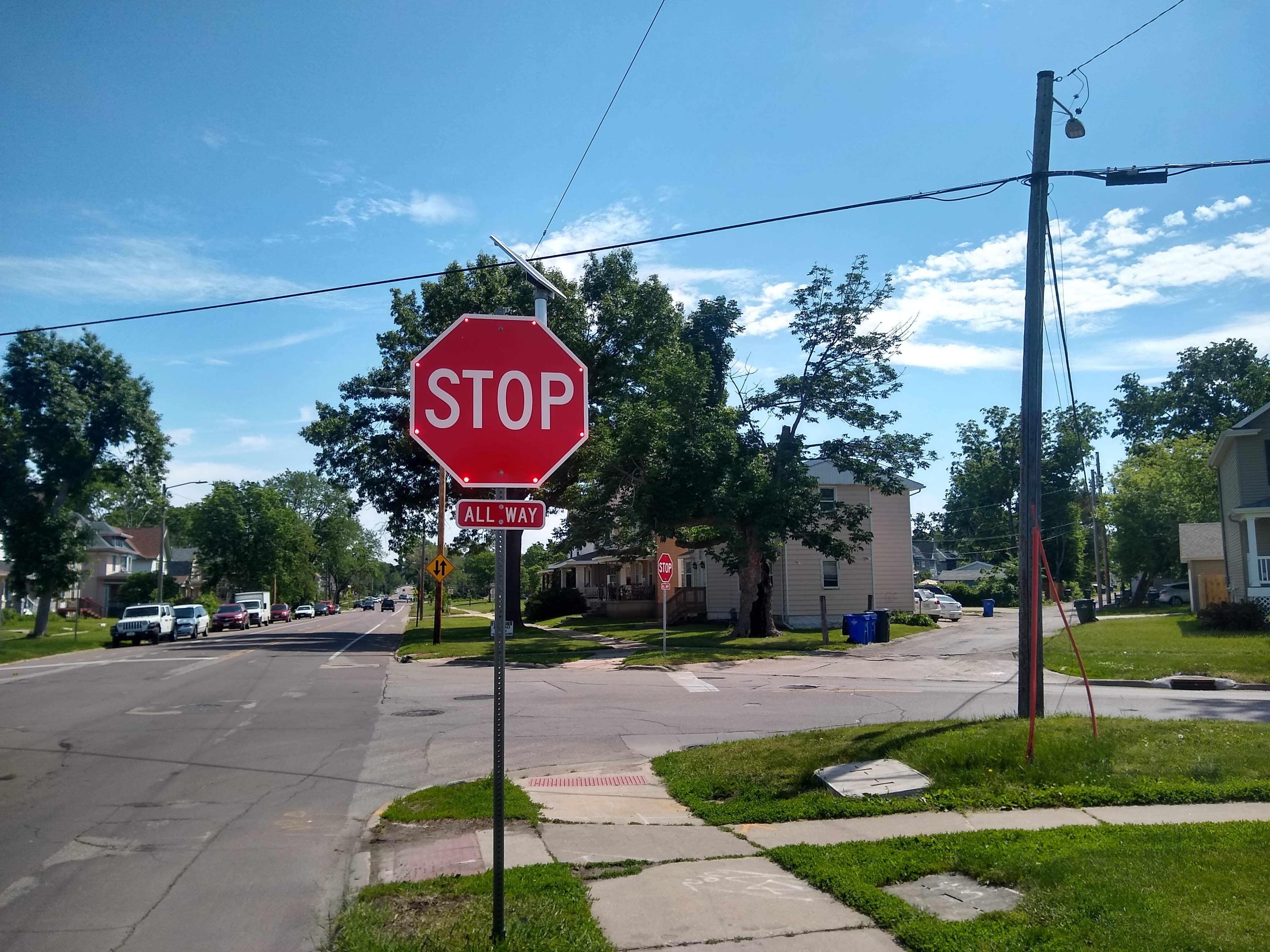
stop sign on 3rd Avenue SE
3rd Avenue SE: Do stop here

If you as a driver encounter a stop sign or a red stop light, you should stop at it. That's the law. If you come to a crosswalk with flashing lights, you should also stop at it. That's also the law, I think. If there's someone in the process of crossing the street, you should stop. It's against the law to hit them, although I found it's not against the law to almost hit them.

My concern here is not with any of those situations. I'm talking about when you as a driver are not obligated to stop, but choose to do so out of an excess of courtesy. Your kindness is well-intentioned but misplaced.

The world we live in is full of anger, and between talk radio and car commercials, anyone is a target. In June 2022, in downtown Cedar Rapids, an enraged pickup driver at a green light pulled around two (properly) stopped cars and into a group of people crossing the street (Lenz 2022). Two women were seriously injured. The driver was arrested but acquitted at trial. The circumstances were unusually political, but the anger and aggression are not. Not everyone is as nice as you, Mr. or Ms. Courteous Driver. I am over here, 30 feet from the street, trying to avoid it all. Please leave me alone!

apartments on narrow street
20th Avenue SW: Soon people will be crossing this street to get to the
Westside Library. Keep driving.

New question: What if there's no one else around, no impatient driver #2 to zoom around you and potentially injure someone, just you in your SUV and someone on foot or bicycle waiting to cross the street? Here there's no danger of serious injury, so a lot of what we've said above doesn't apply. However, I would still keep going, if I were you. If I'm the pedestrian, I'm waiting for you to drive by so it's free for me to cross, a process that takes at most five seconds. However, if you slow to a stop, and motion me across, and I perceive all that, we've taken multiple times that amunt of time. By the time I start to cross, I would have been across, if only you'd kept going. It's not dangerous, just inefficient. Your kindness, while still admirable, is producing frustration.

In fraught times, we need to be patient and forbearing with each other, and in densely-populated cities we need to give everyone some space. Sometimes a little generosity can go a long way. But if not thought through, trying to do someone a favor can end in disaster. In those situations, it's better for everyone if you'd just please maintain course and speed, and we'll all get where we're going in one piece!

Tuesday, August 14, 2018

Bypasses and suburban development


(Video: US 30 construction from Cedar Rapids Gazette)

Two substantial highway projects are underway in Linn County: extension of Iowa 100 around the northwestern side of Cedar Rapids, and diversion of U.S. 30 to the south of Mount Vernon and Lisbon. With total federal and state commitment in the mid-nine figures, it’s worth asking what impact these projects will have on our towns? With widening Interstate 380 between Cedar Rapids and Iowa City also still a live option, what does all this rural concrete say about the vision for our future?

These bypasses will have different effects than the bypasses around small towns I surveyed in my last post. Those moved through traffic out of the center of town, but besides that had no immediate effect, either positive or negative, on the towns themselves. In Linn County we’re dealing with one entirely new road, and one replacement for an existing two-lane bypass. Moreover, we’re dealing with them in Iowa’s second-largest county, one that has seen 17 percent population growth since the 2000 census (average for the U.S., but much faster than the whole State of Iowa). The Cedar Rapids metro area presents a more dynamic context than do the towns in the last post; so, given that change is already happening and ongoing, what will the bypasses contribute to it?

Commercial strip on Bus US approaching 151/13 bypass (Google Earth)
Officials in each town anticipate the bypasses will accommodate, indeed will facilitate, future growth. (The population density of the city of Cedar Rapids is a modest 1,189/sqmi, but we do like our personal space.) Cedar Rapids projects a 2035 population of 161,073, assuming 1 percent annual growth, a gain of 29,000 from the current estimate of 132,228 (EnvisionCR 54). Cedar Rapids's future land-use map anticipates the area around the new highway to be a mix of commercial and "urban medium-intensity" characterized by 4-12 units per acre, a "high-connectivity grid pattern" and "transportation, housing and shopping choices in close proximity to each other" (EnvisionCR 69). 
Future land use map including areas to be annexed (Envision CR 67)
Mount Vernon's map shows a mix of "suburban residential," "general commercial," and "business park."
Future land use map including areas to be annexed (cityofmtvernon-ia.gov)
Lisbon is still working on their map, but they too are bullish on the town’s expansion. City Administrator Connie Meier told the Gazette: We’re hoping to grow the community by having developments up to the bypass, hopefully on the east side of town and south of town, and also incorporate some commercial business along the bypass (Payne 2018: 11A).

The most likely outcome of federal-state highway spending and local growth ambitions is suburban sprawl, by which I mean low-density, car-dependent, loosely-controlled expansion into unsettled areas. Here’s why:
((1)) The new and expanded highways will induce demand, but even so the areas available for expansion would accommodate growth beyond the most optimistic projections. Eyeballing, the area around Highway 100 adds about 20 percent to the Cedar Rapids current area; at current density that would add over 26,000 residents. Mt. Vernon expects to spread not only to the new U.S. 30, but southward along S.R. 1, and as new U.S. 30 swings south it provides Lisbon with plenty of room to grow. So I'll say to fill up all three areas even at low suburban densities would take at least 30,000. That's nearly double the three towns' combined growth between 2000 and 2016, and equals the optimistic growth projection for Cedar Rapids alone. Development is going to be low-density here, and unless economic development and demand for labor ramps up in a hurry, the newly-opened areas will add residents by competing for existing residents with other parts of the county. 

((2)) Because development will occur before annexation, the future land use maps are merely suggestive. This limits their influence on the nature of development, for all that Mt. Vernon city administrator Chris Nosbisch tells the Gazette "it's imperative" for the new commercial area by the bypass to fit with what the town already has (Payne 2018: 11A; see also Kalk 2018). Town leaders ravenous for “game-changers” will accept whatever’s done.

Newer suburban development south of U.S. 30, Lisbon (Google Earth)
((3)) Previous bypasses, like Iowa 13 east of Cedar Rapids or U.S. 30 to the south, have produced exactly this kind of development. Exits off U.S. 30 in Cedar Rapids lead to the miles of big-box stores and commercial strips along Edgewood Road, Williams Boulevard and other "stroads" in that area, with characteristic swaths of pavement and low tax yield per acre. Entering Marion off Highways 13/151? Same. Residential developments around these highways are either large-lot subdivisions or mobile-home complexes, and never both. (The latter are, admittedly, densely-populated, but in a way that's more efficient for the owner than walkable for the residents). Public transit out here is scanty where it exists at all. The current two-lane, non-limited access U.S. 30 south of Mount Vernon and Lisbon mostly features a typical highway commercial strip of gas stations, fast food and car dealers.

((4)) While the last decade has shown some impressive appetite for walkable urbanism living, particularly among younger consumers and empty-nesters, gasoline is too cheap, commutes too short, and the environmental consequences too remote for this preference to expand enough to reshape our development pattern.

((5)) It’s what developers want to build anyway (Samuels 2015).

Edgewood Road SW, looking towards U.S. 30

The negative consequences of the suburban development pattern have been thoroughly catalogued (for example, in these older essays, "Urbanism Review" and “The Urbanism CLEF”). Inducing more driving stresses the environment, the school system and the local economy. The arterial stroads typically used to funnel traffic through populated areas to the highways have seen the greatest increase in pedestrian deaths ("On Foot, At Risk" 2018). An increasing pile of studies have shown negative health impacts of sprawl (Jackson and Kochtitzky 2009). Sure, Cedar Rapids, Lisbon and Mt. Vernon can use the property tax revenue, generated by anticipated new development around the highways, to fund existing services and older parts of their towns. However, like the energy from a sugar buzz, this can’t last forever, and in the meantime will largely be spreading out the metro area population. Given the proclivity of all three towns to expand in low-density, auto-centric ways, this is not good news; in the long run suburban development over-extends the cities' financial capacity (Marohn 2011). Annexations rarely pay for themselves after the initial infusion of property tax revenue (Nielsen 2018).

The solution to ongoing suburban development probably needs to be cultural change, and depending on who you read and how alarmed they are, the impetus for that may be closer than we now think. In the meantime, we could use a regional governmental entity for Linn and Johnson Counties that has the resources to do long-term planning, make the public case for policies designed for resilience, manage and possibly even limit urban growth, and which shares revenues among all the local governments so that they don’t feel the need to pursue separate sugar buzzes to the detriment of the whole (see also Peter Calthorpe and William Fulton, The Regional City: Planning for the End of Sprawl [Island, 2001]).

A resilient city is prepared when current conditions--cheap gasoline, new infrastructure that can go maintenance-free for a while, ready access to federal money, a booming economy--change. Suburban commuting is the opposite of resilient, draws resources away from the city particularly poorer residents, and draws open land and resources away from the natural environment. Sprawling our way into the future is not the way to go.

The Value of Incidental Contacts

  Incidental contacts can happen on sidewalks, but only if there are people going places Places like the Stroget [in Copenhagen] carry an in...