Showing posts with label legislative session. Show all posts

Thursday, May 7, 2026

Iowa's Legislative Session Ends, To Everyone's Relief


skeleton in the law library
Some of us have to live with the consequences of
another legislative session

(5/7/2026) Iowa's public approval of President Donald Trump has dipped to 42 percent in 2026, according to the World Population Review; that puts us only slightly above the national average, and in the middle of the pack of states. That's pretty remarkable, given that our politics have flowed bright red since the 2014 cycle. We can't even gerrymander our congressional districts to help Republicans, because they already hold all four U.S. House seats. Yet early polling--which should be read tentatively, as the election of 2026 is six long months away--shows Democrats with a legitimate shot at the governorship, as well as one or more U.S. House seats, and if that's the case, they might capture a house of the state legislature for the first time in over a decade.

That might account for the particular intensity of the legislative session just concluded. Members of the Democratic minority reported a chaotic closing weekend. My senator, Liz Bennett, reported on the final Saturday morning:

In 12 years, this is the worst and most disorganized I've seen the Iowa legislature. Over 24 hours in this building, here overnight, HOURS between votes, and some of the mot important bills haven't even been agreed upon yet. The majority party (who is in control of the entire government) should've adjourned last night, allowed people to rest while their leadership got things together, and called legislators back when they were ready.

Another senator, Art Staed, a member of Corridor Urbanism back in the day, told KCRG-TV:

This Session was under Republican leadership only, Republicans fighting amongst themselves while the rest of the Capitol suffered. Iowans also suffered with very little public input into these final bills.... Drafters were making mistakes which caused delays. I am absolutely certain we will need to correct some of these poorly thought-out bills next Session (which doesn't begin until January 2027). Why on earth were we working on all of those policy bills that late in Session? Should have been focused on the budget and key areas only.

Once legislators were back on the floor, one Republican bill sponsor cited the source of his information as "AI."

Republicans seemed especially eager to consolidate their policy gains and remind their supporters that their hatred for other people remains as unbridled as ever. A more constructive approach might have been to show that they recognize and care about economic, health, and environmental problems affecting the state, especially the parts of the state where their support is strongest. But maybe it's too late for that.

This is what they did this year at the Capitol (more coverage and longer lists at Barton 2026, Opsahl and Draisey 2026):

  • Clear public good 
    • water quality initiatives [definitely a problem, though questions about adequacy and whether a restart is better than pursuing previous policy cf. Dorman 2026]
    • funds for pediatric cancer research, requiring radon mitigation systems in new homes
    • better access to subacute mental health care
  • Helping their friends
    • tax exemption for nuclear power companies
    • shifts money from school districts to charter schools
    • omnibus agriculture bill including tax relief and increased support
    • bans Chinese, Russian, or North Korean ownership of health care facilities
    • looser training requirements for foster parents, regulations on homeschooling
    • allows health care practitioners and organizations to opt out of procedures for reasons of conscience
    • state officials can carry firearms anywhere on Capitol grounds
  • Sticking it to people they don't like
    • "three strikes" minimum sentences for prior criminal offenders
    • forbids local governments from enacting civil rights protections beyond what's in Iowa code, or issuing identification cards, or having revenue growth above 2 percent
    • limits access to abortion drug mifepristone
    • restrictions on WIC and SNAP benefits
    • requiring universities invest in state innovation programs
    • English proficiency required for truck drivers
    • Limits lawsuits against farmers for greenhouse gas emissions
    • removes availability of HPV vaccine to minors without parental approval
    • restricts access to bail

At the end of this session, we're at the same place when I wrote this last year, or when I wrote this in 2019. Iowa faces persistently low economic growth, despite cutting taxes every year. Incidence of cancer is increasing. Population is growing slowly, but in most of the state it's shrinking. Educated young people are leaving the state. Add on global issues like climate change, economic inequality, and control of new technology. Yet year after year, session after session, our Republican-dominated legislature pulls this grandstanding.

Maybe electing some Democrats will focus everyone's minds. Maybe it won't. It could be that, as Jonathan V. Last argues on a national level in The Bulwark this week, American politics has become so "enshittified" that any policy action to improve the "user experience" has become politically impossible.  It could be argued that any party with a 33-17 edge in the state Senate and a 67-33 edge in the state House, 16 years in control of the governorship, along with control of almost every executive position, is doing something right. And yet things don't get better.

NEWS COVERAGE:

Tom Barton, "Five Issues That Defined Iowa's 2026 Legislative Session," Cedar Rapids Gazette, 4 May 2026

Robin Opsahl and Brooklyn Draisey, "The 2026 Legislative Session is Over. Here's What Passed, Failed, and What is Already Iowa Law," News from the States, 4 May 2026

Friday, May 23, 2025

Iowa's legislature may never run out of symbolism


Iowa House speaker Pat Grassley (R-New Hartford)
Iowa House Speaker Pat Grassley
(R-Hartford); from iowa.gov

(5/23/2025) Legislative session number nine of unified Republican control of Iowa state government ended about the way the first eight did: tax and service cuts, repressing groups they don't like, and full-throated support for whatever President Donald Trump is advocating today. Speaker Pat Grassley posted on Facebook that Iowa voters "send us to Des Moines to be your voice and to do hard things. The session was nothing short of working hard and continuing to do the hard things."

The hard things included some new laws with arguably laudable objectives. Late in the session, Speaker Grassley bragged on resolving conflicts over use of eminent domain to acquire land for a carbon capture pipeline; raising minimum K-12 teacher salaries; and banning student cellphone use in classrooms. Increased funding for community colleges supports a critical service. Requiring cities and counties to allow accessory dwelling units under certain conditions is one approach to providing affordable housing (Strong Towns 2025).

Yet the legislature also spent time on:

  • banning drone surveillance of farms
  • reducing unemployment insurance tax rates on businesses
  • established quotas for Iowa residents in admission to medical and dental residency programs
  • expanded work requirements for Medicaid
  • removing gender identity from the Iowa Civil Rights Act
  • removing perceived traits from the official definition of bullying
  • prohibiting diversity, equity and inclusion positions in community colleges and local government
  • barring use of Medicaid funds for gender dysphoria procedures and therapies
  • lowering the legal age to purchase a handgun from 21 to 18
  • barring sex offenders from serving as firefighters
  • requiring voters to verify citizenship
  • banning ranked choice voting
  • banning citizen police review boards
  • requiring the University of Iowa to establish a School of Intellectual Freedom

The complete list of legislative enactments is at Murphy 2025 (cited below).

The first two reward Republican constituent groups; the remainder are mostly symbolic efforts to establish in law preferred identities and behaviors. In the absence of real problems being solved, their purpose seems to be to make Republican voters feel better about themselves. That also accounts for U.S. Representatives Ashley Hinson and Marianette Miller-Meeks supporting national Medicaid cuts in the reconciliation bill currently before Congress (Nieland 2025), though a lot of what may seem like undeserved health insurance for the shiftless poor actually supports long-term care for the elderly (Nirappil 2025), many of whom live in Iowa and support Republicans.

Irving Point assisted living facility
Irving Point is an assisted living facility in the Oak Hill Jackson neighborhood
(from burnshousing.com)

I continue to question how these packages of rewards to supporters and punishments for others lays any satisfactory groundwork for Iowa's future. A low-tax, low-service state that's hostile to immigration is laughing in the face of demographic, economic, health care, and climate challenges that every place faces. The Iowa Senate Democrats posted: "Growing our state's economy requires attracting and retaining the best and brightest." Their assumption is that a prosperous future Iowa will differ from current Iowa demographics and culture. That is a principal basis of my using this blog to advocate for diversity.

International immigration in the early 2020s more than compensated for U.S. metropolitan area population losses during the pandemic (Frey 2025).  This is particularly important in cities near Iowa--think Chicago, Milwaukee and St. Louis--that have been prone to domestic out-migration. Frey notes:  "Nationally, recent population projections

 indicate that with low levels of immigration (the kind observed during the first Trump administration), the nation’s population would start to decline after 2043, and its labor-force-age population will show no gains by 2035." 

I don't doubt that these new laws reflect the priorities of the voters who have been sending Republicans to the executive and legislative branches. A Civiqs survey at the 100-day mark found presidential approval in Iowa at 48 percent, higher than the country as a whole, though lower than deep red states like West Virginia and Wyoming (McGrath 2025). This may create openings for Democrats in 2026, but incumbent Republican legislators and executives, including Governor Kim Reynolds, won their seats by comfortable margins.

Iowa Republicans remain allergic to difference, and keep governing like if the state had any problems they could be solved by returning to 1958. And they keep winning.

SEE ALSO: 

"Iowa and the Vision Thing," 24 April 2024

Tom Barton, "Reynolds Secures Most of Her Legislative Agenda," Cedar Rapids Gazette, 18 May 2025, 1A, 10A

Erin Murphy, "Which Bills Passed--Or Didn't--the Legislature?" Cedar Rapids Gazette, 18 May 2025, 9A

Grace Nieland, "Hinson, Miller-Meeks Support Medicaid Limits," Cedar Rapids Gazette, 17 May 2025, 3A

ADDED LATER:

Lydia Denworth, "People in Republican Counties Have Higher Death Rates Than Those in Democratic Counties," Scientific American, 18 July 2022

Tuesday, May 9, 2023

Iowa: You're on the Menu

Iowa House chamber
Iowa House chamber on a weekend in March 2023

(5/9/2023) The Iowa legislature wrapped up its session last week, so it's time for my annual pan-the-legislature post. Again this year, the Republican majority took a pass on the problems of their economically-stressed, brain-drained parts of the state, while using the legislative process to target people they don't like. From larger cities to public schools to the transgendered, the majority had plenty of wrath to throw around, and the Governor was only to happy to sign it all. So, kind of the same story as 2022, 2021, 2019, or any year since the Republicans achieved the electoral trifecta (Governor, Senate, House) in 2016. Judging from the election results since then, their crowd is very pleased, even if their places continue to decline. 

Jack Whitver
Jack Whitver, Iowa Senate majority leader

This year, however, felt special, no matter which side you were on. Senate majority leader Jack Whitver (R-Grimes) argued: "If you look at that list of agenda items laid out [by the Governor], we were able to accomplish every single one of them. So I think overall it was a very successful session" (Murphy, Barton and McCullough 2023).

Maybe it was the sheer volume of culture wars legislation that passed? Maybe because this year's barrage is likely to have real impacts on, for example, state government operations and the public schools? Maybe because the efforts Iowa legislature is echoed in other states and the U.S. Supreme Court? When Florida governor and likely presidential candidate Ron DeSantis visited Iowa to test the waters, he and Governor Reynolds remarked on the similarity in the legislation passed this year in the two states. Perry Bacon Jr. writes from Kentucky:

The just-completed session of the state’s legislature was full of new laws that won’t fix any of Kentucky’s problems but instead seem aimed at annoying Democratic voters.... Perhaps the worst bill of all was one that the pro-LGBTQ rights Trevor Project called “among the most extreme anti-trans pieces of legislation in the nation.” 

He could have been talking about Iowa, or Florida, or Texas. a whole lot of other states (see Radcliffe and Rogers 2023). Iowa hasn't silenced a transgendered legislator like Montana, or expelled two black legislators like Tennessee, but it all seems connected to the same war going on here. Maybe, as Texas Democrat James Talerico suggests, this is all "the death rattle of a dying worldview" (quoted in Waldman 2023). In the meantime, though, problems are going unsolved, and people are getting hurt, or at the very least pushed away.

Here then are the principal laws passed in the 2023 Iowa legislative session (list from McCulloch 2023, and Opsahl 2023, with my comments in parentheses):

  • Education savings accounts (promoting private religious schools mostly in urban areas)
  • Government reorganization (for greater control by the governor over state departments)
  • Restrictions on 
    • LGBTQ topics in public schools and library books (don't say gay or you're a "groomer")
    • gender-affirming care for minors (we support parents' rights but only to do or say things the majority likes) 
    • transgender students' restroom use ("We don't look at it as going after any one specific group," said House speaker Pat Grassley (R-New Hartford) (Murphy, Barton and McCullough 2023))
  • Property tax cuts (the major revenue source for cities and school districts)
  • Loosened regulations on teenage employees' hours and tasks
  • Restricted eligibility for Medicaid and food assistance (when food banks are already seeing record numbers)
  • limits on civil suits against corporations in medical malpractice and trucking accidents 
  • cuts to public universities (obviously important to their Democratic-dominant home counties, but active all around the state so this helps no one)
  • requiring presidential nominating caucuses be held in person (defending what is essentially a homey myth while attacking Democrats who are trying to add a mail-in option for '24)
(And this is just legislation. The list does not include budget cuts for water quality monitoring, nor  does it include executive actions, like Attorney General Brenna Bird's suspension of a state program providing emergency Plan B and abortions to rape victims (Rappard 2023), or the University of Iowa encouraging research engineer Chris Jones to retire because his environmental blog posts might threaten the university's state funding (Lenz 2023, Strong 2023).)

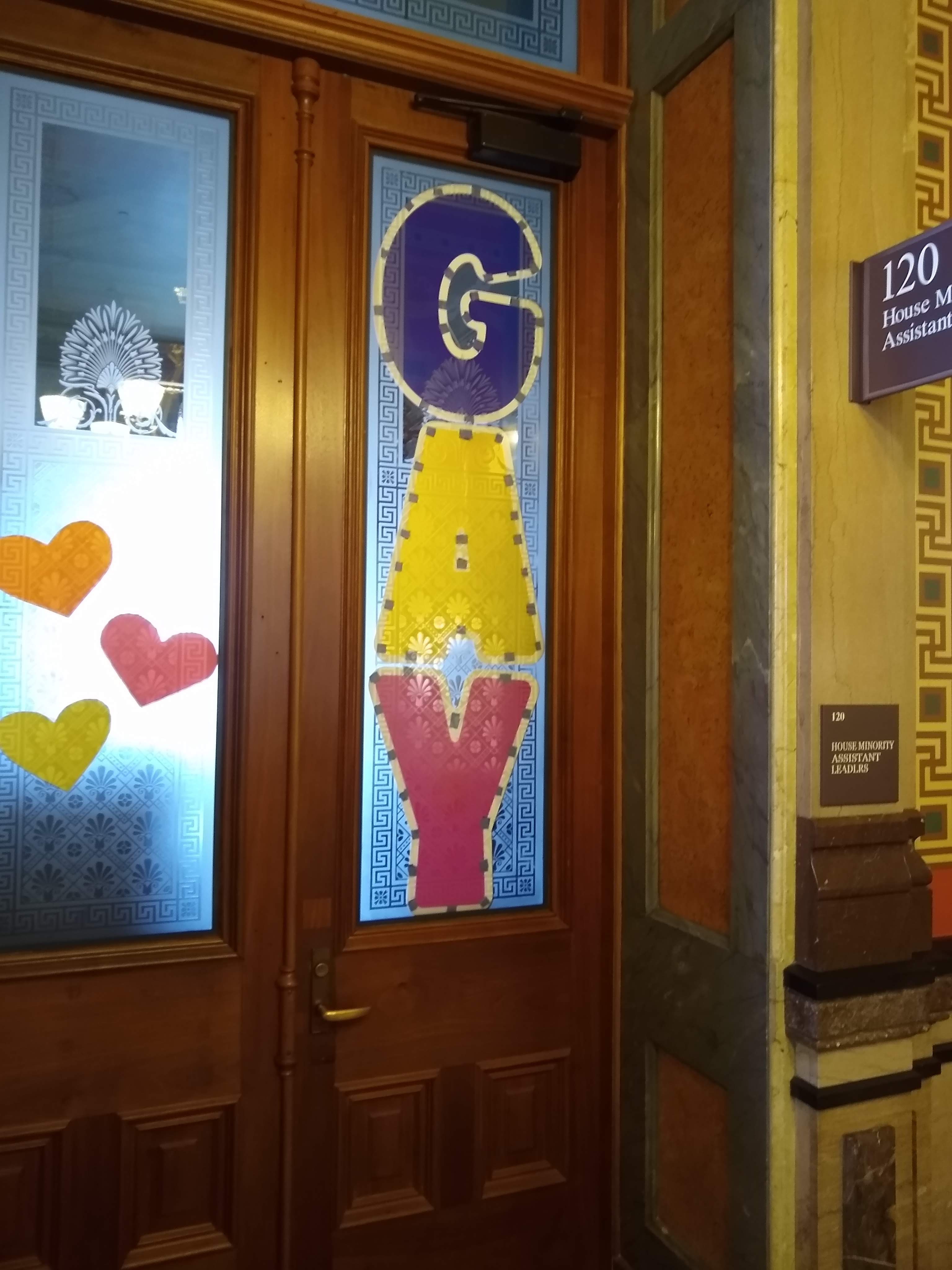
wooden office door with frosted glass windows, paper hearts and letters G-A-Y
Iowa House Democratic leadership office, March 2023

Some of these measures can be argued individually, and some of their parts like property tax transparency and over-the-counter birth control are genuinely good. On the property tax and labor bills, minority Democrats were able to win concessions, so those weren't just rammed through. It's the entire collection I'm calling out--what's in, who gets benefits and who pays the costs--and calling it hateful. The thread that unites all the legislation listed above is it's doing something to people the majority would like to do stuff to, because they're the majority and they can.

cartoon restaurant menu
(Source: clipground.com)

"If you're not at the table, you're on the menu" is practically the political equivalent of a Newtonian law, and this year transgendered people especially youth, public school employees and students, the Democratic state auditor, and the poor were on the menu, just as in other years immigrants, abortion providers, and racial minorities have been on the menu, for the entertainment of Republican constituents.

Opportunities to rebuild our communities, unleash the innovative power of cities, ensure environmental and fiscal sustainability, and welcome people who are different from us... all not taken. Instead we send all manner of signals that we don't like you, while the majority consolidates power and rewards its political allies. Our legislature, as usual, is doing the opposite of what it should be doing. This year just had a whole lot more of it.

[Finally, much of the media coverage of the session, and comments like leader Whitver's quoted above, focus on the central role of Governor Reynolds in making all this happen. I'm not as clear on that, though surely her pugnacious Condition of the State speech in January did much to frame perceptions of the session. To be sure, I wasn't there, so I can't comment on her personal day-to-day role in policy formulation and coalition-building. But it seems that if Iowa is doing pretty much what other Republican-controlled states are doing, then the value added by any individual leader is zero. No matter who was Governor, as long as the Governor was Republican, a legislature with this big a Republican majority in both houses would have produced this exact pile of legislation.]

large apartment building under construction
New Bo Lofts, May 2023

I'm writing this while, outside my window, another building is going up in New Bohemia. Make no mistake, a lot of good things are happening here. The economic vitality of Cedar Rapids and other Iowa cities is keeping the state afloat. The legislature can help spread the wealth (see Zaluska 2023 for a hopeful example), or it can squander these successes by taking cities for granted and promoting intolerance towards the people we need to sustain it all. Stop selling nostalgia and resentment for political points, and start building places of value.

MAIN SOURCES

Perry Bacon Jr., "I'm a Progressive in Kentucky. I Think Republicans Want Me to Leave," Washington Post, 30 March 2023

Caleb McCullough, "Impact of This Year's Legislative Session," Cedar Rapids Gazette, 7 May 2023, 1A, 7A

Erin Murphy, Tom Barton and Caleb McCullough, "Lawmakers Conclude 'Historic' Session," Cedar Rapids Gazette, 5 May 2023, 1A, 8A

Robin Opsahl, "Lawmakers End 2023 Legislative Session with Most Republican Priorities Met," Iowa Capital Dispatch, 4 May 2023

Mary Radcliffe and Kaleigh Rogers, "Red State Voters Support Anti-Trans Laws. Their Lawmakers Are Delivering," FiveThirtyEight, 18 April 2023

Wednesday, June 8, 2022

Iowa legislative session 2022


Iowa presidential votes by county, 2020

(5/3/2022) Iowa's state legislative session ended late in May after hanging fire on a number of Gornor Kim Reynolds' priorities. While previous years in this era of Republican dominance have mostly been about owning the libs, this year saw a number of constituency-oriented economic initiatives. Whether these benefits will trickle down to ordinary Iowans in small towns remains arguable.

According to the Cedar Rapids Gazette (cited below), these were the principal accomplishments of the Iowa legislature in 2022:

  • lowering income tax rates to a flat 3.9 percent, while completely eliminating taxation of retirement income
  • requiring gas stations to sell E15 blended gas year-round, with exceptions for smaller stations
  • reducing the time people can receive unemployment compensation
  • prohibiting transgender girls from participating in interscholastic sports
  • repealing the deadline for public school families to declare their intent to open enroll
  • allowing grocery stores to opt out of the bottle bill
  • outlawing the use of private donations by local election agencies

Legislators also approved the use of semi-automatic rifles to hunt deer ("Iowa Lawmakers Approve" 2022).

AR-15
AR-15 (Wikimedia commons)

What didn't pass, mostly because Republicans were divided over approaches to the issue:

  • tuition support for private school families [it'll be back... three Republican 'no' votes just lost primaries to Reynolds- and Americans for Prosperity-endorsed proponents of this measure]
  • requiring wider publicity of public school classroom and library materials, with potential jail time for educators who traffic in "obscene" material
  • prohibiting employers from mandating vaccination
  • eminent domain for pipeline projects
My typical end-of-session argument is that the majority has been so focused on sticking it to Planned Parenthood, public schools, and transgender people that they have failed to do anything to improve the future prospects of their own aging and shrinking districts. When four counties, none of which voted for either Governor Reynolds or President Trump, account for 77.6 percent of the state's population growth over the last decade, and 40.1 percent of its gross domestic product, you'd think we would be more worried about improving the performance of the other 95 counties than about trans basketball players.

This year the legislature managed to address economic issues as well as the culture wars: eliminating income tax for the well-off elderly residents and mandating purchase of agribusiness products will be economic boons in Republican counties. Putting limits on unemployment compensation, on the other hand, will most hurt people where jobs remain scarce. The remainder will have no discernible economic effect, but might make us feel better and the "libs" feel worse. 

Will communities at large benefit from these favors? And can they use the influx of money to devise long-term plans to thrive? Or at least create jobs for the hard-to-employ? Maybe. In a global economy, of course, the rich don't have to spend their money in their own community. The environment, meanwhile, can go screw itself.
Source: Deviant Art. Used without permission

Republicans currently hold a 60-40 majority in the state House and a 32-18 majority in the state Senate. Over time, Democrats may benefit as urban counties grow and rural counties shrink, but there seems to be little prospect of any Democratic inroads this year, particularly with the national party on the defensive over inflation, COVID restrictions, congressional inaction, and so forth. So it looks like I'll be writing some version of this post for a few more years!

SOURCES

Erin Murphy, "Differences on Display in Legislative Session," Cedar Rapids Gazette, 26 May 2022, 1A, 5A

Erin Murphy and James Q. Lynch, "Private School Vouchers, School 'Transparency' Fail," Cedar Rapids Gazette, 26 May 2022, 1A, 5A

Wednesday, January 13, 2021

Iowa: It's Unreal!


(1/13/2021) Iowa Governor Kim Reynolds to state Republicans' latest round of electoral victories in November by saying "they validated the direction we are taking the state" (Pearce 2020). She doubled down on that Tuesday night during the Condition of the State address, praising the state's response to COVID and the August derecho, as well as its budget surplus. She did not mention the state being 7th per capita in COVID cases (17th in deaths), nor its reliance on federal grants for economic relief. Dislocations to businesses and students by the prolonged pandemic were attributed to overzealous precautions, to which she is determined to put a stop.

It has become an article of faith for a considerable chunk of Iowans that the pandemic is relatively benign, and requiring precautions such as facemasks are a blatant attack on our individual liberties. "Our liberties we prize and our rights we will maintain," goes our state motto, possibly written by someone who had a sense of responsibility to his fellow humans, but also possibly an early form of "You're not the boss of me!" Which would be an okay motto as well. The chamber seemed somewhat empty, as some members were (wisely) attending remotely. About half the members shown when the camera cut away from Reynolds were wearing face masks. The front page of Tuesday's Cedar Rapids Gazette showed a crowd of anti-mask protestors at the Capitol. The legislative leadership has said they will not require masks for committee meetings or floor proceedings. Representative Art Staed (D-Cedar Rapids) reported unmasked colleagues at each of the three committee hearings he attended Tuesday.

So Reynolds's call for public schools to open in-person rings hollow. Of course, students should be in school. Besides what must be an accumulating pile of research on the issue, I can testify from my experiences in 2020 going between in-person and online instruction that the very best students do well either way, but the farther you get away from that standard the more trouble students have with online instruction. So let's get students back to the classroom! 

Washington High School, Cedar Rapids, was closed for repairs until this month
(Google Screenshot)

But what has Governor Reynolds, or anyone in Iowa government, done to make that possible? Besides demanding it, I mean. She's resisted shutdowns and mask mandates, and overruled districts that have tried to do pandemic measures on their own. Tuesday night she called for a bill "that gives parents the choice to send their child back to school full-time." She also wants to expand open enrollment [to Des Moines and Waterloo, IPTV commentator O. Kay Henderson explained afterwards] and charter schools, as well as "education savings accounts for students who are trapped in a failing school." There will be no spending increase, though, because she wants to cut taxes again. She was full of flattery for teachers who went to extraordinary lengths for their students this year, but is proposing nothing to make their jobs less difficult or more safe. Minority leader Todd Pritchard (D-Charles City) called this part of the speech "a little bit of warfare with out public schools."

We want to do what other countries have been able to do during pandemic, without any personal inconvenience or going to the efforts they did.

From education Rerynolds pivoted to red meat about BLM protests. Reynolds did wear a facemask on her way out of the chamber... and hugged a whole bunch of people.

Iowans are brave and good and tough, and if you come to our state, you had better be, too!

The complete text of the governor's speech is here.

SEE ALSO:

"Condition of the State 2020," 15 January 2020

"Condition of the State 2019," 14 January 2019

Tuesday, June 11, 2019

Small towns, rural areas and state legislatures

2018 votes for Iowa Governor, by county
Source: CNN. Used without permission.

(6/11/2019) The divide between successful and unsuccessful places--often oversimplified as "urban vs. rural"--has emerged as a major fault line in contemporary American politics, along with the ever-present racial divide. Where the economic outlook of a place is less than positive, voters--at least white voters--have turned to the Republican Party's anti-government and traditional values ethos, recently overlain with restraints on trade and immigration. (Whether the Republicans, led by the ever-improvisational President Donald J. Trump, will overplay their hand, remains to be seen. For now they are speaking to voters in these places as Democrats and internationally-minded urban elites seem unable to.)

This is reflected in Iowa's political ride this decade, from purple to red. It's a predominantly white state, where most voters live in economically stalled-to-struggling areas, and Republicans have dominated recent state elections.

Iowa has 99 counties, reflecting its past where most labor occurred on farms, and small towns across the state served as market centers for those farms. In this decade, and for the last several decades, most of those counties have lost population. (In the absence of easily-obtainable economic performance data, I use population change as an indicator of strength, assuming that successful places need more workers, and workers are attracted to successful places where they can find a better choice of jobs. Economic success often funds cultural vitality, which is also attractive to people, particularly younger workers.)

According to the U.S. Census Bureau [with Governor Kim Reynolds's percentage of the two-party vote]:
  • 70 of Iowa's 99 counties have lost population between 2010 and 2018 [60.1% of 426,605 votes]
  • 11 counties gained marginally, less than 1 percent (Black Hawk, Boone, Cedar, Crawford, Jasper, Jones, Marion, Muscatine, Plymouth, Pottawattamie, Woodbury) [54.3% of 209,142 votes]
  • 6 counties gained at least 1 percent, but less than 2.9 percent, half the national growth rate (Bremer, Buchanan, Clarke, Davis, Lyon, Washington) [60.9% of 40,246 votes]
  • 5 counties gained at least 2.9 percent, but less than the U.S. growth rate of 5.8 percent (Dickinson, Dubuque, Madison, Scott, Sioux): one near Des Moines, two housing the central cities of Davenport and Dubuque, and two predominantly rural counties in northwest Iowa [54.4% of 140,523 votes]
  • only 7 counties gained population faster than the nation as a whole (Dallas, Jefferson, Johnson, Linn, Polk, Story, Warren): four around Des Moines and Ames, Cedar Rapids, Iowa City, and Fairfield... Fairfield?? [40.8% of 482,145 votes]
Republicans had a tough year nationally in 2018, and lost seats in the Iowa House, but actually increased their already-large majority in the Senate. So, this year, we once again have a legislature and a governor whose support came predominantly from less successful places. One might assume, then, the state would be pursuing policies to help those economies.

One would be wrong. Here is what the Iowa legislature achieved in the 2019 session, which ran from January to April (Gottburg 2019, Rodriguez and Opsahl 2019):
  • legalizing betting on sports events at casinos
  • legalizing growing hemp and loosening restrictions on medical marijuana
  • adding the right of individual gun ownership to the Iowa constitutions, and subjecting any restrictions to "strict scrutiny"
  • city or county property tax increases above 2 percent will require a 2/3 vote
  • prohibiting use of Medicaid funding for sex-reassignment surgery
  • barring Planned Parenthood from receiving federal sex education funding
  • requiring public college and university campuses to adopt "free speech" policies
  • giving the Governor greater influence on judicial selection
  • trespassing penalties for undercover investigations of farms
  • creation of children's mental health system
  • $15 million for flood recovery in western Iowa
Only the last two conceivably could help distressed people in small towns and rural areas, and one of those is a response to a short-term emergency. The rest is nutrition-free candy, mostly for their ideological allies, many of whom admittedly live in small towns and rural areas. I understand a lot of people love guns, and hate transgender people, Planned Parenthood, college faculty and administration, and "liberal" judges, but shouldn't they and their elected representatives also be pursuing constructive solutions to actual problems?

Nationally, a study by FiveThirtyEight found similar outcomes in other states with unified Republican governments (Bacon 2019). Those 22 state legislatures pushed looser gun laws, restrictions on "sanctuary" cities, restrictions on lower governments' abilities to divest from Israel, restrictions on abortion, "right-to-work" laws weakening labor unions, and work requirements for Medicaid recipients. All crowd-pleasing candy, nothing nutritious to help places grow.

No legislature, however well-intentioned, can bring back the 1950s, or whatever form of paradise white Iowans want to think the 1950s were. The future of the American economy is going to be predominantly metropolitan, although we can argue whether the locus of the action will continue the move back to central cities begun in the middle of the last decade (Frey 2019, Florida 2019, Hurley 2018). For example, the State of Arizona, which is growing faster than the U.S. as a whole, is seeing most of that growth near Phoenix and Tucson, and shrinkage elsewhere.

We also know our economic future is going to be primarily service-driven, not centered on farm work or manufacturing or resource extraction. Employment will be less stable, and whatever we do will have to accommodate the realities of diversity and climate change.

Successful places are those that have adapted to the post-industrial economy, but the cost of living, and the cost of doing business, in places like Seattle, San Francisco and Boston--and Chicago, Los Angeles, and New York--are becoming prohibitive, despite their attractions. Smaller places and their environs can position themselves to take advantage of this, and to be significant players in the economic future. BUT! this requires recognizing the realities of the 21st century, and enhancing the assets that are already in place, not playing to anti-elite resentments and culture wars nostalgia.


SOURCES

SEE ALSO:
"Iowa Losing Millennials, Needs Workers," 14 February 2019
"What is the Future of Iowa's Small Towns?" 3 July 2018

The Value of Incidental Contacts

  Incidental contacts can happen on sidewalks, but only if there are people going places Places like the Stroget [in Copenhagen] carry an in...