 |
| Eric Klinenberg at CNU34 |
Twenty-first century social infrastructures are already reviving civic life in nations across the planet: public plazas in low-lying cities that double as massive water storage systems during extreme weather events; massive levees and berms that masquerade as bike paths and parks. Americans should have all these things. (Klinenberg 2018: 293)
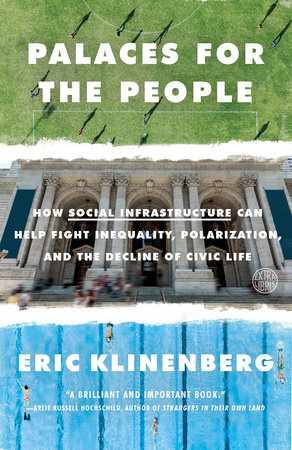
Eric Klinenberg, Palaces for the People: How Social Infrastructure Can Help Fight Inequality, Polarization, and the Decline of Civic Life (Broadway, 2018), 293 pp.
(7/3/2026) There is supposed to be a theory of human evolution where we humans have since hunter-gatherer days differed in our response to strangers. Some see strangers as inherently dangerous, a threat to our precarious food supply; others see strangers as bringing welcome variety, so we could trade lunches or at least hear new jokes. Both of these perspectives are adaptive--some strangers are dangerous--but decades of auto-centric development has left us with a lack of places to encounter strangers in low-stakes, non-threatening ways. The results include an epidemic of loneliness, physical unfitness, and vulnerability to violent crime, homelessness and climate catastrophes.
Eight years after the publication of Palaces for the People, Eric Klinenberg began his keynote address to the Congress for the New Urbanism in Bentonville, Arkansas, last month, with the question: What has happened to the fabric that supports community life? He urged his listeners to "make every project you do work as social infrastructure," whether it's a playground or something less obviously connected, like flood control. We should also fund public libraries, a lot more than we currently are.
Klinenberg grew up in Chicago, and was just about to start graduate school when the deadly 1995 heat wave struck the city. The factors that affected who survived and who didn't, and the factors affecting the geographic distribution of mortality, inspired his field research, and eventually his first book, Heat Wave (University of Chicago Press, 2002). He continues to ask: If sudden natural disasters, as well as the slow corrosive effects of loneliness and despair, have predictable effects, "What conditions in the places we inhabit make it more likely that people will develop strong or supportive relationships and what conditions make it more likely that people will grow isolated and alone?" (2018: 6)
 |
| Social infrastructure: The Union (young adult room), Cedar Rapids Public Library |
Social infrastructure is defined as "the physical places and organizations that shape the way people interact," creating the context for individual-level relationships of all levels of intensity. It can take many forms--public institutions, open spaces, privately-owned establishments--but the common element is "people are welcome to congregate and linger" (16). His first example is public libraries (ch. 1), which "do all kinds of unexpected things for surprisingly large numbers of people... by providing free access to the widest possible variety of cultural materials to people of all ages, from all ethnicities and groups" (37). He describes his visits to the New Lots and Seward Park branches in New York City, where he sees the elderly, teenagers, the unhoused, and immigrants in places where they can find meaning and encounter other people.
 |
| Chalkboard in The Union: The youth have something to say |
Chapter two argues social infrastructure is useful for improving public safety, where outcomes of long-term policies in Philadelphia "suggest that place-based interventions (fixing up vacant and abandoned properties, planting trees and grass) are far more likely to succeed than people-based projects" like tougher criminal sentencing and cracking down on petty crime (70).
Chapter three starts at elementary school, spends most of its time at college, and then goes back to the library. Any of these places can serve as community gathering spaces, but that doesn't happen automatically; they also can fail by putting up barriers or designing for institutional efficiency.
 |
| School playgrounds can be community gathering spaces, but only if they're unlocked |
One big social change since the publication of this book is that the number of people living on the streets has increased by 50 percent, which may affect the real or perceived ability of the community to gather in these types of spaces.
Chapter four focuses on the public health impacts (opioid addiction, food deserts, isolation especially among the elderly and poor) of glaring failures of social infrastructure. Chapter five highlights the role of sports facilities and teams in bringing together people of different backgrounds, which might be a major reason racists fought so strenuously to keep beaches and pools segregated (and why "boys in girls' sports" is such a potent argument today). The epilogue points out the limits of social media, and other billionaires' moonshots, in doing what simple contact can achieve.
Chapter six on climate change is an extension of the argument. Incredibly, as I write this eight years after this book was published, with heat domes over much of the northern hemisphere, widespread fires and flash flooding, the crew in charge of the American national government still insists there's nothing to see here. Even in 2018, it was undeniable that (a) the climate is changing, (b) its effects fall most heavily on those at the margins of society, and (c) we're going to have to build or rebuild a lot of our infrastructure in order to prepare for this.
 |
| Social infrastructure: The McGrath Amphitheatre, park and concert venue and flood protection |
Klinenberg makes the case for making the new physical infrastructure work as social infrastructure as well, as had been planned along the FDR Drive in New York City:
The berms would block and absorb storm surges when necessary, but their everyday function, as parklands and recreational areas for inhabitants of an especially gray and unpleasant part of an especially gray city, is at least equally as important.... Deployable walls, camouflaged as a series of murals that hang from strong hinges on the ugly underside of the FDR Drive, are another key part of the proposal. Most of the time, the structures, which will be designed by local artists, operate as decorative ceiling panels that enhance the experience of walking beneath the highway, which, lacking good alternatives, thousands of residents do each day. (2018: 202)
Klinenberg makes a strong argument for urbanist design. Loneliness and all its ill effects, physical fitness, political polarization, and vulnerability to crime and climate can all be traced to the lack of social infrastructure. In his 2026 talk, he said that if communities design, build, maintain and program it, democracy and civil society will benefit, and there exists a "palpable sense of possibility" in this moment in history, especially among the young. We surely can do with more public libraries, playgrounds, and plazas (with shade for sure!), if they're done right. The alternative, as he said in Bentonville, is "we are all more likely to hunker down in private places."
 |
| (Source: crownpublishing.com) |
Pete Saunders, "Preparing for the Climate Migrants," Corner Side Yard, 2 July 2026
Angie Schmitt, "Ross Chapin on How the 'Pocket Neighborhood' Can Address Loneliness," Love of Place, 24 June 2026


No comments:
Post a Comment