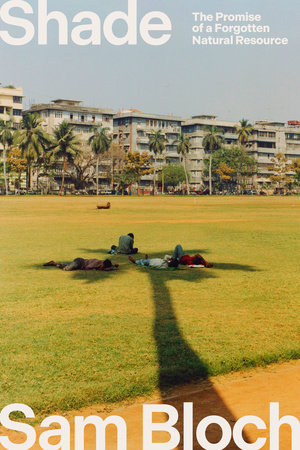
(3/30/2026) Decades ago, when I was still in my insouciant youth, I went on a canoe trip somewhere in the Midwest. When we came to the end of the trip, I reached up to scratch my head, and it (my head) was hot to the touch from being in the sun so long. If my dermatologist is reading this, she now realizes why we are so often in each other's company! I have learned, over the years, to wear hats, and to seek shade.
Shade trees aren't always there when you need them, though. An incredibly violent derecho in August 2020 smashed through 75 percent of my county's tree cover. Humans have long done their own share of tree removal, whether to make room for buildings or roads, to remove shelter for unhoused people or cover for criminals, or simply to allow more natural light to reach interior spaces. (Los Angeles's Pershing Square, the story of which is told on pages 101-104, has suffered from every one of these initiatives.) As the climate changes, however, we may find shade to be a missing ingredient in surviving heat waves and affording our utility bills, not to mention keeping our tempers (p. 118).
 |
| Republic Square, Belgrade 2022: "The horse" is where you find shade during the day |
 |
| Cuburski Park, Belgrade 2022: green play space for apartment dwellers of all ages |
Environmental journalist Sam Bloch takes us all over the world to see places where people suffer for want of shade, and where people are improvising ways to restore lost shade. He starts us in the natural world, where lost shade means no shelter from the sun, which is essential to animals from chinook salmon to chimpanzees. Humans, too, can only tolerate so much time in the hot sun, as we see its effects on our system and our mood from a little accessible neuroscience. "Shade soothes the senses.... Coolness never feels better than when we are warm" (14). The earliest cities, like Ur in the Middle East, were oases of shade, thanks to closely packed houses and carefully aligned streets (ch 2). The quest for cool relied on trees, fabric overhangs, and beginning in 1902, air conditioners. But while air conditioning achieved miraculous short term effects on human health, in the long term it has encouraged inefficient architecture, dramatically increased energy use, spewed enough hot air to raise outdoor temperatures, and decreased our resilience to heat (ch 3). Escaping the heat involves increasing the heat--an ongoing dilemma for our species.
Part II surveys the damage from inadequate shade, nimbly switching from human stories to the physiology of heat to climate data. In chapter four we meet the most vulnerable: those (often migrants) who do outdoor work on farms or construction sites; those with heart conditions or mobility issues; people in the military; and the unhoused. We also learn why the effects of thermal alliesthesia (heatstroke) are worse in the sunshine: the sun acts as "a microwave, shooting heat energy straight into our flesh" (p. 77). Wealthy neighborhoods are generally better-supplied with shade than are poor neighborhoods, and so are better prepared for warming summer temperatures. In Los Angeles (ch. 5), Watts residents are six times as likely as Westsiders to be hospitalized during a heatwave (p. 109), because it can be around ten degrees warmer in the poorer area (p. 106). "You can see L.A.'s shady divide from outer space," says Bloch (p. 98). This goes even moreso for freakish weather like the "heat dome" that struck the Pacific Northwest in late June 2021 (or the Southwest this month). Portland, Oregon hit 116 degrees on June 28, 2021, but there was a 25 degree variation across neighborhoods (p. 132).
Part III examines ways of adapting to climate change. Passive architecture (ch. 7) has significant disadvantages that might outweigh its advantages; the same goes for geoengineering (ch. 9). (What happens when Elon Musk decides to do to the climate what he did to the federal government?) Innovative shade (ch. 8) can be structurally inadequate, like Los Angeles's bus signs, or politically unpopular, like Barcelona's massive street tree program; more happily, Singapore has reduced temperatures on city streets, and Australia has seen skin cancer rates decline with each generation.
Bloch has tried to take a complex problem and break it down into digestible parts, including both symptoms and solutions. The parts don't always cohere into a theme, but even as separate essays the chapters work. Shade from trees can help lower street temperatures that are already rising, as well as mitigate the additional harmful effects of direct sunlight. But he isn't sanguine that such a huge and complex problem requires anything other than huge and complex solutions, involving "collective planning, management, and action" (p. 229).
We need at once to coordinate action through inclusive conversation, probably with a preferential option to poverty-stricken areas; provide hope for collective rationality rather than leaving people to their own devices that will likely make the community worse off; and find a sustained source of resources for all this--all while democracy is teetering throughout the West.
 |
| Greene Square, Cedar Rapids, 2012 (Google Maps screenshot) |
 |
| Greene Square, Cedar Rapids, 2024 (Google Maps screenshot) |
I think this post calls for a follow-up this summer with local shade audits. Watch this space!
SEE ALSO: Fenit Nirappil, "Inactivity in a Warming World Could Spur Hundreds of Thousands of Deaths," Washington Post, 16 March 2026


No comments:
Post a Comment