Friday, November 24, 2023

Black Friday Parking 2023: Mount Vernon Road

parking lot, shopping plaza, for rent sign
2317: One of many smokeshops on the road, used to be a bookstore

I've gone a bit off-script for this year's celebration of #BlackFridayParking. Strong Towns has promoted this event since the mid-10s as a way of highlighting the high costs to cities of zoning regulations that mandate large commercial parking lots (Abramson 2023). Past Black Fridays have taken me to the parking lots of big-box stores on our city's outer edge, and to the vast parking lots all too close to our city center.

Amidst all the giddiness and photography, I've come to the conclusion that, in Cedar Rapids anyway, the problem is not the zoning code. Our giant Wal-Marts and Targets have parking lots even bigger than the code requires, because land is cheap here, customers expect it, and the city is designed in such a way that 90+ of people are going to drive to shop anyway. 

In 2017 I walked 16th Avenue SW, a mid-century commercial corridor that is now a model for discarded sprawl. 

big building with empty parking lot
Still empty in '23: former K-Mart parking lot, 16th Av SW, November 2017

The problem on 16th is not that even large Black Friday crowds couldn't fill the gigantic parking lots, but that there are no crowds at all. (That year I was accompanied by "the other Dr. Nesmith." I don't know whether the excitement was too much for her, but she hasn't been tempted by #BlackFridayParking since.)

This year I followed a similar impulse to Mt. Vernon Road SE. This historic corridor is getting some love from the city in the form on an action plan. Alas, its internal contradictions mean some of its goals are going to have to give way, probably to faster vehicle traffic.

The Mount Vernon Road action plan covers 10th to 44th Streets.

parking lot with many cars
4035: At the east end of the plan area, acres of parking at the Mt. Vernon Road Hy-Vee

 The executive summary describes the challenge on page 19:

The Mt. Vernon Road corridor includes a wide variety of land uses including a neighborhood hardware store, a large grocery store, several gas/convenience stores, banks and credit unions, professional offices, restaurants, bars, and various specialty, variety, drug, auto parts, auto repair, and discount goods stores. The corridor also includes schools, churches, a residential care center, a fire station, and a cemetery.

parking lot at Goodwill
2405: Used to be a pharmacy

However, the dominate [sic] land use is single family residential with just a few multi-family residential properties sprinkled throughout the corridor. There are several quick-serve and fast food restaurants but few sit-down style restaurants. There are vacant properties along the corridor and some occupied commercial sites that are dated and/or in need of renovation and maintenance. There are also several retail uses that are typically not considered neighborhood friendly including tobacco shops and liquor stores.

Because that's the kind of commerce wide fast streets get!

parking lot at O'Reilly's
2663: Used to be a Greek restaurant
empty lot by auto parts store
2700: Used to be an Italian restaurant

Unsurprisingly, public input sessions on the action plan revealed desires for small retail shops, redeveloping vacant lots, fewer "less neighborhood friendly uses," more separation between residential and commercial areas, turn lanes, and slower truck traffic. Bike lanes were nixed, as bicycling on this road is unsafe and slows car traffic (p. 19).
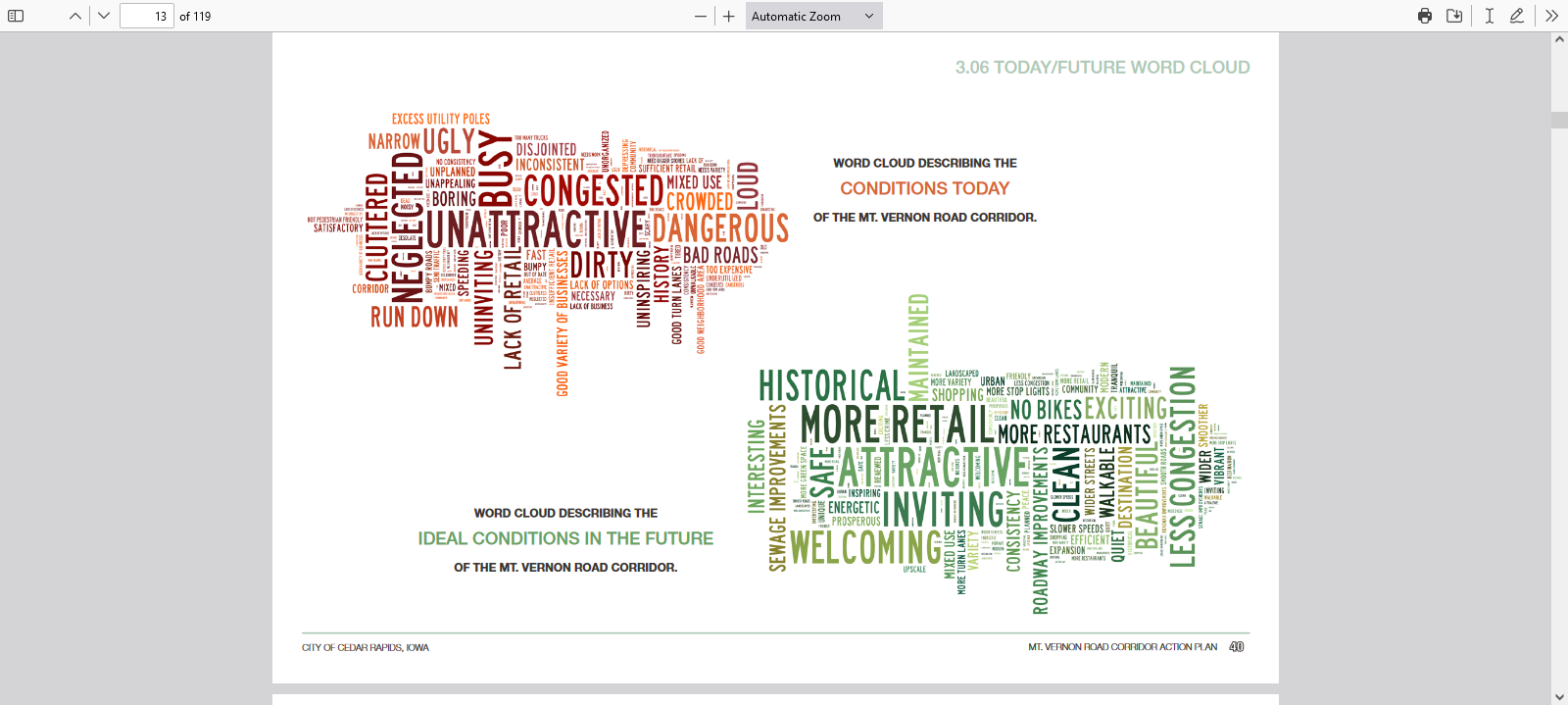
Word clouds generated by Mt. Vernon Road corridor public meetings

shop for lease
902 28th St: Cute shop for a walkable area

parking lot by vacant building
3605: Another vacant property, whose potential changes on a walkable street

The public's desires are reflected in the plan's goals (p 9): (1) promote new retail development and redevelopment along the corridor; (2) encourage neighborhood scale and neighborhood friendly uses; (3) improve traffic circulation and safety; (4) increase walkability and safety for pedestrians and cyclists. I expect the immediate pressure to improve traffic circulation to render the rest of this admirable list unfeasible. I hope I can explain why.

empty lot (used to be a store)
1841: Neighborhood retail lost to road widening
empty lot (used to be stores)
1901: Neighborhood retail lost to road widening

Neighborhood retail (goals 1 and 2) relies on walkability (goal #4), but that would require Mt. Vernon Road to become smaller and slower (goal #3b but not #3a). The stickler, as the plan's authors admit (p. 11), is that Mount Vernon Road has been developed into an arterial, the collector road for the entire southeast side. The authors claim it has too much traffic already--23000 according to the plan text, 18000 according to the state's average daily traffic counts--for its four lanes, and there are too many driveways for comfort as well. 

parking lot by shopping plaza
3303: Even small parking lots are between the (franchise) shops and the sidewalk

Since it is pretty much the only through street in that part of town, there's no reasonable alternative for truck traffic. 

parking lot by shopping plaza
3025: More franchises by parking lots

So the road will be reconfigured to restrict left turns across traffic at 15th and 19th Streets; it will end in a roundabout at 10th Street; parking lot access will where possible be redirected to side streets; and cyclists will be directed to alternative routes on parallel streets. 

road with separated left-turn lane
Approaching downtown, new left-turn lane onto 15th Street,
creating more distance between core neighborhoods on either side

Cars and trucks will move more swiftly, past locations that could have supported neighborhood friendly uses. (See Herriges 2019 on how arterials work, and don't work.)

convenience store with many gas pumps
1420: Gargantuan c-store, nominally in Wellington Heights

This is the point where I should be telling you what the city should be doing to fix this. I confess I'm at a loss. What are we trying to build here? It's not a downtown, where we go for density, mix the uses, slow the cars, and ignore the parking-obsessed. It's not the suburbs, either, nor is it quite a highway. It's become an awkward mix of all three, so that anything you do to fix an immediate issue with Mt. Vernon Road--narrow it, widen it, add pedestrian infrastructure--is going to make something else worse. 

parking lot by shopping plaza
3401: Vernon Village used to have a small grocery and a French restaurant,
which then became a bakery/cafe. Now it might be a ghost kitchen?

(I would like to see bus service along the entirety of Mt. Vernon Road, just shooting straight from downtown to maybe Bertram Road and back. Currently, the circuitous Route 2 travels Mt. Vernon Road eastbound from 19th to 42nd, but not westbound. I don't know that it will fix anything detailed above, help the emergence of cute shops, cut down on vehicle speeds, or make walking safer, but it's curious that this has never been done.)

AutoZone next to boarded up house
2714: Another auto parts store, next to another vacant building 

So, this year my #BlackFridayParking thoughts have wandered far from the subject of parking. But as we see here, excess parking is more than some unproductive government regulation. It is a product of the problematic way we build towns, and how we get around, just as it makes those problems worse. The result is stroads like this one. The parking lots are just the most obvious symptom, or maybe #2 behind the uninspiring commerce.

old school building iwith sign, now vacant
2000: Used to be an arts center, before that an elementary school

The public comments that informed the Mt. Vernon Road Action plan are not wrong, just naive. It's natural for us to want more of the things we enjoy, with fewer consequences. Why can't we have smoother traffic flow and plenteous parking, at cute shops, all at a neighborhood scale? Because, beloved readers, in this vale of tears, cars compete with everything else for space, and the easier we make it for cars to move the less likely they are to stop, to shop or for any other reason. 

CVS parking lot, west side
2711: Big pharmacy with bigger parking lot

CVS parking lot, north side
Same building, different side

The more room we make for cars in the form of parking lots, the less room there is for anything at a human/neighborhood scale. Anyone who's paid attention as Mt. Vernon Road has gotten wider and faster knows this. That's not politics, it's physics.

side street with houses
26th St: One of several cute dead-end streets off Mt. Vernon Road
Access becomes more difficult as the road gets faster

side street with houses, across barrier
18th St: From here to downtown, access is limited by a barrier

Strong Towns video, "Are Parking Lots Ruining Your City" (15:40):


SEE ALSO: "Black Friday Parking 2022," 25 November 2022 

Mark Stoffer Hunter, "History Happenings: Changes Coming to Mount Vernon Road and 19th Street SE," Cedar Rapids Gazette, 24 November 2018

Ben Kaplan, "Mount Vernon Road is Dangerous by Design," Corridor Urbanism, 11 June 2021

Rahul Rejeev, "Children, Left Behind by Suburbia, Need Better Community Design," Public Square: A CNU Journal, 13 November 2023

Historical Aerials

closed Little Caesar's pizza
3404: One of many vacant stores on Mt. Vernon Road

Saturday, November 18, 2023

10th anniversary post: Downtown

historic bank building silhouetted against a bright blue sky
Peppercorn at the Bank, 101 3rd Av SW

Ten years ago this month, the Holy Mountain blog was wringing its bloggy hands about the rebuilding of downtown Cedar Rapids. The opening of an upscale restaurant, Popoli, across the river in the 100-year-old former People's Savings Bank building, had me wondering if downtown was reinventing itself as a playground for the rich.

Today, that space is occupied by Peppercorn Food Company, which opens it for events like wedding receptions and corporate lunches. Even their website is elegant! But downtown as a whole has become a delightful mix of upscale and regular, not to mention commercial and office/service and residential--and coffee and alcohol! The public library and art museum face each other across Greene Square, and there are a number of performing arts venues within walking distance of those residences. Converting one-way streets back to two-way has improved, well, just about everything.

In 2013 I included both sides of the river in my definition of downtown. Today the west side has rebranded as Kingston Village, so that "downtown" to most Cedar Rapidians means the area between the river and maybe 6th Street, from A Avenue to 6th Avenue. (That would be a good question to crowd-source! I bet I'd get some disagreement about that.) I think both sides of the river are important components of the city center, however. Both sides have particular handicaps, but I think the west side's are more easily overcome, and I'm bullish on its long-term development. 

This week I engaged in a rather haphazard web search for housing in the city center, and even though some $450,000 condos have gotten a lot of attention, I found plenty that was not high-end.

apartment complex with sign "Ashton Flats"
Apartments at the Ashton Flats, 217 7th Av SW, run $913-1089 a month
(from their website)


The Village Lofts on 3rd Avenue SW start rentals at $1000 a month; the older Roosevelt Hotel starts at $675. There are more reasonably-priced condos as well: 200 3rd Avenue SW and 905 3rd Street SE run in the upper $100,000s, and condos are available in the Ground Transportation Center building for less. What downtown doesn't have, not surprisingly, is many single-family homes, but there are houses for sale on both sides of the river maybe 1.5 miles away. 

Among a shifting array of downtown restaurants, El Dorado, an unpretentious Mexican bar and grill with magnificent food, has become a favorite with my family. Whatever worries we had ten years ago about the elitism of downtown have not come to pass.

Downtown remains a work in progress. I keep expecting the increased residential population to produce some facilities catering to everyday needs, like grocery stores, pharmacies, and hardware stores. That has not yet happened. There's a big Hy-Vee on Wilson Avenue 1.9 miles away, 7 minutes away by car even at rush hour--the Czech Village Sav-A-Lot and the 1st Avenue are even closer--and that may be all anyone feels they need.

A frequent complaint about downtown is the lack of parking. This is because most of Cedar Rapids remains car-dependent, most people downtown at the moment have driven there from somewhere else, and because the acres of surface parking nearby are not accessible (because privately-owned) or not considered nearby enough to suit drivers. There's a tradeoff between parking and quality-of-life that is not readily recognized. But the struggle is real. A few weeks ago we attended a play downtown on a night there was also a symphony concert. I wish we could have taken a bus instead of driving and parking, but alas, on Saturday night there is no bus.

The future of downtown depends on its connections to nearby neighborhoods. The transect is a concept that refers to development that becomes gradually less intense as it gets farther from the city center. Unfortunately, Cedar Rapids' downtown area is separated from neighborhoods on all sides, so the intensity dramatically collapses. This is particularly true on the east side, where the vast MedQuarter neighborhood lies between downtown and Wellington Heights, and is nearly empty except for weekday working hours. The west side must contend with the interstate and the proposed casino development. 

Together, the MedQuarter, I-380, and the casino-to-be surround downtown in such a way to prevent much walkability. But the west side barriers (highway, casino) seem to me more permeable, and I have hopes that they can be overcome.

NOTE: The City Council will consider a new downtown plan at its December 5 meeting. 


SEE ALSO: 
"News from Downtowns," 23 June 2017

Tuesday, October 31, 2023

Halloween in the neighborhood

masked blogger setaed with carved jack-o-lantern on lap
Halloween 2020: No masks in 2023, but too cold for just a sweatshirt

(10/31/2023) It's a very cold day for Halloween, likely to hold traffic down. We'll have no snow such as our Minnesota and Chicago correspondents report, but it's expected to be 35 at 6 this evening, with the wind making it feel even colder. Ten years ago I reported 145 visitors, but last year on a pleasant evening we had a mere 46, and this year we are less optimistic. Between the weather, the relatively low "door density" in my streetcar suburban neighborhood, and declining participation on my side of the street, there's not much reason to draw a crowd.

Halloween at its best is the great neighborhood holiday. Christmas gets more decoration, Fourth of July makes more noise, but Trick-or-Treating gets children, and often their parents, out to meet their neighbors. (Or someone's neighbors... we seem to get a fair amount of drive-to Trick-or-Treating every year.) Like Addison del Mastro, we have neighbors, around the corner on Crescent Street, who go way over-the-top with their decoration, including everyone who passes by in their celebration. "I can imagine being a kid," he writes, "and waiting with excitement to see what the next holiday is going to look like. It makes me feel like a kid."

Emma Durand-Wood writes on Strong Towns that maintaining Halloween traditions through the pandemic helped her husband realize it "wasn't really about the candy":

Now he could see that opening one’s doors to any and all strangers who showed up was really the ultimate act of neighborliness and hospitality. What’s the first thing you do when someone comes to your home? You welcome them warmly and offer them something to eat or drink. Around the world, hospitality looks like some variation of that. So, Halloween is like a neighborhood-wide expression of low-stakes, high-yield hospitality.

Halloween done right requires walkable neighborhoods. You can't do Halloween on a dark lonely street, or on a stroad, or in a large lot subdivision, or in a high-rise. Ironically, however, the biggest challenge to traditional Trick-or-Treating is from "trunk-or-treat" gatherings put on by shopping plazas, churches, and other organizations. I would say you can't do Halloween walking from space to space in a parking lot, but apparently you can. It's just a poor substitute for calling on your neighbors.

Sign advertising trunk or treat

So where does that leave children and their families who live in places that are genuinely unsafe to Trick-or-Treat? It leaves them in places that are unsatisfactory, not just on October 31, but every day of the year. And maybe this year trunk-or-treat is the best we can do?

But at the same time, for their sake, and for the sake of strong community bonds that we're failing in so many places to develop, we should all put our shoulders to the job of fixing what makes their places unsafe: providing escorts and patrols; slowing the cars, if not closing streets altogether; building and maintaining sidewalks; improving lighting; building housing that has front porches and windows for "eyes on the street."

Halloween done right is a celebration of neighbors and neighborliness, and faith in humanity. It's a tacit recognition of design that facilitates mixing with others. It's a rejection of moral panics about poisoned candy or the people who want to frighten you with dangers all around us.

P.S.--We were pessimistic about the turnout, as it happened! We had 62 before we ran out and turned off the light, so we could have had more. It was our biggest crowd since 2018 (97).

SEE ALSO:

Ryan Allen, "Trick-or-Treat is Worth Saving," Strong Towns, 30 October 2023

Jessica Grose, "Stop Micromanaging Halloween--Let Your Kids Be Free," New York Times, 25 October 2023

Brent Toderian, "Why the 'Trick-or-Treat Test' Still Matters," CityLab, 30 October 2023


Tuesday, October 3, 2023

10th anniversary post: Still sillypants

fenced playground
In contrast to 2013, Washington's Stanton Park remains open


DISCLAIMER: Also in contrast to 2013, I now have a son who works for a federal contractor. So this has become personal!

Ten years ago, I wrote two posts about the U.S. government shutdown, one about the difficulty of knowing when essential conversations about our common life are open and fair to all, and the other a pictorial reflection about being in Washington during the early days of the shutdown. "Some people," said a mother to her daughter explaining why there was a wee fence around Stanton Park, "are being sillypants."

That little girl must be 12 or 13 now, and presumably maturing in an age-appropriate way. That is less clear for congressional Republicans. This week I returned to Washington during another game of congressional chicken over federal budgeting. (I'm not ambulance chasing--really! Both years I was representing Coe College at the October meeting of Capitol Hill Internship Program advisers.) As it happened, the threat of a shutdown seems to have been averted Saturday, or at least postponed for 45 days, and anyhow my trip this year would have occurred too early for another round of shutdown pictures.

Still, as close as we got to a shutdown, with the demolition derby that our national politics has become, occupied the thoughts of all of us who take government people. To paraphrase Lincoln, ours is a government of people, by people, for people--so it will never get things exactly right, it will always leave some if not everyone unsatisfied, and yet it matters a lot to the quality of our lives together. Government is not meant to be a plaything, or a weapon.

After our meeting, I went up to U Street NW clutching the invaluable Frommer's 24 Great Walks in Washington, D.C. [Wiley, 2009... this is walk #15]. Jazz great Duke Ellington (1899-1974 grew up here, and for decades it was a center of black culture, even after suffering much from the 1968 riots.

colorful mural featuring musicians
"Community Rhythms" mural by Alfred J. Smith, U Street station

row houses, one painted vivid red
13th St NW: Young Duke Ellington lived here

large apartment building
13th and T: Adult Duke Ellington stayed here
 
tree shielding nightclub on street corner
11th and U: This club hosted the greats of 50s/60s jazz

There are other landmarks here as well, including a memorial to African-Americans who served in the Civil War that lists every known participant. There also was (on this day, anyway) a young man in a Civil War uniform, expounding considerably about the war and the memorial.

people at African American Civil War Memorial
10th and U: African-American Civil War Memorial
part of giant plaque with soldiers' names at African-American Civil War Memorial
Names on the memorial


very old bank building with outdoor sign
11th and U: Oldest black-owned bank in DC

wax replica of the Lincoln Memorial
12th and S: Wax Abraham Lincoln with wicks for lighting

U Street has gentrified a lot in recent years.

large newly-constructed apartment bldg
Some of the multitude of new construction

While I'm normally rather sanguine about gentrification, which does bring wealth and racial integration to places, it's jarring to see it to such a degree in a neighborhood so closely identified with black history. At least that history is being preserved.

U Street, too, is Washington--a place that embodies America's ongoing efforts to build and rebuild the good life. Washington is more than the cartoonish caricature presented by so many politicians, like former U.S. Representative Rod Blum, who served Iowa for two terns in Congress, and who is probably best remembered for wanting to inflict a recession on Washington. 

Once you get away from the Capitol and into the neighborhoods, though, you find Washington is full of people, a lot of whom work for or with the federal government, and who are trying, as we all are, to do their jobs.

small shops on U Street NW
10th and U: This too is Washington

Friday, September 22, 2023

Art for art's sake


art gallery from outside, interior with patrons
237 Collective on opening night

Welcome to the neighborhood! The 237 Collective has opened at 111 13th Street SE, near the Coe College campus at the edge of the Wellington Heights neighborhood. Owners Paxton Williams and Abby Long-Williams anticipate the space being used for art exhibits, sales of artwork and handmade clothing, and a "third place" style hangout.

Paxton Williams, whose artistic name is EBISU, kicked things off September 15 with a show called "Momentum."

paintings by EBISU displayed at 237 Collective


artist's statement by EBISU
Artist's statement

EBISU combined graffiti-style drawing with found objects. Where on earth was this one found?!

closeup of a Jeff Reed baseball card in one of EBISU's pieces

 The crowd on opening night was young and hip, at least when compared to your humble blogger.

patrons in art gallery between clothing racks and wall displays

opening night patrons at 237 Collective

Here's what the gallery looks like in daylight, in this more ordinary week. 

front desk surrounded by art in various genres
View from the front door

Additional artists' works are now displayed. There are thirteen artists in the collective, with two more immediate prospects.


clothes, art, stairs

The small (1800 square feet) building dates from 1920, and has been many things over the years, including vacant. It's been vacant a lot.

various shutoff notices on door
February 2022

It shares the lot with Cafe Allez, which is anticipated to open early in 2024 in the building occupied 2000-2020 by Brewed Awakenings Coffeehouse. Abby Long-Williams told Little Village that she hoped to spread the young entrepreneurial spirit from trendy neighborhoods like New Bo and Czech Village throughout the city.

Ideally they will be able to draw energy from the cafe, Coe College, and nearby churches and medical facilities. In any case, it's good to have such a creative and aesthetically pleasing venture nearby!

The gallery is open 11-5 Thursday, 11-6 Friday and Saturday, and 11-5 Sunday, with possibly additional hours in time. They plan a Parking Lot Market in October.

alley side of 237 Collective with mural painted on part of the wall
Mural on the alley side

SEE ALSO: Malcolm MacDougall, "237 Collective's New Hub for Local Fashion, Vendors and 'Underrepresented Artists' Opens in Cedar Rapids Friday," Little Village, 14 September 2023

toilet in narrow stall
Retro restroom, in the basement


Tuesday, September 12, 2023

Even a pretty MedQuarter isn't right


Parking lot, 420 7th St SE
Entering the MedQuarter on 4th Ave at 6th St SE

(9/12/2023) Public art, gathering spaces, and coffee carts were among features proposed to the general public by staff of the MedQuarter District at a series of open houses last week. A series of story boards offered a wide range of possibilities, and hence of visions, for the roughly 1.5 square mile district on the east edge of downtown.

story boards with sticky note comments

The district stretches from St. Luke's Hospital (1026 A Avenue NE)...

map of northern part of the district

 ... to the environs of Mercy Hospital (701 10th Street SE), whose campus now stretches across 8th Avenue.

map of southern part of the district

While some features might be more or less attractive to staff, patients, and city residents...

story board with options for placemaking amenities

...overall the MedQuarter concept is a suboptimal use of this space.

Bethel AME church
Bethel African Methodist Episcopal Church (512 6th St SE)

Long ago, the land between 5th and 12th Streets East was full of city residents. An old picture I've seen of Bethel AME Church shows it surrounded by small houses. Today, the church remains, but sits by itself on the otherwise empty block. In thinking about the future of Cedar Rapids, and the need for affordable housing in walkable proximity to work and school and play, we need to restore historic neighborhoods like Oak Hill instead of emptying them out.

story boards with local restaurants
Some current MedQuarter restaurants

The vibrancy of downtown depends on connection to surrounding areas. Too much of the core, in spite of a couple thousand apartments coming online this year, remains oriented to attracting shoppers and diners from elsewhere (so, lots of bars and hair salons, no groceries or hardware). The Wellington Heights neighborhood on the southeast side is the densest in Cedar Rapids, but has no commerce of its own. The restaurants and bars and music venues of the core are fairly close by, but the walk there is bleak and barren.

surface parking lot, with another parking lot in the distance
You want parking? We got parking

There are ways of making that walk less unpleasant, with streetscapes and pocket parks and better lighting. A radical revision of the district could even cut back on its surface parking habit and go in for a dense mix of housing and small shops. Any of this would improve on what's there now, but I feel like I'm voting among false choices.

stories of possibly real MedQ users

The fundamental purpose of the MedQuarter is to serve folks like Sophia and Jason here (and me) with hospitals and clinics that of necessity rely on outside clientele like them, and so need a great deal of territory where we can put our cars. Nothing that requires as much parking as the MedQuarter does belongs where the MedQuarter is.

storyboard threatening expansion
Expansion?

SEE ALSO: "Filling in an Empty Quarter (II)," 25 October 2013

Week Without Driving Diary (III)

A very walkable block! (10/5/2026)  For most of its one mile length, Washington Avenue SE is the very model of a walkable residential street...