Monday, July 1, 2024

Could 1st Avenue East be a Grand Boulevard?

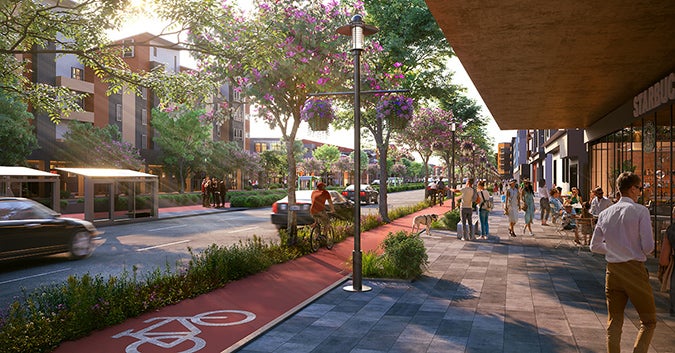
busy street with apartments, trolley, bike lanes, pedestrians and a dog
Is the world ready for 1st Avenue E to look like this?
(Swiped from hdrinc.com; used without permission)

(7/01/2024) The closure this month of the 1st Avenue Hy-Vee and Via Sofia's Restaurant has drawn attention to the perennial low performance of this historic street that slices between the Mound View and Wellington Heights neighborhoods. Without these two anchors, 1st Avenue might now be said to be in a state of crisis.

empty restaurant building with "coming soon" sign
1125: Via Sofia's has closed, but new tenants are coming, possibly soon

Perhaps co-incidentally, the City of Cedar Rapids is undertaking to create a plan for 1st Avenue East from 12th Street (location of Via Sofia's) to 17th Street (one block above Hy-Vee). The street was developed over a hundred years ago, and still bears the signs of being a neighborhood market street. Unfortunately, since then, the surrounding area has been emptied of population, especially below 14th Street, while 1st Avenue has been widened to a five-lane highway that carries 17,000 cars per day through this stretch. Auto-oriented development has not been good for a street built for walkable neighborhoods: The population within a walkable distance has declined, while the cars whizzing through have trouble finding places to park.

Here is an extreme but real example: The side of 2nd Avenue pictured below...

vacant lots on 2nd Ave
1246 2nd Ave SE: vacant church next to vacant lots

...had 71 people living on it between 12th and 13th Streets in 1953, according to Polk's City Directory. Today that number is zero. Extend that story over the whole area between 15th and 5th Streets SE and you can see what happened to neighborhood retail. 

1st Avenue near downtown is worth the city's attention. Even in its current forlorn state, it's outperforming the big box stores on the edge of town.

FINANCIAL PERFORMANCE, 2020-24

(compare to NE side Wal-Mart taxable value $534,981/acre)

NAME

ADDRESS

ACR

ES

TOTAL TAX VALUE 2020

VALUE PER ACRE 2020

TAXES EST

 2020

TOTAL TAX VALUE 2024

VALUE PER ACRE 2024

Cafe Allez & 237

111 13th St SE

0.193

248,200

1,286,010

9,328

207,800

1,076,684

Via Sofia’s

1119 1st Av SE

0.193

398,500

2,064,767

14,977

413,200

2,140,933

Wendy’s

1314 1st Av NE

0.771

1,424,100

1,847,082

49,996

1,454,300

1,886,252

Poppa& Tommyz + apt

1323 1st Av SE

0.289

384,000

1,328,720

13,118

387,000

1,339,100

Arby’s

1417 1st Av SE

0.386

654,200

1,694,819

22,967

720,300

1,866,062

College Commons + apts

1420 1st Av NE

0.874

3,301,000

3,776,888

98,747

4,143,700

4,741,076

McDonalds (closed)

1530 1st Av NE

1.200

1,329,000

1,107,500

46,658

1,090,300

908,583

Finding a formula that works for 1st Avenue near downtown would definitely help sustain the adjacent neighborhoods; if it continues to deteriorate, it will drag them down and create a desolate zone in the core of the city.

Grand Boulevards

face shot of Peter Calthorpe
Peter Calthorpe (swiped from hdrinc.com)

Last month, at the Congress for the New Urbanism, keynote speaker Peter Calthorpe described his idea of grand boulevards, and this might be a solution for 1st Avenue. Grand boulevards are commercial corridors developed with multifamily residential units and served (at least eventually) by public transit. He pitched it as a solution to the housing shortage more than a solution to declining corridors, but it is reported we do need more housing, and anyhow implementation of grand boulevards requires a declining commercial corridor in which to implement them.

closed restaurant with closed grocery store behind it
1530: Closed McDonald's by closed Hy-Vee

(Cedar Rapids residents will at least be familiar with Calthorpe's firm, HDR, which designed the trails on Mt. Trashmore near Czech Village.)

Peter Calthorpe and slide
Calthorpe's presentation at CNU: more focused on housing shortage than under-performing streets

Calthorpe envisions mid-rise buildings with about 100 units, so fairly large, mostly market-rate with maybe 15 percent reserved for affordable prices. (Too high a percentage discourages developers.) As much as missing middle and accessory dwelling units are steps in the right direction, the grand boulevard concept is the only way to get a lot of buildings at scale with private financing. (Governments can't afford to subsidize all the housing that needs to be built, he says.)

Kingston Pointe Apts, 515 2nd Av SW
Kingston Pointe, 515 2nd Av SW, has 18 units on half an acre, but we could go a good bit denser
Ashton Flats, 217 7th Av SW
Another model: Ashton Flats, 217 7th Av SW

The 1st Avenue Grand Boulevard

About 3250 feet worth of 1st Avenue is under study from 12th to 17th Streets, or a total of 30 acres on both sides of the street. If half of that territory is available for redevelopment, that would mean 900 or 1000 dwelling units (at 60+ per acre), which could be like, what, 2500-3000 residents? (Note that I'm not counting potential properties on A and 2nd Avenues, or farther up 1st.)

closed office building
1225: long-vacant office building on lonely block across from Coe College campus

EZ Pawn, 1344 1st Av NE
1344: Not picking on anyone's business, but this close to downtown?

2500-3000 new people living along 1st Avenue will generate more foot traffic for businesses.

1271: Opening of Cafe Allez has been attended by long frustrating delays

These people would need a lot of groceries, for one thing. Their presence on the street would reduce car speeds and crime while increasing liveliness (which can only help attract students to my former employer, Coe College). They would improve the current demand for public transit. "Once you've got a ribbon of development," says Calthorpe, "You can backfill transit along the way." 

Transit available to backfill includes the #5 bus along 1st Avenue, which already runs every 15 minutes, and could be extended to evening service; there could also be a north-south route, say an enhanced route #6, connecting Wellington Heights (and Oak Hill Jackson?) to the Coe and Mt. Mercy campuses up to commercial districts to the north.

Passengers wait for the #6 at Coe College bus shelter, November 2022:
the bus stop for the #5 on 1st Avenue is visible in the background
(Google Earth screenshot)

Constructing all these apartments creates questions about parking (where and how much?) and driveways (open to 1st Avenue or side streets?). I think these are important but resolvable questions. For the record, Calthorpe wants no minimum parking requirements, but that's not the same as no parking at all.  Anyway, the conversation should start with how we want to live, not where we are going to park.

1st Avenue is also a state highway (Business US 151 & SR 922), so civilizing the street itself to slow cars and encourage cycling and walking will require cooperation with the Iowa Department of Transportation. Alexandria, Virginia was able to work this out for King Street, and IDOT is trying to narrow highway right-of-ways through other towns, so I'm encouraged to hope they'll work with us.

SEE ALSO

"Crossing Cedar Rapids' Busiest Intersections: 1st Avenue," 8 August 2023

Martin Pedersen, "Peter Calthorpe Has a Plan for Building More Housing in California," Arch Daily, 7 April 2023

Robert Steuteville, "Grand Boulevards Would Solve the Housing Crisis, Peter Calthorpe Says," Public Square: A CNU Journal, 24 June 2024

Calthorpe's 2017 TED talk, "Seven Principles for Building Better Cities" (14:21)

Friday, June 28, 2024

Post No. 550: Now what?

book shelves, mostly empty
I'm movin' out

Last month I retired from full-time teaching after 37 years, two of them at Western Illinois University and 35 at Coe College. Retirement has been more of a process than a clean break: I am scheduled to teach a political theory class in the spring, I am maintaining an office on campus, and I'm writing this at the "summer office" in the New Bohemia District I've been using the last few years.

I am nevertheless standing at the cusp of something new, of which I have only the vaguest idea. In that sense, I resemble America! It too is standing at the cusp of something new!! The future is always uncertain, but seems especially so now; just think of the questions that loom over the next 10/20/50 years: 

office space available sign
So much vacant office space, along with recent inflation and AI
are among causes of economic insecurity
  • What will happen with work? The unemployment rate is a manageable 4.0 percent, but that masks uncertainty about career stability inflation, and future volatility, as well as the distortions produced by income-wealth inequality. Maybe I'm overly sensitive, living as I do in the non-profit sector, but even as we manage a "soft landing" after the pandemic, there are a lot of causes for worry, especially among young people.
  • How will our lives be impacted by the changing climate? Despite the 21st century's return to the city which was inspiring the creation of this blog, most people remain in car-dependent situations, vulnerable both to climate emergencies and any public policy efforts to forestall them. As climate impacts multiply, they will set off causal chains affecting migration, financial stability at every level, public health, resource availability... you name it. Things could get really interesting, in the not-very-nice sense of that word.
  • Can American democracy survive? The United States has through history survived such awfulness as the Civil War and the Great Depression, but that's no guarantee we're ready for the next big challenge, or even that we won't self-destruct on our own. We are so polarized we can't agree on basic facts, much less common objectives. Our leading political figure, Donald Trump, thrives on chaos and division. A second Trump administration would be unrestrained (cf. VanderHei and Allen 2024), but as the events of 6 January 2021 showed he doesn't need even to win the election in order to sow destruction. And the U.S. Supreme Court apparently will ensure there are no consequences for those who sow that destruction (Marimow 2024).
  • On a more practical level, what will happen with government? Seeing my city and state double down on what Strong Towns calls "the suburban experiment" makes me wonder when the fiddler will need to be paid. When does the struggle to meet obligations become more visible, and who will suffer when it does?
Newly widened portion of Mt. Vernon Road SE
Widening Mt. Vernon Road between Wellington Heights
and Oak Hill Jackson, because cars

We will all be dealing with these mega-questions in the years and decades to come, whether or not we are urbanists. Pete Saunders speculates one way they and we might evolve in the coming decades:
Urban Revival Period (2020-2040): rebirth of cities actually does take hold nationally, as... Interior cities will tout their assets and amenities and become cheaper alternatives to the coasts

Urban Suburbia Period (2035-2055): Suburbs will begin a period of adaptation largely based on their proximity to urban growth areas....

 Exurban Retrenchment (2050-2070): ...many revert into a semi-rural form, since we'll discover that their current form is economically unsustainable.

My town, Cedar Rapids, contains some of each of those elements, and will face each of those challenges.
 
rendering of proposed casino
Screw the transect! We want a casino!! (Source: Peninsula Pacific Entertainment via cbs2iowa.com
)

Meanwhile, as I prudently choose activities to fill my retirement, I too will be dealing with these questions, only not in the capacity of college political science teacher. I may not be much help building websites or building houses, and I'm nobody's activist leader, but in a world of uncertainty some sound analytical thinking might come in handy. That's justification enough to keep blogging, even as I mostly am trying to sort out all the incoming information for myself.

book cover: The New Republican Coalition
I published a book once

Is there a book hidden somewhere in this blog? Michelangelo (I think) used to say that he started sculpting with a block of stone, and kept chipping at it until the sculpture emerged. 550 posts averaging 1037 words apiece--an estimate based on the total word counts of ten randomly selected posts from 2013-23--means I've piled up over 570,000 words along the way. That's a sizable block of stone--according to the website VelocityWriting,com, a non-fiction book will run 25,000-150,000 words--and I am daunted by how much chipping will be required to find any presumed book. Do I have, somewhere in there, a message the public needs to hear (other than bike to work goodsprawl bad, casino also bad)? Moreover, I've already written two books, one published (The New Republican Coalition: The Reagan Campaign and White Evangelicals [Peter Lang, 1994]), one not, so I'd need a more solid purpose than just to do another one. We'll see.

Top posts of the 2020s

Hearts in front window of house spelling LOVE
Hearts across the pandemic, April 2020

  1. "The Hearts of Cedar Rapids," 11 April 2020
  2. "Black Friday Parking 2021," 26 November 2021
  3. "The Kind of President Joe Biden Could Be," 3 July 2020
  4. "Move More Week Diary," 10 October 2022
  5. "Even a Pretty MedQuarter Isn't Right," 12 September 2023
  6. "Hy-Vee is a Symptom of a Deeper Problem," 23 May 2024
  7. "What Should Go into Brewed Awakenings?" 31 July 2020
  8. "More New Less Bo?" 4 July 2022
  9. "Cycling to Marion," 15 August 2023
  10. "The Urbanest Places in Cedar Rapids?" 16 July 2020

Undiscovered posts of the 2020s

On the Sac and Fox Trail, approaching Rosedale Road
MPO Riders on the Sac and Fox Trail

Thursday, June 20, 2024

High hopes for new Westside library


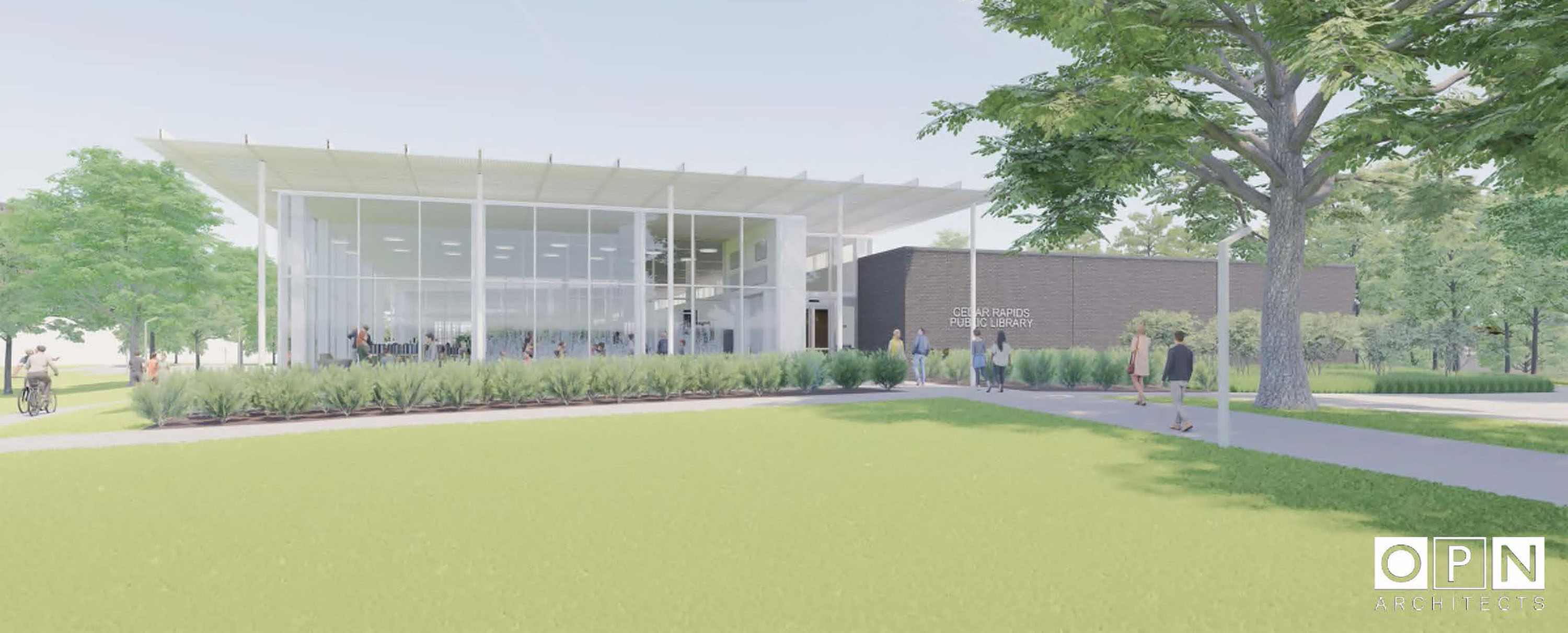
proposed Westside Library
Proposed Westside Library (from crlibrary.org)

The Cedar Rapids Public Library plans to open a new west side location in late 2026, on 27 acres of land purchased with a recent estate gift. The new building will replace the Ladd Library, which is located in a former Target store on Williams Boulevard SW. At a reason information session, Executive Director Charity Roberts Tyler explained the library is committed to serving the growing low-income neighborhood around the Ladd location. The project will go out for bid shortly, with groundbreaking expected in the fall, even as fundraising from public and private sources continues. The accelerated timeline is necessitated by the impending end of the Ladd Library lease.

field across a road will be a library
Westside Library site now, from across 20th Ave SW

The library cites the immediate area's population growth as one factor in favor of the new facility. The new facility, like the Ladd Library, will be located in Census Tract 10.05 (which was part of tract 10.03 before 2020). Despite being about 3.5 miles from downtown, 10.05 and its next-door neighbor 10.04 are among the metro's tracts with the highest population density. They are among the lowest rates of owner-occupied housing and single-family homeownership, and among the highest in percent black and percent Hispanic. They arguably suffered the most damage from the 2010 derecho.

apartments on narrow street
Apartments across 20th Avenue

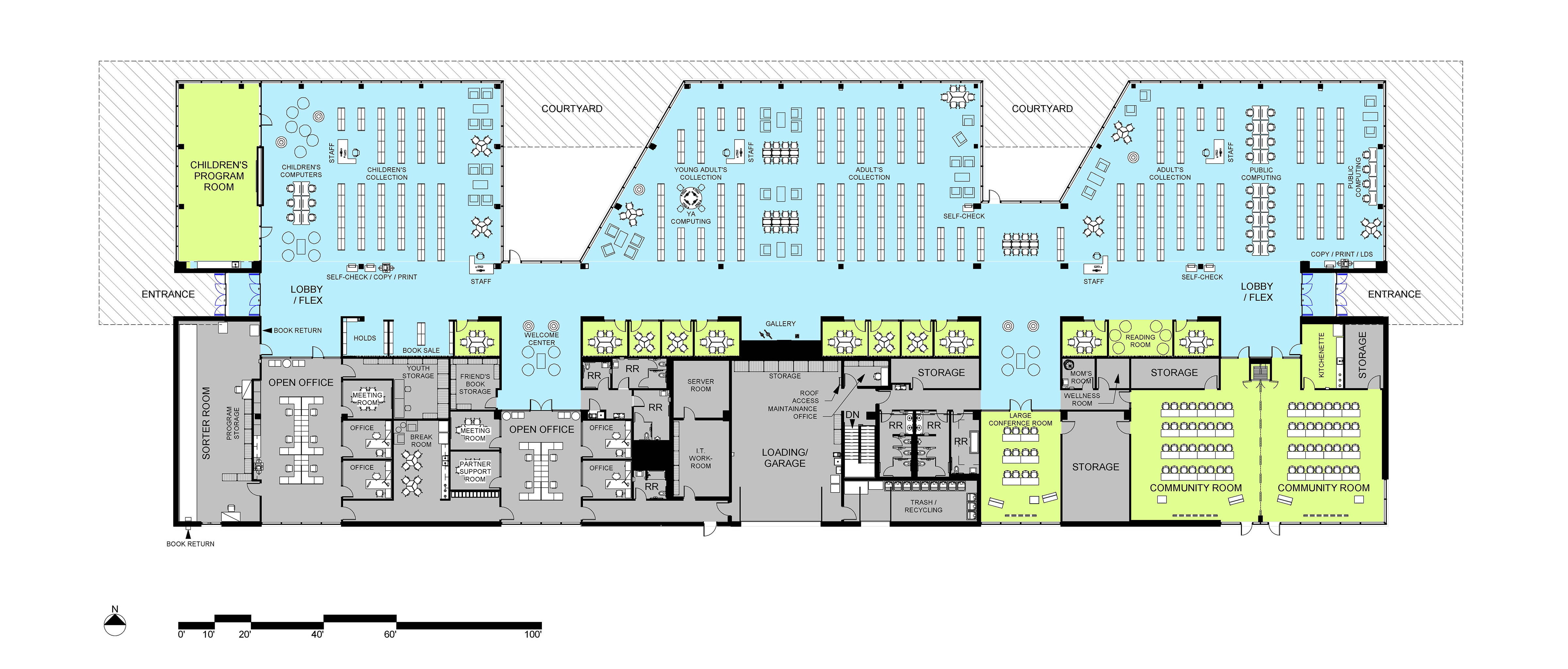
According to the library, the new building will measure about 40,000 square feet, nearly half-again as large as the Ladd space. The increased space will accommodate "larger collection spaces, added community meeting rooms, a larger children's area with dedicated program room, and a new young adult-teen area ("Inspiring Big Dreams" information sheet). They anticipate substantially increasing the current rate of 100,000 visits per year as well.
proposed Westside floor plan
proposed floor plan (from crlibrary.org)

The library will be located towards the southeast corner of the property, near 20th Avenue almost to Edgewood Road. Most of the rest of the land will be developed into a new city park, at least tentatively called Westside Library Park. The park will include a multi-use court, two picnic shelters, a water feature, multiple gardens, and a lot of green space. The western portion, closest to Wiley Boulevard, will be sold. That leaves by my guesstimate about 15 acres for the park, which will be a wonderful resource for the area and environs for the library. Of course, there will be parking, too--one lot off 18th Avenue, and one off a new north-south street at the west end of the park--but not so much as to overwhelm the property.

Westside Library Park site along 18th Avenue SW

There will be quite a few apartment buildings within easy walking distance of the new library. (To find 27 available acres in such a densely populated area is miraculous.) The plans show sidewalks on the developed property on both the 18th Avenue and 20th Avenue sides. To facilitate children independently accessing the library or park, there should be a sidewalk on the north side of 18th Avenue, as well as mid-block crossing lights on both 18th and 20th.
West Park Village mobile home court
West Park Village, across 18th Avenue from the library site

Once away from the immediate vicinity, though, walkability goes quickly to pot. This is an area where the suburban development pattern was aggressively pursued: Edgewood Road, 16th Avenue, Wiley Boulevard, and Williams Boulevard are all wide, high-traffic, high-speed "stroads" that form a ring of danger around the library site. 
Edgewood Road approaching 16th Avenue SW

Residents of the Cedar Terrace Apartments on 12th Avenue, for example, will be only one-third of a mile from the new library, but must make their way across 16th Avenue with its 10,000-15,000 cars per day and 40 mph speed limit. Residents of Cedar Point Townhomes on Westdale Parkway will be 2000 feet away, but must cross both Williams Boulevard and Edgewood Road to get there. Van Buren Elementary School is a mile away, and... you get the idea.

There is talk of connecting the property to the trails system via the Edgewood Trail which will run along Wiley. Bus lines 8, 10 and 12 run close to the site, though none is running more frequently than once every 30 minutes (route 8) this summer, and all are rather circuitous. All of these efforts at accessibility would be made more effective by measures aimed at slowing motor vehicle traffic.

The Westside Library proposal is one of the best ideas around for improving the city. The library provides a vital service, and the new facility will deliver it even better. The proposal is made with careful attention to residents of the immediate neighborhood. The city needs to support the library by doing what it can to make that part of town less dangerous for non-car mobility.

Wednesday, June 12, 2024

Book review: The 15-Minute City


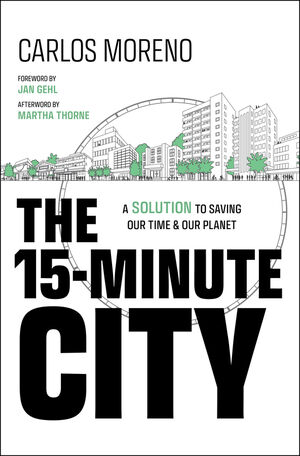
The 15-Minute City cover

Carlos Moreno, The 15-Minute City: A Solution to Saving Our Time and Our Planet (Wiley, 2024), xxii +276pp.

"The 15-minute City" has become a widely popular concept and widely used phrase, especially after it was adopted by Paris mayor Anne Hidalgo to guide that global city's ongoing development. The phrase sprung from the mind of Carlos Moreno, a native of Colombia who is now professor of systems technology at the Sorbonne, when he was attempting to humanize his approach to technology-based city design.

Although I was a pioneer in the emerging field of "smart cities," I saw technology as a powerful lever but no longer as an end in itself. My definitive break with technology-centered approaches came in 2010, when I decided to turn to urban service design as an essential methodology for transforming our cities.... 

[Drawing on the work of Jane Jacobs] My approach has refocused on the design of urban services that meet the needs and aspirations of citizens, putting people at the heart of the debate and integrating fundamental thinking on the geography of time, rhythms, quality of life, and chronotopia--a spatio-temporal concept in which the intersection of place and time creates unique and dynamic experiences in a given environment. [Moreno 2024: 89]

The idea that resulted was that of a city "in which the essential needs of residents are accessible on foot or by bicycle within a short perimeter in high-density areas," or a somewhat larger perimeter in less densely populated areas (p, 14). By reducing the need to commute long distances in cars, the approach is intended to reduce human stress on the natural environment like climate change, but also to reduce the difficulty and time people spend getting places, and to improve individual quality of life and social connection. 

The first third of the book seats the idea in the history of western cities, as a response to the disruptive impacts of cars, Euclidean zoning, and most recently the coronavirus pandemic. These disruptions are familiar to anyone who studies cities, but the story does bear retelling. After 75 years of sprawl we find that "Proximity plays an essential role in lifestyle change and city transformation. The concept of the '15-minute city' and '30-minute territory' is at the heart of this new urban lifestyle..." (p. 13, italics mine). 

It sounds like urbanism! Moreno's multi-faceted approach is indeed similar to that of Jeff Speck, Charles Montgomery, and Jan Gehl (who wrote the forward to The 15-Minute City), as well as not-yet-famous me. Moreno's main contribution is the convenient metric, though at his Congress for the New Urbanism address last month he warned against overfocusing on the number 15.

Carlos Moreno at CNU podium
Carlos Moreno at CNU, May 2024

As we approach mid-book, then, we're set up for a series of examples where the 15-minute city concept has been translated into policy. And we kind of get that. Beginning with Paris (chs 10-11), we go to Milan (ch 12), and then to Detroit (ch 13) and Cleveland (ch 14) in the US, then to Buenos Aires (ch 15), already an admirable array of cities in different situations and parts of the world. The array seems to be the entire story, though, because while we would like to know how cities overcame obstacles to achieve good outcomes (or in the case of Cleveland, which has just begun under Mayor Justin Bibb, what it plans to achieve), we pretty much just get long descriptions of issues and short lists of achievements: Buenos Aires replaced some of its excess of roadways with plantings (Calles Verdes, pp. 186-188); Sousse, Tunisia, adopted a comprehensive plan that included considerations of times and distances travelled, with positive results on a variety of measures (pp. 195-200); Melbourne plans to redevelop a failed mall site (pp. 208-209). Pleszbew, Poland, has built "buffer car parks linked to train and bus services" (p. 221), but I don't know what those are if they're somehow different from regular station parking lots.

When I think of my own town, I think of all the aspects of the problem I wish this book had addressed: How do you assess the problems and potential of your city? How do you overcome inevitable public and interest-group opposition? What are the obstacles to successful formulation and implementation of 15-minute-city-inspired policy? (Speck's book in particular does a much better job of this.) Once the policy is in place, what are some useful measures of success? What are some ways cities have responded to complex or changing facts on the ground? (I think of the presentation on the complicated history of  Barcelona's superblocks I heard this spring.) Some of these are considered in chapters 10 and 11 on Paris, but even then only to a small degree. I'd have preferred four meaningfully detailed cases to a dozen quickies.

At CNU last month, Moreno seemed baffled by the political outrage his viral phrase has inspired. (The first video that came up on an Internet search described 15-minute cities as "the new reservations.") A second edition of this book might address this opposition in a practical way. By "practical" I don't think you're going to convince auto manufacturers and oil companies to be cool, and there's really nothing to be done about the cultural attachment to a car-dependent lifestyle, which is intimately connected to climate denial. But as anyone knows who's engaged even a little with city development, people are more afraid than hopeful about any change that will affect them. Moreno can go on about "happy proximity," but many of us outside of big cities aren't used to any kind of proximity. In Iowa, I'm lucky if someone agrees to share a lap lane at the YMCA pool. One street south of mine, people got everyone to sign a petition against a sidewalk on the south side of the street, including 35 homes on the north side that already had a sidewalk. A new chapter that holds people's hands and assures them everything will not only be okay, but joyously so, and coaches advocates on how to talk to the anxious masses, would be a good addition.

cars lined up at Dunkin' drive-through
Linin' up at Dunkin', November 2021:
How many of these drivers want to live in a 15-minute city?

Thinking about Cedar Rapids also illuminates why Moreno does not want to fixate on a number. There's more, as he would be the first to tell you, to purposeful walking and biking than measuring radii. According to Google maps, a 15-minute walk is about 0.7 miles. I live reasonably close-in, but all that's within that radius is an elementary school, a credit union, two dentists, a grocery store that's closing in a week, several churches, and two fabulous parks (Bever Park and Brucemore National Historic Site). 

Getting on a bicycle means 15 minutes is roughly equivalent to 3.0 miles, which expands my reach to all of downtown, Kingston Village, New Bohemia and Czech Village. Besides all the bars, restaurants, coffee shops, and museums--and hair salons, which New Bohemia has in spades--I am within three miles of the middle school and high school my boys attended, two Hy-Vee Grocery Stores, Bruegger's Bagels, CVS, Walgreen's, two hospitals, Coe College, Mount Mercy University, Cedar Lake (destination attraction in process), and the 16th Street Dairy Queen. When the casino comes, as currently seems inevitable, it will be within three miles as well. But in our town of "happy motoring" (phrase lifted from James Howard Kunstler), not every three mile bike trip is an advisable one. Some of those places require the non-driver to ford huge parking lots, and I won't be riding on Mount Vernon Road any time soon!

wide street with Auto Zone and boarded up shop
Mt. Vernon Road SE, fall 2024: getting in this zone requires a car

So, three cheers for the concept, although I won't be living in a 15-minute city any time, and one and a half cheers for the book.

CNU 34 Diary: Northwest Arkansas

Historic sign found downtown Wednesday, May 13, 2026 I don't know what it must have felt like for a medieval peasant to visit Rome, but ...