Thursday, April 18, 2024

Can there be too much of a good thing?

busy street and skyline of Barcelona
Barcelona (from Wikimedia Commons)

I've never been to Barcelona--in fact, I've never been to Spain--but Barcelona, like Amsterdam, Copenhagen, and Paris, has emerged as a bucket list destination for urbanists. Not only does it have the massive but neighborly Sagrada Familia, an eye-popping Gothic Quarter, and at least 23 other wonders plugged by Earth Trekker, but in the mid-2010s a new city administration undertook an ambitious Urban Mobility Plan based on superblocks.

Superblocks were intended to improve quality of residential life and decrease the environmental impact of motor vehicles by routing vehicles to the exterior of neighborhoods. (See Kohlstedt 2017 for description and diagrams.) The idea was to take maybe nine square blocks, and restrict through traffic from the interior of that area, allowing more pedestrian and commercial activity on narrower park-like streets. 

Earlier superblocks had been effective but tended to produce rapid gentrification; the more aggressive approach taken by the new administration in 2015 seemed more haphazard and produced more pushback (Roberts 2019). The administration of Mayor Ada Colau recalibrated, incorporating more amenities as well as more consultation with the neighborhoods. Subsequent projects incorporated "everything we learned," Port of Barcelona President Lluis Salvado told Vox, so that in what "should have been a more hostile area... the implementation process was almost unanimously accepted" (Roberts again).

Elisabet Viladecans-Marsal

But all is not now blissful in Barcelona, reported Elisabet Viladecans-Marsal at this month's Midwest Political Science Association meeting in Chicago. Viladecans-Marsal is an economist at the University of Barcelona, among other appointments, and has been cited on City Observatory for a co-authored 2022 paper on induced traffic demand. Presenting a work in progress entitled "The Electoral Effects of Banning Cars from the Streets: Evidence from Barcelona's Superblocks," co-authored with Cèlia Estruch, Albert Solé-Ollé & Filippo Tassinari, she said the superblocks continued to show immediate local positive effects, but that the vehicle traffic they displaced were creating more problems around streets designated for through traffic. The experiences of people living along the throughways were so negative that it tipped the political balance of the city: Mayor Colau's party lost their Council majority, and the new Council announced a plan to undo the superblocks.

Viewed from the perspective of people on the throughways, the superblocks of Barcelona sound less idyllic and a lot more like... Cedar Rapids, Iowa. A lot of our houses in Cedar Rapids are built along streets with very low traffic, albeit without the public amenities, shops, and active use of the space that appeared in Barcelona. Our vehicles, doubtless like those in your town, are funneled onto arterials, which function a lot like the throughways around the Barcelona superblocks i.e. they're noisy, unpleasant, and periodically congested. The mess created by this approach to traffic engineering is carefully detailed by Chuck Marohn in chapter 6 of Confessions of a Recovering Engineer (Wiley, 2021).

Inclined as I am to despair anyway, it is easy to conclude that in our complicated world with all of its sunk costs and vested interests, we just can't have nice things. The whole MPSA panel on "International Governing Institutions," on which Viladecans-Marsal appeared, was full of fuel for such despair. Connor O'Dwyer of University of Florida and Vaclav Orcigr of Charles University reported on a well-funded Spatial Plan in the Czech Republic creating fertile ground for state exploitation, while Yooil Bae of Dong-A University reported on the Republic of Korea's failed attempt to restore a region's flagging fortunes by merging three cities into a megacity. Even where injustice and unproductivity are widely-acknowledged, as in the cases of interstate highways plowed through urban neighborhoods (Reimagining the Civic Commons 2024), the people who remain after the sacking now rely on the highway to get places.

Perhaps the lesson of the superblocks is not to proceed too quickly, that great big "game-changing" projects are likely to be rife with unintended consequences. Even when undoing massive auto-centric sacking of our cities, the best approach is to be slow and cautious, and to have a backup plan when things don't go as planned. (If I sound like a charter member of Strong Towns, it's because I am.) Incrementalism can be hard to stick to, though, when--as in Barcelona--the problems you're addressing are widespread, or when markets can move so much faster than your cautious self. 

Catalan flag

Closing disclaimer: Residents of Barcelona will argue they are not in Spain, or if they are it's only under duress. I feel a song coming on...

I've never been to Catalonia/But if I go perhaps I'll see ya...

Pity Hoyt Axton's not still around to finish this.

Wednesday, April 10, 2024

10th anniversary post: "Inequality for All"


film poster Inequality for All
 

Ten years ago this month, I saw the documentary film "Inequality for All," produced by Robert Reich, former Secretary of Labor and longtime advocate for progressive economic policies. In the film Reich argued that increasing economic inequality in America, driven by globalization and technology, was exacerbated by governmental deregulation; that it limited economic opportunity for many Americans; and that it was solvable only by shifting money from the rich to the middle class. 

Reich's film came out three years before Donald Trump stunned the world by getting elected President on a campaign fueled almost entirely by resentment. While analysts debate the source of Trump's sustained appeal, it surely draws to some degree on insecurity brought by economic inequality, as well as cultural nostalgia. Trump, an extraordinarily wealthy man who inherited his fortune, has sharp words for "elites," but of course it is the most vulnerable who suffered the most under his rhetoric and policies.

What has been the story of inequality in the eleven years since the film? FRED, the wondrous economic dashboard created by the St. Louis branch of the Federal Reserve, provides data on the Gini Index going back to 1963. By this measure, inequality declined through the 1960s and 70s, before rising from the mid-30s to around 40 in the early 1990s. It's hovered there ever since, declining a bit when recessions hit upper incomes. At the time "Inequality for All" came out, the single-year high was 41.4 in 2006; it recovered to 41.5 in 2014, and stayed around there through 2019 before COVID hit. It was 39.7 in 2021, the last year for which there are data. I'll lay odds it's back to at least 41.5, if not higher.

As of 2016 our Gini score of 41.1 was the highest in the developed world, with only Israel (39.0) within five points of it (The CIA World Factbook 2023-2024, p. 1007) . The UK scored 34.8, Canada 33.3, Japan 32.9, Germany 31.9, and France 31.6. So it's definitely a choice to be as unequal as we are.

Thomas Piketty's data go back farther, though he prefers to look at income shares rather than the Gini Index (see Piketty 2013: 266-267) the post-1963 pattern is virtually identical. At the time he published Capital in the Twenty-First Century (Belknap-Harvard, 2013), the share of US national income going to the top 10 percent had reached levels not seen since the 1920s (cf. Figure 1.1, p. 24, and Figure 8.7, p. 299). Moreover, those high shares were already sustained longer than they had been in the 1920s, and now of course have been sustained even longer. (The same can be said of the share of national income going to the top 1 percent, viz. Figure 8.8 on p. 300.)

So we're at historical levels of inequality in America. Reich concluded his film on a hopeful note: "History is on the side of positive social change." Certainly we can point to past examples of positive social change, and there's surely no point in being hopeless. But it's hard to see this story ending well without a sharp change of course. Right now the main available business models are far from inspiring: either to sell luxury items to the rich, or cheap crap to the poor. That leaves us with sprawl, unstable employment, unaffordable housing, stressed parents, vehicle gigantism, deaths of despair, and less opportunity for small business starts. And where does that take us? Social fragmentation, threats to democracy, violent outbreaks... the mind reels.

I guess the one thing I would say in 2024 is it's too bad more people didn't listen to Robert Reich back then instead of Donald Trump and his ilk. Positive social change is never easy, but community-building is always worth it.

Tuesday, April 2, 2024

My speech to the graduates

George Caleb Bingham, Canvassing for a Vote 1852
Canvassing for a Vote by William Bingham (1852)

In early April, I was invited by Coe's chapter of Phi Kappa Phi honor society to address their annual induction ceremony and banquet, on a topic of my choice. Of course, it was going to have something to do with urbanism. The motto of Phi Kappa Phi is "Let the love of learning rule humanity."

A complete community constituted out of several villages, once it reaches the limit of total self-sufficiency, practically speaking, is a city-state (polis). It comes to be for the sake of living, but it remains for the sake of living well.... Hence, though an impulse toward this sort of community exists by nature in everyone, whoever first established one was responsible for the greatest of goods.--ARISTOTLE, The Politics, 1252b25, 1253a30 

Have you ever noticed how you feel different in different places? Maybe it's because of the things that are there to do, or the people you're with. Or maybe it's different qualities of the places themselves.

About 15 years ago, I began teaching a first-year seminar called A Sense of Place. The more I taught the course, the more I read about the phenomenon of place, and the more I encountered a vocabulary of sorts describing how places are put together and why that matters:

  • blocks of buildings that are built to the street are more welcoming than when they're stuck behind swaths of parking lots
  • buildings with first-story windows are more welcoming than when they present blank walls (like garages)
  • buildings that look timeless or historic are more welcoming than buildings that look like they were thrown up yesterday and might not be here tomorrow--and if they actually are historic, they can provide familiarity
  • wide streets with fast cars are less productive than narrow streets with slow cars
  • in general, areas built to human scale--in other words, accessible to people walking--are more welcoming and more productive than areas built to auto-scale

Now, my 20s were by far the most mobile, peripatetic decade of my life, and perhaps you are about to find that, too, to be the case. It can take awhile to find your place in the world, and you can be, as I often was, thrown back on yourself, working through temporary jobs and temporary leases and friends of convenience. But I hope that even amidst the unsettledness, you will take time to notice the place (or places) where you find yourself. I hope that you will come to understand the attributes of good places, to appreciate them, and even to look for them. 

All that will make you a deeper, more informed consumer of places. But I'm not here to advocate consumerism, even the deeper variety. I'm here to advocate citizenship.

We hear a lot about citizenship these days, but rarely in a way that guides our ways in life. Maybe citizenship comes up in the context of the convoluted set of rules that automatically winnow us in because we were born in the United States, while winnowing out immigrants who have to figure out this system while also navigating the turbulence of their own lives. At most, maybe we're asked to stand for the national anthem or get teary when someone mentions the troops.

Well, you should stand for the national anthem, and you should at least appreciate when people commit a large chunk of their lives to service. But there's more to citizenship than that...

bust of Aristotle
Aristotle (384-322 BCE)

One of the earliest, and still one of the best, discussions of citizenship is in Book III of Aristotle's The Politics. Aristotle starts by rejecting definitions of "citizenship" based on residence or legal status; he eventually works round to the idea that "citizen" is not something that one is but something that one does. 

Comparing a community to a ship under sail, Aristotle argues that a citizen--like an oarsman, or a lookout, or a captain--contributes their distinctive skills to the collective effort, but what unites them all is their concern for the well-being of the community--because it is in a strong community that we live our best lives. "A good citizen," says Aristotle, "must have the knowledge and ability both to be ruled and to rule, and this is the virtue of a citizen, to know the rule of free people from both sides" (1277b15). Sometimes you make decisions, sometimes you act on decisions made by others, but both ways you are responsible to a group of people who aren't you, in a place common to you all.

And why do you do this? Why would you do this? Because this is what makes your life better, what makes your life worth living. Aristotle's whole Politics begins with the claim that communities are formed for "the good life"--a quality of life that people are unable to attain on their own, or even in small like-minded groups. 

In the diversity of a large community with all the different skills and ideas and possibilities, our world is broadened in delightful and surprising ways. People who turn their backs on these possibilities, out of fear or narrowness or egoism, miss out on a lot of what life has to offer. "Anyone who cannot form a community with others," concludes Aristotle, "or who does not need to because he is self-sufficient, is no part of a city-state--he is either a beast or a god" (1253a25).

Jose Antonio Vargas

Jose Antonio Vargas (from joseantoniovargas.com)

Depending on which first-year seminar you had, you might have read Jose Antonio Vargas's book Dear America [Dey Street, 2018]. Starting with the subtitle, "Notes of an Undocumented Citizen," Vargas expresses Aristotle's idea of citizenship as a life of participation in community: Citizenship is showing up. Citizenship is using your voice while making sure you hear other people around you. Citizenship is how you live your life. Citizenship is resilience (Vargas 2018: 199-200).

And all that participation and resilience occur in a place. The citizen not only understands and appreciates the qualities of their place, they contribute to making that place better for everyone around them. Maybe you'll teach, or coach basketball, or join a church, or help plant a community garden, or be a regular at a nearby bar or coffeehouse. When you escape the bubble of self-concern that politicians and corporations are always trying to put you in, when you are part of a diverse community, when you worry less about the price of toys or not being able to find a parking place, you will be on the way to the good life.

[I realize what I'm saying here sounds like a challenge, or even a reproof. But I really mean it to be an invitation--to a much richer life than you get from consumption, or achieving individual autonomy, or following "the rules"... whatever they are.]

I feel the need to say this tonight, because as we all know, the siren song of individualism is strong. Sometimes it's born of our own impatience and frustration, but a lot of times it's being used to sell something... some thing we don't need and maybe shouldn't have. In this world we are surrounded by messages telling us we will be happier when we think more about ourselves, because we deserve a better lifestyle--more fun, hipper clothes, better-tasting beer, all with free parking for my new car which by the way is guaranteed to turn the heads of my sourest neighbors. 

Sometimes all we have to do is vote for the candidate who promises to take what we deserve away from whoever has it now, and give it to us, the people who should have had it all along. But more often than not, a product is being sold, or a collection of products, like the homebuyers with their "must-haves" on the cable network HGTV. We are consumers! In a market system! Our job as consumers is to demand! Everything we have, everywhere we go, should have the attributes that we demand. Supplying is the job of the rest of the world.

Jesus and Satan looking at rocks
Detail from The Temptations of Jesus (1481-1482)
by Sandro Botticelli (c. 1445-1510)

Rugged individualism-with-cool-new-stuff is an attractive illusion now, and probably always will be with us in some form. Even Jesus had to deal with it.... It's a strange story, about the one Christians believe is the Son of God, but it appears in two of the four gospels [Matthew 4:1-11, Luke 4:1-13] and is mentioned in a third [Mark 1:12-13], so it must be important. Before Jesus begins his earthly ministry, he is driven out to the wilderness where he fasts for 40 days--that's Bible-speak for "a really long time"--and is tempted by Satan. Satan invites Jesus to turn stones into bread, to accept power over all the kingdoms of the world, and to throw himself off a high place to see if angels would catch him. Each time Satan tempts him, Jesus refuses, with a well-chosen verse from the Torah thrown in for good measure. Eventually the Devil gives up.

A story like this has a lot of dimensions, and a lot of potential meanings. I think it is intended to show Jesus's essential humanity--that while on earth he dealt with the same fears, the same needs, the same desires we all do. The political philosopher Thomas Hobbes (1588-1679) called them "gain, glory and security," the three reasons humans are inclined to "invade" or act violently towards one another. In the wilderness, Satan offered Jesus ways--corrupt ways, but ways--to satisfy those needs. In each temptation, Satan was inviting Jesus to fulfill his own desires, to relieve his own suffering, to enjoy himself for once, and in all things to think of himself first.

Just like Jesus, we get hungry. The challenge is when we get so hungry, or frightened, or frustrated, that we act to the detriment of others.

Moreover, a lot of the time, your ability to act for the greater good is constrained by public policy decisions made long ago. (Try living car-free in Cedar Rapids!)

For example...

  • For decades American towns have been marred by traffic engineering efforts to move motor vehicles through them faster, turning livable places into "auto sewers" (cf. Marohn 2021). Interstates have been built through what were once thriving neighborhoods--think I-94 in Chicago or Minneapolis, or I-380 here for that matter--where mostly nonwhite residents lacked the political power to protect themselves or their places. Elsewhere, widened city streets encourage vehicles to go faster, resulting in higher numbers of pedestrian deaths. And traffic still is terrible.
  • Franchise chain operations proliferate, often abetted by local policy favors (cf. Mitchell 2006), though there's plenty of documentation that locally-owned small businesses keep more money in the community. I understand the attraction to local public officials of big projects with "game-changing" impacts, and the attachment people have to brands like Red Robin or Starbucks, yet those places don't build our communities the way local business does.
  • Do you hunger to look good at a low low price? Last week a nearby church showed the 2015 documentary The True Cost, which depicts the heavy environmental, social and health costs borne by people around the world--particularly in textile-producing places like Bangladesh, Haiti and Vietnam--by so-called "fast fashion" sold in stores like H & M. The low prices we pay at these stores come at substantial cost to others.

Even when structures force our hand, as educated people, we at least have the obligation as well as the ability to think about changing policy when we can, and in the meantime about the consequences of our decisions beyond our narrow desires. 

So what am I selling here, self-denial and privation? Good heavens, no, I'm not as sad a sack as all that. As an introvert, I'm not opposed to autonomy, either. But as educated people, we know that autonomy is not ultimately fulfilling, any more than stuff or privilege is. As both Aristotle and the authors of the gospels knew, the good life is unthinkable outside of community. What brings people the most joy, the most inspiration, and all the skills we ourselves don't possess is... other people. Other people! And that includes family, friends, neighbors, random encounters with strangers--everyone who populates our community. 

I hope you will find pleasure in your lives, that you will find plenty of enjoyment and amusement and love and security and rest. I hope, if you drive, you'll have some place convenient to park your car. But as a professor, for a few more weeks at least, I'm here to profess something, and what I'm professing is this: Don't settle for going through life as a consumer. Be a citizen. 

SEE ALSO: 

"Young People of Today, Embrace Walkable Urbanism!" 22 April 2022

"Jesus in the Polis?" 16 August 2013

2022 homily on the temptations of Christ by Pope Francis

Sunday, March 24, 2024

Stopping By Woods on a Snowy Day


line of people outside a building, US flag, snow

It seems I'm always ready for March to bring Indian Creek Nature Center's annual maple syrup festival, even when the last two months in the Midwest hardly qualified as winter. Then Friday came a surprise snowstorm, thick goopy stuff that arrived so suddenly the schools didn't have time to cancel classes. It was already melting by Saturday, but enough remained to lend some scenery to the pancakes and sausages. The Nature Center estimated Sunday that 2700 people came through the lines over the course of the weekend, which means the staff and volunteers served at the rate of 300 people an hour!

"Breakfast Line" sign
This way to the pancakes!


cooks and griddles under a canvas tent
Hard at work over the griddles

pancake/sausage serving line, woods and snow in background
Waiting for the next batch: Untimely equipment failure
created some brief backlogs

volunteer pouring sausages into tray
Refilling the sausage tray

It all plated nicely.
Syrup was made from the Nature Center's own trees.
Coffee donated by Caribou

Most of our party had seconds, which encouraged an after-breakfast hike:
snow and woods, shadow of a bridge
Woodland Trail view


Along the trail:
The old Bertram Road bridge has been repurposed

Amazing Space building

McCarty Wetland

On a chilly morning, few if any people had their pancakes outdoors. There was plenty of room inside in the main hall, where we sat and where there was musical entertainment. People used the classrooms, too, where the ambience doubtless was quieter. We saw a few people we knew, and a lot of people we didn't. What a great place to see your community!

There were also demonstrations of syrup-making down the road at the former Nature Center space.

For the Nature Center, greeting 2700 happy pancake eaters, not to mention mobilizing two days' worth of volunteers, is a good way to promote the many ways it provides value to the community: trails, programs for all ages, acres of wild space, and modeling ecological living. I love the Nature Center, but I confess there are years where I go from maple syrup festival to maple syrup festival without ever getting back. It's good to be reminded that it's here, every day of the year, and doing a lot of good work.

This is particularly important as our warm winter signals the steady accumulation of climate change. I enjoy a clement day as much as anyone, but the last nine months have been the warmest on record worldwide, the oceans have never been this warm in human history, winters are getting warmer, and springs are getting earlier. Something is going down, something that we have only a partial notion of, and it's not going to be pretty. Or clement. It's messing with syrup production, too: this year Nature Center trees produced only 500 gallons of sap (last year they got 2000); the variability affects private producers, too, like Danno Potter of Garnavillo, who told the Cedar Rapids Gazette: It puts a lot of pressure on us. We can't be wrong.... I drink a lot of coffee in the morning thinking how I can (adapt) (Miller 2024). Coffee's going to be affected, too, of course! The Nature Center crowd knows all this, or most of them do anyway. They know we have to live with and in nature, not just put it on our pancakes, and even in a town where you can get anywhere in a car in 15 minutes.

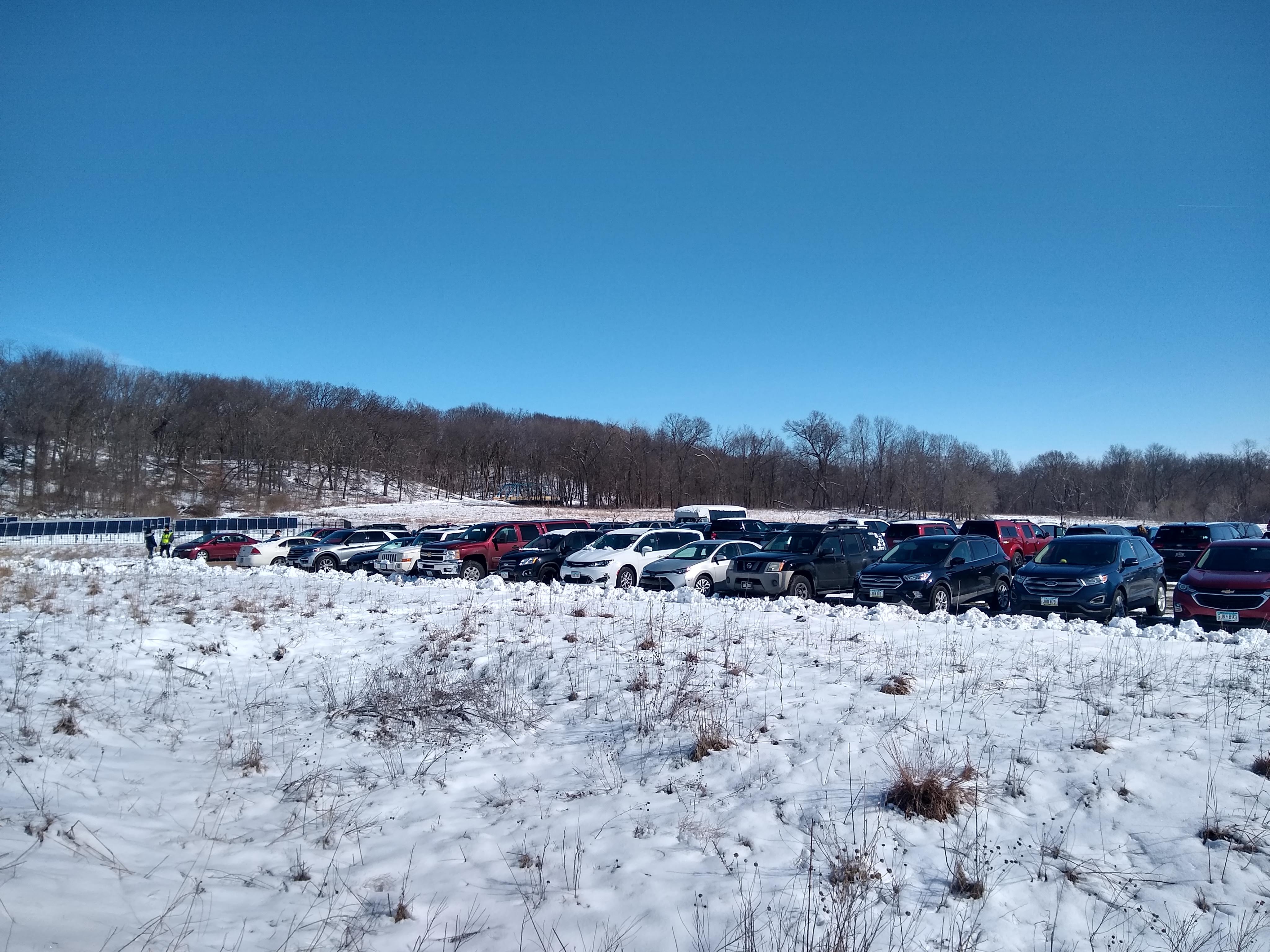
Speaking of which, the Nature Center's remote location has given it room to expand in a genuinely unspoiled area, and to develop an impressive range of hiking trails on its large campus, but it's difficult to get there without a car. (This is shown by the jaw-dropping spread of parked cars during Nature Center events. Cars are bigger than people, of course.) As our metro trail network gets fleshed out, it will be easier to get there by bicycle, at least in the warm months. It's almost three miles from the nearest bus stop, at the Mount Vernon Road Hy-Vee, and there's far from being enough potential traffic to warrant extending the #2 line out this far. It's a conundrum.

Getting all those people there required a lot of cars

Indian Creek Nature Center is on Facebook and Instagram and in the blogosphere. Not on Mastodon, yet, however.

SEE ALSO: "Maple Syrup Festival 2023," 26 March 2023


Saturday, March 16, 2024

Human transit in the Twin Cities


front view of light rail train car
Green Line departing East Bank stop

Jarrett Walker, Human Transit: How Clearer Thinking about Public Transit Can Enrich Our Communities and Our Lives (Island, revised ed, 2024)

Jarrett Walker is out with a new edition of Human Transit, first published in 2011. Walker is a transportation planner, consultant and blogger from whom I've learned a lot about what works and doesn't when it comes to public transportation. I particularly appreciated his insight, explored in the first edition, that any transit system faces a tradeoff between frequency, coverage area, and the ol' budget. Since I've already used those insights to analyze Cedar Rapids transit, and since I had cause to be in Minneapolis this week, it's a chance to examine Walker's ideas in light of the Twin Cities' Metro Transit, a system with which I'm relatively unfamiliar. As it happens, Walker consulted in the Twin Cities, albeit quite a few years ago (Walker 2009).

The fundamental problem addressed in Human Transit is how to move large numbers of people within a small space. Walker refers in the introduction to three efficiencies of transit over cars--space, labor (one driver for many passengers), and strain on the environment (2023: 15)--and pollution, climate, and public health concerns get a few mentions elsewhere in the book, but essentially we're asking how to make the transit we can afford work for the people we've got. It takes as written the aggregation advantages of cities, and that people are living in dense metros for those very advantages.

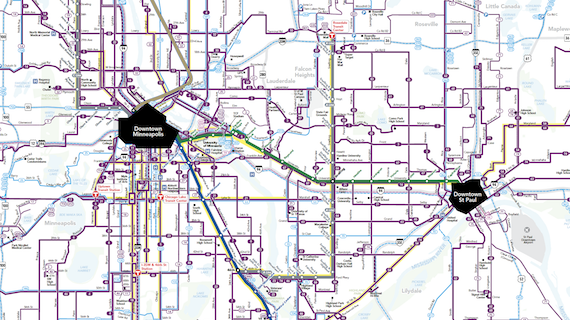
Twin Cities transit map
Metro Transit system map

Even in densely-populated cities, most people must have positive reasons to take transit. Walker focuses on seven common "demands" (expectations) in ch 2:

(1) Connectivity. Are the stops convenient enough to my home and destinations that I can leave the car in the garage or not have a car at all? If I can't get where I'm going on a single line--unlikely in an efficient system consisting of multiple straight lines--are connections easy to manage? 

This is especially hard for a tourist to judge. We stayed at the Graduate Hotel, three blocks from the University of Minnesota's main campus, and kitty-corner from the East Bank station on the light-rail Green Line. We took the Green Line east to the A-Line BRT, then rode that line south to Grand Avenue, at the entrance of Macalester College. The transfer to the A-Line was a bit tricky, as it involved walking swiftly across both University and Snelling, both wide and heavily trafficked streets, to get to the bus stop. 

busy intersection, cars, old buildings
View from the bus stop on an A-Line;
despite the important transit junction, the area is noticeably rundown

On the way back, we took the #63 bus to meet the Green Line at Raymond Avenue. It was not noticeably longer than the journey there, particularly because the train came almost as soon as we got off the bus.

(2) Span and frequency (covered in ch 8). Does the system run enough of the day that I can get to work or school and maybe evening events?

The first St. Paul-bound train on the Green Line rolls through East Bank at 5:21 a.m. Trains come every 15 minutes beginning at 6, only slowing down at 10:30 p.m. The last train arrives at 11:36. Saturday and Sunday schedules are pretty similar.

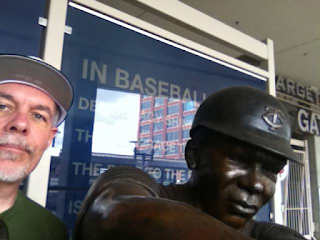
Bruce Nesmith with a statue of Tony Oliva
In 2016 I took the Green Line to its terminus at Target Field where I ran into Tony Oliva

The A-line has a longer day, with the first southbound bus at Snelling and University at 4:15 a.m. and the last at 12:15 a.m. The first #63 bus arrives at Snelling and Grand at 5:15 a.m. and the last at 1:15 a.m., running every 15 minutes from morning through evening rush hour. The different start/end times are curious.

(3) Time. How long does it take to get where I'm going, including and maybe especially the time to get to the station and wait for the bus or train to arrive?

According to Google Maps, it takes 33 minutes in mid-afternoon to get from our hotel to the Macalester College campus by transit, as opposed to 14 by car. If we add in an average wait time of 7.5 minutes for the train, we're at 40.5, plus managing the transit. We got to the East Bank light-rail station just as a train was pulling out, so we waited the full 15. We had about 7 minutes on Snelling Avenue once we'd navigated the intersection, though it seemed longer in the scruffy surroundings, so the total was about 45 minutes.

sign says next train in 11 minutes
Waiting for the train at East Bank

A 45 minute transit run in lieu of a 14 minute drive was still worth it for me, the tourist, because I didn't have to deal with traffic and parking. But if I worked at or near Macalester, I'd probably have my own parking space. (In Washington, D.C., by comparison, the transit time to car time ratio outside of rush hour is maybe 2-1 instead of 3-1.)

(4) Fares (ch 11). How painless is it to pay to ride? For regular riders, there are 7-day and 31-day options which can be loaded onto one's plastic Go-To Card. For tourists, an all-day pass is $5, good for both rush hour and non-rush hour, and usable on all local lines. (A single ride is $2.50 during rush hour, $2 otherwise.) 

I bought my all-day pass on the Metro Transit app, so it was on my phone, while Jane bought a paper ticket at the East Bank station. 

Fare kiosks by the train stop
Fare kiosks

The all-day pass allowed us to transfer without additional payment, and to stop on the way back at the Textile Center across from the Prospect Park train stop. Our different modes of ticket purchases were about equally painless...

all-day pass and credit card receipt
All day passes are $5 on weekdays, $4 on weekends

...but anyhow fare collection on Metro Transit appears to be on the honor system. If you have a Go-To Card you can tap in at the station, but you can't do that with phone or paper; anyhow there's no barrier to prevent non-payers from entering the vehicles.

(5) Civility, mainly of station agents and conductors, but I'd include conditions on the bus or train. Because of the seemingly lax enforcement, we had no interactions with transit employees. Conditions on the vehicles we rode Friday (three separate light-rail trains, one A-line bus, one #63 bus) were a mixed bag. 

Interior, eastbound light rail train

None of the vehicles was crowded, as we did start our travels til after 9:00 a.m. There was a strong marijuana smell on two of the trains, and one train had several passengers who were clearly living temporarily in the train cars. Saturday night on my way back to the hotel on the Green Line, I unwittingly boarded into a drug party that was well underway; I debarked as soon as I could, and trotted to the next car which proved to be a better fit.

(6) Reliability. Can I count on the system to get me where I'm going on time? The vehicles were all on time or very close to it, even though we heard announcements that the Green Line was running slowly due to track issues.

(7) Legibility. If I change my plans at the last minute, is it clear what my new route is? I'd use the Maps app on my phone rather than try to use system resources, whatever city I was in. There aren't system maps about in the Twin Cities, or even route maps for the light rail or BRT. 

sign posted with bus times
Grand Avenue and Snelling: when the bus comes

From my quick tourist's glance, it seems Minneapolis-St. Paul's Metro Transit is doing a lot of things right. The system is easy to use, and mostly comfortable to ride. Even so, for our Saturday tourism, we used our car. Getting there in a-third of the time is irresistible, even for urbanists.

SEE ALSO: 

Ian Guide, "We Need to Talk About Bus Rapid Transit Creep," Streets.mn, 12 March 2024 [The A-line BRT is not BRT. It shares lanes with private cars, and stops at traffic lights. The only way it's special is it makes fewer stops than an ordinary bus, which makes it an express bus, not BRT. On the other hand, the University circulators, one of which I took Saturday night, run much of their route along a "transitway" that is closed to private cars.]
 
Diana Ionescu, "How Public Transit Became Political," Planetizen, 14 March 2024 [includes article to longer article in Governing]
 
 
bus approaching East Bank light rail stop
Washington Avenue: Both metro and university buses drive along the light rail track,
which is ever-so-gently separated from the street

Wednesday, March 13, 2024

FY25 budget

President Biden released the Budget of the United States this week, directly on his State of the Union address last week. The Budget has been a presidential responsibility since 1921, when Congress essentially threw up its collective hands and delegated it to President Warren G. Harding in the Budget Act. Presidents got a significant staffing upgrade relative to this task in 1970, when another Budget Act created the Office of Management and Budget directly responsible to the chief executive.

This edition of the budget is for fiscal year 2025, which begins this coming October 1. It comes somewhat later in the calendar than usual, but otherwise is pretty typical for a budget. It's mostly a continuation of past government financing, with some policy recommendations that would if adopted have some impact on the bottom line numbers. It has no policy authority of its own; actual government financing requires appropriations by Congress, which given its divided and polarized condition tends even more towards the incremental. Still, it's as good a statement as any of the financial shape and direction of the U.S.

Biden's budget projects a country returning to normal over its 10-year time perspective, following the dislocations of the coronavirus pandemic shutdowns--dislocations that were profound but seem to have been mercifully short-lived. Real GDP growth is expected to be in the low 2 percents through fiscal 2034 (Table S-9, p. 173). (It is a real temptation for presidents to forecast exceptional economic growth, because it makes the bottom line look better. Trump did this; Biden hasn't, to his credit.) Inflation is projected to be down to 2.3 percent in 2025 and in the low 2 percents after that. Entitlement ("mandatory") spending is predicted to be stable at 15-16 percent of gross domestic product, with interest payments rising to 3.5 percent of GDP over this period (Table S-5, p. 142).

Government revenues have averaged about 18 percent of GDP since the 1970s, though they dropped sharply during the 2008-10 recession and the pandemic. FY25 revenues are estimated to be 18.7 percent, with gradual rises after that to 20+ percent beginning in FY31 (Table S-1, p. 137). Biden proposes tax increases on "the wealthiest Americans and big corporations" totaling $5 trillion over this period, not to mention allowing most of the 2017 tax cuts to expire when they sunset in 2025.

Government spending has averaged about 21 percent of GDP since the 1970s, running higher during the recession and then surging over 30 percent at the height of the pandemic. FY25 spending is estimated at 24.8 percent, remaining between 24 and 25 percent for the rest of the period (Table S-1, p. 137). It will top $7 trillion for the first time, and reaching $10 trillion in FY33--consistent with growth in the size of the economy, but staggering numbers for someone who remembers Jimmy Carter getting static for proposing the first $500 billion budget. (Now the defense budget alone is more than half-again larger!) There are a few new spending programs included, such as "investments" in health care and expanding access to child care and early childhood education. More notably, the budget projects no cuts in Social Security or Medicare, the two largest and fastest-growing government programs, and declining demands on the defense budget.

The FY25 budget projects a FY25 deficit of $1.781 trillion, 6.1 percent of GDP, optimistically assuming adoption of his proposals and seemingly peace in the Middle East and Ukraine. Otherwise the deficit remains over 5 percent of GDP (Table S-2, p. 138), or gets higher if the 2017 tax cuts are extended. I understand that you don't want to be so aggressive about the deficit that you blow up the economy, and that none of the most-feared negative effects--crowding the private sector out of lending markets, vulnerability in a crisis, vulnerability to international creditors--has come to pass after 40 years of high borrowing. 

 But neither am I sanguine about our financial future. Maybe I'm too Newtonian but the lack of urgency shown by either party when they're in power seems less than resilient. But on the other hand, is rationalizing the budget more urgent than cleaning up forever chemicals or burying interstates or getting the health insurance system on a sound footing?

SEE ALSO:

James Capretta, "The Biden Administration's 2025 Budget," AEIdeas, 12 March 2024

Anna Malinovskaya and Louise Sheiner, "The Hutchins Center Explains: Federal Budget Basics," Brookings Institution, 13 December 2018 [lots of good if out-of-date charts here]

Michael E. O'Hanlon and Alejandra Rocha, "What's in Biden's $850-Billion Defense Budget Proposal?," Brookings Institution, 15 March 2024

Alan Rappeport, "Biden Budget Lays Out Economic Battle Lines with Trump," New York Times, 12 March 2024

Monday, March 11, 2024

10th Anniversary Post: The Gentrification Conundrum Revisited

Census tract 27: Row houses built in 2017 with appraised
values of $400,000+

(3/11/2024) Ten years ago this month, Holy Mountain looked at gentrification, the value of diversity, minimum wage laws, the city's new strategic plan Envision CR, as well as Indian Creek Nature Center's annual Maple Syrup Festival--which happens again in a couple weeks! We will be there to cover every sticky bite, of course.

The piece on gentrification, driven by the middle class's return to cities, surveyed an array of literature both pro and anti. (For other surveys of that array, see Cortright 2014a, Cortright 2014b, and Kaplan 2015.) It also introduced me to Chicago artist Theora Kvitka, whose cartoon I got permission to use at the top of the post.

Gentrification at its worst involves under-invested urban neighborhoods receiving a sudden influx of middle class residents that dislocate the people already living there, who are often working class people of color. (In Alyssa Cole's novel When No One is Watching [Temple Hill, 2020], the newly-arrived whites in a New York City neighborhood not only displace the black residents and yuppify their stores, they capture the blacks and use them for scientific experiments.) But as Joe Cortright has argued, the alternative to gentrification for most neighborhoods has not been humble stability but concentrated high poverty. So, the goal for policy makers should be to encourage investment without blowing up places where people are already living.

I wrote in 2014:

For the older neighborhoods in Cedar Rapids, such as Wellington Heights and the Taylor Area, I've advocated "gentle gentrification," of which I'll admit I have only the very vaguest concept. But this much is certain: We don't build diverse communities by pricing people out of the homes they own. It's difficult enough to overcome habits of class prejudice and segregation without adding a financial hit.

Cedar Rapids is not New York City or D.C. or Denver, but we too have seen changes. Data from the U.S. Census Bureau's American Communities Survey bear out some of those impressions, and although it's not clear how much of these changes are due to movement in and out, there are new poor areas developing at the edges of town.

Several census tracts exist mostly in core neighborhoods, although they do not correspond exactly to neighborhood boundaries.

map of census tracts in Cedar Rapids
Census tracts in the center of Cedar Rapids
(Sources: census.gov)

Data are from the 2000 U.S. Census, and the American Community Survey's five-year estimates published in 2014 and 2022 (so the data center on 2012 and 2020). See table at bottom of post for raw numbers. Note that none of these tracts became whiter between 2000 and 2020.

HARD HIT: Population DOWN, Income DOWN, Poverty UP

Census tract 19: Downtown, with portions of Mound View and Wellington Heights

Population -22.5%, Median Family Income +6.9%, Poverty Rate +69.3%

There's been some condo development downtown, with more under construction, which may account for the jump in income since 2010 (though to keep pace with inflation since 2000, median income would have to be about $47000). There are also some rooming houses in the MedQuarter, and some older housing stock in the neighborhoods in areas that remain poor. The low poverty rate from 2000 relative to today surprises me, because what housing stock we've lost was rickety (around Coe College, for example).

Of the six tracts studied here, this tract has diversified the most, going from 80.2 percent white (not Hispanic or Latino) in 2000 to 62.7 percent in 2018-22.

GENTRIFICATION COMING? Population DOWN, Income STEADY, Poverty UP or DOWN

Census tract 12: including Time-Check

Population -46.7%, Median Family Income +84.7%, Poverty Rate +114.9%

Census tract 26: including Czech Village 

Population -30.2%, Median Family Income +171.4%, Poverty Rate -33.8%

These areas lost much of their housing after the flood, with the city buying out property owners and leveling the houses between C Street SW/Ellis Boulevard NW and the Cedar River. Now that flood protection is being built on the west side of the river, expect construction to begin in earnest. It will be interesting to watch this over the next several years. Note the contrast with nearby tract #22 to the north in terms of economics away from the river.
 
These were the two whitest tracts in 2000, with over 92 percent white (not Hispanic or Latino). Tract #12 remains 87.5 percent white, while tract #26 has diversified somewhat to 77.8 percent white.

GENTRIFICATION STARTED? Population and Income STEADY, Poverty UP

Census tract 22: most of the Taylor Area including Kingston

Population -6.2%, Median Family Income +35.4%, Poverty Rate +124.1%

Kingston Yard four story brick building next to sidewalk
Coming to tract #22: apartment/condo development at Kingston Yard

This area has almost made back the population lost to flood displacement. The jump in income results from burgeoning condo development near the Cedar River, which before the flood was mostly older shops with some housing. (Note, however, incomes still lag inflation, which was +50 percent nationally from 2000-2020.) Because of the flood, this area was mostly vacant in 2010-14, so any displacement had already happened before the new residents arrived. The high poverty rate is probably located in the blocks farther from the river; its persistence is striking, suggesting that area has not shared in the prosperity brought by recent development. Why it is so much higher than 2000, I do not know.

Census tract #22 has diversified considerably, from 86.5 percent white (not Hispanic or Latino) in 2000 to 63.6 percent in 2018-2022.

LOOKS LIKE GENTRIFICATION: Population STEADY, Incomes UP, Poverty DOWN

Census tract 17: including most of Wellington Heights

Population -3.4%, Median Family Income +107.3%, Poverty Rate -45.0%

Census tract 27: most of Oak Hill Jackson including New Bohemia

Population +5.8%, Median Family Income +113.9%, Poverty Rate -10.6%

Wellington Heights, largely untouched by the 2008 flood, has seen some housing investment since 2010, but I still can't explain that phenomenal jump in income or decline in poverty. The eastern border of Wellington Heights is 19th Street SE, but the census tract extends another half-mile farther to Forest Drive, taking in a considerable portion of a well-to-do area (including the home base of Holy Mountain). Maybe that explains the numbers, or maybe it is indeed an indicator of gentrification of the older area.

Oak Hill Jackson has made back the population lost to flood displacement, and a little extra, though the U.S. as a whole gained nearly 18 percent during this period. The surge in income results both from burgeoning condo development near the Cedar River and middle class influx into the working class area farther in. Of the four neighborhoods this looks the most like stereotypical displacement accompanying gentrification, although the poverty rate remains high so not all the poor have been displaced. 

Census tract #27 was the most racially diverse of the six tracts in both 2000 (65.9 percent white not Hispanic or Latino) and 2020 (59.8 percent white). Tract #17 has diversified from 78.6 percent to 67.7 percent white.

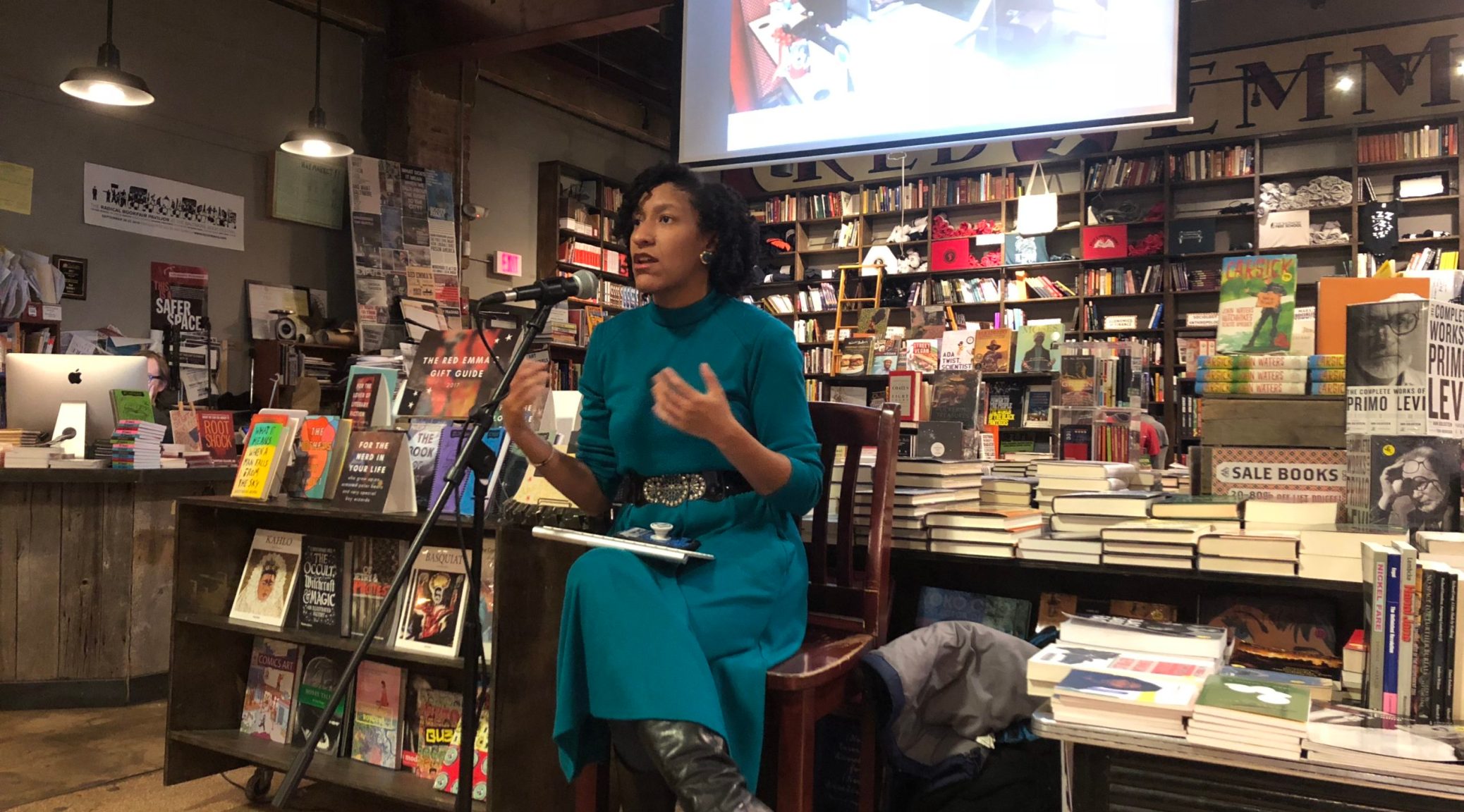
Kristen Jeffers seated, speaking at a bookstore
Kristen Jeffers speaking (from theblackurbanist.com)

Planner Kristen Jeffers, who blogs at The Black Urbanist, just produced an hour-long video called "Six Ways to Defy Gentrification." She describes gentrification, with decidedly negative connotations, as both an economic process ("typically accompanied by displacement") and a cultural process by which neighborhoods become more "respectable" (because previous residents were considered "unwealthy or unworthy" or both). Three of the six pieces of advice, directed at those experiencing gentrification from a less powerful perspective, are:

  1. have faith in yourself (30:00): "you are worthy, you are valid, no matter what your rent is"
  2. ground yourself by cultivating your art (32:00), particularly cultures and folkways like music, fabric or other visual art, gardening, teaching, &c., as well as cultivating your community and your resources
  3. ground yourself through finding every way to make life convenient for yourself (33:45) by inhabiting your neighborhood: walking to the local grocery store, doctor's office, school, &c.

For gentrifiers, she commends:

  1. care about the people around you (41:00), "be that person" who contributes to a diverse community by working and playing together
  2. infrastructure (42:55), including public transportation and pedestrian plazas, but particularly housing that is affordable/accessible for everyone
  3. access (46:15) for people with mobility needs, including everyone in those conversations

Cedar Rapids is growing slowly enough that we ought to be able to manage gentle gentrification, increasing investments in core neighborhoods without dislocating existing residents. I think everybody ought to live as close to the city center as they can, and that services ought to be available within a reasonable distance that makes walking, wheeling, cycling, and public transit viable alternatives. I also think there should be room for everyone, and that the fate of those with fewer resources and/or socially marginalized is the concern of everyone. I see things we're doing right--two-way streets, park development, zoning reform, a flurry of apartment and condo construction in the core--and things we're doing wrong--drive-to urbanism and big "game-changer" projects that don't serve everyday needs or leave room for everyday lives. Could we be doing all this better?

SEE ALSO: 

Pete Saunders, "Rethinking the Affordable Housing Crisis, Part III," The Corner Side Yard, 6 March 2024
Steven Thomson, "As 'Gentrification' Turns 50, Tracing Its Nebulous History," Curbed, 5 November 2014

DATA:

POPULATION


TRACT          2000          2012         2020
     00-20
12TimeCh 3215 1362 1715 -46.70%
17Wellingtn 7137 6598 6891 -3.40%
19Downtwn 3359 2850 2603 -22.50%
22Kingston 2779 2259 2606 -6.20%
26CzechV 3012 2725 2101 -30.20%
27OHJ 1797 1591 1902 5.80%

POVERTY       


TRACT         2000
        2012
        2020
    00-20


12TimeCh 0.087 0.179 0.187 114.90%


17Wellingtn 0.149 0.103 0.082 -45%


19Downtwn 0.225 0.375 0.381 69.30%


22Kingston 0.116 0.293 0.26 124.10%


26CzechV 0.154 0.174 0.102 -33.80%


27OHJ 0.282 0.368 0.252 -10.60%


MEDIAN FAMILY INCOME


TRACT                   2000        2012            2020            00-20
12TimeCh            40451        38365          74722          84.7%
17Wellingtn          55613        72639        115293        107.3%
19Downtwn          31182        28188          33333            6.9%
22Kingston           37946        33304          51364          35.4%
26CzechV             42703        58100          73185          71.4%
27OHJ                  27115        40543          58004        113.9%

10th Anniversary Post: Linn County's First Bicycle Boulevard

  Marion portion of Linn County Trails and Bikeways Map (downloaded from linncountytrails.org) (8/18/2026)  Linn County's first designat...