Tuesday, April 6, 2021

Why I Pedecommute (and Pedal Commute)


sidewalk with snow pile blocking access to the street
Walking to work has its challenges

(4/6/2021) When I was waiting to cross 1st Avenue on my bike on the first Monday of Earth Month, I saw a colleague getting out of her car. She's younger than me, and lives closer to the college. But driving is clearly the default option in our town, as in most places in America. Cars are seductive--for their convenience, for their accessories, and I guess for a certain type their power. I chose differently long ago, and I'm glad I did.

I need to note that my commuting mode is not strictly car-free, and my core motivation is hardly ethical. I simply enjoy walking, or riding my bicycle, over driving. I may well, though I hope I don't, counterbalance the environmental benefits of my commute in some other sector of my life.

I walk or ride because it gives my head time to clear before and after work. A time spent moving at a human pace, being truly able to see things and people around me, without the onrush of stimuli in and out of my car, is good for my mental health. It gives me time to process whatever is going on that needs processing. (For citations of actual research on this, see Rose 2016: 333-334.)

Jeff Speck with microphone in front of display on screen
Jeff Speck in Cedar Rapids, 2015

Jeff Speck says in Walkable City that in order to encourage more people to walk, walking needs to be safe, interesting, useful, and comfortable (2012: 7-11). Cedar Rapids has made significant progress in some areas of town, but most of the city falls far short of these ideals, so I understand why I don't encounter more people on my walks. Most people will walk if there are places they need to go within easy walking distance, if they feel safe from cars, if buildings and trees provide a sense of enclosure, and if there are plenty of signs of human activity. That to some extent describes downtown and some parts of the core neighborhoods. Less than 30 percent of Cedar Rapids children walk to school, and that number will surely decline as schools are closed and attendance areas get larger.

Walking is good exercise. You can, and should, seek out aerobic exercise at a pool or gym, but most people don't. Most people get what exercise they get incidental to their daily tasks, which means if those tasks aren't achievable by a reasonable walk, most people drive and get no exercise. Exercise is good for the body and for the soul, but the way we design our towns makes it difficult. As a result, arguably a bigger factor than diet, over 30 percent of American adults and over 20 percent of teenagers are obese (higher in the Midwest).

Walking is also beneficial to social relations. You notice more of your surroundings when you are moving slowly within them, as opposed to moving fast through them. That is particularly true of the people we live among. A lot of my fellow humans don't look or act like me, but walking among them helps me get used to that. Walk the neighborhood day after day, year after year, and you begin to recognize people--and their dogs--you wouldn't have time to see from a car. Eric O. Jacobsen (2012: 173-174) cites Jane Jacobs (1961: chs 2-4) on the interaction of people on city sidewalks: watching each other means watching out for each other, repeated casual contacts build public trust, children have a chance to learn about the complex world around them. He concludes:

Implicit behind Jacobs's confidence in the city and neighborhood to function coherently is some sense of structure and order that emerges when people live in proximity to one another. There may be a number of ways to account for this implicit structuring and ordering, but one coherent way to think about it is to envision a gracious and sovereign God who both created humanity in his image and is drawing the human creation toward a communal experience of wholeness and harmony. (2012: 179)

One man walking can't make street life, but enough people walking make possible not only street life, but safe routes to school, third places, and other locally-owned small businesses. Cars make possible acres and acres of parking lots.

red tailed hawk on grass near building
A Coe hawk by the sidewalk

Walking you notice more birds, too, not to mention the ways that humans thoughtlessly impact the natural world. Transportation accounts for 28 percent of U.S. carbon emissions, and in suburban-style development about doubles emissions from household energy use. Air pollution from motor vehicles costs about $10 billion a year if you factor in respiratory illnesses caused by pollution. New development, typically large lot subdivisions, takes two million acres of undeveloped land each year (cf. Hester 2006: 201-204, Speck 2012: 51-63). 

Walking and cycling accommodate the environment in ways that cars cannot. Speck (2012: 51-63) criticizes what he calls "gizmo green," which is selling and buying gadgets from electric cars to LEED-certified buildings that improve on comparable older products without as much overall impact on the environment as walking. "It turns out that trading all of your incandescent lightbulbs for energy savers conserves as much carbon per year as living in a walkable neighborhood does each week." He quotes Witold Rybczynski, author of Makeshift Metropolis: "[A] solar-heated house in the suburbs is still a house in the suburbs, and if you have to drive to it--even in a Prius--it's hardly green."

But hybrids are only one trend in American vehicles. Without the high gas prices we had ten years ago, vehicle sizes in America and elsewhere are gigantizing. As Andrew Simms of the New Weather Institute in Britain says, "One of advertising's biggest manipulations has persuaded urban families that it's perfectly 'normal' to go shopping in a two-tonne truck" (Harrabin 2021). 

I'm glad walking and cycling to work lessens my impact on the environment, and helps to develop community feeling in our area. But, as I said, mostly I do it because it feels good.

SOURCES
Randolph T. Hester, Design for Ecological Democracy (MIT Press, 2006) 
Jane Jacobs, The Death and Life of Great American Cities (Vintage, 1961)
Eric O. Jacobsen, The Space Between: A Christian Engagement with the Built Environment (Baker Academic, 2012)
Jonathan F.P. Rose, The Well-Tempered City: What Modern Science, Ancient Civilizations, and Human Nature Teach Us About the Future of Urban Life (Harper Wave, 2016)
Witold Rybczynski, Makeshift Metropolis: Ideas About Cities (Scribner, 2010)
Jeff Speck, Walkable City: How Downtown Can Save America, One Step at a Time (Farrar, Straus and Giroux, 2012)

POST SCRIPT

This is based on my personal experiences, which are as an able-bodied person... for the time being anyway. I do not for a moment want anyone to think that making a city more walkable does not also help those with disabilities. See this Strong Towns interview with Heidi Johnson-Wright, an Americans with Disabilities Act coordinator in Florida (Quednau 2018).

Saturday, March 27, 2021

More like this

Main Street, Galena, Illinois (photo by Robert Manson)

Bob Manson's latest entry on his terrific blog survey of independent bookstores, The Indie Blog Spot, takes him to Galena Book and Paper in downtown Galena, Illinois. Bob describes at as "a very comfortable space... a beautiful, well-lit store with a creaky wooden floor" in "an excellent location, nestled on Main Street alongside many other fine local businesses."

Bob's picture of downtown Galena is arresting. It shows a highly walkable district with numerous mostly local businesses in historic buildings that have been purposed and repurposed many times. Go up the bluff about two blocks and you're in a residential neighborhood, making Main Street eminently walkable albeit crowded during peak tourist season. Ironically, it was made possible because when the river town fell on hard times, it couldn't afford to tear down its old buildings, until eventually they became attractions. Galena's Main Street, along with historic downtown Dubuque, are the two most widely-known of their type in the region, perennial tourist magnets, and have been models for other towns (including New Bohemia and Uptown Marion).

So its success has led to replication, but largely as tourist districts. All of the districts named above have independent bookstores, and good coffeeshops, but no grocery or hardware stores. (There are specialty food stores on Main Street, but locals buy their groceries at the Piggly Wiggly with the gigantic parking lot in an unwalkable location on the edge of town.) Schools are rare. (Yay, Marion.) These are places to visit, not to live. Residential choices remain largely between houses in single-use residential districts, high-end condos, and low-end rentals.

It's possible that Main Street Galena and New Bo only attract people for the experience of an afternoon, but we seem loath to try urbanism on any scale, with the partial exceptions of small college towns (e.g. Decorah, Fairfield, Mt. Vernon). If people find showplace urbanism attractive for shopping and dining, why wouldn't at least some of them want to live in organic urbanism?

Thursday, March 18, 2021

I think this house will be o.k.


It's not often my neighborhood makes the news, but last week the Board of Adjustment was called in to grant a zoning waiver to a house on my very block. The house pictured above, built in 1930, was crushed by an uprooted tree during the August 2020 derecho storm. Earlier this year, the wreckage was cleared away, and now the owners are rebuilding. The lot is 50 feet wide and 140 feet deep.

The first thing you notice about version 2.0 is the garage. The former garage was behind the house, with an alley access. Now there will be a garage that faces the street, with driveway access. This comes dangerously close to the "snout house" design I criticized in October 2016 for infill housing in Oakhill-Jackson. 

It is true that the garage is typically not the loveliest part of the house, and that no other house in our neighborhood has this feature. Even those houses nearby that have driveway access to the street have their garages behind the house. More substantively, as Daniel Herriges (2020) argues, the design creates two problems for any neighborhood: By putting the part where people live behind the garage, it takes away the "eyes on the street" that make pedestrians feel safe, and takes away the signs of human activity that make for an interesting walk.

The traditional city is a sort of social compact. It adheres to certain rules of design not because of aesthetic conformism, but because they produce an environment that is pro-social. The public realm enriches the buildings that front it, and the buildings enrich the public realm.

A front-loading garage, a blank wall, an absent or hard-to-find front door, an over-tall fence around a property: these things spit in the face of that social compact. They send the message, "My world is made up of my private space and the other private spaces I travel to and spend time in." (Herriges 2020)

There is the additional matter that this design feature is prohibited under our town's recently adopted form-based code, as we are "traditional residential-1," at least on that side of the street. (See pp. 215-216.) For that reason the plans were rejected by the Planning Commission, before they were restored on appeal to the Board of Adjustment. Why have a zoning code at all, or a Planning Commission, if we are just going to toss them out as soon as they are challenged by an experienced development team?

That having been said, I'm okay with the outcome. The design of the new house is less aggressive than a lot of the snout houses in subdivisions around our town, and as one of my neighbors noted, it will have a covered front porch and cedar shingles. As troubling as the practice of making zoning exceptions is, I'd have been very o.k. if the owners had decided to build a small store, or a bar, or "missing middle" housing, all of which our neighborhood could use, even if the form deviated from the code. Finally, the clincher is that the owners of the old house are maintaining ownership. If they'd sold the lot to a developer, I'd probably feel differently.

Meanwhile, builders are at work digging the new foundation...

...which is the most excitement our block has seen in a long time. Really, I think this house will be o.k.

Wednesday, March 17, 2021

Iowa Takes Aim at Voting


Jane votes, fall 2020 (Photo by Jane Nesmith)

For this nation to remain true to its principles, we cannot allow any American's vote to be denied, diluted or defiled. The right to vote is the crown jewel of American liberties, and we will not see its luster diminished.--RONALD REAGAN, November 7, 1981

Amid awful suffering and deteriorating conditions, Texas Republicans decided to fight a culture war. In doing so, they are emblematic of the national party, which has abandoned even the pretense of governance in favor of the celebration of endless grievance.--JAMELLE BOUIE, February 19, 2021

Hold our beer, Texas! We have grievances, too! 

Iowa's legislature is in session, which means the usual silliness is being debated and passed while our rural areas depopulate, we have one of the highest rates of COVID deaths in the country, and individuals and businesses struggle with economic recovery. Among the bills making it through the first "funnel"--Iowa has a part-time legislature with a three-month session, so bills must meet certain deadlines to remain under consideration--are prohibitions against traffic cameras, sanctions on social media companies that "censor" conservatives, scholarships to private K-12 schools, allowing the carrying of guns without a permit (unless you're riding an e-scooter), adding gun rights to the state constitution, a constitutional amendment declaring no right to abortion, ending faculty tenure at state universities, and cutting off funds to cities that "defund" their police departments. 

The most recent piece of legislation produced by this august body aims at protecting the sensitive feelings of white men during discussions of racism and sexism (Sostaric 2021b). It specifically bars school curricula or government agency diversity training that "teach, advocate, act upon, or promote divisive concepts." Among concepts declared to be divisive is "that the U.S. or State of Iowa are fundamentally or systemically racist or sexist." Systemic racism is a serious issue--see Alston 2020, Koh 2017, and numerous other thoughtful takes--which the Iowa legislature is taking on in the silliest way possible.

Three bills that might have a positive economic impact are tax relief for individuals and businesses that have received COVID assistance; a substantial appropriation for broadband expansion; and requiring more ethanol to be sold at service stations. The rest is pure candy for those who like Iowa the way it was, whatever that was. House Minority Leader Todd Pritchard noted, "the Governor and majority party's agenda so far this session has been too focused on divisive bills that will make Iowa's recovery even more difficult.... With Iowa's workforce shortage and aging population, anytime Iowa lawmakers send messages that make Iowa look unwelcoming to others is bad for business and Iowa's future." Some even dumber stuff didn't make it through the funnel, but we can hope for next year!

However, as I said, this is pretty much what we've come to expect from our legislature of late: sundry slings and arrows at anyone who doesn't look or act like 1950s Iowa. But, this year...

This year, we're adding making it harder to vote. Governor Kim Reynolds signed a bill March 8 that moves up the deadline for arrival of absentee ballots regardless of when they were mailed, moves back the availability of absentee ballots and early in-person voting to half the time it was before 2017, outlaws mass mailing of absentee ballot request forms (an expedient used during the 2020 pandemic that might not have been repeated anyway), allows each county to have exactly one absentee ballot drop box, requires only the voter to drop off the absentee ballot, and makes disobedience by county officials a criminal offense (Sostaric 2021a). Provisions prohibiting mailing of absentee ballot applications, as well as further shortening the early-voting period were removed on the House floor. The bill was opposed by the Iowa State Association of County Auditors.

This direction is wrong on so many levels: It is part of a concerted effort by Republican legislators across America to make voting more difficult ("State Voting Bills Tracker 2021"). It is by any objective standard an overreaction to concerns about election security, it legitimizes former President Donald J. Trump's five years of baseless complaints that his opponents were cheating, and it disproportionately affects some social groups. Poor and working-class people, racial minorities, people who live in urban areas, and single parents are more likely to find this a hardship. That is what should alarm advocates of community. A common life requires that all be heard, that everyone no matter how humble have the opportunity to be part of the collective conversation. The right to participate is therefore fundamental. This law, passed by one party that represents one demographic (albeit a traditionally dominant one), strikes at the very heart of that. 

The legislative majority annually speaks volumes about who counts and who doesn't in Iowa. This year, they've gone farther, to restrict who can be heard.

SEE ALSO: Erin Murphy, "New Iowa Law Limits Early and Absentee Voting," Cedar Rapids Gazette, 9 March 2021, 1A, 9A

Iowa statehouse (Source: Wikimedia commons)

Monday, February 15, 2021

What's Up in Uptown Marion? (II)

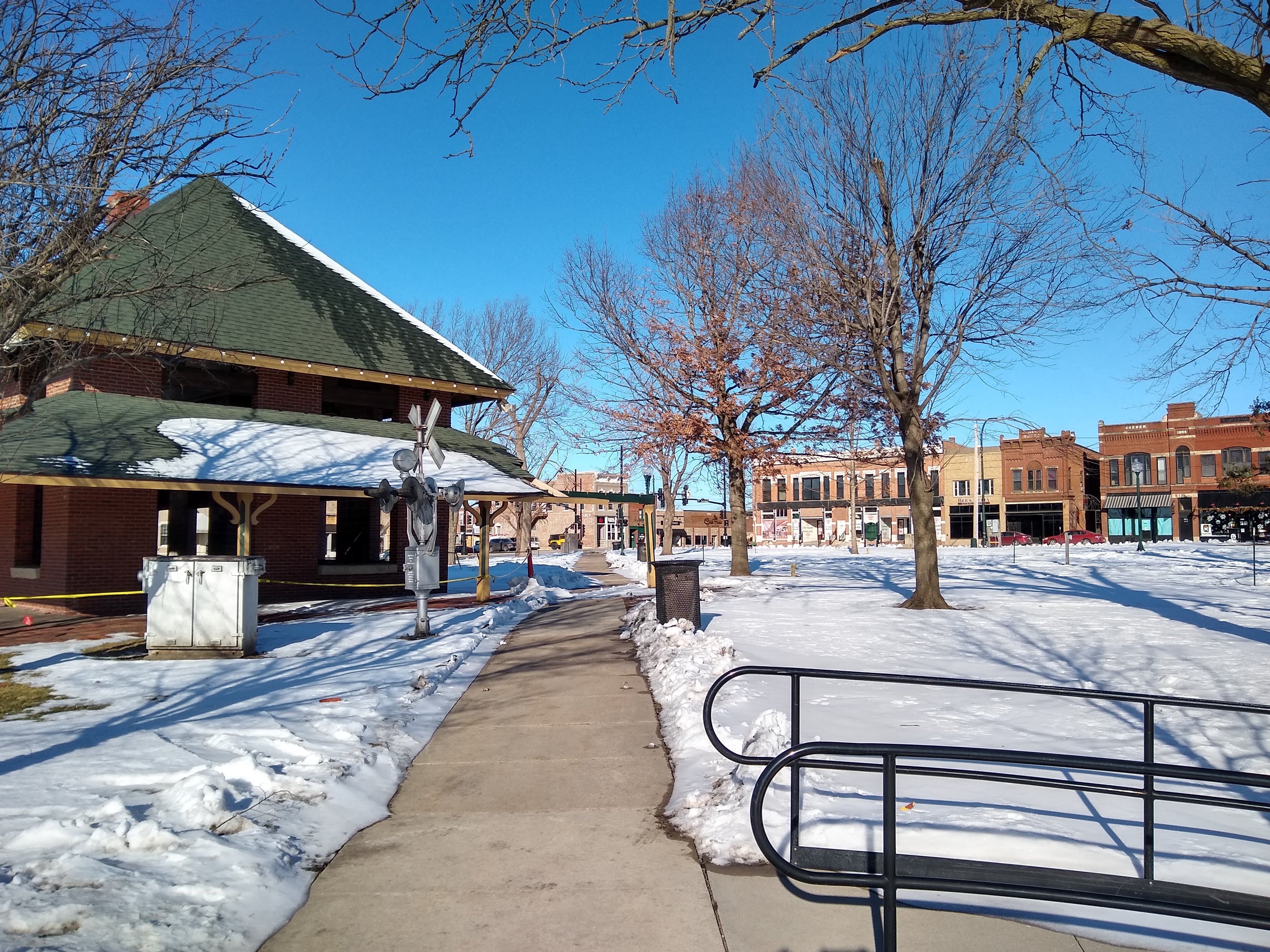
1000 block of 7th Avenue, taken across City Square Park

(2/15/2021) Five years ago this winter, Your Humble Blogger spent part of a day helling about downtown Marion, Iowa (officially branded and hereafter called "Uptown"). Having heard at this month's Corridor Urbanism meeting there were more exciting things going on there, I hurried back for an anniversary look-see. Despite damage from the August 10, 2020 derecho and the persistence of the coronavirus pandemic, things are definitely happening.

Center and path: City Square Park lost trees in the derecho

In our last exciting episode, it was noted that (1) Uptown Marion makes great use of its city square and historic commercial buildings, and was planning some interesting alley projects as well as a new library; (2) the urbanist part of town is really, really small, but seemingly growing and capable of serving nearby residential neighborhoods; (3) Uptown commerce has a high frou-frou-to-practical ratio, and only one coffeehouse; and (4) part of the plan was to divert through traffic from 7th Avenue to 6th Avenue.

(1) Thriving historic commercial district.

City Square Park: The historic depot got hit hard

11th Street: historic buildings, new buildings that blend in,
and east entrance to Art Alley

7th Avenue: south entrance to Art Allley

Art Alley: Back patios of Uptown Snug, Brick Alley Pub, and Short's
create charming synergy (when it's not January)

7th and 12th: What used to be Irwin's Clothing is now a dental office
1100 block of 6th Avenue: Construction of the new public library,
one block east of the current building

First United Methodist has moved, replaced by
Pentecostals of Greater Cedar Rapids.
Historic building suffered much storm damage.


Where the bus stop used to be: Leftover from Christmas?

(2) Expanding urbanism.

1200 block of 7th Avenue, north side:
urbanist foothold increases

1200 block of 7th Avenue, south side:
this strip mall will soon be replaced by a multi-story, mixed use project

800 block of 6th Avenue, south side: a new urbanist foothold,
with a diner and tiny shops including a gift shop, book store,
and jeweler

Longer view of the same space from 9th Street: Your development here?

(3) Drive-to urbanism. The Walkscore for this charming district is 72, but you'd still have to drive a ways for groceries and hardware, for example. Walgreen's at 1225 7th Avenue is both a positive and negative: a positive because you can get prescriptions and some groceries right downtown, a negative because it's a wealth-sucking chain big-box store with a huge footprint right downtown. This cannot possibly be the highest, best use of that land. More changes are coming with new developments on the site of Marion Square Mall and the current public library.

With regard to coffee, Uptown Snug (760 11th Street) has opened a coffee house in the front of the bar, which fills a definite hole because the only coffee last time was at Wit's End (630 10th Street) which has closed--temporarily?--due to storm damage. Kettel House Bakery (945 6th Avenue) and West End Diner (809 6th Avenue) also serve coffee, but are restaurants not coffee houses.

(4) Traffic diversion? As of the last traffic counts, in 2017, 7th Avenue continued to be the main thoroughfare in this area, drawing 12,800 cars per day compared with 6100-6200 on 8th Avenue and 2670-3370 on 6th. Twenty years ago, traffic on 7th was 18,500 per day, with the decrease probably due to the Marion Bypass (IA 100) south of town. The roundabout at 7th Street (pictured above in August 2016) was added in 2015,  intended to divert traffic onto 6th Avenue and make 7th Avenue more pedestrian-friendly (see Kasparie 2016). This morning traffic still seemed heavier on 7th Avenue, and the highway designation (BUS 151/IA 922) still attaches to 7th Avenue as well. It will be interesting to see the next round of average daily traffic counts, but that goes without saying, doesn't it?

Meanwhile, the Marion Fire Department is moving its headquarters from Uptown out to Tower Terrace Road, and the YMCA of the Cedar Rapids Metro Area has just opened a new facility out there. The Police Department's already at another edge of town. Marion's center of gravity clearly has been heading away from Uptown for a long time; the city's growth to an estimated 40,359 in 2019 from 20,479 in 1990 has largely been fueled by suburban expansion. 
 
So where does Uptown fit into Marion's future? Maybe a viable residential option for people who choose not to live in a 20th century auto paradise, and another hotspot of drive-to urbanism for the rest of us.

12th Street south of 7th Avenue: Someone needs to up(town) their snow removal game!

Sunday, February 7, 2021

Review essay: Urbanism for all?


Alex Krieger, City on a Hill: Urban Idealism in America from the Puritans to the Present (Belknap/Harvard, 2019).

Stacy Mitchell, Big-Box Swindle: The True Cost of Mega-Retailers and the Fight for America's Independent Businesses (Beacon, 2006).

A few years ago, I began a talk on urbanism by reading from the excellent novel The Golem and the Jinni by Helene Wecker (Harper, 2013). The author describes in detail the golem's first encounter of late 19th century New York City, full of energy and community and poverty and garbage. I told the group that urbanism was more or less an effort to recapture the energy and community Wecker describes without the yucky stuff.

It seems urbanism is not the first movement in American history to try to pull this off. Most of Alex Krieger's prodigious book is a chronicle of hope, as a succession of dreamers takes advantage of the vast American continent, as well as ever-improving technology, to leave whatever mess they were in to seek economic and social opportunity (chs 1, 9, 12, 16, 18), contact with nature (chs 2, 6, 7, 13), better communities (chs 4, 5, 14, 15), or just some fresh air. These (predominantly white) Americans had big ideas of how they could somewhere produce a mode of living that provided the best of both worlds--be those individualism/community, culture/nature, stimulation/security, e.g.--without the yucky parts of existing arrangements. Existing cities were typically perceived as anti-nature, rushed, stressful, crowded, dirty, noisy, corrupt, and full of disease and poverty and crime. Also difference (ch. 3). 

Las Vegas's wide streets are for people who are going places

So successive generations of dreamers struck out for a new start, either individually or in like-minded communities. Krieger covers a bunch of urban design trends over the centuries, as well as profiles of indicator cities like Washington (ch. 10), Chicago (ch. 11), and Las Vegas (ch.16). He is gentle and sympathetic in his portrayals, dismissing reflexive snobbery (of the "what they wanted was stupid" variety) and cynicism ("it was stupid to want/hope for that"). He pays some but not a whole lot of attention to the continental vastness being dependent on ignoring the presence of Native Americans, or to the nonwhite minorities and poor whites who suffered the impacts of whatever actions were taken towards the next utopia.

Eventually, Krieger's tone turns critical. Late in this exhaustive history of American approaches to place design comes this hint at the author's overall message: When Thomas More coined the term Utopia, the U came from the Greek words for "good" and "no" (p. 336). By chapter 18, on the back-to-the-city movement of "yuccies" and younger retired people in the early 21st century, he is scoring what the utopians have produced: swaths of environmental destruction, isolation or displacement of less powerful poor and nonwhite groups, and hoarding of goods and opportunities. He cities a number of critics of gentrification, including Joel Kotkin and Peter Moskowitz, contrasting their findings with a 1931 quote from James Truslow Adams, who defined the American Dream as a dream of social order in which each man and each woman shall be able to attain to the fullest stature of which they are innately capable, and be recognized by others for what they are, regardless of the fortuitous circumstances of birth or position (The Epic of America, pp.214-215, quoted on p. 344). Boy, is this ever not happening. (See Piketty 2014Reeves 2017).

Finally, in chapter 19 ("Postscript"), he turns cautiously hopeful again. We can and must do better, as we've already striven to do, though not by leaving places and people behind to build a new city on a new hill. Rather, we must our places and their people get better. Like Richard Florida in The New Urban Crisis (Basic, 2017), he has a to-do list: 

  1. sharing access to the abundance of America
  2. minimizing inequality, especially by careful public policy investment choices
  3. stewardship of the environment, especially by curbing excessive consumption
  4. responsibility to a broad idea of common purpose/good
Now, that's my kind of urban idealism! It stands in contrast to displacement-by-gentrification, or to urban renewal (ch. 14).


Stacy Mitchell's occasionally anachronistic but still powerful argument describes another American would-be utopia: the massive "big-box" stores operated across America by massive chains like Home Depot, Target, and the empire that is Wal-Mart. (Frequent mentions of Borders, Blockbuster, and K-Mart are jarring, but the arguments remain current in the age of Amazon.) The chains' promised paradise is one of large quantities of low-cost consumer goods, which would be nirvana to people who identify primarily as consumers. Local governments are attracted to the promise of single-shot job creation. In chapter 2, she tackles "the jobs mirage," including a study by Kenneth Stone of Iowa State University that found Wal-Mart's first ten years in Iowa (1983-1993, at the end of which there were 45 superstores) corresponded with statewide losses of "555 grocery stores, 591 hardware and building-supply dealers, 161 variety stores, 88 department stores, 291 apparel stores, 153 shoe stores, 116 drugstores, 111 jewelry stores, and 94 lawn and garden stores," and all their jobs with them. The low costs that attract consumers (ch. 5) are illusory, too, based on loss leaders and temporary cuts to drive out competition. These putative consumer paradises come at costs to local tax bases, domestic manufacturing, local and global wages, the landscape, the environment, and so on.

Mitchell is one of America's foremost advocates for locally-owned small businesses. Happily she concludes on hopeful notes: how communities have (sometimes) successfully fought back against chains, and how small businesses have banded together to make themselves stronger. Her evidence is thorough, yet her writing remains passionate, which is a difficult combination for any writer. Any observation of the American landscape, however, will show the lessons of all the research she details have been imperfectly learned.
 
Marion, IA, Black Friday 2019


Wednesday, February 3, 2021

We need to talk. About snow


1st Ave and 13trh St SE

Snow and ice can mess up any way of getting around, but in most northern cities the streets are cleared pretty quickly. Sidewalks are up to the property owner, but most eventually get done. A huge, persistent problem, however, is the snow that street plows pile up by the sidewalk.

1st Av and 13th St SE


I'm not here to narc on my neighbors, or to hate on my city, just to point out that there needs to be a way for people to cross the street. These pictures were taken more than 72 hours after the most recent snowfall, but some of this snow has been here since the end of December. (This far north, snow once on the ground stays on the ground until spring, because the air rarely gets warm enough to melt it.)
2nd Avenue and 13th Street SE

I didn't have to work to find these pictures. I just walked home from work. All of these intersections are within one mile of each other. It's not special in any way... just a typical mile in a typical northern city whose development is typically sprawled.
2nd Avenue and 14th Street SE

Some of these intersections are not difficult for an able-bodied person, but would be a challenge for someone who is at all physically impaired, or pushing a stroller, or a small child.
2nd Avenue and 14th Street SE

2nd Avenue and 15th Street SE

Some of these mountains are a challenge to anyone no matter how fit.
2nd Avenue and 15th Street SE

2nd Avenue and Park Court SE

2nd Avenue and 16th Street SE

2nd Avenue and 16th Street SE

3rd Avenue, 17th Street, and Blake Boulevard SE

3rd Avenue and 19th Street SE

3rd Avenue and Nassau Street SE

I don't have an solution, but there needs to be one--for equity, for all the reasons walkable cities are desirable.

We're expecting more snow tomorrow.

SEE ALSO: Minnesota Department of Transportation, "Sidewalk Snow Clearing Guide" (May 2018), especially page 14. They have three suggestions for "snow windrows" as depicted here. [Thanks to John F. Thomas for alerting me to this.]

Book review: The Space Between

  Source: bakeracademic.com Eric O. Jacobsen, The Space Between: A Christian Engagement with the Built Environment  (Baker Academic, 2012), ...