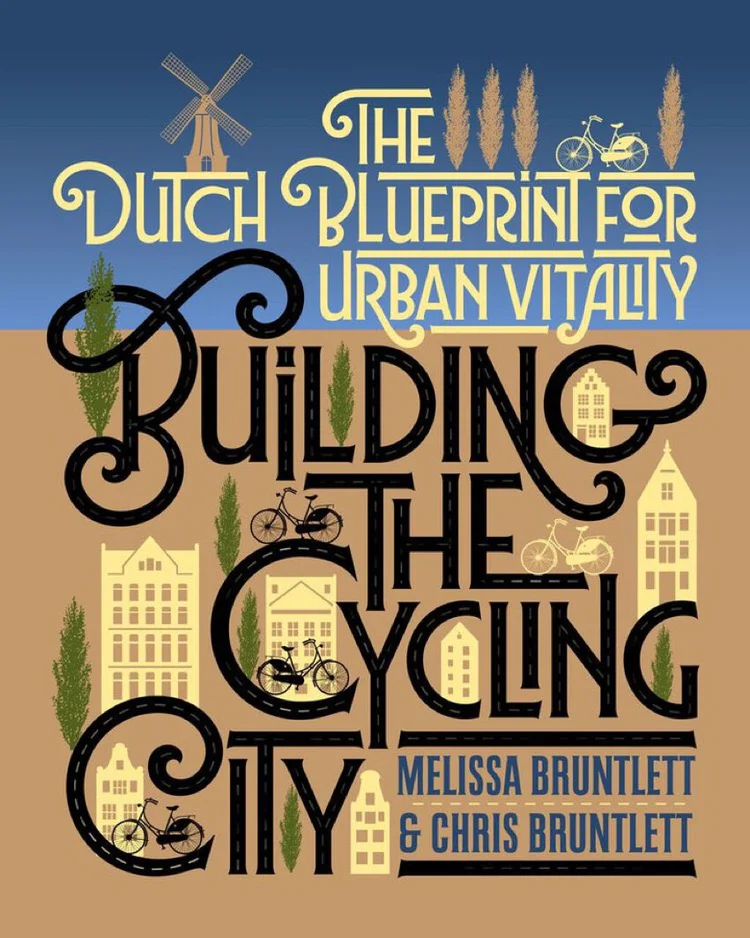
Melissa Bruntlett and Chris Bruntlett, Building the Cycling City: The Dutch Blueprint for Urban Vitality (Island Press, 2018), xiii + 223pp.
(6/2/2026) When the husband-and-wife team of Melissa and Chris Bruntlett toured bicycling facilities in the Netherlands in 2016 on assignment for Daily Hive, that country had a long-standing reputation for cycle commuting, such that North American cities despair of replicating their success. When they expanded their articles into this book the Bruntletts sought not only to describe Dutch efforts, but to show it was not ever thus, and that Dutch transportation policy was made the same slow, uncertain way in which all policy is made.
Political scientist John Kingdon explained transformative policy change as resulting from the rare confluence of widely recognized problems, availability of acceptable policy solutions, and favorable political alignments (see Hoefer 2022). The Dutch city of Rotterdam, heavily bombed during World War II, experienced two such transformations: first, rebuilding on the car-centric North American model (pp. 7-10), and then, beginning in the early 1970s, repurposing much of the street space to make cycling and walking possible (pp. 10-13). Building the Cycling City tries to answer: How did that happen? Could it happen in the towns where we live?
VIDEO: Active Towns riding interview with Rotterdam city staff (1:11:29)
Most of our cities have for decades been built around the movement of motor vehicles, which has made it increasingly difficult, not to mention dangerous, to get around any other way, even for short trips. This has led to bad outcomes, some of which they list at the beginning of the book: "widespread obesity, traffic congestion, climate change, class inequity, social isolation, and budgetary constraints" (p. 1). But, as Kingdon would tell us, bad outcomes don't become policy problems until they are widely recognized as such. The OPEC oil embargo of 1973 was one such catalyst, and an emptied-out downtown district was another, but at least as important in the Netherlands were grassroots campaigns like Stop de Kindermoord ("Stop Child Murder") begun to combat rising numbers of children killed in traffic (pp. 93-94).
Most importantly, the situations were defined as "too many people driving too many cars too fast," instead of locating their sources in oil markets and/or too many children in public spaces. (Looking at you, United States!) The Dutch framing meant countries like the Netherlands sought policy options to slow traffic speeds, and to enable people to use other ways of getting around. Such options are explored throughout, but particularly in chapters two, four, and eight. Dutch bicycle makers have emphasized (upright) functionality over speed or fashion, so "everyday cycling in regular attire" is "a perfectly practical activity, even when carrying an extra load" (p. 29). When cycling infrastructure appeared, more people were willing to use it to commute to work or school. Dutch engineers produced guidelines for designing bicycle networks that are "continuous, recognizable, safe, and intuitive for all users" (Meredith Glaser of the University of Amsterdam, quoted on p. 69).
 |
| Bentonville plans to extend trails system to new subdivisions on the west side of town |
Many people with longer commutes have come to use bicycles to get to the train stations, so a system has evolved (described in chapter eight) with massive secure bike parking at one end and low cost rentals (OV-Fiets, which is nationwide) at the other end. While there are no good North American equivalents of this system, metropolitan Atlanta is looking at attempting some variation of it (pp. 164-170).
 |
| In Charlotte, the Rail Trail runs directly by the light rail line (here, at Bland Station) |
The final piece of policy action is political support, sometimes from the mass public, and sometimes from key people in positions of power. Importantly, the Bruntletts discuss two cities' experiences in each chapter, one in the Netherlands and one in North America. In chapter 3, we meet Vancouver mayor Gregor Robertson, who in 2009 began a program of street improvements by installing separated bike lanes on the Burrard Street Bridge, which is now heavily used by cyclists--nine million trips in 2017. "A few loud critics can make anything look controversial," he told the authors. "It had zero impact on [car] traffic from day one" (pp. 60-61). In chapter five, we meet Jonathan Fertig, an architect and activist in Boston, whose skilled use of social media led to "tactical urbanism" installations that became actual ways of slowing auto traffic (pp. 103-108). In chapter ten, we see people in the Netherlands socializing new residents (immigrants, children) to the cycling culture, as well as similar efforts in Seattle and Auckland. The Dutch experience is exceptional, to be sure, but it is not sui generis. It could happen here, wherever "here" is for you.
 |
| Tri-State Trails advocates for trails and bikeways in and around Cincinnati, and sponsors Breakfast on the Bridge |
SEE ALSO:
Modacity Life website
"Picture Post--Vennendaal," As Easy as Riding a Bike, 3 March 2015
Melissa and Chris Bruntlett explain their 2019 move to Delft on The Good Place (48:12);


No comments:
Post a Comment