Thursday, August 8, 2019

Film review: "Paris to Pittsburgh"


See the source image
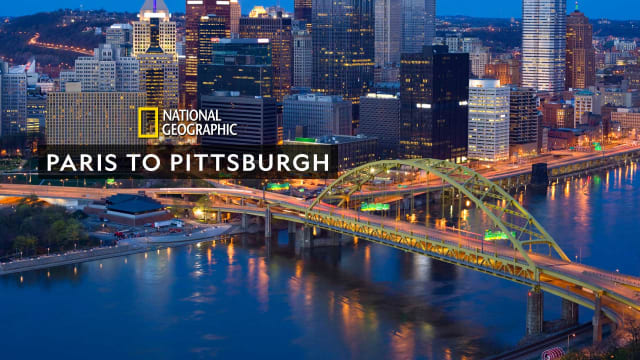
Last year's National Geographic documentary, Paris to Pittsburgh, highlights local and grass-roots efforts to combat climate change, against the backdrop of the growing threat and the utter failure of the American national government (and most state governments) to take it seriously. The film's tone is positive--encouraging as well as optimistic--which is both a strength and a weakness.


The warning signs keep coming. Tuesday the World Resources Institute published a report showing declining groundwater supplies causing "extremely high water stress" in 33 large cities with a combined population of 255 million; climate change exacerbates the problem, due to droughts as well as faster evaporation on hotter days (Sengupta and Cai 2019). Today the United Nations reports that climate change is exacerbating stress on land and water resources caused by overpopulation and poor management (Flavelle 2019). Scientists have found evidence for the impact of climate change on a broad variety of fronts. (See these posts for a sampling of such research from 2014.) And there's the escalating pile of natural disasters that happen around America and compete for attention and federal governmental relief.

Attention, as the saying goes, must be paid. And yet year after year, American politics remains stuck on whether this phenomenon exists at all. The film takes its title from President Trump's 2017 statement announcing American withdrawal from the international agreement known as the Paris Accord: "I was elected to represent the people of Pittsburgh, not Paris." The statement was apparently crafted for its alliterative charm rather than actual engagement with anyone in actual Pittsburgh, Pennsylvania, as one theme repeated throughout the film was the efforts of the mayor, city council, and citizens to do what they could in the absence of national action. Meanwhile, the administration props up coal mining corporations, staffs itself with climate change deniers, and tries to block states like California from mandating higher fuel efficiency standards.

This approach has been politically successful, which surely terrifies anyone who finds the climate change models even somewhat persuasive. President Trump was elected once, and may well be elected again, and anyhow Republicans at the state level have taken a similar approach: Florida (Florida, readers!) governor Rick Scott has banned the phrase "climate change" from state agency communications, and North Carolina in the administration of Pat McCrory barred any research at all into mitigation. The Atlantic Ocean is, I assume, duly impressed.

Getting ready to watch the film at St. Paul's United Methodist Church
I suppose no one can possibly take a position like "our activities are destroying life on the planet, but I refuse to do anything about it." So the only available way to justify refusal to act is to deny that there's anything to act against. Some may be motivated by economic interests: the film calls out Exxon, Koch Industries, and Shell. But that's a tiny number of people. Why are their denials falling on such fertile soil? I think there are three reasons:
  1. political/ideological resistance. Climate change evidence has been produced by scientists, who are elites; policies to address it have been pushed by environmentalists; and effective action will require government at the national and international levels. There are a lot of people who find some or all of those to be anathema.
  2. complexity. Climate is complicated. A number of factors influence it, including but not restricted to human activities; it's easily confused with weather, which by the way is just gorgeous in Cedar Rapids today; scientific projections have a wide range of outcomes; and the impact so far includes a wide variety of sometimes-opposite phenomena (floods, droughts, heat waves, cold waves). Climate change is at the same time both too erratic and too subtle.
  3. despair. The international scope of climate change means anything we do, or the United States does, can be counteracted by someone else. Moreover, seven decades of the suburban development pattern that is decried by urbanists mean we're stuck in a particular kind of built environment that constrains efforts to live more sustainably. It can seem hopeless.
Wisely, Paris to Pittsburgh focuses its effort on the despair obstacle. Its callouts are few and brief, it spends a little but not much time on the science, and it doesn't spend much time arming you for Thanksgiving arguments with your Ann Coulter-fixated uncle. But if you are inclined to ignore the climate threat because you feel powerless to do anything, the filmmakers are ready to give you the halftime locker room peptalk of your life.

"A movement was galvanized around the country" when Trump took the national government backward on the issue; "a revolution is underway." The film visits Miami, where rising ocean levels are destroying beaches, larger "king tides" regularly cause widespread flooding, and "salt water intrusion" in the Everglades threatens the supply of fresh water; Kalona, Iowa, where farmers struggle with erratic weather during growing seasons, and the state has dealt with a succession of massive floods; Ventura, California, reeling from a catastrophic fire; and, of course, Pittsburgh. In each place, locals in and out of government are taking aggressive, positive action against the climate threat--even in "very conservative politically" rural Iowa. The State of New Jersey became the 16th state to join the interstate climate alliance when Republican governor Chris Christie was succeeded by Democrat Phil Murphy in 2018. Towards the end of the film, we see scenes from the Youth for Climate Action massing in Washington, D.C. [Locally, the Iowa City City Council last night declared a "climate crisis," and voted to accelerate the town's greenhouse gas emissions targets (Smith 2019).] The kids are all right, and so are a lot of other people in a lot of places.

Sandbags against the rising river, New Bohemia, June 2013
Of what does this revolution consist? Mostly switching from fossil fuels to renewables. The City of Orlando is not just wondering where they're going to put a potential 2.5 million climate refugees from south Florida, but has moved to an all-electric bus fleet, experimented with floating solar arrays on lakes, and has facilitated citizen "fleet farming" in private yards to increase the supply of local produce. Casa Pueblo, Puerto Rico, runs entirely on alternative energy, which protected it from the long-term effects of the 2017 hurricane. The rural electric cooperative in Kalona, Iowa, is switching to all solar and wind to save money; Iowa is the nation's leader in wind energy, and the film profiles two female students at Iowa Lakes Community College planning careers in the booming field of renewable energy. The State of California has passed ambitious renewable fuel (and emissions reduction) mandates, though a lot of their state wealth comes from fossil fuel extraction.

The makers of Paris to Pittsburgh are to be commended for avoiding the pitfall of much environmental rhetoric, which tends toward the doom-and-gloom. Solar energy is more accessible and less expensive than ever, and the same goes for hybrid or all-electric cars. These are steps that require some but not that much effort, and are within the reach of many families.

Another strong point is the emphasis on local cooperative effort. The opening montage segues from various dismissive statements by President Trump to more urgency from local officials. As any urbanist will tell you, good change starts when neighbors meet to work together. Localities can be parochial, and clannish, but the need to address direct real-world problems tends to cause both public officials and citizens to be less ideological in their response.

There's a danger in making response to climate change seem too easy. If throwing on some solar panels and switching to electric vehicles were all it took to solve it, climate change wouldn't be much of a crisis. I'm no scientist, but intuition tells me even mitigating the damage is going to require some heavy lifting. And not just of sandbags: Iowa state senator Rob Hogg (D-Cedar Rapids), author of America's Climate Century (CreateSpace, 2013), who is quoted extensively in the film, hopes the "spirit of the sandbag" seen in 2016 flood protection efforts could translate into preventative measures. Those are reactions to entirely different phenomena, however.

And the economic incentives seem so strong as to be irresistible, but they aren't rooted in any sort of moral or community concern. Sure, cheaper solar got the "very conservative politically" farmers of Kalona off the dime, but if someone came up with an even cheaper fuel made from, say, meadowlarks, those farmers would switch again in a minute. It's nice that economic incentives seem to dovetail with what needs to be done--Iowa's superannuated U.S. Senator Charles Grassley is shown marveling at the jobs created by wind energy--that can turn in a minute. It's a lot easier to be an urbanist when gas is $5 a gallon than when it's half that.
Jeff Speck

The happy talk verges on what urbanist Jeff Speck calls "Gizmo green" i.e. just buy this product and both you and the Earth will be happier. In Walkable City (Farrar Straus and Giroux, 2011) he quotes Witold Rybczynski:
Rather than trying to change behavior to reduce carbon emissions, politicians and entrepreneurs have sold greening to the public as a kind of accessorizing. "Keep doing what you're doing," is the message, just add another solar panel, a wind turbine, a bamboo floor, whatever. But a solar-heated house in the suburbs is still a house in the suburbs, and if you have to drive to it--even in a Prius--it's hardly green. 
Speck cites a U.S. Environmental Protection Agency study finding driveable vs. walkable location had a bigger effect on climate footprint than type of car, housing material, or single- versus multi-family housing. Then he notes the EPA moved its Kansas City headquarters to a LEED-certified building in the suburbs... to which employees had to drive instead of walk to work (Speck 2012).

Enough dyspepsia. Would I rather people act against climate change, however incompletely, or not? Put that way, the answer's obvious; if people are going to be in suburbs anyway, better that they drive hybrids and install solar panels. Paris to Pittsburgh gets points for nudging us, passionately and encouragingly, in the right direction. Still, it would be better for the climate if we slammed the brakes on the suburban model of development.

Trailer for the film:


SEE ALSO:

"The Artlessness of Climate Change Policy," 31 May 2017
"Policy Responses to Climate Change," 26 August 2013

Wednesday, August 7, 2019

Incremental changes to bus routes


The City of Cedar Rapids will be instituting some tweaks to its city bus routes later this month. The array will still be largely as it was after major changes were implemented two summers ago. Bigger changes may be in the offing.
Buses gather at the GTC before 5:15 departures
The bus system features eleven lines that run out of the downtown Ground Transportation Center, plus two circulator routes based that serve the northern suburbs out of Lindale Mall. Service begins at 5:15 a.m. Monday through Friday and 8:15 a.m. Saturday. (There is no service Sunday.) The last weekday buses leave the GTC at 6:15 p.m. and return at 7:05. Routes run hourly, with these additions:
  • some routes run additional buses in the mornings (5:45-6:45-7:45) and the afternoons (12:45-1:45-2:45-3:45). Interestingly they don't do so during the typical evening work commute.
  • the #5 runs along 1st Avenue between downtown and Lindale Mall every 15 minutes
Annual ridership in Cedar Rapids increased to 1.1 million early in the decade ("Cedar Rapids and Iowa City" 2011), and since have varied around that number, with ridership approaching 1.4 million in 2015 and (following the '17 route changes) 1.27 million in 2018 (Schmidt 2019). 


Hourly ridership has consistently stayed at 20 per vehicle-hour all decade as well. Cedar Rapids has avoided ridership drops in Iowa City and other towns (Schmidt 2019, "There's a Reason" 2019), but ridership proportional to population is still much smaller here. I think our ridership is less elastic i.e. those who ride have no alternative way to get around, but those who can drive (or walk, or bike) do. Hence the consistency. This makes sense for a system that has always valued coverage over ridership; as Ben Kaplan says, "It's designed to get a small number of people anywhere they need to go slowly, rather than a large number of people a few places quickly (Kaplan 2015; see also Walker 2018). (For a more intensive discussion of transit system goals, see Walker 2015).

The meeting place for the #5, #20 and #30 is moving
What's changing? Here is what catches my eye, admitting an eastside bias to that eye:
  1. The Lindale Mall base of the #20 and #30 will be moved across Collins Road to the corner of Twixt Town Road and Southview Drive, near the Pet Smart. Originally (July 2017) located directly by the mall, it was moved to the edge of the parking lot. I think this will be a better location, because it will mean less deviation from the road, so it will be more convenient for people not going to the mall. This is particularly true for people transferring from the #20 to the #30 or vice versa. Only the inbound #5 will go to the mall; it will once again go all the way to the door.
  2. The eastside routes will line up along the numerical avenues: #5 on 1st, #6 on 2nd (below 10th), #3 on 3rd, #4 on 4th, and #2 on 5th (above 10th; below 10th it runs on 12th Avenue).
  3. The #2 will enter Oakhill-Jackson in a straighter fashion, on 10th Street and then 9th Street, rather than veering up to 15th Street. My friend Charles lives down there; I hope this doesn't make it harder for him!
  4. Currently the #3 runs extra buses in the morning only, and the #11 only in the afternoon. Due to low ridership on the #3, there'll be extra buses on the #11 both times.
  5. The current tangle of routes by Westdale will be somewhat eased by making the #1 and the #12 more direct. The #12 will no longer serve the Summit Village and Grand View Village mobile home parks, but they will still be served by the #10. All three lines will continue to serve Westdale, Wal-Mart and Target.
Current configuration of Routes 1, 10 and 12
Are bigger changes coming? Iowa City's transportation director stated a goal of doubling ridership in the next ten years, but Cedar Rapids has not. Even so, night service on some lines might begin in 2020, says transit director Brad DeBrower (Schmidt 2019). Other items on my wish list, like mobile ticketing and summer rides for kids, not to mention a downtown circulator, will have to wait.

SOURCES
"Bus Route and Schedule Changes"
Mitchell Schmidt, "Why Are Fewer People Riding Buses? Local Transit Officials Are Seeking Solutions," Cedar Rapids Gazette, 21 June 2019

EARLIER POSTS
"What's Next for Cedar Rapids Transit," 20 November 2018
"Cedar Rapids Rolls Out Bus Line Changes," 4 August 2017

Monday, August 5, 2019

Need workers? First, lighten up


Our organizations are more effective and less fragile when all the people involved don't look alike, don't think alike, aren't coming from the same place. Diversity has a real, positive effect across the board for how well organizations are able to execute and how well they're able to find their way forward.
--BEN DILLON, co-owner and chief strategy officer for Geonetric

It is not a sign of success that most places in Iowa are losing population, particularly among young people of working age. 92 of Iowa's 99 counties have either lost population in the 2010s, or gained more slowly than the nation as a whole; that's 93 percent of our counties, higher than the national average of 86 percent (Ozimek, Fikri and Lettieri 2019: 7). Exactly three counties--Johnson (Iowa City), Polk and Dallas (Des Moines and vicinity)--saw increases of 10+ percent in population aged 25-54, defined as prime working age, between 2007 and 2017. Five more saw marginal increases (0-10 percent): Linn (Cedar Rapids), Scott (Davenport), Story (Ames), Warren (south of Des Moines), and Jefferson (Fairfield). Though that short list of counties includes the state's largest, 59 percent of Iowans live in a county that lost prime-working-age population (pp. 9-10).

I have used population growth as a surrogate measure of a place's success, mostly because data are easy to obtain and work with; turns out it's significantly meaningful in its own right. A recent Economic Innovation Group report cites many deleterious effects of population loss (in most but not all cases, pp. 14-27):
  • faster loss of prime working age population
  • lower employment rate of those in prime working age population
  • lower proportion of high-skill workers (because they're the ones able to move)
  • loss of housing value, affecting family wealth, consumer spending and construction employment
  • more vacant/abandoned properties
  • loss of local government revenue
  • loss of "dynamism" (fewer startups, lower worker productivity, less attractive workforce)
These situations are not unique to Iowa, of course. Only one county in Illinois, exurban Kendall County, has experienced strong prime-working-age growth in the last decade. Cook County (Chicago) has lost population among this age group, as have all of its "collar counties," especially Lake and McHenry. While Forsyth County, North Carolina (Winston-Salem) has gained prime-working-age population, but they've tended to be in lower-wage jobs (Porter 2019).

A view of the Time Warner Center mixed-use development when it opened in New York City in 2004.
Time Warner Center, New York City (Getty Images, used without permission)
The story of the 21st century American economy has been spectacular, almost unbearable, growth in a few "superstar cities," with rest trying to catch up while still cleaning up from the 20th century industrial phase. As Eduardo Porter explains in The New York Times:
[A] limited set of successful cities... draw both highly-educated workers seeking well-paid jobs and high-tech companies that want to employ them... The new pattern of economic development amounts to a fundamental break from the decades after World War II, when poorer and generally smaller cities were catching up with richer, bigger places. In recent years, this convergence stopped. Many midsize cities and small towns that found manufacturing-based prosperity in the 20th century have lost their footing in the tech-heavy economy of the 21st (pp. B1, B6).
As a result, writes Richard Florida, We now have two distinct sets of metro areas based on skills: those with high concentrations of cognitive and people skills (which are closely correlated at 0.86), and others with high levels of motor skills. The unemployment rate for motor skills workers fluctuates over time but is trending higher, while the rate for the other two groups is flat and remains low even in recessions. Their geographic separation means that places, too, experience consistently positive or varying-but-trending-negative economies. Less-educated workers, in fact, do best in places that are dominated by cognitive and people skills (Florida 2019).

So, what is to be done? You could try resentment; President Trump and Governor Reynolds would be grateful for your support, thought once in office they've done more to feed resentment than actually doing anything about it. You could try luring a big employer with a tax-break, though there are plenty of sad experiences to advise you otherwise: Winston-Salem's incentives lured Dell in 2005 (it left town in 2009) and Caterpillar, which has created about a third of the jobs it said it would (Porter 2019). You could swing for the fences with a big project like a stadium or a casino; the track record for those is even worse than for economic incentives.

State Rte 175 through Grundy Center seems ripe for a road diet.
Remarkably, I-DOT is willing, but the residents are not.
(Google Maps screen capture)
So what is to be done is the un-flashy and un-quick process of improving local capacity. Vey and Love find support for enhancing the capacity of places through transformative and inclusive design that facilitate business development and individual creativity; enhancing the capacity of individuals with skill development and mentoring (see also Florida 2019); and inclusive community engagement.

The report from Economic Innovation Group concludes with an intriguing proposal for "heartland visas," where skilled immigrants would be admitted to "places confronting chronic population stagnation or loss as a means of boosting economic dynamism and fiscal stability" (p. 37). Unlike existing H-1B visas, immigrants would not be tied to a specific job or employer, though they would need to find a job or start a business "within a reasonable period of time." The program would be optional for local communities, so each place would decide for itself whether it wanted to play. Something like the heartland visas, combined with already-low cost of living compared with superstar cities, could facilitate an influx of skilled immigrants into struggling regions of the country, including most of Iowa.

The word "facilitate," however, does not mean "make it happen." I see three barriers, from the immigrants' perspectives, to making this happen. Are there employers with well-paying jobs and markets for entrepreneurship? Is the place otherwise attractive, with the urbanism that allows for density and vibe?

Image
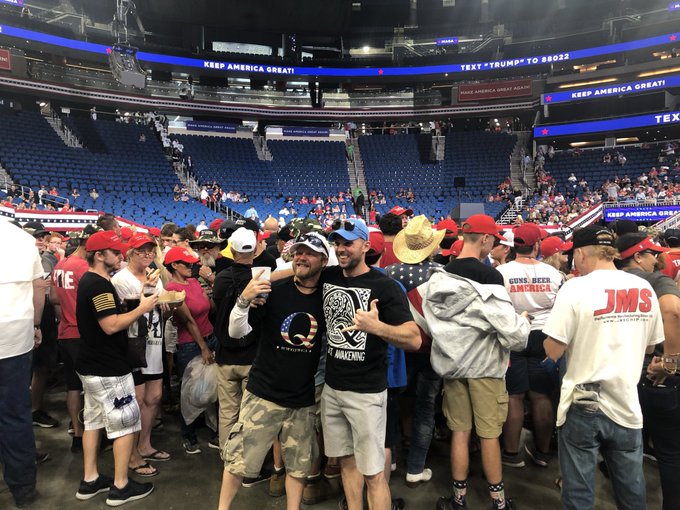
White supremacistwear at a Trump rally in Orlando (swiped from Twitter)
The third barrier is less tangible than the economic and physical ones, but it may be just as important: how welcoming is the community? Few people are willing to go where they're not welcome and, with the President of the United States leading by example, immigrants (and people of color, and so forth) are hearing loud and clear in many ways that they are not welcome. MAGA hats may make the wearer feel badass, but they send a clear message of hostility to people not like them. Des Moines, one of Iowa's most successful places, might get away for awhile with their anti-upzoning ordinance, but most places can't afford that luxury. [8/7/19: The intent and impact of this ordinance may be more complicated than it first seemed; see Sisson 2019 with hat tips to Phillip Platz and Seth Gunnerson.] The shooter this past weekend at the Wal-Mart in El Paso, Texas, was clearly deranged, but nonetheless reflects a zeitgeist that is all too widespread. "How do you stop these people?" Trump asked a rally in May. "Shoot them!" came a response. Well, of course you do. "That's only in the Panhandle can you get away with that statement," Trump chuckled amidst the cheers.

What does it mean to welcome immigrants? It surely means more than not shooting them, and even more than just allowing them to come. Welcome requires affirmation and outreach. In St. Louis, the Mosaic Project connects immigrants with peers in their industries, offer resources to entrepreneurs, and provides mentoring and support for spouses. Global Louisville is a public-private partnership that offers mentorship and business development assistance as well as coaching local businesses in cultural fluency. The Charleston (SC) Regional Development Alliance offers similar services to newcomers and long-time residents. Columbus (OH) offers global fluency training to local businesses. "You have to create a welcoming tonality of your local community at the same time you have to be attracting international people," says Mosaic Project executive director Betsy Cohen. "If you bring the seed, and the soil isn't receptive, it won't thrive" (Barker, Gootman and Bouchet 2019).

Struggling places could learn a lot from successful cities. That would start by ignoring the dystopian rhetoric conservatives are selling, and seeing cities as they really are. "Instead of bleeding residents, much of urban America is growing," writes Washington Post reporter Griff Witte (2019).
Rather than scaring away young, educated workers, cities have become a magnet for them. Once a turnoff for corporate investment and development, many urban neighborhoods have become the most coveted places to be.
Residents of the depopulating places of America need to recognize that our towns are not going to look like they used to. They may be more diverse, or they may be more desolate. They can either be different-and-thriving, or continue to die. Folks need to get over whatever fears and dislikes prejudice them against "the other." And then they need actively to reach out to welcome the people their places sorely need.

MAIN SOURCE: Adam Ozimek, Kenan Fikri, and John Lettieri, From Managing Decline to Building the Future: Could a Heartland Visa Help Struggling Regions? (Economic Innovation Group, April 2019)

OTHER SOURCES
Rachel Barker, Marek Gootman, and Max Bouchet, "Welcoming Communities Make for Globally-Competitive City-Regions," The Avenue, 5 August 2019
Richard Florida, "How 3 Skill Sets Explain U.S. Economic Geography," City Lab, 16 July 2019
Eduardo Porter, "A Bigger Gap for Not-So-Big Cities," New York Times, 17 July 2019, B1 & B6
Jennifer S. Vey and Hanna Love, "Demands for Place are Reshaping Our Communities, But How Can the Benefits Be More Widely Shared?" The Avenue, 24 June 2019
Graf Witte, "Trump Says Cities Are 'A Mess.' They're Actually Enjoying a Golden Age," Washington Post, 3 August 2019

EARLIER POSTS
"Small Towns, Rural Areas, and State Legislatures," 11 June 2019
"Iowa Losing Millennials, Needs Workers," 14 February 2019
"What is the Future of Iowa's Small Towns?" 3 July 2018

Thursday, July 18, 2019

The choices parking forces

walkers on urban pedestrian plaza
Pedestrian mall by Baruch College, New York City (Swiped from patch.com)

(7/18/2019) What kind of city are you? A big draw with densely-populated mixed-use downtowns? A large city with a natural barrier to growth like a mountain range or an ocean? A legacy industrial city with miles of under-performing areas? Or a small city without a big name but with plenty of cheap land and no natural barriers to expansion?

Where you sit strongly affects where you stand on issues like traffic and parking. Some cities, like New York, San Francisco or Seattle have the crowds and the confidence to consider closing streets, instituting congestion pricing for auto traffic (see also Trumm 2019 on Seattle), and charging market rates for parking (Shoup 2005).

The brilliant work of Professor Donald Shoup, and articles like this one from Grist with the headline "Cities Finally Realize They Don't Need to Require So Much Damn Parking," are centered in this first category of towns. Grist's examples are Chicago, New York, Seattle and Washington, D.C.--though they also note Buffalo and Fayetteville have eliminated ordinances requiring parking minima for development. Shoup, a professor at UCLA, does a lot of his empirical research in his hometown of Los Angeles.

Legacy industrial cities, on the other hand, are staring into the abyss of obsolescence; they need more traffic, and have plenty of parking. Ditto many small towns and rural areas.

Surface parking lot on a Tuesday afternoon, New Bohemia neighborhood
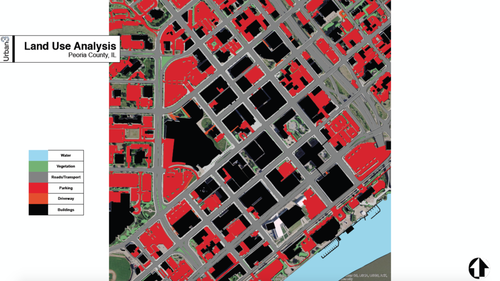
Towns like mine (pop. 132,228) are in neither of those categories: We have some demand, but are nervous about sustaining it, and are without physical--or, for the moment, economic--barriers to spreading. Land is cheap, and it's easier to overdo the parking and out of anxiety there might one day be too little.

This map of downtown Peoria, IL shows the enormous amount of land devoted to parking. (Source:  Urban3 )
Parking areas in downtown Peoria, Illinois (Source: Urban 3)
Too many people in and out of city government place too much concern about parking, preferably free-of-charge and easy to find. How many people express this concern is hard to say without doing opinion research, which I have not done--not even a measly focus group. But it's a lot: The subject of parking inevitably comes up in conversations about development, even about areas where there are already huge swaths of surface lots.

Strip mall parking lot, Black Friday 2015
Note that the problem is really not city-imposed parking minima, where the city demands private developers provide more parking than the developers would otherwise provide, but a more generalized anxiety. We are not LA or New York, and we know it. I have had someone tell me with a straight face that parking in downtown Cedar Rapids is a "disaster;" resident concerns about parking, along with traffic and noise, frighten the City Council away from infill development (see Kaplan 2017); and parking lots have caused the destruction of historic structures in potentially-productive parts of town (see SaveCRHeritage 2013a, 2013b). Parking lots predominate in our core areas, and of course are ubiquitous along our commercial stroads like Collins Road, Edgewood Road, Mt. Vernon Road, and 16th Avenue. And yet there's never enough.

I would characterize the pro-parking argument this way: The city needs to provide the largest amount of parking space it can, free of charge, because: (1) shoppers, employees and those who attend events have come to appreciate the convenience of door-to-door driving; (2) Cedar Rapids consumer businesses are mostly competing on price and convenience (with the strip malls and big-box stores, with the Internet) rather than on vibe or experience; and (3) there's no particular reason not to.

Shoup's empricial study of the Westwood Village area of Los Angeles found drivers spending an average of 3+ minutes looking for parking. His answer is to charge the market price for parking, which he defines as the price that leaves one meter free on every block. Cedar Rapids residents, goes the argument, have a market price for parking that is near zero, and little appetite to search for spaces, because they have choices. So anything other than plenteous free parking will doom businesses and piss off voters.
Free on-street parking, 3rd St SE
Done right, parking for cars can actually contribute to walkability. Speck (2018: 150-151) argues that on-street parallel parking helps to calm traffic while supporting mixed uses. Angle parking...
Lincoln Square, North Lincoln Avenue, Chicago
Note that placement on this one-lane, one-way block reduces car-bike conflict
..."increases the parking supply and slows traffic, both of which are great for urban retail" (p. 154). Taken in moderation, parking can indeed support other uses of the street, particularly when they bring customers to businesses, so they can remain in business, so we can walk or bike to them.

Even larger parking areas can in some cases support urbanist development, if they're moved away from the action (Kaplan 2015). Using the example of 2nd Street SE downtown, Ben notes, "This stretch of downtown is all parking lots, loading zones, and blank walls. It's also necessary. This space functions as a repository for all the stuff you need to help 1st Street and 3rd Street be great streets." Similar phenomena can be observed on 15th and 17th Avenues SW, flanking the re-emergent heart of Czech Village that is 16th Avenue; the lengthy and capacious Lot 44 (pictured above), on the river side of New Bohemia; and Henry Street in Decorah, which makes Water Street possible. Rochester, Minnesota has incredibly dense development around the Mayo Clinic, facilitated by emptier areas that surround it, though as the Downtown Master Plan (2010: 31) notes, "the fringe areas... often exhibit a pattern of development, including many blocks of surface parking lots, which does not provide either a gentle transition from Downtown or a strong edge." In 2019, we need parking areas, but too much parking can strangle development.

Edge of downtown Rochester
There are reasons not to go the route of acres of free parking. Shoup (2005, ch 5) cites several negative impacts of excessive, free-of-charge parking:
  • it warps urban form, because there are parking lots where there could be housing, stores or restaurants; 
  • it removes potentially productive land from use;
  • it frustrates walkers by placing destinations farther apart;
  • it amounts to a subsidy of driving by non-drivers, because the parking spaces are paid for with tax money; and so
  • it incentivizes driving of private cars, as opposed to other, more environmentally- and fiscally-friendly forms of transportation.
As Shoup argues, there are tradeoffs between parking space and productive space, between accommodating cars and encouraging walking, between subsidizing parking and everything else in the city budget, between parking and financial productivity. I'll allow these tradeoffs are not the same in a town like Cedar Rapids as they would be in a big-name, densely-populated city, and even that the consequences of developing some of these parking lots are going to be different here than there. But we need to acknowledge the choices, and recognize there are costs (opportunity as well as financial) to an obsession with parking.

Strip malls and big-box stores are not financially productive places (Quednau 2017); let's stop building them, and let's stop subsidizing their existence. We could charge market prices for parking, and use the revenue to fund improvements in the area (Shoup 2005, chs 15-21)--including, if the situation warrants, municipal parking garages--compatibly designed, of course.


Nevada City, California, recently raised their meters to $1/hour from 25 cents, with the revenue dedicated to fire protection; even then, it should be said, merchants and residents are ambivalent (Bliss 2019).

More housing and offices closer to "the action" will provide a 24-hour population that doesn't need to drive to get there. Encourage owners of large parking lots needed at different times (churches, clinics, restaurants) to share facilities rather than having their separate lots vacant most of the time (Herriges 2018). Improve public transportation near active places, like between Kingston Village and New Bohemia. Provide non-financial support for local business development (Mitchell 2017). Help, or at least allow the core areas of our town to become places where people want to be, and where businesses need to be.

Town and Country Mall, Black Friday 2015
Cedar Rapids, like most towns its size and in its region, has been built around the automobile to such a degree that to get around any other way requires considerable effort. Our vast parking infrastructure reflects that, of course, and to change that is akin to altering the flow of a powerful river. The effort and cost occur right away, and the long-term benefits are... long-term. And yet...

We need to acknowledge that the places we build, and how they evolve in the future, result from choices--not inevitability, not nature, but our choices. If we are not making the choices, someone else is making the choices for us. So, what kinds of places are we choosing? The great Danish architect-designer Jan Gehl says in the documentary "The Human Scale:"
We have known this about the motorcar: If you make more roads, you will have more traffic. Now we know about cities: If you make more places for people, you will have more public life. In cities that have done away with their public spaces, life has become totally privatized (quoted at Borys 2018).
So, what kinds of places are we choosing to build? What values are we choosing with? You can't parking lot your way to public life.

Former K-Mart, Black Friday 2017
SOURCES:
Donald Shoup, The High Cost of Free Parking (Planners Press, rev ed, 2011)
Jeff Speck, Walkable City Rules: 101 Steps to Making Better Places (Island Press, 2018)

PREVIOUS POSTS:
"Hiking the (Parking) Crater," 25 January 2018
"Black Friday Parking 2017: After the Ball is Over," 24 November 2017
"Downtown vs. Parking," 29 September 2013
"The Parking Dilemma," 31 July 2013

One more video:


Monday, July 8, 2019

Here come the scooters!


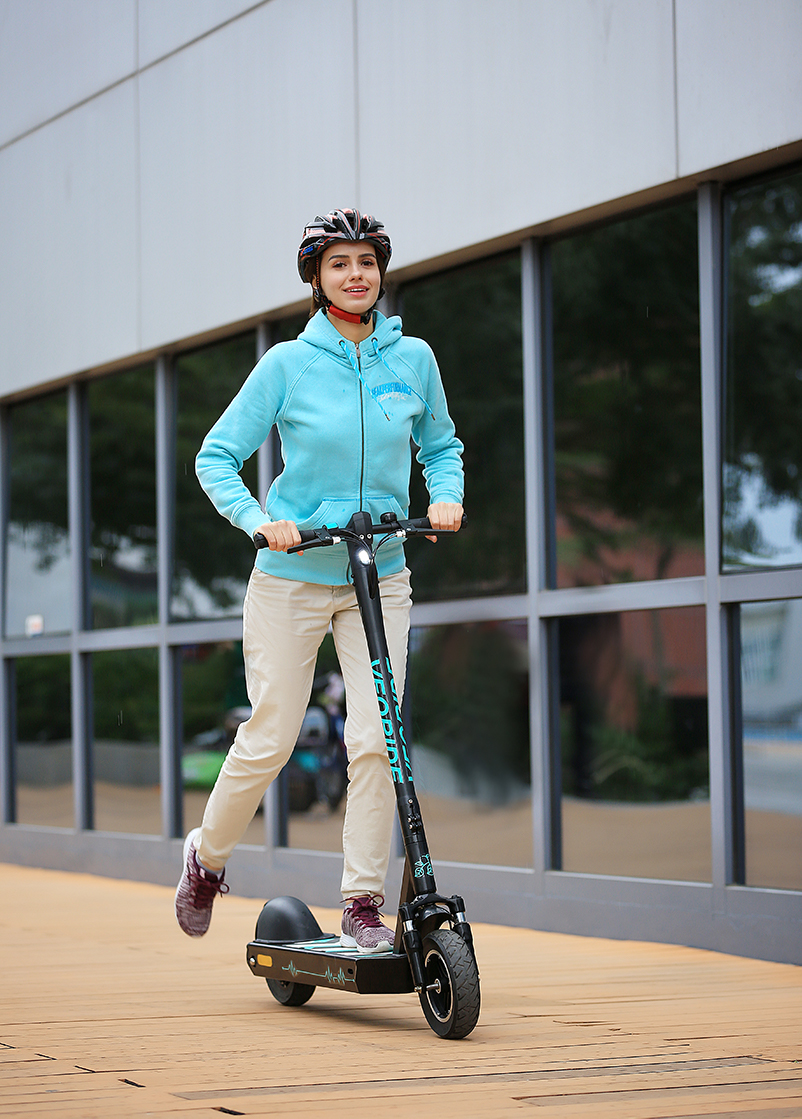
Source: Veoride.com
Electric-assist scooters will go "on trial" next month in Cedar Rapids, with a rental concession run by Veoride, the same firm that runs the bike share program. The timing is set to coincide with the start of fall classes at Coe College and Mount Mercy University. Thirty scooters will be available for a two-month period. The fees will be the same as for the bikes: $1 to unlock plus 15 cents per minute, with discounts for those who qualify for local, state or federal assistance programs.

If the bikes, which I've ridden a few times, are any indication, the scooters will be serviceable and durable if not glamorous. From the Veoride website:
Each VeoRide scooter features 10-inch wheels with a proprietary, shock-absorbent tire and comes equipped with a built-in sensor to detect road conditions and automatically engage the motor and braking system to slow the vehicle and protect the rider. The swappable battery located in the deck of the scooter creates a lower center of gravity, the motor positioned at the rear provides greater stability and keeps the vehicle from lurching forward, while the mountain-bike type suspension ensures a smooth ride. The speedometer lets riders know how fast they are traveling, and VeoRide can program and adjust scooter speed to meet a community’s standards.
Atlantic writer Robinson Meyer offers these additional tips, which you may not need, but for which I will be grateful if I ever find myself on one of these things: 
It’s best ridden with one leg on the platform and the other hanging off the side for emergency braking, or fleeing. For a classic scooter, all propulsion has to come from either gravity or the rider’s body, pushing off the ground with his foot. An e-scooter only needs you to push off when coming out of a stop. (After that, the engine takes over.) The push-off/scoot-forward/hit-the-throttle movement is the only real coordination required.
Meyer recommends riding in the bike lanes: Sidewalks are small, and are reserved for pedestrians, poor dears. Roads are big and have lots of space for us Big Scooter Adults. [SEE ALSO: Benjamin Schneider, "What Happened When I Rented an E-Scooter for (Almost) a Month," City Lab, 1 July 2019]


Bird reached agreement with Kansas City after starting there with a "guerilla drop"
(swiped from kansascity.com)
Scooter programs come highly recommended. Corridor Urbanism co-founder Ben Kaplan was nothing short of ecstatic after trying them out in Kansas City last year. They are amazing, he wrote. Every city should have them. All the good things you have heard about the scooters are true. He went on: They are cheap, fun, and useful. For one trip, I went two and a half freaking miles and it was delightful.

Meyer of the Atlantic says his three-mile commute to work in Washington, D.C. "had never gone so fast" as when he finally tried it by scooter. His main concern is that scooters are too "socially conspicuous" to endure, and will soon join the ranks of transition lenses, cargo shorts, and Camelbacks which "have never escaped their dorkiness." Ben replies: Are they dorky? Hell yeah. Will you care once you're on one? Hell no.

See the source image
Jenny Durkan, mayor of Seattle
Nevertheless, we must ask ourselves, are we doomed? If you're like me, you ask yourself this question all the time, anyway, so let's consider whether electronic scooter rental in Cedar Rapids--or your town, if you're not fortunate enough to live in the city SmartAsset rated #6 Best City of Living the American Dream--will exacerbate or mitigate this doom.

Concerns about scooter invasions fall into two categories: danger to the riders themselves, and danger or at least inconvenience to everyone else. Seattle mayor Jenny Durkan, before changing her position in May 2019, had long been opposed to scooter rentals in her city. She explained in an interiew:
It's so funny, every mayor who's got them says don't take them.... [E]very city that has scooters has had significant traumatic injuries. And one trauma doc was quoted as saying it's like we forgot everything about seatbelts, helmets, and other safety equipment. So, look, I know that some people think that scooters are fun. I think the danger of them, and the demonstrated danger of them and the liability of the City--cities now are paying out millions of dollars in judgments for people who are hurt, because you're the City saying here use a scooter. (Trumm 2018)
Nashville, Tennessee is suspending their pilot scooter program, which featured 4,000-odd scooters being rented by seven companies. The immediate stimulus was the death of a 26-year-old man last month; he was struck by a car while riding a scooter with double the legal maximum of alcohol in his blood, but complaints had been building for awhile (Short 2019).

Then there's the impact on everybody else. In April, an 81-year-old man was killed in a Paris suburb when he was hit by a scooter; Paris, too, is considering fewer scooters and more regulations (Prigent 2019). Also this month, in Oregon, the Multnomah County Sheriff's office found 57 rental e-scooters in the Willamette River near Portland. A Chicago friend and community activist of many years standing expressed exasperation on Facebook: Are there no rules of the road for the damn scooters? Her friends sympathized: Does not appear so.... Apparently not.... None. About 10 years ago when they first came out people were riding them and they were getting tickets. The city passed the law: no scooters. Now they are legal because I can rent them. One of them hashtagged "#rahmsrevenge," referring to the unpopular former mayor, Rahm Emmanuel, whose administration introduced the rental program.

Californians interviewed by the New York Times complained about scooters scattered willy-nilly on the sidewalks and blocking handicapped ramps, and sidewalk-riders terrifying the disabled and elderly (Bowles and Streitfeld 2018). As they did in Kansas City, Bird, LimeBike, and Spin began renting out scooters in Los Angeles, San Francisco and Santa Monica without consulting with the governments or the neighbors. "They just appeared," said a San Francisco official. "I don't know who comes up with these ideas or where these people come from."

Scooter safety tips, from Veoride.com
Is riding scooters dangerous? Maybe, if you're inexperienced, or drunk, but evidence from Kansas City Tacoma and Portland found relatively few injuries. Nashvilleans on scooters go to Vanderbilt Medical Center with injuries from crashes one or two times per day, but in the first three months of this year 7,859 motor vehicle crashes caused 2,145 injuries and 15 deaths (Short 2019). (See also Cortright 2019). As Chuck Marohn of Strong Towns Tweeted:
Some citizen complaints about scooters may be a response to their novelty. In Cedar Rapids, the scooters aren't here yet, but electric assist bike rentals began in May. Local TV station KCRG ran an arguably overblown story about rental bikes not being returned to rental stations, even though that is not required. (Riders are only instructed to lock the bike to end the ride, and to leave the bike in an upright position in a place that does not impede pedestrian or vehicle traffic, or access to private property.) The report quoted a downtown worker: I walk through Redmond Park every day to and from work and usually at the night time is when I'll see a bike or two there (emphasis mine). And, lest we forget, bike lanes freaked us out when they were introduced in 2013.

Alert the media! Dockless car blocking a driveway in New Bohemia

Wellington Heights: Where do the scooters go in this picture?
A huge part of the problem, to the extent there is a problem, is that Cedar Rapids, like most towns, has for decades built transportation infrastructure with one goal in mind: the speedy movement of motor vehicles. The realities of the 21st century, along with demand from some members of the public, have caused our city to adopt a complete streets policy, but accommodating multiple modes of transport with a network built for cars is no easy matter.


Education, and informational videos like this one, will help reduce accidents due to user error, and encourage cooperative mixing:


But when problems arise with the introduction of scooters in Cedar Rapids, and there will be problems, the people who watch this video will not be the ones causing them. The public will exaggerate the problems because we're used to cars and we're not used to scooters, but the problems will be real, because aggressiveness and opportunism are part of the human experience. The 21st century is requiring more sharing of space, even in spacious and sparsely-populated Iowa, which means there will inevitably more encounters with assholes using a variety of modes of transport.

Is enforcement the answer? I often hear complaints that cyclists and pedestrians aren't subject to law enforcement the way motor vehicles are. This is bunkum; anyone with eyes can see motor vehicle violations on a daily basis that aren't penalized, either. (For the tragic side of this, see Shill 2020.) The fact is, our streets are pretty much anarchic, and I have to admit for the most part it works. Should the police reallocate their resources to provide more traffic enforcement? If so, I pray it's done in an even-handed way, and not in a way that targets scooter riders, or young people, or poor minorities.

I am a transportation omnivore: I drive, cycle, walk, and take the bus. I would like to continue to do all those things without the fear of being struck by an errant scooterist, or (in my car) striking the scooterist. And if scooters as great as Ben says they are, then I want a chance to add them to my transportational toolbox.

Wednesday, July 3, 2019

Priests, prophets and the 4th of July

Swiped from Agence France Presse via washingtonpost.com
I hate, I despise your festivals, and I take no delight in your solemn assemblies.
Even though you offer me your burnt offerings and grain offerings, I will not accept them; and the offerings of well-being of your fatted animals I will not look upon.
Take away from me the noise of your songs; I will not listen to the melody of your harps.
But let justice roll down like waters, and righteousness like an ever-flowing stream.
--AMOS 5:21-24

We will be having one of the biggest gatherings in the history of Washington, D.C., on July 4th. Major fireworks display, entertainment and an address by your favorite President, me!
--DONALD TRUMP

Independence Day is Thursday, marking the 243rd anniversary of American independence from Great Britain, and our country's annual mid-summer holiday. I'm afraid I'm not feeling it this year. I'm often not feeling it on the Fourth of July, being ambivalent about crowds, loud sharp noises, and (often) excessive heat. This year, though, I'm really not feeling it.

America has a lot to celebrate, of course: our heritage of individual freedom, all the natural beauty preserved in our national parks and wilderness areas, all the people from the military to first responders to teachers to social activists to planners to writers and artists who have dedicated their lives to their communities and country. At our best we have been an example and inspiration to the rest of the world, the "city on a hill" to which the early settler John Winthrop aspired--and probably a better version than Winthrop and his Puritans might have produced on their own. The Founders of our country were flawed individuals--by our standards they were racist, sexist and elitist--but they created a framework that could be expanded and adapted. 

See the source image
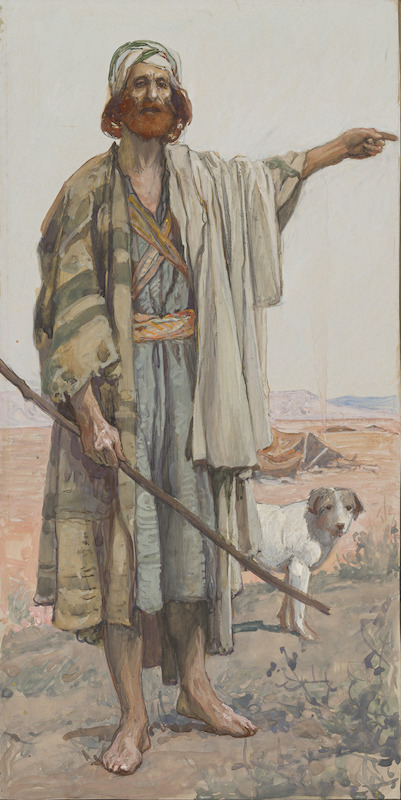
The prophet Amos (Wikimedia commons)
The Fourth of July is a holiday tailored to "priestly" celebration of America. I use the term "priestly" in the sense Martin E. Marty did when he visited Coe College nearly 30 years ago and did an impromptu lecture on civil religion in my class. Marty had just published Religion & Republic: The American Circumstance (Beacon, 1987) which included a chapter reflecting on "two kinds of two kinds" of American civil religion. The priestly-prophetic dimension particularly made an impression on me. Here's his explanation:
The priestly will normally be celebrative, affirmative, culture-building. The prophetic will tend... toward the judgmental. The two are translations of Joseph Pulitzer's definition of the compleat journalist or, in my application, of the fulfilled religionist: one comforts the afflicted, the other afflicts the comfortable. Needless to say, no adherent need always express only one side or kind... Thus a priest may judge and a prophet may and often does integrate people into a system of meaning and belonging. But the priest is always alert to the occasions when such integration can occur and the prophet is always sensitive to the fact that he may have to be critical of existing modes of such integration. (pp. 82-83, emphases mine)
For a priestly example, think of almost any American president, but maybe Ronald Reagan more than most, with his celebration of the mythos of small-town America. Or George W. Bush at a naturalization ceremony in 2008: Throughout our history, the words of the declaration have inspired immigrants from around the world to sail to our shores. These immigrants have helped transform 13 small colonies into a great and glowing nation (Tumulty 2019). For a prophetic example, think of Martin Luther King's speech to the March on Washington in 1963, noting despite the magnificent words of the Constitution and the Declaration of Independence... America has given the Negro people a bad check; a check which has come back marked "insufficient funds."

Americans should take pride in our heritage and what we have today. And yet the danger of being too self-congratulatory, too self-satisfied looms especially large this year. We need to set aside the self-praise of our priestly class for a spell, and give the fireworks a rest, and think about what we're doing.
Pictures of crowded detention camps from the Inspector General's report in the New York Times
The situation at the U.S.-Mexico border is so awful it defies description. Moreover, it's evil--evil because a problem we didn't ask for has been inflated many times by prejudice and fear. I've criticized the toxic politics of President Donald Trump, and as President he bears a lot of responsibility for these atrocities. But he can't make things happen on his own; there's been way too much cooperation, and way too little outrage, for anyone to claim that what's going on at the border is not itself a manifestation of America. Faced with an influx of refugees, the United States has responded by ignoring their claims, imprisoning them, threatening Mexico, and unbelievably, kidnapping their children, drugging them, and farming them out to commercial operators who are neglecting and abusing them. The New York Times reports:
A chaotic scene of sickness and filth is unfolding in an overcrowded border station in Clint, Tex., where hundreds of young people who have recently crossed the border are being held, according to lawyers who visited the facility this week. Some of the children have been there for nearly a month.
Children as young as 7 and 8, many of them wearing clothes caked with snot and tears, are caring for infants they’ve just met, the lawyers said. Toddlers without diapers are relieving themselves in their pants. Teenage mothers are wearing clothes stained with breast milk.
Most of the young detainees have not been able to shower or wash their clothes since they arrived at the facility, those who visited said. They have no access to toothbrushes, toothpaste or soap.... The border station in Clint is only one of those with problems. (Dickerson 2019)
If anyone doubts that these abuses are serious, the Brookings Institution offers a summary of research on the long-term impacts of bad hygiene, sleep patterns disturbed by lights on all night, minimal food and no exercise. Small children, forcibly separated from their parents for long periods of time, have in some cases been lost by either government or private operators. The Brookings writers wonder:
How can government lawyers argue that no soap, lights on all night, and minimal food are safe and sanitary conditions for children? Who have we become as a nation? (Hirsh-Pasek, Golinkoff, and Rauh 2019)
The situation has been worsening for at least a year ("Zero Tolerance" 2018, Miller 2018, Dickerson 2018, Chen and Ramirez 2018), and has been documented as well as the chaos and governmental evasions and cover-ups will allow. It has gotten renewed attention after the release of a report by the Department of Homeland Security's Office of Inspector General, after several members of Congress visited facilities in Clint and El Paso, Texas this week (Mettler, De Bonis and Thebault 2019), after investigative reporting by Pro Publica, the Associated Press, and several legal aid groups. President Trump and Vice President Pence leapt into action when the conditions came to light, only to blame the mess on congressional Democrats for not appropriating money. "We're doing a fantastic job under the circumstances," said Trump. What about leadership? "The President and I are going to stand strong, call on Congress to do their job," said Pence (Flynn 2019). The administration is all about ginning up fake crises, but when it comes to actual ones, they're helpless?

The mess at the border would be extremely difficult even if the administration hadn't inflamed the situation while evading their own responsibility. The proper solution is easier said than done: for the immediate term, treat the influx of refugees as the humanitarian crisis it is, as though it were a hurricane or a flood--get whatever resources are necessary to the scene, and treat people with compassion instead of contempt. For the long run, the U.S. needs to address situations in the countries of origin, particularly El Salvador, Guatemala and Honduras (see Medicins Sans Frontieres 2017, Kristof 2019). It does no good to be offended at the refugees, and apparently little good even flagrantly to mistreat them, if the situations they're fleeing are worse. Help them improve.

See the source image
Sherman Tank (Wikimedia commons)
Not included in our military parade because they're no longer made
Instead, we get rationalization and evasion of responsibility, while the priestly side of Independence Day is carried to a ridiculous extreme by a military pageant in Washington, D.C., complete with tanks and fighting vehicles. What would Amos, or Jeremiah, or Martin Luther King, say about that? Or about the Border Patrol Facebook site where they joke about migrant deaths and post obscene depictions of Latina lawmakers? Or people who are totally fine with all this, and contributed a record $105 million in the last three months to Trump's reelection effort?

The most destructive American public policy in my lifetime was the Vietnam War. Second, arguably, was the second Iraq war. The refugee mess on the Mexican border doesn't compare with those for magnitude. But those wars, however they're viewed in hindsight, at least had some plausible justification. The utter gratuitousness at the border, and the malice that informs it, make it more purely evil.

On this Fourth of July, America needs a prophetic call back to itself. And priestly celebration of its accomplishments. But mostly prophecy.

SEE ALSO:
Eugene Kiely, Robert Farley, and Lori Robertson, "Confusion at the Border," Factcheck.org, 3 July 2019
Jeremy Raff, "What a Pediatrician Saw Inside a Border Patrol Warehouse," Atlantic, 3 July 2019
"Eventually, We're Going to Have to Figure Out Immigration," 10 January 2019
"Fourth of July in Cedar Rapids," 5 July 2013 [I was in a more priestly mood that year]

RAICES logo
There are a number of organizations actively mitigating the situation at the border. I have been contributing to RAICES, which has a 30-plus-year presence in the region providing legal services to immigrants.

10th Anniversary Post: The Election and Our Common Life

  Your humble blogger with KGAN reporters on election night 2016 (from Eric Wylie's Facebook page) (11/6/2026)  A recent New Yorker  car...