Friday, April 27, 2018

King Street that Complete Street

 [W]e... want to celebrate the exemplary Complete Streets initiatives that are transforming policy into practice and creating places for people.... [T]his report highlights a handful of the communities, people, and places that are embracing implementation and equity in their Complete Streets efforts.--Emiko Atherton, Director, National Complete Streets Coalition ("Best Complete Streets Policies" 5)
Alexandria, Virginia, has been included among "The Best Complete Streets Policies of 2017" by the National Complete Streets Coalition, a division of Smart Growth America. The award is for the re-do of King Street, the city's main artery.

The most famous section of King Street is through Alexandria's Old Town District, running about a mile from the Metro station to the Potomac River waterfront. This section won a Great Streets Award from the American Planning Association in 2011. The APA noted:
[A] 1992 plan led to redevelopment from low-scale warehouses, an auto dealership, and surface parking to offices, hotels, restaurants, and infill commercial development.... With its attractive mix of dining, retail, and other attractions for residents and visitors alike, King Street continues as an economic center and gathering place for the City of Alexandria--a role it has served since George Washington drew early plats for the street in 1749.
free trolley (funny-looking bus) service runs all day between
the Metro station and the waterfront
Alexandria's website lists several waves of follow-up to the 1992 plan: a 2005 King Street Retail Strategy for Old Town from Metro Station to the waterfront, a 2008 King Street Outdoor Dining Overlay Zone adopted to encourage restaurants to offer outdoor dining options, and retail wayfinding signs for King Street which are part of citywide program. The result is a tourist-friendly zone of small specialty shops and restaurants, built close to the street on small blocks.

The Potomac River

shipbuilder, Waterfront Park

Old Town shops tend towards the touristy

The Atheneum (1852), formerly a bank,
now headquarters of the Northern Virginia Fine Arts Association

Stabler-Leadbeater Apothecary (1805); where Robert E. Lee got his meds

Market Square and City Hall

Gadsby's Tavern (1770), still a working restaurant

wayfinding signs

The CVS was one of the few shops I saw catering to everyday life.
There are no grocery stores on King Street, but several nearby

Christ Church (1773), where George Washington worshipped

more functionality: the library branch

restaurants have much outdoor seating, just for days like this
Yes, there's coffee! Misha's seemed to be a favorite among the locals


The George Washington Masonic National Memorial dominates the
landscape by the Metro station...
...though the smaller War Memorial is closer
The recent recognition from the National Complete Streets Coalition was for Alexandria's efforts to improve King Street above the Metro station, where it is a thoroughfare with single-family homes and non-commercial destinations (T.C. Williams High School, the large multi-use Chinquapin Park including a recreation center, several churches and a historic cemetery). Its average daily traffic count in 2017 was about 13,000. The group notes Alexandria added crosswalks, buffered bike lanes and updated bus stops, as well as reducing auto lane width and reducing the speed limit to 25. After a year there were no crashes on the re-done road which had long averaged seven a year, auto speeds were down 18 percent, and there was zero-to-minor increase in congestion at intersections. NCSC also praised their community feedback and impact evaluation processes ("Best Complete Streets Policies" 34-36). Since King Street is also State Route 7, the State of Virginia must have been involved as well.

T.C. Williams High School, which is enormous
Chinaquin Park has multiple features, including a woodsy trail
First Baptist Church of Alexandria, largest of several churches on the route
(and they're planning an expansion)
Ivy Hill Cemetery dates from 1856
Side court with big houses

A big house. Neighborhood residents clearly had the political power
to block these changes, and they didn't. Props to them for that.
Crosswalk treatment
Another crosswalk treatment
Buffered bike lane south of the high school

The bike lane shifts as it approaches the intersection with Janney's Lane

Below Janney's Lane the bike lane becomes the dreaded sharrow
Intersection closed to cars. I don't know when this was done.

Speed indicator on the northbound side just above the Metro station.
Note the grim-looking privacy fence which runs about 1/4 mile along the sidewalk
I'm a fairly confident bicycle rider, but would I ride to Old Town from the high school or the Baptist Church? Maybe, possibly--there are still some holes in the bike infrastructure. I did walk it, on a Thursday mid-day, and found it pleasant and unfrightening. Alexandria is to be congratulated on the progress it has made.


SOURCES


City of Alexandria, "King Street," https://www.alexandriava.gov/kingstreet/

National Complete Streets Coalition, "The Best Complete Streets Policies of 2017," https://smartgrowthamerica.org/resources/best-complete-streets-initiatives-2017/

"TransAction Plan Includes and Defines Bike and Pedestrian Projects for Northern Virginia," WashCycle, 13 December 2017

Saturday, April 21, 2018

Bike lanes for Irving Street?


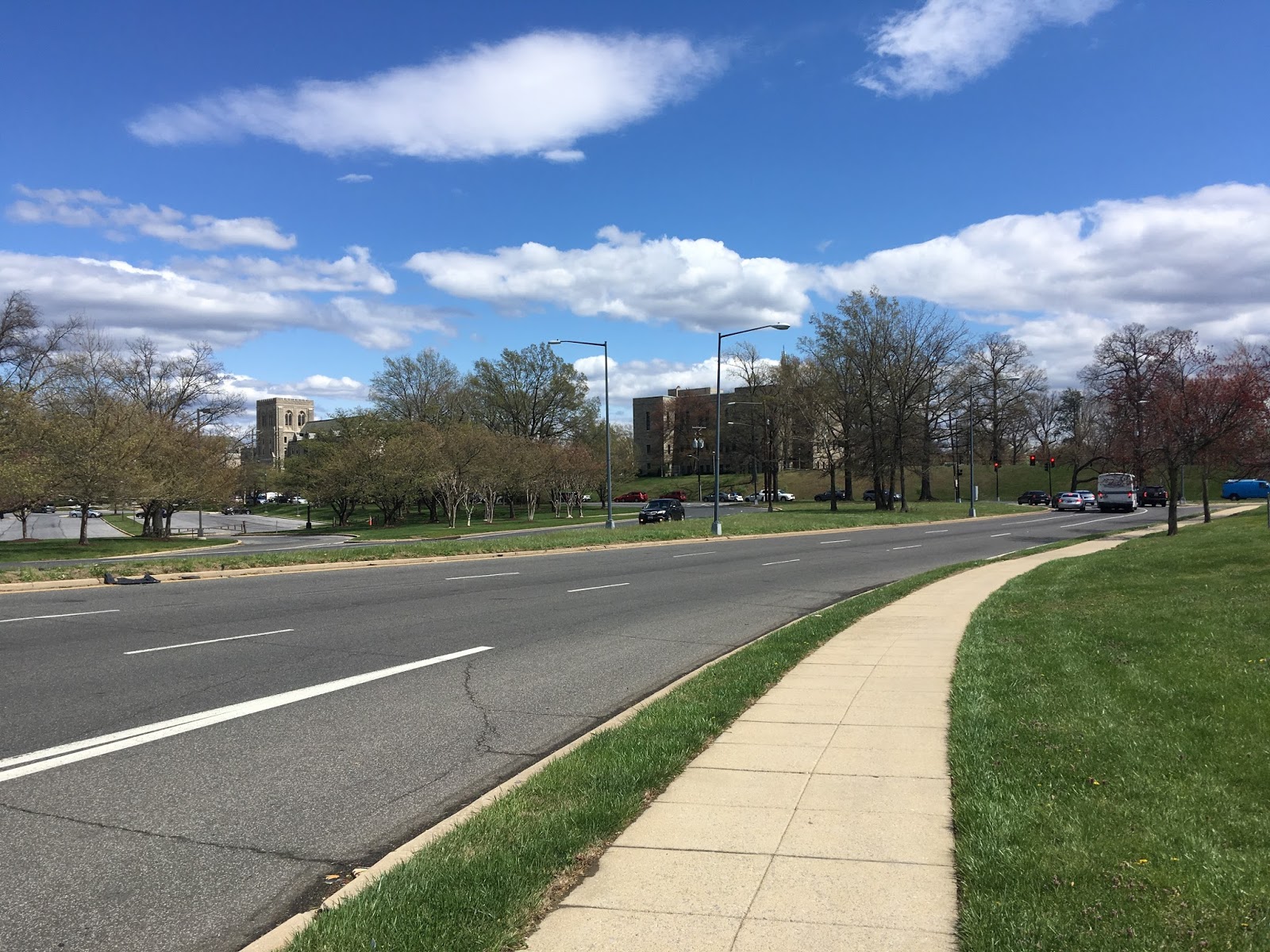
A public meeting is expected early this summer on a proposed re-do of Irving Street in northern Washington, D.C. Irving currently has three rootin'-tootin' lanes each way, making it the exemplar of an auto conduit that had been grafted onto the urban framework in the day when everyone was going to drive everywhere. Its average daily traffic count is 18300-20400, meaning that most of the day its high capacity and superhighway design create an invitation to drive fast.

Part of the plan for Irving Street is to create two-way protected bike lanes. Washington has a lot of bike infrastructure, compared to other places I've spent time, but it has a lot of active cyclists as well. Moreover, there is a hole in the bike map right about here; there is no way to get by bicycle from the northwest side to the northeast side (or vice versa) north of R Street. So viable bike lanes would create an important link in the system, connecting the Brookland neighborhood to Columbia Heights and Petworth, and creating bike access to the Washington Hospital Center, Catholic University and other area employers.

It also promises to improve pedestrian access/safety by slowing the cars. When I walked the proposed route on a windy Thursday mid-afternoon, I saw only one cyclist (on the sidewalk) but quite a few pedestrians going both directions. Every single time I stopped at a curb a driver waved me across, a still-amazing-to-me feature of Washington that I'm going to have to unlearn once I leave. But that's not something you can necessarily count on, even here, particularly when they're merging off or onto the cloverleaf at North Capitol.

Kenyon Street at the west end of the route, just east of Warder.
Kenyon's already under construction, so it's hard to tell how it would be impacted.

Wangari Gardens, on the south side of Kenyon,
approaching the merge into Irving

Wangari Gardens again.
How many of those 18300-20400 speeding cars know this is here?

Kenyon and Irving. Wonder what happened here?

Crosswalk from the southside of Kenyon to the south side of Irving. 
(The bike lanes would likely be on the north side of the streets.)

Approaching Washington Hospital Center.
At 1st Street NW, one scenario has the lanes shifting from the north side of Irving
to the center median, which will be a tricky interface indeed

Approaching the cloverleaf intersection with North Capitol Street

Part two of the cloverleaf. In the distance is the majestic basilica at Catholic U.
We are now on the northeast side.

Approaching Catholic University, Irving intersects with Michigan.
The lanes would continue on Michigan for one block.

Intersection of Michigan and 4th Streets from the steps of the basilica.
4th Street NE will have protected bike lanes soon, from Michigan south to Lincoln.
In this 1970 poster (displayed at the Anacostia museum) protesting a proposed blitz of highway development in central Washington, Irving is shown as a normal street. with Michigan as the thoroughfare:

So I'm guessing the widening of Irving happened to compensate for the central freeway not being built?
The Green Line was constructed instead

Protesting the Central Freeway proposal in Brookland
(taken at the Anacostia Museum)

Protesting the Central Freeway proposal in Brookland
(taken at the Anacostia Museum)
Washington is not unique in having bulldozed neighborhoods in order to facilitate auto traffic. The Irving Street re-do, improving bicycle and pedestrian access between northwest and northeast Washington, will help to enhance the neighborhoods that remain.

SEE ALSO: Crosstown Multimodal Study

Crosstown Multimodal Transportation Study area map
Source: dccrosstownstudy.com

Sunday, April 15, 2018

Letter from Washington (VI): Greetings from Boston


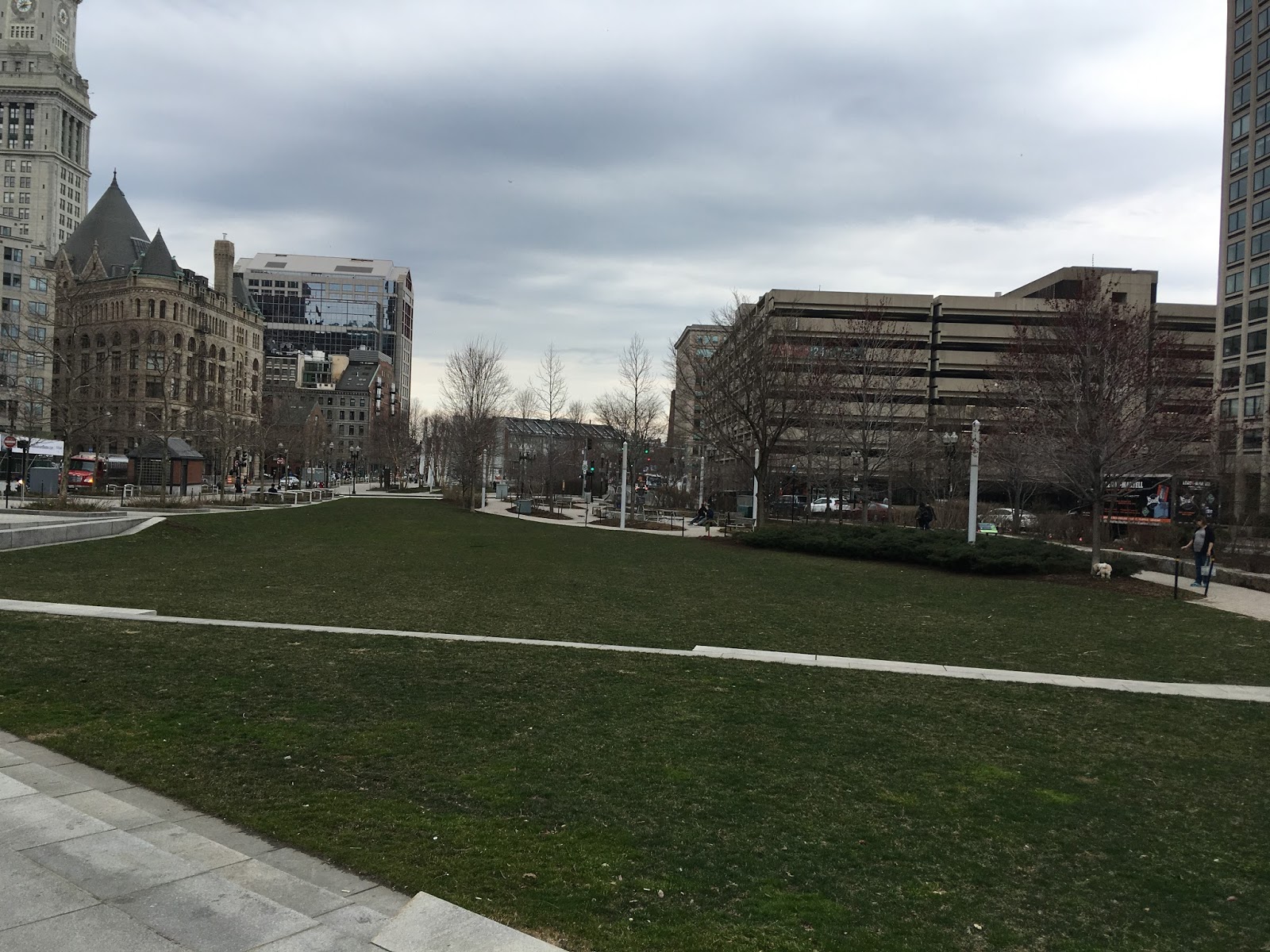
This weekend we're in Boston visiting friends. It's Marathon weekend, but wherever we've been the crowds have been pretty well absorbed. We've sampled the public transportation system, which like most places is doing a lot with too few resources. And on Friday they took us on a tour of the North End neighborhood, which played a crucial role in the emergence of new urbanism.

The ur-work of new urbanism is The Death and Life of Great American Cities by Jane Jacobs (Random House, 1961), a perceptive writer and activist based in New York City. Many of her insights came from living in New York's Greenwich Village, which she helped preserve from the destructive hand of New York's uber-planner Robert Moses. But she also drew on the North End. Here she is, in the introduction, after chronicling the disastrous effects in several cities of what would come to be called "urban renewal:"
Consider, for example, the orthodox planning reaction to a district called the North End in Boston. This is an old, low-rent area merging into the heavy industry of the waterfront, and it is officially considered Boston's worst slum and civic shame. It embodies attributes which all enlightened people know are evil because so many wise men have said they are evil. Not only is the North End bumped up right against industry, but worse still it has all kinds of working places and commerce mingled in the greatest complexity with its residences. It has the highest concentration of dwelling units, on the land that is used for dwelling units, of any part of Boston, and indeed one of the highest concentrations to be found in any American city. It has little parkland. Children play in the streets. Instead of super-blocks, or even decently large blocks, it has very small blocks; in planning parlance it is "badly cut up with wasteful streets." Its buildings are old. Everything conceivable is presumably wrong with the North End. In orthodox planning terms, it is a three-dimensional textbook of "megalopolis" in the last stages of depravity. The North End is thus a recurring assignment for M.I.T. and Harvard planning and architectural students, who now and again pursue, under the guidance of their teachers, the paper exercise of converting it into super-blocks and park promenades, wiping away its nonconforming uses, transforming it to an ideal of order and gentility so simple it could be engraved on the head of a pin (pp 11-12, bolding mine).
In 1959 she visited the North End for the first time in two decades, and was "amazed" at the steady, incremental progress the neighborhood had made.
The streets were alive with children playing, people shopping, people strolling, people talking. Had it not been a cold January day, there would surely have been people sitting. 
The general street atmosphere of buoyancy, friendliness and good health was so infectious that I began asking directions of people just for the fun of getting in on some talk. I had seen a lot of Boston in the past couple of days, most of it sorely distressing, and this struck me, with relief, as the healthiest place in the city. But I could not imagine where the money had come from for the rehabilitation, because it is almost impossible today to get any appreciable mortgage money in districts of American cities that are not either high-rent, or else imitations of suburbs (pp 13-14).
So she called an acquaintance in the planning department of the City of Boston.
"Why in the world are you down in the North End?" he said. "Money? Why, no money or work has gone into the North End. Nothing's going on down there. Eventually, yes, but not yet. That's a slum!" (p 14)
As it happens, though, the crime and health statistics for the North End were vastly better than other neighborhoods of similar social class; not only that, but the planner admitted he liked dropping by every now and then.
I often go down there myself just to walk around the streets and feel that wonderful, cheerful street life... But of course we have to rebuild it eventually. We've got to get those people off the streets (pp 14-15).
Where we ate. Restaurants have been a major economic contributor to the North End for years
By some miracle, benign neglect or local activism, urban renewal never came to the North End. It suffered the construction of the Central Artery in the 1950s, and then the dislocation of its reconstruction (the "Big Dig") 15-20 years ago, but out of all that came the Rose Kennedy Parkway promenade.


Today the North End is one of the hottest areas of the city. The gentrification has come with the inevitable displacement of some of the longtime Italian residents, so it's far from paradise. But the success of the North End, in the face of all scorn and neglect, helped to inspire the urbanism of today that may yet save the world.


Image result for jane jacobs
Source: strongtowns.org

Wednesday, April 11, 2018

Book review: "Happy City"


Charles Montgomery, Happy City: Transforming Our Lives Through Urban Design. New York: Farrar Straus Giroux, 2013.

Montgomery's argument for urbanism begins with the typical tales of woes created by the suburban model of development (see the list of costs, p. 47), but Part II of the book rolls out a fascinating new dimension: analysis of urban design using psychology research into human happiness. Montgomery's clear writing makes the research findings accessible to the layperson. The book offers practical solutions to policy problems, as well as encouragement for individuals who want to make a difference.

There are various definitions of happiness around, from Socrates to Charlie Brown to the Ray Conniff Singers, but in this discussion it refers to the aspects of a good life, including joy, health, freedom, resilience, fairness and connection (ch. 2). Montgomery writes, "The city that acknowledges and celebrates our common fate, that opens doors to empathy and cooperation, will help us tackle the great challenges of this century" (p. 43), including strenuous commuting, difficult parenting, and the loss of connection to other people. He also includes the volatile housing market and high energy costs, which may be more reflective of the 2013 publication date than they are of today's conditions, but who knows whether and how soon they'll return?

Montgomery eschews scolding, and urges us to eschew it, too. (So does Chuck Marohn of Strong Towns, who said on a recent podcast that he used to get angry about the lack of progress in his hometown, but now focuses on what can be achieved, and finds more people are listening to him as a result.) Montgomery's psychology-based take is we as a species are predisposed to be dissatisfied with our lives, which leads us to make non-rational choices about housing, highways, risk assessment, and so forth (ch. 5). So while well-designed cities might be the answer to a lot of problems, to get people there we have to make them funner.

Four ways to get down this East Capitol Street... does genuine choice make people happier?
Just a few of the many research-driven insights from this rich-but-highly-readable work:
  • People want the right mix of natural features and contact with neighbors. Different people want different mixes, so we need to offer a variety (something the suburban model of development is not good at--ch. 6)
  • We can use design to encourage human contact, including by slowing or eliminating auto traffic (ch. 7). Architect Jan Gehl, who designed much of contemporary Copenhagen: "We found that if you make more road space, you get more cars. If you make more bike lanes, you get more bikes. If you make more space for people, you get more people and of course then you get public life" (p. 151).
  • The vast majority of commuters drive, but a lot of them don't like it. While driving on a clear road creates feelings of mastery, driving in traffic is hard mentally and physically. Walking and cycling are the most pleasurable forms of commuting (ch. 8), and "immobility is to the human body what rust is to the classic car" (p. 183).
  • Public transit is the least pleasurable form of commuting, because "decades of under-investment mean that the typical transit journey is crowded, slow, uncertain or uncomfortable" (p. 193). Stressors include the anxiety of waiting for a bus or train, feeling unsafe, getting stuck on the bus in traffic... and the low status of bus riders. Feelings of low status impacts one's happiness and health, as well as overall social conditions. "This is terrible news for the United States," he adds in a footnote (p. 238). All these stressors are addressable, and he lists some methods that have been tried in places like Copenhagen, Bogota and New York City (chs. 9-10). "People make different choices when they are truly free to choose," he argues (p. 217), pointing to the revolutionary changes in Danish habits over the last four decades.
Real-time information on arrivals can ease the anxiety of waiting for a train or bus;
both Washington and Cedar Rapids allow tracking by phone app
I'm in Washington, D.C., for a little while longer, but my permanent home is in Cedar Rapids. I wonder how much Montgomery's arguments translate to a small midwestern city? Does this, from a section entitled "The Lonely Everywhere," resonate?:
Let's say that you and I want to meet for an ice-cream cone at the end of our workday before heading home for dinner. First we both must chart the geographic area each of us can reach in that time. Then we must see if our territories intersect. Then we need to figure out if the journey to and from a rendezvous point in that zone leaves enough time to make the meeting worthwhile. Each of us has an envelope of possibility on the space-time continuum. The more our envelopes intersect, the easier it is for us to actually see each other in person (p. 57).
Cedar Rapids is not Atlanta, though sometimes it seems as though we aspire to be. We're certainly not New York or Copenhagen. Housing is cheap, open land is cheap, and as long as energy is also cheap there's not much to stand in the way of sprawl. Most of the attractions--museums, the ballpark, NewBo City Market, Legion Arts--are easy to get to, and free parking is plentiful.

The vast majority of Cedar Rapidians drive to get anywhere; despite city efforts to build sidewalks and design safe routes for cyclists, non-car transportation is really difficult. The hardy few bike, the handicapped take the bus, and pretty much everyone else drives. I can walk nearly a mile to work and not see another person walking. Still, while big city residents might laugh at what we call traffic, from curbside Cedar Rapids drivers seem to demonstrate more anxiety than mastery. There isn't much choice for housing, either: single family homes on large lots, expensive condominiums or ragged rentals. Montgomery may not be writing for cities like ours, but we should probably be paying attention to him anyway.

SEE ALSO: "The Happy City" website: https://thehappycity.com/


Monday, April 9, 2018

Digital privacy and our common life

Mark Zuckerberg in a crowd at congressional hearing
(swiped from vox.com. Used without permission)

The ordinary American thinks of themselves as a customer, when in the business model of many of the companies, they're just a product. They're just trying to gather information about you in order to re-sell it to yet another third party who you don't know at all and had never any intention of doing any business with.
--Senator Ed Markey (D-MA) on National Public Radio, 4/10/2018

Mark Zuckerberg testifies down the street this week at hearings before the House Energy and Commerce and Senate Commerce Committees (Timberg and Romm 2018). Facebook has come under renewed scrutiny, again, because of revelations that the sketchy marketing firm Cambridge Analytica obtained data from tens of millions of Facebook users without their consent. Last weekend, I saw that Chicago is plastered with ads promising Facebook will be doing more to combat fake news and data mining (cf. Frenkel and Singer 2018). Weirdly, I haven't seen any of these ads in Washington.

Birgit SIPPEL
Source: European Parliament
A couple weeks ago, with considerably less fanfare than Zuckerberg's appearance, Birgit Sippel, member of the European Parliament from Germany, told an audience at the Brookings Institution that while the EU is considering greater privacy protection, ultimately we must choose between two models of media. Sippel is the rapporteur for the EU's new General Data Protection Regulation, which requires more disclosure to individuals about use of their personal data, and increases penalties for violations (Brandom 2018). She additionally made strong statements in favor of individual control over what personal information is tracked, compiled and available to marketers during the course of the hour-long interview with Cameron F. Kerry of Brookings.

For me, the key take-away from Sippel's talk was that if there is going to be information, it must be gathered, and somehow the gathering must be paid for. In the days of newspapers, information was gathered by reporters and assembled by editors, all of whom were paid staff of the paper. To access the information, readers had to pay for a newspaper. (Truth in anachronism: We get daily delivery of a paper Post while we're in Washington; at home in Iowa, we subscribe to both the Cedar Rapids Gazette and the New York Times.) If we access the news on the Internet for free, there needs to be an alternative funding model, and for various reasons the model that has emerged involves tracking clicks and selling that information. Facebook, which has emerged from a number of long-forgotten competitors to dominate the electronic public square, is "free and always will be" because they make money selling the information they collect on their users.

My first reaction is that these are not the only two models available, though for practical reasons they may be the most likely outcomes. There are at least three other ways that you can get information:
  1. Commercial broadcasting model. Broadcast radio and television stations are funded by advertising, so their material is free to the listener/viewer. The bet is that they can attract enough of the right kinds of users that advertisers are willing to pay dearly for access to them. Internet ads exist, although so do ad blockers.
  2. Public broadcasting model. Public radio stations, and most other non-commercial operations, don't sell advertising, though corporate underwriting is increasingly approaching a distinction without a difference. The Corporation for Public Broadcasting gets a vanishingly small subsidy from the U.S. government, but for the most part public radio depends on the good will of user-donors. Wikipedia and Greater Greater Washington, to name a couple sites I frequent, make appeals for donations, but I don't know how successful they are.
  3. Library model. If I wanted to read a daily newspaper growing up, I had to use the school library or the public library. Libraries are funded by governments or institutions and available to users, most of whom have paid taxes or tuition that funds the library. As Jane a.k.a. "The Other Dr. Nesmith" has pointed out, libraries combine the resources of the community to achieve "a whole world of resources just waiting to be used," far more than even a Zuckerberg could afford to purchase on his own.
Funded by taxes and donations:
Cedar Rapids Downtown Library grand opening, 2013

I want people to be paid, and paid well, for the work they do, but...

In my blogging, and in the course preparation I do in my paid job, I've become accustomed to having a large array of resources at my fingertips. I read sources with hot links, and use them myself, assuming that interested readers can follow their curiosity to more information about whatever aspect of the subject grabs them. I contribute to Greater Greater Washington and Strong Towns, and have even thrown the occasional ducat at Wikipedia, but I simply cannot fund all the web resources I use. Maybe a quarter a click?
one baseball

I'm a baseball fan, but I stopped paying for online broadcasts when they raised the fee from $9.95 to $14.95 per year. I read articles about the Cubs on the Chicago Tribune website until they tell me I've reached my monthly limit, when I switch over to always-free cubs.com. Thomas Hobbes told us that when we look at ourselves we should see the whole of human nature, and I conclude that a paid subscription approach to information on the web would change the universe in which I've become accustomed to working and thinking.

Maybe I overrate how boring I am to data miners, but sometimes I'm willing to let whoever have whatever, just so I can use websites for free. Let Cambridge Analytica or Vladimir Putin try to troll me. I know how to ignore them.

Monday, April 2, 2018

Letter from Washington (V): Coffee on Capitol Hill

Here on Capitol Hill, I live in a coffee-intense neighborhood. It comes, I guess, from the area being both densely-populated and well-heeled. As a coffee-lover, it's a happy feast of choices right at hand. My longest walk to any of the places reviewed below is roughly the same as the shortest walk to a coffeehouse from my home in Iowa.

Awhile ago, when I found a spot to read the paper among the many nooks and crannies of Bourbon Coffee on Pennsylania Avenue, I was struck by the similarity of the layout to Wit's End in Marion, Iowa. That got me thinking about what Cedar Rapids coffeehouses most resembled the coffeehouses of Capitol Hill. I don't claim these are replicas--the real estate situation alone means Cedar Rapids coffeehouses tend to be physically larger than those in D.C., and I couldn't find good matches for every one--but there do seem to be ecological niches in the two business environments. I didn't review national chains, but I did include Port City Java, with which I was not previously familiar.


Port City Java, 701 North Carolina Av SE (0.3 mi). Across the street from the Eastern Market, this is the largest space of any on this list, plenty of room beckons whatever the time of day. A bay window looks out at busy North Carolina Avenue, and there's a street-facing patio for pleasant days. WiFi password is simple and memorable. Founded (1995) and headquartered in Wilmington, North Carolina, where all their coffee is roasted. Fair-trade and single-origin options. This is their only store in Washington (and in fact their only store outside of the Carolinas). Website includes breakfast and lunch menus. CR comp: Mr. Beans, or since it's a franchise Scooter's on Edgewood Rd.


Jacob's Coffee House, 401 8th St NE (0.4 mi). This shop near the Northeast Community Library is in a fairly quiet and residential area, although 8th Street and Maryland Avenue are important thoroughfares. Tables are constructed for two but fastened together so they work for a larger group. If you come alone at a busy time you'll probably need to share a table with somebody, which seems to be expected so it's OK. CR comp: Brewed Awakenings.


Bourbon Coffee, 621 Pennsylvania Av SE (0.4 mi). Located on a bustling block with numerous restaurants and small shops, Bourbon is distinctive for its multiple small rooms which make it cozy but maybe difficult to find the right spot for your group. There's an outdoor patio in back which it was too cold to try the day I visited.

Bourbon was founded in Kigali, Rwanda in 2007, now based in Washington. Coffee is directly acquired from Rwandan farmers and cooperatives--"direct trade" not just "fair trade," with information on sources and varieties on the website. One of four DC locations. Supersize me! They offer 20 ounce mugs. CR comp: Wit's End.


Peregrine Espresso, 660 Pennsylvania Av SE (0.4 mi). I overlooked this shop for a long time because of their bland exterior, but to my shame was also overlooking their cool schwa logo. Their name suggests their specialty; they did a brisk business while I was there on a Monday morning, for fancy drinks not drip coffee. My drip coffee was delicious and served in a ceramic cup, but at $3.00 for 12 ounces is rather pricey even for DC. They also serve coffee in pour-over and iced forms, as well as other beverage options. Multiple snack choices. Founded here in 2008, it is now one of three locations, all in Washington. Coffee roasted by Counter Culture Coffee of Durham, North Carolina. [P.S. 4/3/18: This was my former student Emily Crouch-Ponder's go-to coffee spot when she lived in the District: "The baristas were always knowledgeable--when I was there, one of theirs was competing at a national level--and friendly."]


Ebenezer's Coffeehouse, 201 F St NE (0.5 mi). A couple blocks from Union Station, Ebenezer's is typically busy and often it's hard to find a place to sit. You do see people on laptops, so hanging out is clearly approved, but it has more of a high-powered vibe. Owned and operated by the National Community Church, which has its offices next door, it opened 2006 in a site that was a diner in 1908. Coffee roasted by One Village Coffee of Souderton, Pennsylvania. Vendor information and breakfast-lunch menus on website. CR comp: Brewhemia.


Sidamo Coffee & Tea, 417 H St NE (0.6 mi). I'm not a big fan of hyper-commercial H Street, which is fast becoming a condo ghetto, but Sidamo is special. It's narrow and deep, like most of these establishments, so you can get away from the street pretty easily. If you sit toward the front, as I did, you can watch them grind the beans. There's a patio in back. Its Ethiopian owners offer a coffee ceremony on Sunday afternoons. Their largest size is "gigante," which is 16 ounces after all. Ceramic cup was chipped but I could work around that. Free WiFi. Website includes breakfast and lunch menus. Opened in 2006.


Loaf Coffee, 101 15th St NE (0.9 mi). Just opened, a couple blocks east of Lincoln Park, this is a wonderful space for nearby residences. It previously housed a coffeehouse called Mia's. Loaf is nearly a mile from where I live (!), so I haven't been there much. Its location is convenient to Eastern Senior High School, so it has potential as a student hangout. Website includes breakfast menu, snack and lunch items, and they've just started a pasta dinner option.


Cafe Bliss, 201 Massachusetts Av SE (0.3 mi). There are so few seats here it's clearly meant for people to grab and go. Union Station and the congressional offices are close at hand, so that's surely functional. But I am looking for hangouts, and so haven't tried it. CR comp: Coffee Emporium, though to be fair I've never failed to find someplace to sit at Coffee Emporium.

Prices at these places are pretty similar: $2.50-3 for a 16-ounce coffee. (All have fancier options, but my tastes are simple.) That's pretty similar to Cedar Rapids prices, though a lot of coffeehouses in Cedar Rapids offer free or discounted refills which I don't see in DC. Even so, it's a lot for someone on a fixed or small income to be a regular. Does that hinder their potential to be third places? Or are coffeehouses today so culturally-defined that only certain classes or races ever frequent them?

SEE ALSO:
Rosie Spinks, "The Caffeine Curse: Why Coffee Shops Have Always Signalled Urban Change," The Guardian, 8 April 2016
Jamie Liu, "45 Essential Coffee Shops Across the DMV," Eater, 9 August 2017

PS-Back in the era of Facebook notes (c. 2011), I surveyed coffeehouses in Cedar Rapids and Marion, most of which still exist. If you're interested, I'd be happy to share that with you if you contact me.

Navigating homeownership

  Navigating homeownership panel (L to R): Jennifer Pratt, Stephanie Schumacher, Matt Skogman, Ann Roushar, Zach Kucharski (9/23/2026)  Pros...