Wednesday, July 5, 2017

What's up, Cleveland?

See the source image
Source: Wikimedia commons

(7/5/2017) Cleveland, Ohio, has had as tough a time as any American city making the transition from the industrial to the post-industrial era. During the decade 2005-2015, when many observers saw a return to urban centers by both residents and businesses, Cleveland's population actually dropped by 14.2 percent, more than any large city except for Detroit and New Orleans. On key indicators of community well-being, Cleveland's percentage of adults with a bachelor's degree or higher (15.8), median household income ($26150), and percentage of adults in the labor force (58.2) score well below the U.S. as a whole, and below even comparable cities like Chicago, Milwaukee and Pittsburgh. This has occurred despite the presence of "eds and meds" led by the world-renowned Cleveland Clinic, the city's largest employer.

The City of Cleveland has maintained a lot of the downtown architecture from its heyday, while trying to open up access to Lake Erie. The Terminal Tower was built in 1930 as transportation hub and commercial space, overlooking Public Square:

Inside views:


Public Square is a pedestrian plaza, managed by the mayorally-appointed Group Plan Commission. Beginning in 2011 and dedicated in 2016, the remade Public Square was the first project for the commission, though the new young trees provided little protection from the Sun on the hot day we visited:

Public Square in 1920. Source: Wikipedia
Public Square also contains the 1894 Soldiers' and Sailors' Monument, which we were surprised to find was open to the public. Our guide says "90% of Clevelanders know this is here, and 10% know it's open to the public." The interior lists all county residents who served in the Civil War, as well as stained glass windows and sculptures with varying degrees of fancifulness.

Across Public Square from the Tower Center is the Old Stone (First Presbyterian) Church, built in 1855 though Presbyterians have been worshiping on this corner since 1819:

The view down Ontario Street towards the courthouse:

On the other end of the visual delight spectrum, the view down Prospect Avenue towards the Tower Center. Casinos are not civic buildings:

Along Rockwell Avenue, a sign of difficult walking. If the design cues are saying "Cross here," a lot of good a sign is going to do.

The Cleveland Public Library is two blocks from Public Square down Superior Street. Its new Louis Stokes Wing sits nicely next to the original facility, and has some quiet spaces inside...

...while the Eastman Reading Garden between them made for a shady parklet, popular on this sunny summer day.

The commercial areas around the city center feature a lot of massive buildings, historic but not enough variety to be inviting. An exception was East 4th Street, a narrow street closed to traffic and featuring a number of popular gathering places:

The Arcade, a proto-mall dating from 1890, by contrast was rather quiet even on a hot day. Its architecture is impressive...

...but shops like this might have been busier with street access.

North of downtown is Lake Erie. There's enough car traffic to make walking tricky; the Group Plan Commission plans a pedestrian bridge which may help. Attractions (besides the lake) include the home field for the NFL's Cleveland Browns (at left)...

...the Great Lakes Science Science Center...

...and the Rock 'n' Roll Hall of Fame.

We went east via rapid transit to visit the Cleveland Museum of Art. There's some transit-oriented development happening by the new Little Italy stop....

...bringing new people to a charming, walkable neighborhood.

The Cozad-Bates House, build in 1853

Even "star" cities struggle with issues of concentrated poverty, gentrification, infrastructure and so on. Cleveland's struggle to catch up to the post-industrial world exacerbating all those other struggles. A whirlwind tour of the city shows it has good bones in many places, civic attractions that are well-supported, a powerful if mixed heritage, and efforts towards promoting walkability. In theory all a city can do is lay the groundwork for prosperity and then the private sector takes over. What does it do when step one doesn't seem to be working?

(Or maybe it is starting to work? This article in Cleveland Magazine documents a dramatic change in attitude among Cleveland residents towards their home city. Those interviewed for the article seem to put unwarranted faith in attitude and branding as keys to success, but do I have a better answer?)

SEE ALSO:
"Can Cities Change Their Luck," 20 June 2016
"Two Tales of Cities," 7 June 2016
All things Cleveland at cleveland.com
Sheehan Hannan, "Who Are We Now," Cleveland Magazine, 1 July 2017

Monday, June 26, 2017

Health care (II)

Senator Mitch McConnell of Kentucky,
principal architect of the Senate Republican health care bill
Senate leaders are trying to get to a vote in the next few days on the latest version of the Republican health care act, dubbed the Better Care Reconciliation Act. The bill is intended to repeal the Affordable Care Act of 2010 ("Obamacare"), while minimizing political damage to Republicans by preserving some of its more popular features.

The Congressional Budget Office (CBO) Monday released its assessment of the effects of the bill: the number of insured Americans will decline by 22 million in 10 years, while the federal deficit will decline by a total of $321 billion. The deficit reduction could in theory be greater, but the bill also repeals the tax increases on upper brackets included in the 2010 law (Kaplan and Pear). The CBO did not to my knowledge assess whether the law would fulfill President Trump's April promise that individual premiums and deductibles, which have risen pretty steadily for more than 30 years, would be "much lower," but a collection of health economists and policy experts consulted by The New York Times predict many people will face substantially higher deductibles, or premiums, or both. Rodney L. Whitlock, a former Senate Republican policy assistant, thought deductibles would reach "almost assuredly five digit" territory (Adelson).

Obamacare was passed after more than six decades of effort to pass a national health insurance bill that had previously yielded government health programs for the elderly (Medicare, passed in 1965) and the poor (Medicaid, also passed in 1965) as well as a series of bloodied presidents who attempted broader approaches. The policy window was open only because Democrats briefly had a "filibuster-proof" Senate majority of 60-40, and because provider groups were willing to negotiate with the administration which they had not been in the 1990s when Bill Clinton was President. A few Republicans were involved in policy talks in the summer of 2009, but withdrew coincident with the rise of the grass roots conservative movement known as the Tea Party.
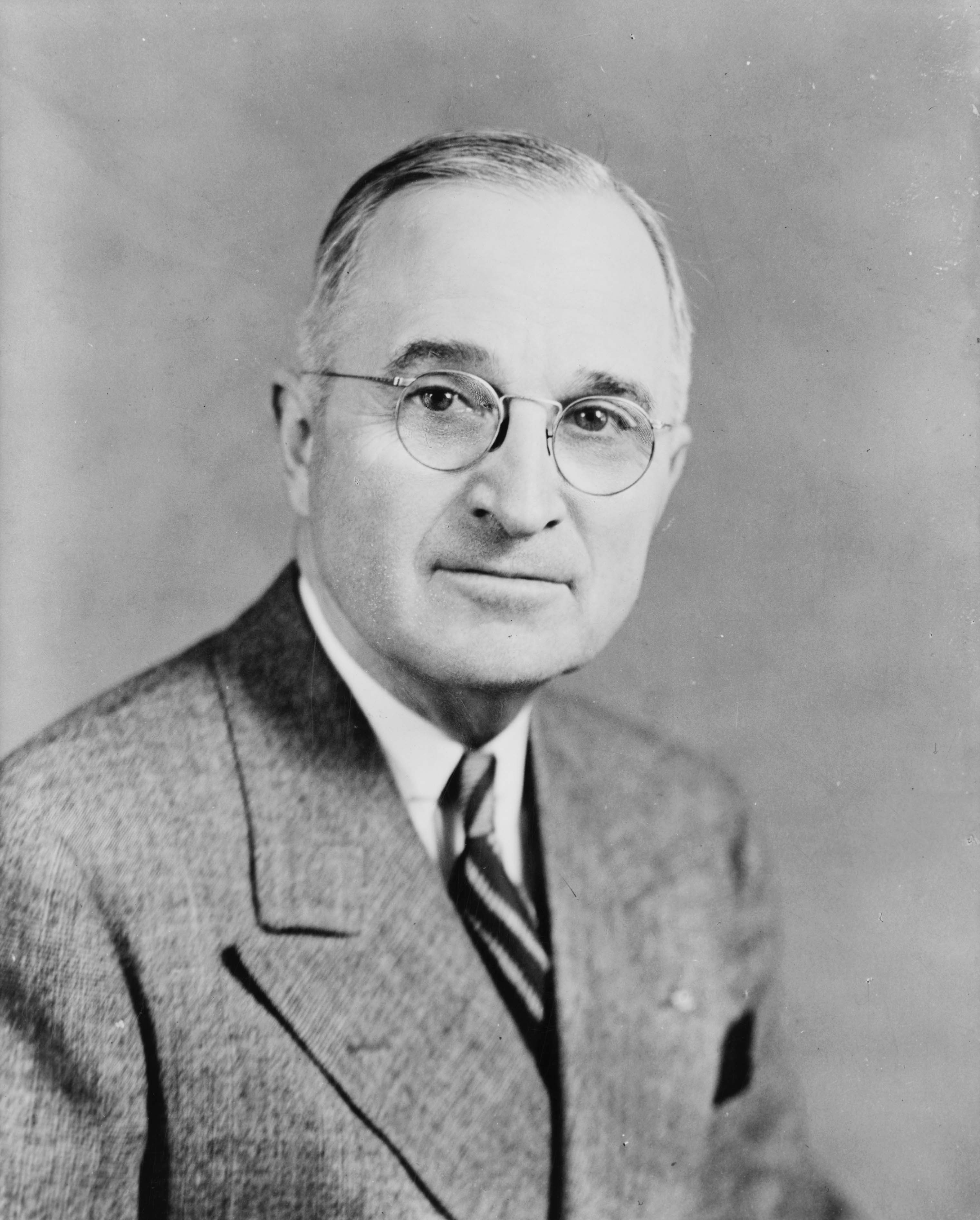
President Harry S Truman (1945-53) advocated an early national health program
Health care policy efforts were sustained by the persistence of three problems:
  1. Lack of insurance. According to the Kaiser Family Foundation, 15 percent of non-elderly Americans lacked insurance in 2013, a proportion that had been pretty consistent dating back to the 1980s. They weren't always the same 15 percent, as people cycled in and out of employment or eligibility for Medicaid, so the percentage of people with inconsistent access to insurance was somewhat higher. Lack of insurance is associated with major health problems, shorter life expectancies, inconsistent care and financial stress.
  2. Under-insurance. This is harder to measure, but a large population had health insurance that didn't actually cover what they ultimately needed, due to limits on benefits, exemptions for pre-existing conditions, or what wasn't covered by the policy to begin with. This has contributed to the rise of crowdfunding appeals to pay for unanticipated health care expenses.
  3. Rising costs. Health care inflation had been running well ahead of the consumer price index at least since 1980, when health care spending amounted to about 1/12 of U.S. gross domestic product. It is now about 1/6 of GDP, placing financial stress on consumers, businesses that provide health insurance for their employees, and governments at all levels.
The existence of these three problems created substantial obstacles to opportunity in America. In a country that prides itself on meritocracy, the ability to rise is handicapped when accident of birth dooms some of us to inferior health care, not to mention housing, education and so on.

The ACA, for both practical and political reasons, eschewed national health insurance for patches on the existing system (which is not only well-established but fiercely defended by the provider groups that had defeated earlier policy efforts). Roughly based on the approach taken in Massachusetts a few years earlier, it created incentives for employers to offer insurance benefits, virtual markets for individuals in each state ("health care exchanges"), subsidies for individuals and small businesses, and expansion of the Medicaid program. It mandated minimum "essential" coverage in all policies, that everyone have health insurance, that coverage could not be denied for pre-existing conditions, "community rating" for all regardless of age sex or health status, and that children could remain on their parents' health insurance until they were 26. All these emphasized access rather than cost control, though there were some aspects of the bill that sought spending efficiencies.

President Barack Obama, for whom the Affordable Care Act
of 2010 was a primary legislative achievement
Opposition was characteristically virulent, based largely on philosophical and political reasons. Some worried that government would become too large and powerful. There was also reflexive opposition from the Republican Party in Washington and most states that they controlled. Dozens of votes were taken in Congress to repeal all or part of Obamacare, but tellingly, in six years no hearings were ever held on what if anything should replace it once it was repealed. Republicans nationally proved a lot better at winning elections and talking the program down than at designing policy, and thus arrived at their moment of victory quite unprepared.

Serious health care policy makers note Obamacare needs fixing:
  1. Costs continue to rise, after a hiatus early in the decade which may have been a fluke, or may have been a temporary effect of the severe recession which dampened demand for just about everything. Health care inflation didn't start with Obamacare, but is unsustainable and will doom the program even if nothing else does.
  2. Insurance exchanges have had an uneven record in practice, even after the initial enrollment bugs were worked out. Many counties have one or zero companies offering policies to individuals, which doesn't provide consumers with any benefits of competition. A more stable basis for the program would surely help.
  3. Millions of people have been added to insurance rolls, but millions more remain outside. The proportion of uninsured non-elderly Americans dropped from 15 percent in 2013 to 10 percent in 2015, but still, 10 percent. Weak penalties for not buying insurance were probably understandable early on, but the "introductory rate" era is past and they must be strengthened if coverage of the long-term ill is going to be sustainable. (See comments by Dan Mendelson, president of Avelere Health, on Morning Edition Monday.)
A full repeal of the ACA would require 60 votes in the Senate to break a certain filibuster, so Republicans are pursuing only those changes that have budgetary impact in a "reconciliation" approach that cannot be filibustered. The Republican-controlled House passed the Affordable Health Care Act on May 4, 2017, without committee hearings and before the CBO had fully analyzed its effects. It was blocked in the Senate. Senate Republican leader Mitch McConnell revealed the somewhat different Senate version on June 22, also without committee hearings while pushing for a quick vote. Reservations within the Republican caucus, however, have prevented a vote thus far.

President Donald J. Trump has not been involved in the policy making process,
and his statements on health care have been vague and contradictory
The Republican approaches are less overtly assaults on the ACA structure than the "repeal" rhetoric of the last seven years would have predicted, but the dry-sounding policy changes may lead to the same effect. Sarah Rosenbaum of the Milken Institute School of Public Health at George Washington University charges: "A terrible blow to millions of poor people is recast as an easing off of benefits that really aren't all that important, in a humane way" (Ornstein). Rather than ending Medicaid expansion, for example, the current bill phases out the additional national support to states, which along with spending caps would create a strong disincentive for states to continue it. Medicaid spending caps would have the effect of reducing federal spending on that program, which is administered by states although primarily funded by the federal government (Adler, Fiedler and Gronniger).

Ending mandates on policy coverage, having insurance and community rating would lower the costs of policies for some, while driving it up for others. Moreover, without the individual mandate the viability of the mandate for pre-existing conditions would be doubtful, though the Senate bill has added a "lockout" provision requiring a six-month waiting period for getting insurance if one has let previous coverage lapse. What Brookings analysts concluded about the House bill--In general, enrollees who are younger, have higher incomes, or live in low-cost areas are most likely to be better off, while enrollees who are older, have lower incomes, or live in high-cost areas are most likely to be worse off (Brandt et al.)--is probably true of the Senate bill as well.

If access to health care is to remain part of our common life, it requires more than holding the line on repealing the Affordable Care Act. It requires advocates, because the complex set of system patches created by the ACA could be starved of funding more easily than it could be repealed by law. ("Perhaps let OCare crash and burn!" tweeted the President Monday morning, noting repeal is "Not easy!") Ensuring access while controlling costs is surely difficult, though the parties and interests in this ongoing policy process are making it more difficult than it needs to be, given the experience of other industrial democracies. That means seriously addressing the market failures (information, competition, merit goods) endemic to privately-produced health care. I don't know if that's even possible in such a polarized political environment, but signs of unrest in the states offer some hope.

EARLIER POST: "Health Care," 4 May 2013

DATA FROM KAISER FAMILY FOUNDATION
"Health Insurance Coverage of Nonelderly" (2013-2015)
"Premiums and Tax Credits Under the Affordable Care Act vs. the Senate Better Care Reconciliation Act," 23 June 2017

POLITICAL ANALYSIS: Nate Silver, "Mitch McConnell Isn't Playing 13-Dimensional Chess," FiveThirtyEight, 27 June 2017

Friday, June 23, 2017

News from downtowns


The evolution of downtown Cedar Rapids continues, nine years after our catastrophic flood. Work continues on the Smulekoff's Furniture building. The Early Bird coffeehouse has moved into an inviting new space, soon to be joined by an entertainment venue. Across the street is the parking lot that may yet become One Park Place. The CRST Tower is open for business. Plans to complete one-way-to-two-way conversions on 2nd and 3rd Avenues are in place (though taking longer to accomplish than had been anticipated). The Roosevelt Hotel sign will once again illuminate the night sky. And inside the Roosevelt, Mod's Market is opening a convenience store next month providing an option for light grocery shopping.

And Hibu has moved their HQ to the Town Center Buidling
Downtowns across the country are trying to catch the urban wave, with mixed results. Detroit, apparently rebounding after being flat on its back just a few years ago, is adding design amenities to encourage people to hang around. The northwest Arkansas town of Johnson is planning to create a downtown where there now is nothing; neighboring Bentonville has done this, I think, which is somewhat ironic given that Bentonville is the home of Wal-Mart, which is not known as a friend to downtowns new or old.

In other places, plans for urban development have run afoul of residents. The Denver suburb of Greenwood Village voted down an ambitious (too ambitious?) plan for development around a light rail station. The transit-oriented development (TOD) plan might have been too ambitious; it's hard to tell between the claims of this pro-TOD plan document and this anti-TOD video. Santa Monica, California, defeated an anti-development referendum, but is trying to thread the needle between downtown housing and traffic concerns of existing residents; its city manager doubts housing can ever be affordable in this swanky beachfront community.

Alan Mallach of the Center for Community Progress suggests a number of ways that state governments can support urban revitalization (Mallach 2017: 43-49):
  • Let local officials take the lead, rather than being too prescriptive. "Leaving aside direct state intervention, state urban policies err more often in placing narrow and often arbitrary constraints on local discretion; or, alternatively, in imposing the state’s preferences on local governments despite local officials’ judgement that those preferences are inconsistent with the city’s needs or policy goals" (p. 43).
  • Target resources to areas of greatest need, like central cities (and small towns) that lack the tax base of wealthier communities. He cites research by Jennifer S. Vey (Restoring Prosperity, Brookings Institution Press 2007) to the effect that not only are metropolitan areas the main economic drivers of their states, but that metropolitan economies track the economic health of their central cities.
  • Treat local regions as social-economic wholes rather than assortments of either rival municipalities--the city of Pittsburgh, for example, is one of 133 governments in Allegheny County, Pennsylvania--or disconnected functions like job creation, transportation, housing and so forth.
  • Make inclusion of all citizens an underlying goal, by supporting wages or adding conditions to economic development incentives (See Table 10, p. 42).
Of course whether state elected officials are inclined to Mallach's advice depends on whether they want to build their states' cities instead of undermining them and pre-empting everything they try to do.

Even where state governments are amenable, urban revitalization can be threatening to local residents concerned with the negative effects of change. The easiest change to sell would be the Detroit example, small touches that were privately funded. More large-scale change brings specters of crime, noise, parking shortages and drainage issues. Santa Monica city manager Rick Cole argues that the majority of people in his town are neither "pro-development real estate interests" nor "the organized older homeowners who oppose them."
They are interested in their jobs, safe neighborhoods, access to good schools and green parks, and places to start a life or raise their kids. They are concerned about air and water quality, they demand better transportation choices, and they have demonstrated a willingness to pay for them. They are equally tired of lousy city planning and half-baked ballot initiatives.
Is there a constituency for urban development done right? Brent Toderian, now in private practice but formerly a planner for the City of Vancouver, urges communities to take "NIMBYs" seriously--their concerns are valid, and sometimes their facts are right--but to have the political will to say no to them when they're wrong. "Often I will learn how to do yes better and address their fears, or at least mitigate them" (Roberts). Beyond that, Toderian has three basic principles for revitalizing urban areas:
Density done well has three components.
 One, it has to be of a very high design quality. I don't just mean aesthetics, although that can be part of it, but it's about profound relationships being addressed through smart design.
The second piece is that it has to be multimodal. In fact, it has to have active transport priority: walking, biking and transit have to be emphasized. If you try to design density around cars, it's a recipe for failure. You have to make walking, biking and transit not just available, but delightful. 
The third piece is amenities and a diversity of housing types, to make density not just compact, but livable and lovable. It's the difference between cramming people in and creating great neighborhoods. So, amenities such as parks and green spaces, public and people places, heritage preservation and integration, community and cultural facilities, civic facilities, even things like incubator space for artists. Amenities are the things that give communities heart and vibrancy. It also includes housing diveristy: rental housing and public housing.   
One big variable in city-building is the future of retail. The global financial firm Credit Suisse predicts over 8000 stores will close by 2017, the most of any year this century, and that the ultimate toll on malls will see a quarter of them close within five years (Peterson). Where will shopping go? Some is going online, a lot to discount stores... any significant uptick for traditional downtowns? The best case scenario has brick-and-mortar retail evolving in interesting new ways that would add life to downtown areas.

SOURCES
 Alan Mallach, State Government and Urban Revitalization: How States Can Foster Stronger, More Inclusive Cities (Lincoln Institute, 2017)
 Hayley Peterson, "Wall Street Bank Says a Quarter of Shopping Malls Will Close in 5 Years," Business Insider, 31 May 2017
 David Roberts, "Making Cities More Dense Always Sparks Resistance. Here's How to Overcome It," Vox.com, 20 June 2017


Tuesday, June 20, 2017

Race relations 2017

Philando Castile
Philando Castile (from CNN)

Last week's acquittal in the 2016 shooting of Philando Castile in St. Anthony, Minnesota, brought race relations back onto the American political agenda, albeit in a way limited by the ongoing investigations into the Trump presidential campaign, terror attacks in London, and not least the seeming intractability of the issue itself.

Nevertheless the unusual circumstances of the tragedy had seemed to indicate the police officer would be held accountable in this case: Castile's passenger filmed the encounter, and their interactions were non-confrontational (Smith). When the jury found the officer not guilty, it begged the question: Under what if any set of circumstances will a white officer be found guilty of shooting a black man?

Meanwhile, a more systematic Stanford University study of body camera footage in Oakland in 2014 finds blacks and whites are treated differently at traffic stops--less respectful address, less likely to use "please" and "thank you," more commands--by officers of all races (Ordway). Another study based in Greensboro, North Carolina, found blacks were far more likely to be stopped, searched, and receive force (LaFraniere and Lehren). [Castile was shot after he was stopped for a broken tail light.] The shootings in Minnesota, North Carolina, New York &c. are just the tip of the iceberg.

The new regimes in the U.S. Departments of Justice and Education are showing every sign of pulling back on civil rights enforcement, with smaller budgets and less use of tools like consent decrees on local governments (Huseman and Waldman). This is not to say previous policy implementation was flawless, but consent decrees have shown a certain utility, and the administration characteristically has not offered a new policy approach.

Just having a policy, though, doesn't mean it's good. Small Business Administration incubation of minority-owned businesses under Section 8(a) of the Small Business Act has largely failed to meet expectations, according to Grant Lewis of George Mason University. Mason concludes that many recipients are gaming the grants during the nine years of eligibility, rather than using them to move themselves to a more level playing field with whites who have more access to capital: The limited term of the program, rather than encouraging firms to become self-sustaining, in fact encourages them to exit the market once subsidies are withdrawn (Trilling). The racial disparity in wealth is huge and surely affects the racial disparity in business formation (cf. Shaft on tech startups). Is the solution better screening? Better program design? Intentional outreach?

Black voter turnout declined in the 2016 presidential election, both nationally and in the six states whose narrow outcomes gave Trump the Electoral College. Particularly in Wisconsin and Florida, black turnout fell considerably from parity with white turnout (Frey). In the short run, all groups need to use political participation to articulate their interests. But in the long run, we need a better sense of common destiny.

Our common life in 21st century America begins with the recognition that we have a common life, that black and white, and all the other divisions we see in our society, are on the same vessel, and we will sink or swim together. Planner Annette Koh writes:
Our naiveté borders on negligence if we don’t explicitly address how the very presence of certain bodies in public has been criminalized and the color of your skin can render you automatically “out of place.” Stop-and-frisk policies have criminalized an entire generation of Black and Latino youth in the name of public safety. What kind of places are we making in American cities where a 12-year old kid is shot in his own neighborhood park? (Koh)
What would happen to blacks who are inspired to attempt tactical urbanism actions (Hurley)? If America is at the point that young black men are inherently scary, enough so to justify extreme measures of self-defense, we are so far from where we need to be we can't see there from here. Hope is hard to find, but what choice do we have but to figure this out?

SOURCES
 William H. Frey, "Census Shows Pervasive Decline in Minority Voting Turnout," The Avenue, 18 May 2017
 Amanda Kolson Hurley, "DIY Urban Planning is Happening All Over the Country. Is It Only for White People?" Washington Post, 27 October 16
 Jessica Huseman and Annie Waldman, "Trump Administration Quietly Rolls Back Civil Rights Enforcement Across Federal Government," ProPublica, 15 June 2017
 Annette Koh, "Placemaking When Black Lives Matter," Project for Public Spaces, 24 May 2017
 Sharon LaFraniere and Andrew W. Lehren, "The Disproportionate Risks of Driving While Black," New York Times, 24 October 2015
 Denise-Marie Ordway, "Body Camera Footage Suggests Police Treat Black Drivers with Less Respect," Journalist's Resource, 7 June 2017
 Shaft, "A Black Man Walks into the San Francisco CTO Summit," Medium, 10 May 2017
 Mitch Smith, "Minnesota Officer Acquitted in Killing of Philando Castile," New York Times, 16 June 2017
 David Trilling, "Government Contracting Program May Be Failing Minority Businesses," Journalist's Resource, 9 June 2017 [see also links therein]

EARLIER POSTS
"Race: A Way Through?" 10 March 2017
"The Latest Bad News and Our Common Life," 17 December 2014

Sunday, June 18, 2017

Land Between Tour

Photo by Robbie Nesmith
Four years ago, my son Robbie enrolled at Luther College, which meant our family has traveled back and forth along the 108-mile route between Cedar Rapids and Decorah. Along the way we repeatedly passed some intriguing signs, and places we always meant to stop but never did. Robbie graduated this spring...

...and is headed shortly to his new life in Seattle, so it came to be now or never for some of these landmarks. Last week "now" occurred.

Em's Coffee Co., Independence (pop 5966). Route 150 takes you right through downtown Independence. Em's is located on the north side of 1st Street.

We parked on the south side and crossed--with considerable difficulty (ADC is 11000, so it's easy to see Em's from 150 but not so easy to stop). The shop is bright and cheerful.

The coffee hit the spot, and we enjoyed chatting with the energetic mother-daughter team running the place. The meeting room in the back ("The Newsroom") gives it definite third place potential. When it's too late in the afternoon for coffee they also sell ice cream. For more on Em's, see this 2012 article by Steve Gravelle.

Tim's New and Unusual, Hazelton (pop 823). Nearly every trip to and from Decorah we've been greeted by a large pink ape. (This is even true in snowstorms... is there an APSCA division for stuffed animals?)

We were glad to stop and make its acquaintance.
Photo by Robbie Nesmith
Down the street is the Hazelton School Museum, built in 1913-14 and open by appointment (which we didn't have).

Barrel Drive In, West Union (pop 2486). At Em's they had invited us to stay for lunch, but we knew where we were headed.

Near the crossroads with U.S. 18 you can get food on a tray attached to your car window...
Photo by Robbie Nesmith
...and your root beer in a frosty glass mug.

I had the house specialty, the Hi-Boy, a double burger with dressing. Robbie had grilled chicken and a root beer float. Great road food. Across the road are a Hardee's and a Subway... how do those even stay in business when there's the Barrel?

Shrimptastic, Fayette (pop 1491). One of Iowa's two shrimp farms.
Photo by Robbie Nesmith
We stopped on a Thursday, and they'd already sold out for the week! Pre-order quickly, I guess.

Goeken Park, near Eldorado (unincorporated). The sign promised a "scenic overlook" and it didn't disappoint, though the view of the picturesque burg on the Turkey River is partly obscured by trees.

The turnoff is right at the top of a ridge, and is easy to miss. The park also contains camping hookups, a playground for the little ones with new equipment, and a large flat area the purpose of which we were unable to determine.

St. Antony of Padua, near Festina (unincorporated, pronounced with a long "i"). Two miles off the highway, well sign-posted, this is billed as the "world's smallest church," which claim it is not easy to verify.

Here's an attempted side view, showing two of the four stained glass windows:

Inside, the pews would seat about eight comfortably (four pews, two per pew):

The chapel was erected in 1849 by a pioneer family, whose descendants still manage it--very well, I'd say, as there wasn't a blade of grass out of place. There are family graves, a statue of Our Lady of Seven Dolores...

...and a pioneer cabin...

...containing this cabinet...
...which served as one of the earliest post offices in Winneshiek County.

Here's its entry on Roadside America.

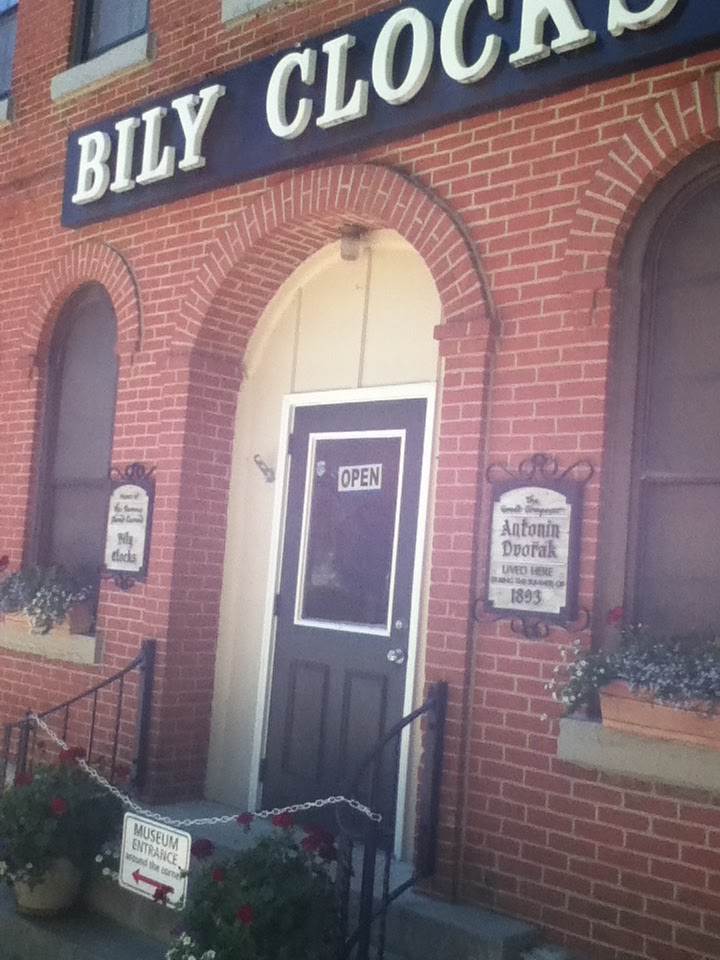
Bily Clock Museum, Spillville (pop 367). The Bilys (their name rhymes with "really") were brothers who farmed near here through most of the 20th century. (They died in 1964 and 1965, respectively.) Their hobby was making clocks, and they took it seriously--from ordering the finest wood and mechanisms to intricately carving projects that took several years each.
The Apostles Clock
They never sold a clock, though Henry Ford was said to have offered them a million dollars for one of them. They nearly burned them all while grieving for their devoted sister, who died suddenly in 1946, but fortunately were talked out of doing that and into leaving the clocks to the town of Spillville.

The museum is located in a house where Antonin Dvorak spent a very pleasant summer in 1893.

 There's a lot of his memorabilia...

...as well as an old barn containing artifacts pertinent to my interests in politics...
Voting machine
...and policy.

Here's their entry on Roadside America.

Winneshiek County Freedom Rock, Calmar (pop 978). A couple blocks west of U.S. 52 in this "cross-roads of northeast Iowa" is a memorial to soldiers, first responders, pioneers and Native Americans who helped make the country what it is today.
Photo by Robbie Nesmith
We were back in Cedar Rapids about eight hours after we set out, our curiosity somewhat satisfied but realizing we'd barely scratched the surface of the towns in the "land between."

Friday, June 16, 2017

Education update


Taylor School, rehabbed after the 2008 flood,
1.5 miles from New Bohemia
President Trump's appointment of a prominent advocate of private schools, Betsy DeVos, as U.S. Secretary of Education, has brought new attention to long-standing questions surrounding education. There have been public schools in America for nearly four hundred years, but they are not exempt from those who argue that the market could do it better. It's my impression that this question gets raised a lot more often these days than it did when I was attending school decades ago in my middle-class hometown, from which nearly all of my classmates went off to attend college. President Trump has called school choice "the civil rights issue for our time" and promised $20 million in funding during his 2016 campaign; DeVos told an audience at the Brookings Institution in March that she supports school choice because
  1. Parents know what is best for their kids and no parent should be denied the opportunity to send their son or daughter to a school where they feel confident he or she is going to learn in a safe and learning and growing environment.
  2. Good teachers know what's best for students in their classrooms.
  3. State and local leaders are best equipped to address the challenges they face, not the federal government.
These principles are intended to be self-evident, although I'd say each is at least arguable.

The fiscal 2018 budget contains a 13.5 percent cut ($9 billion) in federal spending on education, while including a new line of $1.4 billion to "support new investments in public and private school choice." This would occur through Title I (of the Elementary and Secondary Education Act of 1965), which goes to districts with high poverty populations, will include bonuses for districts that "allow Federal, State and local funds to follow students to the public school of their choice." More research money would be specifically directed to the topic of school choice as well (Mann, Ujifusa).

In previous passes at education policy (see links below) I've noted that spending on education by all levels of government has held steady at about 4 percent of GDP since the late 1960s, yet concerns about the adequacy of funding have increased. In 2014 it was exactly 4.0 percent, which on the one hand was the lowest since 1988, but on the other hand spending never exceeded 4.5 percent during this period. Surely one factor in the financial squeeze is transportation: Each decade school districts transport a greater number of students, and spend more on transporting them. [See this article by Krista Johnson of Iowa Watch detailing how financial pressures on Iowa school districts are exacerbated by Iowa's school aid formula.]

Valid measures of vitally important education outcomes are hard to get.
  • Graduation from high school is a basic but rather crude measure of educational attainment; rates have been rising until recently, but more slowly in 2015 and 2016, and definitively accounting for either phenomenon is difficult. Great differences exist by state and race (Dynarksi). 
  • On international tests, American students score slightly above average. On the 2015 Trends in International Mathematics and Science Study (TIMSS) American 4th graders finished 11th among 57 countries in mathematics and 8th in science; American 8th graders finished 9th among 33 countries in mathematics and 8th in science. [The Progress in International Reading Literacy Study (PIRLS), referenced in my post,last August, was given in 2016 and the results are not yet available. In the last test, in 2011, American 4th graders ranked 6th among 53 countries.] These overall measures, of course, mask great differences within the United States based on socio-economic status and place of residence. And it's not clear that the tests measure actual educational objectives. Few if any jobs involve a person taking a series of timed tests.
It seems clear, though, that in a world where career opportunities are getting ever more challenging, a lot of young adults are not prepared for the challenge. And it also seems, particularly in densely-populated urban areas, that there are opportunities to re-think education in ways that address diversities of learning styles, talents, aspirations and more. However, it won't do to make a fetish of freedom, or of budget savings, or to outsource the community's responsibility to educate every citizen. A recent article in The American Prospect showed how closing schools in Chicago, Newark, Philadelphia and Washington achieved neither budgetary savings nor improved educational outcomes, placed burdens on students most of whom are non-white, and in some cases left neighborhoods with large empty buildings (Cohen). Cedar Rapids Community School District is considering similar widespread closings.

We only have a common life when all are included and opportunities are substantially equal. That begins by recognizing that we're not there yet. State--and to a lesser extent, federal--funding has mostly equalized wide disparities among local school districts, but as Matthew M. Chingos and Kristin Blagg at the Urban Institute point out, that hardly covers the disadvantages with which poor students start. A stronger response to this situation will surely involve innovation and budgetary efficiencies, but not if that means trying out our pet theories on poor students, and certainly not if it leaves poor students worse off.

SOURCES
Matthew M. Chingos and Kristin Blagg, "School Funding: Do Poor Kids Get Their Fair Share?" (Urban Institute, 2017)
Rachel M. Cohen, "The Devastating Impact of School Closures on Students and Communities," The American Prospect, 22 April 2016
Mark Dynarski, "What We Don't  Know About High Schools Can Hurt Us," Brookings, 18 May 2017
Elizabeth Mann, "3 Observations on Trump's Education Budget," Brown Center Chalkboard, 7 June 2017
Grant Ujifusa, "Trump Budget Would Slash Education Dept. Spending, Boost School Choice," Politics K-12, 23 May 2017

OLDER POSTS
"Starting a Conversation about Education," 16 August 2015
"Is Our Children Learning?" 15 August 2016

10th Anniversary Post: The Election and Our Common Life

  Your humble blogger with KGAN reporters on election night 2016 (from Eric Wylie's Facebook page) (11/6/2026)  A recent New Yorker  car...