As the convention center nears completion, the skywalk is being installed this week. This will connect the convention center to its parking garage across 1st Av. I hope it will eventually connect to the main Skywalk System, though that would have to be done through the US Bank parking garage. (It will definitely connect to the 4th St. parkade, so in theory the Skywalk could be back to its original length, at this end anyway.)
As of this morning they are still in the "prep" stage. Here are some pictures I took before I came to work. Vantage point is the trail crossing at 4th St. (which can be for the time being made without anxiety, as 1st Av is closed for this operation)
The thing itself. A passerby remarked "it looks like they cut it a little long," but I think it has to fit into slots in the buildings.
Wider view.
The hole in the convention center where it will go.
Harder to see around the railroad crossing post, but this is where it goes into the parking garage.
Friday, May 17:
The skywalk's still on the street as of 8:00 this morning. They must have a lot of prep work to do.
It gives me a chance to show the machine they're using. I couldn't get a good shot of the whole thing, though.
Thursday, May 16, 2013
Wednesday, May 15, 2013
Losing Track of What Really Matters
|
||||
Bruce,
There's
no denying it. We are living under one of the most troubled administrations of
the past century.
It now appears that the Obama administration deliberately LIED to the American people
about the tragic terrorist attack in Benghazi, Libya last September.
And,
after three years of secrecy, Barack Obama's IRS just admitted to targeting and
harassing conservative grassroots groups because of their political ideology!
Scandals are dominating the news, even the elite media I patronize. The mass media must be foaming at the mouth. FOX News should probably check their blood pressure.
All of a sudden, it seems, there is a confluence of seemingly unrelated events that look bad for the Obama administration: the Justice Department snooping on phone records of Associated Press reporters, the Internal Revenue Service singling out Tea Party groups for special scrutiny, the Department of Health and Human Services soliciting health care providers for financial support for state health insurance exchanges, and the deaths of four diplomats in an attack on the U.S. mission in Benghazi, Libya. The events may individually be anything from unfortunate outcomes to administrative lapses to actual malfeasance either at low or high levels. I'm getting no vibes from politicians' responses; perhaps one could get a hint from the degree of expressed outrage, but as the right's amps are stuck on "11" this never varies anyhow. One clue is the existence of multiple congressional hearings. In the 1980s Iran-contra scandal--now, there was a scandal for you!--the convictions of Oliver North and others were thrown out on appeal because their trials had been compromised by statements at congressional hearings. Ever since, then, you can pretty much figure that if Congress is holding hearings they're not expecting anything criminal to result, just some political embarrassment.
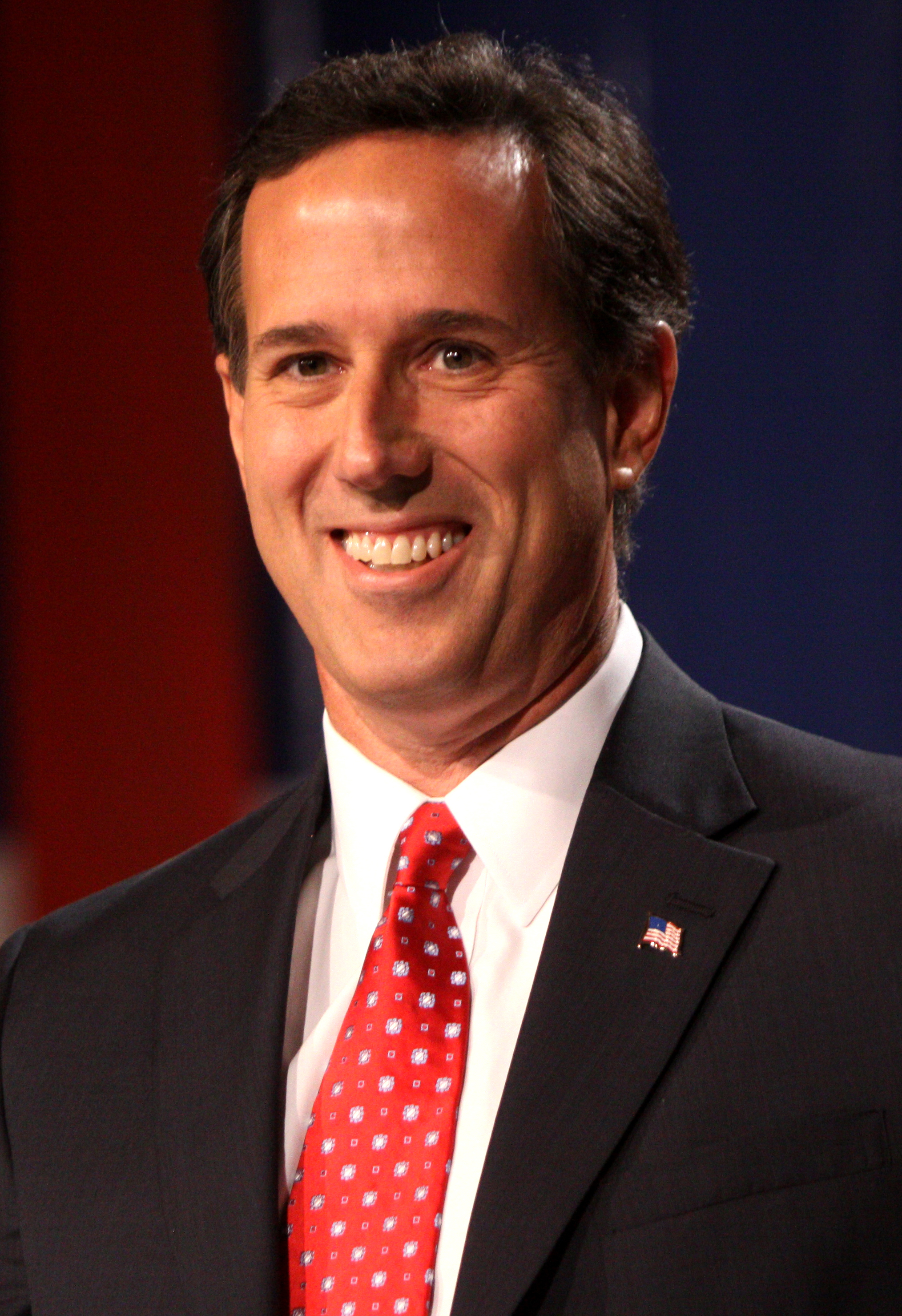
I don't want entirely to dismiss the importance of the issues involved, particularly of the creepy business with the AP, although the unremitting outrage does get to looking fake, particularly when it comes from the throat of Senator Mitch McConnell, who tries very hard to act sincere, but just can't pull it off, or former Senator and presidential candidate Rick Santorum (above, with "Donate Now" button). And the news media, as The New York Times's Frank Bruni argued yesterday, find political fallout everso entertaining, even moreso than what substance the scandals themselves possess. (See also Larry Sabato's 20-plus year-old book, Feeding Frenzy.)
BUT! None of this gets at the core issues in this blog: issues of economic opportunity, environmental sustainability, and living with diversity that are going to determine whether and how we Americans are going to be able to live together in the years to come. If you're going to get outraged about Sibelius putting the arm on health care providers, spare a little anger for members of Congress and state government officials who are doing whatever they can think of to prevent people from getting health insurance. Or companies that crush unions in this country while they allow their products to be manufactured in death traps in Bangladesh. Or those who complain of government ineffectiveness while thwarting any effort to make it function. Or the sustained disinformation campaign on climate change. Or politicians who can't fix our immigration mess because they're afraid of offending angry xenophobes. Or haters who cry out against gay marriage and adoptions even as more and more children are being raised in single-parent families.
I'm not claiming that these are the only issues we should talk about, only that critical matters like these get swept under the rug while we're fulminating about who knew what and when did they know it. That may be fine with McConnell, Santorum and their ilk, who show no interest in any of my issues other than hostility towards anyone or anything that tries to address any of them. Which in turn leads me to suspect, much as I dislike conspiracy theories, that the manufacturers of outrage have a hidden agenda at work here.
Obama may get roughed up in this collection of scandals. That's his problem, not mine. But the real losers in all this are the poor, the sick, the vulnerable, the "other" and the environment. Again.
Sunday, May 12, 2013
A big ho hum
The new management of Westdale Mall rolled out their plans for redeveloping the moribund commercial space. It may work for them, but from the community perspective it's nothing special. It does nothing to make connections where they are lacking in this city, and does nothing to prepare for a future without cheap oil.
Here's the new map, from Friday's Gazette...
... which also has an online report with pretty pictures.
This is definitely old stuff. What they're essentially going to do is rearrange the many many parking spaces, and reconfigure the stores. Beyond the parking lots, the new Westdale will be no better integrated into the city than the old one was. Westdale is an island of sorts, bordered by wide roads that bear heavy car traffic: Williams Boulevard, Edgewood Road, Wilson Avenue and 29th Avenue. It's part of a bigger swath of land from 16th Avenue to US 30 that is a hideous succession of commercial strips. To see what I mean, map a location like "2315 Williams Blvd SW, Cedar Rapids IA 52404" and zoom out to see the area around it.
The designers' schematics all show happy people walking, but they all got there by car. Technically you could walk or bike to the new Westdale--just as you can now--but you would be foolish to make the attempt.
To be fair, changing the future is probably too much to expect from one project, which is about converting underutilized space back into profitable commercial territory. There arguably is some public interest in achieving this modest goal, although the $10 million the city is expecting to kick in is surely excessive. But for those who hope to make Cedar Rapids a better place to live, the new Westdale will be a big ho hum.
I wish they'd put the casino out there.
[Added 10/7/13: TED Talk by Ellen Dunham-Jones on retrofitting suburbia, with many more imaginative ideas]
Here's the new map, from Friday's Gazette...
(Cedar Rapids Gazette, 10 May 2013, p. 1A)
... which also has an online report with pretty pictures.
This is definitely old stuff. What they're essentially going to do is rearrange the many many parking spaces, and reconfigure the stores. Beyond the parking lots, the new Westdale will be no better integrated into the city than the old one was. Westdale is an island of sorts, bordered by wide roads that bear heavy car traffic: Williams Boulevard, Edgewood Road, Wilson Avenue and 29th Avenue. It's part of a bigger swath of land from 16th Avenue to US 30 that is a hideous succession of commercial strips. To see what I mean, map a location like "2315 Williams Blvd SW, Cedar Rapids IA 52404" and zoom out to see the area around it.
The designers' schematics all show happy people walking, but they all got there by car. Technically you could walk or bike to the new Westdale--just as you can now--but you would be foolish to make the attempt.
To be fair, changing the future is probably too much to expect from one project, which is about converting underutilized space back into profitable commercial territory. There arguably is some public interest in achieving this modest goal, although the $10 million the city is expecting to kick in is surely excessive. But for those who hope to make Cedar Rapids a better place to live, the new Westdale will be a big ho hum.
I wish they'd put the casino out there.
[Added 10/7/13: TED Talk by Ellen Dunham-Jones on retrofitting suburbia, with many more imaginative ideas]
Thursday, May 9, 2013
Downtown semester
Spring finals are over at Coe, grades are in at least for seniors, and this weekend features the traditional commencement festivities, starting with the Department of Political Science Salute to Seniors at my house Friday night. That means starting next week I am moving back into my office.
I spent most of my sabbatical leave away from Coe, either at home--with two computers on because I have different programs on them--or, one or two days a week, downtown at the public library. The main branch of the Cedar Rapids Public Library was destroyed by the June 2008 flood, so it's in a temporary storefront location until the new branch opens August 24.
The library shrank last month when construction began on an underground parking garage. The temporary wall is on the left. Some serious crashing noises were coming from behind it today. The door in the back of the picture leads into the rest of what's left of the Armstrong Centre.
The downtown library seemed an appropriate place to think about public policy related to place. For most of the last four months, the library has been my office and the skywalks have been my stomping grounds. I spent four to six hours a day at the library, reading the vast variety of place literature and getting accustomed to the steady trickle of patrons throughout the day. Mostly people came in during work breaks to pick up videos or books, but there were always people spending time on the computers. I got to know some of the regulars, by face or mannerisms. My favorite was a cheerful guy I think of as "My God," not in the John 20:28 sense, but because he would sit at the table with the Gazette and inevitably mutter as he read, "My God... My God..." Seems like a reasonable response to the news.
I evolved a schedule of sorts, breaking about 11 for coffee and about 2 for my sack lunch. There are four downtown coffee places within easy reach of the skywalks. I rotated among all four, and while I like them all and each has its strengths, I eventually decided my favorite is the Early Bird in the Town Centre building. The managers are good-humored, even goofy, and the atmosphere is the most pleasant and relaxed.
My favorite place to eat is on the ramp over 3rd St that leads into US Bank.
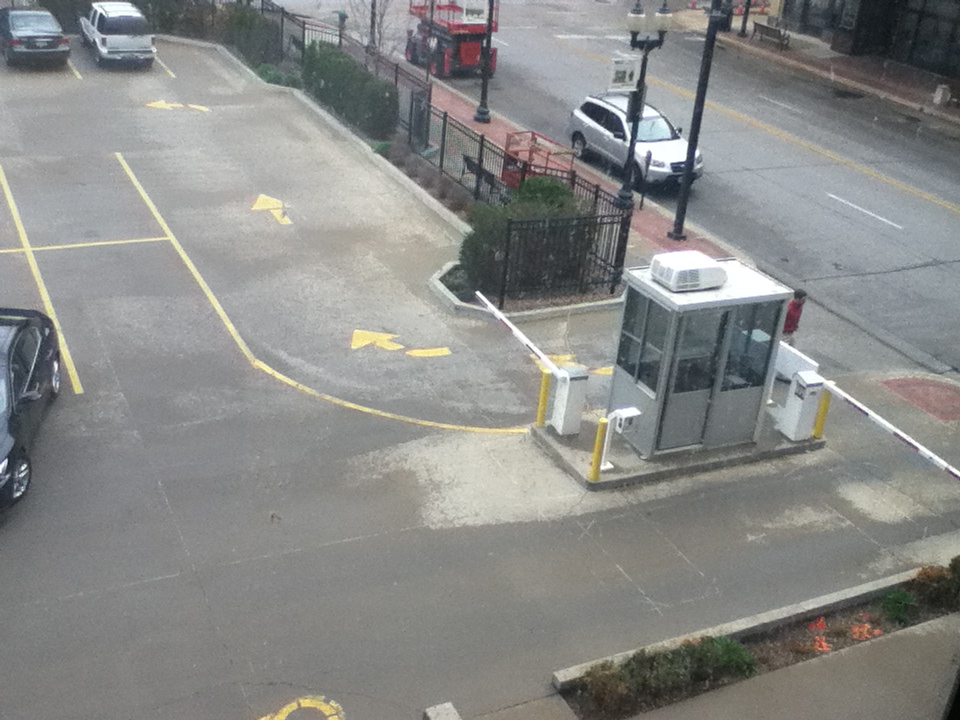
I still don't know if it's for public use or just for their employees, but no one ever questioned me. It gave me a great view of the construction of our hotel and convention center, which opens next month. I could watch the ever-changing marquee over Theater Cedar Rapids, which of late is flirting with the new marquee at the convention center. I also watched the cars go in and out of the bank parking lot. There's an arrow directing entering traffic to the right, which about 5 percent of cars actually did, though I think it's less out of rebelliousness than obliviousness. At least once a day, also, someone got stuck at the gate without the token to make it go up. Better than TV is the US Bank parking lot.
The skywalks used to run from the US Cellular Center, through the Roosevelt Hotel, then through downtown to the bus station and public library. Now the library and bus station have moved, and the US Cellular Center is under construction, so the ends are cut off. What's left starts a little past US Bank. There's a doctor's office I've never had occasion to use...
Some vacant office space in case you're really intrigued by all this and want to move your business here...
Some long hallways decorated with childlike art by Four Oaks...
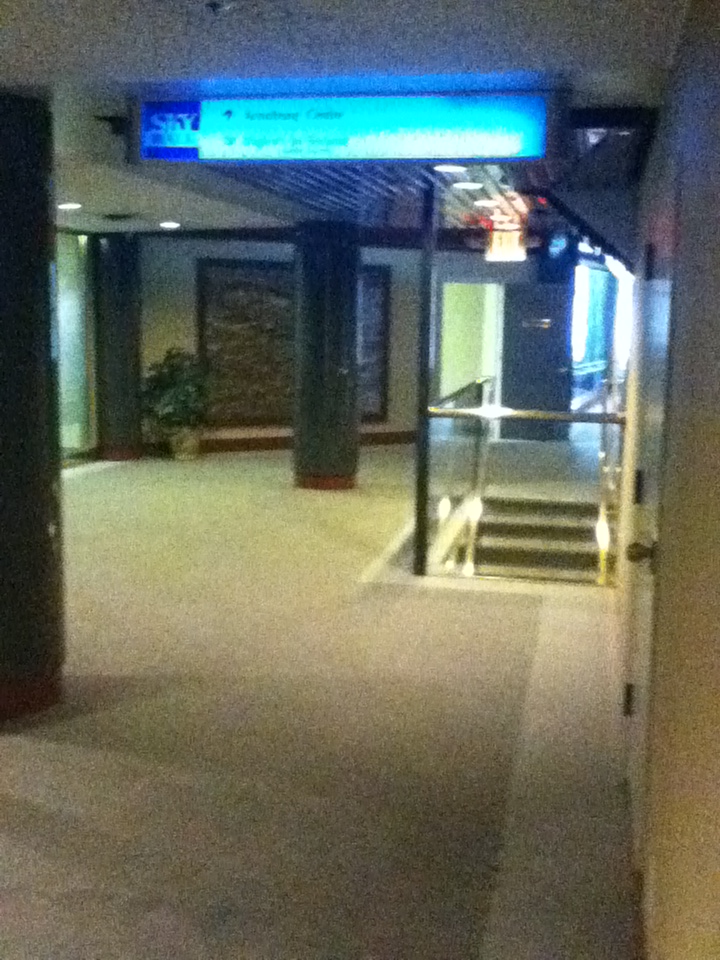
The entrance to the Armstrong Centre, where the library is located. When we moved here it was still a department store, but it closed within a year. It is the hub of the skywalk's spokes.
On ground level is the Armstrong Centre food court, which boasts Sub King and Austin Blues BBQ, as well as--this is important--one of three public restrooms downtown. (The others are in the Alliant Building and behind the Blue Strawberry, if you ever need to know.) I tried to rotate among them so as not to wear out my welcome at any.
The bottom of the stairs (see above) and the entrance to the library:
South out of the Armstrong Centre there's a hallway with art:
The historic Sokol building (1908), the future of which is uncertain:
A spur off this route goes towards the Alliant Building. It used to go all the way to the 1st Street parkade, but that was demolished in 2011. Now you are stopped in the Higley Building. This dark, exotic hallway serves the law firm of Scherup Blades
This glamorous stairway leads straight down into a fitness center, or turn left and exit onto 3rd St.
If you walk down 3rd St a little to the Law Building you can join the Skywalk at United Fire and Casualty, which makes a nice loop back to the Armstrong Centre.
Today was rainy, but Tuesday was the nicest day of the year so far, and I sat outside with my coffee in front of Coffee Emporium. That's not always possible to do, because for some reason if anyone's smoking on the sidewalk the smell penetrates the whole block. But Tuesday people were walking up and down 3rd Av.
Several were eating ice cream... Deb's must have been doing a good business. I began to wonder who all these people were. I'd sort of assumed that everyone downtown either worked there or was lost, but many of them clearly fit neither description. Awhile ago, my son Eli was walking the skywalks with his friend Chris, and reported they kept getting strange looks. He interpreted those looks as suspicion, but I'm sure I'm not the only one who is surprised at seeing anyone downtown who isn't working at a bank or law firm.
Has our downtown become--can it be possible?--a destination? Why were these people here? I became very curious to know their stories, as Wim Wenders says happens to him when he goes to a new place. Downtown Cedar Rapids is by now not a new place to me, but the variety of people I saw of whom I knew nothing showed me how little I know of it. In front of the Alliant Building, a young woman spoke sharply into her cellphone, "That's if I let you... I don't know yet... I told you I wouldn't see you if you were using..." Ah, humanity. So many people, with so much going on. I'll probably never talk to them, but maybe I can help make a world they can live in.
I spent most of my sabbatical leave away from Coe, either at home--with two computers on because I have different programs on them--or, one or two days a week, downtown at the public library. The main branch of the Cedar Rapids Public Library was destroyed by the June 2008 flood, so it's in a temporary storefront location until the new branch opens August 24.
The library shrank last month when construction began on an underground parking garage. The temporary wall is on the left. Some serious crashing noises were coming from behind it today. The door in the back of the picture leads into the rest of what's left of the Armstrong Centre.
The downtown library seemed an appropriate place to think about public policy related to place. For most of the last four months, the library has been my office and the skywalks have been my stomping grounds. I spent four to six hours a day at the library, reading the vast variety of place literature and getting accustomed to the steady trickle of patrons throughout the day. Mostly people came in during work breaks to pick up videos or books, but there were always people spending time on the computers. I got to know some of the regulars, by face or mannerisms. My favorite was a cheerful guy I think of as "My God," not in the John 20:28 sense, but because he would sit at the table with the Gazette and inevitably mutter as he read, "My God... My God..." Seems like a reasonable response to the news.
I evolved a schedule of sorts, breaking about 11 for coffee and about 2 for my sack lunch. There are four downtown coffee places within easy reach of the skywalks. I rotated among all four, and while I like them all and each has its strengths, I eventually decided my favorite is the Early Bird in the Town Centre building. The managers are good-humored, even goofy, and the atmosphere is the most pleasant and relaxed.
My favorite place to eat is on the ramp over 3rd St that leads into US Bank.
I still don't know if it's for public use or just for their employees, but no one ever questioned me. It gave me a great view of the construction of our hotel and convention center, which opens next month. I could watch the ever-changing marquee over Theater Cedar Rapids, which of late is flirting with the new marquee at the convention center. I also watched the cars go in and out of the bank parking lot. There's an arrow directing entering traffic to the right, which about 5 percent of cars actually did, though I think it's less out of rebelliousness than obliviousness. At least once a day, also, someone got stuck at the gate without the token to make it go up. Better than TV is the US Bank parking lot.
The skywalks used to run from the US Cellular Center, through the Roosevelt Hotel, then through downtown to the bus station and public library. Now the library and bus station have moved, and the US Cellular Center is under construction, so the ends are cut off. What's left starts a little past US Bank. There's a doctor's office I've never had occasion to use...
Some vacant office space in case you're really intrigued by all this and want to move your business here...
Some long hallways decorated with childlike art by Four Oaks...
The entrance to the Armstrong Centre, where the library is located. When we moved here it was still a department store, but it closed within a year. It is the hub of the skywalk's spokes.
If you look carefully you'll find the stairs leading down to the library. (I don't think the escalator has been there since the flood.)
On ground level is the Armstrong Centre food court, which boasts Sub King and Austin Blues BBQ, as well as--this is important--one of three public restrooms downtown. (The others are in the Alliant Building and behind the Blue Strawberry, if you ever need to know.) I tried to rotate among them so as not to wear out my welcome at any.
The bottom of the stairs (see above) and the entrance to the library:
South out of the Armstrong Centre there's a hallway with art:
The historic Sokol building (1908), the future of which is uncertain:
A spur off this route goes towards the Alliant Building. It used to go all the way to the 1st Street parkade, but that was demolished in 2011. Now you are stopped in the Higley Building. This dark, exotic hallway serves the law firm of Scherup Blades
This glamorous stairway leads straight down into a fitness center, or turn left and exit onto 3rd St.
If you walk down 3rd St a little to the Law Building you can join the Skywalk at United Fire and Casualty, which makes a nice loop back to the Armstrong Centre.
Today was rainy, but Tuesday was the nicest day of the year so far, and I sat outside with my coffee in front of Coffee Emporium. That's not always possible to do, because for some reason if anyone's smoking on the sidewalk the smell penetrates the whole block. But Tuesday people were walking up and down 3rd Av.
Several were eating ice cream... Deb's must have been doing a good business. I began to wonder who all these people were. I'd sort of assumed that everyone downtown either worked there or was lost, but many of them clearly fit neither description. Awhile ago, my son Eli was walking the skywalks with his friend Chris, and reported they kept getting strange looks. He interpreted those looks as suspicion, but I'm sure I'm not the only one who is surprised at seeing anyone downtown who isn't working at a bank or law firm.
Has our downtown become--can it be possible?--a destination? Why were these people here? I became very curious to know their stories, as Wim Wenders says happens to him when he goes to a new place. Downtown Cedar Rapids is by now not a new place to me, but the variety of people I saw of whom I knew nothing showed me how little I know of it. In front of the Alliant Building, a young woman spoke sharply into her cellphone, "That's if I let you... I don't know yet... I told you I wouldn't see you if you were using..." Ah, humanity. So many people, with so much going on. I'll probably never talk to them, but maybe I can help make a world they can live in.
Tuesday, May 7, 2013
Under construction
The Chicago Regional Council of Carpenters has been picketing various construction sites downtown for the last week or so, and then today, easily the nicest day we've had so far in 2013, they were gone. Our local newspaper, The Cedar Rapids Gazette, has never reported on their presence, and nothing to say about their disappearance. Neither has the Council's own web site. I was thinking I should just ask one of the picketers, but then--poof!--they were gone. Just as well, perhaps, as I hate initiating conversations. I made a very poor journalist.
There certainly is a lot of construction sites around. On a brief walk around downtown today I saw:
the parking garage, taken across 2nd Av...
eventually it will be attached by a skywalk across 1st Av to:
to the downtown hotel and convention center
(taken a few weeks ago; it's nearly complete now)
the downtown library, on 4th Av, scheduled to open August 24
something at 2nd St and 6th Av...
the new federal courthouse is in the background
the levee and amphitheater, which you can perhaps see across the river...
Here's a better view from a couple weeks ago:
Taken the same day:
This parking lot on 1st St will soon be the new CRST headquarters...
and, of course, there's the parking garage going in below the Armstrong Building...
No shots of the garage, but if you try to enter the public library by the old way,
you get into this empty triangular room, which some people find disconcerting
I didn't venture as far as the new fire station or the juvenile justice center, but you get the idea.
The news "blackout"--due, I'm sure, to the Gazette having shed too much staff, rather than ideological bias--means we don't know if the picketers are gone because the conflict was solved, a restraining order was issued, it was too nice out, or they were celebrating Tchaikovsky's birthday. I do know, from a 2011 Gazette story, that pickets in Iowa City that summer protested the use of nonunion labor at a University of Iowa construction site. I wouldn't be surprised if there weren't nonunion carpenters abounding on these various projects I saw today. Iowa is after all a "right-to-work" state--a cheesy euphemism if ever there was one--on top of which Governor Branstad forced the City of Cedar Rapids to abrogate its labor contracts in 2011.
American unions have a checkered history, with thuggery by the notorious Teamsters and featherbedding (requiring the hiring of unnecessary employees) by too many others. Milton Friedman famously charged them with causing inflation and distorting the labor market, though other economists question that. On the whole unions have been good for Americans--whether or not you're in a union, you can thank them for establishing traditions of weekends, safe working conditions, and health and retirement benefits--and their precipitous decline in the last 40 years has unsurprisingly coincided with declines in wages, job security, and working class standards of living in general.
Less materialistically, the decline of unions coincides with a tilt in our society towards individualism. With cooperation for mutual benefit in disrepute, our lives are at the mercy of our employers and the government, because at their best unions were a check and balance on both.
I'm comfortably middle class, with an unusual degree of job security, and expect I'll enjoy or reap the benefits of most of the buildings currently under construction downtown. Coming around at last to the core question of this blog, we can't live together if some of us are prospering at the expense of others' well-being. And we can't live together if we're competing to see who works cheapest and longest, and everyone is sinking or swimming on their own.
Saturday, May 4, 2013
Health care
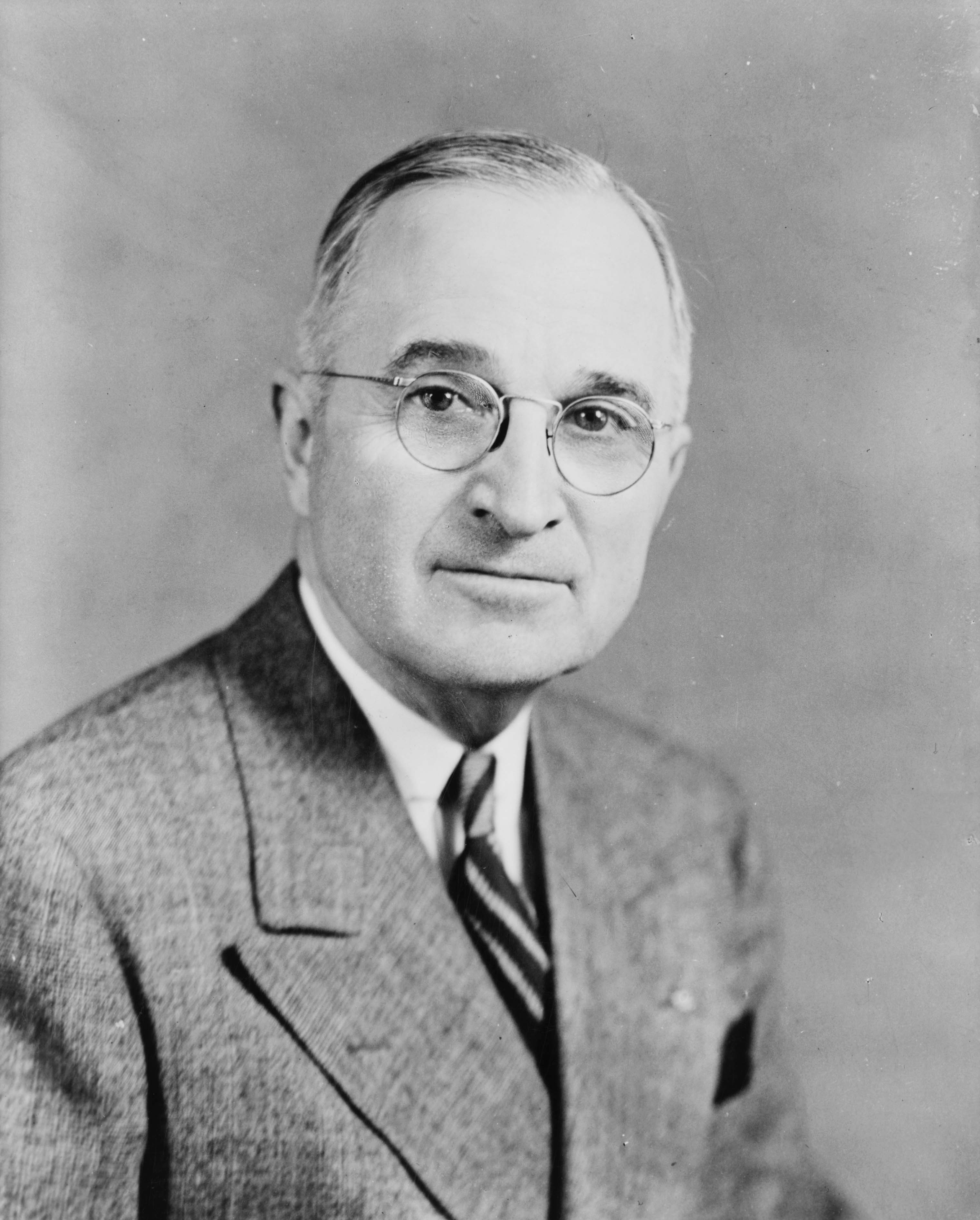
(President Harry S. Truman, an advocate of national health insurance.)
It's been a tough week for the Affordable Care Act, the health care reform law passed in 2010 and currently in the implementation phase. A Politico story (see below for link) validated a spurious claim that has been making the rounds in the last year, to wit, that members of Congress are seeking to exempt themselves from provisions of the law mandating purchase of insurance from purchasing exchanges. President Obama is being criticized by members of his own party for lack of leadership and failure to communicate on health care, with Montana Senator Max Baucus saying "I just see a huge train wreck coming down" as the law is implemented. And Friday Caroline Humer of Reuters news agency reported few insurance companies are enrolling in the state-level insurance exchanges, which makes it questionable whether those exchanges will be able to operate as intended.
The exemption falsehood is the latest in a series of fact-free efforts to manipulate public opinion, dating back to Sarah Palin's 2009 crusade against putative "death panels," and even farther back to hoary charges of "socialized medicine." However, unlike death panels, which theoretically could have been in the law even though they weren't, the exemption story is fundamentally absurd. The law doesn't affect people with insurance, as long as the insurance plan itself qualifies. Members of Congress, who have very good health insurance, aren't exempt from a requirement to buy insurance that they're already buying. And even those required to buy insurance aren't required to buy it from exchanges.
So what is giving this lie legs? As should be obvious to anyone, some people really really really want this law to fail. This certainly includes former Pennsylvania Republican Senator Rick Santorum, whose 2011 presidential campaign appearances in Iowa featured lengthy tirades against the law. When I saw him speak at Mt. Pleasant, he claimed that America ceased to be a free country when the law was passed; he wondered why we're helping people get health care when we don't help them get food and housing (um, actually, we do); and raged against longer waiting times in doctors' offices. Swell guy, that Santorum, and no wonder he's pushing the exemption story to the max this week. If you're as angry about it as he is, which hardly seems humanly possible, write an angry letter your representative and send Santorum's group some money.
(Former Pennsylvania U.S. Senator Rick Santorum, whose public
persona is angry, and inaccurate to boot.)
The other criticisms are harder to assess. In an ideal world, the Obama administration, and particularly the President, would be noting that we're embarking on quite the grand social experiment, and issuing regular public statements of information and reassurance. But I don't know how reasonable it is to expect that, given that other stuff keeps coming up, like the civil war in Syria or the bombings in Boston, that have to be addressed, too. More basically, I'm pretty sure people overestimate the effectiveness of even focused presidential rhetoric. There is a lot of noise in the world of politics, more and more each week it seems, and even if the President's is the loudest voice in the country it still gets drowned out more often than not. There need to be more people involved in this effort besides Obama and Secretary Sibelius. Is Baucus helping?
It would be nice if the health insurers were feeling confident and enthused, too. Given that we've never done this sort of thing before as a country, some degree of uncertainty is inevitable. Nothing Obama says or does can undo that. Could the government do a better job of cushioning the insurers against whatever it is they're worried about? Maybe. Given that insurers were very much a part of the bill's formulation in 2009--if anything provider groups were too involved in the process, because few members of Congress were willing to negotiate their votes--you'd think this would have come up. But let us grant that at least some of the insurers' concerns are legitimate. Those should be addressed. Insurers should not, however, be indemnified against any conceivable loss or inconvenience. This isn't about them.
Health insurance is important to the central question of this blog: how are we Americans going to live together? Between 15 and 20 percent of adults 18-65 are without health insurance at any given point in time; expanding that point to a year, or two years, the percentage gets larger, as different people get and lose insurance. (Up-to-date numbers from the Kaiser Family Foundation here.) That number would, I'm sure, at least double and maybe triple or more, if we change the subject to underinsurance, that is, having insurance that does not adequately protect a person against medical emergencies. This is not a trivial matter. People without insurance have significantly higher incidence of major health problems, less consistent care, shorter life expectancies, and much more vulnerable finances. (For data see Katherine Swartz's chapter, cited below, and the sources she cites in endnotes 3-10. There is also a 2008 study by the Urban Institute.) Bottom line: Health insurance is critical to equality of opportunity. It matters very much whether people have it or not. It is not, as Justice Scalia suggested in his dissenting opinion, a luxury item that is purchased by people who have made it economically. It is, for the past 30 years anyway, a significant demarcation between the "haves" in our society and the "have-nots."
Moreover, to the extent that uninsured and underinsured people get their medical care in emergency rooms, it raises health costs for everyone. Did Senator Santorum ever wonder, if they're not paying the cost of emergency care, who is? Did he ever wonder if someone in his family would have a medical emergency and have to wait for uninsured people who got there first?
I support implementation of the Affordable Care Act, if only because it is the only game in town. It is the only means currently available that will address the critical problem of uninsured and underinsured people. Single-payer is not on the table. And Republicans, for all their full-throated opposition to "Obamacare," have offered nothing in the way of alternative methods once they achieve their goal of repealing it. Indeed, several G.O.P. senators, including Iowa's Charles Grassley, who were engaged in health care talks with the administration in 2009, fled as soon as the Tea Party turned up the heat that August. Once in awhile, Paul Ryan or someone will pop up with a suggestion, but do these ever get committee hearings or floor votes in the Republican-controlled House of Representatives? There have been over 30 votes to repeal the Affordable Care Act; how about something of substance?
Moreover, the style of reform enacted in the Affordable Care Act has worked, at the state level, in Massachusetts. Massachusetts is not America, of course; its population is overall better-educated and had a higher proportion of insured people before its health care law was enacted in 2005. Perhaps most importantly, implementation of health reform in Massachusetts was facilitated by cooperation between Republican Governor Mitt Romney, legislative Democrats, and provider groups.
The Massachusetts experience shows that health care reform can work. For sure there will be problems along the way, but those can and will be overcome if people in power work together to overcome them. On the other hand, with enough fear-mongering, misinformation, and foot-dragging, the Affordable Care Act can very well be effectively undermined. Obama's legacy would suffer, people would have even less faith that government can do anything right, insurance companies could do things the hugely profitable way they've always done them, and maybe the rest of us would enjoy shorter waits for doctor visits. Maybe those would all be good things. But those are picayune matters, compared with the opportunity to what we need to do: make people more healthy, promote economic opportunity, and keep America from becoming even more divided than it already is.
SOURCES
John Bresnahan and Jake Sherman, "Lawmakers, Aides, May Get Obamacare Exemption," Politico, 24 April 2013, http://www.politico.com/story/2013/04/obamacare-exemption-lawmakers-aides-90610.html.
John Harwood, "The Next Big Challenge for Obama's Health Care Law: Carrying It Out," New York Times, 30 April 2013, A10.
Caroline Humer, "U.S. Insurers Wary of Health Reform," The Gazette (Cedar Rapids, IA.), 2 May 2013, 1A, 8A.
Robert Pear, "Obama Says Health Care Law Is 'Working' and Changes Won't Be Widespread," New York Times, 1 May 2013, A15.
Katherine Swartz, "Uninsured in America: New Realities, New Risks," in Jacob S. Hacker (ed), Health at Risk: America's Ailing Health System--And How to Heal It (Columbia, 2008), 32-65.
ALSO WORTH A LOOK...
Linda Bergthold, "Obamacare: Will the Trains Run on Time?" HuffingtonPost.com, 30 April 2013, http://www.huffingtonpost.com/linda-bergthold/obamacare-will-the-trains_b_3189634.html: soberly positive expectations for implementation
Bill Keller, "Five Obamacare Myths," New York Times, 16 July 2012, http://www.nytimes.com/2012/07/16/opinion/keller-five-obamacare-myths.html?src=me&ref=general&_r=0... somewhat dated, but a useful reminder of the junk that was circulating last summer
Glenn Kessler, "Obama's Claim that 90 Percent of Americans 'Don't Have to Worry' about 'Obamacare," WashingtonPost.com, 30 April 2013, http://www.washingtonpost.com/blogs/fact-checker/post/obamas-claim-that-90-percent-of-americans-dont-have-to-worry-about-obamacare/2013/04/30/01414c02-b1f7-11e2-9a98-4be1688d7d84_blog.html: how Obama has exaggerated claims for the benign impact of the Affordable Care Act. Particularly Kessler points out that the underinsured, whom Obama has overlooked in his speeches on the subject this week, will need to get better insurance, which will cost 'em.
Wednesday, May 1, 2013
Please rise, remove your hats, and pay attention to this commercial
Yesterday I took advantage of a lovely afternoon and got out to my first Kernels game of the year. The Kernels are a low minor league affiliate of the Minnesota Twins, having just switched affiliations after 20 years with the verbosely-named Los Angeles Angels of Anaheim. They play in Veterans Memorial Stadium on the city's southwest side maybe two miles from downtown. The stadium is located in an area devoted to sports facilities, containing in addition the ice arena, the football stadium shared by all the city's high schools, and some tennis courts. (The idea of such special districts is to separate functions that really can't be integrated into a neighborhood structure, although there are neighborhoods right around the area that surely have to deal with parking and noise issues.) The official name of their facility actually is Perfect Game Field at Veterans Memorial Stadium, which allows us to honor veterans while simultaneously selling naming rights. The Angels aren't the only ones who tend to the verbose, I guess!
I don't know how to act when the commercial is showing. I hate being manipulated, and this manipulation is so blatant I feel duty bound not to go along with it. But how? I've refused to stand during the commercial, but I feel conspicuous, which shouldn't be bad, since I'm standing up (well, sitting down) for my convictions, but as a college professor I feel suspect enough already when it comes to civil religious observations. AND I still have to pay attention to the damned commercial, so I'll know when it's time to stand for the actual anthem
.
(In this picture, swiped from www.kernels.com, we are looking more or less south. Rockford Road runs along the left side. The ice arena appears at the top of the picture. The circly thingy between the ice arena and the stadium is the veterans' memorial. You can see the tennis courts along the right side of the picture. Kingston Stadium is across the parking lot. Note the proximity of houses at the bottom of the picture, across 8th Avenue. A similar neighborhood is across 15th Street from Kingston Stadium.)
The Kernels won, and I ran into two people I hadn't seen in awhile. Kernels' uber-prospect Byron Buxton beat out an infield hit, hit a mammoth home run, and laid down a sacrifice bunt; he's hitting .392, and Twins fans may justifiably salivate for the day he arrives in the majors..
Some post I should talk about baseball, and baseball parks as places. (One of my conversations yesterday, with former Lisbon HS teacher Greg Carter, touched on that very subject.) But today I want to complain about one aspect of an otherwise pleasant experience.
I've been attending baseball games for almost 50 years, and have seen many changes in how they're presented. By now I've gotten used to advertising on the outfield wall, commercials between innings and naming rights for everything that moves (none of which were features of the Wrigley Field of my childhood). I understand that baseball is a business, and that underneath the transplendent experience I had yesterday is some rather vigorous commerce. I get that. I'm OK with that.
I'm not OK with sponsoring the national anthem.
The national anthem ("The Star-Spangled Banner") has been sung at major and minor league baseball games since the 1940s, when the feature was added in hopes of buttering up the U.S. government enough to be allowed to continue to operate during World War II. It's a civil religious exercise that is a little silly on some level, but don't tell that to fans at a minor league baseball park. Minor league baseball and American civil religion go together like hot dogs and buns. When it's time for the anthem, the announcer doesn't need to tell us (though he does anyway) to stand at attention and remove our hats.
Which is all the more reason NOT TO SELL ADVERTISING ON THE NATIONAL ANTHEM. (I'm sorry, was I shouting? I didn't mean to.) I've seen a lot of minor league games around the country, and the Kernels are the ONLY TEAM I KNOW THAT DOES THIS!! (Oops. I did it again.) The current sponsor is Cedar Memorial Cemetery. So we rise, remove our caps, and get a commercial for the cemetery before the anthem is played. Before Cedar Memorial, the sponsor was Wendy's Restaurants, with the spiel delivered by a retired military officer in uniform. Talk about wrapping commerce in the flag!
(Pledging allegiance to Cedar Memorial Cemetery, 5/20/2013)
The advantage to the sponsor is obvious. Of all the companies that sponsor ads on the outfield wall, goofy goggles races, or ads that play on the video screen before the game and between innings (which everyone born since 1950 has long-since learned to tune out), Cedar Memorial is the only one who is guaranteed a totally attentive audience. This may be great for the cemetery, and the Kernels if they're getting an appropriate premium price for this ad, but it seems grossly unfair to me. Maybe 'business ethics' is an oxymoron. Maybe we should accept the logic of the market, and the superior judgment of the Job Creators, but this seems to cross a line of grotesqueness. They are taking advantage of people's feelings of patriotism, and the reverent behavior that flows from that, to pitch them a product.
I don't know how to act when the commercial is showing. I hate being manipulated, and this manipulation is so blatant I feel duty bound not to go along with it. But how? I've refused to stand during the commercial, but I feel conspicuous, which shouldn't be bad, since I'm standing up (well, sitting down) for my convictions, but as a college professor I feel suspect enough already when it comes to civil religious observations. AND I still have to pay attention to the damned commercial, so I'll know when it's time to stand for the actual anthem
.
I am dust, and to dust I will return. When I do, it occurs to me I could go far towards securing the financial future of my loved ones by having commercials at particularly sensitive points in the memorial service. Dairy Queen, are you interested? My church, I'm sure, would never go for this, but I bet Cedar Memorial would be fine with it!
Subscribe to:
Posts (Atom)
Navigating homeownership
Navigating homeownership panel (L to R): Jennifer Pratt, Stephanie Schumacher, Matt Skogman, Ann Roushar, Zach Kucharski (9/23/2026) Pros...
-
(2/4/2016) The social movement we call urbanism is a forest with several species of trees. At the risk of losing the concept of the forest...
-
President Donald Trump (Wikimedia commons) (9/17/2026) On September 24 I will present the concluding lecture in a four-part series on ...
-
Wide sidewalk on Emmons Street approaching downtown Hiawatha (12/16/2025) Of my three posts in December 2015, two were on the subject of si...