Saturday, May 23, 2026

10th anniversary post: Thinking Big in Cedar Rapids


Dale Todd speaks at Cedar Rapids Public Library, 
May 2016

 "Waterfronts are the rock stars of city infrastructure."--

MATTHEW LISTER, MANAGING DIRECTOR FOR GEHL AMERICAS,  AT CNU34

(5/23/2026) When Dale Todd spoke at a special edition of 1 Million Cups Cedar Rapids at the Cedar Rapids Public Library ten years ago, on behalf of the package of projects known as Destination Cedar Rapids, he was between stints on the Cedar Rapids City Council. Ten years later, those projects are well enough along to show they connect the city in important ways, while the jury's still out on the other big idea pitched that week, MedQuarter.

CONNECT CR
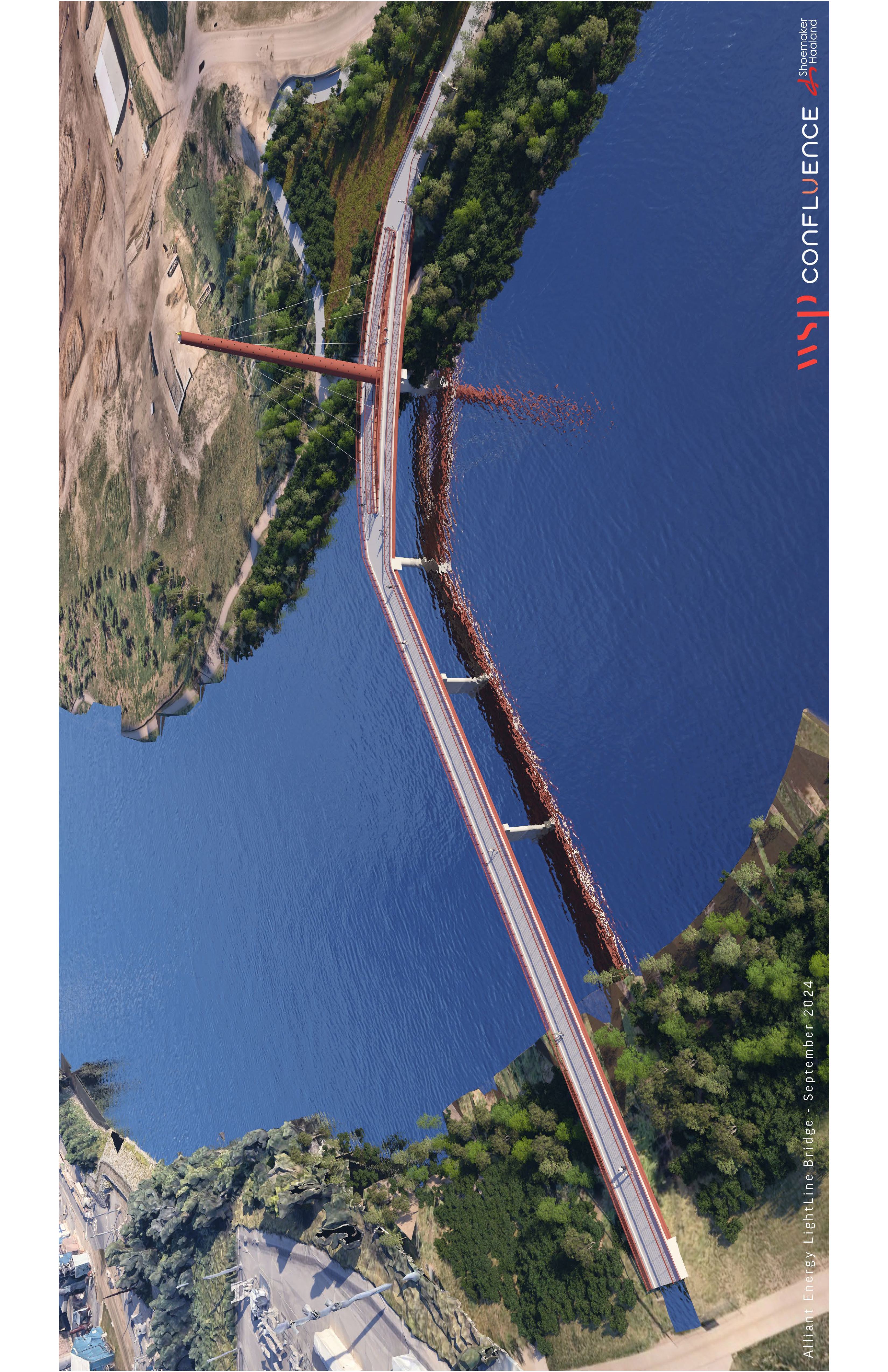
bridge over river, containing trail and tower
Conceptual picture of the Alliant Energy Lightline
bridge over the Cedar River
(swiped from cedar-rapids.org)

Destination Cedar Rapids is now known as Connect CR, and has been supported by $5 million from the City of Cedar Rapids, an equivalent amount from the Hall-Perrine Foundation, and donation of Cedar Lake by Alliant Energy. The hope is to activate the Cedar River and the man-made Cedar Lake, for as  Another CNU speaker, Eric Klinenberg, argued for infrastructure like this that serves both functional (flood protection) and social purposes.
plans for Cedar Lake

Cedar Lake required a great deal of remediation, and apparently the leveling of numerous trees as well. (I know one avid birder who can't bring herself to return to what had been one of her favorite spots.) A lot of features, like the shelters and challenge course, remain to be built. It is scheduled to be completed in 2027.
Northern view of Cedar Lake

Yet on a Monday mid-afternoon, people were already using the space, walking and cycling around the lake on the trails, or sitting on benches by the lake.
cyclist riding on trail seen from the bottom of the hill
cyclist on upper trail, taken from lower trail

 It is accessible by trail from the north or from Downtown, though being located across I-380 from neighborhoods it's only walkable for the bold and fit.
houses on the other side of interstate highway bridge (it's all railroad property, though)
You can see Mound View from Cedar Lake, but
the train tracks mean you can't get there from here

Down the trail, the Alliant Energy Lightline bridge will connect the Cedar Valley Nature Trail, as it rolls south of Czech Village, to where development is planned in the New Bohemia expansion. Completion is planned for this fall, when it will be a huge contribution to trail system connectivity. In time it may also and help build a neighborhood south of New Bohemia.
river, partly-finished bridge, and construction equipment, with city in background
Construction progress as of today: view from the SW side

Cedar Lake and the Alliant Energy Lightline are connected by the Cedar Valley Nature Trail, and highlight our emerging trail system. Together they provide both fun and utility. What is fun and useful for residents also is attractive to visitors (see "The Public Realm" 2026.) City Manager Jeff Pomeranz is quoted on the city webpage: "We need these kinds of special places for our residents, for our businesses, and for our visitors." The page also appropriately notes that entire ConnectCR package is "designed to strengthen connections across our city."
one end of the bridge, amidst various construction equipment
North end of the Lightline Bridge,
from 10th St SE

KCRG-TV report on bridge construction from earlier this month (1:48):


MEDQUARTER

MedQuarter banner on pole

I've said a lot about the MedQuarter in this space, most of it negative, but the fact that very little has changed in its 55 blocks during the last ten years means that good choices are not precluded. Ten years ago I imagined an optimistic scenario in which:
Development creates an important connection between what's happening Downtown and in New Bohemia, and the core neighborhoods of Oak Hill-Jackson and Wellington Heights. This proves a source of sustenance for Downtown and New Bo. Work force housing gets built. Expanded employment opportunities create vibrant, diverse neighborhoods that in turn sustain street life and local businesses. Maybe even: Density gradually replaces the current ridiculous oversupply of parking, while visitors are accommodated by local circulator buses that provide easy transportation between clinics and other local sites.
street, parking lot, trees
Looking east from 8th Street and 4th Avenue, 2014
street, parking lot, trees
The same view today
(The adorable shrub at the corner was removed after 2021)

Looking at the four parts of the "general theory of walkability" created by Jeff Speck (Walkable City: How Downtown Can Save America, One Step at a Time [Farrar Straus and Giroux, 2012]), the MedQuarter does not perform as well as it should be doing, as close as it is to Downtown.

  • safety: Mixed. There are sidewalks throughout the MedQuarter, and converting one-way streets back to two-way has helped with traffic speeds. Design still favors motor vehicles, and 1st Avenue, as well as 7th and 8th Streets near I-380, are not safe for pedestrians or cyclists. The lack of buildings and people, particularly at night, does not help people feel safe, either. 
  • comfort: Poor. The streets are wide, with few shady street trees (although 8th Street by Mercy Hospital is a nice exception), and at least during the day a lot of noisy car traffic.
  • interesting: Poor. With a tiny residential population and little commerce, there are few signs of life on the street. Most sidewalks are next to parking lots or large buildings.
  • useful: Poor. Once you leave the hospital, there are few destinations for walking or cycling: no parks or elementary schools, a couple ethnic grocery stores, a handful of restaurants, the Post Office, an excellent coffeehouse that unfortunately is only open three days a week, a few other places.
trees, parking lot, a distant (medical) office
The MedQuarter has many parking lots and few places

I think this could be fixed, if anyone wanted to. The three big boys--the two hospitals and Physicians Clinic of Iowa--are there to stay, and their preponderance of out-of-area visitors means parking is always going to be a concern. But it doesn't have to be the only concern. If the MedQuarter develops in a way that facilitates connection between the neighborhoods and Downtown--besides driving through it, I mean--it could strengthen the city socially and fiscally. Besides, car dependence is antithetical to public health. I'm not optimistic that these are considerations for those who wield power over the area, but as of now, it could still happen.

ORIGINAL POST: "Thinking Big in Cedar Rapids," 4 May 2016

No comments:

Post a Comment

10th anniversary post: Thinking Big in Cedar Rapids

  Dale Todd speaks at Cedar Rapids Public Library,  May 2016   "Waterfronts are the rock stars of city infrastructure."-- MATTHEW ...