Sunday, February 19, 2023

Trails and bikeways ideas

2015: Steve Sovern promoted a new bridge across the Cedar River

Your humble blogger has been named to the Advisory Council on my city's and county's Trails and Bikeways Plan! Our first meeting is next Friday morning. I'm not sure what to expect, other than there are more than 30 people on the committee, so we can anticipate a diversity of viewpoints.

A trails and bikeways plan might well be expected to seek more of both trails and bikeways. I submit we can do this most effectively by prioritizing ways, not only of enhancing the experience of cyclists, but of achieving broader community goals. The prophet Jeff Speck, whose book Walkable City: How Downtown Can Save America, One Step at a Time has just been reissued in a 10th anniversary edition [Picador USA, 2022], argued in the first edition that when public policy encourages cycling, it achieves four side benefits (what we academics call "positive externalities):"

  1. slowing car traffic, making streets safer for everybody
  2. less land devoted to parking, so more productive
  3. less pollution and greenhouse gas emissions
  4. better urban fabric, so more possibility of urban life
If we keep the why front and center, it will help us choose the what.

People choose to ride bicycles for two sets of reasons: recreation (fun, exercise) and commuting (getting to work, school, shopping, and social life). Trails mostly serve the former, although creating direct routes like the Cemar and Cherokee Trails can dramatically improve commuting efficiency; bike lanes mostly serve commuters, but can improve access to trails as well. While our plan ought to improve the experiences of people who are already doing these, the most important job now is to encourage people to try cycling who currently are using cars for short trips. That's what moves us towards those four social benefits: Some ridiculous percentage of trips in America are under two miles. If we could cause more of those to be taken by bicycle, we could change the world.

My ideas, listed below, have some infrastructure in them, but mostly address obstacles to biking on the infrastructure we've already built. I hope we're able to pursue some of these.

New Infrastructure

1. Look for opportunities for more direct routes. The Cemar Trail, once completed, will enable you to get from downtown Marion to downtown Cedar Rapids more quickly on a bicycle than you can in a car. Bikes aren't always going to be competitive with auto travel for speed, but the closer we can get the more likely people are to try cycle commuting. More like this, please.

2. Look for opportunities in areas of concentrated poverty on the edges of town. Mobile home parks and less-expensive apartment complexes are often found near high-traffic and/or high-speed stroads like Collins Road and Wiley Boulevard. Personal cars can be a money pit, particularly for the economically vulnerable. How can we improve the infrastructure in their neighborhood to make it safer and more encouraging?

3. Look for places that could draw a lot of cycling. The Cedar Rapids Community School District is redoing the whole elementary school array, and has plans to do the same for middle schools. They will have bigger attendance areas than current schools, so more students will be driven, but even so we should definitely make it possible for children to ride safely to school.

4. Connect Coe College to the Cedar Valley Trail. Is this special pleading? Coe (my employer) is close to Cedar Lake as the crow flies, but bikes must take a circuitous route. Coe houses about 1000 young leaders of tomorrow, a concentrated population of potential cyclists. 

Existing Infrastructure

1. Convert on-street lanes and sharrows to higher levels of service, where warranted. Sharrows aren't infrastructure anyway, nor are signs on major streets that say "bikes may use full lane." Yes, they may, but few will use the street at all, unless it feels safe.

The dreaded sharrow: 4th Av & 10th St
(Bike lanes end in the 700 block of 4th)

2. Dedicated fund for maintaining existing infrastructure. Nothing lasts forever. Construction is by definition sexier than maintenance, but neglect of maintenance dooms the whole project.

Removing obstacles

1. Road diets will slow cars and create space for other users. One immediate need: 1st Avenue east of the junction at Williams Boulevard is a major thoroughfare through downtown. Maybe we add a bike lane, maybe we don't, but the key is to slow the cars sufficiently that cycling feels (and is) safe. Slower driving is safer for drivers and their passengers, too.

2. More patrolling of streets will improve everyone's behavior. Enforcement is secondary to design, as any disciple of Strong Towns will tell you, but it's another way to control the speeds, particularly of the biggest and fastest vehicles. However...

2a. Legalize the Idaho stop. While I appreciate the opportunity to rest at stop signs and red lights, less world-weary cyclists should be able to proceed with caution in the absence of cross-traffic.

3. Where the numbers of cyclists warrants, install secure bike sheds rather than relying only on bike racks. More people will ride if they can worry less about theft.

4. E-bike rentals or even giveaways. One study found e-bike riders burn more calories than traditional riders like me, because they ride farther and more frequently.

5. Fund an extensive survey of public attitudes about cycling, so we're not relying on comments of convenience or passion. Even the active cyclists on this committee have some limitations on their perspectives.

Other public policy

1. Event planning, coordinated with management of the new apartments and condo units in core areas of the city. Don't just hope for good results from infill, prime the pump of potential cyclists. All the new infrastructure creates the potential for walkable/bikeable streets, but we only see the benefits of cycling and walking if people do them.

Start of construction of the Banjo Block last summer:
184 new apartments downtown

2. Legalize ADUs and missing middle housing. We'd have a more bikeable city with more density, because density equals destinations to bike (and walk) to. Just because our terrain is flat is no reason we have to sprawl all over it. And while we're at it...

3. Adopt a land value tax. This is my latest obsession, but by gum, we'd have a more bikeable city with more urban life if we could fill in the empty parts of the core areas where the clods are land banking.

SEE ALSO: "Why I Pedecommute (and Pedal-Commute)," 6 April 2021 [or check the posts linked under "bicycles" in the labels column on the right side of your screen]

Alec Davis, "How I Learned to Be Vulnerable," Waste of Space, 20 February 2023

Charles Marohn's interview with Jeff Speck on the Strong Towns podcast is here.

Saturday, February 4, 2023

What's Happening in Illinois?


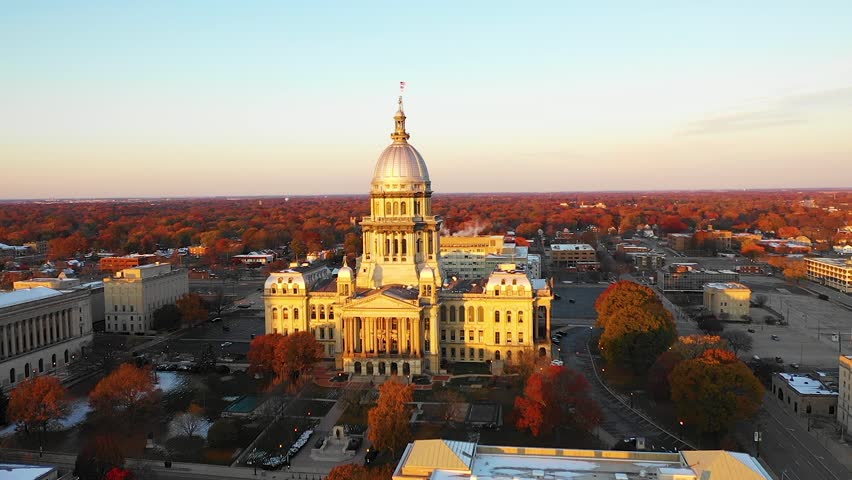
Illinois State Capitol
Illinois State Capitol, Springfield
"Just outside Chicago, there's a place called Illinois"
(70s tourism slogan)

My native state of Illinois lost another chunk of population this year, according to Vintage 2022 estimates released last week by the U.S. Census Bureau. Illinois's population losses stand out, even by the standards of the Midwest, which has lost 0.3 percent of its population since the 2020 Census. , Illinois has declined 1.8 percent in the last two years; the next-sharpest declines, in Michigan and Ohio, were only 0.4 percent each. In the middle of those states, Indiana has gained 0.7 percent. Even Iowa looks comparatively good, at plus 0.3 percent. Nationwide, only New York and the District of Columbia (both -.2.6 percent) lost more of their population over the last two years than Illinois. [On the other hand, in 2022 Illinois ranked second in the Midwest (3.1 percent) behind South Dakota (3.5 percent) in percentage increase in employment. There's more than one metric around, and population may not be the best indicator of a state's well-being.]

From 2010 to 2022, the U.S. as a whole has gained not quite 8 percent in population. In that time, Illinois has lost 0.17 percent, ranking ahead of only Mississippi (-0.24 percent) and West Virginia (-3.84 percent) (World Population Review 2022). The clearest story to explain this has come from the right; Pete Saunders (2022a) characterizes their version as centering on Chicago as the 21st century American Urban Dystopia--staggering crime and violence, frighteningly bad public schools, and high taxes that do more to support rampant political corruption than quality public services. It follows the only effective remedy would be a sort of militarized neoliberalism: cut taxes and services, privatize education, stomp on the criminals, can the racial justice stuff, and vote Republican. This is supposedly how they get it done in sunnier areas and wealthy suburbs (cf. Voegli 2022).

Illinois is losing population in non-metropolitan areas.

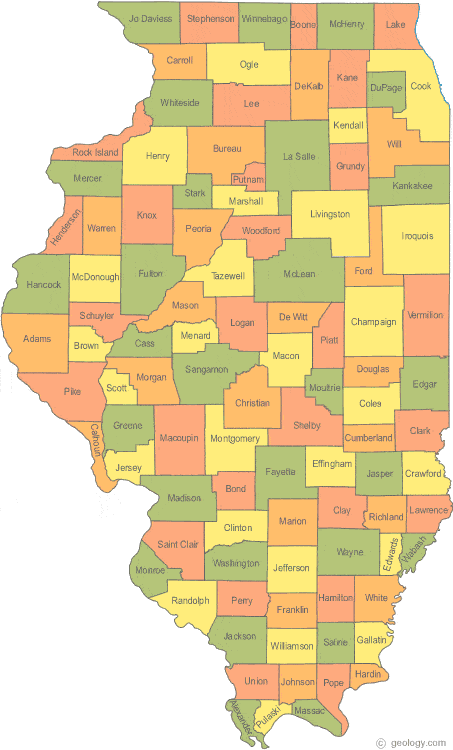
When we examine data at the county level, though, Illinois' story gets considerably more complicated. Its 102 counties can be divided among census-defined metropolitan areas (40 counties in 13 metros), micropolitan areas (23 counties in 19 micros), and purely rural areas (the remaining 39 counties). Only one county, Kendall at the edge of the Chicago/Naperville/Elgin MSA, grew faster than the U.S. as a whole; two others, Monroe south of St. Louis, and Johnson near Carbondale in southern Illinois, came close.
State of Illinois with county divisions
Illinois and its 102 counties
(Creative Commons)

In all, 15 counties in Illinois gained at least some population from 2010 to 2022. These include eight of the nine counties in the Chicago MSA, Champaign County (home of the University of Illinois), McLean County (home of Illinois State University), two of the three counties in the Carbondale/Marion MSA (home of Southern Illinois University), Monroe County in the St. Louis MSA, and rural Carroll County in rural western Illinois. Each surely has its own story to tell, but here are some observable patterns, few of which are unique to Illinois:

  • Successful urban areas, around Chicago and the largest universities, are propping up the rest of the state, though not growing as fast as successful metros elsewhere in the country 
  • The state is hemorrhaging outside the metros, with 60 of 62 micropolitan and rural counties losing population, 16 by more than 10.0 percent
  • Sangamon County (Springfield) is holding almost steady with a 0.68 percent population loss since 2010, though Springfield hasn't been able to capitalize--ha ha!--on the headquarters of state government as have Des Moines, St. Paul, Madison, Indianapolis, and Columbus
  • Some urban areas are not doing well at all, possibly because of commitments to outdated industries (Decatur, Kankakee, Peoria, Rockford, St. Louis); the same might be said of the Quad Cities, although Scott County, Iowa (Davenport) is growing
  • The two biggest drops among micropolitan counties are McDonough (-19.77 percent) and Coles (-15.61 percent), home to regional state universities that have suffered precipitous enrollment losses... a sort of Rust Belt of the mind as higher education evolves
modern library building
Malpass Library, Western Illinois University, McDonough County,
where your humble blogger started his teaching career
(from wiu.edu)

Illinois' loss of population is obviously not a single problem, but a confluence of several phenomena which are probably best addressed separately:
  1. Why has there been so much population loss in rural places? Can something be done in some of these areas (tourism, local industry, organic food) to revive some of these places?
  2. What can be done with struggling industrial (or small university) cities?
  3. Why isn't Chicago (or Champaign-Urbana, Carbondale, and/or Bloomington-Normal) growing faster than it is?
Of course, realizing this doesn't explain why their combined effects is so strong in Illinois; Wisconsin and Michigan, for two, have a lot of the same characteristics.

Cairo, Illinois, seat of Alexander County (372 miles from Chicago),
largest proportionate population loss among Illinois counties

But, what about Chicago?

Despite the evidence, for whatever reason(s), when discussing Illinois' problems a lot of talk turns to Chicago.  As we've seen, Chicago and environs are growing, not shrinking, but perhaps they could be growing faster? 

A good place to start is "Tottering Chicago," a series of insightful blog posts by Chicago-based writer Pete Saunders. 

smiling Pete Saunders
Pete Saunders
(from businessinsider.com)

It's worth reading in toto, but a key point Saunders makes is that Rust Belt "legacy" cities like Chicago are in a different situation than New York ("knowledge economy-based city" that now must deal with the consequences of its success) or Dallas (looking good due to a recent air conditioning- and Interstate highway- and low wage- and annexation-fueled growth spurt). "There are signs that Chicago is making very real progress in its transformation," Sanders suggests, "yet there are deeply rooted challenges that root Chicago down, and that gets discussed more than its positives." 

Saunders notes that since 2010, Chicago has added 97,000 households city-wide, the core of the city has grown faster since 1980 than any other American city, and has been successfully attracting recent college graduates. [Saunders also notes the limitations of using population growth/decline as a surrogate for a place's success (Saunders 2022b).] Poverty persists, but the principal crisis--and biggest threat to sustained prosperity--has been an increase during the pandemic of "frightening" crime: homicide, carjacking, and overall gun-involved violent crime. The bottom line:
Chicago has a thriving, dense core; some prosperous communities on the outskirts; and a vast, mostly poor, less-populated hinterland in between. Bridging that gap may not be impossible, but there's much work to be done. (Saunders 2022a)
industrial building
Loft apartments by the Bloomingdale ("606") Trail, Chicago

Chicago's reality is far from a perfect, but also far from the doomsday fantasies of, say, recent Trump-style gubernatorial candidate Darren Bailey. Saunders concludes (Saunders 2022e) with some recommendations for Chicago and other Rust Belt cities similarly situated, which might have some lessons for Rockford and Peoria as well:

  1. "Be who you are." Acknowledge and build on strengths, and avoid radical solutions that try to replicate 1980s Dallas. Avoid all ideologues, rightists and leftists, selling pet formulae for success.
  2. "Lean in on immigration." Unfortunately, this requires more coherence and less hostility in national policy, but do whatever can be done. 
  3. "Promote affordable urbanism and authenticity." Chicago offers urban life at a much lower cost than New York or Seattle; done right, this could work in smaller metros as well.
  4. "Boutique manufacturing," by which he means more artisanal workshops, leaving the big plants to chase lower labor costs in the South and across the border.
  5. "Water security." Shore up environmental infrastructure, and prepare for climate refugees.

What is to be done?

Addressing Illinois begins by acknowledging its complexity: Illinois is more than Chicago, and Illinois's problems are more than Chicago's. The biggest population losses are occurring in rural areas where small towns are no longer needed to service family farms, and that indicates a different set of policy approaches--although immigration is going to be a start here, too (cf. Frey 2023 and Pipa 2022). Don't wait on the federal government to act, either. 

Each region of the state, moreover, consists of a complex set of people, all of whom have something to bring to the conversation that deserves to be heard--heard without ascribing irrationality or corruption. Voegli figures the only reason people of means still live in Chicago is that they are cultural snobs who would rather be assaulted by urban criminals than live around conservatives. Don't be like him.
Jackson Boulevard, downtown Chicago,
Illinois' most economically productive district

We can't do everything everybody wants, and we shouldn't do everything anybody wants, but we need to hear everybody and take account of them all. Who knows where complementary interests might be found? Besides this...
  • Look for ways, the less radical the better, to improve the lived experience of current residents. Small steps can be simply expanded or rescinded; radical moves and "game-changers" cannot be. (cribbed from Strong Towns)
  • Illinois's reputation for high taxes and urban crime, however exaggerated, aren't helping its image or the mood of its people. (Do taxes explain why Rock Island, Rockford and Cairo are shrinking while towns across the border are growing?) Addressing these needs to be part of whatever gets done.
  • Agreeing in part with Voegli, look for every opportunity to improve the quality and quantity of education in the state (cf. Gilmartin and Hurley 2018, Frey 2019)--as long as we strive to include everyone, because...
  • Every policy proposal needs to take into account the role of racial discrimination in creating the world in which we live. 
  • Every policy proposal needs to take into account all the ways we have sought to accommodate motor vehicles, at the cost of our community, our environment, and our bodies.
turnstile, varnished interior train station
Quincy L stop, Chicago Loop

Friday, January 20, 2023

Kim Reynolds Declares War


I live in Iowa, which is the happiest, most fiscally sound, and best-governed state in the universe, and also the one with the most economic opportunity. In what our recently reelected governor, Kim Reynolds, calls "a world increasingly marked by chaos," it is comforting to live in a place that is so normal and right-thinking and non-threatening.

There are Iowans, and there are extra-special Iowans like our law enforcement heroes and "parents" (i.e. parents who agree with the governor), and then there are... well, I don't know what to call them, but they're everywhere, aren't they? Even in Iowa. About the only surprise one gets in Iowa is that not everyone appreciates living in this paradise. While recounting her administration's accomplishments in her annual Condition of the State address, Governor Reynolds took time to point out that these accomplishments happened despite the direst predictions of our opponents ("as expected"--just like them!), members of the media (booooo!), and "so-called experts." In the face of our excellence, that bunch characteristically resorted to "hysteria," saving their "angriest attacks" for requiring schools to be in-person during the coronavirus pandemic. When those haters goes on about overcrowded hospitals and Iowa at one point having the highest death rate in the country, we know they're just hating for the sake of their own bilious hatred. Unlike us, they don't want what's best for our children!

We plan to shift money from under-funded public schools to private schools because we want to give "every child a chance to succeed." We could address concerns like those of Darwin Lehmann, superintendent of the Central Springs and Forest City school districts, who told the Cedar Rapids Gazette--an acknowledged media outlet, I regret to say--he worried about the proposal's impacts on public schools (McCullough 2023). But we don't see concerns, only "hysteria," and we "ignore the hysteria," don't we?

Of course, this can't go without mentioning a public school teacher who sent one of her children to private school, and some of her colleagues turned their backs on her! Haters, is what they are, haters and meanyheads! "It's about our children," haters! And we can't talk about our plan to ban all abortion without mentioning Sara in the audience, whose partner left her when she changed her mind about getting an abortion. That's the sort of moral sewer our enemies live in, folks, not only wrong all the time about policy but wrong all the time about life. And children!

(By the way, Sara now counsels other women who face the same decision she did. Until we pass the law and there won't need to be decisions any more.)

The Governor announced a public awareness campaign on the dangers of the opioid fentanyl, as well as increased penalties for manufacturing and distributing fentanyl. Fentanyl comes from immigration, which comes from Mexico through "the holes in the border," which come from the Biden administration. Truly I say to you, it is what enters Iowa that defiles it. (For the record, two days before the speech, President Biden had been in El Paso, Texas, to announce new measures on immigration policy (see Ignatius 2023)).

So let us get angry, stay angry, and all will stay well in the State of Iowa. I know this, you know this, and that's all we need to know, which is why we don't need to have any interviews with pesky reporters. And whoever wrote the headline atop this post? Probably hates children. And if someone would like to know about job creation, or the pandemic, or groundwater pollution, or police oversight, or climate change that brings tornadoes in January... well, they probably hate children, too.

girl making angry face
(swiped from http://taccle2.eu/wp/core-skills/how-do-you-feel)

SEE ALSO:

"Is Iowa Becoming Even More Republican?" 3 December 2022

"Why Should I Vote For..." 23 October 2022

"Condition of the State 2022," 11 January 2023

Monday, January 16, 2023

Provoking Action: MLK Day 2023

musicians and string instruments at the front of church sanctuary
Harmony School of Music leads the gathering in song

Cedar Rapids' annual Martin Luther King Day celebration included calls for involvement as well as coming together as a community. The observance returned to St. Paul's United Methodist Church after three years online due to the pandemic. 

large gathering people seated in wooden pews
Gathering for the service

Pastors Keeyon and Stephanie Carter, who started Wellington Heights Community Church in 2020, received the Dr. Percy & Lileah Harris "Who Is My Neighbor" Award. Gentine Nzoyikorera, a senior at Kennedy High School, received the student award. The eleven-member planning committee was recognized; many of them have helped put on quite a number of these celebrations.

The day also featured an afternoon tornado touching down near Monticello, a bizarre event for January in the northern Midwest.

man at microphone
Tony Loyal told the story of his great-grandmother
in Jim Crow era Mississippi

Throughout the evening, the emphasis remained on the need for activity, moreso than the nature of the persistent evils against which we need to act. Betty Johnson of First Light Christian Fellowship noted "we're more and more and more divided," which if unchanged "the harder and the further we will fall." Maybe in such a supportive gathering--Cedar Rapids really puts its best face forward at these events--specifying what we're fighting is unnecessary? Or maybe the evils are so widespread and pervasive they're obvious to everybody. Perry Bacon Jr. wrote in today's Washington Post that "the so-called racial reckoning" in the wake of the murder of George Floyd "has not resulted in much real, deep policy change--and there are few signs that it will anytime soon." Bacon continues:

American police officers killed more people in 2022 than any year over the past decade, according to data compiled by the group Mapping Police Violence.... The bold policy changes touted by activists in the summer of 2020, such as drastically reducing government spending on policing and reallocating that money for housing assistance and other programs that would disproportionately benefit Black people, not only have no chance of being passed nationally but are a non-starter even in many blue cities and states. There is no real public discussion of... policies that would be necessary to improve conditions for Black Americans on a broad scale.

To which I'll add there are so many distractions--some unavoidable, and some I daresay intentional.

woman speaking into microphone
Gentine Nzoyikorera, President of Black Student Union
at Kennedy High School

In light of this continual cycle of hope and frustration, Tamara Marcus of Advocates for Social Justice said she has learned from older activists as well as her own experience that "this work is hard and defeats will happen," and counseled younger activists not to give into despair or anger, but to "love even harder" in the face of defeat. Gentine Nzoyikorera noted that her school's Black Student Union had only four members when it confronted the Cedar Rapids School Board about the police presence in the school, but gained a hearing because they actively sought allies. Keeyon Carter urged people to "continue to do the good work but don't forget relationship" that goes deeper than accomplishing specific tasks. Lori Ampey of Tanager Place concluded the speeches by calling for inclusion, non-judgment, and perseverance across ages, sexual orientations, and mental health: "Leave here today with the intent of finding something to do."

man, woman, and two children in front of church
Pastors Keeyon and Stephanie Carter and their family;
longtime activist Anne Harris Carter is at left

The bottom line, in the words of former African American Museum of Iowa Director Tom Moore, is that Dr. King would be pleased at the progress since the 1960s but "we still have a long way to go." This annual gathering reminds us there are a lot of people in Cedar Rapids, fully in the face of cynicism and disillusionment, fighting a lot of evils. One of them might be your new best friend!

six young dancers in line
Mt. Zion Youth Explosion Dance Team

tables and posters arranged around hall
Some of the organizations represented at the service

students gathered around computer screen
Earlier today, Coe College students gathered to transcribe
Freedmen's Bureau documents for the Smithsonian Institution

SEE ALSO: "Onlining About Redlining: MLK Day 2022," 18 January 2022

Grace King, "On King Day, Meet 'Who Is My Neighbor?'" Cedar Rapids Gazette, 16 January 2023, 1A, 9A

Friday, January 6, 2023

Book review: Arbitrary Lines


At Christmas I got COVID and this book!

M. Nolan Gray, Arbitrary Lines: How Zoning Broke the American City and How to Fix It [Washington: Island Press, 2022], xii + 240 pp.

(1/6/2023) Way back in 2016 I got named to a steering committee for revisions to the zoning code in my city of Cedar Rapids, Iowa. I attended meetings for a bit over a year, then the meetings kept getting scheduled when I was teaching classes, then I went off to a sabbatical. The city now has a form-based code and no parking minima for certain core areas where there is going redevelopment after the 2008 cataclysmic flood. The rest of the city is pretty much the same. I doubt I was much help.

My thought at the time, inasmuch as I'm able to get back in touch with 2016-me, was that zoning reform could accomplish two objectives: (1) by allowing mixed uses, we could reintroduce some vitality to parts of the city and stop some of the destructive features of single-use ("Euclidean") zoning; and (2) by defining the form of construction instead of usage, we could streamline the development process and thereby lower construction costs. Based on our city's updated zoning map, linked here, we may not have gotten there.

2016-me would surely have benefited from a hole in the space-time continuum that would have gotten me an advance copy of Arbitrary Lines, a brief but tightly-argued work by New York City-based planner M. Nolan Gray that promises to be the starting point for all future conversations about zoning. (Producing this book involved both Island Press and George Mason University's Mercatus Center, a collaboration I for one never expected to see.) 

In less than 200 pages, Gray makes the case that zoning does more harm than good and should be abolished--no reform, just get rid of it. He notes that zoning was not practiced by local governments until the early 20th century, when a coalition of the privileged--commercial landlords, affluent homeowners, and nativists--deployed zoning to defend middle class areas from incursions by immigrants and the working-class (ch. 1). Subsequently it has operated to protect property values while limiting the supply of housing and making it thereby less accessible and more expensive (ch. 3), limiting movement to areas of the country with high-performing economies thereby restricting individual opportunity and overall growth (ch. 4), restraining racial minorities (ch. 5), and causing more resource consumption and environmental stress (ch. 6). Well, of course it has. 

In chapter 8, Gray makes the case that fragmentation of metropolitan governments means that even the best-intentioned zoning code is going to be manipulable by powerful interests. In chapter 9, he commends the example of Houston, Texas, which has managed to grow quickly and remain relatively affordable while accommodating the well-off and not descending into land use chaos. "Even before zoning," he points out, "Industries need to be where land is cheap and transportation is accessible, and complaining neighbors are few and far between" (p. 152). But he also is pragmatic enough to recommend urgent steps short of outright abolition, including ending single-family zoning, abolishing parking minima, dealing with regulations on minimum floor area and lot size, and allowing single-room occupancy and manufactured housing in city limits.

This is really a lot to pack into a little book. I wish he had dealt with form-based codes, and spent more time on the difficulty of achieving housing affordability when so many people have their principal investments in their home i.e. their golden years depend on housing being less affordable (cf. Hertz 2016). On the latter point, he allows "it suggests a bleak future" and any "gains may be on weak political future" (p. 64). Maybe by spreading information about the social harms of zoning we can appeal to people's better angels? There certainly has been movement in the angelic direction, such as Minneapolis abolishing single-family zoning and Fayetteville liberalizing its ADU ordinance.

Cedar Rapids is a small city surrounded by farmland that seems to beckon us to sprawl further. Maybe we will grow as people relocate from high-demand areas. (Our governor says this is already happening.) Gray warns this "at best just buys us time... Absent fundamental reforms, the housing affordability crisis will only spread" (p. 65). So what could Cedar Rapids have achieved, had it decided in 2019 to go Full Houston with its land use policy? Less cost pressure on hot neighborhoods like New Bohemia and Kingston because those developments could be spread around the city? Manufactured homes that aren't on the absolute fringe of the city? Missing middle housing and accessory dwelling units in connected places? Enough density in spots to support better public transit? More intense development closer to surviving public schools?

Hey, a fellow can dream, can't he?

SEE ALSO: "Re-Zone CR Open House," 20 June 2018

Tuesday, January 3, 2023

Happy City (The Game) and the Happy City

smiling man holding game box in front of lighted Christmas tree

Having spent fall semester teaching from Happy City by Charles Montgomery, I can not imagine a more appropriate Christmas present than Happy City, a new game for ages 10 and up from Gamewright. Thanks to my wife Jane--who has also used Happy City in a class--for this astutely-chosen gift!

Happy City has no relationship to Montgomery's book. He is not mentioned in the game materials or on the website, so I assume the coincidental titles are exactly that... coincidental. Even so it practically begs for comparison, which I am about to undertake. Keep in mind, though, this card game is aimed at children; if you're cruising the Internet looking for someone slagging a children's card game, you should definitely check out Yu-Gi-Oh: The Abridged Series on YouTube. You will not find that tone here.

On the other hand, the book Happy City, while accessibly-written, is a book for adults who have a tolerance for complexity and counterintuitive research findings. It would be hard for the most brilliant designer to translate Montgomery's argument into a game for the whole family intended to be played in under 30 minutes.

Playing Happy City

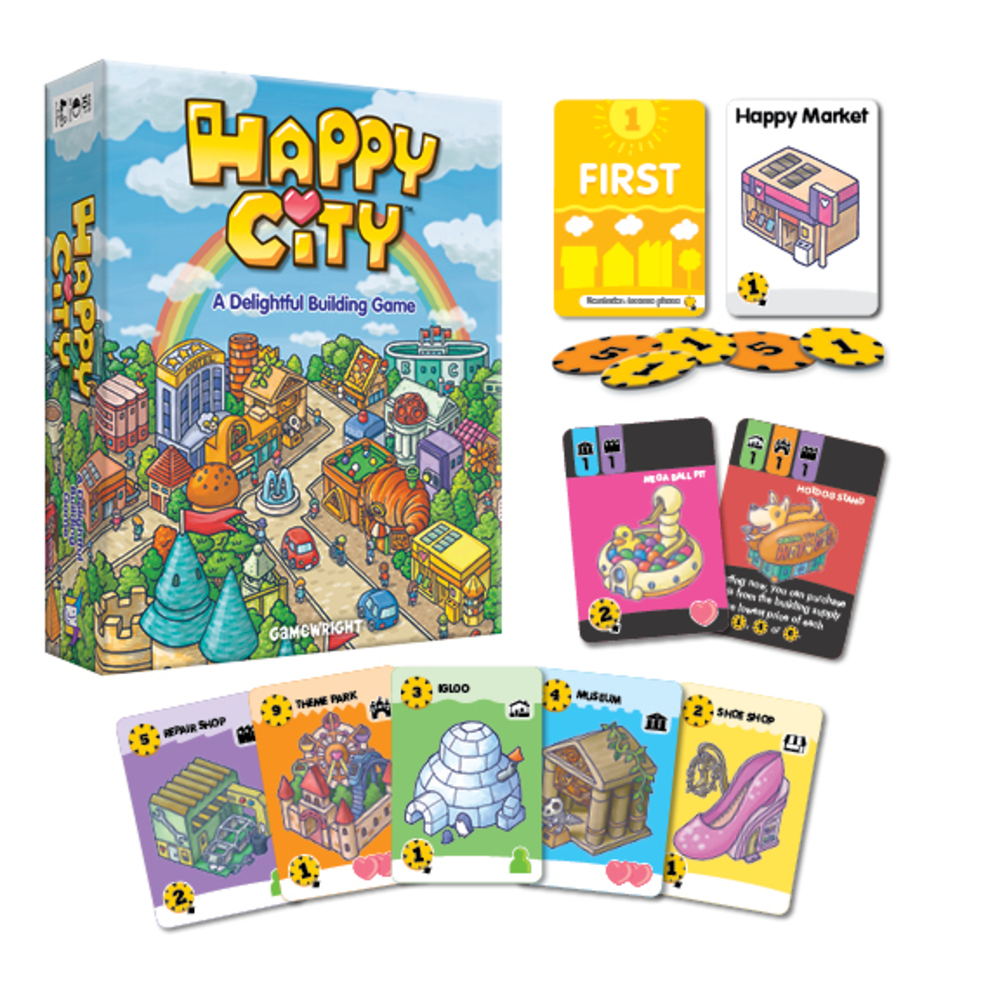
Happy City is a game for 2-5 players. Play goes in order of how recently each player has in their actual life traveled to another city. Each player starts with a mildly-profitable store, and from that attempts to build a city with high population and high citizen happiness. Each building is represented by a card; the game ends after one player's city has ten cards. The winner is the one with the highest overall score, determined by multiplying the population score and the happiness score. 

Happy City game box and selected cards
Source: gamewright.com/product/happy-city

The key to building your happy city is to maintain a positive flow of income, so that you can buy the features that will bring in people and/or make them happy and/or add to the city's income. The buildings come in several categories. Players are encouraged to draw from a mix of categories, though they may not use more than one of the same kind of card. Some examples:
  • Happy Market: 1 coin of income (paid at the beginning of each round of turns)
  • house: cost 1 coin, 1 population point
  • apartment complex: cost 3 coins, 2 population points
  • high-rise: cost 6 coins, 3 population points
  • library: cost 2 coins, 1 happiness point
  • repair shop: cost 5 coins, 1 population point, 2 coins of income
  • restaurant: cost 5 coins, 1 happiness point, 2 coins of income
  • casino: cost 7 coins, 2 happiness points, 2 coins of income
  • ski resort: cost 8 coins, 3 happiness points
  • steelworks: cost 1 coin, -1 (yes, -1) happiness point, 1 coin of income
boys sitting on climbing equipment
I'd give our library at least two happiness points!

In time, with the right mix of card/building types, players can pick from a selection of bonus building cards (e.g. Superhero Central, Happywood Studios, Unicorn Ranch), which amp up both population and happiness scores. An expert version of the game has more bonus buildings and more complicated scoring.

Evaluation

Happy City does a very good job of modeling a number of factors related to city development. The primary importance of income, making it a prerequisite to any actual building, is a good way to put fiscal realities at the forefront of our considerations. The folks at Strong Towns will be gratified that all income in the game is locally-generated. We are not relying on federal or state grants to grow our cities.

Calculating the final score by multiplying happiness by population is a good way to model the interaction of those two factors. A small number of people experiencing a lot of happiness is an enclave or an exclusive club. A large number of people experiencing low happiness are existing in a place, not citizens of it. A large number of people experiencing a lot of happiness is a happy city.

Casino, Las Vegas NV

A third good point is, even though the city is developing in a centrally planned non-organic way, at least the planner/player is responding to values that have been established externally (presumably, in the economic market or political arena) rather than by themselves. Players are not Robert Owen or Le Corbusier or Marshal Tito constructing our own utopias, but working with preferences expressed by others. Last time I played, I added a casino to my city, not because I believe they're in any way productive, but because I needed the income and the happiness points. (For the record, I think the game vastly overrates casinos and sports stadiums on both counts.) 

Besides all this, you can't really sprawl or do exclusionary zoning with only ten cards.

The biggest difference between Happy City and Happy City is how each understands happiness. The game's  high happiness scores for leisure and entertainment facilities suggests the authors equate happiness with personal fun and pleasure. Montgomery's book goes into considerable detail in questioning that sort of premise, describing in chapter 2 a more long-term feeling of well-being, and later arguing that extrinsic motivators like fun things to buy or visit are overrated by people as sources of happiness. It's intrinsic motivators like health and social connection that endure and contribute to feelings of well-being. As Mitchell Reardon, a senior planner at Montgomery's firm, told the Shared Space podcast in March 2021: 
We are social creatures, yet for decades city planning has sought to divide us. We're just trying to knit this back together, and COVID has really underlined how critical that connection is.
Shared streets, like at Washington's Wharf,
are essential to experiencing that place

Urbanists like Montgomery spend less time on the commercial and industrial features of a town than on whether or not they're connected. In Walkable City [Farrar Straus and Giroux, 2011], three of Jeff Speck's four components of walkability deal with the experience of the walk--does it feel safe? comfortable? interesting?--and only one with the walk's destination. Jane Jacobs spends the first three chapters of her landmark The Rise and Fall of Great American Cities [Modern Library, (1961) 2011] talking about sidewalks. In part two, she articulates the prerequisites for urban success--mixed primary uses, small blocks, some older buildings, and concentrated population--none of which have to do with what specifically goes on those blocks or in those buildings. Toronto-based 880 Cities, which aims to  make cities "great" for 8-year-olds and 80-year-olds, focuses their efforts on "your community's streets and public spaces." And so on.

Street musician on pedestrian-only Knez Mihailova, Belgrade

Montgomery devotes the middle third of his book to assembling neuroscience research and lived experience on how happiness can be designed. Creating spaces for informal gathering, often out of infrastructure previously devoted to cars, attracts people and helps build social connection and trust (Montgomery 2013, ch. 7). He quotes Jan Gehl: What is most attractive, what attracts people to stop and linger and look, will invariably be other people. Activity in human life is the greatest attraction in cities (p. 150). In a society where so many people drive to work yet experience daily unhappiness doing so (pp. 179-181), anything to enhance the opportunities to cycle or walk will improve the city's happiness. So will anything to help those on public transit, "the most miserable commuters of all" (p. 193). Finally, opportunities for refuge and experience of nature will relieve stress and restore our souls (ch. 6).

walkers on sandstone trail, with trees
Boyson Trail, Marion IA

These aren't simple push-button interventions, either. They require a lot of trial and revision, and attention to different people's lived experiences in different places. That makes sense; after all, cities are "problems of organized complexity" (Jacobs [1961] 2011, ch. 22). It follows that any attempt to model all the complexity at the level of a two-dimensional board game is going to fall short, so let us not cavil at Happy City, which after all is a fun and quick play, and which gets a lot of the city right.

Just let's don't confuse amenities with happiness.
Happy City book cover


SOURCE: Charles Montgomery, Happy City: Transforming Our Lives Through Urban Design. New York: Farrar Straus Giroux, 2013.

SEE ALSO: 
James Brasuell, "City-Building Video Games for Planners," Planetizen, 25 December 2022 [if video games are more your thing than card games]

Monday, December 26, 2022

Should This Intersection Be a Roundabout? Should Any?

Should this intersection be a roundabout?

intersection with turning car
(Google Earth screen capture)

The four-way stop at Forest Drive and Cottage Grove Avenue, right by Washington High School on the southeast side of Cedar Rapids, has twice had roundabout proposals rejected. A third bite at that apple is therefore unlikely, but is that a good thing? Anyway, roundabouts are the pumpkin spice of the street design world right now, with strong feelings on both sides, and therefore we must have an opinion. Might as well be an informed one.

We can move the conversation along a little by noting roundabouts are likely to be useful (if still controversial) in some places and not useful in others. A roundabout at the intersection of U.S. 30 and State Route 1 outside of Mt. Vernon untangled a problematic intersection. Commonly-cited advantages of roundabouts compared with traffic lights are they move vehicle traffic more efficiently while lowering their maximum speed (a win-win!), with fewer injuries, cost less, and aren't subject to power outages. Strong Towns (2018) notes that “roundabouts can even out traffic flow compared to typical signalized intersections which tend to create stop-and-go lineups of cars. But whether they can relieve truly congestion depends on what is causing it…” The "Mythbusters" show even found roundabouts moved traffic better than four-way stops (see Ihnen 2013Gursten 2014).

Forest and Cottage Grove are in town, about two miles from the city center. Cottage Grove had an average daily traffic count of 5800 in 2017. (Forest Drive’s count hasn’t appeared on the map since at least 2009.) The main traffic issues, though, occur at the beginning and end of the school day, so roughly 7:30-8 a.m. and 2:30-3 p.m. 

The location of the high school at that intersection means that we’re anticipating cyclists and pedestrians as well.  Here the Internet is frankly not encouraging. For cyclists, the Iowa Department of Transportation advises:

Bicyclists have a legal right to ride on most roadways just like motorized traffic. Roundabouts are just like other intersections in that bicyclists may either follow the rules of the road and maintain travel on the roadway or use available paths and crosswalks to safely bypass the roundabout.

The New York Department of Transportation adds these tips:

1.     If you are comfortable riding in traffic, take the lane and circulate like you are a vehicle, making sure you yield to traffic in the circle when entering.

2.     Ride at the speed of the circular roadway to discourage cars from passing you.

3.     When you exit the roundabout, use your right hand signal.

4.     If you are uncomfortable riding through the roundabout, dismount and walk your bike as a pedestrian at the designated crosswalks.

But it’s one thing to have “a legal right,” it’s quite another to feel safe exercising it. Indeed, a 2021 review of 49 studies mostly from Europe found:

Crash data and observations suggest that when cyclists “take the lane” and operate as vehicles – as is allowed or even recommended in some current design guidelines – this leads to conflicts and crashes between circulating cyclists and entering drivers who may have “looked but failed to see” (and thus failed to yield to) the cyclist.

They conclude that discretion is the better part of valor.

Providing separated cycle paths around the roundabout seems to be a lower-risk and more comfortable design solution, although care must be taken to encourage appropriate yielding at crossings.

This makes sense, though a series of intersections at which diversion is required is going to get frustrating, resulting in either more aggressive cycling or no cycling at all, neither of which are outcomes we should desire.

Satisfactory solutions for pedestrians are also elusive. The Iowa Department of Transportation recommends:

Pedestrians should always use the crosswalks; and make sure the vehicle operators see him/her before entering the crosswalk.

This seems reasonable enough, but this video from Minnesota-based traffic engineers Stonebrooke…

…shows that we are expecting pedestrians to wander out of their way to find the crosswalk, and expecting vehicle drivers to stop for them when they ask to cross. We are expecting strollers to go straight while we push them with one arm while holding the other one out for all to see, and we are expecting we will not feel silly doing that. Good luck, with all of that.

Strong Towns (2016) allows “a roundabout can provide good, safe crossing opportunities for pedestrians, but only if engineers have pedestrians and bicyclists in mind when they design the roundabout…” This means (1) single-lane roundabouts not multi-lane, (2) not having pedestrians cross lanes with “particularly heavy” exiting volumes, (3) maintaining clear sight lines for drivers, (4) locating crosswalks away from the circle itself, (5) pedestrians signals to accommodate blind pedestrians, and (6) beaucoup public education.

They also note all this works “only if drivers use them properly.”

For this reason, Jeff Speck (Walkable City Rules, Island Press, 2018) wants roundabouts out of urban areas.

There are a number of features that make roundabouts feel less walkable than traditional intersections. 
  • First, they ask people who are trying to walk in a straight line to divert well to the side, and then back again, in order to keep moving across town. 
  • Second, while they require cars to slow and yield to pedestrians, vehicles never actually come to a full stop unless something is blocking them; roundabouts feel dynamic, and pedestrians prefer environments that are static. 
  • Third, they introduce into urban areas a design vocabulary which is unavoidably automotive; they swoop. (2018: 164-165, bullets added)

But our intersection isn't in an urban downtown, it's two miles away by a high school. Traffic is heavy for half an hour to an hour on school mornings and afternoons, and light the rest of the day. I think the roundabout might be highly functional 22-23 hours a day: drivers on either street could proceed without having to come to a full stop, and pedestrians might be glad to have them out of the way quicker.

It's those brief periods when traffic through this intersection is heaviest that give me pause. Moreover, it's heavy with inexperienced drivers taking themselves to school. Not many people walk to the high school; as Cedar Rapids schools get bigger and more spread out, fewer students walk. However, because of where the stop is located, city bus riders must also cross both streets to get to the school. As confusing as four-way stops can be, would people on foot be more confident getting across the street if cars were not coming to full stops?

We can hope for more pedestrian and cyclist traffic in the future. Just because the area isn't urbanized now, there's no reason that it should never be, given its proximity to the city center and development on 1st Avenue. A federal Safe Routes to School grant was recently used to build a wide sidewalk through this very intersection that coincidentally links the Interurban and CeMar trails. Does, or could, this encourage more walking and cycling, at all times of day?

Bottom line: There would be certain advantages to putting a roundabout here, but its effect on pedestrian and cyclist behavior now and particularly in the future tells me we shouldn't do it.

Where Should We Build Roundabouts?

So, are we dissing all roundabouts? By no means! That would be the sort of reflexive know-nothing opposition for which Boomers like me are so famous, and we can't support that. So, let's look for some intersections where (a) there is a complex intersection of two high-traffic streets; (b) there is currently a traffic light; and (c) it is not nor is it likely to become an urbanized area.

This town is replete with intersections possessing all three of those conditions, and so is your town, because of the way we've all been developing for 50-75 years. I'd look in the same concentrated commercial areas I visit for Black Friday Parking:
  • 1st Avenue and Collins Road E
  • Council Street and Collins Road NE
  • 16th Avenue and Williams Boulevard SW
  • Edgewood Road and Williams Boulevard SW
  • Edgewood Road and Blairs Ferry Road NE
  • probably a lot more, but these would be towards the top!

SEE ALSO: "When Are Roundabouts Indicated?" 2 August 2018

Kai Ryssdal and Nicholas Guiang, "Don't Panic, It's Just a Roundabout," Marketplace, 22 December 2022

Extreme roundabouting: (I am absolutely not recommending this!!)


Justice in the World Today

  Hope he gets some of that coffee: Statue of Thucydides in Vienna, Austria (7/31/2026)  A long time ago, according to the ancient Greek his...