Friday, June 24, 2022

The Future of Downtown Cedar Rapids


Bullish views of downtown Cedar Rapids were expressed by a public-private partnership of a panel Tuesday morning, sponsored by the Cedar Rapids Gazette. Mayor Tiffany O'Donnell, Jesse Thoeming of the Cedar Rapids Metro Economic Alliance, and two business owners applauded the vast increase in downtown housing and the flood protection that has enabled it, while hoping for more ideas to sustain downtown growth.

Construction underway on the "banjo block":
A game-changer I can get behind

Darryl High, a property developer and also chair of the Downtown Self-Supported Municipal Improvement District (SSMID), said downtown was at last "becoming an urban neighborhood." High cited much new construction as well as conversions of office space, concluding it will serve to "bring more people" which will eventually lead to service providers. Mayor O'Donnell anticipates a wider variety of housing that will lead to "people walking their dogs downtown." This vision of a 24-hour downtown has taken awhile to emerge, but is good to hear. 

Andy Schumacher, co-owner of Cobble Hill restaurant downtown as well as Caucho in New Bohemia, says he's noticed since Cobble Hill opened in February 2013 that office workers go home after work, and that a different crowd comes out to dinner in the evening, if it indeed it appears at all. A residential population might well be the key to sustaining downtown energy, particularly if a wider set of housing choices could allow for more "lower-middle-class vibe" than the pricey condos that have led development for the past few years. 

The Iowa Building (1914) is being retrofitted for housing
(Google Street View screen capture)

Schumacher's comments echo those of Jane Jacobs, who in a long, lyrical passage in The Death and Life of Great American Cities [Modern Library, (1961) 2011: 65-71] described the ballet of the good city sidewalk... in which the individual dancers and ensembles all have distinctive parts which miraculously reinforce each other and compose an orderly whole. This dance happened in the course of every day--without needing special festivals or events to get people there!

Jane Jacobs

On Hudson Street in New York's Greenwich Village sixty years ago, the ballet began with residents leaving for work, businesses opening their doors, and middle school students walking to school.
I make my own first entrance into it a little after eight when I put out the garbage can, surely a prosaic occupation, but I enjoy my part, my little clang, as the droves of junior high school students walk by the center of the stage dropping candy wrappers. (How do they eat so much candy so early in the morning?) (68)

Over the course of the day, the sidewalk sees elementary school students, commuters emerging from subways and taxis, shoppers, the lunchtime crowd, workers on break, children released from school, people stopping to shop on the way home, diners, and nighttime dog walkers. Her writing is so lovely, particularly considering her actual purpose is to make an argument, that I can hardly resist quoting the whole six pages. You should read them for yourself... along with the rest of this timeless book! 

Fair question: Will Downtown residents shop at corner stores
when there's a 67000 square foot Hy-Vee six minutes' drive away?

Schumacher noted the ease of auto-commuting in the Cedar Rapids metro area means that a mobile population isn't necessarily going to stay in the downtown area. How a "vibrant, growing downtown" (High) develops within "a very suburban town" (Schumacher) is a perplexing question--really worth thinking about as the conversation shifts, as it inevitably does, to what attractions the downtown should seek. ("What are workers looking for?" asks the mayor.) 

  • It is possible that Cedar Rapids' core will grow through in-migration of telecommuters looking for a less expensive but still urban version of their current cities. ("Look at us! We're cheap... and kinda urban... just don't pay attention to the legislature, lol!!") Thoeming suggested doing the riverfront right could make us stand out to would-be digital nomads. 
  • It is possible that the much-talked-about big regional attraction, which Mayor O'Donnell thankfully has repackaged as "an entertainment complex with a casino in it," will draw residents as well as encouraging visitors to check out other downtown establishments. (Schumacher called this "a question I don't have the answer to.") 
Market After Dark promo, from Cedar Rapids
Downtown Farmers Market Facebook page
  • It is possible that Downtown will mostly draw people in for big events, like the farmers' market and outdoor movies, or "closing 2nd Street every once in awhile" (the mayor).
Do we need to provide the rest of the region with reasons to "come visit downtown" (Darryl High), or do we follow Strong Towns' dictum that...

Drive-in visitors will need places to park, of course, crowding residents and leading to the vast swaths of parking lots that already plague the core of our town. Check out my town, or your town, at the interactive map created by Katya Kisin (2022). All that parking creates space that increases the distance between destinations, so walking is less convenient and the land less productive.

Darryl High said that Downtown has been in contact with other SSMIDs like the MedQuarter and New Bohemia on having a trolley route around the area. This would be great, if frequent enough, augmenting public transportation in an important way. Overall, as Brent Toderian argues, development of core areas needs to emphasize alternatives to cars:
[I]t has to be multimodal. In fact, it has to have active transport priority: walking, biking and transit have to be emphasized. If you try to design density around cars, it's a recipe for failure. You have to make walking, biking and transit not just available, but delightful. (quoted in Roberts 2017) 
An hour's discussion is hardly enough to touch on all the facets of downtown development, but I would have like to have seen more attention to socioeconomic inclusion/equity. The restauranteur Andy Schumacher, whom I quoted above, did call for greater variety of housing types and prices within the downtown area. 

There was no discussion, however, in response to the moderators' question about connectivity, of connections to core residential neighborhoods like Wellington Heights, Oak Hill Jackson, and the Taylor Area. As of now downtown is surrounded by a gigantic doughnut of emptiness that separates it from all other parts of town. If we could close some of that, and create seamless connections to the city's most densely populated and diverse areas, it would do wonders for individual economic opportunity, and the resilience of the local economy, not to mention vibe.

8th Street SE bisects an "empty quarter" between 
Downtown and Wellington Heights
(Google Street View screen capture from May 2022)

Another issue would be how to assist locally-owned, small businesses to populate the downtown area. (See my report on a talk by Ellen Shepherd of Community Allies, or the array of evidence aggregated by Stacy Mitchell of the Institute for Local Self-Reliance.)

[Personal note: As I bicycled to get coffee before the webinar, 25 cars went by me on 3rd Avenue SE. Only seven were headed towards downtown; 17 were outbound, and one was doing the funky cross at 14th Street. This is only one 1.5 mile data point on one morning, but it is interesting and might signify broader trends?] 

The panel was moderated by Gazette columnist Michael Chevy Castranova and reporter Marissa Payne.

SEE ALSO: 
     Marissa Payne, "Cedar Rapids Looks to Re-Imagine Downtown, Shifting from Office Center to Entertainment," Cedar Rapids Gazette, 26 June 2022
     Rick Reinhard and Chris Elisara, "A Call to Rethink Dying Houses of Worship," Public Square: A CNU Journal, 7 June 2022. [By my count, only five churches remain in the Downtown Cedar Rapids area: Bethel African Methodist Episcopal, First Presbyterian, Grace Episcopal, St. John the Baptist Greek Orthodox, and Veritas; only the aging but thriving First Presbyterian has a substantial physical footprint. Getting into the MedQuarter and Wellington Heights is a different story.]

PREVIOUSLY ON HOLY MOUNTAIN:
"News from Downtowns," 23 June 2017

Monday, June 20, 2022

Book Review: Co-Crafting the Just City


James A. Throgmorton, Co-Crafting the Just City: Tales from the Field by a Planning Scholar Turned Mayor (Routledge, 2022).

Yuval Levin, a scholar at the American Enterprise Institute and a former aide to Newt Gingrich and George W. Bush, gave a talk to the Bipartisan Policy Council this week previewing the next Congress which very likely will have one if not both houses under Republican control. Levin's talk was based on his 2013 book, The Great Debate: Edmund Burke, Thomas Paine, and the Birth of Right and Left [Basic Books], which argues that Burke's and Paine's responses to 18th century monarchy define contemporary political divides. A lot got lost in the space-time continuum, particularly how the party of Trump can cast itself as the defender of institutions--see Gardner and Arnsdorf 2022, any account of the January 6 riot at the U.S. Capitol, or for that matter Waldman 2014--but it was possibly helpful in understanding contemporary conservatives' self-image.

So it was refreshing to pick up the memoir of James A. Throgmorton, who served as mayor of Iowa City from 2016-2019. Even on that island of leftism in our state, Throgmorton and his allies on the City Council were not blowing up the city's institutions in the name of liberation, but rather trying to extend the promises of those institutions more inclusively: When I was mayor in Iowa City, the vision of fostering a more inclusive, just, and sustainable city acted as my "north star," and, to move in that direction, we took actions to reduce race-related inequities, increase the supply of affordable housing, adopt an ambitious climate action plan, improve relationships between city government and diverse marginalized communities, pursue more inclusive and sustainable land development codes/policies, and more (3). Nothing got smashed... no one got beheaded!

Throgmorton on steps
James A. Throgmorton and friends, from sppa.uiowa.edu

After an introductory chapter discussing his background and presenting his approach to the book, Throgmorton takes us year by year through his seven years on the City Council in the 2010s. He covers policy issues as well as details of the life of a Council member. Along the way, he explains his frustration with what he sees as a more managerial culture on the Council; he made it his mission to use his position to try to make the city more "just," and eventually found the capacity to encourage allies to run for and win a Council majority. The chapters are well-enough organized that neither the broad coverage nor the important details get overwhelming. His habit of referring to others involved in Iowa City politics by their first name and last initial (Rockne C., John T., Mazahir S.) is odd and gets distracting, although I myself frequently do it in correspondence.

In his quest towards the just city, Throgmorton focuses on city design issues--understandable for a planner--particularly increasing the population density of the downtown area, and on racial equity and inclusion. In his first two years on the City Council, "None of the economic development efforts [undertaken] focused on improving the lives of Iowa City's lower-income residents, especially those who were black" (54), yet Iowa City was not exempt from the wave of awareness that blacks around the country have less and encounter the police more and differently. 

Here Throgmorton clearly identifies an "oppressed" group for which the police department and a lot of other institutions clearly are not working. Yet, consistently, his response and those of his allies on the Council is not to smash the institution but to reform it, or to attempt to ameliorate racial disparities. In 2014, amid protests against the shooting of Michael Brown in Missouri, and release of a study clearly showing racial disparities in Iowa City's own police practices, Throgmorton argues to the city council for a three-pronged approach: (1) build stronger bonds based on mutual trust (between City government and the city's black community); (2) address the deeper inequities in education, employment, income, housing, incarceration, and so on presented in the equity director's two reports; and (3) devise programs that could potentially be funded with revenues generated by a revised [local option sales tax] (102).

Not revolutionary stuff. After he became mayor in 2016, there were more grants for affordable housing, the police are encouraged to further reduce disproportionality in contacts with blacks and whites, and five city departments tried out a Racial and Socioeconomic Equity Toolkit (133). A 2018 meeting with a group of black mothers yielded more suggestions:

First, there is not much for kids to do in Iowa City to stay out of trouble, regardless of color. he City could provide a place black youth could go for structured activities other than the City's two large recreation centers. Second, the place and activities would have to be well-managed, with on-site guidance and leadership being provided by African-American residents who would be part-time employees of the City. Third, the City could work with leaders in the black community and faculty at the university and Kirkwood Community College to help black youth gain a deeper understanding of African-American history. And fourth, the City could help small or new community organizations learn how to write successful grant applications. (152)

All this is much more Burke than Paine, assuming we can translate Paine's attitudes toward the 18th century British and French monarchies into 21st century civil rights policy. Moreover, Throgmorton's most consistent adversaries are defined, not by ideologies hearkening back to debates over the monarchy, but "neoliberal 'Boomtown' advocates (a.k.a. the growth machine)" at the local level, as well as "the conservative Christian, ethno-nationalist, free-market fundamentalist regimes that dominated state and federal government" (192). Does he contradict himself? I don't think so. The political manifestation of conservatism in America today is an awkward mix of "rigid orthodoxy for them, unbridled liberation for us," which neither sounds remotely like Burke nor acknowledges human sinfulness. There's a lot of short-term political advantage in it, too (see Rampell 2022).

To be fair, Throgmorton's book is about local government, which has for a long time been more pragmatically-focused than the national politics Levin describes (see Barber 2013). In his concluding chapter, Throgmorton describes the hard work required of a local mayor or council member, and the level of knowledge required, particularly to be a change agent (192-199). The pace of change makes it a long game, while the electoral cycle is short (199-204). The concept of "co-crafting" (207) acknowledges any city's complexity, the limited power of any individual to effect change, and the collaborative nature of any policy effort. Like Strong Towns' Chuck Marohn, Throgmorton does not cite Burke but shares his ambivalence towards easy fast answers.

P.S.--Throgmorton's account of politics in Iowa City during the 2010s is thorough and reflective, with lessons for citizens and practitioners everywhere, and so we can forgive his overlooking arguably the most galvanic night of June 30, 2015 (see also Cole 2015).

Wednesday, June 8, 2022

Iowa legislative session 2022


Iowa presidential votes by county, 2020

(5/3/2022) Iowa's state legislative session ended late in May after hanging fire on a number of Gornor Kim Reynolds' priorities. While previous years in this era of Republican dominance have mostly been about owning the libs, this year saw a number of constituency-oriented economic initiatives. Whether these benefits will trickle down to ordinary Iowans in small towns remains arguable.

According to the Cedar Rapids Gazette (cited below), these were the principal accomplishments of the Iowa legislature in 2022:

  • lowering income tax rates to a flat 3.9 percent, while completely eliminating taxation of retirement income
  • requiring gas stations to sell E15 blended gas year-round, with exceptions for smaller stations
  • reducing the time people can receive unemployment compensation
  • prohibiting transgender girls from participating in interscholastic sports
  • repealing the deadline for public school families to declare their intent to open enroll
  • allowing grocery stores to opt out of the bottle bill
  • outlawing the use of private donations by local election agencies

Legislators also approved the use of semi-automatic rifles to hunt deer ("Iowa Lawmakers Approve" 2022).

AR-15
AR-15 (Wikimedia commons)

What didn't pass, mostly because Republicans were divided over approaches to the issue:

  • tuition support for private school families [it'll be back... three Republican 'no' votes just lost primaries to Reynolds- and Americans for Prosperity-endorsed proponents of this measure]
  • requiring wider publicity of public school classroom and library materials, with potential jail time for educators who traffic in "obscene" material
  • prohibiting employers from mandating vaccination
  • eminent domain for pipeline projects
My typical end-of-session argument is that the majority has been so focused on sticking it to Planned Parenthood, public schools, and transgender people that they have failed to do anything to improve the future prospects of their own aging and shrinking districts. When four counties, none of which voted for either Governor Reynolds or President Trump, account for 77.6 percent of the state's population growth over the last decade, and 40.1 percent of its gross domestic product, you'd think we would be more worried about improving the performance of the other 95 counties than about trans basketball players.

This year the legislature managed to address economic issues as well as the culture wars: eliminating income tax for the well-off elderly residents and mandating purchase of agribusiness products will be economic boons in Republican counties. Putting limits on unemployment compensation, on the other hand, will most hurt people where jobs remain scarce. The remainder will have no discernible economic effect, but might make us feel better and the "libs" feel worse. 

Will communities at large benefit from these favors? And can they use the influx of money to devise long-term plans to thrive? Or at least create jobs for the hard-to-employ? Maybe. In a global economy, of course, the rich don't have to spend their money in their own community. The environment, meanwhile, can go screw itself.
Source: Deviant Art. Used without permission

Republicans currently hold a 60-40 majority in the state House and a 32-18 majority in the state Senate. Over time, Democrats may benefit as urban counties grow and rural counties shrink, but there seems to be little prospect of any Democratic inroads this year, particularly with the national party on the defensive over inflation, COVID restrictions, congressional inaction, and so forth. So it looks like I'll be writing some version of this post for a few more years!

SOURCES

Erin Murphy, "Differences on Display in Legislative Session," Cedar Rapids Gazette, 26 May 2022, 1A, 5A

Erin Murphy and James Q. Lynch, "Private School Vouchers, School 'Transparency' Fail," Cedar Rapids Gazette, 26 May 2022, 1A, 5A

Monday, June 6, 2022

Love in the name of STOP: Recovering a Street's Safety and Productivity


3rd Avenue at 15th Street SE, heading downtown

The first time I went downtown after I returned to Cedar Rapids from Belgrade, I had to remind myself not to cross the street in front of a car coming half a block away. Cedar Rapids drivers aren't particularly aggressive or malicious, but unlike crowded central Belgrade, drivers can go a long way without seeing a pedestrian, so aren't always ready when they appear. Safer to wait on the curb for the cars to pass.

Yet it wasn't hard to notice some positive changes for the city's walkability in the three weeks I'd been gone. The 16th Avenue bridge between Czech Village and New Bohemia is open. Construction work continues on major new residential developments on 4th and 16th Avenues SE. And, to my surprise and gratification, stop signs were installed on 3rd Avenue at 15th Street. Slowing the cars along 3rd represents a huge step towards restoring the residential quality of this neighborhood.

Here it is in the direction I walk home from church. The ambient light prevents you from seeing the flashing alert lights framing the sign, so you'll just have to believe me.

3rd Avenue at 15th Street SE, heading the other direction

3rd Avenue traverses Wellington Heights, one of the city's oldest neighborhoods. About 1960, in order to facilitate car traffic into and out of downtown, it was widened and made one-way, with predictable results: car speeds increased, the neighborhood declined, and walking became more difficult. (Andrew Price (2021) would say we made the mistake of turning a street created by citizens over to traffic engineers.) In the 1970s and '80s, as businesses left downtown for office parks and strip malls, auto volume on 3rd declined and speeds increased.

3rd Avenue passing Redmond Park, 2014

The 1960 changes to 3rd Avenue had made driving easier and faster. However, as Strong Towns reiterated today as they announced their Safe and Productive Streets campaign, a great street is not about moving automobiles, but about building a successful place.... A street is, and always has been, a platform for growing community wealth and capacity, the framework for building prosperous human habitats (Marohn 2022). Children were growing up on 3rd Avenue, within easy walking distance of an elementary school, a park, and a grocery store, but the redesigned street made it problematic to get to any of them.

In 2019 the city took some major steps towards undoing the damage, restoring two-way traffic, creating bike lanes from the third lane, and fixing intersections to slow turning cars--all definite improvements. One problem that remained was the lack of traffic controls between 10th and 19th Streets, which coupled with average daily traffic counts of 2660-3260 meant that cars could still get up quite a head of steam. Installing a stop sign halfway along should keep vehicle speeds more reasonable.

Four-way stops can still be tricky for pedestrians. 3rd Avenue is about 40 feet wide, and that's a lot of ground to cover before traffic starts coming the other way. I prefer to cross streets when there are no motor vehicles to be seen at all. But stopping cars at 15th should improve safety all along 3rd Avenue.

Remembering my time in the stop sign-chocked Capitol Hill neighborhood of Washington, D.C., four years ago, I'll suggest some other streets we could work on: 19th Street SE between 3rd and Bever Avenues as well as between Bever and Mt. Vernon Road (4290-7200 adc); Bever Avenue SE between 19th and 34th Streets (4230 adc and the dreaded sharrow logos); and 16th Street NE between B and H Avenues (4890 adc). These are each auto thoroughfares with modest traffic volumes whose long stretches without stops invite drivers to endanger pedestrians and each other. 

When we treat streets like their primary purpose is moving automobiles, we end up with bad streets. We end up with streets that are hostile. Dangerous. Violent. Streets where people don’t want to be..... They are not loved, and places that aren’t loved ultimately lose their capacity and decline (Marohn 2022).

In our city's core, there remains considerable suburban design to undo. As we undo it, we can dream about creating memorable places to live, not just to drive through.


Tuesday, May 31, 2022

Some final thoughts from Belgrade


Stopping to rest by the Salon of Contemporary Art

I've spent three weeks in Belgrade, and there's been a lot to take in. In my earlier posts, I've looked at walkabilitycyclingthe transit systemthe fantastic pedestrian-only zone, and coffee. There's more to see, and much more to learn, but it seems it's time to return to our regular programming.

If this post isn't long enough for you, check out the delightful miscellany in Belgrade Bites by Netherlander Yvo Kuhling (cited below). I discovered this book while writing this piece, when it was lent to me by my colleague Dennis Barnett. Kuhling provides sympathetic commentary from a non-Serbian (Dutch) perspective informed by long-term residence.

1. Small businesses. 

Small shops along Maksima Gorkog

The number of small establishments on any given street is staggering. How do they all stay in business? There are so many places to buy pre-made sandwiches, coffee, pop, slices of pizza, or pharmaceuticals, or place a bet on a sporting event, all within easy walking distance. To paraphrase a local saying, "If we have that many apoteke, it's because we need that many apoteke." I guess.

2. Radno vreme ("open hours"). 

Along with that is the number of places that are open late--not just bars. The other night walking back from the theater we passed a barbershop where a guy was getting a haircut. In my town I can't get a haircut or buy flowers or get a cup of coffee at 9:45 pm. Here I can.

3. The porous language barrier. 

My brain is picking up some Serbian phrases, but it is not as spongey as once it was, and the Cyrillic alphabet gives me the fantods. I am humbled that so many Serbs I meet in this international city not only speak English but are fluent.

Ljuobomir Davidovic plaque on Njegoseva

I do try to use my phrases (hvala lepo=thank you very much, pivo tamno=dark beer) but my knowledge of Serbian is not functional. Very quickly the Serbs and I resort to English, or if that fails I'm pointing at what I want. I'm not proud of that, but it seems to be okay.

4. Smoking.

Cigarettes are common here, more like the U.S. 40 years ago than now. Restaurants routinely provide ashtrays on each table. It's not permitted on the transit vehicles, though I've seen vaping there. "Do not come between a Serb and his cigarette," warns Kuhling. "On the street, in the hospital, at work, at the gas pump, in the clothing store, anywhere really" (2014: 49).

5. Dining al fresco. 

Adventure Caffe 2 in the pedestrian zone

In a city of 1.3 million, it can seem that as many as 800,000 are dining or drinking outside at any one time. As people take advantage of the lovely weather and plenteous outdoor seating, they amplify the vibe of the city.

6. Building to the street, but... 

Voivode Dragomina, Belgrade

As you can see from this picture of our block, central city residences typically are built to the sidewalk, but for privacy's sake pedestrians are confronted with a series of screens or outright walls. I was particularly struck by the difference in Novi Sad when we did a field trip there...
Strosmajerova, Novi Sad

No porches, but a lot of windows--Eyes on the street everywhere, at least in the parts we visited. Same goes for Zemun. Those towns are on the historic Austro-Hungarian side of the Danube, while we're staying on the Ottoman side, so maybe it relates to that?

7. Produce! 

Strawberries at Kalenic Green Market

Speaking as someone from a northern land, the Mediterranean climate is miraculous. The biggest miracle of all is the produce, available daily in green markets (pijace). We landed at the peak of strawberry season, and they are everywhere in abundance. Price range 200-300 per kilo ($1-1.50 per pound), and each one is perfect. 

8. Free Wi-Fi Zona.

Throughout the city we can intermittently find the helpful municipal WiFi, which we've come to think of as a friend. It can be cranky--signing on four times in three minutes is not unheard-of--but it's free, and its coverage area is wider than I'm used to. 

9. The three trgs.

Trg Republike, open space with pedestrians crossing
Trg Republike, with the "the horse" and the National Museum to the right

Our movements through the central city, though bookended by Kalemegdan and Cuburski Parks, are usually defined by three well-known squares (trgs) that serve as the basis for all navigation.

Trg Republike is centrally-located and functions as a starting point. Matt Willis (Eyewitness Travel: Serbia [Dorling Kindersley, 2016: 51]) calls the Trg Republike "the city's main focal point" It is spare, open, punctuated by the 1882 statue of Prince Mihailo Obrenovic II called by Kuhling (2014: 203) "the meeting point par excellence ('Where?' 'At the horse.' 'Okay.')". It has the National Museum on one side, the National Theater on another, and a third abuts the pedestrian zone.

Studenski Trg (Google Street View screen capture from Nov. 2014)

Less than half a kilometer away, Studenski Trg is tree-lined and relaxing. Located near some of the University of Belgrade facilities (biology, chemistry, mathematics, philology, physics) it is ideal for hanging out between classes, on a work break, or while waiting for your next travel adventure. The Ethnographic Museum and Yugoslav Film Archive are nearby.

To the south, Trg Slavija boasts a musical fountain that I have never heard because I have no desire to hang around this hellscape, even if you offered to pay for a subscription to this blog. Eight streets come together in a large roundabout, all of them deeply resentful of the others. A lot of bus and tram lines come through, too, but with transfer points several minutes' walk apart. Dennis's favorite burek place is here, though, so all is not completely lost.

Thanks for reading! Signed, 

БРУДЕ НЕСМИТХ

SOURCES

Yvo Kuhling, Belgrade Bites: Reflections on the White City (Uitgeverij Ubique BV, 2014)

Matt Willis, Eyewitness Travel: Serbia (Dorling Kindersley, 2016: 51) 

SEE ALSO: "Letter from Washington (VIII): End of Semester," 15 May 2018

Sunday, May 29, 2022

Coffee and community in Belgrade

Cappucino on the patio at the Villa Allegra hotel

(5/29/2022) There is a lot of coffee in this neighborhood, more within a mile radius than I could possibly survey in a three weeks' stay. It is served at restaurants and bars, and a plenteous variety of small shops. (Starbucks looms near the primo shopping areas, but we need not speak of them.)

I've had to learn about cappucino and espresso, because coffee here rarely comes in the vats I've been drinking in the States. Locals call what I drink "drip" or "filtered" coffee, usually with the sort of tone that accompanies talk of narwhals. (They don't have those here, either.) And don't even ask about free refills, though at these prices...

Coffee menu at Topolska 18

...you would be far more churlish than the average reader of this blog if you did. Coffee is served with large glasses of water, or for additional charge your choice of juice, soda, beer, or the potent local liquor rakija.

Prices and offerings vary little outside the city center, but it's good to know what kind of food you can get: croissants, sweet rolls, cake, sandwiches, salads, or none of the above might be found, sometimes not until you're seated.

Local favorites

La-La Kafe, Cara Nikolaja II 83. Small shop on a main drag that doesn't show up on the map, but well worth the stop. The first time I came here Andrej the barista was playing the piano and chatting (in English) with two visitors, including a singer from Sicily. I sat in the window seat, and easily joined in, and then a woman tried to give me an order (in Serbian) through the window. The second time I had to wait a little for my croissant, but it came hot and delicious fresh from the oven. Decor is LPs, 45s and album covers, with a preference for 1960s/70s R & B. Good mix of baked offerings and coffee concoctions. Cedar Rapids comp: Kismet, for the personal stamp the owners put on the place.

Topolska 18, Topolska 18. Signs on the street direct you to the interior of the block, where this shop serves coffee, pastries and sandwiches in a lovely courtyard. This was the first place I went where I didn't take away, and the staff gently schooled me in the local customs of ordering at the table not the counter, and paying when you leave. Good to know. Snack items tend toward the very rich; for my birthday I tried the vocna torta (fruit cake), which was very good. One room in the cafe is the deciji kutak, or "children's corner." Cedar Rapids comp: Cafe St. Pio, which has neither outdoor seating nor deciji kutak, but is certainly child-friendly and has the same attention to aesthetic.

Chains

Kafeterija Cubura, Makenzijeva 81. Kafeterija shops are found all over Belgrade but concentrated south of downtown. This was the first place I found "filtered" coffee, so of course I got some, but at $7.35 for 500 ml (about 17 ounces) it was a one-time treat and a rare example of a higher price in Serbia than in the U.S. Extensive outdoor seating is exceedingly pleasant though the shop is on an important intersection one block from Cuburski Park. Car noise is buffered by parked cars, trees, and the surrounding conversation. Wide variety of food offerings. Cedar Rapids comp: Brewhemia, also at a busy intersection but without the buffer.


Caffe Soul, Cara Nikolaja II 67. This is a small chain, with one other location near downtown. Outdoor seating at their Vracar site is buffered from the busy thoroughfare with this wooden latticework, yet it's open enough that it enabled me to watch the city come to life on a quiet Sunday morning. Interior has more of a bar feel, with beer signs, English-language cutesy coffee signs, and cigarette smoke.


Pekara Lulu, Maksima Gorkog 4b. Local chain of bakeries that serve coffee. The nearest one to here is an outpost with takeaway only. Not bad, not particularly memorable, except that the first time I went there I ordered what looked like a baguette but had a hot dog enclosed. The Serbian name means "hot dog roll." Every day is an adventure in another language! Cedar Rapids comp: Lightworks, which is currently takeout only, although I can't promise they'll have hot dog rolls.

Other Finds

Bozidaric Cafe, Radoslava Grujica 3. In the back of a building, off a street filled with children going to school. They seem to attract plenty of "regulars." No food, though. Cedar Rapids comp: Uptown or Veritas, both of which are carved out of spaces with other primary uses.

Kafe Posejdon, Maksima Gorkog 47. A tiny shop with no food and only three tables; the other two were occupied by locals in vigorous conversation. The hostess didn't speak English, but we managed. It felt like the real Serbia. But as you can see from the picture, shortly after I visited they were shut down for non-payment of taxes! Cedar Rapids comp: Coffee Emporium, for the shop size and loyal clientele, but which does regularly pay all applicable federal and state tax obligations.

029, Gracanicka 3. This handsome shop is located between Cuburski Park and the iconic St. Sava Temple. Nice but not excessively so, and the prices are the same as everyone else's. Cedar Rapids comp: Dash Coffee Roasters.

Away from home


Costa Coffee, Kneza Mihailova 40. This way station on the pedestrian walkway turns out to belong to a British-based chain. Oh well. I found a New York City-themed coffeehouse, with a dwindling supply of baked goods by the time I got there late in the morning. Signs advertising WiFi and palacinke (Serbian pancakes) but no way of getting either.


Padrini Gardos, Njegoseva 51, Zemun. The class stopped here on a trip to Zemun. Plenty of cappucino and a pleasant outdoor seating area between the Danube River and the Gardos Tower, though without a view of either. An Orthodox church, Hram Svetog Oca Nikolaja, is nearby, too. Their Instagram page shows a variety of food offerings, but those of us who ate on this trip got ice cream from Tio Gelato across the street.

SEE ALSO:

"Letter from Washington (V): Coffee on Capitol Hill," 2 April 2018

"Coffee in Cedar Rapids," Before Holy Mountain (2011)

Addison del Mastro, "Coffee Shop Kind of Day," Deleted Scenes, 24 May 2022

Alex Fitzpatrick, "Now Sailing: Your Morning Brew," Axios, 25 May 2022

Tuesday, May 24, 2022

The Knez Mihailova

picture of shoppers on the Knez Mihailova
One section of the pedestrian-only Knez Mihailova

In 2013, when New York City announced plans to close Greenwich, Vesey, and other streets around the World Trade Center site to unauthorized vehicle traffic, I expressed concerns about the viability of pedestrian-only streets in the United States. But seriously, with up to 15,000 people per hour using the busiest block before the pandemic (Dobnik 2014), New York's probably going to be okay, and the success of pedestrian zones in university towns has also been encouraging. 

A recent Tweet from Florence by Lava Sunder...

...produced reports from Belgrade (my picture above), Bologna (on certain days), Brussels, Buenos Aires, Copenhagen, Mexico City, and the entire town of Pontevedra, Spain.

The 750 meter long pedestrian-only street in downtown Belgrade known as Knez Mihailova--named for a chieftain in the early 19th century--is the spine of a no-car zone including all streets that lead into it from where it splits off from the busy boulevard Terazije until it ends at the Pariska highway across from Kalemegdan Park, and including portions of parallel streets as well. The souvenir shops along with some of the restaurants and other attractions may be more oriented to visitors than residents, but either way there's always a crowd--even on the Monday midday when I took these pictures.

The Knez Mihailova begins where it splits off from the Terazije:
Southern end of the Knez Mihailova

It can also be accessed from the landmark Trg Republike (Republic Square)...
the Knez is past the big building on the left
 
...and from the lovely Studenski Trg (Students Square) by the University of Belgrade:
Alley access from Studenski Trg 

Buildings along the Knez Mihailova are just the right height to provide enclosure, and there's just enough bend in the street to provide intrigue.

Looking northward

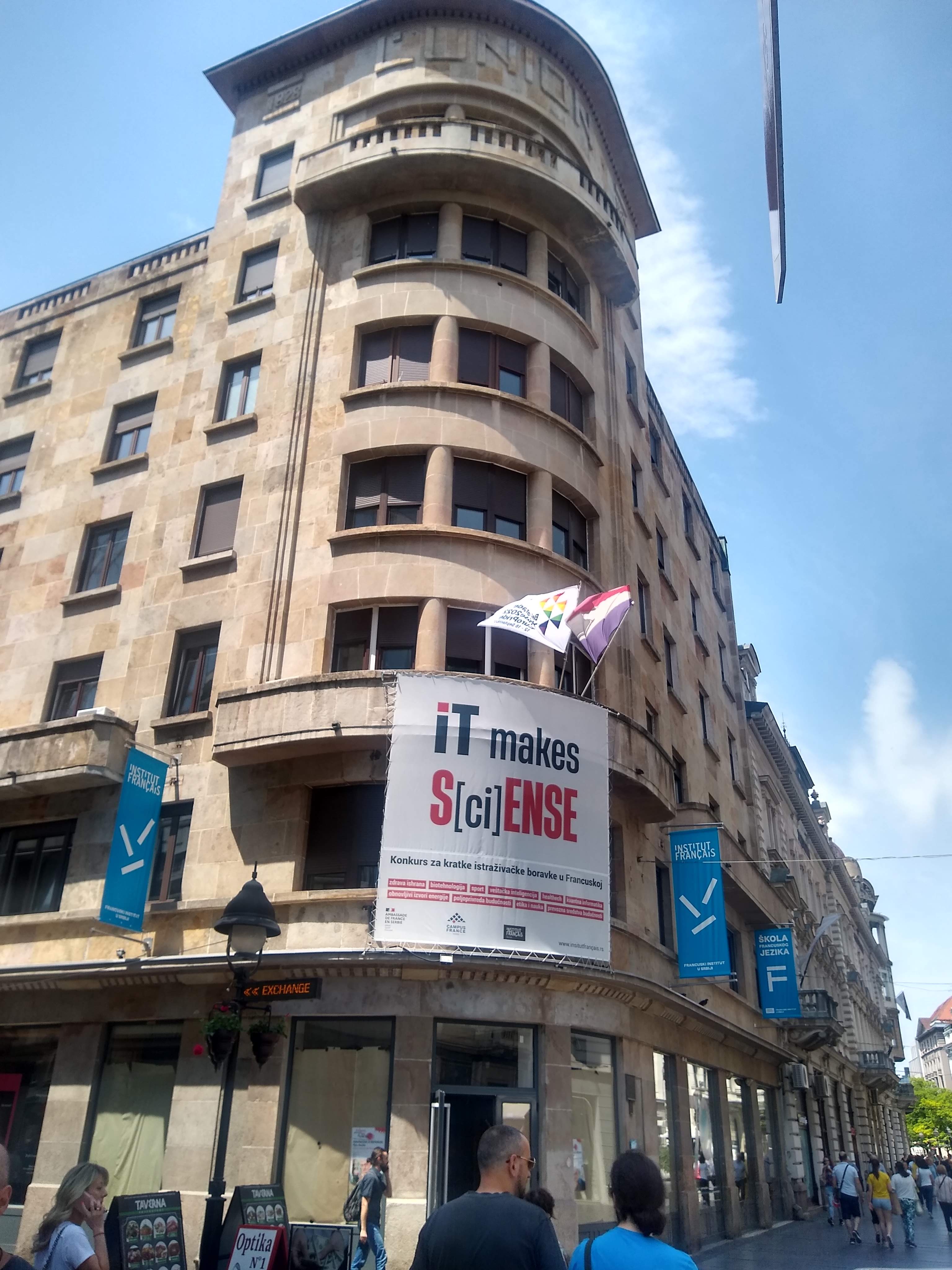
Blocks are anchored by historic buildings, like this one which houses the Institut Francais de Serbie:

Zmaj Jovina 11

Fancy hotels like the Indigo give it a touristy feel:

Kneza Mihaila 20

Geca Kon's bookstore is the oldest bookstore in the Balkans

Kneza Mihaila 12

Al fresco dining is widely available:

Adventure Caffe 2, Zmaj Jovina

While commerce is dominant, there are obvious signs of a residential population:

Akademski Plato 35

Not all apartments are that fancy, though probably the primo location allows for premium pricing:
Down Dure Jaksica

Portals add intrigue to your walk, even if this one goes to a parking lot:

Kneza Mihaila 48

Another portal leads to a Handmade Market:

Entrance to the market

There are museums in the district, including the Zepler Museum of Contemporary Serbian Art:

42 Kneza Mihaila

Street musicians rotate at what seems to be a designated spot. Not all have rabbits.
Intersection with Nikole Spasica.
Steakhouse behind her (Kneza Mihaila 49) advertises halal food

There are wayfinding signs...

Intersection with Kralja Petra

...maps with 5- and 15-minute walk radii...
Wayfinding sign with 15-minute walks from Trg Republike

...and for the globally-minded, a latitude-longitude marker:
a.k.a. Kneza Mihaila 36

Toward the north end of the Knez Mihailova, there is... a mall? Really? It has a Starbucks, WiFi, restrooms, and an information booth that testily stresses it is not a "park ranger" i.e. is only for mall shoppers.
Kneza Mihaila 54

At the approach to the Pariska highway and Kalemegdan Park are two landmark buildings. On the west (left) side is the Salon of the Museum of Contemporary Art, built in 1937.

Pariska 14

Between the Salon and the Pariska, poet and government official Milan Rakic (1876-1938), a native of this very street, tends his garden:

Park Milana Rakica

Across the street is the Belgrade City Library, built in 1867 for a hotel:

Kneza Mihaila 56
(formerly Hotel Srpska Kruna, built 1867)

It has books...

Familiar titles in an unfamiliar alphabet
...and art!


Work by Tamapa Zderic is on display through May 30

The Knez Mihaila ends at the busy boulevard Pariska, across which is the entrance to Kalemegdan Park. 

Wait for the green! The Pariska is wide and cars move fast

Justice in the World Today (II)

Rising rents are just one obstacle to opportunity today (Source: Joint Center for Housing Studies of Harvard University ) Some time ago, Fir...