Friday, January 29, 2021

Can my church be a third place? Can yours? Should yours??

Corridor Urbanism favors bars for meetings.
Why not a church?

The term third place entered the national vocabulary more than thirty years ago with the first publication of Ray Oldenburg's The Great Good Place [Paragon House, 1989], and the concept seems as popular as ever. Clearly, Oldenburg struck a nerve with his description of neighborhood gathering places lost in America's rush to the suburban model of development after World War II. The quest to recover authentic third places has been part and parcel of the back-to-the-city era that has marked the first two decades of this century.

Meanwhile, the book went to a 2nd edition in 1999 (DaCapo), and then in 2001 he edited Celebrating the Third Place: Inspiring Stories about the 'Great Good Places' at the Heart of Our Communities (Marlowe), in which proprietors of third places tell their stories. 

Oldenburg would rather describe third places than provide a crisp definition. The concept is complicated: The Great Good Place runs to 296 pages of text. On page 2 of Celebrating the Third Place, he does equate the term with "a setting beyond home and work in which people relax in good company and do so on a regular basis." His most common short formulation, though, is "informal public gathering places." "Conversation is the main activity," he argues (1999: 26):

Nothing more clearly indicates a third places than that the talk there is good; that it is lively, scintillating, colorful, and engaging.... The persistent mood of the third place is a playful one. Those who would keep conversation serious for more than a minute are almost certainly doomed to failure. (1999: 26, 37)

This conversation must cross friend groups to qualify fully:  

The B.Y.O.F. (Bring Your Own Friends) tavern may initially offer a convincing illusion of a third place, particularly when it is crowded.... The illusion is one of unity, of everybody enjoying themselves together. Upon closer examination, however, one finds that there is no unity.... The individual entering alone is almost certainly doomed to remain that way. The patrons, by their choice of seating, the positioning of their bodies, the contained volume of their voices, and their eye movements indicate that invasion of their group by others is neither expected nor welcome. Nobody meanders from one group to the next. No one calls out to friends across the room. (1999: 171)

Sometimes The Great Good Place seems at war with itself, because the heyday of third places in America occurred in extremely gendered times. If you can have a men-only third place, can you slice and dice the public in other exclusive ways? Can you be a little bit inclusive? Now I'm even more uncomfortable than I was when I started writing this essentializing paragraph, but length constraints require we push on and essentialize, so essentialize we will! 

The subtitle of Oldenburg's first book is Cafes, Coffee Shops, Community Centers, Beauty Parlors, General Stores, Bars, Hangouts, & How They Get You Through Your Day. Celebrating the Third Place includes plenty of those, plus a garden store, a gym, and a photo shop. Just being a cafe doesn't make you a third place, though; he warns against those who would co-opt the popularity of the concept for their own economic gain without providing authentic community:

Developers build houses and call them "homes." They build socially sterile subdivisions and call them "communities." It's called "warming the product." It's also happening with alleged third places. Officials of a popular coffeehouse chain often claim that their establishments are third places, but they aren't. They may evolve into them but at present, they are high volume, fast turnover operations that present an institutional ambience at an intimate level. Seating is uncomfortable by design and customers in line are treated rudely when uncertain of their orders. (2001: 3)

The third places are, then, predominantly small commercial establishments: "The best places are locally owned, independent, small-scale, steady-state businesses" (2001: 4). However, people gather in all kinds of places that don't fit that description, for all kinds of reasons. Can a sports stadium be a third place? How about a grocery store? A high school? A theater group? A Starbucks? A casino? Possum Lodge? A friend's basement rec room? An online college writing center

What about a church? Mine had an orientation/planning meeting last weekend, and the desire to make our church a third place figured prominently in the discussion.


In chapter 2 of The Great Good Place, Oldenburg describes third places as a "leveler" accessible to the entire neighborhood and so expanding everyone's range of association; a "neutral ground" where no one whoever they are has pride of status (with the exception of well-established "regulars"); and a place where conversation is the main activity and main purpose for gathering. They are accessible at most times of day, informal so they accommodate people's home and work obligations, playful, and with a low external profile. At their core...

The first and most important function of third places is that of uniting the neighborhood... Places such as these, which serve virtually everybody, soon create an environment in which everybody knows just about everybody. In most cases, it cannot be said that everyone, or even a majority, will like everybody else. It is, however, important to know everyone, to know how they variously add to and subtract from the general welfare; to know what they can contribute in the face of various problems or crises, and to learn to feel at ease with everyone in the neighborhood irrespective of how one feels about them. A third place is a "mixer." (1999: xvii-xviii)

...in other words, similar to Jane Jacobs's theory of sidewalks, but one level up!

A church, however open it would like its doors to be, is constrained as an informal, public "mixer" by having a creed--though these vary widely in rigidity--and formal membership. Churches have a variety of associations for people, not all of them positive. Their main function is to hold worship services and to provide spiritual benefits to its members. Without products to sell, they rely heavily on fundraising to support paid staff, outreach ("evangelism") to increase membership, and a bewildering array of committees that require members to staff. All run counter to the playful informality of third places, which might be why those tend to be small businesses, which have an owner and employees to keep the beer or coffee flowing and the restrooms clean.

Nevertheless, I've been in a few churches over the years that have some qualities of a third place:

Wesley United Methodist Church and Foundation, Urbana IL, runs a coffeehouse that hosted a broad clientele in the 1980s when I volunteered and quaffed non-alcoholic beverages there. (The church also had a large lounge that attracted students during the week for studying or naps; at least it did during the less security-conscious '80s.)  Back then, at the risk of shocking the young people of today, there weren't coffee houses dotting the landscape, and if you wanted to go someplace near campus that wasn't a bar you had to go to the Etc. The main menu items were "wassail," a very sweet and highly-caffeinated beverage made from Dr. Pepper syrup, and "orts," a sort-of-cheese curds made from Velveeta brand sort-of-cheese. The Etc. is in one corner of a large building, and I'm not sure how many of its customers even know it is attached to a church. In my time it was only open eight hours a week (8-12 Fri/Sat), so limited on the accessibility dimension. 

Getting ready for Jazz Night, March 2018

Westminster Presbyterian Church, Washington DC, has Jazz Night every Friday and Blues Night every Monday--again, only a few hours a week, unlike a regularly-open coffeehouse or bar. Music venues are more for performance than for conversation, but at Jazz Night there are long breaks between sets when people wander all over the sanctuary/performance space to greet each other. Even more conversation can be had in the basement, where they serve delicious home-cooked food. I went there one Friday night to check it out, and after that I returned every time I could. I never attended a service at the church, though. I don't know how many people in the audience do, either, but I suspect it is a lowish percentage. What does the church get out of it? Some spillover increase in membership? Or just the joy of being a community institution?

Veritas Cafe, from their website

Veritas Church, Cedar Rapids IA, is located toward the south end of downtown Cedar Rapids, easily walkable from any of the core neighborhoods. They have been selling Dash Coffee Roasters products in their lobby for a couple years, and are currently open 7:30-3 weekdays. (They close at 12:30 Fridays.)  They have plenty of space, so it's easy to socially distance, and the open floor plan facilitates seeing other people who happen to be there. I attended one service at Veritas in maybe 2017 to see a former student get baptized, and probably won't be back, but that doesn't matter to being welcomed and feeling comfortable at the "cafe."

Each of these churches is built to the street in a walkable neighborhood--design matters!--and they have been able to provide something the neighborhood needs (a safe meeting place during a pandemic, live music, non-alcoholic "wassail") that is sufficiently impelling to overcome any reservations on the parts of attendees about whether they belong there. It's important also that each church sustains awillingness to devote ongoing space, energy, and custodial time to activities which ask nothing of attendees regarding creed or membership, and do not contribute (much) to church attendance, maintenance, or finances. 

Looser affiliations may be where the practice of church is heading in the 21st century, but not all are buying it. Notably, four people at our church's vision discussion--all men, curiously--advocated for more efforts towards increasing membership and financial contributions. There are valid reasons to pursue those goals, too, but they seem at cross-purposes with becoming a third place.

SEE ALSO:

Johnny Dzubak, "What is a Third Place and Why Do You Need One," The Art of Charm, 8 April 2015, and "Third Place, Part Two: Finding the Right Third Place for You," 15 April 2015. Dzubak has a different way of essentializing Oldenburg than I do, with more stress on individual benefits and less on community functions of third places. Nevertheless, it's an interesting take. And I wish Dzubak had been my older brother forty years ago when I really needed these life lessons!

Sara Joy Proppe, "Sit On It," Strong Towns, 21 January 2016. Houses of worship can contribute a lot to neighborhood walkability by providing places to sit in their yards.

Tuesday, January 19, 2021

MLK Against the Mob


Officer Eugene Goodman.
Still from Igor Bobic (Huffington Post) video of Capitol Hill riot
(swiped from Yahoo News)

There is nothing blacker than uncertainty--JULIAN RANDALL

This year's observance of Martin Luther King Day took place less than two weeks after a white supremacist riot at the U.S. Capitol, less than a year after the killing of George Floyd in Minneapolis set off weeks of protests, and during a coronavirus pandemic that has killed over 400,000 Americans, disproportionately people of color. The commemorations mixed anger, sadness, and hope.

The mix of feelings came across strongly during "Not Just Another Day Off," a video medley of poetry and oratory produced by the Folger Shakespeare Library in Washington, D.C. and available through their website until Thursday. Julian Randall, Camonghne Felix, and Joe Ross read original poetry, while actors read excerpts from speeches by Frederick Douglass, James Baldwin, Malcolm X, Audre Lorde, and, of course, Martin Luther King. Felix's poetry in particular ran the gamut of emotions, containing physical pain, anger, hunger, and renewal in one short text. From "Yes, It Is Possible":

But this time, my system nosed down, bringing me down to my knees to purge....

And it was like this for days, I couldn't stomach a morsel, my receptors stunted with the shock of an imminent shift.

...until, at once, it stopped, and I woke to find myself at the kitchen table, perfectly unbothered... as if life itself were some benign victory I'd won.... 

Poet and activist Camonghne Felix

"The American Dream is at the expense of the American Negro," Baldwin stated during a 1965 debate with William F. Buckley. It was this statement that was read for this event, and which created a fascinating juxtaposition on King Day, given that King's most famous oratory is his "I Have a Dream" speech at the March on Washington in 1963. King's formulation assumed a well-made society from which blacks were unjustly excluded; it remained only to undo that exclusion, and blacks too could fully benefit from the American experience. Baldwin suggested two ways in which that American experience could only happen with exclusion and suppression of blacks: black slave labor created the wealth (including the construction of the White House, by the way) that whites enjoyed, and that un-wealthy whites still had the psychic benefit of having blacks between them and the bottom of the social hierarchy. Without the oppression of blacks, whites would lose wealth and social position.

These two takes on the American Dream speak directly to whether the current system is fixable, and why race persistently matters. King describes a world where race loses its relevance when segregation is lifted and barriers to opportunity are removed. He was not so naive to believe that the Civil Rights Act and Voting Rights Act were all it would take, and later argued for direct remedial action. But given civil rights laws, enforcement of civil rights laws, evolving social attitudes, and some degree of reparation, blacks as well as whites can partake of the American bounty. [You could find evidence in professional sports, where racial integration has been followed by spectacular incomes enjoyed by top athletes.]

Baldwin's darker vision suggests that the bounty itself is illusory, that the appearance of wealth only exists because powerful (white) people have taken more than their share. Eliminate oppression, and you eliminate the wealth as well. This is frankly terrifying to contemplate, as we work for inclusive communities with opportunities for all. Can we not have a crowded table with all manner of good things and no one excluded or exploited? But this take on Baldwin helps to explain systemic racism, widening income and wealth gaps, and ten-plus years of white anxiety bordering on paranoia.


Monday morning at 10:30 the DC Library presented Paula Wayne Shelton reading and talking about her book Child of the Civil Rights Movement (Dragonfly, 2013). Shelton is the daughter of Andrew Young, and she talked about knowing Martin Luther King when she was a child, and participating in the 1965 march at Selma. It's an upbeat, celebratory book that ends with the presidential signing of the Voting Rights Act. She was interviewed after the reading by two members of the library's teen council. She told them she wanted to show the "loving, warm and caring person" King was to children who know him only as a statue. There was some reference to current events, but mostly the questions from the children in the audience were of the "What was it like?" and "How did you write it?" varieties. Shelton is currently a 1st grade teacher at Georgetown Day School, and lives near Capitol Hill.

Lovar Davis Kidd, filmed at CSPS Hall

At 7 in the evening, St. Paul's United Methodist Church hosted the annual Cedar Rapids city observance. Since 2020 this has dispensed with a main speaker in favor of a variety show format, this year on the theme of Protest. There were memorable performances of "Lift Every Voice and Sing," "Precious Lord, Take My Hand," and "Amazing Grace," spoken word performance by Rahma and Raafa Elsheikh, and an interpretive dance to King quotes by Lovart Davis Kidd. The Percy and Lileah Harris Who is My Neighbor Awards went to Nate Klein of Mt. Mercy University, and three youth awards: Diamond Roundtree from Washington High School (now at University of Northern Iowa), and Rahma and Raafa Elsheikh from Kennedy High School and the Academy for Scholastic and Personal Success. Ann Harris Carter, daughter of Percy and Lileah Harris, preceded the presentation by reading the Good Samaritan story from the Gospel of Luke, concluding with: "(1) What is this Scripture saying to me? and (2) What am I going to do about it?"
Ann Harris Carter

What would it take to create what King later called a "person-oriented society" as opposed to a "thing-oriented society" (in his 1967 speech "Beyond Vietnam")? As frustrating and maddening as it can be, it seems despair is not an option. We must keep at it.
 
SEE ALSO: Grace King, "Martin Luther King Jr. Service in Cedar Rapids Honors 'Neighbors,'" Cedar Rapids Gazette, 19 January 2021

LAST YEAR'S POST: "Call and Response: MLK 2020," 21 January 2020


VIDEO: Mavis Staples sings "Freedom Highway" live in 2011

Wednesday, January 13, 2021

Iowa: It's Unreal!


(1/13/2021) Iowa Governor Kim Reynolds to state Republicans' latest round of electoral victories in November by saying "they validated the direction we are taking the state" (Pearce 2020). She doubled down on that Tuesday night during the Condition of the State address, praising the state's response to COVID and the August derecho, as well as its budget surplus. She did not mention the state being 7th per capita in COVID cases (17th in deaths), nor its reliance on federal grants for economic relief. Dislocations to businesses and students by the prolonged pandemic were attributed to overzealous precautions, to which she is determined to put a stop.

It has become an article of faith for a considerable chunk of Iowans that the pandemic is relatively benign, and requiring precautions such as facemasks are a blatant attack on our individual liberties. "Our liberties we prize and our rights we will maintain," goes our state motto, possibly written by someone who had a sense of responsibility to his fellow humans, but also possibly an early form of "You're not the boss of me!" Which would be an okay motto as well. The chamber seemed somewhat empty, as some members were (wisely) attending remotely. About half the members shown when the camera cut away from Reynolds were wearing face masks. The front page of Tuesday's Cedar Rapids Gazette showed a crowd of anti-mask protestors at the Capitol. The legislative leadership has said they will not require masks for committee meetings or floor proceedings. Representative Art Staed (D-Cedar Rapids) reported unmasked colleagues at each of the three committee hearings he attended Tuesday.

So Reynolds's call for public schools to open in-person rings hollow. Of course, students should be in school. Besides what must be an accumulating pile of research on the issue, I can testify from my experiences in 2020 going between in-person and online instruction that the very best students do well either way, but the farther you get away from that standard the more trouble students have with online instruction. So let's get students back to the classroom! 

Washington High School, Cedar Rapids, was closed for repairs until this month
(Google Screenshot)

But what has Governor Reynolds, or anyone in Iowa government, done to make that possible? Besides demanding it, I mean. She's resisted shutdowns and mask mandates, and overruled districts that have tried to do pandemic measures on their own. Tuesday night she called for a bill "that gives parents the choice to send their child back to school full-time." She also wants to expand open enrollment [to Des Moines and Waterloo, IPTV commentator O. Kay Henderson explained afterwards] and charter schools, as well as "education savings accounts for students who are trapped in a failing school." There will be no spending increase, though, because she wants to cut taxes again. She was full of flattery for teachers who went to extraordinary lengths for their students this year, but is proposing nothing to make their jobs less difficult or more safe. Minority leader Todd Pritchard (D-Charles City) called this part of the speech "a little bit of warfare with out public schools."

We want to do what other countries have been able to do during pandemic, without any personal inconvenience or going to the efforts they did.

From education Rerynolds pivoted to red meat about BLM protests. Reynolds did wear a facemask on her way out of the chamber... and hugged a whole bunch of people.

Iowans are brave and good and tough, and if you come to our state, you had better be, too!

The complete text of the governor's speech is here.

SEE ALSO:

"Condition of the State 2020," 15 January 2020

"Condition of the State 2019," 14 January 2019

Monday, December 28, 2020

Does America Need a Truth Commission?

Source: https://pursuit.unimelb.edu.au/. Used without permission.

The New Year offers a chance at restart for Americans and the world, along with the rollout of the coronavirus vaccines, and the impending inauguration of the avuncular president-elect Joe Biden. Besides that, though, it offers us all a chance to rest from collective trauma... rest from ten months (so far) of a deadly pandemic and the economic dislocation and social distancing it has wrought, rest from an unusually virulent election campaign whose overtime finally ends January 5 with the Georgia runoffs, and rest from a presidential term marked by relentless and aggressive public relations, alternative facts, erratic policy making, and outbursts of gratuitous cruelty and violence

One way that's been suggested to achieve national rest and reset is through a national Truth and Reconciliation Commission. A local version is underway in Iowa City, to address issues of racial justice. The nine-member commission was authorized by the City Council in June, appointed last month, and began their work before Christmas. They are charged with investigating discrimination, hosting a forum for stories of those impacted by racism, and facilitating conversations across racial lines. Commission member T'Shailyn Harrington told The Gazette: "Once you have these conversations, there's no way someone in good conscience can say instances of racial injustice don't happen in Iowa City. If there's evidence of something, there's no way you can say, 'That's fake news'" (Hermiston 2020; see also KCRG 2020). 

Priscilla B. Hayner in 2016
(Source: Independent Commission on Multilateralism. Used without permission.)

Priscilla B. Hayner, author of a major worldwide survey of truth commissions, suggests five defining features: 
A truth commission (1) is focused on past, rather than ongoing, events; (2) investigates a pattern of events that took place over a period of time; (3) engages directly and broadly with the affected population, gathering information on their experiences; (4) is a temporary body, with the aim of concluding with a final report; and (5) is officially authorized or empowered by the state under review. (Hayner 2010: 11-12)
She counted 40 truth commissions begun through 2009 (Hayner 2010: xi-xii). Hayner is a co-founder of the International Center for Transitional Justice, and has participated in quite a lot of them herself. She is, notably, more frank than sanguine in her reflections.

My interest in this topic comes from my own fatigue, as well as the strong impression that the common life that this blog celebrates has become badly torn. This interest preceded my awareness of public calls for an American truth commission, but come they have. The prolific author and former Labor Secretary Robert Reich called for one in a widely-circulated Tweet in October, promising 
It would erase Trump's lies, comfort those who have been harmed by his hatefulness, and name every official, politician, executive, and media mogul whose greed and cowardice enabled this catastrophe (quoted in Brown 2020). 
The same week, Elie Mystal presented a more detailed argument in The Nation: 
We need a form of truth and reconciliation commission precisely because our normal institutions have failed.... When a plane falls out of the sky, we don't just shrug our shoulders and say, 'Gravity has consequences.' We send in a team of experts to pick through the wreckage, figure out exactly what went wrong, hold people accountable, and make recommendations for future safety (Mystal 2020). 
Similar calls came from U.S. Senator Elizabeth Warren (D-Massachusetts) and MSNBC commentator Chris Hayes. More narrowly, Elaine Kamarck of the Brookings Institution has called for a commission to review "what went wrong" with the American government's handling of the coronavirus pandemic (Kamarck 2020).
Makeshift medical facility in North Carolina, March 2020
(North Carolina Health News. Used without permission.)

The idea is far from universally beloved. Hillbilly Elegy author J.D. Vance called the advocates "whiny," telling FOX News: 
Instead of... moving on with the life of American democratic politics, they want to go backward and punish everybody.... [R]eally what this is saying is you are going to be punished for trying to implement your ideals and principles into the work of government (Creitz 2020). 
More objectively, Harvard professor Jill Lepore argues that a commission focused on Trump would violate the American tradition of peaceful transfers of power dating back to the election of 1800. The Trump administration should be investigated by journalists, chronicled by historians and, in some cases, tried in ordinary courts. She does support proposals to use commissions to study the coronavirus response, racial injustice, and American Indian boarding schools. More broadly, 
what the nation needs, pretty urgently, is self-reflection, not only from Republicans but also from establishment Democrats and progressives and liberals and journalists and educators and activists and social media companies and, honestly, everyone (Lepore 2020).
Moreover, the record of past truth commissions is mixed. South Africa's famous post-apartheid truth commission allowed victims of violence to speak before the nation, but ignored broader impacts of the apartheid system. Commissions' capacity to accomplish nationwide reconciliation is vastly overstated (Zvogbo and Crawford 2020). Even the most successful commissions fall short of their ideal goals: A South African statement-taker told Hayner Perhaps sixty percent feel better, but those people are only healed sixty percent (Hayner 2010: 150). 

Jules Bakery in Marion is the latest metro business to close.
(Source: julesbakery.com. Used without permission.)

Maybe Lepore is right, and what we really should be doing is self-reflection. But like most Americans, I think on reflection that I'm pretty cool already. Maybe what America needs is not a Truth Commission so much as an Empathy Commission to guide us toward that self-reflection. This is definitely not to settle political scores; I'll let prosecutors and creditors deal with the President. However, we can have common life only if we are inclusive enough to know something of each other's stories, and can once again see difference as a variation of "us" rather than an alien "them." We need to not merely to affirm in words each other's humanity, we need it to feel it in our guts. Off the top of my head the commission should hear testimony from: 
  • Central American refugees whose children were taken from them
  • immigrants who contracted COVID in detention 
  • state government officials and workers who dealt with a succession of instigated attacks while also managing elections, a recession, and the coronavirus
  • people of color who have faced official or unofficial violence
  • peaceful protestors who met with official violence
  • police officers who have dealt with protests during a pandemic
  • people who have suffered looting of their property
  • people who have suffered violent crime
  • health care workers on the front lines against COVID
  • small business owners whose livelihoods have suffered during the pandemic
  • school teachers and staff
  • school age children
  • parents of school age children
  • people who've worked through the pandemic at meatpacking plants, grocery stores, and other "essential" but low-paying, low-security, and high-exposure jobs
  • religious groups whose observances have been disrupted
  • elderly and disabled people whose activities and contacts have been severely curtailed
Pitfalls immediately appear. It might well seem to be trivializing the historical pervasiveness of racial injustice by wedging it in besides all these more recent problems. We are ill-advisedly deviating from Hayter's five essential features, as (1) many of these situations are ongoing, (2) the list fails to focus on a pattern of events, and (3) it fails to focus on a single affected group of people. At the same time, the J.D. Vances of the world might see the Empathy Commission as another form of "whining," while the event itself could get entitled or political in a hurry. Maybe we'll wind up recycling some more unsubstantiated but highly colorful allegations of voter fraud

It's also not clear Americans all want to move on, or even have an inclusive common life. Well over 40 percent of Americans continue to support Trump's performance as President, and are not likely to want to move on from whatever he represents to them. A Pew Research Center survey this fall found 77-80 percent of both Trump and Biden voters saying about the other group, "Not only do we have different priorities when it comes to politics, but we fundamentally disagree about core American values." An even larger proportion of both camps, 89-90 percent, said election of the other candidate "would lead to lasting harm to the U.S." The severity of political conflict has grown increasingly divorced from the magnitude of policy disagreement, wrote a group of scholars in Science magazine this fall, featuring the tendency to adopt a moralized identification with one political group and against another--in other words, they are not just wrong they are "alien" and "iniquitous" (quoted in Edsall 2020).

Maybe my Empathy Commission could tone those feelings down a bit, but at this point how do we even get people to the table?

Redmond Park, Cedar Rapids, a public space with potential
in the Wellington Heights neighborhood

Though there are lots of reasons why it can be unpleasant (Cox 2020), we each of us need to learn how constructively to encounter difference. If that can happen, it will most likely happen at the local level, rather than via national television or social media. There's the Iowa City effort. There's Richmond, Virginia, where the National Trust for Historic Preservation is supporting an effort to transform Shockoe Bottom, once America's second-busiest slave market, into a "site of conscience"... part of the international network of such historic places that bring difficult history to light and spark public dialogue to address modern-day injustices (Nieweg 2019); first they had to undo a surface parking lot and block suburban-style development of a baseball stadium. Also in the Cavalier State, the legislature has legalized "jaywalking," a huge step in democratizing streets (Gordon 2020).

In a well-designed place, buttressing such conversations that a commission "authorized or empowered by the state" (Hayter again) are able to facilitate, people come together randomly, unintentionally, and frequently on the city's sidewalks. Good fences may make good neighbors, but we also need gaps in those fences where neighbors can meet in low-stakes encounters that build trust (Jenny 2020). Let's hear from Jane Jacobs again:
I do not mean to imply that a city's planning and design, or its types of streets and street life, can automatically overcome segregation and discrimination. Too many other kinds of effort are also required to right these injustices.

But I do mean to say that... tolerance, the room for great differences among neighbors--differences that often go far deeper than differences in color--which are possible and normal in intensely urban life, but which are so foreign to suburbs and pseudosuburbs, are possible and normal only when streets of great cities have built-in equipment allowing strangers to dwell in peace together on civilized but essentially dignified and reserved terms. ([1961] 1993: 94-95) 

New Bo City Market courtyard, a public space amidst drive-to urbanism,
but with easy access to core neighborhoods

Of the 2021 priorities for cities in Strong Towns's end-of-year survey, some focus on physical structures, some on financial arrangements, and only some directly on people, but all involve improving proximity. Joel Dixon (zoning), Talicia Richardson (regulation), Tamika Butler (equity), and Mike McGinn (combination of all three) in particular point out that good public space involves physical design, but also an inclusive approach to who is allowed to use that space, and how they are allowed to use it.

When it comes to encountering difference, we need the conversations that a commission can facilitate, but success requires a well-designed place. 

PRINT SOURCES: 

Lee Hermiston, "'Truth and Reconciliation Commission' Gets Started," Cedar Rapids Gazette, 20 Sunday 2020, 1C, 8C

Jane Jacobs, The Death and Life of Great American Cities (Modern Library, [1961] 1993)

Tuesday, December 22, 2020

The Spirit of Christmas Needs Urbanism!

Greene Square, Cedar Rapids

In Adam Hamilton's new book analyzing the meaning of Christmas for Christians, he spends a chapter on the Scriptural image of Jesus-as-light. The Gospel of John introduces Jesus with The true light, which enlightens everyone, was coming into the world (John 1:9, NRSV), and later Jesus describes himself, I am the light of the world. Whoever follows me will never walk in darkness but will have the light of life (John 8:12, NRSV).

What is this darkness, and this light? Hamilton identifies two sources of darkness: [1] moral darkness, external acts of selfishness or misguided zeal like terrorist attacks and child abuse; and [2] existential darkness, internal feelings of being lost or unloved (2020: 123-128). He goes on to describe the birth of Jesus as "God's response to both moral and existential darkness" (128), providing hope and trust in times of despair. But as the chapter continues, there is an interesting turn. As it turns out, 

We are God's plan for changing the world... for addressing injustice, for healing the wounds of injury and suffering. We are God's plan for including every person in this beloved community.... As we become children of the light, we cannot keep that light within ourselves. It is meant to spill out from us naturally and touch the lives of others. And every time it does, the light extends just a little farther, the darkness recedes bit by bit, the kingdom of God expands, and the world is changed. (140-141, emphases mine)

Hamilton illustrates this concept with the story of Kansas City's Secret Santa, who gives away $100,000 worth of $100 bills each Christmas season to people who need it (143-145). I'm ambivalent about this example, which is so striking it's easy for people to say, "Great, but I can't afford to give away $100,000 to strangers," and to dismiss it. A better example is the woman (p. 143) who helps low-income children both locally and in Africa, though again how many of us can afford to travel to Africa?

I take his main point, vividly illustrated by the collective passing of candlelight at Christmas Eve service, to be that each of us has the potential and the task to spread the light. "In our world," he warns, "you're either bringing darkness or light" (146). Without the option of sitting on the sidelines cheering on spectacular heroes like Secret Santa, we can spread the light steadily, which more often than not is going to mean incrementally. Smiles or friendly words are ways the light gets spread that are attainable for any of us.

Sometimes it can happen just by being there. In the early years of Brewed Awakenings Coffeehouse in Cedar Rapids, I invited myself to play guitar on the occasional afternoon, and when they didn't chase me away, I kept doing it. One day a woman came in and sat with her coffee by the fireplace near where I was singing. She stayed for awhile, and as she left she said, "Thank you for singing. I was feeling terrible when I came in, but your songs are funny and they made me feel better." I hadn't come there with that intention. If I'm honest with myself, my main motive was probably seeking attention. But I somehow became a vessel for the light to reach her existential darkness.

The lesson is in how many things had to come together for that to happen: There had to be a coffeehouse, or some kind of third place, for her to go for respite, that also occasionally welcomed goofy would-be songwriters. Its existence required an intrepid entrepreneur like Deb Witte, who started Brewed Awakenings, a city code that enabled it to open, and an older, low-rent building in a decent location to facilitate its takeoff. Even Secret Santa needs a place where he can efficiently encounter people to help. In suburban style development he could walk for a very long time before encountering anyone at all, whether or not they were in need of his help.

Light can get spread all kinds of ways, in all kinds of places. But if we want it to happen a lot, and Hamilton says God does so we do too, then we need the kind of places where people encounter other people on a frequent basis. In other words, we need walkable urbanism, with its short blocks, safe and interesting walks, mix of uses, and human-scaled buildings close to each other. 

In her chapter entitled "The Uses of Sidewalks: Contact," Jane Jacobs demonstrated how city design done right facilitates a series of informal, low-stakes encounters that grew social trust, community identity, personal safety, and organizing capacity:

The sum of such casual public contact at a local level--most of it fortuitous, most of it associated with errands, all of it metered by the person concerned and not thrust upon him by anyone--is a feeling for the public identity of people, a web of public respect and trust, and a resource in time of personal or neighborhood need. ([1961] 1993: 73, emphasis mine)

 City design done wrong kills those capacities:

The more common outcome in cities, where people are faced with the choice of sharing much or nothing, is nothing. In city areas that lack a natural and casual public life, it is common for residents to isolate themselves from each other to a fantastic degree. (85)

Do you want to spread the light? Have you resolved, with the woke version of Ebenezer Scrooge, to "honour Christmas in my heart, and try to keep it all the year?" Either we make progress towards walkable urbanism, or else we fail and the world gets darker.

SOURCES

Adam Hamilton, Incarnation: Rediscovering the Significance of Christmas (Abingdon, 2020)

Jane Jacobs, The Death and Life of Great American Cities (Modern Library, [1961] 1993)

SEE ALSO: 

Robert Steuteville, "My Christmas Wish: A Return to Street Grids," Public Square: A CNU Journal, 22 December 2020

David Vera-Barachowitz, Mike Flynn, and Lian Farhi, "The Post-Pandemic Street," Planetizen, 22 December 2020


Tuesday, December 15, 2020

Religious freedom for whom?

The Bill of Rights in the U.S. Constitution begins with religious freedom: Congress shall make no law respecting an establishment of religion, or prohibiting the free exercise thereof... (Of course, the primacy of these phrases is due to the first two amendments proposed by Congress failing of ratification in the state legislatures, so what was to have been the third amendment got elevated to first. I'm trying to execute a rhetorical flourish here, so please keep your historical accuracy to yourself.)

(And yes, I do occasionally contemplate groups of angry white men proclaiming their 4th Amendment right to brandish automatic weapons, as well as nervous white-collar defendants pleading the 7th.)

Bill of Rights cartoon


We get very little help, alas, from the members of 1st Congress, in elaborating the meaning of those religious freedom phrases, including words like "exercise" and even "religion" (Witte and Nichols 2016: 81-95). For much of the U.S. history, the Supreme Court has wrestled with articulating a standard for deciding cases when religious people, however defined, claimed exemption from laws. In Reynolds v. U.S. (1878), dealing with the Mormon practice of polygamy, Chief Justice Morrison Waite argued that religious people were never entitled to exemptions from otherwise-constitutional laws: To permit this would be... in effect to permit every citizen to become a law unto himself. Maybe, but by the 1940s, when the religious freedom clauses began to be applied to state laws, Waite's non-standard was widely thought to be inadequate. In the 1963 case of Sherbert v. Verner, dealing with a Seventh Day Adventist denied unemployment compensation benefits for refusing to work on Saturday, the Court required a religious exemption because the state (South Carolina) had failed to demonstrate a "compelling state interest." Even when the government demonstrated such an interest, they would also need to prove that denying religious exemptions was the "least restrictive means" possible to attain that interest.

In 1990, a new Justice Antonin Scalia wrote a decision moving the standard back towards Reynolds. In deciding against members of the Native American Church whose ceremonial use of the drug peyote ran afoul of Oregon narcotics laws, Scalia wrote: We have never held that an individual's religious beliefs excuse him from compliance with an otherwise valid law prohibiting conduct that the State is free to regulate. At another place he used the phrase a neutral, generally applicable regulatory law, which led to this standard being dubbed "general applicability." Even the general applicability standard, though, was not enough to save a Hialeah, Florida ordinance prohibiting animal sacrifices, which the Court found had been specifically aimed at thwarting the Santerian Church of Lukumi Babalu Aye.

The Supreme Court building in 2018

The general applicability standard has not worn well (Volokh 2015).  It was never overruled by constitutional amendment, but a bipartisan effort in Congress restored the compelling state interest for federal law in the Religious Freedom Restoration Act of 1993. Ironically, social conservatives who revere Scalia have proven the most restive; their efforts described by Goldford (2012) to include orthodox forms of Christianity in the original meaning of the Constitution have shifted in these changing times to... claiming religious exemptions from generally applicable laws. In 2015, the Court found 5-4 in Hobby Lobby v. Burwell that the religious owners of the Hobby Lobby Corporation were burdened by the contraceptive coverage requirement in the Affordable Care Act. The Obama administration's arguments for a compelling state interest in providing access to health care were rejected, as well as their proposals for any alternative means to achieve it. (See the companion case of Wheaton College v. Burwell, also a 5-4 decision, finding a religious college was burdened by filing a form to get exempted from the contraceptive provision.)

Most recently, there are last month's 5-4 decisions in Roman Catholic Diocese of Brooklyn v. Cuomo and Agudath Israel v. Cuomowhich found the State of New York's pandemic restrictions on public gatherings improperly applied to attendance at religious services. (See Dawid 2020Barnes 2020.) Another decision is expected soon on a similar case from California (cf. Liptak 2020). 

Part of the problem with the pandemic cases has been the level of nuance in state restrictions. They can read like Euclidean zoning codes, making hair-splitting distinctions that leave them vulnerable to attack on grounds of favoritism. The Diocese of Brooklyn complained in their petition to the Court they were subject to onerous fixed-capacity caps while [the state was] permitting a host of secular businesses to remain open in "red" and "orange" zones without any restrictions whatsoever.... The result is that Target and Staples can host hundreds of shoppers at a time, and brokers can spend 40 hours per week working and hosting customers in poorly ventilated office buildings, but Catholics cannot attend a 45-minute Mass. When Governor Andrew Cuomo defended the measures because some Catholic and Jewish services had become super-spreader events, the plaintiff organization Agudath Israel said he had drawn targets on a map over neighborhoods of a discrete religious minority (all quotes from Barnes 2020; see also Liptak 2020)

(The New York orders' alleged discrimination against religious exercise was disputed. Justice Sonia Sotomayor, in her dispute in Diocese of Brooklyn, argued New York treats houses of worship far more favorably than their secular comparators, noting that the orders closed movie theaters, concert venues, and sports arenas, while houses of worship only had to limit attendance. Surely the Diocese cannot demand laxer restrictions by pointing out that it is already being treated better than comparable secular institutions.)

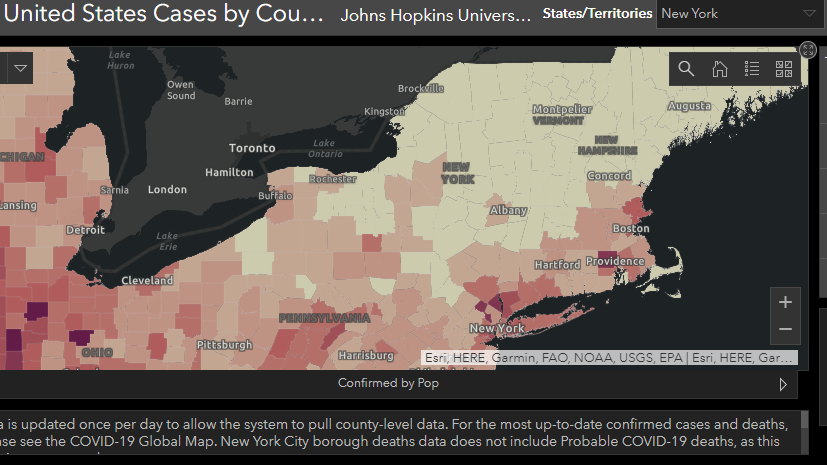
COVID Cases by county, New York and environs
(Source: Johns Hopkins University of Medicine. Used without permission.)

Unlike Hobby Lobby and Wheaton College (Sullivan 2014), the pandemic cases don't involve arguably unresolvable issues of whether the plaintiffs are exercising religion; they unquestionably are. The issue in Diocese of Brooklyn and Agudath Israel is whether there is a compelling state interest. The unsigned majority opinion doesn't reject outright the presence of public health considerations during a pandemic that has officially killed 300,000 Americans and likely has killed 100,000 more. It is also true that America has fared far worse during the pandemic than other industrialized countries, largely because we've been unwilling to impose more stringent restrictions. (The chart at the bottom of the post compares coronavirus death rates among advanced industrial democracies. The United States, an outlier in terms of religious devotion, is not the poorest-performing of the group when it comes to keeping its citizens alive, but many of our less religious peers have done much better.) And some individuals, like health care workers and those with disabilities, are particularly at risk when the contagion is not controlled (Mogul 2020Wilder 2020).

Yet, the decision argues, The restrictions at issue here, by effectively barring many from attending religious services, strike at the very heart of the first amendment's guarantee of religious liberty. If controlling a deadly pandemic is not a "compelling state interest," what state interest could possibly qualify? Does the First Amendment now require religious exemptions to all laws? I'm proud to be an American, where at most I know I'm free? 

Just like state governments struggling to rationalize pandemic restrictions, the Supreme Court needs for its own and everyone else's sake to avoid appearing arbitrary and capricious in articulating standards for its decisions. With certain notable exceptions, including the Santeria case, the free exercise clause has been interpreted in whatever way favors traditional majority culture: yes to conservative groups wanting exemptions from public health regulations, yes to evangelical business owners who don't want to insure their employees if they have to include contraception, yes to evangelical bakers who don't want to make wedding cakes for gays, no to Native American peyote users or cemetery owners, no to Mormons (at least in the 19th century). Libertarianism for me, authoritarianism for you?

Traditional majority culture has found a home in the Republican Party, as witness overwhelming white evangelical support for Republican candidates from Reagan to Trump (Gjelten 2020); meanwhile it responds to demographic and cultural change by going into a defensive crouch. "It pains me to say this," Justice Samuel Alito told the Federalist Society, "but in certain quarters, religious liberty is fast becoming a disfavored right" (Barnes 2020). Disfavored by whom? That sounds too much like President Trump trying to rediscover the War on Christmas. Five of the six Republican appointees to the Court made up the majority in these decisions. Whose favoritism matters?

In a 2014 blog post, Prof. Winnifred Fallers Sullivan of Indiana University highlights the riskiness of all free exercise jurisprudence:

The need to delimit what counts as protected religion is a need that is, of course, inherent in any legal regime that purports to protect all sincere religious persons, while insisting on the legal system's right to deny that protection to those it deems uncivilized, or insufficiently liberal, whether they be polygamist Mormons, Native American peyote users, or conservative Christians with a gendered theology and politics. Such distinctions cannot be made on any principled basis. (Sullivan 2014)

Protection versus denial is a binary choice, and like most binary choices it is a false one. We can and should agree to protect the religious liberty of all, but take into account the social costs of exercise. Native American Church members should not be driving cars while impaired by peyote, and in fact the controlled nature of their ceremonies prevents that. Religious exercise that prevents non-participants from accessing health care is a different matter, though we could address the flaws in the health care system that give rise to the question in the first place. Religious exercise that puts non-participants at significantly higher risk of contracting a deadly disease should not be arguable... unless we're claiming that protection of religious liberty can never be limited. 

Without a "principled basis" for deciding free exercise cases, and consistent application of those principles, what are we left with but the exercise of power by one group over another? "Religious freedom" is a rather lofty phrase for that.

Thanks to my colleague Dr. Meira Kensky for pointing me towards the piece by Sullivan, and other helpful suggestions.

SEE ALSO: "Rights and Our Common Life," 26 August 2015

PRINT SOURCES

Dennis J. Goldford, The Constitution of Religious Freedom: God, Politics, and the First Amendment (Waco: Baylor University Press, 2012).

John Witte Jr. and Joel A. Nichols, Religion and the American Constitutional Experiment (New York: Oxford University Press, 4th ed, 2016)

DATA

COUNTRY          COVID DEATHS       PER 100,000        % REL V IMP

Belgium                      18,054                        158                    11

Italy                             65,011                        108                    21

Spain                           48,103                        103                    22

United Kingdom         64,402                          97                    10

United States             301,006                          91                    53

France                          57,911                          86                    11

Sweden                          7,514                          74                    10

Switzerland                    5,692                          67                      9

Netherlands                  10,168                          59                    20

Portugal                          5,649                          55                    36

Austria                            4,648                          53                    12

Ireland                             2,126                          44                    22

Canada                          13,553                          37                     27

Germany                        22,475                          27                    10

Denmark                             950                          16                       9

Finland                               466                             8                     10

Norway                               393                             7                    19

Australia                             908                             4                     18

Japan                                2,649                             2                     10

South Korea                        600                             1                     16

SOURCES: New York Times interactive “Coronavirus World Map: Tracking the Global Outbreak,” 12/15/2020; Pew Center for Religion and Public Life, “The Age Gap in Religion around the World,” 6/13/2018

Saturday, November 28, 2020

Whither Iowa?

In an election that sent mixed messages nationally, Iowa clearly reaffirmed its move to the Republicans in 2020. President Trump won the state by eight percentage points, U.S. Senator Joni Ernst was reelected by a 52-45 margin, Republicans gained two U.S. House seats, and the party strengthened its margins in both houses of the legislature. Iowa's Republican victories contrast it with Georgia, which voted for the Democratic presidential candidate for only the fourth time since 1960, and Arizona, which had previously gone Democratic only once since 1948. (For more on swinging swing states, see Mejia and Skelley 2020.)

Andrew Green, a political scientist at Central College in Pella, concludes: I was of the mind that the right candidate and the right message was the ticket to win back some of those voters. And if Joe Biden isn't that candidate, I'm not sure what other national level Democrat would be able to come into the state and win back those voters. I fear they're lost, if not for a generation but maybe longer than that (Murphy 2020: 7A).

Iowa went for Trump by eight percentage points in an election that Joe Biden won nationally by four. This twelve point swing away from the winner was one more than in 2016, when Trump won Iowa by nine and lost the national popular vote by two. The last election with a greater swing was at the height of the farm crisis in 1988, when Democratic candidate Michael S. Dukakis won Iowa by 10 points while losing nationally by eight to George H.W. Bush.

The crisis this year is the coronavirus. Iowa currently ranks #3 in the world for the prevalence of COVID-19 infections (New York Times 2020), and we've just had our worst week yet for deaths from COVID, but Republicans seem to pay no price for irresponsible statements and actions from Trump on down to the state level. Our irritable governor, Kim Reynolds, was not wrong when she said the election results "validated the direction we are taking the state."

If a pandemic and an erratic President couldn't shake that direction, I think Iowa's course is set for at least the next decade. Looking at the map above, we can identify:

  • four solidly blue counties: Johnson (Iowa City), Linn (Cedar Rapids), Polk (Des Moines), and Story (Ames), including the state's two largest cities and the two larger state universities
  • five counties that were roughly evenly split: Black Hawk (Waterloo-Cedar Falls), Dallas (West Des Moines), Dubuque, Jefferson (Fairfield), and Scott (Davenport), a mix of legacy industrial, burgeoning suburb, and Fairfield
  • 90 solidly red counties: all the rest, which include rural and struggling urban areas
Data from the U.S. Census Bureau (except the GDP numbers, which come from the Bureau of Economic Analysis) show the election results reflect the reality of two Iowas, one of which is older, whiter, and poorer than the other, shrinking in population but still numerically stronger:


IOWA

Blue counties (4)

Divided (5)

Red counties (90)

Population

2019

3,155,070

965,124

(30.6)

513,230

(16.2)

1,676,716

(53.1)

Pop. Growth

2000-2019

   228,746

207,835

  82,466

     -61,555

Job Growth

2010-2019

   143,194

  77,335

  40,382

      25,474

Pct White

2019

89.9

84.3

86.8

94.0

Pct 25-34 w BA+

2019

  4.3

  6.6

  5.2

  2.7

GDP (x $1000)

2018

189,701,596

73,927,772

(39.0)

29,515,941

(15.6)

86,257,883

(45.5)


Iowa's political and economic patterns vary less by urban vs. rural than those of the nation as a whole, the counties Biden won account for 70 percent of the economy--very close to the Trump/Clinton divide in 2016 (Muro, Duke, You and Maxim 2020; see also Rucker and Costa 2020). The Brookings Institution authors conclude:
Blue and red America reflect two very different economies: one oriented to diverse, often college-educated workers in professional and digital services occupations, and the other whiter, less-educated, and more dependent on "traditional" industries.... The economic rift that persists in dividing the nation is a problem because it underscores the near-certainty of both continued clashes between the political parties and continued alienation and misunderstandings.

But the problem isn't economic diversity, as the authors eventually admit, or even inequality of outcomes. Diversity should be a source of resilience in uncertain times, and if some sectors of the state are succeeding better than others, we can use some of those resources to help struggling sectors and places improve. One might expect that Republicans would use the political power they've attained since 2010 to do exactly that, but as I've argued, they've tended to, in the words of Muro et al., "stoke the hostility and indignation held by a significant minority." (President Trump made this a major source of his political appeal, and weirdly for an incumbent President made his biggest 2016-20 gains nationally in the counties with the least job growth, but he's been far from the only one.) More of this, they conclude, would be "a particularly unsustainable situation for Americans in communities of all sizes."

A collaboration between Strong Towns and Urban3 argues for more local-driven initiatives, including matching microgrants for property improvements, reform of outdated and restrictive zoning and building codes, and improving walkability (Marohn 2020). Others have suggested a rural housing initiative, investment in local human capital, taking advantage of specific local assets like access to natural areas, and encouraging immigration (Menner 2018, Benfield and Epstein 2012, Brown 2018, Gilmartin and Hurley 2018). Another Brookings study suggests several initiatives President Biden and the next Congress could undertake to update struggling economies as well as the bewildering array of federal rural policies, including access to broadband and financial capital; regional integration; and thorough policy review (Pipa and Geismar 2020). 

An Iowa that acts to support its strong towns and rural areas will be a stronger, more attractive state in years to come. But symbolic acts of resentment--"defunding" Planned Parenthood, preempting school districts' and county auditors' attempts to operate during the pandemic, passing bill after bill against gun control or abortion, banning non-existent Sanctuary Cities--are cheaper and easier.  "Let's stop pretending it was 'economic anxiety,'" Democratic pollster Conrad Belcher told the Washington Post. "That ugliness is about tribalism. Many of the most hotly contested states are ground zero of the changes happening in America.... Where this battle is hottest is where diversity is greatest" (Rucker and Costa 2020). 

Iowa ranks 11th among U.S. states in how much our demographics resemble the America of the 1950s (Kentucky is 1st; Kolko 2016). We can't and shouldn't try to preserve that; continuing down the road of tribalism would make the whole state, including where cities have been successful, less attractive. For now, it may be enough to say with Lyz Lenz:

This town, this state, it belongs as much to me as it does to anyone else. I don't know why I keep waiting around for Iowans to say I belong. I belong. I have now lived here longer than I have lived anywhere else. And truly, the problems here exist everywhere: it's just easier to hide from them in other places.... And I don't know who needs to hear this, but the place you are, it belongs to you, too.... Even if you have to watch as local politicians annually debate your right to make your own healthcare choices. Even if you have to watch people who make your body and your life a joke get reelected over and over. (Lenz 2020) 

Lenz concludes, "I am here, and I love this town," and so am I; the state's attractions cannot be denied, its successful places are successful for good reasons, and the brain drain in most of the state is likely to remain at most at a steady trickle. Still, the future of the state depends on us committing to having one, which is difficult when nostalgia and resentment keep winning at the polls.

SEE ALSO:
Brookings report: "Building Resilient Rural Places" (1 December 2020)
Erin Murphy, "Iowa's Urban-Rural Divide Widens," The Gazette (Cedar Rapids), 8 November 2020, 1A, 7A

Justice in the World Today

  Hope he gets some of that coffee: Statue of Thucydides in Vienna, Austria (7/31/2026)  A long time ago, according to the ancient Greek his...