Thursday, August 8, 2013

Auto-Row Historic District update

The mission-style Firestone building is not going to be part of
an Auto-Row Historic District...

...but there's still a possibility for this former Pontiac dealership.

The proposed Auto-Row Historic District received the final nail in its coffin at tonight's meeting of the Cedar Rapids Historic Preservation Commission, at least in its current form. Several speakers raised the possibility of creating a smaller version of the district some time in the future.

Terry Toye of the Federal Emergency Management Administration (FEMA) told the commission that FEMA supported the current proposal of the City of Cedar Rapids and other stakeholders to use the money that had been intended to support the Auto-Row designation for seeding a new program in historic preservation at Kirkwood Community College. The proposal to use FEMA money for this program is now up for 30-day review, Toye said. She added that FEMA is anxious to get the original grant application, which dates from 2008, closed out.

The money under discussion has an odd history. After the 2008 flood, FEMA awarded the city a flood mitigation grant to repair the heavily-damaged 1st Street Parkade. When the city decided instead to demolish the parkade, it proposed an alterate project, that being the creation of the Auto-Row Historic District. It would have commemorated the building of numerous auto-related businesses along 2nd and 3rd Avenues SE beginning in the 1910s, and helped to preserve those structures still standing. The proposed district would have included 2nd Avenue on both sides from 6th to 7th Streets, and on the south side from 7th to 10th Streets; and 3rd Avenue on both sides from 7th to above 8th Street, except for a parking lot on the southwest corner of 3rd and 8th. The proposal was vigorously opposed by St. Luke's Hospital, but supported by many smaller property owners. A further twist in the drama occurred when several supporters were not notified of a meeting of stakeholders last winter. Faced with apparent majority opposition, including the powerful medical interests, the city withdrew its earlier support for the project and switched to the Kirkwood proposal. (No supporting businesses were present at this meeting.)

Toye said that if the signatories switched back to Auto-Row, FEMA would be amenable, but noted that contributing structures between 7th and 10th Streets have been demolished since the original proposal making the overall case weaker, besides which time is running out on the original grant. She noted the peculiarity of the process that led to the Kirkwood proposal, but did not seem fazed by it.

Several members of the commission, while acknowledging the finality of the grant decision, expressed hope that some Auto-Row proposal could go independently forward. Todd McNall admitted "HPC made some decisions without all the property owners having been notified," and so "we should pursue some designation." Tim Oberbroeckling asked "How many [businesses] are going to pull out" of historic structures in the area without the designation and the financial incentives that come with it, and with the possibility of generous purchase offers either from downtown or medical interests. Mark Stoffer Hunter argued there is "plenty of real estate for both [new commercial development and historic preservation] to happen," as has been the case downtown and in New Bohemia.

Most discussion centered on the block of 2nd Avenue between 6th and 7th Streets. There are seven buildings on the block, all businesses or nonprofits, six close enough to their original design to be considered "contributing." Doug Jones of the state historic preservation organization was encouraging, noting that a lot of the research and preliminary comments had already been done relative to the original proposal.

John Albert {?} of the MedQuarter commission said that historic preservation is part of the master development plan they are working on.

Friday, August 2, 2013

Walking down to the edge of town

James James
Said to his Mother,
"Mother," he said, said he:
"You must never go down to the end of the town,
if you don't go down with me."
--"DISOBEDIENCE," A.A. MILNE


1st Avenue is unique in Cedar Rapids in that it goes from one end of the town to the other. Interstate 380 ("Avenue of the Saints") and U.S. 30 also do, but those are limited access highways not streets. 1st Avenue begins on the northeast side at the border with Marion, past Collins Road, and goes through several miles of mostly commercial strips until you get to my neighborhood near Coe College. That's where I pick it up; last week Eli and I walked the rest of the length of it, about 8 miles to where it ends in a subdivision, at an intersection with 80th Street West. Along the way it takes you through a number of strata of the town.

(Entering the Coe College campus, at College Drive [13th St])

Between Coe and downtown, 1st Avenue goes through a modest commercial district. This is a mostly "dead zone," but less so on 1st than the other streets. It has a few small collections of restaurants, bars and other shops. The 1100 block on the south side has two restaurants and a bar, convenient to Coe and the medical buildings. A similar bunch is in the 800 block on the north side, with a restaurant, a bar, a cleaners, and my former student's law office.

(1100 block southeast, from Coe's campus)

It also has the new Central Fire Station, which is nearly complete.

(Central Fire Station, 713 1st Av SE, under construction)

Downtown proper, to my mind, begins at 5th Street. As you can see the entry view is dominated by the massive hotel and exhibition center on the north side. As we walked by, the valet parkers were ready and able, but without much business at 11:30 a.m.

(Entering downtown, 1st Av and 5th St SE)

The east and west sides of town are demarcated by the Cedar River. On the left, on Mays' Island, is the Veterans Memorial Building that served as the city hall before the 2008 flood. It is being rehabbed for commercial and conference space, as well as a service facility for disabled veterans.


You can watch the river go by, in the company of Miss Liberty.

Once across the river and into the west side, there is a swath of vacant land. On the south side, that will be the site of the casino and its parking facility. I'm not sure what's going to happen with the north side.

Past St. Patrick's Church...
(St. Patrick's Church, from stpatrickscr.org)
...there are a couple more blocks of small shops...

...then at 10th Street it becomes surprisingly residential. (Remember it's been commercial since back at the town line, except for a couple blocks at 27th Street East.) Between 10th and 15th there are some impressive older houses, in various stages of repair.

Past 15th St on the left is Cleveland Park, which we proved yet again is exactly one hour's walk from our house. At 18th St the street dramatically changes character.

Most traffic forks left onto Williams Boulevard; 1st Avenue (the right fork) becomes a quiet residential street. We noticed the change in noise level in less than a block! From here to Edgewood Road it is an older neighborhood. Eli judged the age of the trees by their size; I noted that the houses and lots were mostly smaller than in today's developments. There is also Cleveland School and a number of houses of worship, including Christ Presbyterian, Hillside Wesleyan and the spectacular Islamic Center.

Beyond Edgewood the lots and houses become larger.

Then, at Jacolyn Drive, we switch to condos. Some of them look quite nice.

As we continue along the rental properties become less physically attractive. The area around 1st and Johnson Avenue has become rather notorious. I'm told, on what authority I don't know, that a lot of poor people moved out here when rental properties in Mound View and Wellington Heights were torn down. There are reports of violent crime in the area and more widespread incidents of petty crime. I feel bad for the neighbors, and for the brick apartments in the 5000 block of 1st Av. which have a 50s sort of nostalgic feel. They certainly look sturdy and serviceable; I hope they're not getting trashed.

Once past Johnson 1st Av returns to older neighborhoods with smaller lots. Across from Coolidge School some young boys spotted us. One of them asked Eli if he were "that one guy." Eli said he was.... At the intersection with Stoney Point Rd is the house of State Senator Wally Horn, notable for the stuffed people on the front porch.

Beyond Stoney Point we're back to large lot subdivision. This area has expanded considerably since I first walked across town 10 years ago. (To my recollection it then ended just past Rockvalley Dr.) The most recent development occurs along a tendril of 1st Av...

...with farm fields visible within a couple blocks on either side.


As with Pioneer Drive SE, it didn't seem to us like much building has occurred since we last walked here in 2011, but the city did punch 1st Av all the way through to 80th St.


Wednesday, July 31, 2013

The parking dilemma

Shoup in Paris (Source: shoup.bol.ucla.edu)
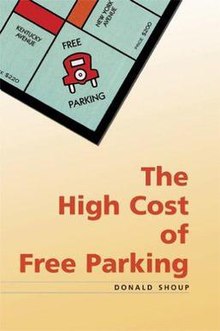
Donald Shoup, The High Cost of Free Parking (Planners Press, 2005)

(7/31/2013) Donald Shoup is an economist at UCLA who in 2005 published the definitive book on motor vehicle parking. It is a massive work (which alert readers will recognize as code for "I didn't read all of it"), painstakingly describing studies by himself and others. But it comes down to this: free curb parking creates all manner of problems for society. The solutions are to allow fewer parking spaces, charge more for parking, and (maybe) require limits on parking spaces.

Shoup lists in chapter 5 a number of ways free parking creates harms: it subsidizes cars (all taxpayers provide a resource that decreases the cost of car-driving), distorts transportation choices (because driving is cheaper), warps urban form (all those parking spaces) and debases urban design, increases housing costs, burdens low-income households, damages the economy and degrades the environment. In busy areas free curb parking means individual drivers "cruise" for an open space, sometimes for several blocks, adding to traffic congestion, as Shoup explains in this clever video. His own study of the Westwood Village area of Los Angeles found drivers spend an average of 3.3 minutes to find a curb space, which translates over the course of a year into 100,000 hours of cruising-for-parking by all drivers, going a total of 945,000 miles and wasting 47,000 gallons of gasoline (ch. 14).

One way towns have dealt with demand for parking on the street has been to require businesses (including medical facilities, schools and apartment buildings) to provide parking lots. This has resulted in a massive use of land for car-parking, particularly in certain areas. Surface parking lots are physically unattractive, waste space (and the money used to build them), and create vast empty areas in the town. Empty areas mean more space between places people are going, making people more likely to use cars; and they make those parts of town as a whole less attractive to people. If you're in Cedar Rapids and need a specific example, look at the area between 5th and 12th Sts, running pretty much from the interstate to the river, with a spur between New Bohemia and downtown. That's a lot of territory, and it is full of parking lots; if I had more time and research assistants, I'd count them, but it must run into multiple thousands of spaces.
The High Cost of Free Parking.jpg

There are several reasons for this phenomenon, but the most basic cause is city zoning requirements. Part I of the book (chs 2-10) details the extent of parking requirements for new construction, based on shaky or no data, and almost always excessive. Developers who wish to provide less parking must petition for an exemption, with uncertain prospects for success. Why governments persist in this irrationality is not clear, but it's probably some combination of (a) demands from the public, especially shoppers who want to park for free, and neighbors who want the shoppers parking somewhere besides in front of their houses; (b) impressive but false precision marketed by planning agencies; and (c) inertia.

It's not clear, though, that if governments backed off, the problem would vanish. (If so, Houston, Texas, which has no municipal zoning to speak of, would have solved this problem, to the envy and wonderment of all.) Developers and business owners have their own reasons for liking parking lots. In a society where a huge proportion of trips are made by motor vehicle, parking lots give customers somewhere to put their vehicles while they shop. Again, Cedar Rapids provides some instructive examples. The parking lot on the site of the former First Christian Church, and the one that required the closing of a block of 2nd Av, were initiated by the medical facilities, not by the city. Both have detracted from the urban fabric, but it's certainly easy to park there when you need to.

Shoup suggests several solutions, some small and some large. Cities should repeal minimum parking requirements; can provide central space(s) for public parking instead of requiring separate lots for each business; and/or encourage developers to provide incentives to customers and employees not to drive. More intensive solutions include market prices for parking spaces (explained in the video linked above, and detailed in chapters 15-21 of The High Cost of Free Parking). Today's technology allows for better adjustment of prices to varying demand at different times of day, and for more efficient collection of fees. (Many's the time I've lacked the right change to park at an open meter.) Political resistance to market-priced parking can be overcome by dedicating the revenue to pay for public services in the neighborhood.

Westwood Village is an example of an area with what Randolph T. Hester calls "impelling form" (a phrase I'm in love with, you may have noticed). A city is "impelling" when people are willing to endure some cost or inconvenience to get there. (The impelling nature of Chicago explains why businesses there haven't decamped en masse to Indiana, even though Indiana's taxes are lower than Illinois'.) As applied to parking, it matters enough to people to visit UCLA and/or the businesses around it that they are willing to pay market price for parking or take public transportation or walk. Pasadena has done even better than Westwood Village, coming from farther back (pp. 413-418). The vicious cycle described by Shoup that has dominated American towns since World War II--excessive supply of parking incentivizes driving while increasing space between businesses, thereby making walking harder and places less lively--is in such places reversed. Then it becomes a virtuous cycle, as parking lots are replaced by residences and businesses, making for a more lively and impelling town.

I, however, write to you from an under-confident college in an under-confident town. The under-confidence of Cedar Rapids is exemplified by our "Song of Dedication," which is written from the perspective of someone moving away. "Time and my life are like the river"... We'll miss this lovely town, but we're leaving. It's hard for the city to stand up for development when we're afraid businesses will leave for the hinterlands, and businesses are afraid they'll lose customers to outlying strips, if there isn't beaucoup parking. We don't get on the virtuous cycle if everyone deserts before we have a chance to become impelling. Shoup suggests Business Improvement Districts, like the Medical SSMID in Cedar Rapids, can be vehicles for collecting and spending parking revenue. But my conversations with Medical SSMID folk in May suggest they are more concerned with providing adequate amounts of parking for out-of-town patients than with filling in what is already a parking-rich empty quarter.


 (These are rather poor pictures. You'd have to see the whole area from above to get the full effect.)

(This was taken at 11:00 on a Wednesday morning. Certainly we have no shortage of parking, just maybe not in exactly the right spots.)


Coe faces a quandary similar to that faced by the City of Cedar Rapids and the Medical SSMID. A few years ago, we built a parking lot that runs for two blocks along 14th St. There are some trees around it, but even so it's not pretty, and creates something of a barrier between Coe and the Mound View neighborhood.
(The lot is mostly empty during the summer, but filled to capacity during the school year.)

In the hearing before the Board of Adjustment, Coe's representative expressed concern that the cars had to go someplace, and better a big parking lot than all over the streets. A city person wondered why Coe students had to all have cars. After all, Northwestern University bars students from having cars on campus for at least a year. Well, our representative responded, we're not Northwestern. And it's true that students aren't willing to endure as much to attend Coe as Northwestern students are willing to endure to attend Northwestern. Just so, Cedar Rapids isn't Chicago. And few churches around town would say they have a surplus of congregants. So they all build parking lots, too. How do towns like ours get off the vicious cycle?

OTHER STUFF

Donald Shoup website

"Freakonomics" podcast on parking's pricing problem (March 2013)

"The Shoupistas" Facebook group

Alan Durning, "What's in Your Garage?," Sightline Daily, 5 June 2013 [http://daily.sightline.org/2013/06/05/whats-in-your-garage/]... addresses parking requirements at individual residences, which I don't get into above, but which surely are an additional zoning absurdity. Thanks to John Heaton for sending this my way.

Sunday, July 28, 2013

A gathering of spirits in Cedar Rapids

Author Parker Palmer commended community spirit to a large audience at First Presbyterian Church in Cedar Rapids last night. He urged the listeners to "imagine how we might live our political lives as people healing the whole," and not to become discouraged either by others' rage or the lack of tangible results.

Parker J. Palmer, from couragerenewal.org

Palmer is the founder of the Center for Courage and Renewal in Seattle, Washington. Joining him on the program singer-songwriter Carrie Newcomer and pianist Gary Walters, making for an interesting mix in which Palmer's pithy observations were punctuated by Newcomer's songs (including "Better Angels," on which Palmer is credited as co-writer) and a couple instrumental improvisations by Walters. The evening concluded with Newcomer leading the crowd in two of her songs, "If Not Now" and "Peace Like a River." So we got the glow of a folk concert combined with the extended commentary of a lecturer who's clearly thought deeply about the problem of how we can all live together.

(Carrie Newcomer, from carrienewcomer.com)

For the record, the third song Carrie Newcomer sang was "Betty's Diner," which is included on this playlist of songs that evoke a spirit of urbanity.

Palmer focused his talk almost entirely on the audience, rather than on those unnamed persons who may not share our interests in building a civil community that approaches our aspirations.  He spoke of the importance of relationships, arguing "the more you  know about another person's story, the harder it is to dismiss or demonize them." Diversity, which the U.S. Constitution tends to encourage, means including all kinds of differences not just demographic. And by "including" Palmer stressed he meant more than "mere toleration." Differences are to be valued, because what we (Americans, humans) hold in common is more important. It is easy, maybe too easy, to see where others fall short of this appreciation; it is harder to see it in ourselves, but the more we try the easier it is to keep working for community and not get discouraged. One of the participants told the story of an Indian doctor running a vaccination project who said that if they vaccinated 10,000 people a day it would take 300 years to vaccinate the whole country. When asked "How do you do it?" he responded "One person at a time."

The ideal of community is challenged by individualism and outrage, which are everywhere abundant. Palmer suggested each of these are not forces in and of themselves, but symptoms of something else. He characterized individualism as an "illusion" given the reality of inter-dependence, jokingly suggesting that July 5 be designated Inter-Dependence Day. It's a place people retreat when the project of community becomes too challenging. (The same can be said for retreat into tribes of like-minded people. Parker said at one point, "You can learn a lot about people when you find out what they mean be the word 'we.'")

Outrage is a symptom of "broken-hearted" politics; across the political spectrum economic insecurity, cultural issues and war seem beyond our control. The key is not to react to the emotion or the illusion, but to recognize the pain that lies behind them. Telling our stories, especially if we can do it with humor and gentleness, creates bonds in a way that hurling our opinion cannot. Maybe someone's heart can be made "to break open" instead of in a million pieces.

Palmer did not discuss those who traffic in outrage, for surely it is quite an industry these days, maybe outgrossing some more traditional sectors of the economy. Maybe we can/should just ignore them?

In his concluding section Palmer listed a number of specific ways to work towards community: listening to children, exposing students to different beliefs, inquire instead of argue, if you're involved in a church ask if your congregation is truly safe for diversity, encourage workplace, and respond to hateful expression with gentleness and caring. We must, he concluded, live out our answer in the "tragic gap" between the harsh realities of this world and what we know to possible even--especially--when we know we won't see results in our lifetimes. But we should keep working anyway.

Some concluding thoughts from your humble author. Last week one of my Facebook friends posted, in response to vandalism at the Lincoln Memorial, "How can people do such things?" It put me in mind of a much-younger Robbie when we found some graffiti at our neighborhood park, asking me with a confused mix of emotions why someone had written "I hate --" on the equipment. I could come up with any number of answers, but perhaps it's best not to answer it at all. Perhaps it's best to leave the question hanging out there. We all know of the evils in this world, and the evil that people do, and over time we get more experience with it all. Maybe it would do us good not to try to understand it, to always be surprised by it, because we're spending our mental energies looking for the good in people. I believe I will try this, though it will require daily exertion to undo bad mental habits of many years' standing.

Thomas Merton wrote in Conjectures of a Guilty Bystander (1966: 158): 
In Louisville, at the Corner of Fourth and Walnut, in the center of the shopping district, I was suddenly overwhelmed with the realization that I loved all those people, that they were mine and I theirs, that we could not be alien to one another even though we were total strangers.
Merton's enclave, where he had believed himself separate, was the monastery where he lived. For others it might be living in a large-lot suburb, enclosure in an ideological bubble, or being in the white middle-class. To build community we need to get out of our enclaves.

Reader, I too, even I, have at times felt the overwhelming feeling Merton describes. Palmer's essential argument is this feeling must be sustained, so that your love for humanity is not a momentary rush of passion but a long-term relationship. The challenge, that requires the daily exertion I mentioned in the last paragraph, is in time (sometimes not very much time) you realize that much of humanity does not want a long-term relationship with you. Some have no interest in developing community; some even think that ensuring economic opportunity, accommodating diversity, and environmental sustainability are foul ideas. Some people think that when your gay friends get married it is a body blow to our civilization. Others steal unguarded purses, abuse alcohol or drugs, or are mean to kids. They smile in your face, when all the time they want to take your place. Or they talk on and on, and on and on and on, always about themselves. The temptation to give up on the whole community thing is ever-present; faithfulness to community in the face of all this surely is strenuous.

I am reading The Duty of Delight by Dorothy Day (1897-1980). Page after page she records her self-doubts, her fears, her daily encounters with difficult people. And yet she persevered. She was a model of faithfulness.

P.S.--A couple weeks ago, I wrote a post entitled "Who Is My Neighbor?" that posed, though not very directly, the issue of whether the welfare of others is a practical problem or purely a moral (or religious) problem, either for individuals or communities. Palmer dealt with this question last night only in brief, so briefly in fact that I didn't catch what he said. I think it's a pertinent question, though, and will probably return to it in time.

SEE ALSO Emily Busse, "'Healing the Heart of Democracy' Emphasizes Community in Cedar Rapids," Cedar Rapids Gazette, 28 July 2013 [http://thegazette.com/2013/07/27/healing-the-heart-of-democracy-emphasizes-community-in-cedar-rapids/]. 

Tuesday, July 23, 2013

Geography is destiny?


(Source: http://opportunityinsights.org. Used without permission.)

The New York Times yesterday reported at length on a study of economic mobility by metropolitan area. The results reported in the Times focused on the chances of a child whose family was in the bottom 20 percent of incomes moving into the top 20 percent by age 30. Not surprisingly the chances aren't very great overall (8 percent), but the variation across areas was striking. They ranged from 11 percent in Salt Lake City, San Jose and San Francisco, to 4 percent in Atlanta, Charlotte and Indianapolis. That may not seem an awfully wide range, but note that if all outcomes were totally random 20 percent of people in each quintile would wind up in each quintile. Getting 11 percent of a poor population into the top 20 percent is fairly impressive, while 4 percent is pretty darned close to zero.

[For the record, Chicago's score is a weak 6.1 percent. Cedar Rapids scores 12.6 percent, higher than any of the larger metropolitan areas. I'd call that unbelievably high. I'm not sure 12.6 percent of all Cedar Rapids children are going to wind up in the richest quintile, much less 12.6 percent of poor Cedar Rapids children. There are areas of west Texas and North Dakota that score over 30 percent, which is ridiculous. I'm not sure why these anomalies exist... maybe too small a sample size? Anyway, it suggests treating data from smaller population areas with caution, which I do not do below, but even if I did the points I make still stand.]

The results are so intriguing that it's easy to overlook some details and some important qualifications. So before I comment on the findings, let's address these.

First of all, the "quintiles" are groups of 20 percent of the U.S. population, ranked by family annual income. For the starting point:
  • top quintile (80-99th percentile) = $107,000+
  • second quintile (60-79th percentile) = $73,000-107,000
  • middle quintile (40-59th percentile) = $47,000-73,000
  • fourth quintile (20-39th percentile) = $25,000-47,000
  • bottom quintile (0-19th percentile) = less than $25,000
For the end point, the study took age into account. A 30-year-old reaches the top quintile at $70,000 annual income. For 45-year-olds it's $100,000.

Secondly, movement from the bottom to the top is used as a measure of mobility, but it certainly is not the whole story. One can live very well in the second and middle quintiles, for example, and they can be worthy aspirations; but being truly stuck at the bottom can be cause for despair. Data showing movement from the bottom quintile to the top 60 percent might be more illuminating. Age 30 (chosen because they analyzed a group born in 1980 and 1981) is not necessarily the finish line. It is the age at which many people have begun having families, but if mobility were occurring more gradually--say, if poor children were regularly making it above the median by age 40 or 50--that would still indicate a strong degree of economic opportunity.

The authors of the study were specifically investigating the impact of tax policies on mobility, but found (to their surprise, they said) "only slightly" positive impact of larger tax credits for the poor and higher taxes on the wealthy. What did have an impact:
  • size and dispersion of social classes: are poor families isolated in ghettos, or more dispersed across neighborhoods with a mix of incomes?
  • marriage, or at least the proportion of households with two parents
  • education, quality schools at the elementary and high school levels [The news story quoted Lawrence Katz, an economist, who noted that the areas of highest mobility correspond roughly with areas that established high schools earliest and have a long tradition of strong education]
  • civic engagement, greater membership in religious and community groups
What had little or no impact:
  • number of local colleges
  • cost of college (whew!)
  • extreme wealth
  • overall wealth (e.g. Seattle and Atlanta are similar in average income but Seattle has way more mobility)
  • race (greater mobility for whites is explainable by location, but see below)
The study is a brief for the role of place, particularly city design when we're talking about how the poor are or aren't connected to the parts of the city where the jobs are. (Do they live there already? Do they have access to public transportation? Is traffic prohibitively congested?) As noted in earlier posts, city design can also affect levels of civic engagement... that's the premise behind walkable cities, and the movement to establish third places. For Cedar Rapids, it shows why it's critically important to get the MedQuarter district and the West side right. If they develop in a way that creates jobs and builds connections from the downtown out to the poorer neighborhoods, that will do much to create economic opportunity in this city. If they develop in ways that create even more physical barriers, that will have the opposite effect, and institutionalize those barriers for decades.

Eyeballing the map suggests some relationship to politics, though I confess that relationship is unclear. The Times map has the areas under 5 percent in black, so they're easy to spot. They occur in parts of Alaska, Arizona, South Dakota, Indiana, Arkansas, Mississippi, Alabama, Georgia, South and North Carolina. The 2012 electoral vote total from those ten states was Romney 87, Obama 0. All but Arkansas have Republican governors. [NOTE: Looping in Louisiana and Virginia, which have specks of low mobility connected to commuting zones in Mississippi and North Carolina, respectively, makes it Romney 97, Obama 13, and 11 of 12 Republican governors.] Those states also have higher rates of inequality and poverty in spite of economic growth 2001-07, more child poverty, and higher percentages of women addicted to painkillers. [10/7/13 update: add declining female life expectancy.] Something's going on there, either in policy or culture, that's producing suboptimal outcomes.

That should give us pause before we embrace the Mississippi economic model: low taxes, low public services, little labor or environmental regulation, weak-to-no unions.

Finally, I wonder if the authors were too quick to dismiss the corrosive effects of racial prejudice. They note that whites have higher rates of mobility than blacks, but point out that that's due to where they live. Whites and blacks in the same area (e.g. Atlanta) have the same levels of economic mobility, but more whites tend to live in higher-mobility areas (e.g. Seattle). Race, then, is spuriously correlated to economic mobility. 

But I wonder if, instead, race is an antecedent variable? In plain English, do metropolitan areas have lower social mobility because there are high proportions of blacks living there? It's been pretty well documented that racial diversity affects how whites think about politics. Particularly lower-income whites are less likely to support redistributive policies, even though they'd benefit from them, if they live near blacks. If my mental image of poverty has a black face, is it easier not to pursue policies that create economic opportunity (and the resulting mobility)?


SOURCES

Emily Badger, "A Child in Seattle Has a Much Better Chance of Escaping Poverty Than a Child in Atlanta," The Atlantic Cities, 22 July 2013 [http://www.theatlanticcities.com/jobs-and-economy/2013/07/child-seattle-has-much-better-chance-escaping-poverty-child-atlanta/6275/]

Raj Chetty, Nathaniel Hendren, Patrick Kline and Emmanuel Saez, "The Economic Impacts of Tax Expenditures: Evidence from Spatial Variation Across the U.S.," http://www.equality-of-opportunity.org/.

David Leonhart, "Geography Seen as Barrier To Climbing Class Ladder," New York Times, 22 July 2013, A1, 12.

Monday, July 22, 2013

Why historic preservation

Historic preservationists, with whom I have spent some quality time, feel like their animating passion is unappreciated by a lot of developers. They quote developers telling them things like, "Sure, people miss such-and-such a building for a while, but eventually they forget."

Did anyone actually say this? If they did, they said something that is accurate, but only at the surface level. I will personally admit to an amazing inability to remember whatever was there before what's there now. [Wasn't that always there? Weren't we always at war with Eurasia?] Today there probably are people who drive down 3rd Avenue and think, "People's Church used to be there. What a cool old building that was. That thing that took its place sure is butt-ugly." But even in such egregious cases, such comments will--as the developers know--diminish with time.

 And soon we'll forget where the A & W was, where they put your tray in your car window well into the 1990s, or Hubbard Ice Company, where they used to erect a huge red-white-and-blue block of ice on Fourth of July. Conscious memories are fleeting things, as are feelings of sadness at the loss of city landmarks.

At the subconscious level, though, it's a different story. It is here that historic preservation matters, for three reasons:
  1. Familiar places help to orient you, giving you a sense of where you are, in a place that is comfortable because it is familiar. No, I don't get lost driving down 3rd Avenue because People's Church and the First Christian Church are gone. But it doesn't feel right... feels alien. Take out First Presbyterian and Daniel Arthur's and I might as well be on Mars.
  2. To thrive, a downtown--or any part of a city--needs to feel interesting and safe to people. That occurs when there is a mix of old and new buildings. Sure, a new building doesn't have to be ugly. [Do you like the Great America Building? So do I! But a downtown full of such buildings would be ghastly.] Anyhow, character takes time to acquire even in a well-designed building. Would Little Bohemia be what it is in a new structure?
  3. Historic buildings connect residents of a place to that place's history. If you're in Boston, or colonial Williamsburg, or Amana, of course you've got tourists who are interested, too. But even towns that aren't famously historic have history. And if you're going to spend time there, your experience deepens if you feel connected to former residents who have long since passed.
For each of these reasons, historic preservation matters to people who may not consciously consider it a priority, and the loss of historic structures has impact long after people realize it.

Besides comfort, appearance, and connection, there are other reasons why I feel historic preservation is a public good. As Jane Jacobs (The Death and Life of Great American Cities [Random House, 1961], ch. 10) argued years ago, older buildings tend to have lower rents. This makes room for a wider set of entrepreneurs. The big boys, like Alliant Energy or Wellmark or Physicians Clinic of Iowa, can afford to occupy offices that are brand spanking new. A start-up store or tavern, not so much. Yet it's these little stores, restaurants and taverns that give life to a neighborhood, especially after business hours. This is where third places are most likely to spring up, not to mention affordable housing.

b/w picture of railroad station
Union Station was demolished in the early 1960s
(swiped from gazetteonline.com)

And sometimes we find we need buildings we had gotten rid of because we thought they were useless. About 50 years ago Cedar Rapids got rid of its historic downtown train station and replaced it with a parking garage. Who needs an ol' train station when everyone has cars and cheap oil will flow forever? Now that what James Howard Kunstler calls the "era of happy motoring" is endangered, maybe we'd like intercity commuter rail service, in which case we might could use that old train station after all.

Peace and quiet

My son Eli and I spent three days in Chicago last week, my second visit to the Windy City this year.
(Lakefront, looking north from Ohio Street Beach, 7/16/13)

Being in a more dense, urban environment than I'm used to means there are more people, a faster pace of life, and more ambient noise.These are part of what make urban life attractive to many people. Phrases like "sleepy old town" and "quiet evening at home" are typically not intended as compliments. Yet it occurs to me that (a) some people choose to live in suburbs and small towns because they want to live away from the crowds and noise; and (b) everyone probably needs some measure of peace and quiet in their lives.

We shouldn't overstate the contrast. It gets noisy in Cedar Rapids, too, even on the toney southeast side. There are car alarms, ambulances, outdoor speaker systems, barking dogs, unmuffled motorcycles and lawnmowers, not to mention several people seem to be in daily training for the leafblower Olympics, usually when we're trying to listen to music or have a conversation. But even if it isn't always quiet when you want it to be, you can always count on periods of quiet, often extended periods.

In Chicago the noise and hustle are more constant, though that statement begs for qualification. The River North area, where I usually stay, is less bustly than the Loop. I didn't spend any time in residential neighborhoods, which I'm guessing are quieter than downtown though still noisier than my neighborhood. [Truth in blogging notification: The last sentence was written while the author's next-door neighbor was vivisecting a tree with a chainsaw.]

As I pondered this an article appeared in the New York Times last week talking about noise in New York City. The main problem at present seems to be that building construction is occurring at such a pace that crews are working round-the-clock. That would seem to be a temporary problem, atypical even of large cities. The letters-to-the-editor that commented on the article were uncommonly interesting: one person recalled a car alarm going off night after night until a neighbor took a baseball bat to the offending car; another writer noted the problem of highway noise in rural areas.

While enjoying my visits to Chicago I've come to appreciate opportunities to step out of the urban flow and enjoy some quiet time. In April, for example, I enjoyed a movie at the Gene Siskel Film Center, and a church service at the Chicago Temple. Apart from the quality of the actual events, being in those places allowed me to slow down for awhile and recharge my batteries. You can find the same sort of rest-for-the-senses in libraries, museums, and where accessible natural settings. The restaurants, bars and coffee houses I've visited didn't quite qualify, but I imagine with some simple investigation you could find quiet places to hang out. [Note that sanctuaries or quiet places aren't the same as third places, which are places to seek interactions not solitude.]

So, quiet peaceful places exist, even in America's third largest city, to the benefit of all, I'm sure. But what about people who want more than an occasional respite? For now cities probably can and should seek future residents from the set of people who enjoy a faster pace and more interactions, and who can put up with a little noise. They may even find it a "Beautiful Noise," to quote the title of a Neil Diamond song and album. They can sell the advantages of the urban environment, and not try to be something they're not. And I'm certainly not advocating making people live in places they find unpleasant.

But, what if society changes in the way that some people are predicting: considerations of energy, environment, economy and/or government finance pushing the population to consolidate? If there are no jobs, what happens to small towns? If gas is $6.00 or $7.00 a gallon what happens to large-lot suburban subdivisions? And if people who'd rather be (relatively) isolated find themselves forced to relocate to a more urban area, what personal and social problems will that lead to?

FURTHER READING: Randolph T. Hester, Design for Ecological Democracy (MIT Press, 2006), ch. 15.

10th Anniversary Post: The Election and Our Common Life

  Your humble blogger with KGAN reporters on election night 2016 (from Eric Wylie's Facebook page) (11/6/2026)  A recent New Yorker  car...