Wednesday, December 8, 2021

Book Review: Confessions of a Recovering Engineer


16th Avenue SW, Cedar Rapids

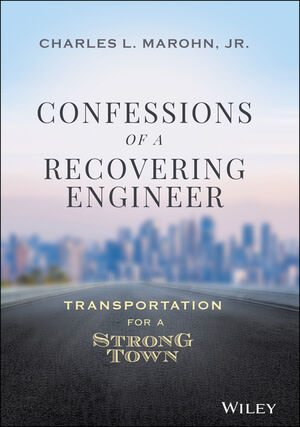
Charles L. Marohn Jr., Confessions of a Recovering Engineer: Transportation for a Strong Town. Hoboken NJ: Wiley, 2021.

(12/8/2021) What is the purpose of transportation? Charles Marohn's seminal contribution to this topic has been to note that it depends on where the transportation is occurring. Sometimes it is to get from one place to another quickly and safely; sometimes it is to get around within a productive place. In the first case, you want a road, with the best American examples being the interstate highways between metropolitan areas. Within places, you want a street that accommodates a variety of uses including but not limited to or even favoring automobiles.

America's greatest development mistake has been decades of urban design that practically makes a motor vehicle a requirement for participating in society, and results in streets that try to be roads at the same time: stroads are high-speed roads that also feature commercial development that draws a lot of auto traffic. They are financially unproductive, as he explored in his previous book, Strong Towns (Wiley, 2020), but they are also dangerous. (See especially chapter 2.) It is the safety (or lack thereof) of the places where people live that is the focus of the current book.

The statistical analysis and critical thinking that inform this work are framed by three powerful stories. In the introduction he recounts a conversation between pre-awakening Chuck and a woman whose property is about to be severely impacted by a road-widening project and who can't understand Chuck's explanation of why it will improve her life. (Spoiler alert: It won't improve her life, because, as he comes to realize, "improvements" like these make people's lives worse not better.) Then in chapter 1, we meet the Gonzalez family of Springfield, Massachusetts, whose daughter was killed by a car as they made their way from the public library to the parking lot; young Destiny is lifted from the bin of statistics to stand for all the people who are killed on stroads as they try to go about their daily lives. Finally, in the final chapter, Marohn recounts his own harrowing experience, as he too narrowly missed becoming a victim of design. These stories give life, meaning and purpose to the analysis.

Mt. Vernon Road SE near where two boys on a scooter were badly injured in June


Marohn's most important early premise is that transportation is not neutral, nor strictly technical as engineers might (and apparently do) conceive it. It is a question of values. If we design streets to move cars faster while putting everyone else at greater risk, that's a choice that reflects the city's values. Marohn's mission is to make explicit the values implicit in transportation design. Who matters? What matters?

His hope with this book is to introduce Americans to what previous generations enjoyed: "great streets" (the title of chapter 5). Great streets exist for the purpose of "wealth creation," which in turn "is really about building the capacity to endure over time" (pp. 66-67), allowing for adaptation over time, especially incremental growth. This only works when the growth occurs in ways that increase the city's assets faster than its liabilities: "A city can build miles of streets [to move a high volume of vehicles], but if there is not enough private sector investment on those streets to offset the ongoing maintenance costs, the community is merely growing poorer" (p. 68). Making a street a better place to live increases land value, and land value per acre is the quickest way to measure community wealth. Incremental growth, rather than frozen zoning or large-scale developments, is the way to do this:

Single-family homes add garage apartments or convert into duplexes. Duplexes are redeveloped to become fourplex units. Commercial buildings are subdivided to allow more tenants. Gaps are filled in. Space is used more productively. (p. 71)

We find ourselves back at the financial analysis of the first book. Marohn argues that transportation choices must serve this basic reality, but also that "a prerequisite for building wealth is that a street be safe" (p. 66). The traditional grid pattern does this; the arterial/collector system not only does not do this, it creates traffic congestion and the temptation to widen streets into stroads (ch. 6). He picks apart the analyses used to justify widening streets and bashing highways through towns (ch. 8). Roundabouts do this, if and only if correctly; traffic lights do not, and they waste time and encourage aggressive driving (ch. 7). Chapter 7 may deserve its own post, given that so many of my fellow Cedar Rapidians are convinced roundabouts are spawns of Satan.

In chapter 9, he uses the same logic to discuss public transit. This "is the only way to overcome the geometric space limitations of the street while still building wealth," because buses don't require huge parking lots, but only if it is run with a service orientation i.e. frequent and reliable runs between places of value: "All the public employees, lawyers, accountants, salespeople, clerks, and everyone else working in the core downtown should find it ridiculously convenient to board... and get to wherever they need to be to conduct business in the core downtown" (p. 157). Cedar Rapids's coverage orientation means buses spend a lot of time and money serving areas with few riders, making transit a drain on resources at the same time it is a non-starter for all but the truly desperate.

These are the highlights of a book that dips into additional transportation-related topics like scooters, rideshare, the impractical ideas of Elon Musk, and why police should discontinue routine traffic stops. All are in service of making transportation work, in a safe, financially-sound way, to build communities for people. I could use fewer long block quotes from the first book, which is consistently referred to with its full title and subtitle, but on the whole Marohn is a fluent and passionate writer with a lot of hard evidence to support his arguments.


Friday, November 26, 2021

Black Friday Parking 2021


The day after Thanksgiving again found me prowling the parking lots of the Cedar Rapids metropolitan area, on my annual mission for Strong Towns, the urbanist organization of which I am a member. (I just got the recurring donation thing figured out, and now I am feeling rather Strong myself!) Strong Towns has been running this event nationwide since 2013, mainly to point out the negative impacts of minimum parking requirements in city zoning codes. Their crowdsourced map started in 2015, a cooperative venture with the Parking Reform Network, includes Cedar Rapids as an example of a city that has removed parking maxima for its downtown (Jordan and Wilberding 2021).

Regulations concerning parking comprise 25 pages of the Cedar Rapids municipal code. They are "intended to ensure that adequate parking is provided to meet the needs of individual site designs and the community at-large" (32.04.02.A.1); later the same section refers to "appropriate" amounts of parking. These terms represent value judgments, in spite of the calculations suggested in 32.04.02.B and other attempts at objectivity. They seem to say "You be you, and we'll figure out the parking," but that assumes everyone makes free choices, and those free choices result in the best possible city design. I'd argue both of those assumptions.

The section contains numerous tables defining minimum parking requirements for a given development. General parking requirements (Table 32.04.02-3, pp. 132-134) include two per residential dwelling unit, with less for buildings with small apartments and accessory dwelling units; live-work units are required to have an additional parking space for every 333 square feet of office space. Cemeteries are required to have one parking space for every 50 square feet of the chapel. Elementary and middle schools are required to have two parking spaces per classroom, while high schools are required to have six per classroom plus one per 300 square feet of non-classroom floor space. Want to teach ballet? Studios and instructional spaces are required to have one per 333 square feet. Financial institutions are required to have one per 200 square feet used by the general public, plus one per 600 square feet not used by the general public. This is a fascinatingly granular table, and the effort to compile it must have been impressive.

More importantly, Cedar Rapids now--and I'm pretty sure this is a recent development--has maximum parking rules, as well as exemptions and exceptions to parking minima. Maxima are determined as a percentage of minima (Table 32.04.02-5, p. 135): if 0-49 spaces are required based on Table 32.04.02-3, for example, developments can have no more than the greater of 6 spaces or 150 percent of the minimum number required. Section 32.04.02.F allows exceptions for downtown, and reduced minima for shared parking spaces, residences for the elderly or handicapped, closeness to a bus stop, and connection by sidewalk to trails.

At the very least, this shows sensitivity to the way parking lots waste urban space, and a willingness to develop at least the core part of the city in a way that can serve multiple functions besides car storage. I do not, however, think that Cedar Rapids parking craters are caused by municipal regulation. I think they're caused by the way we do things, at least most of us most of the time, with the ability to ignore people who must or want to do things in a different way. For example, the Blairs Ferry Road Target, in whose parking lot I took three pictures the very first year I did #BlackFridayParking, has 173,941 square feet of retail space, which indicates a minimum of 523 spaces. Maybe I'll count them next year? I'm pretty sure they have a lot more, and were never sweating that zoning regulation back in 2002.

There may be, somewhere in the Cedar Rapids municipal code, an ordinance requiring me to have a second helping of stuffing at Thanksgiving dinner. All that stuffing has analogous negative effects on my physical health to the effects of all that parking on our towns' civic, environmental, and financial health. (Also, by discouraging walking and cycling, too much parking makes us less healthy, just like too much stuffing!) But I'm not stuffing in the stuffing because I'm concerned about an ordinance. I'm doing it because it's what I do on Thanksgiving. Similarly, we build commercial property with gigantic parking lots because that's just what's done.

You be you, drive to Target or Wal-Mart or Fleet Farm, and we'll make sure there's a space for you to park your car. But all this parking is not a neutral engineering/planning response to what people happen to do. It is part of a chain of fateful choices by powerful people that cause the town to develop in a way that driving is what everyone must do.

Fleet Farm, 4650 Cross Pointe Blvd built 2019 189,595 sqft store on 832,867 sq ft lot required parking spaces 570 actual ??

NE edge of the lot

SE edge of the lot

Fleet Farm is a new big-box kid in town. I remember when Chuck Marohn referenced them in his 2015 speech at Iowa City, and multiple people including me corrected him to "Farm and Fleet." We are all aware of Fleet Farm now! There were a lot of shoppers at Fleet Farm this morning, in search of deals like these...


...and they came in a lot of cars, but there was room for plenty more!

Hy-Vee, 5050 Edgewood Rd built 2005 87,524 sqft store on 494,842 sqft lot required parking spaces 263 actual ??

west edge of the lot

Groceries aren't your stereotypical Black Friday purchase, but the lot at this suburban Hy-Vee was nearly full. Elsewhere in this gargantuan plaza, many stores were not open...
It's quite the strip


Another lot of parking

People in this subdivision could walk to Jimmy John's,
or Hy-Vee!

Wal-Mart, 2645 Blairs Ferry Rd built 1990 204,266 sqft store on 772,783 sqft lot required parking spaces 614 actual ??


Lowe's is west of Wal-Mart

NW look at Wal-Mart

Sam's Club is east of Wal-Mart

"You could build a small town in that parking lot"--
awed Twitter comment

I did not take pictures of the closer-in sections of the parking lots, so it behooves me to tell you there were a lot of shoppers at all of these stores... just not nearly enough to fill the parking lots. Gigantism of stores and parking lots are a bill of goods sold on convenience and ease of access. It's time to pay attention to what they do to our town's social fabric, fiscal health, &c. 

Dunkin' Donuts: I don't understand my fellow humans
(Similar scenes at McDonald's and Starbucks)

SEE ALSO

"I Wish This Parking Was...," 27 November 2020 [last year's COVID lockdown-appropriate alternative]

"Black Friday Parking," 27 November 2015 [my first venture]

Associated Press, "Holiday Shopping Moves Into High Gear But Challenges Remain," KTLA, 25 November 2021

City of Cedar Rapids, Zoning Ordinance, 14 March 2021 [Section 32.04.02, "Parking," is on pp. 129-154]

Charles Marohn,"Where Parking Reform Ideas Go to Die... or Not," Strong Towns, 24 November 2021 [a story with a happy ending!]

Strong Towns, "Where Will You Be on #BlackFridayParking Day?" 22 November 2021 [this year's invitation]


Black Friday shopping can be a real battle?


I'm enjoying this way too much

Monday, November 22, 2021

Cedar Rapids mayoral runoff 2021


Washington High School Step Team, January 2020:
Can these young people find their futures in Cedar Rapids?

City Council elections are opportunities to take stock of where we are as a city and where we would like to be going. In my post from the last mayoral election four years ago, I complained that the candidates lacked either specific policy proposals or an overall vision of the city's future direction. I concluded: America, which includes Cedar Rapids, faces some profound challenges. How do we enable a satisfactory quality of life and economic opportunity for our citizens in the face of economic, environmental, racial, an financial challenges?... We've managed to have a school board election and two rounds of a city council election this fall without serious debate over any of these.

I did give the 2017 finalists, Brad Hart and Monica Vernon, credit for strategic competence: As a manager of problems with high levels of personal activity and familiarity with the city, either would be fine. Does that seem a bit naive today? All I can say is, after two years of relative quiet, the problems of 2020 and 2021 were of unusual magnitude: a worldwide pandemic that refused to go away, a summer of civil rights protests responding to murders elsewhere but recalling a 2016 police shooting here, and then the incredible force of the August 10 derecho. In 2017 I had been thinking about traffic and the city budget and stuff. The city and school district did as much as they could with the pandemic given heavy-handed oversight by a regressive state government, but the policy response to civil rights protests failed to satisfy advocates and makes progress on inclusion uncertain, and precious time was lost with Mayor Hart's delayed response to the derecho. Then there was Hart's deranged voice mail message for CSPS director Taylor Burgen. Perhaps day-to-day competence is not enough.

On November 2, 2021, city council members Marty Hoeger, Tyler Olson, and Ashley Vanorny were reelected without opposition; in District 3, Dale Todd won reelection by a wide margin (62-37) over  Tamara Marcus, the county sustainability manager. Marcus proved to be an exceptionally thoughtful candidate, and I hope she will continue to be present in local politics. The only race, then, to require a runoff was the race for mayor, where former newscaster Tiffany O'Donnell led with 42 percent to 28 percent for both Mayor Hart and Amara Andrews. Andrews had exactly 41 more votes than Hart, who conceded and endorsed O'Donnell. The runoff will occur Tuesday, November 30.

The executive power in Cedar Rapids, like most towns, is mostly in the hands of the city manager since 2010, Jeff Pomeranz, who by all accounts has made good choices on policy (one-way to two-way conversions and protected bike lanes) and city staff. What's left to the mayor, besides one vote on a nine-member City Council, is the public visibility that comes with the position. Ron Corbett (2019-2017) used his position, among other things, to advocate for health and fitness, promoting Blue Zones, commuter as well as recreational cycling, and sidewalks. Who we elect as mayor says much about how we see ourselves as a city.

Meanwhile, a letter writer to the Cedar Rapids Gazette Sunday complained about the lack of amenities for senior citizens, mainly by railing against cyclists. I don't know enough to comment on the senior amenity situation, and can only wonder how a town full of voting senior citizens could possibly be deficient. I can say we need a mayor who can explain to people why inclusion is a good thing, and why policies that seem to benefit people who are not you can actually benefit you by improving the city as a whole.

O'Donnell and city
Tiffany O'Donnell (from her campaign site)

O'Donnell became well-known as a television newscaster for 20 years, including 15 at the local Fox affiliate. She is the CEO of Women Lead Change, which calls itself "the state's premier leadership organization for women, dedicated to the development, advancement and promotion of women," and was active in the founding of and fundraising for the New Bo City Market. Her website highlights the need to "take the city where it needs to go" in order to retain young people and "the workers of the future." There's not much issue detail, and a lot of obvious, but her priorities page includes downtown and river revitalization, and the intent to "incentivize and support growth of existing businesses" and "lean into our entrepreneurial economy," which are worthy goals indeed. Her last-week op-ed (O'Donnell 2021) touted her leadership credentials and the need for change.

Andrews husband and dog
Amara Andrews and friends (from campaign website)

Andrews, a newcomer to city politics, is an executive with True North Companies whose beat includes transportation and business development. She was also active in business development in Champaign, Illinois. She is involved in Advocates for Social Justice, which arose out of the 2020 protests, and the Academy for Personal and Social Success. Her website is far more substantive than O'Donnell's. She notes the need to shift business support towards assisting existing small and midsize businesses, while attaching public goods conditions when we use tax incentives; the connection between walking and biking infrastructure and needed improvements to our public transit system; and one-stop "opportunity centers" to help workers with any and all barriers to employment. Her last-week op-ed (Andrews 2021) discussed the coalition-building and persistence that led to the creation of the city's citizens review board, and talked about the need to include the unhoused in policy efforts.

Both candidates are hitting the right notes, even if Andrews's are arranged for a chamber ensemble and O'Donnell's for Casio keyboard. I'm a word guy, so Andrews is the one speaking to me, yet it would be nice to have a Mayor O'Donnell bringing her networking experience to bear on our common life. Both articulate the need for policy change, which is refreshing in a city where the political culture can be maddeningly complacent. Cedar Rapids has done some remarkable things in the last 15 years, but we are far from being the inclusive, environmental, walkable, and opportunity city we need to be. To have someone in the mayor's seat showing why and how we need to do things differently would really be something.

SEE ALSO:

Amara Andrews, "Choice is Between Change and More of the Same in C.R.," Cedar Rapids Gazette, 21 November 2021, 1C, 4C

Tiffany O'Donnell, "Time to Stop Being 'OK' With "OK' in Cedar Rapids," Cedar Rapids Gazette, 21 November 2021, 1C, 4C

Thursday, October 7, 2021

Open Streets DC 2021


"Celebrating the People of Park View,"
mural by Rose Jaffe and Kate Zaremba in 2016

"If you close it, they will come?" Washington's Open Streets program returned to Georgia Avenue NW this month and got a turnout every bit as numerous, diverse, and fun-loving as they had two years ago.

Georgia Avenue north of New Hampshire Avenue

Again, job stuff kept me away until the last hour or so. This year, though, I walked south from the Metro station instead of north, so while the joy was the same, as was my commemorative t-shirt, the pictures are different.

Out of the Metro

The absence of cars on the street enabled activities including...
The Honey Larks on the Reduce Energy Use DC Main Stage

young and very young walkers

Enjoying snacks and company in the shade of street trees

Recreation at Bruce Monroe Community Park
Chalking and painting

Services along the route included...

Water station

Roller skating lessons

Police chilling with everybody else

Dance lessons in progress

Information booth (where I filled out a survey to get the t-shirt)

City Council member Brianne K. Nadeau

I did not see Council member Nadeau, but one of her staff was in a vigorous discussion about the future of Bruce Monroe Community Park, where a housing development is planned. Conversations like this can happen naturally when the design brings people together.

There seemed to be less public anxiety about the chaos that would ensue when the street was closed, possibly because I didn't have the local FOX station on during breakfast. Local merchants were definitely taking advantage of the opportunit


antique shop

restaurant with outdoor seating

more outdoor seating with jaunty pretzels

They have all the herbs

They have all the beans

Ice cream!

The long festival came to an end at the intersection with Barry Place...


...adjacent to historic Howard University

By this time, they were taking down their booths...

...and the police were warning all the mellow people that cars were about to return.

I'm glad Washington gave people the opportunity to imagine for a day all the many things we could do with some of the space we currently devote to cars. Soon, the city will try other streets. I hope I can be around when it happens!


SEE ALSO: "Open Streets DC," 11 October 2019


Monday, September 27, 2021

Connecting the dots, and the city, at 1900 1st Av NE

1900 1st Ave NE from across the intersection (Google Maps screen capture)

(9/27/2021) This week the Cedar Rapids City Council is expected to adopt the Community Climate Action Plan produced by its appointed advisory committee after much public discussion (Payne 2021a). Among its provisions is improving neighborhood walkability. "In a 15-minute walk, you should be able to meet most of your basic needs, whether it be a grocery store, whether it be healthy food, whether it'd be a park, whether it be a retail store, perhaps," city sustainability coordinator Eric Holthaus told the Gazette. "This will be challenging to do certainly in some areas, but it's the vision that we have and is important."

Jeff Speck in Cedar Rapids, 2015

In their urbanist primer Suburban Nation (North Point Press, 2000, chapter 4), Andres Duany, Elizabeth Plater-Zyberk, and Jeff Speck list four prerequisites for street life: meaningful destinations accessible on foot; safe streets for bicyclists and pedestrians; street trees and buildings that provide a comfortable feeling of enclosure; and signs of human activity.

A principal challenge to both walkability and climate action is our city's streets network, which was developed with the primary goal of moving cars. Exhibit A is 1st Avenue, a five-lane megastroad that carries X cars per day through many of our core neighborhoods and downtown. It is, I can tell you from personal experience, quite a challenge to cross safely on foot or on a bike.

Crossing 1st Avenue: My current tactic is to lurk here and wait for a break in traffic

So, the current debate over the former Western Fraternal Life Association building at 1900 1st Avenue NE is about more than preserving a midcentury modern office building, or a brewing conflict between the property owner and residents of the surrounding neighborhood. It is about what kind of city we will be, and how well we can connect, in this case, the Mound View and Wellington Heights neighborhoods.

Until recently this was the headquarters of the Western Fraternal Life Association insurance company. Kwik Trip recently bought the property and wants to build a campus on the site with a Kwik Star convenience store, gas station, and carwash. Their business record is impressive; other Kwik Stars in Cedar Rapids have significantly higher taxable values per acre than comparable businesses. The taxable value per acre for a convenience store (BP?) at 4141 Center Point Road NE was $614,000 in 2017; the new Kwik Star at that location, minus car wash, scores over four times as much ($2,851,707). Their plan may or may not represent the "highest, best" use of the property, but their financial case is good. That's not the problem (although its likely impact on surrounding property values is beyond my power to estimate).

The main problem is that, with the stated intent of improving neighborhood walkability, the city by approving this plan would be making it worse. It would facilitate driving at a time when we need to encourage alternatives, and would make crossing any part of that intersection more difficult by adding more traffic from more directions. It would be harder for students from the southeast side to walk to Franklin Middle School, and harder for anyone to walk from one side of 1st Avenue to the other. The store portion Kwik Star might be a destination, but would require crossing an active parking lot, and the proposal clearly fails on Duany et al's second and third dimensions. The climate crisis requires better.

A better use of the property, for walkability and climate friendliness, would be a commercial operation that would serve the needs of people above 19th Street, possibly including additional residences. More people walking would be good for the climate and good for their health, and the right use of that property might stimulate development along A Avenue as well.

Which leads me to the other problem: Why are corporations the ones who so often are driving the development discussions in the city? What can we do to help local businesses be the ones meeting basic needs? This year's mayoral election is not encouraging. A recent candidate forum at the Olympic South Side Theater produced the following ideas (Payne 2021b): more conversations as well as support for NewBoCo and the Metro Economic Alliance (Tiffany O'Donnell); partnership with Kirkwood to provide technical assistance (Brad Hart); more conversations, better career education, and removing barriers like child care (Amara Andrews); and "jobs jobs and jobs" (the artist formerly known as Greg Hughes).

Technical assistance and child care are a start, but we can and must do better. Stacy Mitchell of the Institute for Local Self-Reliance offers eight policy strategies cities can use to support local businesses in her article appropriately entitled "8 Policy Strategies Cities Can Use to Support Local Businesses." These include zoning for multi-story pedestrian-oriented districts, set-asides for local businesses, a business diversity ordinance, an adaptive reuse program for vacant buildings, redirecting economic resources, and finding ways to expand access to capital which is not a problem for corporations like Kwik Trip. Any combination of these would facilitate better ideas for 1900 1st Avenue NE.

A car-dependent city full of convenience store-car washes is going to achieve peak car shininess, but will not achieve environmental or financial resiliency. For that we need infrastructure and local businesses that encourage less energy use and keeping our dollars in town.

SEE ALSO: Ben Kaplan, "Would It Make Cedar Rapids Better If This Was Torn Down for a Gas Station?" Corridor Urbanism, 9 September 2021

While we're at it, could we lose this terrifying slip lane? Slip lanes encourage faster driving, and make walking neither safe nor comfortable. Save them for the Interstate Highway System.

(19th & 1st again; Google Maps screen capture)

10th Anniversary Post: The Election and Our Common Life

  Your humble blogger with KGAN reporters on election night 2016 (from Eric Wylie's Facebook page) (11/6/2026)  A recent New Yorker  car...