Wednesday, February 20, 2019

Hey, IDOT, leave my stroad alone!

The six lanes of 1st Avenue (Iowa Rte. 922) by Coe College
A major challenge to creating a walkable town is the legacy of auto-centric street widening in past decades. Reconfiguring or narrowing the street so it works with, rather than through, the neighborhood is a logistical as well as a political challenge. It is especially so when the street in question is a state highway. While there are exceptions--I wrote about King Street (State Rte. 7) in Alexandria, Virginia last spring--for the most part state transportation departments have their standards and they're sticking with them, and too bad for the town that has to co-exist with a four-lane highway slashing through its commercial and residential districts. (For a tragic case from Syracuse, New York (State Rte. 108), see Larsen 2017.)

My home state's Department of Transportation, on the other hand, has for some time been suggesting to towns that they could put their state routes on "road diets" (see Strong Towns 2019). Typically this involves taking a four-lane road and converting it to three--one lane for through traffic in each direction, and a central turn lane. This leaves room to create bike lanes, on-street parking, bulbouts at crosswalks, room for street trees, or other treatments that enhance the safety and convenience of pedestrians and cyclists. Not only does this accommodate more modes of transportation than the current number of one, but it reduces crashes and traffic speeds without impacting overall traffic flow (Schmitt 2014; Speck 2012: 163-167, both cited below). All this serves to support the local business climate as well.

The Iowa Department of Transportation Design Manual lists four reasons for towns to consider road diets:
  • high accident rates involving left turning movements, sideswipes, rear-ends, or crossing traffic
  • the need for traffic calming 
  • pedestrian and bicyclist safety issues 
  • “defacto” left turn lanes: areas where a four-lane facility is operating like a three-lane facility, with the inside lanes operating as left turn lanes.
IDOT notes A portion of US 75 in Sioux Center, Iowa has been converted from a four-lane facility to three lanes with a [two-way left-turn lane] and the results have been very positive: a sharp decrease in accidents and excessive speeding, and support from both the public and businesses along the highway. Average daily traffic counts (ADTC) through downtown in 2015 ranged from 11,000-13,000, roughly the same as four years earlier.

IDOT considers cutting to three lanes appropriate up to an average daily traffic count of 15,000-17,000. What probably matters more is the highest volume of traffic on a typical day: the Federal Highway Association Road Diet Informational Guide recommends 750 vehicles per hour per direction (vphbd) as the top for a road diet, but suggests towns "consider cautiously" peak volumes as high as 875. Both manuals contain a number of reasons not to do it as well: roads that serve to move traffic rather than to access property, that have vehicles with frequent stops or slow starts, near railroad crossings, or where there is on-street parking (IDOT). This seems overly cautious to me, though I can certainly see concerns about backups at at-grade crossings--many trains move slowly through downtown Cedar Rapids, and there's only one bridge over the tracks--or waiting for someone to parallel park.

The central Iowa town of Indianola is considering a second round of road diet on State Rte. 92 (Albertson). 2016 ADTC for 2nd Av is 10000-12000 west of the intersection with US65/69, where it's been converted to three lanes, lower east of the intersection where four lanes remain. IDOT data show the four-lane portion has three times as many crashes as the four-lane portion, despite the lower traffic count.

Downtown Grundy Center (Google Maps screenshot)

Perhaps not surprisingly, there has been some pushback. The IDOT manual warns, Typically, initial community reaction to the conversion will be negative since it seems logical to assume that eliminating a lane will reduce capacity and increase delays. These gains in safety, commercial viability, and overall pleasantness seem to come at the expense of auto drivers. A lot of these drivers have children who walk to school, or enjoy a good walk or bike ride themselves, but others are not willing to yield the policy privileges they've enjoyed for decades. A Los Angeles group called Fix the City, complains of those who "want to make driving our cars unbearable by stealing traffic lanes from us on major streets and giving those stolen lanes to bike riders and buses" (Linton 2019).

In Iowa, Rep. Sandy Salmon (R-Janesville) wants to ban IDOT from promoting/recommending road diets in towns (Albertson 2019). Her bill, House File 41 would prevent IDOT from doing anything other than providing statistical data to the towns through which its highways run. As it works in Iowa, the final decisions rest with the affected towns, as it should be--right, conservatives?--but there are always those who see any step away from auto-centrism as a threat to western civilization that must be opposed at any cost.

Other towns where IDOT recommendations have met with local pushback:
  • Knoxville: ADTC 2014 on Iowa Rte. 14 peaks at 10700 south of the intersection with Madison St. At intersection with Pleasant St it's 7900 s and 9200 n
  • Grundy Center: ADTC 2017 on Iowa Rt 14 is 6200 on G Av where Rtes 14 & 175 run together. When they split it's 3590 on 4th St (Rte. 14) and 4590 on G Av (Rte. 175)
Really, Grundy Center? 6200 cars a day need four lanes??

As I've noted in earlier posts, the future of Iowa's small towns continues to be very much in doubt. Traditional small towns retain the grid patterns and older commercial buildings that inspire urbanists everywhere. Maybe those downtowns can't all be brought back to life, but how running a four-lane highway through them helps town life is beyond me.

MAIN SOURCES:
Jeff, "Grundy Center Fights Back Against Three-Laning," Iowa Highway Ends (Etc.), 13 February 2019
Joe Linton, "L.A. Anti-Road Diet Conspiracy Trolls Trying to Go National," Streetsblog LA, 4 February 2019
Angie Schmitt, "The Airtight Case for Road Diets," Streetsblog USA, 29 October 2014
Jeff Speck, Walkable City: How Downtown Can Save America, One Step at a Time (Farrar Straus and Giroux, 2012)

Thursday, February 14, 2019

Iowa losing millennials, needs workers


older man, having crossed a slushy street, trying to navigate a snowbank
We can't do anything about Iowa weather, but maybe there are other ways to retain our young workers and our seniors
(2/14/2019) William H. Frey’s interesting analysis (cited below) of census data on migration for the Brookings Institution reveals shifts over recent years in moves by both young workers (aged 25-34) and seniors (aged 55+). While his analysis focused on major metropolitan areas, are there lessons in here for Iowa for attracting and retaining either group?

First, despite economic recovery, relocations by both groups have not returned to pre-recession levels. Does that mean individuals are constrained by lack of resources from moving to employment centers or retirement communities? The choice of places people have gone or left also suggest affordability is a primary concern. Iowans take heart! Our state has a delightfully low cost of living, particularly when it comes to housing and transportation.

Houston is #1! (Source: elratoneducado.blogspot.com)
The number one landing spot for young workers between 2012 and 2017 was… Houston. Dallas was #3. Why are we not hearing more about these trendy places? Other cities with a net gain of 7000 or more include Austin, Charlotte, Denver, Portland and Seattle. All of the top 20 are in the South or the West except for Columbus, Kansas City and Minneapolis-St. Paul. Metros with the biggest loss of millennials are (in order) New York, Los Angeles, Chicago, San Diego and Miami. Frey’s analysis: Today’s young adults, now including those in the prime millennial ages, show a penchant for “educated places”… as well as more affordable areas… with pre-recession hotspots like Riverside, Phoenix and Atlanta showing reduced appeal. Those pre-recession hotspots are, of course, full of car-dependent suburban subdivisions.

“Educated places” like Austin, Denver and Seattle have nearly half of young workers with college degrees. This is also true of the three Midwestern cities among the leading landing places for young workers. It’s not the only key to success: #1 Houston has only 33 percent of young workers with college degrees, and Dallas is barely above that, while Boston (58%), Washington (54%), Hartford (50%) and New York (47%) all show net losses. Surely affordability, or the lack thereof, has a lot to do with that; those of us who believe price signals are real have been waiting awhile for the trendy places to top out while places with lower costs of living take off.

Seniors are, not surprisingly, headed for the Sun Belt, led by Phoenix, Tampa-St. Petersburg, and Riverside. But sunny Los Angeles showed the second largest losses among seniors (behind New York), and San Diego also had a net loss. Seniors who relocate seek the sun but are also fleeing high costs-of-living.

Iowa is one of 19 states that had net out-migration among both groups between 2012 and 2017: -896 among young workers, and -1705 among seniors—this despite our low cost-of-living and low unemployment rate. Iowa also has sad, lonely employers: “I’ve been in three business visits already today,” Governor Kim Reynolds said one day last month, “and at every stop, business is growing…. But they need people” (Miller 2019).

Of course, if there were a simple answer for that, we’d have found it by now. We can probably now say that there’s no quick fix—whether that be tax cuts, business relocation incentives, or big attractions. A number of towns have maintained or increased their population by welcoming refugees (Misra 2019); we might think about enhancing our Bureau of Refugee Services as well as lobbying the Trump administration to change their current anti-refugee policy.

In the longer term, we might think about the future impact of automation on employment… research suggests that small cities (like Dubuque and Sioux City, rated the most likely in Iowa to suffer great impacts) will feel the effects of automation on employment more than large cities, because large cities have greater proportions of knowledge workers (Frank et al. 2019). We probably want to stop the streak of several years of funding education below the level of inflation, which looks to continue this year (Lynch 2019); sure, it saves money and allows us to keep taxes low, but it hardly supports the “educated places” Frey notes are attracting younger workers. If the state needs workers we need a plan to fund essential services.


MAIN SOURCE: William H. Frey, “How Migration of Millennials and Seniors Has Shifted Since the Great Recession,” Brookings, 31 January 2019

SEE ALSO: "What is the Future of Iowa's Small Towns?" Holy Mountain, 3 July 2018

Tuesday, February 5, 2019

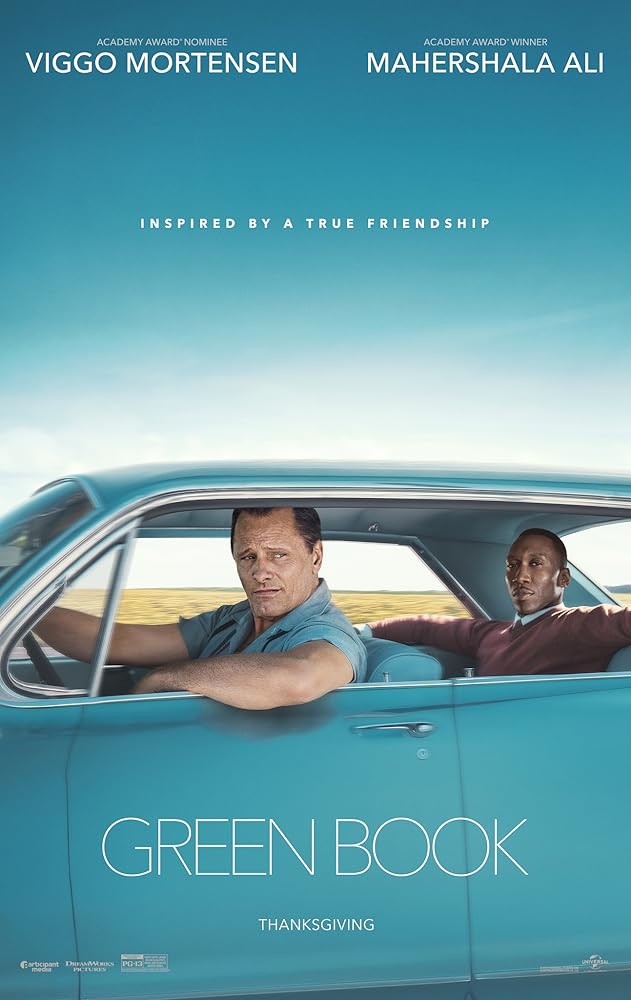
Green Book and wedding cakes

Viggo Mortensen and Mahershala Ali in Green Book (2018)
Poster (Source: imdb.com)
While the rest of America was watching the Super Bowl, my wife and I played rebels and went to a movie instead. We saw “Green Book,” directed by Peter Farrelly, which tells the based-on-a-true-story of a 1962 concert tour of the southern U.S. by black pianist Don Shirley. Mahershala Ali stars as Dr. Shirley, Viggo Mortensen plays the parochial white New Yorker who serves as Shirley’s muscleman-driver, and Linda Cardellini plays Mortensen’s wife.

Green book
Example of green book, from New York Public Library
via history.com

The Green Book referenced in the title, which as book qua book actually doesn’t factor that centrally to the plot, was a publication intended to guide black travelers around segregated America, listing places where they could shop, eat, lodge, and so forth. Many of those places depicted in the film were rather low on the amenities scale, but blacks who looked for better accommodations were putting their lives on the line. In the course of the movie Dr. Shirley was physically assaulted twice when he found himself in whites-only facilities; other occasions were merely awkward.

Mahershala Ali in Green Book (2018)
Listed in the Green Book, low on the amenities scale (Source: imdb.org)
Segregation in 1950s-60s America was by no means confined to the South. The State of Iowa, which comprises about 54,000 square miles, as of 1953 included exactly twelve places where African-Americans of that day could lodge; that year entrepreneur Cecil Reed found no place his family could stay between Cedar Rapids and Denver ("Sepia Motel" 2018, Fannon 2013). The scarcity and sketchiness of public accommodations open to blacks surely informed the public accommodations provision of the 1964 Civil Rights Act which bars discrimination on the basis of race. As with segregated schools, segregated accommodations were separate but not close to equal.
Page showing Cedar Rapids's lone entry in the 1940 Green Book
Fast forward to this decade, where a number of businesses small and large are claiming exemptions from civil rights laws protecting gays and lesbians, based on the Constitution’s guarantee of free religious exercise. In a widely-known case, the Supreme Court last June upheld a Colorado bakery owner’s religious freedom claim against the State of Colorado after the baker refused to bake a cake for a gay couple’s wedding. Four years earlier, the Court found the Hobby Lobby Corporation entitled to claim religious exemption from providing their employees insurance plan(s) under the Affordable Care Act that included contraception coverage.

I’ve been making the case on this blog that inclusion of all, on an equal basis, is a fundamental aspect of community; in our common life, there can be no second-class citizens. You can’t exclude people based on their race, religion, gender, sexual orientation, &c., &c. If you believe religiously, as people did not too long ago, that blacks are not entitled to the same access to opportunities as whites, that religious belief is twisted but protected, but can’t be applied in the public square. Exclusion from the benefits of society is fundamentally wrong.

But, pragmatically, gays getting married, or women seeking contraception, are not today in the position of blacks circa 1962. There surely are multiple bakeries in Lakewood, Colorado (pop. 147,000) that would do a cake for a gay couple; insurance companies at the time of the Hobby Lobby case seemed eager to find a work-around to keep the corporation’s hands clean. Without denying that we’re not close to full equality of all people, both gay marriage and contraception are part of the mainstream national culture today. No Green Book is necessary for anyone to find the services they need.

Viggo Mortensen and Mahershala Ali in Green Book (2018)
Outside Hawkins' Mens' Store, where things aren't going to go well (Source: imdb.org)
There still is, of course, the problem of humiliation when one finds that “we don’t serve your kind.” Ali’s character in “Green Book,” Dr. Shirley, repeatedly encounters situations where establishments that don’t display a “Whites Only” sign nonetheless serve only whites, or serve blacks but don’t allow them to use dressing rooms, eat in the actual restaurant, and so forth. It seems at the very least establishments that claim religious based exemptions from serving certain types of people make that publicly known. Then everyone would know in advance who could get served, and could make their purchasing and job application decisions accordingly. (Note: There is a bar in Cedar Rapids I won't patronize because until recently they displayed a prominent sign banning do-rags. I don't wear do-rags, but I also choose not to be associated with what smells like racism.)

I'm coming from a position of privilege on every dimension, so I'm trying to speak cautiously here. (Unfortunately, Blogger does not offer a "Cautious" font.) I think exclusion is exclusion, and it's wrong. Paint it with religion, and it's still exclusion, and it's still wrong. The conditions faced by black Americans well into my lifetime were intolerably wrong, and the provisions of the Civil Rights Act were way overdue. Could it be that the contemporary situations I referenced are... tolerably wrong?

Monday, January 21, 2019

Color blindness vs. opportunity

See the source image
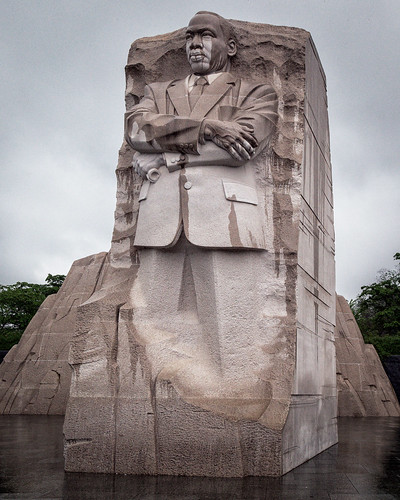
Martin Luther King Memorial, Washington DC

(1/21/2019) Those of us who remember, albeit vaguely in my case, the era of Dr. Martin Luther King Jr., can perhaps be forgiven for wishing the whole racial equality thing settled, so we can move on to some other crisis, like poverty or world peace. One has only one attention span, after all. However, race refuses to settle, refuses to consign racism to a bygone and unlamented era, refuses to quit the stage of American politics.

Dr. Evelyn Carter
Dr. Evelyn Carter, from evelynrcarter.com

A lot of that has to do with how deeply wired race is to our ways of interpreting the world, says Dr. Evelyn Carter, a social psychologist with the diversity consulting firm Paradigm Strategy Inc. Race is part of the way we categorize people we meet, pre-consciously, so before our enlightened ideals have a chance to kick in our impressions of others are "auto-populated" with racial ideas, often of the rather unenlightened sort.

Dr. Carter spoke on Martin Luther King Jr Day in Cedar Rapids, in a morning celebration at Coe College and in the evening at St. Paul's United Methodist Church. (In between the two she ran a workshop at the public library.) Both talks were on the inadequacy of color-blindness as an ideal for navigating the world. She recognized the allure of color-blindness: people want to be seen as individuals not as stereotypes, and interracial conersations about race are inevitably stressful and exhausting. Whites don't want to say the wrong things, and blacks don't want to make themselves a target. So it's easier to avoid the subject.

Other studies show whites tend to over-focus on the progress made in race relations since the 1950s, which, while considerable, still falls far short of the equal opportunity the country promises. In 2016 median family wealth for whites was $171,000; for blacks it was $17,600 (Besette 2019). The disparate situations mean a world of difference in terms of access to health care, housing, travel, educational opportunities and internships, not to mention much greater vulnerability to any life setback. Not surprisingly, as a consequence, young African-Americans and Latinos are much more likely to live in poverty, drop out of school, and be unemployed (Besette 2019).
Dr. Carter speaking at St. Paul's UMC
Dr. Carter argued color-blindness stifles conversation about what's going on in the world, thereby inhibiting remedial action, and keeps us frm being good neighbors. At St. Paul's she addressed the parable of the Good Samaritan in the Christian gospel of Luke, arguing that Jesus's concept of neighbor does not necessarily mean someone like us with similar experiences and attitudes, but anyone in whom we can recognize common humanity. "How would you want to experience the world?" she asked. "How would you want to be treated, to be shown mercy?" Dr. King's 1963 speech in Washington, she said, did not advocate for a color-blind society--a common interpretation of the "content of their character" passage--but a "beloved community" involving a variety of gifts.

She concluded both talks by commending "frank conversations about race" as the only way to overcome the racial divide and begin to achieve some semblance of King's dream. She proclaimed herself an optimist, believing that these conversations can and will happen. She recommends:
  • "Lean into the awkwardness." White people in particular should stop trying to prove their sympathy-likability ("peformance orientation") and try to learn as much as they can from the other person.
  • "Remember that relationship can go a long way." The more time you spend with someone the more trust you build.
  • Conversation can clarify what needs to be done (referencing Luke 10:37, Jesus said to him, 'Go and do likewise.')
Her wisdom and optimism are important antidotes to a racial scene in America that can seem intractable to the sympathetic white, not to mention downright dangerous to the black or Latinx.

Johnson STEAM Academy choir sang some lively tributes to Dr. King
Ana M. Clymer, Cultural Equity Statewide Coordinator,
accepting the Percy and Lileah Harris "Who is My Neighbor" Award
(Fun fact: The Harrises were Dr. Carter's grandparents)

SEE ALSO:

Camille Busette, "Our Day of Reckoning," Brookings, 12 January 2019
Alison Gowans, "MLK Day Speaker, Granddaughter of Percy and Lileah Harris, Encourages Hard Conversations," Cedar Rapids Gazette, 20 January 2019
LAST YEAR'S POST: "Acting for Inclusion in a Fearful World," 16 January 2018 (also 2017 2015)


Monday, January 14, 2019

Condition of the State 2019

(Source: Wikimedia.org under Creative Commons license)

Here's what we know about Iowa in 2019: Of its roughly 54,000 square miles, roughly 50,000 of them contain places that are losing population and wealth, and are voting Republican. Republicans have had unified control of state government since 2016 after holding the governor's office and state House since 2010. They renewed control in 2018 despite a Democratic wave nationwide. The Statehouse is pretty much an "office of rural affairs," with urban Democrats at the margins.

So, I'll say with my best Ross Perot voice, "it doesn't take a rocket scientist" to imagine the Governor and legislature putting their best efforts and resources into resuscitating Iowa's struggling small towns, rural areas and small industrial cities. In earlier posts (cited below) I've cited recommendations from researchers on how to do this: support universities, welcome immigration, develop public-private partnerships, small business incubators, improve digital skills, subsidize extension of broadband access, and in desperate cases relocation assistance, a rural housing initiative, and better funding for state agencies (Smith 2018, Hendrickson Muro and Galston 2018, Menner 2018, Florida 2017).

However, what we've seen since 2016 is little-to-no progress on any of these economic initiatives, and a whole lot of crowd-pleasing and tax-cutting. Besides the biggest tax cut in the state's history last year, which will only help the situation if supply-side economics miraculously starts to work, we've seen annual bills restricting abortion--including last year's "fetal heartbeat" bill--as well as de-funding Planned Parenthood, barring sanctuary cities, loosening gun control, ending collective bargaining for public employees, blocking minimum wage increases in urban counties, and cutting the state budget.

This year, according to the Gazette's daily previews, top legislative priorities include holding the line on spending while expanding gun rights, cutting property taxes, legalizing sports gambling, and making the judicial selection process less merit-based and more partisan. How any of this helps the people who are hurting, wherever they are, I can't see, unless they draw some comfort from pissing off liberals.

Governor Kim Reynolds
Gov. Kim Reynolds (R-Iowa), from governor.iowa.gov
Governor Kim Reynolds's second Condition of the State address Tuesday was civil and positive, in the tradition of this address, but rather small potatoes. That may be as good as it gets, given the priority placed on cutting taxes. She began with an extended section celebrating Iowa's residents and legislative achievements (see above), then announced "the future is now" while discussing various initiatives (some state, some private) to prepare students and workers for the new economy. (Later in the speech, a post-prison initiative got the highest praise possible: "And it's run without! government! funding!") There was also an extended discussion of mental health policy, signaling that is going to be higher on the agenda than previously thought, though much of the work ahead involves undoing the damage the state did earlier in the decade.

She ignored all of the ideological red meat on the legislature's table, which was polite, but left me wondering how much of her address actually related to the legislative session just underway.

The Governor nodded at the need for rural economic development, in the usual ways. Virtual connectivity was hailed as the key to retaining young people and keeping rural communities vital, and she's asking for $20 million, so I'll give her that. Second on the list was expanded rural housing tax credits. Oh, and we'll now have an actual office of rural affairs, to be called the Center for Rural Revitalization. She was more personal last year when she said "When I go home, I hear the disappointment and I feel the frustration when another storefront closes." But the hesitation to commit much in the way of state resources to addressing deep-seated local issues is the same. At least we can send them texts when we pass another gun rights bill!


SEE ALSO
"Election 2018 and What Happens Next," 20 November 2018
"What is the Future of Iowa's Small Towns," 3 July 2018 [includes a fair amount of economic data on urban/suburban vs. rural Iowa]
"Condition of the State 2018," 10 January 2018

Thursday, January 10, 2019

Eventually, we're going to have to figure out immigration

Swiped from wbur.org
President Trump made his first-ever speech to the nation from the Oval Office last night, trying to justify why the need for a 1000-foot-long wall across our border with Mexico is so excruciating that it is worth a government shutdown to force Congress to accede. With a robotic delivery and flagrantly misleading "information," he probably didn't convince anyone, but he might have managed to reassure the true believers he's still with them. House Speaker Nancy Pelosi and Senate Democratic Leader Charles Schumer were barely more energized as they tried to convey their party's stance as rooted in common sense and fairness, albeit with very little in the way of detail.

I was missing a lively, young, technically-literate Democrat who could, with a few props, explain how electronic surveillance worked better to solve all of the problems attendant to illegal immigration. That would have provided a contrast to our President in so many ways. But, alas, that didn't happen in this universe. And where is the vision? Where is the equivalent of Martin Luther King's 1963 dream of interracial community?

President Trump's immigration policy is so awful almost any alternative would be better, rather like every direction is south when you're at the North Pole. (The same could be said for his environmental policy.) Listening to wall advocates, you immediately wonder if they understand how the 21st century actually works, or if this is all about symbolic expression of--what? Hatred of Mexicans? Leaving one's mark in a sort-of permanent way? Add in the gratuitously cruel handling of refugees, including what amounted to kidnapping their children, and the utter unpreparedness of ICE and the Department of Homeland Security for implementing any of these policies, and you're left with the conclusion that the entire policy is fueled by malice. Ignorance, malice, and lack of resources--no wonder Pelosi and Schumer felt confident in asserting they could do it better.

Eventually, though, we're going to have to get specific. We're actually at a rather quiet phase of the immigration cycle, or would be were it not for President Trump's knack for creating chaos out of order. Overall immigration levels have recovered from the financial crisis era, but remain below long-term averages. The best estimates of undocumented persons as well as undocumented workers in the United States have them at their lowest levels in over a decade. Moreover, a sizable proportion of both groups have been in the U.S. more than 10 years; fewer are newly-arrived (Krogstad, Passel and Cohn 2018; for data on Mexican border apprehensions, see Ramon 2018). It's surely possible to imagine both economic and political pressures getting more intense. Nicholas Kristof calls 2018 "the best year in human history" because of worldwide progress against poverty, lack of access to education and premature death. May that progress continue! but if there are reversals that will increase the number of people in developing nations willing to take the risks involved in getting to America. And what of refugees, who the President has denigrated and horribly mistreated? As climate change accelerates, and basic resources become scarce in more places, the resulting instability and violence will produce refugee flows that will make those of the last few years seem like a Sunday in the park. Are we ready for that?

Figure 2 U.S. immigration and natural increase
Immigration is one way to counteract a declinig birth rate. Or not
(Source: Frey 2018. Used without permission)
I don't think we are ready at all, other than majorities of Americans disapprove of Trump's approach. We need a coherent, predictable immigration policy that takes account of all legitimate interests in the policy debate. That means admitting all those needed for labor supply, as well as providing an avenue for refugees with a well-founded fear of persecution. It should provide security against dangerous people, drugs &c. but also to regulate the entry of immigrants--and not just those entering across one particular physical border--to some nationally-agreed upon level. It should provide clear, manageable paths to permanent and temporary residence. It should take account of those who have been in the country so long they have become part of the national fabric, such that chasing them out would do more harm than good. The resources necessary for enforcement, naturalization and managing the flow of temporary workers should not be difficult to get. Whatever the associations with the name, Immigration and Naturalization Service (INS) is a much better name for this operation than the too-narrowly-focused Immigration and Customs Enforcement (ICE).

It goes without saying that this policy should be thoroughly debated in Congress, for however long it takes, as was the case with the landmark Immigration Acts of 1965 and 1986. It should not result from the President holding the government hostage until he gets what he thinks he wants.

It also goes without saying that opposition to immigration that is racially-based--viz. the President's frequent characterizations of Mexicans and "shithole countries"--should be recognized and called out for the racism it is.

The alternative to immigration laws that relate closely to the realities on the ground is, I suppose, the default option of continuing to muddle through as we have for decades. This policy has evolved in a way that's clearly adaptive to various realities, which means it's working after a fashion, despite its incoherence.  Current policy also distributes its costs unfairly to Border Patrol officers, who put their lives on the line for laws the country isn't committed to, and to undocumented laborers, who are too vulnerable to resist economic exploitation. It also creates space for unscrupulous politicians to exploit racial fears and resentments.

A country that celebrates community in all its diversity needs to have a frank conversation about immigration. For the forseeable future, it's up to Democrats to take the lead on that.

Transcripts of the President's speech and the Democrats' response are here.

Friday, January 4, 2019

Three questions for places in the New Year

building on snowy street
Cedar Rapids winter overflow shelter
(swiped from cbs2iowa.com)

1. Can we do better by our mentally ill and addicted citizens? People living on the streets are a constant of urban places, even in smaller cities like Cedar Rapids. Of the cities where I spent time, Seattle seems to have the most aggressive street people, including one fellow downtown known for periodically shouting at no one in particular, "Excuse me, sir? SIR? SIR? FUUUCK!" There have been reports of urinating in front of stores, and following other people for blocks. No wonder Seattle's mayor called homelessness "an emergency" a few years ago (Treatment Advocacy Center 2016). But variations of these phenomena are found everywhere. In New York City last month, a police officer was attacked by three homeless men.

One plausible if somewhat-dated estimate had the homeless population with severe mental illness at 325,000 (Treatment Advocacy Center 2016).  Homelessness comes in many forms, and much of it is driven by issues of supply and affordability. People living on the streets are often mentally ill or addicted to substances (which are not mutually exclusive categories). Nationally, estimates range around a third of homeless who are severely mentally ill, though local studies have found higher proportions (Baldwin 2016). (People who are homeless for economic reasons tend to be less visible to the general public, and probably to researchers, too.) Their situation has been exacerbated for decades by deinstitutionalization and closing of psychiatric hospitals, driven by state budgets as well as idealism.

While institutionalization is not the solution for everyone, neither is it compassionate to allow people to drift and struggle, facing perils of crime, weather and eating food from dumpsters. Can we improve access to addiction treatment and antipsychotic drugs? Provide better transitional living situations? Support more research into causes and cures? Meanwhile, we rely on short-term heroic solutions like shelters, or try to law the problem away by making sleeping on the streets a crime.

Downtown Washington, Iowa

2. Is there potential for economic development in small towns and rural areas? This is a question we've visited before, but with the imminent reconvening of Iowa's office of rural affairs (a.k.a. the state legislature) it's worth looking at what might be done for underperforming areas besides tickling their feelings of resentment with culture wars bills.

A recent Brookings study argued that small towns and rural areas might do best by cooperating with nearby small cities (Arnosti and Liu 2018). If our economic future is going to be anchored by digital and knowledge-based skills, policies to revive extractive industries like mining should be recognized for the false promises they are; instead, "rural America's best bet might be to support economic growth in urban centers, including micropolitan areas, and strengthen linkages between urban and rural communities." Successful metros can and do subsidize projects elsewhere in the state; successful metros near rural areas improve access to jobs and capital for rural residents while retaining social connections; and some of those taking advantage of nearby opportunities will return to their hometowns (the "boomerang" effect). Richard Florida (2018) notes that not all rural counties are suffering population and job loss, though the examples he cites--a Tesla factory in Storey County, Nevada; an expanded casino in Love County, Oklahoma; and an expanded retirement community in Sumter County, Florida--smack of smokestack-chasing and so may be limited in their instructive utility.

Arnosti and Liu approvingly quote Bloomberg columnist Noah Smith, who argues, "In order to compete with the big cities, rural America needs fewer factory towns of 5,000 people and more small university cities of 50,000." They argue states should (1)  empower communities' and regions' capacity to chart their futures; (2) prioritize local job creation over recruitment of firms like Tesla or OCI NV; (3) strengthen post-secondary education; and (4) seek to close regional disparities. There's a lot there to choose from; we'll see if Governor Reynolds or the Iowa legislature pursues any of it, or sticks to the ever-popular culture wars.

heroImage.Alt
(Photo by Tela Chhe, from flicker.com via minneapolis2040.com)

3. Can Minneapolis 2040 [a] work? [b] serve as a model for other cities? In December 2018, the Minneapolis City Council passed a new comprehensive plan. Most notable among its many topics, the plan calls for policy changes that could conceivably have an earth-shaking impact on housing supply and affordability by allowing duplexes, triplexes and apartments in a vast area of the city where they are not currently permitted (Schuetz 2018, Sisson 2018). If it plays out as hoped, the increased density will produce substantial improvement in the city's environmental footprint, better community connections, an opportunity for all those people who say they want to live in walkable communities actually to do that, and more fiscally-sustainable infrastructure. As Strong Towns Tweeted: Minneapolis 2040 will undoubtedly have a huge impact on economic justice and the affordable housing landscape. But allowing neighborhoods to adapt and grow incrementally will have an even bigger impact on something more fundamental: pure finance. 

Other cities, starting next door with St. Paul, are looking at what Minneapolis has done and are preparing to ask their doctors if Density might be right for them. But there remains much work to be done to turn this legislative miracle into on-the-ground reality.


Anyone who follows politics knows that the fight doesn't stop with enactment; it just rolls across the street to a new bar. The zoning code will need to be changed to incorporate the new goals i.e. to make them legal. As in any place facing housing issues, landowners and developers will need to be assured there's profit to be made in these kinds of projects. And specific projects are sure to be protested by affected neighbors (Schuetz 2018). On the other hand, new Mayor Jacob Frey chose to spend his political capital on passing this, and it did pass, and that alone represents an intriguing new page in this story.


Coffeeneuring Challenge 2026

  The leaves say: It's time for Coffeeneuring! What's the secret to our success? I say it's the autumn appeal of low-key two-whe...