Wednesday, January 29, 2014

Pete

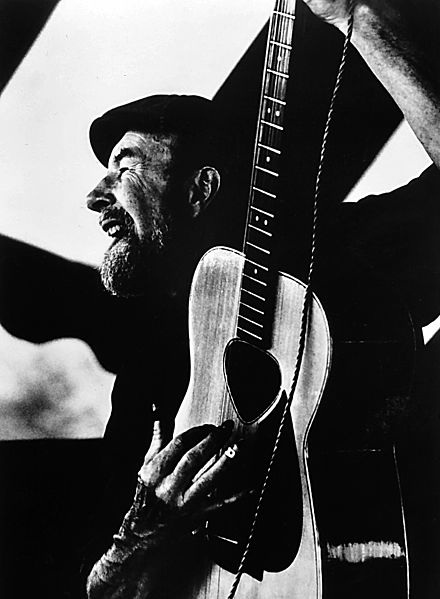
Pete Seeger (1919-2014)
Pete Seeger, from Wikimedia Creative Commons

If there were a community-building hall of fame, Pete Seeger, who died Monday at the age of 94, would be in it. Seeger, with a very average voice but a genuine way with people, began performing around 1940 with the Almanac Singers which also included Woody Guthrie. Even as a solo act, his concerts were never solo performances, but were built around teaching songs to the audience so they could be done together. The songs he brought--children's songs, work songs, early American songs, South American songs--had simple melodies and often powerful messages. Anyone could sing, he preached, and in fact everyone should sing. If you weren't hitting the same notes as your neighbor, well, that was harmony.

Seeger is also valued because he displayed public passion for things that matter, the things which enable us humans to live with each other: a clean environment, justice for the downtrodden, not taking ourselves too seriously. He lived for a long time in upstate New York, maintaining a connection to place that included a decades-long crusade to clean up the Hudson River. In his younger days he called himself a Communist, which in retrospect appears naive and silly. But he paid a disproportionate price for exercising his freedom of speech: he was barred from television and many public appearances for many years during the 1950s and early 1960s. It's also clear in retrospect that McCarthyist repression was far more of danger to America than Seeger-the-Communist was. He got some payback in 1994 when he was awarded a National Medal of Arts by President Bill Clinton.

Much of Seeger's oeuvre is still available on Folkways Records. A good introduction to Seeger's music is "The Essential Pete Seeger" (Vanguard), which has 23 songs covering the period 1950-1974. Vanguard also has several collections by the Weavers, a quartet which featured Seeger, Ronnie Gilbert, Lee Hays and Fred Hillerman. (Their 1980 reunion concert is depicted in the movie "Wasn't That a Time?") Some excellent contemporary versions of songs associated with Seeger are included in Bruce Springsteen's tribute "We Shall Overcome: The Seeger Sessions" (Sony, 2006). The book How Can I Keep from Singing? by David King Dunaway (Villard/Random House, revised edition, 2008) thoroughly covers Seeger's life and career.

Here's a vivid passage from Dunaway (p. 263 to be exact) which represents Seeger at his best.
[In 1962 Seeger sang to five hundred schoolchildren at P.S. 84 in New York City.] Reaching these squirmy kids was a challenge; their music teacher had barely managed to finish "America the Beautiful" without being booed off stage.
"Seeger walked down the aisle," journalist Peter Lyon wrote, "wearing a fuzzy sweater, a shirt of firehouse red, rough worsted trousers and heavy thick-soled shoes." Until he started playing, he looked like a gaudy scarecrow: "But when he unlimbered his banjo and gave the children a warm, inclusive smile, something magical happened in the room. He sang:
Lou, Lou, skip to my Lou... 
 "At the second line, fifty voices were singing with him. At the third, a hundred had joined in, and scandalized teachers were shushing all over the hall. To no avail: Seeger and the children understood each other perfectly.... This routine miracle achieved, Seeger walked back up the aisle, submitted to an interview by three small shrewd reporters for the school paper, signed several autographs, rescued his instrument from a group of eager experimenters and made his way to the street." 
SEE ALSO

Jon Pareles, "Pete Seeger, Champion of Folk Music and Social Change, Dies at 94," New York Times, 29 January 2014, A20 [http://www.nytimes.com/2014/01/29/arts/music/pete-seeger-songwriter-and-champion-of-folk-music-dies-at-94.html?_r=0]

Appleseed Recordings Pete Seeger site: http://www.peteseegermusic.com, text dated from 2007 or '08

Live Performances:

Sunday, January 26, 2014

Dogs on blogs


I discovered a new (to me) blog this week, "Another Place for Me," which is written by Gracen Johnson, a recent graduate student now living in Fredericton, New Brunswick. She makes excellent short videos illustrating current issues. A few of them feature her adorable small dog. Rufus.

In the most recent video, "Another Place for Me Winter Special: Dogs in the City," Rufus and Ms. Johnson illustrate how dogs can add to the life of the city. In a nutshell, dogs in a city means people walking dogs, which adds life (and eyes) to the street. This increases the potential for businesses to open where people can walk to, and by people we mean people with dogs and people without dogs. The more people, the more life, and the city becomes a better place to live. And we meet people, as I can regularly attest, having become acquainted with any number of dog walkers I regularly see in our neighborhood.

It's worth mentioning that in her video, the dogs are leashed and well-behaved, and the street scenes are bustling but uncrowded. Alas, it is not always so. I hear complaints about dogs getting underfoot at our crowded downtown farmers' markets, and dogs who bark all day long. And those dogs are theoretically under someone's control. My friend Niles Ross notes that a walk along 32nd Street NE is complicated not only by decaying sidewalks but by dogs running loose. "Yes, there is a leash law," he points out, "but nobody enforces it. The mail carrier has repeatedly called, but by the time anyone shows up--if indeed anyone does--the dog(s) is/are somewhere else." I've had enough run-ins with dogs, unleashed or lunging at their leash, over the years to tax the patience of even the most devoted reader of this blog. Suffice to say they have certainly made we wary of any dog I don't know, and even wary me got bit on the hand by a Jack Russell terrier last month.

Suffice also to say there's poop, by the pile (literally!).

Gracen Johnson is right, of course, both on the matter of walkable cities and on the matter of dogs. But to get to the happy place depicted in her video, we're going to have to re-learn things our grandparents' generation probably took for granted. Just as our species needs to re-learn how to use third places, and how to mix cars with bicyclists and pedestrians, we--dogs, their owners, and those of us who are neither--need to re-learn how to behave when we're in close proximity.

Saturday, January 25, 2014

Bibles and places


Aunt Clara kept her Bible right next to the phone
In case she needed a quote when she talked to someone
--"CHILDISH THINGS," JAMES McMURTRY

Christians in Cedar Rapids got a shock this week, if they were paying attention, when the American Bible Society ranked our city 96th out of 100 in "Bible-mindedness." Used to thinking of ourselves as a typical, upstanding, not-terribly-exciting slice of middle America, we find ourselves sharing space with such bastions of liberalism as Boston and San Francisco, down the list from Las Vegas and New York City. And we're below Madison? Seriously??

The American Bible Society was founded in 1816, and appears from its website to have an evangelical orientation. "Bible-minded" is a crude measure of fundamentalism. According to the post on the ABS website, the survey was done of 46,274 households between 2006 and 2013. Respondents were classed as "Bible-minded" if (a) they had read the Bible in the previous seven days, AND (b) they responded "strongly agree" to question(s) about the "accuracy" of the Bible. Cities are ranked by the percentage of respondents who thereby qualify as Bible-minded  Chattanooga led with 51 percent, followed by Birmingham (50 percent), and Roanoke (48 percent). Cedar Rapids scored 17 percent. At #100, with a mere 9 percent, is Providence.

It's a pretty low threshold for Bible reading. It doesn't say whether you read it for an hour, or half an hour, or half a minute, just that you read it. That would produce interesting data in itself, of course, but what separates the occasional reader from the "Bible-minded" is not degree of devotion but interpretation of Scripture.

"Accuracy" is a highly problematic word in this context. What does it mean to say the Bible is "accurate?" A scale is accurate when it gives a precise measure of weight, but is that any kind of standard for a religious text? I Kings 7:23 has Hiram designing the Temple with circles whose circumference is three times the diameter, which would look like the kinds of circles I draw. The 16th century Church's insistence that the Book of Joshua provided a scientifically accurate depiction of the universe terrified Copernicus such that he delayed publication of his findings about the solar system until after his death. Did Methuselah actually live 969 365-day years? Was Sarah actually 99 years old when she bore Isaac? I think one could be quite sincere in their religious beliefs without affirming the accuracy of these numbers. What then is accurate? The interpretation of God's laws? The historical fact of the stories? The translation from the original language?

Are Goya's paintings "accurate?" I find a lot more truth in The Third of May 1808 than in a lot of well-meaning social science or journalism.

Assuming--I can't tell from the report--the question on accuracy was stated more or less as above, the meaning of the word "accuracy" is up to the respondent, which is a dangerous thing in survey sampling. My hunch is most people took it to mean some manner of factual accuracy, and so most of the people who "strongly agree" are fundamentalist Christians.

So we wind up with a map of fundamentalism in the United States. There are better measures out there, and less showy to boot. But the results are mostly what you'd expect. It is hard to tell what is the unit of analysis. The article refers to "cities," but they clearly mean some definition of metropolitan area. "Cedar Rapids/Waterloo" is not a city, they are two cities 50 miles apart. Nor are they part of a single metropolitan statistical area as defined by the U.S. Census Bureau. They are part of the same media market, but not near the top 100 in size. So how is Cedar Rapids, or "Cedar Rapids/Waterloo," even on this list?

Oh well, I quibble. To the map! Of the 32 cities in the first column of rankings, all are in Southern or border states except 4 (Wichita, Bakersfield, Indianapolis and Grand Rapids). That is not surprising for any measure of fundamentalism. The Midwest, Texas and Florida populate most of the middle column. The last column has a number of west coast cities, a lot from the northeast, and of course Cedar Rapids. Defining the northeast as Maryland and Delaware on up, only Johnstown/Altoona and Philadelphia appear in the middle column, with 15 cities in the last column. From the West Coast states, besides Bakersfield, there are three cities (Spokane, Portland and Sacramento) in the middle column, and six in the last.

How to account for Cedar Rapids's place on the list? They may have tapped into something I haven't; my hunch is that there was either too small a sample size or computational error. Cedar Rapids isn't the weirdest anomaly, though. How is Salt Lake City #87?

What difference does fundamentalism, or being "Bible-minded," make to the places people live? Someone should try correlating this list of Bible-minded cities with one of those lists of great places to live.

SOURCE: "The Most (and Least) Bible-Minded Cities in America," http://www.americanbible.org/features/americas-most-bible-minded-cities

Tuesday, January 14, 2014

Condition of the State

See the source image
Terry E. Branstad in 2010 (Source: Wikimedia commons)
Iowa Governor Terry E. Branstad addressed the new session of the state legislature Tuesday, giving by my count his 19th Condition of the State address. (He's entering the final year of his fifth non-consecutive term, and is expected to announce his candidacy for re-election soon.)

The speech was matter-of-fact, honoring the state's traditions and making some non-controversial proposals. Branstad is not a dramatic person, Iowa is not a nation-state on the order of California or Texas, and Iowa culture doesn't seem to go for drama. To this blog's core question, what can we do to develop our common life, the answer seems to be: In Iowa we have a common life, and we prefer that no one messes it up. Even the Senate Democratic leader, Mike Gronstal of Council Bluffs, found little to quarrel with in a post-speech interview with Dean Borg of Iowa Public Television. Borg had to probe hard to get Gronstal to allow that he would have liked to have heard more from the governor about more predictable budgets for the state's public schools. A controversial proposal by legislative Democrats to raise the minimum wage went unmentioned by either side. For the record, so did passenger rail, which the governor steadfastly opposes. Metropolitan regional authorities and the environment aren't even on the radar screen.

As places go, Iowa has few urban areas: only Des Moines has a population greater than 150,000. We have a lot of small towns, of the sort that inspired the new urbanist theme of connection. As has been the case for decades, most of these towns have lost economic vitality and population to urban areas. Branstad raised an interesting proposal to provide tax incentives for businesses to repurpose abandoned civic buildings. Beyond that, there wasn't much addressing the realities people in Iowa and elsewhere now face. We'd like more engineers (hooray for STEM classes) and fewer bullies, but otherwise we want things to go on more or less as they have been (hooray for Watermelon Days).

Branstad's speech began by celebrating how Iowans work together with a "sense of community." Oddly, the first example he cited was getting wrestling restored to the line-up of Olympic sports. (The University of Iowa and Iowa State University have two of the country's top wrestling programs, and high school wrestling is pretty big here as well.) Then he suggested we turn this energy towards fighting the U.S. Environmental Protection Agency, which is fixing to back off its dubious mandate to include ethanol in motor fuels. He then launched his main theme, "Iowa is working," celebrating an improved economy and state budget as well as better health insurance coverage, and contrasting Iowa's seemingly consensus-based politics with the ongoing dysfunction in Washington. Included was the obligatory mention of "out-of-touch bureaucrats." Of course, the economy and state budget owe a lot to various national economic stimuli, and health insurance wouldn't have happened without a kick in the rear from the national government, either. The speech's invitation to self-congratulation was in sharp contrast to the City of Cedar Rapids, whose officials regularly credit the state and federal governments with vital assistance in rebuilding from the 2008 flood.

It begs the question of what exactly the government of a small state can or should do. A state is neither the national government, with all its resources and power, nor is it a metropolitan area where people could potentially feel a defined common destiny. And Iowa is a small state. Are we a place apart, like Camelot, with special people and soil and government? Or are we flotsam in a national economy, hanging on as well as we can? I suspect we're more the latter than the former, though with enough insulation from short-term trends that things are never as bad here when the national economy is bad, nor are they are good when the national economy is good. Someone in a poor section of town, or a town that is seeking to be stronger and more resilient, would find little encouragement in this speech. It may be that the state or any state has none to offer.

Governor Branstad's speech can be viewed on the state's website, https://governor.iowa.gov/2014/01/gov-branstad-delivers-2014-condition-of-the-state-iowa-is-working/. The Iowa Public Television site includes Dean Borg's interview with Senator Gronstal as well as clips from previous addresses at http://www.iptv.org/iowapress/story.cfm/full_program/11310/cos_20140114_condition_state_2014/video.

Monday, January 13, 2014

Nothing says community like...

...a great big pile of Christmas trees! This has been a Cedar Rapids tradition for as long as I can remember. We take our trees to the Sac and Fox Trail parking lot off Bertram Road. The Indian Creek Nature Center uses the mulch to build trails.

Monday, January 6, 2014

Non-places, places of cloning, and virtual places

(shopping mall, from www.meneren.com)

One of the major themes in writing about places is variously called "the end of place," "non-places," and "placelessness." Beginning with Edward Relph in the 1970s, some observers have noted that as the world has gotten smaller, places have become less distinctive. "Supermodernity" (Marc AugĂ©'s word for the world we're living in) means:
  • the ease of transportation and communication means we're often more involved in getting from one location to another, and/or talking across distance, than in being in any one place;
  • the surge in home construction in America that followed World War II has led to housing and area templates that are relatively inexpensive to build and easy to replicate; and
  • as we move more, and travel more, we crave the comfort of familiar sights.
So we get interstate highways, airports, shopping malls, motels, subdivisions and office parks that are virtually indistinguishable, and a world full of McDonald's, Starbucks', Targets, and USA Todays that offer uniform, predictable menu items, store layouts and news no matter where we are. Maybe 20 or 30 years ago McDonald's ran a commercial featuring a little girl whose family moved far away. She looked terrified, until they stopped at McDonald's, and by gum, there was Ronald, and he looked pretty much the same as he had in her old hometown, and so everything was going to be OK.

I can relate to the girl's feeling. After I graduated from college, I moved 950 miles to take a job in a small Louisiana town. The job was not, as they say, a "good fit," and for that and other reasons I spent that summer in an ongoing state of homesickness. One weekend I went to visit a friend in eastern Texas. When we went to the mall in his town, it was the first time I'd been in a mall since I'd moved to the South, and... it looked and felt very very much like the mall I'd left! For an hour or so, then, I was "home."

Much as I understand  homesickness and yearning for comfortable familiarity, though, the flipside is that if you're always homesick for someplace you are not, you'll inevitably miss the reality of the place you are. And if towns design themselves just like every other place is designing itself, they'll wind up being no place.

The Brazilian architect Lineu Castello calls buildings that look like they've been ordered from a catalog "places of cloning." He's not ready to condemn them outright, though. Castello looks for their ability to integrate into the existing cityscape in ways the enhance human activity there. If they add to the liveliness they are OK. If they stand out awkwardly, and inhibit rather than facilitate human activity, then no matter how well-built and -designed they are very costly mistakes.

I'm no expert, but I'd call the Great America Building in downtown Cedar Rapids an example of successful integration. As an office building it's pretty generic, but it creates a plaza by the river...
Great America - Exterior Plaza
Great American Building courtyard, from OPN Architechts website
...that makes for an effective gathering place--there was quite a group there for the fireworks last summer, for instance--and Cedar River Trail entrance. You can easily walk to, by, or around the building. The new public library is also an effective building, and less generic.

On the other hand, I'm not crazy about the rebuilt hotel and convention center. It's massive, and is hard to walk by. It imposes itself on the block rather than blending in.
I'd say the same about the new federal courthouse, and have my worries about the casino when it arrives in a year or so.

The same logic applies to designing whole neighborhoods. I can't say I was thrilled to read in today's Cedar Rapids Gazette that the city is planning to use the Highway 100 expansion as a lever for "geographic growth," and has annexed 63 acres of rural land northwest of the city where developers want to develop. I'm not sure there's a market for more sprawl, but developing is their business not mine, so there probably is. But Cedar Rapids is hardly densely-populated as it is, and Linn County hardly suffers from an excess of open land. Really, though, to stretch Lineu Castello's logic, how we sprawl matters more than that we're sprawling. If the new development is denser than Bowman
Woods or Granite Ridge or Pioneer Avenue subdivisions at other edges of town, and if there are places to work and shop within walkable distance of where people live, then we'll have added a real live neighborhood. If we're going with a large lot subdivision full of big house clones, we'll have added another non-place to a town that already has plenty of them.

Finally, how do virtual places fit into the place/non-place classification? They're not just for teenage geeks anymore! My friend Niles Ross made sure I saw a blog post from the Washington Post on the
Nao, a robot that promises to provide social connections for the homebound elderly. Your body might not permit you to get out and around, but you can send your Nao out to hobnob. Niles, in what I might characterize as high dudgeon, points out that in a sprawled town the homebound are far from anywhere that people congregate; that a cracked sidewalk perilous for a frail elderly person is likely to be equally perilous for a little robot; and that being homebound is often as much a matter of city design as it is a person's physical condition. I agree.

SOURCES
Marc Augé, Non-Places: An Introduction to Supermodernity (Verso, 2nd ed,
2010)
Lineu Castello, Rethinking the Meaning of Place: Conceiving Place in Architecture-Urbanism (Ashgate, 2010)
Matt McFarland, "Turning Robots into Surrogates for Senior Citizens," Innovations, 31 December 2013, http://www.washingtonpost.com/blogs/innovations/wp/2013/12/31/turning-robots-into-surrogates-for-homebound-senior-citizens/
Edward Relph, Place and Placelessness (Pion, 1976)
Rick Smith, "Cedar Rapids Plans for Growth, Maximizing 'Pull Factor,'" Cedar Rapids Gazette, 5 January 2014, 1A, 7A, http://thegazette.com/2014/01/05/cedar-rapids-plans-for-growth-maximizing-pull-factor/
Rick Smith, "C.R. Takes on 2 Annexations," Cedar Rapids Gazette, 7 January 2014, 1A, 8A

P.S. The Atlantic Cities blog reports that the amount of paved roads in the United States hasn't changed appreciably since 2005 (see Eric Jaffe, "Have We Reached Peak Road?," Atlantic Cities, 6 January 2014, http://www.theatlanticcities.com/commute/2014/01/have-we-reached-peak-road/8019/). Whether this is a blip or a bend in the curve remains to be seen, of course, but it's possible other locales no longer share our urge for "geographic growth."

Tuesday, December 31, 2013

Song of the year


One New Year's Eve, when I was a teenager in the 1970s, I got caught up in the excitement of listening to a radio station's countdown of the year's top hits, and decided to make my own list. That much is easy to explain; what is less easy to explain is that I've done it every year since. Anyhow I now have a considerable time series of my musical tastes. My early choices tended towards mellow songs ("Stop and Smell the Roses" by Mac Davis was the inaugural song of the year) or novelty records ("Convoy," "King Tut"). Since then I've gotten hipper, or at least less mainstream, but the choices have remained visceral. My criterion seems to be mostly what recording gave me the most pleasure that year, with perhaps an idea that the track would be the most memorable in the future. Often I'm wrong about that. Rare has been the song of the year that is clearly tied to that year. I imagine most of my choices are interchangeable, except that the musical styles might give them away as the product of a certain era.

For 2013 my song of the year is "Same Love" by the Seattle hip-hop artist Ben "Macklemore" Haggerty and his collaborator Ryan Lewis. It is a well-crafted track: Macklemore's spoken patter weaves in and out of the soulful singing of Mary Lambert. The chorus, "She Keeps Me Warm," was written by Lambert and has since been completed and released by her as a single in its own right (Spanos). Macklemore manages to maintain both a conversational tone and the rhythm of the piece. If they should choose in the future to collaborate on a track about national parks, or art museums, or the baseball trading deadline, it would be well worth a listen.

What sets "Same Love" apart from the 2013 pack, though, is the topic, as well as how the artists address it. Gay marriage is very much a topic of the current age. Ten (I hope) or at least twenty years from now, it will be so uncontroversial that songs about it will seem as quaint as the doomed inter-class romance described in the Shangri-Las' "Leader of the Pack," or the generation gap in "Signs" by the Five Man Electrical Band, do today. Twenty years ago, the song would have been too far ahead of its time. The only top 40 hit I can think of that dealt sympathetically with homosexuality was "The Killing of Georgie" by Rod Stewart, a ballad about a hate crime which hit #30 on the U.S. pop charts in 1977. (I can't remember: did Stewart openly say Georgie was gay, or was it just implied?) "Les Boys" by Dire Straits, a track on their extremely popular 1985 album Brothers in Arms, is openly sympathetic but the gay men he describes are goofy and alien. I have more examples of pro-gay folk songs from the 1990s, including "Home is Where the Heart Is" (Sally Fingerett), "Radical" (Catie Curtis) and "Oh, Baby I Love You So" (Ann Reed), as well as a line in Greg Brown's "The Poet Game," but these were hardly big-time pop hits. [I missed Melissa Etheridge's #8 hit from 1994, "I'm the Only One," which celebrates a gay relationship (McKinley)]. For the record, "Same Love" hit #11 on the U.S. charts this year (Caramanica).

It's also important to me that Macklemore's presentation is so straightforward and common-sensical. I can personally identify with his journey on this issue. He does not ape the confrontational style of, say, Glenn Beck. He's not looking to fight some culture war, just explaining his position. As the song progresses we see how his thinking evolved from his early fears to a recognition that there is more uniting us humans than there is dividing us ("Whatever God you believe in/We all come from the same one..."). That recognition is critical to sharing the world and creating community in the 21st century. And, with a nod to Parker J. Palmer, such unity comes from discussion and a willingness to empathize, not from slogans and shouting.

RELATED SITES

"BN Albums of 2013," http://public.coe.edu/~bnesmith/albums13.html

"Same Love" Video : http://www.youtube.com/watch?v=hlVBg7_08n0

SOURCES

Jon Caramanica, "A Singer Whose Context is 'Love and Heart,'" New York Times, 12 November 2013, http://www.nytimes.com/2013/11/13/arts/music/mary-lambert-breaks-out-on-her-own.html

"Macklemore Releases 'Same Love' Video in Support of Gay Marriage," Huffington Post, 4 October 2012, http://www.huffingtonpost.com/2012/10/04/macklemore-and-ryan-lewis-same-love-gay-marriage_n_1937384.html

James McKinley Jr., "Stars Align for a Gay Marriage Anthem," New York Times, 30 June 2013, http://www.nytimes.com/2013/07/01/arts/music/stars-align-for-a-gay-marriage-anthem.html?_r=0

Brittany Spanos, "Mary Lambert on Critics of Macklemore's 'Same Love:' 'I'm Gay and Part of the Song Too!'" The Village Voice Blogs, 15 November 2013, http://blogs.villagevoice.com/music/2013/11/mary_lambert_qa.php

Chart positions pre-2000 from Joel Whitburn, The Billboard Book of Top 40 Hits: Complete Chart Information about the Artists and Their Songs, 1955-2000 (Watson-Guptill, 7th ed., 2000).

Navigating homeownership

  Navigating homeownership panel (L to R): Jennifer Pratt, Stephanie Schumacher, Matt Skogman, Ann Roushar, Zach Kucharski (9/23/2026)  Pros...