Tuesday, June 4, 2013

Local businesses

When I'm at Coe, and feel the need to get out of the office for a cup of coffee, the choice is obvious: Brewed Awakenings Coffeehouse is just across 1st Avenue and offers an impressive selection of coffee as well as a nice atmosphere.


Starbucks doesn't tempt me, as the nearest of their stores is nearly four miles away. (The PUB in Coe's Union sells Starbucks Coffee, but that's a quite different type of place.) But what if the situation was reversed? What if Starbucks was right across the street, and the nearest local option was, say, Blue Strawberry downtown, which is over a mile from Coe?

My heart says go with the local business, defining Brewed Awakenings as "local" because its two stores are both in Cedar Rapids, and Starbucks as "national" because it is headquartered in Seattle and has zillions of stores all over the world. But are there some data to support my preference? I know, for example, that the Starbucks Corporation has been using much of the same international tax sheltering that Apple has been criticized for, but that distracts from the central question: Does it really matter which coffee place I choose? Or does it depend on the terms of franchising?


Changing the subject to ice cream highlights the conundrum. The closest ice cream place is Dairy Queen, located two blocks from Coe's campus. For awhile, following the same prejudice that leads me to choose against Starbucks, I traveled across town to the Kool Moo. Lately, we've been going to the Dairy Queen on 16th St NE. Laura and Todd Henderson, who own it, are great people who live two blocks from their store and are very active in the community. The people in line with me represent a cross-section of the city, and I often recognize people I know. Dairy Queen is a national brand, but the 16th Street Dairy Queen seems very local.

This Sunday's Gazette business section had an article noting that Cedar Rapids has a shortage of upscale retailers like Nordstrom's and Whole Foods. Is this bad? Our vibrant array of local coffee places flourishes because Starbucks was very late in moving in here. Could there be local businesses doing what Nordstrom's does? Would that be better for Cedar Rapids?

Am I blue


The City of Cedar Rapids is participating in the Blue Zones Project, a nationwide initiative run out of Tennessee by Healthways Inc., and sponsored in Iowa by Wellmark Blue Cross Blue Shield (by far the largest health insurance provider in the state). Blue Zones promotes healthy living through exercise, dietary choices and positive attitudes. (The Blue Zones folk tend to longer lists, like the Power 9 list of healthy lifestyle habits, and the 11 Blueprint sections at last night's open house. Anyone who's taken my classes knows that a list of more than five things makes me woozy, so I have condensed it down to three major areas.)

Monday night there was an open house at Coe College. Volunteers from Blue Zones, the city, and maybe other organizations solicited opinions from visitors. Look at all the blue t-shirts!


Blue Zones operates a wide range of initiatives, seemingly on the theory that if they can start people talking about a variety of dimensions of healthy living, and achieve results on even a few of them, they will have done a great deal of good. I like that theory.

City design is one of their areas of interest, as indeed it is one of mine. From their website:

A community's streets, sidewalks and trails help people bike and walk more. Many cities have used the same techniques as the Blue Zones Project™ does to increase pedestrian and bike safety in roads, expand and build bike lanes and maintain sidewalks. These kinds of improvements allow for great sources of exercise for individuals and makes a community more livable overall.

Many people in Cedar Rapids are already using such pathways to get some exercise--some just because they feel like it, and a greater number because they own dogs. This is definitely something to be said in favor of dogs, who need walks throughout the year, and not just when it's nice out as it is now.

In trying to get more people to exercise, Blue Zones focuses on persuasion as well as more/better pathways. That may not work, though, for many people who don't own dogs and aren't self-motivated to walk. What they need is some place to go that's easiest to get to on foot. A lot of areas in any city as sprawled as Cedar Rapids don't have anything like that. Even in my close-in neighborhood, the only place within a five-minute walk is Brucemore (which admittedly is pretty special). Better city design needs not only more sidewalks and bike lanes, but more places to walk and bike to. [As I waited to write on the comment sheet, I noticed the woman in front of me was the first one to mention needing places to walk. Points for her! But then she used the example of the walking area at the proposed redesign of Westdale, which will in fact be a walking area you can only get to by car. Arggh.]

Along the same lines, Blue Zones encourages work places to provide exercise areas for employees and time to use them. Coe rocks in this area, with our pool, racquet courts, and two workout rooms. We are a college with traditional-age students, after all. But I think businesses can help a lot just by where they choose to locate. To pick unfairly on one business, Aegon USA might well have all that stuff, but they're on their own huge campus a long way from anywhere. Just to get across the parking lot is a long walk. Contrast that with CRST, which is locating their new office downtown. Even if they don't have fancy exercise equipment, they're close to restaurants, coffee houses and other places people can walk to on their lunch hours a lot more easily than they can drive anywhere.

One of the interesting walking ideas Blue Zones is promoting is the "walking school bus," where parents and/or community volunteers escort children to their neighborhood school.
(a "walking school bus" in action, from the Blue Zones website)

I think this is a great idea, and if I didn't typically have to be at work before school starts I would cheerfully volunteer. One problem is schools like the recently-built Viola Gibson School, located on busy and unwalkable Blairs Ferry Road. Another problem, in fact the problem in my own neighborhood, is that parents tend to opt out of Johnson School, even though it's about three blocks away, because it has been designated a School In Need of Assistance. So they drive their children to schools farther away.

Conversations about healthy living are conversations worth having. A lot can be done without persuasion, which some may consider to be scolding, if we pay attention to what Hester (Design for Ecological Democracy, 2006) calls "impelling form."

Friday, May 31, 2013

CR flood "Five Years Out"


The University of Iowa Public Policy Center held an excellent symposium in Cedar Rapids today, examining progress and future policy challenges five years after Cedar Rapids's historic flood. The symposium was held at the National Czech and Slovak Museum and Library south of downtown; the museum has been moved to higher ground since 2008, having been worked over quite destructively by the flood waters. Meanwhile, record spring rains have brought the river to the brink of flooding again. [Here's my wife Jane's report on the situation as of this afternoon.)

 Any number of commenters find this ironic; I would say it was going to happen sooner or later, and probably introduced a sobering element to the discussions.

There were four panels, a keynote speech and a delicious lunch. The panels started with science, and moved gradually towards a focus on public policy.

 A lot of the policy discussions dealt with the need to change agricultural practices, with not as much as I'd expected on development in Cedar Rapids. However, Joe O'Hern, Cedar Rapids's executive administrator for development services, received a few pointed questions from the audience.

O'Hern's panel also included Kamyar Enshayan, director of the Center for Energy & Environmental Education at the University of Northern Iowa. Enshayan argued that policy makers are ignoring clear mathematical, scientific and engineering data that bear on future flooding. Three specific lessons which have not led to policy response are:

  1. Flood plains are important, and shouldn't be built upon. He didn't call out Cedar Rapids, but did mention Cedar Falls and Iowa City as the only Iowa municipalities that have restricted development in the 100-year flood plain.
  2. Diverse cropping systems are better than the continuous corn or corn-and-soybean planting that dominates Iowa agriculture. This is driven by perverse incentives in the federal commodity support program.
  3. Burning fossil fuel is destabilizing our climate.
Cedar Rapids is, of course, rebuilding downtown, which is within half a mile of the river. Earlier, city manager Jeff Pomeranz congratulated the city on retaining 82 percent of the businesses that were flooded, and this blog has already testified to the vigorous reconstruction activity going on. The trendy New Bohemia area is also right by the river, and while we were discussing various New Bo businesses were being sandbagged against the coming deluge.


Enshayan didn't challenge Cedar Rapids's development choices, but two or three members of the audience did. In response, O'Hern pointed out that downtown is where downtown is, that there's "an existing huge investment in the 500-year flood plain," and that this remains the core of the city. We can't, he said, pick it up and  move it. He also said the since the flood the city has opened up over 200 acres of green space along the river.

I'm with O'Hern on this. In an earlier post I imagined an urban zone from Wellington Heights in the east across the river to the Taylor Area in the west (and, why not, extending south to New Bohemia). This is, of course, dependent on proper development of the Medical Quarter. To the extent that the city can become more compact, it will address some of the fossil fuel problem that Enshayan also cited. For civic reasons it matters very much that city hall is downtown (which it once more is, in a former federal courthouse next to the river) as opposed to River Ridge or Westdale Mall. But the nagging question remains: if we redevelop this area, are we asking for trouble?

[The equation changes in favor of urban redevelopment if Cedar Rapids gets better flood protection. Pomeranz mentioned this as an ongoing need, and State Senator Rob Hogg returned to this theme several times. "Don't gush too much over Cedar Rapids," he cautioned a fellow panelist. "We have a long way to go." But since 2008, two flood protection referenda have been rejected by Cedar Rapids voters.]


Thursday, May 30, 2013

"Detropia"


The independent film "Detropia" is available at the PBS website until June 17. It is co-directed by Heidi Ewing and Rachel Grady. "Detropia" is a disturbing look at the troubled city of Detroit that tries to end on some hopeful notes (the people we meet are resilient, the auto industry has added some jobs, there are opportunities for artists to live and work in really cheap space). A question repeatedly raised in the film, though, is whether the tribulations of Detroit are harbingers for other parts of America. To be sure, there are echoes of Detroit, albeit on much smaller communities, in farm towns across the country. Yet Detroit is in many ways unique among American cities: its quantum growth from 1930-1960 was driven by a single industry, and today it has an unusually low percentage of college graduates (though Cleveland is close). Even so, as the poster child for the twin demons of suburban sprawl and urban poverty, Detroit's experience raises difficult questions about the sustainability of America's current lifestyle.


I have never been to Detroit. Even though I've lived my entire life (except for one summer) in the Midwest, and even though my family travels at least once a year from Iowa to Ohio, I've never had occasion to visit the Motor City. So I have no personal experience to use in placing the film's content into context. Nor is there any immediate prospect of Cedar Rapids becoming a mini-Detroit. Yet there surely there hangs a cautionary tale here from which we might learn something.

What's the matter with Congress?

I'm teaching the American Congress course this fall; in the past I've emphasized organization of the institution and how public policy is made in conjunction with the other branches. Lately, though, Congress has been so prominently dysfunctional I've decided to reorient the course to address that.

Dysfunction is easy to define but hard to measure. It's not like Congress was wildly popular or being widely praised prior to the last few years. Ralph Nader was calling Congress "the broken branch" of government as long ago as the 1970s, and it was at the end of that decade that Glenn R. Parker and Roger H. Davidson published their famous Legislative Studies Quarterly article, "Why Do Americans Love Their Congressmen So Much More Than Congress?" And it was more than 20 years ago that I wrote an ill-considered op-ed piece for the Cedar Rapids Gazette arguing for a parliamentary system of government because Congress and the President seemed unable to resolve important issues of the day like the budget, energy and health care reform.

The few and imperfect metrics we do have, though, point in the same general direction: however much past policy making has been plagued by gridlock, and whatever the degree of public disapproval of what went on in the Capitol building, the last three years have hit historic lows. The Washington Times Futility Index for the 112th Congress (2011-2013) was 330, breaking the old record by more than 10 percent, a quantitative way of saying there were way fewer bills considered, fewer negotiations undertaken and fewer laws passed than usual. The public reduced its already-low job approval of Congress from an average of 25 percent for most of the last decade to around 10 percent. (It has since "rebounded" to around 15 percent in most polls.) Things have changed. Maybe Congress didn't work very well before--that's arguable--but today it's come completely off the track, with no sign of being able to right itself.

A Congress that's off the track is problematic for everyone, regardless of their interest in politics. A dysfunctional national government endangers all of our welfare. Government policy needs to contribute to the goals this blog is promoting--economic opportunity for all, a sustainable future, provision of public goods, and accommodation of social diversity--as well as to provide a check on the private sector. Adding to public cynicism at a time when some things are crying out for political solutions is unconscionable.

The key word in diagnosing congressional dysfunction is polarization; in other words, there is more distance now between Republican and Democratic members of Congress than there has been in any of our lifetimes. But how did this come about? And why, if the public so strongly disapproves of its results, doesn't it moderate? Legislation (or not) relates to representation. And so my Congress class will spend more time than usual analyzing public opinion in order to assess whether and how well members of Congress are representing the public.

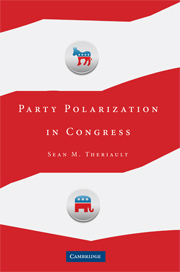
We'll start with three accessible books that analyze the recent relationship of Congress to the public: Party Polarization in Congress by Sean Theriault (Cambridge, 2008); Disconnect: The Breakdown of Representation in American Politics by Morris P. Fiorina with Samuel J. Abrams (Oklahoma, 2009); and The Disappearing Center by Alan I. Abramowitz (Yale, 2010). 

Each of the books sees members of Congress as responsive to some specific constituencies, rather than to the public as a whole. These constituencies are more ideological than the general public is: in Fiorina's words (chapter 2) they have different issue concerns, hold their views with more certainty and consistency, and publicly express their positions more confrontationally, making politics a strange and unattractive (and unresponsive) activity for everyone else. The polarization of those constituencies is what's driving polarization in Congress, and the relative parity among those constituencies means each side can block the other's initiatives but can't pass its own--gridlock!

The Disappearing Center: Engaged Citizens, Polarization, and American Democracy
The main difference between the books' arguments is over the make-up and particularly the size of those constituencies to which Congress is responsive. Fiorina's "political class" are the people actively working in election campaigns, comprising at most 10 percent of the population... hence the "disconnect" between extreme members of Congress and the moderate majority of the public, justifying the ill repute in which most hold the national legislature. Abramowitz's "engaged public" includes anyone taking an interest in politics, particularly electoral politics. I didn't catch a percentage estimate, but it's probably at least half of the adult population, maybe moreso as turnout and interest have risen dramatically during the Bush and Obama presidencies. In this view, members of Congress are not only representing the ideological views of most people, they're engaging their attention as well.

So has representation broken down (Fiorina/Abrams), or is it working too well? Both Abramowitz and Theriault see the emergence of parliamentary-style responsible parties, in a system that requires wide-ranging dialogue and compromise to function. The disconnect, then, is not between members of Congress and the public, but between the political system and its users. My students and I will be wrestling with these questions this fall.

Friday, May 24, 2013

Filling in an empty quarter

Earlier posts testify to my attachment to downtown Cedar Rapids (or downtown anywhere, for that matter). But in the nearly 25 years that I've lived here, downtown development has faced a huge handicap. It is surrounded on all sides by dead zones, which despite a few contributing businesses exhibit no signs of civic life. This makes downtown an island, with some attractions and employers but unable to draw continually on the city for the stuff of life.

To the northwest, downtown is blocked by the large factories of Cargill and Quaker Oats, the interstate highway, and A Avenue, which was quite the urban boulevard back in the day but is now essentially a service road. To the southwest, across the river, the 2008 flood wrought a great deal of destruction, but even before then the area was underused. In a couple years the casino will go in there; I'm doubtful that will help. Southeast of downtown there's been some remarkable development in the New Bohemia area, but between the two--between 5th Avenue and maybe 10th Avenue--there's a large swath of large buildings and large parking lots. Which is what you find to the northeast as well, beginning as soon as 5th Street and going to around 12th. Here are some pictures I took this morning a little past 10, walking down 8th Street:

 (A Avenue at 8th Street, looking n.e. towards St. Luke's Hospital)

 (1st Av, looking northeast; at right is the masonic lodge)

 (2nd Av looking southeast; the new fire station is under construction at right)

 (8th St, looking n.w. from 3rd Av towards 2nd; at right is
Phong Lan, a very fine Vietnamese restaurant)


There are some lovely buildings in that area--First Presbyterian Church, Immaculate Conception, and Daniel Arthur's Restaurant--but in general there's no action. Even in the middle of the day there's no one on the street. People apparently walk from their offices to their cars, and then drive somewhere else.

Now comes a group with the power and resources to bring this dead zone to life. A group of area business owners, including our two non-profit but gigantic hospitals, are at work on a master plan for a Medical District. Last night I attended a public open house facilitated by the Lakota public relations firm of Chicago. I am very curious but not particularly hopeful.

The group has formed a SSMID, which stands for Self-Supported Municipal Improvement District, and is pronounced "smid." A map of the district can be found here. The SSMID designation allows members to raise a surtax among themselves, to keep the proceeds in the area, and to direct how these additional funds are appropriated by the city. (Thanks to Phil Wasta of Tallgrass Business Resources who patiently explained this to me last night. I hope I got it right.) These resources will allow them to proceed with improvements to the area.

The SSMID commission is trying to tip their hand as little as possible. Scott Freres of Lakota said, "Our ideas haven't jelled yet. There are none." I find this hard to believe, but last night they were mainly about soliciting public comments. There were stations devoted to questions about transportation in and out of the district, visual design and branding, opportunities for improvements, and miscellaneous "big ideas." I don't know, without a plan to respond to, that the public's input was substantively valuable. I'm sure my half-formed opinions were not. Their questions weren't always clear; if we're shown two pictures of raised planters, are they asking to choose between styles? Then what of pocket parks, which I strongly support, but not if they're like the one depicted (a bunch of adults standing on a brick patio)? Members of the Save CR Heritage preservation group were present to advocate for not demolishing any more historic buildings, which certainly is a valuable perspective.

In talking with various people last night, I came away with the idea that the commission is mainly concerned about people driving in from surrounding counties seeking the district and finding what they're looking for when they get there. This would be done with better signage, prettier landscaping, and clear branding. Other than branding, which I suspect is heavily overrated by the branding industry, I agree that these are necessary steps. (If I get cancer, I just want to go somewhere where they will make it go away, whether or not it has a name, raised planters and wrought iron signage.) But these steps amount to a limited vision where the city needs a broader one.

To build connections across downtown and between parts of the city, there needs to be free flow through them. (Here I follow the new urbanists, of whom I've posted earlier.) That means, for starters, one should be able to walk from Wellington Heights on the east side to the Taylor Area Neighborhood on the west side at any time of day and find plenty of activity. This requires at least (a) a greater variety of businesses to attract people to the area; (b) a variety of residential developments; and (c) ordinary places for those people to shop and play. From New Bo to the MedQuarter, there are now no grocery stores, no hardware stores, two pharmacies (open only during the day) and one playground (in New Bo). So who would want to live there?

I got very few signals that the MedQuarter folk are interested in developing such connections. The blocking of 2nd Avenue between 12th and 10th last year certainly indicates it wasn't then a priority. The project planners can certainly talk the new urbanist language; one of the maps even showed a "5 minute walk" radius, although for some reason it radiated from Immaculate Conception. But is there interest or motivation to help make it happen? Is it in the purview of businesses to take a broader view than their own bottom line? I remember the bank bailout in 2009, when instead of using the windfall to start lending and hiring the banks sat on it. President Obama's apparent naivete was widely panned at the time; banks aren't interested in implementing your public policy, you silly president, they're interested in making money. Apple's tax-avoidance contortions, revealed this week, were rational and legal, but done with utter disregard for America, Ireland and the other places they set up shop (or pseudo-shop). Should we expect more of the hospitals and their allies?

There are a few residences in the MedQuarter now, mostly old houses that have been converted to apartments.
(300 block of 8th St)

They're quite scruffy, and I'm sure their occupants are, too. If this block gets prettied up, where will they go? What will happen to them?

MedQuarter businesses and the city share interests in sustaining viable businesses and job creation. But the city's interests extend beyond that set, and I'm not hearing that the businesses consider that theirs do. I hope the SSMID will do more than turn an empty quarter into an empty quarter with a brand and better signage, but is there any reason to anticipate they will?

[Note: The SSMID commission plans two more public workshops this summer, at which I expect we'll get more details of what they have in mind. They tentatively plan to present their draft plan to the city in September, and the final plan in October.]

Friday, May 17, 2013

Security vs. urbanity?

Three summers ago my family went on an eastern vacation. We spent a day in New York City; this is Robbie's photo of the World Trade Center site.


Now, as the new World Trade Center progresses--it may not be finished until 2019--questions are arising as to how it will be connected to its surrounding neighborhood. A draft environmental impact statement this week reveals, for the first time publicly, Police Department plans for security. And they are elaborate, including guard booths and various barriers to vehicular and sidewalk traffic. Here's a rough map, from The New York Times website:


Here's what they mean by a sally port, a vehicle barrier controlled by the police from the booth:


A bollard is a vertical post that mainly controls vehicles. Here's one from the Global Industrial website, which you can buy for $51.95:

I guess their impact on pedestrians would depend on how many there were on a given stretch of sidewalk.

The conundrum New York faces is clear. On the one hand, the new World Trade Center is an obvious target for another terror attack, and if my company is going to locate there we are going to be as sure as we can that we are not going to be blown up. And no one, particularly first responders such as police, who was in any way connected to the 2001 attacks and their dreadful aftermath wants to risk a repeat of that.

On the other hand, planners, and even Mayor Michael Bloomberg, had hoped that the new WTC would be integrated into the neighborhood so that there would be flows and connections and all the things that the New Urbanists call "urbanity," with Fulton and Greenwich Streets reopened for the first time since the first World Trade Center was constructed in 1970. Said Bloomberg in 2002: We can imagine innovative ways to manage streets and traffic downtown, reinforcing the feeling that this is one place. Getting around easily means community, and that's what we're trying to create. I'm not aware Mayor Bloomberg has weighed in on this latest proposal, but the Times article includes vehement complaints from the former director of the city's Office of Operations, the former vice president of the Lower Manhattan Development Corporation, and the former chair and the former director of planning and land use for Community Board 1.

The security vs. community conundrum is not unique to New York City. One of the motivations behind suburban development has been the desire of families to live in more secure environments; of course that brings sprawl and all its attendant costs, but particularly loss of community. But in a city which has suffered a deadly attack unique in our recent history, the conundrum surely has more immediate resonance.

A side controversy has to do with the impact on urbanity of restricting vehicular traffic. The New Urbanists, following Jane Jacobs, base everything they want on the presence of diverse lots of pedestrians throughout the day. Yet despite some European success in creating auto-free downtowns, in America most experiments have been disastrous. Champaign, Illinois had virtually killed its downtown by the time I moved there in 1982, and I remember State Street in Chicago was closed to vehicles for awhile. In New York, argues former community board chair Julie Menin, vehicle restrictions around the Stock Exchange and police headquarters have killed local businesses. On the other hand, the deputy police commissioner for counterterrorism, Richard C. Daddario, argues: The campus security plan will not isolate the World Trade Center from the Lower Manhattan community.... The argument... ignores the fact that people largely experience the city on foot and on bikes.

P.S. 18 June 2013: From designer Jeff Speck's book Walkable City, page 98: These car-free successes provide a powerful lesson that unfortunately does not apply to most American cities. It is a mistake to think that similar designs will produce similar results in vastly dissimilar places. Face it: you aren't Copenhagen, where cyclists outnumber motorists. You aren't New York, where pedestrian congestion can actually make it impossible to walk south along Seventh Avenue near Penn Station at 9:00 a.m. Unless you have similar residential and pedestrian density and stores that can thrive in the absence of car traffic--a rarity--to consign a commercial area to pedestrians only, in America, is to condemn it to death. So, the design described above might work for New York City, but don't try it at home!

Navigating homeownership

  Navigating homeownership panel (L to R): Jennifer Pratt, Stephanie Schumacher, Matt Skogman, Ann Roushar, Zach Kucharski (9/23/2026)  Pros...