Monday, February 15, 2021

What's Up in Uptown Marion? (II)

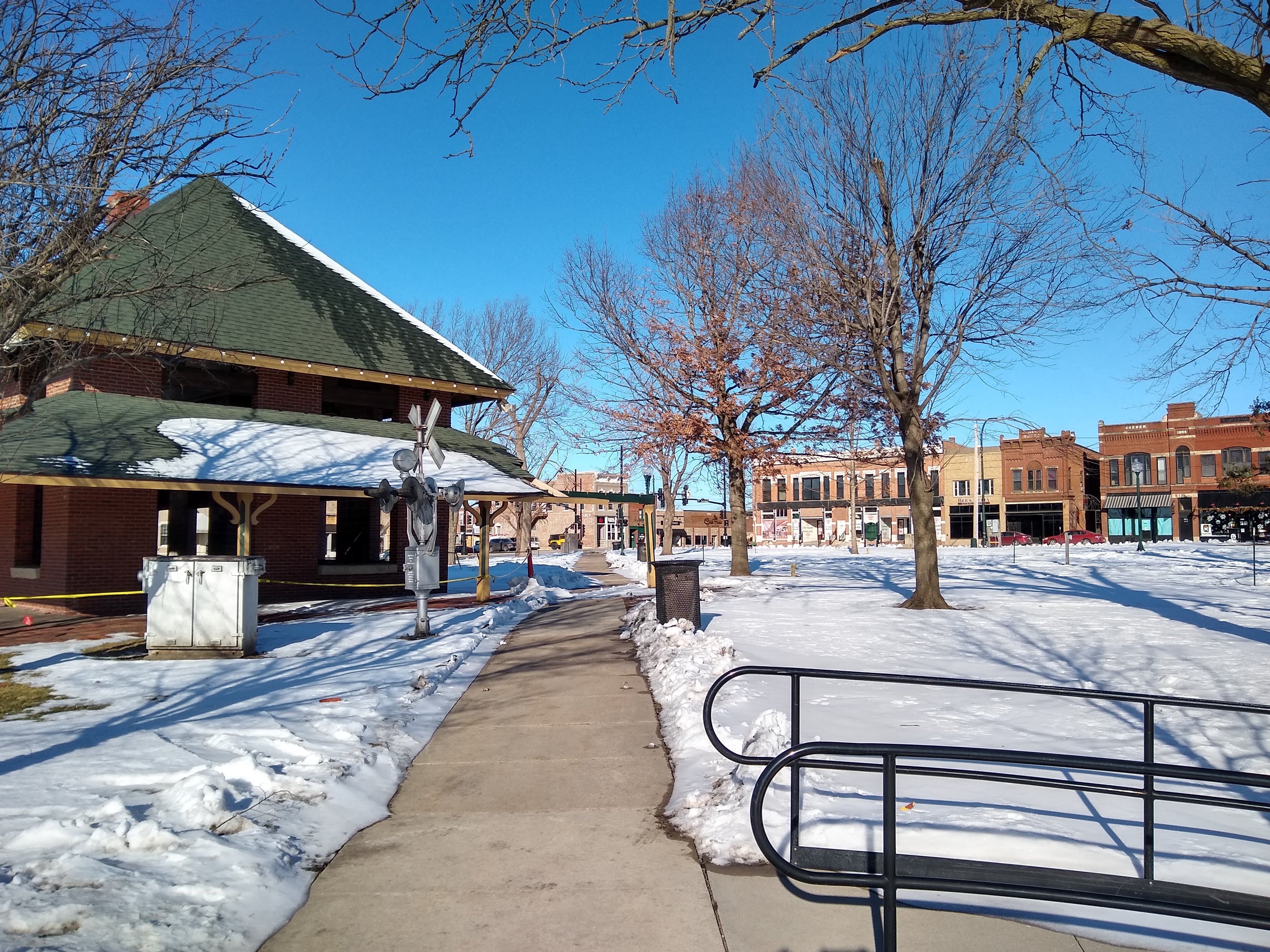
1000 block of 7th Avenue, taken across City Square Park

(2/15/2021) Five years ago this winter, Your Humble Blogger spent part of a day helling about downtown Marion, Iowa (officially branded and hereafter called "Uptown"). Having heard at this month's Corridor Urbanism meeting there were more exciting things going on there, I hurried back for an anniversary look-see. Despite damage from the August 10, 2020 derecho and the persistence of the coronavirus pandemic, things are definitely happening.

Center and path: City Square Park lost trees in the derecho

In our last exciting episode, it was noted that (1) Uptown Marion makes great use of its city square and historic commercial buildings, and was planning some interesting alley projects as well as a new library; (2) the urbanist part of town is really, really small, but seemingly growing and capable of serving nearby residential neighborhoods; (3) Uptown commerce has a high frou-frou-to-practical ratio, and only one coffeehouse; and (4) part of the plan was to divert through traffic from 7th Avenue to 6th Avenue.

(1) Thriving historic commercial district.

City Square Park: The historic depot got hit hard

11th Street: historic buildings, new buildings that blend in,
and east entrance to Art Alley

7th Avenue: south entrance to Art Allley

Art Alley: Back patios of Uptown Snug, Brick Alley Pub, and Short's
create charming synergy (when it's not January)

7th and 12th: What used to be Irwin's Clothing is now a dental office
1100 block of 6th Avenue: Construction of the new public library,
one block east of the current building

First United Methodist has moved, replaced by
Pentecostals of Greater Cedar Rapids.
Historic building suffered much storm damage.


Where the bus stop used to be: Leftover from Christmas?

(2) Expanding urbanism.

1200 block of 7th Avenue, north side:
urbanist foothold increases

1200 block of 7th Avenue, south side:
this strip mall will soon be replaced by a multi-story, mixed use project

800 block of 6th Avenue, south side: a new urbanist foothold,
with a diner and tiny shops including a gift shop, book store,
and jeweler

Longer view of the same space from 9th Street: Your development here?

(3) Drive-to urbanism. The Walkscore for this charming district is 72, but you'd still have to drive a ways for groceries and hardware, for example. Walgreen's at 1225 7th Avenue is both a positive and negative: a positive because you can get prescriptions and some groceries right downtown, a negative because it's a wealth-sucking chain big-box store with a huge footprint right downtown. This cannot possibly be the highest, best use of that land. More changes are coming with new developments on the site of Marion Square Mall and the current public library.

With regard to coffee, Uptown Snug (760 11th Street) has opened a coffee house in the front of the bar, which fills a definite hole because the only coffee last time was at Wit's End (630 10th Street) which has closed--temporarily?--due to storm damage. Kettel House Bakery (945 6th Avenue) and West End Diner (809 6th Avenue) also serve coffee, but are restaurants not coffee houses.

(4) Traffic diversion? As of the last traffic counts, in 2017, 7th Avenue continued to be the main thoroughfare in this area, drawing 12,800 cars per day compared with 6100-6200 on 8th Avenue and 2670-3370 on 6th. Twenty years ago, traffic on 7th was 18,500 per day, with the decrease probably due to the Marion Bypass (IA 100) south of town. The roundabout at 7th Street (pictured above in August 2016) was added in 2015,  intended to divert traffic onto 6th Avenue and make 7th Avenue more pedestrian-friendly (see Kasparie 2016). This morning traffic still seemed heavier on 7th Avenue, and the highway designation (BUS 151/IA 922) still attaches to 7th Avenue as well. It will be interesting to see the next round of average daily traffic counts, but that goes without saying, doesn't it?

Meanwhile, the Marion Fire Department is moving its headquarters from Uptown out to Tower Terrace Road, and the YMCA of the Cedar Rapids Metro Area has just opened a new facility out there. The Police Department's already at another edge of town. Marion's center of gravity clearly has been heading away from Uptown for a long time; the city's growth to an estimated 40,359 in 2019 from 20,479 in 1990 has largely been fueled by suburban expansion. 
 
So where does Uptown fit into Marion's future? Maybe a viable residential option for people who choose not to live in a 20th century auto paradise, and another hotspot of drive-to urbanism for the rest of us.

12th Street south of 7th Avenue: Someone needs to up(town) their snow removal game!

Sunday, February 7, 2021

Review essay: Urbanism for all?


Alex Krieger, City on a Hill: Urban Idealism in America from the Puritans to the Present (Belknap/Harvard, 2019).

Stacy Mitchell, Big-Box Swindle: The True Cost of Mega-Retailers and the Fight for America's Independent Businesses (Beacon, 2006).

A few years ago, I began a talk on urbanism by reading from the excellent novel The Golem and the Jinni by Helene Wecker (Harper, 2013). The author describes in detail the golem's first encounter of late 19th century New York City, full of energy and community and poverty and garbage. I told the group that urbanism was more or less an effort to recapture the energy and community Wecker describes without the yucky stuff.

It seems urbanism is not the first movement in American history to try to pull this off. Most of Alex Krieger's prodigious book is a chronicle of hope, as a succession of dreamers takes advantage of the vast American continent, as well as ever-improving technology, to leave whatever mess they were in to seek economic and social opportunity (chs 1, 9, 12, 16, 18), contact with nature (chs 2, 6, 7, 13), better communities (chs 4, 5, 14, 15), or just some fresh air. These (predominantly white) Americans had big ideas of how they could somewhere produce a mode of living that provided the best of both worlds--be those individualism/community, culture/nature, stimulation/security, e.g.--without the yucky parts of existing arrangements. Existing cities were typically perceived as anti-nature, rushed, stressful, crowded, dirty, noisy, corrupt, and full of disease and poverty and crime. Also difference (ch. 3). 

Las Vegas's wide streets are for people who are going places

So successive generations of dreamers struck out for a new start, either individually or in like-minded communities. Krieger covers a bunch of urban design trends over the centuries, as well as profiles of indicator cities like Washington (ch. 10), Chicago (ch. 11), and Las Vegas (ch.16). He is gentle and sympathetic in his portrayals, dismissing reflexive snobbery (of the "what they wanted was stupid" variety) and cynicism ("it was stupid to want/hope for that"). He pays some but not a whole lot of attention to the continental vastness being dependent on ignoring the presence of Native Americans, or to the nonwhite minorities and poor whites who suffered the impacts of whatever actions were taken towards the next utopia.

Eventually, Krieger's tone turns critical. Late in this exhaustive history of American approaches to place design comes this hint at the author's overall message: When Thomas More coined the term Utopia, the U came from the Greek words for "good" and "no" (p. 336). By chapter 18, on the back-to-the-city movement of "yuccies" and younger retired people in the early 21st century, he is scoring what the utopians have produced: swaths of environmental destruction, isolation or displacement of less powerful poor and nonwhite groups, and hoarding of goods and opportunities. He cities a number of critics of gentrification, including Joel Kotkin and Peter Moskowitz, contrasting their findings with a 1931 quote from James Truslow Adams, who defined the American Dream as a dream of social order in which each man and each woman shall be able to attain to the fullest stature of which they are innately capable, and be recognized by others for what they are, regardless of the fortuitous circumstances of birth or position (The Epic of America, pp.214-215, quoted on p. 344). Boy, is this ever not happening. (See Piketty 2014Reeves 2017).

Finally, in chapter 19 ("Postscript"), he turns cautiously hopeful again. We can and must do better, as we've already striven to do, though not by leaving places and people behind to build a new city on a new hill. Rather, we must our places and their people get better. Like Richard Florida in The New Urban Crisis (Basic, 2017), he has a to-do list: 

  1. sharing access to the abundance of America
  2. minimizing inequality, especially by careful public policy investment choices
  3. stewardship of the environment, especially by curbing excessive consumption
  4. responsibility to a broad idea of common purpose/good
Now, that's my kind of urban idealism! It stands in contrast to displacement-by-gentrification, or to urban renewal (ch. 14).


Stacy Mitchell's occasionally anachronistic but still powerful argument describes another American would-be utopia: the massive "big-box" stores operated across America by massive chains like Home Depot, Target, and the empire that is Wal-Mart. (Frequent mentions of Borders, Blockbuster, and K-Mart are jarring, but the arguments remain current in the age of Amazon.) The chains' promised paradise is one of large quantities of low-cost consumer goods, which would be nirvana to people who identify primarily as consumers. Local governments are attracted to the promise of single-shot job creation. In chapter 2, she tackles "the jobs mirage," including a study by Kenneth Stone of Iowa State University that found Wal-Mart's first ten years in Iowa (1983-1993, at the end of which there were 45 superstores) corresponded with statewide losses of "555 grocery stores, 591 hardware and building-supply dealers, 161 variety stores, 88 department stores, 291 apparel stores, 153 shoe stores, 116 drugstores, 111 jewelry stores, and 94 lawn and garden stores," and all their jobs with them. The low costs that attract consumers (ch. 5) are illusory, too, based on loss leaders and temporary cuts to drive out competition. These putative consumer paradises come at costs to local tax bases, domestic manufacturing, local and global wages, the landscape, the environment, and so on.

Mitchell is one of America's foremost advocates for locally-owned small businesses. Happily she concludes on hopeful notes: how communities have (sometimes) successfully fought back against chains, and how small businesses have banded together to make themselves stronger. Her evidence is thorough, yet her writing remains passionate, which is a difficult combination for any writer. Any observation of the American landscape, however, will show the lessons of all the research she details have been imperfectly learned.
 
Marion, IA, Black Friday 2019


Wednesday, February 3, 2021

We need to talk. About snow


1st Ave and 13trh St SE

Snow and ice can mess up any way of getting around, but in most northern cities the streets are cleared pretty quickly. Sidewalks are up to the property owner, but most eventually get done. A huge, persistent problem, however, is the snow that street plows pile up by the sidewalk.

1st Av and 13th St SE


I'm not here to narc on my neighbors, or to hate on my city, just to point out that there needs to be a way for people to cross the street. These pictures were taken more than 72 hours after the most recent snowfall, but some of this snow has been here since the end of December. (This far north, snow once on the ground stays on the ground until spring, because the air rarely gets warm enough to melt it.)
2nd Avenue and 13th Street SE

I didn't have to work to find these pictures. I just walked home from work. All of these intersections are within one mile of each other. It's not special in any way... just a typical mile in a typical northern city whose development is typically sprawled.
2nd Avenue and 14th Street SE

Some of these intersections are not difficult for an able-bodied person, but would be a challenge for someone who is at all physically impaired, or pushing a stroller, or a small child.
2nd Avenue and 14th Street SE

2nd Avenue and 15th Street SE

Some of these mountains are a challenge to anyone no matter how fit.
2nd Avenue and 15th Street SE

2nd Avenue and Park Court SE

2nd Avenue and 16th Street SE

2nd Avenue and 16th Street SE

3rd Avenue, 17th Street, and Blake Boulevard SE

3rd Avenue and 19th Street SE

3rd Avenue and Nassau Street SE

I don't have an solution, but there needs to be one--for equity, for all the reasons walkable cities are desirable.

We're expecting more snow tomorrow.

SEE ALSO: Minnesota Department of Transportation, "Sidewalk Snow Clearing Guide" (May 2018), especially page 14. They have three suggestions for "snow windrows" as depicted here. [Thanks to John F. Thomas for alerting me to this.]

Friday, January 29, 2021

Can my church be a third place? Can yours? Should yours??

Corridor Urbanism favors bars for meetings.
Why not a church?

The term third place entered the national vocabulary more than thirty years ago with the first publication of Ray Oldenburg's The Great Good Place [Paragon House, 1989], and the concept seems as popular as ever. Clearly, Oldenburg struck a nerve with his description of neighborhood gathering places lost in America's rush to the suburban model of development after World War II. The quest to recover authentic third places has been part and parcel of the back-to-the-city era that has marked the first two decades of this century.

Meanwhile, the book went to a 2nd edition in 1999 (DaCapo), and then in 2001 he edited Celebrating the Third Place: Inspiring Stories about the 'Great Good Places' at the Heart of Our Communities (Marlowe), in which proprietors of third places tell their stories. 

Oldenburg would rather describe third places than provide a crisp definition. The concept is complicated: The Great Good Place runs to 296 pages of text. On page 2 of Celebrating the Third Place, he does equate the term with "a setting beyond home and work in which people relax in good company and do so on a regular basis." His most common short formulation, though, is "informal public gathering places." "Conversation is the main activity," he argues (1999: 26):

Nothing more clearly indicates a third places than that the talk there is good; that it is lively, scintillating, colorful, and engaging.... The persistent mood of the third place is a playful one. Those who would keep conversation serious for more than a minute are almost certainly doomed to failure. (1999: 26, 37)

This conversation must cross friend groups to qualify fully:  

The B.Y.O.F. (Bring Your Own Friends) tavern may initially offer a convincing illusion of a third place, particularly when it is crowded.... The illusion is one of unity, of everybody enjoying themselves together. Upon closer examination, however, one finds that there is no unity.... The individual entering alone is almost certainly doomed to remain that way. The patrons, by their choice of seating, the positioning of their bodies, the contained volume of their voices, and their eye movements indicate that invasion of their group by others is neither expected nor welcome. Nobody meanders from one group to the next. No one calls out to friends across the room. (1999: 171)

Sometimes The Great Good Place seems at war with itself, because the heyday of third places in America occurred in extremely gendered times. If you can have a men-only third place, can you slice and dice the public in other exclusive ways? Can you be a little bit inclusive? Now I'm even more uncomfortable than I was when I started writing this essentializing paragraph, but length constraints require we push on and essentialize, so essentialize we will! 

The subtitle of Oldenburg's first book is Cafes, Coffee Shops, Community Centers, Beauty Parlors, General Stores, Bars, Hangouts, & How They Get You Through Your Day. Celebrating the Third Place includes plenty of those, plus a garden store, a gym, and a photo shop. Just being a cafe doesn't make you a third place, though; he warns against those who would co-opt the popularity of the concept for their own economic gain without providing authentic community:

Developers build houses and call them "homes." They build socially sterile subdivisions and call them "communities." It's called "warming the product." It's also happening with alleged third places. Officials of a popular coffeehouse chain often claim that their establishments are third places, but they aren't. They may evolve into them but at present, they are high volume, fast turnover operations that present an institutional ambience at an intimate level. Seating is uncomfortable by design and customers in line are treated rudely when uncertain of their orders. (2001: 3)

The third places are, then, predominantly small commercial establishments: "The best places are locally owned, independent, small-scale, steady-state businesses" (2001: 4). However, people gather in all kinds of places that don't fit that description, for all kinds of reasons. Can a sports stadium be a third place? How about a grocery store? A high school? A theater group? A Starbucks? A casino? Possum Lodge? A friend's basement rec room? An online college writing center

What about a church? Mine had an orientation/planning meeting last weekend, and the desire to make our church a third place figured prominently in the discussion.


In chapter 2 of The Great Good Place, Oldenburg describes third places as a "leveler" accessible to the entire neighborhood and so expanding everyone's range of association; a "neutral ground" where no one whoever they are has pride of status (with the exception of well-established "regulars"); and a place where conversation is the main activity and main purpose for gathering. They are accessible at most times of day, informal so they accommodate people's home and work obligations, playful, and with a low external profile. At their core...

The first and most important function of third places is that of uniting the neighborhood... Places such as these, which serve virtually everybody, soon create an environment in which everybody knows just about everybody. In most cases, it cannot be said that everyone, or even a majority, will like everybody else. It is, however, important to know everyone, to know how they variously add to and subtract from the general welfare; to know what they can contribute in the face of various problems or crises, and to learn to feel at ease with everyone in the neighborhood irrespective of how one feels about them. A third place is a "mixer." (1999: xvii-xviii)

...in other words, similar to Jane Jacobs's theory of sidewalks, but one level up!

A church, however open it would like its doors to be, is constrained as an informal, public "mixer" by having a creed--though these vary widely in rigidity--and formal membership. Churches have a variety of associations for people, not all of them positive. Their main function is to hold worship services and to provide spiritual benefits to its members. Without products to sell, they rely heavily on fundraising to support paid staff, outreach ("evangelism") to increase membership, and a bewildering array of committees that require members to staff. All run counter to the playful informality of third places, which might be why those tend to be small businesses, which have an owner and employees to keep the beer or coffee flowing and the restrooms clean.

Nevertheless, I've been in a few churches over the years that have some qualities of a third place:

Wesley United Methodist Church and Foundation, Urbana IL, runs a coffeehouse that hosted a broad clientele in the 1980s when I volunteered and quaffed non-alcoholic beverages there. (The church also had a large lounge that attracted students during the week for studying or naps; at least it did during the less security-conscious '80s.)  Back then, at the risk of shocking the young people of today, there weren't coffee houses dotting the landscape, and if you wanted to go someplace near campus that wasn't a bar you had to go to the Etc. The main menu items were "wassail," a very sweet and highly-caffeinated beverage made from Dr. Pepper syrup, and "orts," a sort-of-cheese curds made from Velveeta brand sort-of-cheese. The Etc. is in one corner of a large building, and I'm not sure how many of its customers even know it is attached to a church. In my time it was only open eight hours a week (8-12 Fri/Sat), so limited on the accessibility dimension. 

Getting ready for Jazz Night, March 2018

Westminster Presbyterian Church, Washington DC, has Jazz Night every Friday and Blues Night every Monday--again, only a few hours a week, unlike a regularly-open coffeehouse or bar. Music venues are more for performance than for conversation, but at Jazz Night there are long breaks between sets when people wander all over the sanctuary/performance space to greet each other. Even more conversation can be had in the basement, where they serve delicious home-cooked food. I went there one Friday night to check it out, and after that I returned every time I could. I never attended a service at the church, though. I don't know how many people in the audience do, either, but I suspect it is a lowish percentage. What does the church get out of it? Some spillover increase in membership? Or just the joy of being a community institution?

Veritas Cafe, from their website

Veritas Church, Cedar Rapids IA, is located toward the south end of downtown Cedar Rapids, easily walkable from any of the core neighborhoods. They have been selling Dash Coffee Roasters products in their lobby for a couple years, and are currently open 7:30-3 weekdays. (They close at 12:30 Fridays.)  They have plenty of space, so it's easy to socially distance, and the open floor plan facilitates seeing other people who happen to be there. I attended one service at Veritas in maybe 2017 to see a former student get baptized, and probably won't be back, but that doesn't matter to being welcomed and feeling comfortable at the "cafe."

Each of these churches is built to the street in a walkable neighborhood--design matters!--and they have been able to provide something the neighborhood needs (a safe meeting place during a pandemic, live music, non-alcoholic "wassail") that is sufficiently impelling to overcome any reservations on the parts of attendees about whether they belong there. It's important also that each church sustains awillingness to devote ongoing space, energy, and custodial time to activities which ask nothing of attendees regarding creed or membership, and do not contribute (much) to church attendance, maintenance, or finances. 

Looser affiliations may be where the practice of church is heading in the 21st century, but not all are buying it. Notably, four people at our church's vision discussion--all men, curiously--advocated for more efforts towards increasing membership and financial contributions. There are valid reasons to pursue those goals, too, but they seem at cross-purposes with becoming a third place.

SEE ALSO:

Johnny Dzubak, "What is a Third Place and Why Do You Need One," The Art of Charm, 8 April 2015, and "Third Place, Part Two: Finding the Right Third Place for You," 15 April 2015. Dzubak has a different way of essentializing Oldenburg than I do, with more stress on individual benefits and less on community functions of third places. Nevertheless, it's an interesting take. And I wish Dzubak had been my older brother forty years ago when I really needed these life lessons!

Sara Joy Proppe, "Sit On It," Strong Towns, 21 January 2016. Houses of worship can contribute a lot to neighborhood walkability by providing places to sit in their yards.

Tuesday, January 19, 2021

MLK Against the Mob


Officer Eugene Goodman.
Still from Igor Bobic (Huffington Post) video of Capitol Hill riot
(swiped from Yahoo News)

There is nothing blacker than uncertainty--JULIAN RANDALL

This year's observance of Martin Luther King Day took place less than two weeks after a white supremacist riot at the U.S. Capitol, less than a year after the killing of George Floyd in Minneapolis set off weeks of protests, and during a coronavirus pandemic that has killed over 400,000 Americans, disproportionately people of color. The commemorations mixed anger, sadness, and hope.

The mix of feelings came across strongly during "Not Just Another Day Off," a video medley of poetry and oratory produced by the Folger Shakespeare Library in Washington, D.C. and available through their website until Thursday. Julian Randall, Camonghne Felix, and Joe Ross read original poetry, while actors read excerpts from speeches by Frederick Douglass, James Baldwin, Malcolm X, Audre Lorde, and, of course, Martin Luther King. Felix's poetry in particular ran the gamut of emotions, containing physical pain, anger, hunger, and renewal in one short text. From "Yes, It Is Possible":

But this time, my system nosed down, bringing me down to my knees to purge....

And it was like this for days, I couldn't stomach a morsel, my receptors stunted with the shock of an imminent shift.

...until, at once, it stopped, and I woke to find myself at the kitchen table, perfectly unbothered... as if life itself were some benign victory I'd won.... 

Poet and activist Camonghne Felix

"The American Dream is at the expense of the American Negro," Baldwin stated during a 1965 debate with William F. Buckley. It was this statement that was read for this event, and which created a fascinating juxtaposition on King Day, given that King's most famous oratory is his "I Have a Dream" speech at the March on Washington in 1963. King's formulation assumed a well-made society from which blacks were unjustly excluded; it remained only to undo that exclusion, and blacks too could fully benefit from the American experience. Baldwin suggested two ways in which that American experience could only happen with exclusion and suppression of blacks: black slave labor created the wealth (including the construction of the White House, by the way) that whites enjoyed, and that un-wealthy whites still had the psychic benefit of having blacks between them and the bottom of the social hierarchy. Without the oppression of blacks, whites would lose wealth and social position.

These two takes on the American Dream speak directly to whether the current system is fixable, and why race persistently matters. King describes a world where race loses its relevance when segregation is lifted and barriers to opportunity are removed. He was not so naive to believe that the Civil Rights Act and Voting Rights Act were all it would take, and later argued for direct remedial action. But given civil rights laws, enforcement of civil rights laws, evolving social attitudes, and some degree of reparation, blacks as well as whites can partake of the American bounty. [You could find evidence in professional sports, where racial integration has been followed by spectacular incomes enjoyed by top athletes.]

Baldwin's darker vision suggests that the bounty itself is illusory, that the appearance of wealth only exists because powerful (white) people have taken more than their share. Eliminate oppression, and you eliminate the wealth as well. This is frankly terrifying to contemplate, as we work for inclusive communities with opportunities for all. Can we not have a crowded table with all manner of good things and no one excluded or exploited? But this take on Baldwin helps to explain systemic racism, widening income and wealth gaps, and ten-plus years of white anxiety bordering on paranoia.


Monday morning at 10:30 the DC Library presented Paula Wayne Shelton reading and talking about her book Child of the Civil Rights Movement (Dragonfly, 2013). Shelton is the daughter of Andrew Young, and she talked about knowing Martin Luther King when she was a child, and participating in the 1965 march at Selma. It's an upbeat, celebratory book that ends with the presidential signing of the Voting Rights Act. She was interviewed after the reading by two members of the library's teen council. She told them she wanted to show the "loving, warm and caring person" King was to children who know him only as a statue. There was some reference to current events, but mostly the questions from the children in the audience were of the "What was it like?" and "How did you write it?" varieties. Shelton is currently a 1st grade teacher at Georgetown Day School, and lives near Capitol Hill.

Lovar Davis Kidd, filmed at CSPS Hall

At 7 in the evening, St. Paul's United Methodist Church hosted the annual Cedar Rapids city observance. Since 2020 this has dispensed with a main speaker in favor of a variety show format, this year on the theme of Protest. There were memorable performances of "Lift Every Voice and Sing," "Precious Lord, Take My Hand," and "Amazing Grace," spoken word performance by Rahma and Raafa Elsheikh, and an interpretive dance to King quotes by Lovart Davis Kidd. The Percy and Lileah Harris Who is My Neighbor Awards went to Nate Klein of Mt. Mercy University, and three youth awards: Diamond Roundtree from Washington High School (now at University of Northern Iowa), and Rahma and Raafa Elsheikh from Kennedy High School and the Academy for Scholastic and Personal Success. Ann Harris Carter, daughter of Percy and Lileah Harris, preceded the presentation by reading the Good Samaritan story from the Gospel of Luke, concluding with: "(1) What is this Scripture saying to me? and (2) What am I going to do about it?"
Ann Harris Carter

What would it take to create what King later called a "person-oriented society" as opposed to a "thing-oriented society" (in his 1967 speech "Beyond Vietnam")? As frustrating and maddening as it can be, it seems despair is not an option. We must keep at it.
 
SEE ALSO: Grace King, "Martin Luther King Jr. Service in Cedar Rapids Honors 'Neighbors,'" Cedar Rapids Gazette, 19 January 2021

LAST YEAR'S POST: "Call and Response: MLK 2020," 21 January 2020


VIDEO: Mavis Staples sings "Freedom Highway" live in 2011

Wednesday, January 13, 2021

Iowa: It's Unreal!


(1/13/2021) Iowa Governor Kim Reynolds to state Republicans' latest round of electoral victories in November by saying "they validated the direction we are taking the state" (Pearce 2020). She doubled down on that Tuesday night during the Condition of the State address, praising the state's response to COVID and the August derecho, as well as its budget surplus. She did not mention the state being 7th per capita in COVID cases (17th in deaths), nor its reliance on federal grants for economic relief. Dislocations to businesses and students by the prolonged pandemic were attributed to overzealous precautions, to which she is determined to put a stop.

It has become an article of faith for a considerable chunk of Iowans that the pandemic is relatively benign, and requiring precautions such as facemasks are a blatant attack on our individual liberties. "Our liberties we prize and our rights we will maintain," goes our state motto, possibly written by someone who had a sense of responsibility to his fellow humans, but also possibly an early form of "You're not the boss of me!" Which would be an okay motto as well. The chamber seemed somewhat empty, as some members were (wisely) attending remotely. About half the members shown when the camera cut away from Reynolds were wearing face masks. The front page of Tuesday's Cedar Rapids Gazette showed a crowd of anti-mask protestors at the Capitol. The legislative leadership has said they will not require masks for committee meetings or floor proceedings. Representative Art Staed (D-Cedar Rapids) reported unmasked colleagues at each of the three committee hearings he attended Tuesday.

So Reynolds's call for public schools to open in-person rings hollow. Of course, students should be in school. Besides what must be an accumulating pile of research on the issue, I can testify from my experiences in 2020 going between in-person and online instruction that the very best students do well either way, but the farther you get away from that standard the more trouble students have with online instruction. So let's get students back to the classroom! 

Washington High School, Cedar Rapids, was closed for repairs until this month
(Google Screenshot)

But what has Governor Reynolds, or anyone in Iowa government, done to make that possible? Besides demanding it, I mean. She's resisted shutdowns and mask mandates, and overruled districts that have tried to do pandemic measures on their own. Tuesday night she called for a bill "that gives parents the choice to send their child back to school full-time." She also wants to expand open enrollment [to Des Moines and Waterloo, IPTV commentator O. Kay Henderson explained afterwards] and charter schools, as well as "education savings accounts for students who are trapped in a failing school." There will be no spending increase, though, because she wants to cut taxes again. She was full of flattery for teachers who went to extraordinary lengths for their students this year, but is proposing nothing to make their jobs less difficult or more safe. Minority leader Todd Pritchard (D-Charles City) called this part of the speech "a little bit of warfare with out public schools."

We want to do what other countries have been able to do during pandemic, without any personal inconvenience or going to the efforts they did.

From education Rerynolds pivoted to red meat about BLM protests. Reynolds did wear a facemask on her way out of the chamber... and hugged a whole bunch of people.

Iowans are brave and good and tough, and if you come to our state, you had better be, too!

The complete text of the governor's speech is here.

SEE ALSO:

"Condition of the State 2020," 15 January 2020

"Condition of the State 2019," 14 January 2019

Monday, December 28, 2020

Does America Need a Truth Commission?

Source: https://pursuit.unimelb.edu.au/. Used without permission.

The New Year offers a chance at restart for Americans and the world, along with the rollout of the coronavirus vaccines, and the impending inauguration of the avuncular president-elect Joe Biden. Besides that, though, it offers us all a chance to rest from collective trauma... rest from ten months (so far) of a deadly pandemic and the economic dislocation and social distancing it has wrought, rest from an unusually virulent election campaign whose overtime finally ends January 5 with the Georgia runoffs, and rest from a presidential term marked by relentless and aggressive public relations, alternative facts, erratic policy making, and outbursts of gratuitous cruelty and violence

One way that's been suggested to achieve national rest and reset is through a national Truth and Reconciliation Commission. A local version is underway in Iowa City, to address issues of racial justice. The nine-member commission was authorized by the City Council in June, appointed last month, and began their work before Christmas. They are charged with investigating discrimination, hosting a forum for stories of those impacted by racism, and facilitating conversations across racial lines. Commission member T'Shailyn Harrington told The Gazette: "Once you have these conversations, there's no way someone in good conscience can say instances of racial injustice don't happen in Iowa City. If there's evidence of something, there's no way you can say, 'That's fake news'" (Hermiston 2020; see also KCRG 2020). 

Priscilla B. Hayner in 2016
(Source: Independent Commission on Multilateralism. Used without permission.)

Priscilla B. Hayner, author of a major worldwide survey of truth commissions, suggests five defining features: 
A truth commission (1) is focused on past, rather than ongoing, events; (2) investigates a pattern of events that took place over a period of time; (3) engages directly and broadly with the affected population, gathering information on their experiences; (4) is a temporary body, with the aim of concluding with a final report; and (5) is officially authorized or empowered by the state under review. (Hayner 2010: 11-12)
She counted 40 truth commissions begun through 2009 (Hayner 2010: xi-xii). Hayner is a co-founder of the International Center for Transitional Justice, and has participated in quite a lot of them herself. She is, notably, more frank than sanguine in her reflections.

My interest in this topic comes from my own fatigue, as well as the strong impression that the common life that this blog celebrates has become badly torn. This interest preceded my awareness of public calls for an American truth commission, but come they have. The prolific author and former Labor Secretary Robert Reich called for one in a widely-circulated Tweet in October, promising 
It would erase Trump's lies, comfort those who have been harmed by his hatefulness, and name every official, politician, executive, and media mogul whose greed and cowardice enabled this catastrophe (quoted in Brown 2020). 
The same week, Elie Mystal presented a more detailed argument in The Nation: 
We need a form of truth and reconciliation commission precisely because our normal institutions have failed.... When a plane falls out of the sky, we don't just shrug our shoulders and say, 'Gravity has consequences.' We send in a team of experts to pick through the wreckage, figure out exactly what went wrong, hold people accountable, and make recommendations for future safety (Mystal 2020). 
Similar calls came from U.S. Senator Elizabeth Warren (D-Massachusetts) and MSNBC commentator Chris Hayes. More narrowly, Elaine Kamarck of the Brookings Institution has called for a commission to review "what went wrong" with the American government's handling of the coronavirus pandemic (Kamarck 2020).
Makeshift medical facility in North Carolina, March 2020
(North Carolina Health News. Used without permission.)

The idea is far from universally beloved. Hillbilly Elegy author J.D. Vance called the advocates "whiny," telling FOX News: 
Instead of... moving on with the life of American democratic politics, they want to go backward and punish everybody.... [R]eally what this is saying is you are going to be punished for trying to implement your ideals and principles into the work of government (Creitz 2020). 
More objectively, Harvard professor Jill Lepore argues that a commission focused on Trump would violate the American tradition of peaceful transfers of power dating back to the election of 1800. The Trump administration should be investigated by journalists, chronicled by historians and, in some cases, tried in ordinary courts. She does support proposals to use commissions to study the coronavirus response, racial injustice, and American Indian boarding schools. More broadly, 
what the nation needs, pretty urgently, is self-reflection, not only from Republicans but also from establishment Democrats and progressives and liberals and journalists and educators and activists and social media companies and, honestly, everyone (Lepore 2020).
Moreover, the record of past truth commissions is mixed. South Africa's famous post-apartheid truth commission allowed victims of violence to speak before the nation, but ignored broader impacts of the apartheid system. Commissions' capacity to accomplish nationwide reconciliation is vastly overstated (Zvogbo and Crawford 2020). Even the most successful commissions fall short of their ideal goals: A South African statement-taker told Hayner Perhaps sixty percent feel better, but those people are only healed sixty percent (Hayner 2010: 150). 

Jules Bakery in Marion is the latest metro business to close.
(Source: julesbakery.com. Used without permission.)

Maybe Lepore is right, and what we really should be doing is self-reflection. But like most Americans, I think on reflection that I'm pretty cool already. Maybe what America needs is not a Truth Commission so much as an Empathy Commission to guide us toward that self-reflection. This is definitely not to settle political scores; I'll let prosecutors and creditors deal with the President. However, we can have common life only if we are inclusive enough to know something of each other's stories, and can once again see difference as a variation of "us" rather than an alien "them." We need to not merely to affirm in words each other's humanity, we need it to feel it in our guts. Off the top of my head the commission should hear testimony from: 
  • Central American refugees whose children were taken from them
  • immigrants who contracted COVID in detention 
  • state government officials and workers who dealt with a succession of instigated attacks while also managing elections, a recession, and the coronavirus
  • people of color who have faced official or unofficial violence
  • peaceful protestors who met with official violence
  • police officers who have dealt with protests during a pandemic
  • people who have suffered looting of their property
  • people who have suffered violent crime
  • health care workers on the front lines against COVID
  • small business owners whose livelihoods have suffered during the pandemic
  • school teachers and staff
  • school age children
  • parents of school age children
  • people who've worked through the pandemic at meatpacking plants, grocery stores, and other "essential" but low-paying, low-security, and high-exposure jobs
  • religious groups whose observances have been disrupted
  • elderly and disabled people whose activities and contacts have been severely curtailed
Pitfalls immediately appear. It might well seem to be trivializing the historical pervasiveness of racial injustice by wedging it in besides all these more recent problems. We are ill-advisedly deviating from Hayter's five essential features, as (1) many of these situations are ongoing, (2) the list fails to focus on a pattern of events, and (3) it fails to focus on a single affected group of people. At the same time, the J.D. Vances of the world might see the Empathy Commission as another form of "whining," while the event itself could get entitled or political in a hurry. Maybe we'll wind up recycling some more unsubstantiated but highly colorful allegations of voter fraud

It's also not clear Americans all want to move on, or even have an inclusive common life. Well over 40 percent of Americans continue to support Trump's performance as President, and are not likely to want to move on from whatever he represents to them. A Pew Research Center survey this fall found 77-80 percent of both Trump and Biden voters saying about the other group, "Not only do we have different priorities when it comes to politics, but we fundamentally disagree about core American values." An even larger proportion of both camps, 89-90 percent, said election of the other candidate "would lead to lasting harm to the U.S." The severity of political conflict has grown increasingly divorced from the magnitude of policy disagreement, wrote a group of scholars in Science magazine this fall, featuring the tendency to adopt a moralized identification with one political group and against another--in other words, they are not just wrong they are "alien" and "iniquitous" (quoted in Edsall 2020).

Maybe my Empathy Commission could tone those feelings down a bit, but at this point how do we even get people to the table?

Redmond Park, Cedar Rapids, a public space with potential
in the Wellington Heights neighborhood

Though there are lots of reasons why it can be unpleasant (Cox 2020), we each of us need to learn how constructively to encounter difference. If that can happen, it will most likely happen at the local level, rather than via national television or social media. There's the Iowa City effort. There's Richmond, Virginia, where the National Trust for Historic Preservation is supporting an effort to transform Shockoe Bottom, once America's second-busiest slave market, into a "site of conscience"... part of the international network of such historic places that bring difficult history to light and spark public dialogue to address modern-day injustices (Nieweg 2019); first they had to undo a surface parking lot and block suburban-style development of a baseball stadium. Also in the Cavalier State, the legislature has legalized "jaywalking," a huge step in democratizing streets (Gordon 2020).

In a well-designed place, buttressing such conversations that a commission "authorized or empowered by the state" (Hayter again) are able to facilitate, people come together randomly, unintentionally, and frequently on the city's sidewalks. Good fences may make good neighbors, but we also need gaps in those fences where neighbors can meet in low-stakes encounters that build trust (Jenny 2020). Let's hear from Jane Jacobs again:
I do not mean to imply that a city's planning and design, or its types of streets and street life, can automatically overcome segregation and discrimination. Too many other kinds of effort are also required to right these injustices.

But I do mean to say that... tolerance, the room for great differences among neighbors--differences that often go far deeper than differences in color--which are possible and normal in intensely urban life, but which are so foreign to suburbs and pseudosuburbs, are possible and normal only when streets of great cities have built-in equipment allowing strangers to dwell in peace together on civilized but essentially dignified and reserved terms. ([1961] 1993: 94-95) 

New Bo City Market courtyard, a public space amidst drive-to urbanism,
but with easy access to core neighborhoods

Of the 2021 priorities for cities in Strong Towns's end-of-year survey, some focus on physical structures, some on financial arrangements, and only some directly on people, but all involve improving proximity. Joel Dixon (zoning), Talicia Richardson (regulation), Tamika Butler (equity), and Mike McGinn (combination of all three) in particular point out that good public space involves physical design, but also an inclusive approach to who is allowed to use that space, and how they are allowed to use it.

When it comes to encountering difference, we need the conversations that a commission can facilitate, but success requires a well-designed place. 

PRINT SOURCES: 

Lee Hermiston, "'Truth and Reconciliation Commission' Gets Started," Cedar Rapids Gazette, 20 Sunday 2020, 1C, 8C

Jane Jacobs, The Death and Life of Great American Cities (Modern Library, [1961] 1993)

Justice in the World Today

  Hope he gets some of that coffee: Statue of Thucydides in Vienna, Austria (7/31/2026)  A long time ago, according to the ancient Greek his...