Saturday, February 29, 2020

We build community from the ground up

See the source image
Source: eskipaper.com (Creative Commons)
My spirits have been trending low of late. Maybe I'm not getting enough Vitamin B, or maybe winter's gone on too long. Maybe I'm kind of a pessimist. Or maybe it has something to do with last week's Democratic presidential debate, an unprecedented display of obstreperousness that has me thinking that President Trump's reelection is increasingly likely. Mismanagement of government, personal corruption, foully abusive rhetoric, and cruel treatment of the most vulnerable among us have cost the President nothing, and have if anything solidified his base. Meanwhile, the viable alternatives are eating each other up like the gingham dog and calico cat. "O Scotland, Scotland!"

Three years ago, as Trump began his Presidency, I dared to hope that his performance would result in broad and decisive repudiation. Although his presidency has been even more relentlessly bad than I could have foreseen, at this point broad repudiation seems far from likely. If he is defeated for reelection, it will be narrowly, with the results in a few states decisive. The next Democratic president, for whom I can tell you right now I will surely vote, will have run based on unaffordable promises and sticking it to the billionaires, and will find themselves at the helm of a broken government of a riven, ungovernable country. Good luck with that.

We are, in short, more broken and more fearful than I'd thought. Putting the pieces back together is going to take a long time, the next President's first term at the very least. And the first thing we need to do--not what some President needs to do, but what we need to do, so Presidents can eventually do productive President stuff--is to learn how to live together.

That starts locally. (For an argument that this has already started in towns around the United States, see Studer 2020.)
See the source image
Source: wuestenigel.com (Creative Commons)
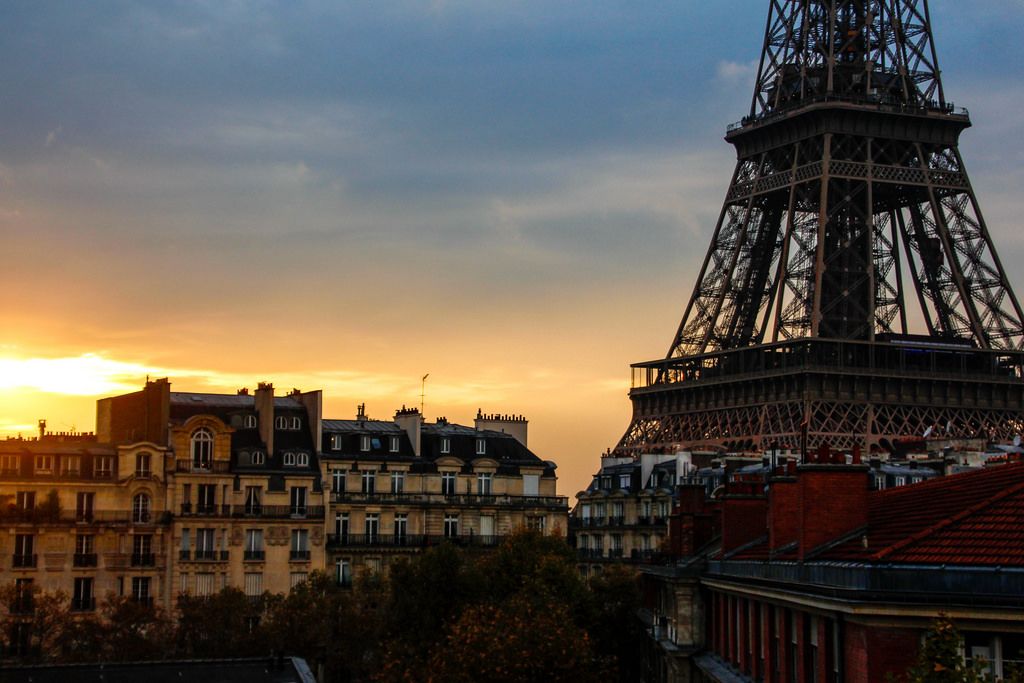
One set of interesting ideas is floating around Paris, France. Anne Hidalgo, running for reelection as the Mayor of the City of Paris, wants to make it a "15-minute city" (O'Sullivan 2020). This means something different in a city with 21000 residents per square mile that has closed many streets to through auto traffic, than it would in a sprawling burg like Cedar Rapids, where most adults can get anywhere in 15 minutes by getting in their cars. The campaign's image...
Paris En Commun campaign image
...shows work, shopping, dining, recreation, culture and health care within walking distance of every residence ("chez moi"). This would involve sacrificing road space to pedestrians and cyclists, designing public spaces for multiple use throughout the day, and promoting small shops, clinics, and performance spaces. It would involve somehow comfortably accommodating the needs of hordes of tourists as well as those residents who couldn't afford rising rents driven by the new amenities. City Lab notes that Mayor Hidalgo's plan as yet has neither timetable nor budget.

Even so, similar approaches have been proposed in other cities, including Barcelona, London, Melbourne, and Portland. More important for our blogging purposes are the principles are at work here: these advocates are striving to build inclusive communities.

Carlos Moreno, who teaches at the Sorbonne as well as serving as an adviser to Hidalgo's campaign, articulates six "things that make an urbanite happy,” including “Dwelling in dignity, working in proper conditions, [being able to gain] provisions, well-being, education and leisure. To improve quality of life, you need to reduce the access radius for these functions” (Belaich 2020, translated and quoted at O'Sullivan 2020). I will argue that these six are also opportunities that ought to be available to everyone--to be clear, not to make the state the employer, educator or entertainer of last resort, but to design the city such that all of these are attainable to everyone.

So, how to translate this to a contemporary American city, a typical one where, as O'Sullivan of City Lab reminds us, "Car-centric suburban-style zoning [has led] to an era of giant consolidated schools, big-box retail strips, and massive industrial and office parks, all isolated from each other and serviced by networks of roads and parking infrastructure (O'Sullivan 2020)?" That's my town, all right, and probably yours, too. Most people here are used to it, and content enough with it that they fear changes more than either such traffic as there is or the externalities it produces (pollution, isolation, lack of exercise, &c.).
Collins Road Square on Black Friday
We need the city government, not to make our choices for us, but to make choices possible. That means recognizing that not everyone has a car; while usually around here that is for economic reasons, going car free might be a commendable environmental or lifestyle choice, were it possible. Whether or not you actually have a car in Cedar Rapids, they are a necessity. They should at least be a choice.

Our transit system could and should continue to evolve, and ditto our bike infrastructure. But it's darned near impossible to design bus or bike routes for a sprawled city, where even bus riders live far apart from each other. So we need to point towards at least some parts of the city becoming denser, allowing granny flats and even small apartment buildings. Strong Towns argues that the next level of development in any neighborhood ought to be automatically legal (Marohn 2016); let it be so. While affordable housing is a different issue here than in a boomtown like Seattle or San Francisco, my friend Eric tells me it's impossible to build a $100,000 house. So let's have ordinances that encourage preservation and sale of existing housing stock, and that require landowners to keep older housing stock in reasonable shape so it continues to be livable. Pass a land value tax: It should not be possible to hold onto valuable property, letting it lie fallow or degrade, without paying for the privilege (Siskoff 2020).

Protesting demolition of the Hach Building in New Bohemia, 2014.
This property, in primo location by the Bridge of Lions, is currently fallow with no prospect of development.
Same goes for commercial buildings. We do have a yen for the shiny and new, and back it up with tax increment financing. But shiny new rents are hard to afford for local businesses, so the shiny new building down the street from me houses a Jimmy John's franchise, a Scooter's Coffee franchise, a Clean Laundry franchise, and an H & R Block tax franchise. Given that local businesses do better at job creation and at keeping money in the community, we should do better by them (Studer 2019).

We need to support public institutions, in particular public schools, but also libraries, parks, and so forth. When they suffer, middle-class people can always find alternatives. This is less true for people of lower incomes. A city with good neighborhood schools is a strong city. A city where the well-off have created housing and educational enclaves for themselves, and the heck with everyone else, is not a strong city.

Finally, we need to make life better--safer and more comfortable--for pedestrians and cyclists. Narrow the streets to slow the cars, build sidewalks where they haven't been built already, and maintain them where they are. The city could look into helping people concerned about upkeep of sidewalks, if it weren't already gasping to keep up with maintaining our ever-expanding street network. Sidewalks, bike lanes, and trails are not only important for getting around, they're important places for the public to meet each other. A walkable city provides thousands of incidental contacts every day, which is the basis for trust across lines of difference.

Neighborhood connections are not popular with everyone.
I wish this resonated with people. But we are a country of individualists, for whom community is often defined narrowly or even viewed with suspicion. We spend a lot of money and effort keeping the wrong people away, because they're inconvenient--they might park where we're used to parking, they might get in our way when we're in a hurry, their stuff might fill a view we've become accustomed to--or because we've been taught to fear them. Ownership and security are powerful motivators.

President Trump knows this. Despite multiple profound flaws, he's built a resilient presidency by appealing to people's fears, often in the most grotesque but apparently crowd-pleasing ways--the atrocious handling of refugees stands out.  Here in Cedar Rapids, any attempt to improve access to housing or non-car transportation runs up against a wall of fear and anger.  Just ask the developers of affordable housing on Edgewood Road, or live work units off Johnson Avenue. The residents of Chandler Street SW and Grande Avenue SE successfully fended off the spectre of sidewalks. Now Cottage Grove Place is weighing in against a proposed trail development between Washington High School and the Cemar Trail.


The 21st century demands an alternative to our dominant paradigms of development: market forces looking for short-term profits, political leaders listening to whatever song a big developer sings, and individuals protecting their patch of ground from children walking to school. We need something no law can provide: a cultural change that favors community, recognizing individual autonomy not as an absolute value but as the fantasy it is.

We need to conduct ourselves as if other people mattered.

Monday, January 27, 2020

God Land--It's complicated


God Land: A Story of Faith, Loss, and Renewal in Middle America

Lenz, Lyz, God Land: A Story of Faith, Loss and Renewal in Middle America. Indiana University Press, 2019. viii + 151 pp.

A few years ago, a high school friend changed his relationship status on Facebook from "Married" to "It's complicated." Deluged by expressions of concern and support, he quickly changed it back. Everything was fine, he assured us, "But what marriage isn't complicated?"

Indeed, what marriage isn't? Or what church, or club, or town, or country? But there are a lot of forces out there, in and out of politics, demanding we choose between opposing alternatives, as if everything were binary and life were a true-false test.

When last Lyz Lenz appeared on this blog, she was writing about the uncertain future of rural and small town churches (Lenz 2016). That research is included in this book, which covers a range of religious and political phenomena, but with at least one common thread: We don't understand each other. Americans are by and large too comfortable with our stereotypes to understand across differences, which ultimately makes it hard to grasp even our own situations.

The Midwest is complicated:
These are the frustrations of the people who live here with the depictions of the Midwest. We are conservative, but also very liberal. We are farmers, but we are also business people. We are the place people are often from, and yet not the place to move to. We are the connective tissue between the coasts, but are also flown over. Resisting representation, caught between the extremes, we are seen as a void--a "great desolation" wrote the novelist O.E. Rolvaag. But that's the biggest mistake people have been making about this great middle place since America was first settled--assuming that it's empty. (50)
Religion is complicated:
When we talk about divide, we also have to talk about union--we have to talk about the messy meetings between strangers and the outpourings of love. We have to talk about strangers standing in pews next to one another, singing the same songs, saying the same prayers, offering one another handshakes of peace, sharing bread and wine--and even if all of these small rituals mean different things to each person, we are there together offering ourselves in messy and holy community. (55)
Even traditional Christianity as practiced in the rural Midwest is complicated: The heartland is full of faith, both expansive and hard. Both full of beauty and of fatalism. It's an open hand and a closed fist (33). Elsewhere, but I can't find the damn quote, Lenz notes that the elderly church ladies she interviews radiate disapproval, but even so if she were in trouble they would be quick to offer a meal, a ride to the hospital, whatever.

Occasionally we meet someone who successfully navigates across the complexity to meet the human on the other side in an act of love.
Several months after I moved out and filed for divorce, a friend of mine sends her father over to my house with a chair from her house.... Instead of bringing me the hand-me-down chair, however, her father brings me a brand-new chair he bought just for me. It's leather and it's gorgeous. And I'm shocked.
I've never met this man before. He's a local business owner and a very conservative Catholic. I worry that he might judge me... But two of his daughters have divorced, he tells me. He says in a year I'll be doing better than before... While he moves the chair in, he jovially remarks on the sign in my dining room that reads "Resist!" and I'm embarrassed by his generosity, my politics and poverty. The only thing I have to offer him is a box of Girl Scout cookies, which he accepts gladly. The next day he sends me a picture of the cookies cut up into letters that spell "Resist." (54)
A lot of the stories, however, find something other than this intuition of common humanity. Shrinking rural churches don't welcome the newcomers that could keep their institutions alive, because the newcomers are too different, so they shun and resent them. (The Asian American Reformed Church profiled in chapter 8 is established only after protracted struggles with white residents of the town and the national Christian Reformed denomination.) Instead of reaching across religious divides, they reinforce them. To a troubled world, they respond with myths, about the virtues of the flames they keep alive (see chapter 3 on nostalgia) and the iniquity of the other. One pastor's wife's shout of "City values are sinful!" abruptly ends discussion on that topic (108). And nothing gets better.

Looming throughout the book is the national presence that is Donald Trump, whose political success has fed off divisions while encouraging and deepening them. He's first mentioned on page 1, and last 2 1/2 pages from the end. Trump has become something of a national Rorschach test, allowing many in the Midwest to see a sympathetic protector of their threatened value system. The author meets a Muslim friend for coffee:
She tells me she never felt separate from the community here until the election [of Trump in 2016]. Seeing people she knows, people her husband works with, posting such hateful things on Facebook about Muslims in America and supporting that man, that man who is now the president--well, that really gave her pause. "These are the people I've had in my home. The people I've fed, and then I see them posting on Facebook like I am the enemy, like I am the problem." (122)
However, the white evangelical Christians who voted in such a huge proportion for Trump are preoccupied with their own grievances:
Two days after the attack in Pittsburgh [in 2018, when eleven worshipers at a synagogue were gunned down], one of my former pastors shared a story on Facebook, which alleged that ESPN edited out references to Jesus in a story about football player Tim Tebow. "There has never been a worse time to be a Christian," declared my former pastor. This pastor's feed is filled with dire warnings about how Christians in America are going to be banned, soon, if we are not vigilant.... A white Christian pastor, ignoring the violence against [blacks, Jews, and] Muslims while perpetuating a victim narrative for Tim Tebow, is part of the story of faith, most notably the stories we fail to tell. And these silences are inextricably linked to race, power, and class. (124)

Trump, too, is complicated: both the galoot who glibly mocks or ignores half of America, with his rhetoric as well as his ethics-free life, and the gallant defender of traditional moral values.

Reading God Land, I often felt whipsawed among all the contradictions and complexities. Maybe I too yearn for a little simplicity in this troubled world. But God Land is a little postmodernist miracle of a book, preaching that we oversimplify the world ("essentialize" in postmodernist lingo) at our peril. The world is complicated, and a clear-eyed faith can help us navigate complexity and conflict, addressing problems as one diverse-but-beloved community. (See Marohn 2015 & Proppe 2016 on this.) Nostalgic, insular faith might comfort us for the moment, but it's false comfort, ignoring complex realities and intensifying conflict. We need to see more, however confusing and uncomfortable this complicated world can be, and to do better.

Lyz Lenz (swiped from lyzlenz.com)

SEE ALSO:

Lyz Lenz "The Death of the Midwestern Church," Pacific Standard, 20 January 2016 [updated 2017]

Tuesday, January 21, 2020

Call and response: MLK 2020


Annual celebration at St. Paul's United Methodist Church
Action and response were the main themes of Cedar Rapids's annual Martin Luther King Jr. Day celebrations Monday at Coe College and St. Paul's United Methodist Church--appropriately, because a number of the participants I talked to expressed understandable impatience at the slow pace of change. Overtly legal discrimination is thankfully behind us, but we live in the world it created, and it leaves people of color separate from and less prosperous than their white siblings. In day-to-day life they are perceived and treated differently, which perpetuates the disadvantage. Even Dr. King--who, after all, wrote a book called Why We Can't Wait--expressed impatience and frustration. Angelina Ramirez, a Coe College student who spoke at the morning event, noted he criticized his own famous "I Have a Dream" speech in later years as naive.

The evening event eschewed the usual featured speaker in favor of more brief presentations from community groups and individuals, memorably including dancing from the Washington High School Step Team....
 ...interspersed with commentary from Keesha Burke-Henderson, recently of Morehouse College in Atlanta, and now director of diversity and international student success at Mount Mercy University. The presentations were organized to alternate calls and responses. (The format could use some polishing--a lot of the actual response came in the form of applause, with so many standing ovations it began to feel like a State of the Union address--but I hope they try it again next year.)

One compelling call came from local story teller Zette St. Charles, who spoke briefly on the theme "Will You Answer When Called."
Zette St. Charles
Source: African American Museum of Iowa
St. Charles recounted all the role modeling she's gotten over the years, particularly from older family members, which she found both inspiring and intimidating. [The corresponding response came from the Amen Choir, children from local churches, whose song and dance got the audience up and going, even me.] Anne Carter, daughter of local icons Percy and Lileah Harris, cited evidence from conversations with her own children that skin color continues to define life experience. [The corresponding response was "We Shall Overcome," sung by the combined choirs of Coe College and St. Paul's, to which members of the audience gradually rose and some joined in.]


Molly Lamb, a teacher at McKinley Middle School in Cedar Rapids, was awarded this year's Percy & Lileah Harris "Who is My Neighbor" Award. Haley Cummings, a senior at Xavier High School, was the first winner of what will become an annual youth award.


The morning session at Coe featured a number of breakout sessions. Two speakers highlighted less familiar works of Dr. King's, which are not included in my prized copy of A Testament of Hope: The Essential Writings and Speeches of Martin Luther King Jr. (Harper & Row, 1986). Karl Cassell, managing partner at Cedar Rapids-based Top Rank, reflected on King's 1967 speech "The Three Evils of Society," referring to (1) racism, (2) extreme materialism, and (3) militarism. Cassell said not only are they still with us, but they've taken new forms, such as the militarization of local police departments. He concluded with a warning: "What we allow to happen to the least of us will eventually happen to all of us."

Keesha Burke-Henderson talked about King's 1955 speech at Holt Street Baptist Church in which he accepted the leadership of the Montgomery bus boycott, and his 1956 sermon "The Death of Evil Upon the Seashore." Both are facially less optimistic than "I Have a Dream," but contain calls to action with, as Burke-Henderson stressed, attention to methods, outcomes, and spiritual ideals that admitted no equivocation or gray areas. He concluded the latter with a challenge to act, hopefully: "Let us not despair. Let us not lose faith in man and certainly not in God." Individuals as well as societies can change, even an individual with "a prejudiced mind."

Dean of Students Marc' Bady celebrates his first MLK Day at Coe
Unlike, say Christopher Columbus, whose day we used to celebrate, the life of Martin Luther King Jr. remains pointedly relevant today. This is a source of frustration as well as inspiration. Why aren't things getting better, faster? Progress has come slowly, as we heard from a number of people Monday, and backsliding is so easy. President Trump, predictably, came up a lot; he is, of course, a symptom of something more fundamental, something having to do with fear, which is a primal emotion and one that is easy to trigger. (Cue Martha Nussbaum, The Monarchy of Fear: A Philosopher Looks at Our Political Crisis (Simon & Schuster, 2018).) Race, as has often been remarked, is inextricably intertwined with all of American history. That sad fact won't be eliminated without strenuous effort. Easy for me to say, of course, since as a white male I get to check in and out as seems convenient.
Blake Shaw, Iowa City musician, gets things started at Coe
Martin Luther King Jr.'s birthday comes with music, very good music, rivaling Christmas as the foremost musical holiday of the year. For one thing, we get to sing James Weldon Johnson's "Lift Every Voice and Sing," a.k.a. the Negro National Anthem, which is one of my favorite hymns. It has a superb message, and the music is singable with just enough quirks to keep it interesting. Johnson wrote--in 1921!:

Stony the road we trod, bitter the chastening rod,
Felt in the days when hope unborn had died,
Yet with a steady beat, have not our weary feet
Come to the place for which our fathers sighed?

King's message, and Johnson's song, mixing lament and hope, remain relevant, not only because of the persistence of racial problems. The 21st century requires a thoughtful, concerted response to the economic, environmental and financial fixes we're in. That means we have to figure out democracy, real democracy, including everyone's voice. That means we have to figure out how to work across differences, how to overcome fear, how to listen, how to negotiate. King continues to point the way.


SEE ALSO:
"Music, Dancing, and Poetry Celebrate MLK Day at Cedar Rapids Church," KCRG-TV, 20 January 2020
LAST YEAR'S POST: "Color Blindness vs. Opportunity," 21 January 2019

Wednesday, January 15, 2020

Condition of the state 2020


Iowa Governor Kim Reynolds's third Condition of the State address bore a lot of resemblance to her previous ones: In 45 minutes or so, she saluted Iowa's small town and rural history, while promising budgetary magic (cutting income and property taxes while increasing funding for mental health and water quality), subsidies for farmers, and a pro-life measure, this time an amendment to the state constitution. She also called out the tech education efforts of Osage Community Schools, which has established a partnership with Cedar Rapids-based NewBoCo, where my son works.

Reynolds at NewBoCo in October 2019 with executives David Tominsky and Eric Engelmann (swiped from the gazette.com)


One distinctive aspect of Reynolds's time as Governor has been her interest in criminal justice reform, particularly changing Iowa's strict provisions on disenfranchisement of felons, for which she wants another constitutional amendment. Her call came about 35 minutes into the speech, but we'd been led by advance publicity to expect it, she's talked about it before, and she spent some time on the subject, so it's clearly something she believes in.

She gave both practical and idealistic reasons for doing so. She argued that prisoners that are effectively re-integrated into the community are less likely to re-offend, which makes our communities safer. She also believes in "redemption," and that "When someone has lost their way, we are called to seek them out," alluding to Jesus's parable of the lost sheep (Matthew 18:12-14, Luke 15:1-7). She recognized in the audience William Burt of Waterloo, who has established a remarkable record of community service and entrepreneurship after being released from prison, and who recovered his voting rights by petitioning the governor.

Reynolds also quoted Ronald Reagan to the effect that the right to vote is the "crown jewel of American liberties." This is why it's such an important issue to me. I'm ambivalent about absolute expressions of many rights, viewing them as efforts to close off essential community conversations about the terms of our common life. But voting is different, because the quality and equity of those conversations is absolutely dependent on their inclusiveness. Only when people are fully included in society does that happen.

New York University's Brennan Center for Justice includes voting rights restoration as a key part of their Ensure Every American Can Vote campaign. They argue, Millions of Americans are barred from voting because of criminal convictions in their past. Felony disenfranchisement laws, relics of our Jim Crow past, hit African Americans disproportionately hard. (On the origins of these laws, see Behrens, Uggen and Manza 2003.) When Governor Tom Vilsack issued an executive order in 2005 automatically restoring all ex-felons' voting rights, voting turnout increased, until the order was rescinded by Governor Terry Branstad in 2011 (Meredith and Morse 2015).

Iowa is the currently the only state in the U.S. where all felons permanently lose their right to vote (unless they successfully petition). In eight other states, mostly in the southeast, this may happen. Other states restore voting rights after the expiration of the sentence, or parole, or probation. Two states, Maine and Vermont, allow prisoners to vote. (See map at procon.org.) The number of people affected, currently over 6 million potential voters, has increased dramatically in recent years, as you can tell by comparing the numbers in articles only a couple decades old which use figures like 4.7 million.

The process of amending Iowa's constitution begins in the state legislature. Both houses must pass the measure in consecutive years. Last year the House passed it but the Senate did not, so we start all over again in 2020.

Complete text of the governor's address is here.

SEE ALSO: "Condition of the State 2019," 14 January 2019

Wednesday, January 8, 2020

The opposite of BRT

The 10:15 run of Route #2 waiting to turn left
Some cities are putting resources into Bus Rapid Transit (BRT), which tries to overcome the disadvantage of most public buses--they get stuck in the same traffic as private cars, without the convenience of immediate access that cars offer--without the expense of new rail infrastructure. Indianapolis's Red Line is one example. Yonah Freemark (2020) estimates 354 miles of BRT were added to American transit networks during the 2010s, at a total cost of $2.8 billion (albeit a tiny fraction of the efforts towards more roads).

Vancouver introduced the RapidBus this week on four routes; CBC reporter Justin McElroy found the RapidBus went about as fast as his car between a train station and the University of British Columbia--faster, if you count the time he spent parking and unparking (McElroy 2020).


Transit guru Jarrett Walker (2009) identifies three subtypes of BRT:
  1. Dedicated lanes and grade separated (no intersections)
  2. Dedicated lanes but at-grade with signals
  3. Shared lanes, at grade, but with signal priority (and stops spaced widely apart)
Richmond, Virginia's new BRT system is at level #2, with dedicated lanes and signal priority, although there are questions about how well the Transit Signal Priority is working in practice (Gordon 2020).

A city's choice depends on resources, both financial and land-available-for-pavement. A 2001 GAO study found the typical cost of creating BRT was about $15 million per mile (cited in Jeff Speck, Walkable City (Farrar, Straus and Giroux 2012), p. 157), which was about half the cost of light rail, but still... not beanbag. Speck has standards: True BRT systems include not only a separated path, but also signal priority at intersections, level boarding at raised pay-to-enter stations, ten-minute headways, and GPS-enabled wait-time indicators. If you can't do most of those things, don't call it Rapid (Speck 2012: 157). But Walker notes that Los Angeles BRT is at level #3, with shared lanes but transponders which can influence traffic signals--not ideal, but they could create 700 miles of routes in ten years. Las Vegas, where I rode an express bus last summer, seems to be a similar system, but has dedicated lanes downtown.

Even a low threshold for Rapid gives buses some advantage over cars in traffic, maybe in some cases enough to compensate for the fact that your car is available in your driveway to fulfill your every wish without delay.

Smaller cities may not have the density or the space or the budget to add features to their bus systems. I imagine most cities the size of Cedar Rapids have done what Cedar Rapids has done: spread their federal transit dollars across as much of the city as possible. (Even Tulsa, which is three times our size, has only just started dipping its toe into more frequent service along Peoria Avenue, though they've had nighttime service for a long time.) We serve the desperate, wherever they are, while the service level means anybody with options chooses their cars.

Although! The 2017 schedule changes marginally improved service by straightening some of the crookeder routes and adding service to route #5. My impression is that ridership has marginally increased as a result, particularly on the #5. [UPDATE: Elizabeth M. Darnall, transportation planner for the Corridor Metropolitan Planning Organization, confirmed to me that while apples-to-apples comparisons are difficult because of route changes, ridership on the #5 and the new Hiawatha and Marion circulars increased more than 40 percent in the first two years.]

What cities of any size should not do is disadvantage bus transportation relative to private cars. That is a recipe for making public transportation irrelevant. OK, a "coverage" system like ours is inherently telling most people "Drive if you can." But, to add insult to injury, there are intersections in congested area where buses wait at stop signs while cars go through on the cross street. A particularly egregious example of this is 2nd Street and 12th Avenue SE, which was recently converted from traffic lights to stop signs. Conversion good!--though any future transponders will now do no good there. But the stop signs only exist on 2nd Street, so when the #2 bus comes down it has to wait to turn left until all the cross traffic on 12th Avenue has passed AND then yield to northbound traffic on 2nd. Also, route #6, which goes inbound on 2nd Avenue SE, has to stop for traffic on both 8th and 7th Streets.

Here's the #2 this afternoon, waiting, and waiting, to turn left onto 12th (after waiting through a long line of auto traffic so it could turn left onto 2nd Street from 8th Avenue):


It's the opposite of Bus Rapid Transit... Bus Prolonged Transit? Bad acronym. Bus Interminable Transit Experience (BITE)? Bus Using Left Lane Stuck Here Indefinitely Transit?

Solutions: Make 2nd and 12th a four-way stop. I understand what the city is trying to do with 7th and 8th, and tinkering with intersections creates dangerous levels of confusion, but how about sending the #6 down another street which is not similarly controlled, like 1st or 3rd Avenue?

And then... look for opportunities to facilitate the steady movement of buses on all routes.

Monday, January 6, 2020

The persistent relevance of urbanism in an age of chaos

Discussing plans for west side development, June 2014
A month from the Iowa precinct caucuses that start the long process of voting in the 2020 presidential election, the U.S. announced it had killed Qasem Soleimani, commander of Iran's Quds Force, as well as an Iraqi militia leader, in a drone strike (Marcus 2020). Between this and the imminent start of voting for President, the news is full of impeachment efforts and the frightening effects of global climate change. With all that's going on in the world, city-level issues can seem pretty unimportant. They aren't.

The urbanist project at the local level, step by incremental step, remains the critical response to problems of our common life in the next century.

CNU logo

Urbanism entered our national vocabulary in 1993 with the founding of the Congress for the New Urbanism, Reacting against five decades of suburban development, the CNU charter proclaimed: We stand for the restoration of existing urban centers and towns within coherent metropolitan regions, the reconfiguration of sprawling suburbs into communities of real neighborhoods and diverse districts, the conservation of natural environments, and the preservation of our built legacy. "New" Urbanism wasn't new in the sense of never having been thought of, but rather represented a rediscovery of traditional city design that provided for human life as suburban development did not: social connectedness, community identity, individual choice, environmental sustainability, and fiscal sustainability. (See a list of classic urbanist texts below.)

Seems all well and good, but how can we possibly ponder "the restoration of existing urban centers" and "the preservation of our built legacy" when the issues and personalities at the national-international level are so huge?
See the source image
Source: picgifs.com
In contrast to national politics, where we can watch helplessly as the country stumbles into conflict or the President Tweets out another juvenile nickname for his opponents, local activity offers people the opportunity to make an impact, and to see the impact they make. President Trump is an extreme example, but national politics has long been mostly a spectator sport, like the NFL playoffs except with real-world consequences, which is why the Russians were so easily able to co-opt social media in 2016.

People working on temporary crosswalk across street
12th Av SE, April 2018

At the local level, you know what (and who) you're dealing with. In Cedar Rapids, the pedestrian infrastructure on 12th Avenue SE grew out of a Better Block project in spring 2018 (pictured above). Anderson Park got playground equipment because of one family's activism, and Redmond Park has been adopted by a group in the Wellington Heights neighborhood. The 1500 block of Park Avenue SE remains one-way, for better or worse, because of neighborhood objections to the city's plan to reconvert it. During my semester in Washington, I saw the creation of the Safe Streets in Hill East group that lobbies for pedestrian and bicycle improvements in the neighborhood where we lived. I could go on. Examples abound.

Win or lose, participate or don't participate, local decisions define the conditions of our daily lives. The residents of the Rompot neighborhood didn't succeed in blocking the expansion of the adjacent train yard, and they will live every day with the consequences. More simply: Do you live with constant noises and noxious smells? Is it easy to meet people? Is there a place to get a quick ingredient you're missing that you can walk to without taking your life into your hands? Do your sewers work? City design matters to people, all the time.

People walk to this grocery store, but it's a battle
Local issues are, in short, about the conditions that people encounter in their daily lives. A one-way-to-two-way street re-conversion can make the difference between a speedway and a neighborhood. A good city park provides space for recreation, relaxation, and meeting. (See Kramer 2019 for a case from Pittsburgh where restored nature was chosen over a casino and/or strip mine.) The conditions of our streets affect how people make their daily way to work, school, and shopping. A city that overspends on infrastructure faces a day of reckoning where its citizens can't count on the bridges, sewers, electric lines and essential services they need (cf. Marohn 2019). Decisions at the local level affect the economic opportunities by which we make our livings, not to mention the quality of social interactions with our fellow residents.

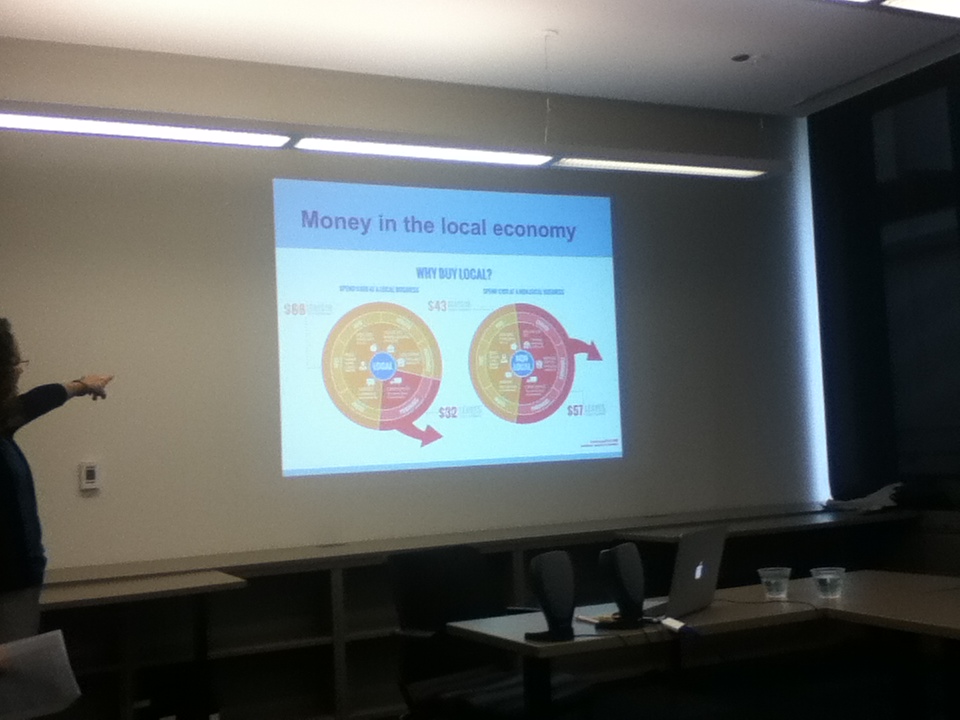
Ellen Shepherd of Community Allies points to the demonstrated advantage of locally-owned businesses
Most importantly, the key issues we face require thinking about how we live our lives, and designing the conditions that make change possible--and that too happens locally. Individuals can resolve to live more ethical or neighborly lives, but the conditions that support those resolutions require conversations. There is no guarantee those local conversations will ever happen, nor that when they do they'll be adequately inclusive, deliberative, or lead to good outcomes. But the locality is the only place where they can happen.

Bike lanes and buses improve individual mobility as well as social connections

Want to address our epidemic of depression? Obesity? Gun violence? Poverty? All are driven by the way we've designed our communities to encourage or (until recently, mostly) discourage community-building. Want to address climate change and other environmental problems? We could use some effective international agreements, to be sure, but the rubber meets the road with individual behavior, and that means cities not designed for car-dependence. Worried about our fiscal future? At both the individual and community level, urbanist design is sustainable as suburban design is not. (See Karlinsey 2019.)

This graph, based on the comparison of atmospheric samples contained in ice cores and more recent direct  measurements, provides evidence that atmospheric CO2 has increased  since the Industrial Revolution.  (Source: [[LINK||http://www.ncdc.noaa.gov/paleo/icecore/||NOAA]])I'm not denying that we live in a global economy and a global climate, and that important decisions about them need to be made at the national and international levels. I'm not denying that a presidential administration that deals in favors and spite, while bidding constantly for attention, needs to be replaced. Some resources can only be moblized at the state or national level, and sometimes valiant local efforts are thwarted by state and national government malice.

I am saying that the drama of world politics should not distract us from building the towns we need to live in. I am also saying that the quality of national-level policy solutions depends in large part on their foundations--social, economic, cultural--in our communities. Washington Post columnist E.J. Dionne this week quoted Robert F. Kennedy:
When you teach a man to hate and fear his brother, when you teach that he is a lesser man because of his color or his beliefs or the policies he pursues, when you teach that those who differ from you threaten your freedom or your job or your family, then you also learn to confront others not as fellow citizens, but as enemies — to be met not with cooperation but with conquest, to be subjugated and mastered. (quoted in Dionne 2020)
A strong citizenry starts with the incidental contacts we have with others, which only happen when the town is designed to encourage them. On that basis everything else--unity, prosperity, quality of life--is built.

Make pancakes not war!
CLASSIC URBANIST TEXTS:
 Calthorpe, Peter, and Fulton, William. The Regional City: Planning for the End of Sprawl. Island, 2001.
 Duany, Andres; Plater-Zyberk, Elizabeth; and Speck, Jeff. Suburban Nation: The Rise of Sprawl and the Decline of the American Dream. North Point, rev ed, 2010.
 Gehl, Jan. Cities for People. Island Press, 2010.
 Hester, Randolph T. Design for Ecological Democracy. MIT Press, 2006.
 Jacobs, Jane. The Death and Life of Great American Cities. Random House, 1961.
 Kelbaugh, Douglas S. Repairing the American Metropolis: Common Place Revisited. University of Washington Press, 2002.
 Kemmis, Daniel. Community and the Politics of Place. University of Oklahoma Press, 1990.
 Oldenburg, Ray. The Great Good Place. Paragon House, rev. ed., 1999.

SEE ALSO:
"Gleanings from the New Urbanism," 19 April 2013

Monday, December 30, 2019

The future of religious spaces (VI)

52-4-cover 

Every year about this time, Faith and Form produces its worldwide survey of the best in religious art and architecture--mostly architecture, because "[f]or the second year in a row, the jury was concerned about the low number of Religious Art entries" (Crosbie 2019). It's fascinating, eye-catching, and an opportunity to reflect on the roles religion and religious places play in our common life.

It's also the time when Christians like me celebrate the birth of Jesus. We have appropriated Jewish prophecy like that of Isaiah, who may or may not have been discussing the Messiah when he wrote:
A shoot shall come out of the stump of Jesse, and a branch shall grow out of his roots.... He shall not judge by what his eyes see, or decide by what his ears hear; but with righteousness he shall judge the poor, and decide with equity for the meek of the earth; he shall strike the earth with the rod of his mouth, and with the breath of his lips he shall kill the wicked. (Isaiah 11:1, 3b-4, NRSV)
Hearing these familiar verses again this year, I was struck by the seemingly casual reference to the killing that needed to happen to achieve the peace and justice of the "holy mountain" eventually proclaimed in verse 9. Again with the killing! which seems to be a prerequisite for Biblical promises. God's ways are beyond the scope of this blog, but it altogether too tempting to believe that things will be great once we (the hands of God?) first get rid of all the wicked/idiots/haters/evildoers. This is a prime example of what philosopher Martha Nussbaum (The Monarchy of Fear, Simon & Schuster, 2018, pp. 81-84) calls the "just world hypothesis"--the belief that I would get what I want if I weren't thwarted by bad guys--a worldview that leads to destructive, retributive anger. Instead of anger we need to affirm a common life, right this very minute, to deal with all humanity has to deal with. Excising the other only saps our energy and most likely adds to the evil instead of solving it.

The Christian apostle Paul offers us a rhetorical way out of this trap. In his letter to the Roman church, he writes of the believer dying to sin (see esp. ch. 6). How this death is accomplished seems to be a combination of divine grace, individual effort, and good old-fashioned Christian orthodoxy (see O'Brien 2012). That need not detain us here; we need only to accept that religious language about killing the wicked can apply to the evil within each of us, rather than some definitive expulsion of some individuals for the ultimate happiness of others.

Back to this year's award-winners. Leaving judgments about art and architecture to the professionals, and recognizing that what happens within places is as important as how they're designed, we urbanists can ask: How do the physical features of religious places help us achieve connection in a disconnected world?

One way is to bring us, for a time, away from the world into a place apart. Spectacular sanctuaries, like Boston's Cathedral of the Holy Cross, can achieve that by creating its own world of wonder.
Elkus Manfredi Architects
Cathedral of the Holy Cross won an award for renovation
Usually these grand sanctuaries have spectacular acoustics as well, so those who raise their voices in song or prayer become part of a greater whole. Through our encounter with the divine, we are re-centered for life in the world.

Another way is to arrange seating in a circle around the altar, rather than having everyone in the congregation facing the same direction, as in Seattle's St. Anne Church.
Stephen Lee Architects
St. Anne Church won an award for renovation
Author James F. White (Protestant Worship and Church Architecture, Oxford University Press, 1964) argues this older form, abandoned for awhile, emphasizes communal worship rather than individual emotional reaction in a hierarchical setting. (See especially chapters 4 and 5.) Shifting from my experience to our action also re-orients us to a world of diverse people.

Most urbanist of all is the religious building that is accessible to the street, such as St. Bartholomew's Episcopal Church, which fronts directly onto Park Avenue in Manhattan--a block from the #6 subway line.
Acheson Doyle Partners Architects, PC
St. Bart's Church won a restoration award for its dome, which is not relevant to this post
This is the "meaningful destination easily accessible on foot" commended by Andres Duany, Elizabeth Plater-Zybeck and Jeff Speck (Suburban Nation, North Point Press, 2010 rev. ed., p. 64). In fact, it contributes to all four of their prerequisites for the street life--meaningful destinations, safe streets, comfortable streets, interesting neighborhood--needed to support community. Contrast that with the award-winning new church, St. Luke the Evangelist in suburban Ankeny, Iowa...
Neumann Monson Architects
St. Luke the Evangelist Catholic Church
...which opens onto a parking lot accessible from Weigel Drive only by a long driveway. Neither it nor the school next door will ever be walkable. (It's not even clear how you would walk from one to the other.) No one will ever happen by.

Jane Jacobs (The Death and Life of Great American Cities, Random House, [1961] 1993, pp.72-73) waxed eloquent about the social utility of public spaces like sidewalks that are building blocks of connected neighborhoods.
They bring together people who do not know each other in an intimate, private social fashion and in most cases do not care to know each other in that fashion....
The trust of a city street is formed over time from many, many little public sidewalk contacts. It grows out of people stopping by at the bar for a beer, getting advice from the grocer and giving advice to the newsstand man, comparing opinions with other customers at the bakery and nodding hello to the two boys drinking pop on the stoop, eying the girls while waiting to be called for dinner, admonishing the children, hearing about a job from the hardware man and borrowing a dollar from the druggist, admiring the new babies and sympathizing over the way a coat faded....
The sum of such casual public contact at a local level--most of it fortuitous, most of it associated with errands, all of it metered by the person concerned and not thrust upon him by anyone--is a feeling for the public identity of people, a web of public respect and trust, and a resource in time of personal or neighborhood need.
The intentional design of religious places, new and old, architectural wondrous and humbly utilitarian, can contribute substantially to the public identity that will sustain us all through whatever lies ahead. Or not.

Primary Source: Michael J. Crosbie (ed), "2019 International Awards Program for Religious Art and Architecture," Faith and Form 52:4 (2019). All photos are from the article, and are used without permission.

Last Year's Model: "The Future of Religious Spaces (V)," 28 December 2018

10th Anniversary Post: Paying Attention to the Suburban Development Behind the Curtain

  (Google Maps screenshot) (9/5/2026)  Ten years ago, we in the United States were engaged in a presidential election campaign that would br...