Saturday, June 25, 2016

Globalization's challenge to cities

 
Source: dimassuryo.files.wordpress.com

(6/25/2016) Thursday's referendum in Britain on whether to remain in the European Union has been interpreted, at least in part, as a referendum on the increasing integration of economies across the Earth, which has accelerated in the last three or four decades. The phenomenon of globalization has been credited and blamed for a number of developments during this time; in fact while these developments might be caused by globalization, others are symptoms of a small world, the ability of economic power to buy political power, or mere coincidence. Globalization has certainly been associated with individual economic insecurity as well as the failure of state political institutions, and that has created volatile politics all over the world (Langfitt 2016).

From a troglodyte's perspective the world began to globalize 3000-4000 years ago as trading developed across groups and, as navigation developed, across geographic regions. But that's not what we're talking about here. Technology has increasingly enabled manufacturing, marketing and to a certain extent service provision to occur across space without noticeable impact on the product or the consumer. No more is it enough to be the best bank, car dealer or bookseller in your part of town; now you're competing with banks, or car dealers, or booksellers all over the world.

In Thomas Friedman's felicitous phrase, today's world is "flat." Without going all in on his argument, the flatness metaphor is useful for illustrating how geographic barriers to competition have been removed, which makes economic security more difficult to achieve whether one is an individual, a firm or a city. Friedman, while noting that people "have to run harder to stay in place," generally sees this as a positive development, and he's far from alone in this. Tougher competition brings more and better choices for consumers, and all those firms and workers running harder will keep improving human life. Friedman emphasizes skill development as the answer to individual and national insecurity, particularly advocating improvements to the U.S. education system.

The benefits are hard to deny: Besides offering greater choices for consumers, a flat world has allowed development of a middle class in emerging nations like China and India, and reduced the extent of poverty worldwide especially in Latin America (FAO 2015). Of course, for the winners in global competition the rewards are huge. Just ask Jeff Bezos, founder of Amazon.com, who is probably the richest bookseller the world has ever known, or the heirs of Sam Walton, who founded the most dominant retail chain in history. However, a lot of people, at least in the West, are finding that global opportunity cuts both ways, and are stressed by what seems like a loss of control over their lives (Berube). This insecurity is exacerbated by advances in automation, which allow manufacturing to be done by a fraction of the work force of days gone by; a liberal (at least in practice) immigration regime which flattens even local labor markets; and doubts about our ability to replicate the economic growth of the 20th century. (For the last point including its impact on politics and society, see Thomas Piketty, Capital in the Twenty-First Century [Harvard, 2014], ch. 2.)

What the forces of globalization, automation, immigration and slow growth have in common is that they raise questions about the future of work. The pop culture image of the blue collar working stiff slogging his way through the working day (think Johnny Paycheck's classic song "Take This Job and Shove It" or Fred Flintstone shouting "Yabba dabba do!" when the whistle blows at quitting time) seems positively blessed in retrospect. However boring, arduous or dehumanizing their jobs, that era's "blue collar aristocrats" could generally count on jobs being there for anyone able to work. If cars were going to be made, steel produced or coal mined from the Earth, large numbers of American (mostly) men were going to be needed to do it.

Previous technological advances have, of course, brought insecurity. The Luddite protests more than 200 years ago may not have been reacting to technological advances, but plenty of their contemporaries feared for their jobs in the Industrial Revolution (Conniff 2011). Eventually the descendants of the Luddites found work in mines, on railways, and in trades, joined unions and were paid reasonably well, and of course many people until relatively recently worked on farms (cf. Lebergott 1966). And maybe the answer to the future of work is just around the corner. Millions of jobs have been created since the depths of the recession in 2010, with the official U.S. unemployment rate falling from over 10 to below 5 percent. However, there's a difference between a job and a career; wages remain stubbornly stagnant and long-term unemployment persists at a high level (Kille 2014Burtless 2016). From the perspective of 2016, the future of work remains mysterious. If the current presidential campaign is any indication, political elites have less of a clue about what to do than I do, which unfortunately is saying a lot. It's little wonder that an insecure public turns on easy targets. If only we could ditch the EU bureaucrats, environmental regulations, or large banks; if only we could raise the minimum wage, restrict immigration, or make college free; then everything could go back to the way it was. Except somehow we'd get to keep all the cool stuff.

American cities today find themselves in a variety of positions. Some continue to reel from the collapse of the industrial economy four decades ago, and are struggling to serve citizens with multiple needs, stem declines in population, and figure out some way back onto the horse that is the global economy. Others have found their places in the global economy, as centers of technology, medicine, media and the like. But even those cities have a substantial number of poor citizens the benefits aren't reaching. Cities of all types are having to come up with policy solutions when [a] they are elusive, [b] past errors have left city finances in shaky states, and [c] people everywhere--not just Britain--are skeptical of government elites who collect taxes yet seem unable to deliver satisfactory outcomes.

 
Source: globalizationns31.yolasite.com
I am no libertarian. I firmly believe that the answers to the problems of the 21st century will be found through conversation, building connections and collective effort. "We're all stuck here for awhile," as Rodney King once said. They will require government in order to articulate and administer collective decisions. But I'm not surprised that a lot of people react to the 21st century by sticking it to whomever they can--elites, phantoms, and each other.

SEE ALSO: David Wessel, "In Wake of 'Brexit,' Addressing Voter Anger with More Than Lip Service," Brookings, 24 June 2016, http://www.brookings.edu/research/opinions/2016/06/24-wake-of-brexit-addressing-voter-anger-wessel

OLDER POSTS
"The 'New Normal' Economy and Place," 20 November 2013
"State of the Union and Places," 29 January 2014
"The Future of Economic Inequality," 1 October 2014

Monday, June 20, 2016

Can Cities Change Their Luck?

Birmingham, Alabama is losing population despite the success of its university
(Source: Wikipedia commons)
(6/20/2016) In my last post, I noted that central cities have been enjoying a resurgence of late, keeping pace or exceeding the job creation of their surrounding suburbs. That week brought more good news for central cities: GE Digital announced it will add about 100 software jobs in the City of Providence, and fast food giant McDonald's will move its corporate headquarters to the City of Chicago from suburban Oakbrook in 2018.

Yet individual cities' experience of this resurgence has been uneven. From 2005, when some of the cultural shifts became identifiable, to 2015, U.S. Census Bureau estimates have the country's population as a whole growing by 8.4 percent. Some cities' populations increased by multiples of this during the same period, a clear sign of success; others stagnated or even shrank. In fact, the combined population of the 51 central cities from metropolitan areas of greater than 1 million population grew 8.2 percent, almost exactly the national average.

For the sake of convenience I've grouped these cities into four categories based on population growth 2005-15. Group boundaries are rather arbitrary, and each city surely has its own story to tell as to why it wound up where it did (or maybe why the Census Bureau's estimates were off). Moreover, raw population growth may not be as good an indicator as, say, change in the population of young educated people or growth rate of per capita GDP. My purpose is to show that there are multiple places having these diverse experiences.

STARS
(14.7+)
ABOVE AVERAGE
(8.4-14.7)
BARELY KEEPING UP
(1-8.4)
FALLING BACK
(negative growth)
Charlotte NC 35.4
Austin TX 35.0
Raleigh NC 32.1
Denver CO 22.3
Washington DC 22.1
Boston MA 19.3
Seattle WA 19.2
Nashville TN 19.2
Portland OR 18.5
Orlando FL 17.1
San Antonio TX 17.0
San Francisco CA 17.0
Columbus OH 16.4
Las Vegas NV 14.4
Miami FL 14.1
Houston TX 13.9
Richmond VA 13.7
Tampa FL 13.2
San Jose CA 12.6
Riverside CA 11.1
San Diego CA 11.1
Jacksonville FL 10.9
Louisville KY 10.6
Minneapolis MN 10.2
Indianapolis IN 8.8
Salt Lake City UT 8.2
Sacramento CA 7.6
Philadelphia PA 7.1
Phoenix AZ 6.9
Kansas City MO 6.8
New York NY 5.0
Milwaukee WI 3.7
Los Angeles CA 3.3
Virginia Beach VA 3.3
Providence RI 1.3
Hartford CN -0.3
Rochester NY -0.6
Atlanta GA -1.4
Baltimore MD -2.2
Memphis TN -2.5
Pittsburgh PA -3.9
Chicago IL -4.3
Buffalo NY -7.8
Birmingham AL -8.2
St. Louis MO -8.3
Cleveland OH -14.2
New Orleans LA -14.3
Detroit MI -23.6

The "clustering force" noted by Richard Florida and others surely exists, but in some places it's producing an upsurge of good outcomes and in others it's barely detectable. Asking why actual experience varies so greatly is surely pertinent, as struggling cities seek to change their luck, and even smaller cities like my hometown of Cedar Rapids, Iowa, try to find their places in the post-industrial economy.

A successful city possesses a growing economy that includes diverse career opportunities, amenities that help people enjoy life, and a positive ethos that creates pride and a sense of attachment. They probably also try to build on existing advantages: a natural port, natural or historical attractions, successful businesses, a well-educated population. Successful cities can build on their previous success in order to sustain themselves in changing times, both economically and in terms of their physical appearance: Like Florida, Nikhil Naik and colleagues found that population density and proportion of college-educated adults predicted improvement in the appearance of an urban neighborhood, which would logically attract even more investment (Naik et al. 2015). But what about cities that, for whatever reason, find themselves struggling? How do they right the ship?

One common resort is now discredited, but perhaps not discredited enough, so please allow me to discredit it some more. A number of governments have tried to defibbrilate their cities into prosperity through backing a major project or corporate relocation. In the 1989 film "Roger and Me," Michael Moore shows the City of Flint seeking to cope with the loss of auto manufacturing by subsidizing tourism, including a theme park called Auto World, the Water Street Pavilion marketplace and a Hyatt Regency hotel. All quickly fail. Other towns have subsidized corporate relocations at a cost to their own tax bases and service capacity, not to mention considerable bitterness when the company fails or leaves to chase the next subsidy somewhere else. "The subsidies are touted as necessary for job growth, to stimulate depressed regions and promote economic development," notes Thomas Patterson, chair of the libertarian Goldwater Institute. "Unfortunately, they just don’t work” (Zimmerman 2011; see also Kenneth P. Thomas, Investment Incentives and the Global Competition for Capital [Palgrave Macmillan, 2011]; David Swenson and Liesl Eathington, "Do Tax Increment Finance Districts in Iowa Spur Regional Economic and Demographic Growth" [Iowa State University, 2002]).

So what is a failing city to do? A spin around current writing on the subject turns up these themes:


"Meds" form the core of the economy of Rochester Minnesota's economy
Eds and Meds. Universities and medical centers, if they're large, can be major employers as well as engines of new economic development. A 2008 article in Governing profiling the impact of the University of Alabama branch campus on the city of Birmingham quoted Carolyn Adams of Temple University on universities' ability to host "networks of knowledge and entrepreneurship that create new products and processes" (Gurwitt 2008). It's also been pursued by Baltimore, Philadelphia Pittsburgh, and to some extent in St. Louis (Mallach and Brachman 2013: 34-35). Another study argues that spending on universities' research and development impacts a place's level of human capital more than degree production does (Abel and Deitz 2009). Entry-level non-clinical jobs can provide opportunity for the poor and unemployed (Dorsey 2016); on the other hand, there have not been a lot of middle-wage jobs in these fields (Dwyer 2013). And these institutions are unlikely to be tempted away to greener pastures, although Physicians Clinic of Iowa threatened to flee from Cedar Rapids to suburban Hiawatha, and now their new building blocks 2nd Avenue.

The new economy. The future of high-end employment is technical, so a city's prosperity depends on its ability to attract technical jobs. The tech clusters of America can all be found in the left-hand column in the table above. So it's altogether reasonable for struggling Providence, Rhode Island, to celebrate an influx of jobs from GE Capital, General Electric's "industrial Internet innovator" (Muro 2016). Providence has the "eds" (Brown, University of Rhode Island) as well as a history of manufacturing; could that combination be a foundation for renewal? Is it OK to wait until someone like GE recognizes your advantages, or do you need to do more? More broadly, Mallach and Brachman (2012: 7) add, "Economic growth, however, must be export-driven and produce goods and services or draw spending from the regional, national or even global economy. Autarchy is not a recipe for success in today's world." What can you offer that the world needs? This is an easy question to articulate, but hard enough to answer for an individual who has flexibility and mobility a city does not have.

Promote education. The Public Policy Institute of California notes that "the next boom industry," whatever it is, is unlikely to produce sustained stable growth, as witness the bursting of the housing and Internet bubbles (Bohn 2016). They advocate broad-based nurturing of businesses as well as investment in education as a way to prepare the work force for jobs in "the new economy" as well as provide resilience in economic downturns. Are there operational definitions of these admirable principles?

Use space wisely. The Lincoln Institute for Land Policy's comprehensive 2013 report (Mallach and Brachman 2013) commends an approach of "strategic incrementalism" which includes but is not limited to "rebuild[ing] the central core, sustain[ing] viable neighborhoods through targeted investments, and repurpos[ing] vacant lands for new activites" (p. 3; see also pp. 24-29). Can residential neighborhoods be made viable choices for middle class families by improving shopping, schools and transportation connections? Can there be an appropriate new form, instead of clinging to the layout that worked sixty years ago when the city was twice its current population? Some sections might become lower-density residential, green space, and even urban farms, depending on the extent of depopulation (p. 28). Additional recommendations involve building partnerships with other governments in the region, as well as state and national governments (pp. 13-18); these may or may not be politically feasible, so I'm focusing on what cities can do on their own.

Open culture. Richard Florida's notorious "Bohemian-Gay Index" (2008: 135-139) correlated city success with the proportion of gays and "bohemians," defined as those who work in arts, design, entertainment and media. The explanation is that such people are by both temperament and necessity attracted to places that welcome a variety of people. Those places maximize their human capital and nurture an environment of creativity across all fields of endeavor (business and technology as well as the arts). The cities of Charlotte and Orlando get this; the state governments of North Carolina and Florida do not.

Amenities? This is another explanation for the Bohemian-Gay Index. Yet these may not be the first steps you want to take when resources are scarce. Studies of the economic impact of arts and culture investment and minor league baseball stadia are cautiously positive. The Lincoln Institute report argues new residents aren't drawn by amenities but create them once they move in (pp. 27-28). On the other hand, small amenities like wider sidewalks or curb extensions can be tried out at very low expense, as Andrew Price describes in Hoboken.

Accept your pre-ordained fate. A pair of economists have discovered that the most productive places in the Americas today are on the sites of productive places in pre-Columbian times (Maloney and Caicedo 2016). Sometimes there are obvious natural advantages (good farmland, near a coast); sometimes, as in the case of Tenochtitlan/Mexico City, the Spanish were attracted to a place the Aztecs had made successful, as one thing led to another. Maybe if your town didn't work for the indigenous peoples, it isn't going to work for you.

Montezuma says, "Yeah, that place was a dump 500 years ago, too"
I confess to being unable to sort out causes from effects from coincidences. And I wonder how much is due to certain people being in the right place at the right time? (If Bill Gates had been from St. Louis...?) But steady development of an environment supportive of entrepreneurship and diversity is probably a less risky course of action than some grand project. Selling that approach to the body politic is a different story altogether, of course.

LITERATURE REVIEW: Rachael Stephens and Leighton Walter Kille, "Urban Regeneration: What Recent Research Says About Best Practices," Journalist's Resource, 29 January 2015, http://journalistsresource.org/studies/government/municipal/legacy-cities-challenges-opportunities-urban-regeneration

SOURCES:
 Jaison R. Abel and Richard Deitz, "Do Colleges and Universities Increase Their Region's Human Capital?" Federal Reserve Bank of New York, October 2009, http://www.newyorkfed.org/research/staff_reports/sr401.html
 Sarah Bohn, "Economy: California's Future," PPIC, January 2016, http://ppic.org/content/pubs/report/R_116SBR.pdf
 Charlotte Dorsey, "In Charlotte, Healthcare Jobs May Be Pathway out of Poverty," Next City, 24 May 2016, https://nextcity.org/daily/entry/charlotte-healthcare-jobs-white-house-health-careers-pathways
 Rachel E. Dwyer, "The Care Economy? Gender, Economic Restructuring, and Job Polarization in the U.S. Labor Market," American Sociological Review 78:3 (June 2013), 390-416
 Richard Florida, Who's Your City? How the Creative Economy is Making Where to Live the Most Important Decision of Your Life (Basic, 2008)
 Rob Gurwitt, "Eds, Meds and Urban Revival," Governing, May 2008, 45-50
 Alan Mallach and Lavea Brachman, Regenerating America's Legacy Cities (Lincoln Institute for Land Policy, 2013)
 William F. Maloney and Felipe Valencia Caicedo, "The Persistence of Fortune: Patterns of Economic Activity in the Americas Since Pre-Colonial Times," VoxEU, 14 June 2016,
http://voxeu.org/article/landscape-columbus-would-recognize
 Mark Muro, "Can the Internet of Things Help Renew Rustbelt Cities?" The Avenue: Rethinking Metropolitan America, 14 June 2016, http://www.brookings.edu/blogs/the-avenue/posts/2016/06/14-internet-of-things-rust-belt-muro
 Nikhil Naik, Scott Duke Kominers, Ramesh Raskar, Edward L. Glaeser and César L. Hidalgo, "Do People Shape Cities, or Do Cities Shape People? The Co-Evolution of Physical, Social and Economic Change in Five Major U.S. Cities," NBER Working Papers, October 2015, http://macro.media.mit.edu/papers/NaikEtAl_UrbanChange_WP.pdf
 Julie Ann Zimmerman, "The Folly of Corporate Relocation Incentives," CityLab, 16 December 2011, http://www.citylab.com/work/2011/12/folly-corporate-relocation-incentives/737/

Tuesday, June 7, 2016

Two Tales of Cities


I used to live in New York City
Everything there was dark and dirty
--“TWELVE THIRTY,” w/m by John Phillips

(6/7/2016) A persistent theme throughout my life has been where people were going to live since they obviously weren’t going to live in cities.  I grew up in a middle-class suburb during the Baby Boom, heir to the development pattern that began in the late 1940s, only 25 miles from the City of Chicago but yet light-years away at the same time. Many of my friends’ parents commuted to work in the central city, but soon large employers themselves—Bell Laboratories, Amoco—began moving out to the suburbs, creating “edge cities” and diminishing Chicago’s relevance as an employment center. Industries decamped en masse from the northern Rust Belt to the sunny and union-free South. At the same time, my high school teachers spoke of a coming virtual world where we could live anywhere we wanted to, such as Montana if we were outdoorsy, and remain in contact with our employers. Was the future in edge cities? The New South? The woods of Montana?
Wherever the future was going to be, it wasn’t going to be in Chicago. Like other older American cities, Chicago was full of poverty and crime, unemployment, blighted blocks, and bad schools. It was a nice place to visit—for a concert or a ballgame, as long as you stayed in the “right” neighborhoods—but you wouldn’t want to live there. Like a lot of industrial cities, Chicago’s population peaked in 1950. By 1992, the majority of voters in U.S. presidential elections lived in suburbs.


It would come as a shock to 1970s me—and just about everyone else at that time—that cities are enjoying a resurgence of late, at least in terms of employment. (The record on population growth is more complex, and needs a separate post to untangle.) Despite the evident charms of the suburbs, the South, and the wilderness, cities appear to have advantages that can’t be replicated anywhere else.

In a careful analysis of census data, Joe Cortright (2015) has noticed the long-term trend of central cities losing employment share reversed after 2006 in many of the largest metropolitan areas. Overall, in spite of a deep recession and a slow recovery, central city job growth in the 51 largest metropolitan areas increased from an annual rate of 0.1 percent from 2002-07 to 0.5 percent in 2007-11. At the same time job growth in outlying areas fell from 1.2 percent annually to negative 0.1 percent. While job growth in outlying areas has rebounded since then, central cities have kept pace (Cortright 2016).

Central city job growth in areas like finance, law, accounting, creative and other professional services that are already clustered in core areas suggests this trend likely is sustainable and not a weird artifact of the recession (Cortright 2015: 19-28; see also Ehrenhalt 2011). Even with the national government treating central cities like “disaster zones,” while state governments “are often openly hostile to their major cities… When cities collect networks of entrepreneurial firms, smart people, universities and other supporting institutions in close proximity, incredible things happen” (Katz 2010; see also Florida 2013, Glaeser et al. 2011).

What’s driving the economic revitalization of central cities? Cortright (2015: 29-32) suggests a preference for urban living by well-educated young adults; cities becoming “centers of consumption” (restaurants, arts and entertainment, recreation); a comparative advantage in location of knowledge-based industries, education and health care; more entrepreneurship; and a decline in construction of new highways. Also, cities are less affected by ongoing declines in manufacturing employment because they lost their manufacturing jobs decades ago. Smart Growth America (2015) identified nearly 500 companies that moved into or expanded within central cities between 2010 and 2015; motivations included attraction and retention of talent, identifying the company brand with the city, and being closer to customers, business partners and creative collaborators (pp. 11-20). A critical element of this phenomenon is what Richard Florida (2008) calls the clustering force, although he sees its effects spreading through a region and ultimately to mega-regions:
When people--especially talented and creative ones--come together, ideas flow more freely, and as a result individual and aggregate talents increase exponentially: the end result amounts to much more than the sum of the parts. This clustering makes each of us more productive, which in turn makes the place we inhabit even more so--and our collective creativity and economic wealth grow accordingly. This in a nutshell is the clustering force (p. 66)

The Resurgence of Cities and the Persistence of Concentrated Poverty

 This renewed urban joy has not, however, spread to all sectors of the city. Most urban centers continue to feature large areas of concentrated poverty that have not benefited from the economic development around them.

In a separate City Observatory report, Cortright and Dillon Mahmoudi (2014) analyzed poverty in census tracts (average population about 3900) in the 1970 and 2010 censuses for the 51 metropolitan areas with 2010 populations greater than 1 million. Of 1119 tracts with 1970 poverty rates greater than 30 percent, 737 still were above 30 percent 40 years later. An additional 2428 tracts—some of which had poverty rates lower than the national average in 1970—had high poverty in 2010. Meanwhile, only 105 of the original 1119 had poverty rates below the national average in the last census. The authors conclude:
The data presented here suggest an "up or out" dynamic for high-poverty areas. A few places have gentrified, experienced a reduction in poverty, and generated net population growth. But those areas that don't rebound don't remain stable: they deteriorate, lose population, and overwhelmingly remain high-poverty neighborhoods. Meanwhile, we are continually creating new high-poverty neighborhoods (p. 24).
Concentrated poverty hurts the city’s overall reputation, and stresses social service agencies and the police. Central city governments remain in perilous financial condition. Individuals are deprived of economic opportunity: the more income segregation in a metropolitan area, the less income mobility for individuals (Chetty, Hendren, Kline and Saez 2014). This is exacerbated by racial differences: Those living in urban areas of concentrated poverty are predominantly black and Hispanic. (Very poor whites are mainly in rural areas; see Reeves and Kneebone 2016.)

A rising tide is supposed to lift all boats, but a lot of urban boats, even in the most resurgent cities, aren’t getting any lift. Researchers have argued that middle class self-segregation and self-protective attitudes, abetted by local zoning laws limit the spread of benefits from gentrification (Lees 2008). Other causal factors include wider income inequality overall--driven by "skill-biased technological change, globalization.... and the stagnant wage growth, especially for moderately skilled workers" (Cortright and Mahmoudi 2014: 8-9, 23).
Effective solutions are hard to come by, too.  Reeves and Kneebone explain:
A number of local, regional, state, and federal policies and interventions already exist to address these various dimensions of disadvantage in different ways, including efforts to boost wages through local minimum wage campaigns and outreach strategies to connect low-income workers to tax policies like the Earned Income Tax Credit; cradle-to-career education initiatives to build skills; work support programs that help people find and keep stable employment; health initiatives to close gaps in health outcomes; and place-based efforts to deconcentrate poverty. But the presence of such efforts is patchier in some communities than others and the extent to which these kinds of strategies coordinate across programmatic or policy silos to work effectively together varies widely.
A New York Times report from a couple years ago about cities’ efforts to combat persistent poverty was largely pessimistic in tone, because the economy operates at a much larger scale than that of the city (Lowrey). The reporter quotes economists Alan Berube of the Brookings Institution ("Cities just don't have the tax and trade policy and tools to rein back inequality in a significant way") and Edward Glaeser of Harvard ("Most localities are very restricted in the kinds of stuff they can do"). The “Moving to Opportunity” Experiment begun in 1994 found that relocating children to low-poverty neighborhoods dramatically increased their lifetime earnings relative children in areas of concentrated poverty (Chetty, Hendren and Katz forthcoming); scaling that up from 1500 families might be tricky.

SOURCES:

Raj Chetty, Nathaniel Hendren, Patrick Kline and Emmanuel Saez, “Where is the Land of Opportunity? The Geography of Intergenerational Mobility in the United States,” Quarterly Journal of Economics 129:4 (2014): 1553-1623

Raj Chetty, Nathaniel Hendren and Lawrence Katz, “The Effects of Exposure to Better Neighborhoods on Children: New Evidence from the Moving to Opportunity Experiment,” American Economic Review, forthcoming

Joe Cortright, “Surging City Center Job Growth,” City Reports, 23 February 2015

Joe Cortright, “Cities are Adding People, Jobs and Businesses,” City Observatory, 25 May 2016

Joe Cortright and Dillon Mahmoudi, “Lost in Place,” City Observatory, 12 September 2014

Alan Ehrenhalt, The Great Inversion and the Future of the American City (Alfred A. Knopf, 2012)

Richard Florida, Who’s Your City? How the Creative Economy is Making Where to Live the Most Important Decision of Your Life (Basic, 2008)

Richard Florida, “The Boom Towns and Ghost Towns of the New Economy,” The Atlantic, October 2013

Edward L. Glaeser, Giacomo A.M. Ponzetto and Kristina Tobio, “Cities, Skills and Regional Change,” 31 March 2011

Bruce Katz, “City Centered, Investing in Metropolitan Areas to Build the Next Economy,” The Brookings Institution, October 2010

Annie Lowrey, "Cities Advancing Inequality Fight," New York Times, 7 April 2014, A1, A3.

Richard V. Reeves and Elizabeth Kneebone, “The Intersection of Race, Place, and Multidimensional Poverty,” Brookings, 21 April 2016

Smart Growth America, Core Values: Why American Companies are Moving Downtown, 18 June 2015

Tuesday, May 31, 2016

Can regional planning be antifragile?

Nassim Nicholas Taleb
(swiped from fooledbyrandomness.com)

(5/31/2016) Nassim N. Taleb argues that individuals and systems might merely survive chaos, but if they're properly prepared they can actually thrive in it. He calls this characteristic antifragility, which can be thought of as one step beyond resilience (or Taleb's preferred term, "robustness.") Fragile people are destroyed by chaos, robust people ride it out, but antifragile people come out stronger. The same classification can be applied to businesses, governments, scientific research and any number of other contexts (see Table 1, pp. 23-27). In chapter 2 he presents a wide range of examples including body-building, obsessive love, mass riots, ideas and their critics. The book was published long before the U.S. presidential election, but Donald J. Trump, whose support increases the more virulently he is criticized, seems to be a distinctively antifragile candidate. (Hillary Clinton might be, too.)

In Book I Taleb argues that antifragility not only exists, but that to develop it is in most contexts a desirable goal, because prospering is better than mere survival. He further argues that because specific crisis events are random and therefore unpredictable (see pp. 66-70), the best way to prepare for chaos--to develop antifragility--is to be subject to the right amount of stressors over time. Stress provokes progress by requiring innovative responses:
I hold--it is beyond speculation, rather a conviction--that innovation and sophistication spark from initial situations of necessity, in ways that go far beyond the satisfaction of such necessity... Naturally, there are classical thoughts on the subject, with a Latin saying that sophistication is born out of hunger (artificia docuit fames). (pp. 41-42)
Too little stress makes one fragile, albeit too much stress without time to recover can be fatal. In other words, whoever first said "What doesn't kill me makes me stronger"--Taleb tells me it was Friedrich Nietzsche (1844-1900)--was onto something.

Finally, in chapter 4 ("What Kills Me Makes Others Stronger"), Taleb argues that groups and systems are strengthened--made more anti-fragile--when individuals fail. "[E]rrors and their consequences are information," says Taleb. "For complex systems" like societies and economies "are, well, all about information" (p. 57). Those individual failures can serve as negative examples for the rest of the group, and anyhow the survivors are likely to be stronger than those who perish:
Restaurants are fragile; they compete with each other, but the collective of local restaurants is antifragile for that very reason. Had restaurants been individually robust, hence immortal, the overall business would be either stagnant or weak, and would deliver nothing better than cafeteria food--and I mean Soviet-style cafeteria food, Further, it would be marred with systemic shortages, with, once in a while, a complete crisis and government bailout. All that quality, stability, and reliability are owed to the fragility of the restaurant itself. (pp. 65-66)

Applying this powerful concept to governments, Strong Towns asks: We often assume that regional planning is good; people working together. I tend to see regional planning as an attempt to simplify (dumb down) complex systems into merely complicated system. Would we all benefit -- as in airline crashes or restaurant startups --  from having cities behave more independently and competitively? What would need to change to optimize this approach?

I've argued elsewhere that metropolitan governance needs to be made stronger, not weaker. I follow the logic of Peter Calthorpe and William Fulton (The Regional City, Island, 2001, esp part I) who argue that competition among municipalities has often served to diminish the quality of the whole region, particularly for people who can't afford to ride the waves of exurban development. Even the well-off suffer the effects of the suburban model such as traffic congestion and air and water pollution.

If we are starting a metropolitan area we might well decide to let a hundred municipalities bloom with a garden variety of policy mixes and see what happens. In 2016, however, American metropolises find themselves with older central cities and first-ring suburbs existing alongside edge cities with wealthy residents and cheap real estate. Letting things rip... well, that's what we've mostly been doing for the last 100 years. Chicago is already in competition with the well-heeled edge city of Naperville, and close-in suburbs like Bedford Park and Rosemont that lure businesses with subsidies and low tax rates. Chicago is competing more effectively of late, but too many people are still left behind without resources or opportunity in areas where law enforcement and school systems are over-stressed.

So the obstacle to antifragility is not regions per se, or planning per se, but regional planning that tries to suppress competition among municipalities in order to guarantee good outcomes for everyone. Does this occur? I can well imagine that it does, because even though "something deep in your soul likes a certain measure of randomness and disorder" (Taleb 63), the human drive to create order is also strong. When people have market power, they often try to use some of it to purchase some security for themselves and then to avoid inheritance taxes so they can pass it on to their descendants. Individuals and towns can use political power the same way, manipulating the regulatory function to try to preserve their advantages. Any number of posts on the Strong Towns site have shown that national policy can have a distorting effect as well (see also Calthorpe and Fulton ch 5). Stronger regional government, though, would be better-positioned to respond to general as opposed to narrow interests. The answer to bad planning is not no planning: As Andres Duany and colleagues argue, "better policy and better planning can produce better cities" as long as urban leaders "borrow a page from the suburban developers' handbook and look at their communities from the outside in, through the eyes of a customer who is comparison-shopping" (Suburban Nation, North Point, 2000, p. 154).

Regional planning can be antifragile when it is empowered to address the quality of the system as a whole: when building codes, transportation, and so forth enable competition between businesses and municipalities, while ensuring opportunity for everyone. Calthorpe and Fulton again: Each community and neighborhood "will need to develop its own vision of community and the built environment" but also "will have to find a way to tap into the emerging Regional City" and to "progress toward greater diversity, more walkable environments, and a more compact urban form" (p. 195). The metropolitan system can prosper when competition among municipalities means more than zero-sum poaching of each other's businesses and well-off residents, and when every individual is positioned to benefit from the success of the region. Someone--probably government--needs to have authority to defend those without political or market power--like natural spaces, and the poor and working class. Of course, planners should allow for the possibility of failure, but the act of failing should not be catastrophic for the people of the town, nor mean that individuals are trapped in poverty for endless generations. Recognize that the failure of a restaurant or a bank has many fewer negative consequences for the citizen than the failure of a town.

SEE ALSO
 Dave Alden, "Is It Time for Regional Government?" Where Do We Go From Here, 25 May 2016, http://northbaydesignkit.blogspot.com/2016/05/is-it-time-for-regional-government.html
 Mariia Zimmerman, "Celebrating Regional Planning's Golden Anniversary," MZ Strategies, 13 May 2016, http://mzstrategies.com/blog/celebrating-regional-plannings-golden-anniversary

Thursday, May 26, 2016

Post No. 200: Next to the arena


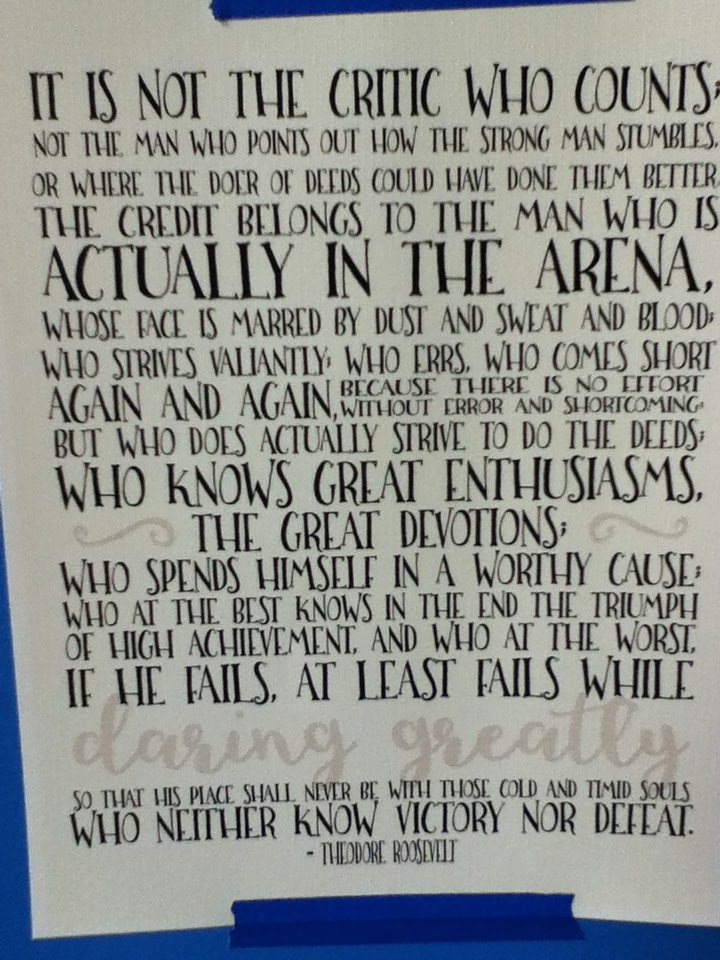
Theodore Roosevelt is making the rounds lately, which is good to see: As a multifaceted man who recognized the complexities of policy and policy making, and who looked for opportunities to use governmental power to advance the public interest, he offers a lot by way of example to today's political scene.

In particular I've been seeing a lot of this quote, which originates in the time between his presidency and his 1912 bid to return to the office:
This poster is on the wall of the Vault, a co-working space where I'm spending the summer. It's meant to inspire the entrepreneurs and techies who are hoping to use the resources in the Vault to launch their businesses.

I am inspired to take time to salute those in the arena, whether their arena be business, society or politics. As I've been thinking about the poster and this milestone post, I see examples all around me of people who are putting themselves forward in positive ways.

There's Eric Engelmann, the visionary CEO of Geonetric who houses and nurtures the Vault:

The teachers and staff at Garfield School, where I volunteer, whose dedication to their students taxes their minds and their bodies:
 
Preservationists like Beth and Tom DeBoom, who put time and energy into saving buildings like Cedar Rapids's historic White Elephant shop (here, in its new location waiting to be renovated):


The staff of Foundation 2, a suicide prevention and crisis intervention task force who today celebrate the opening of their new youth shelter:


The men and women through the years who have served in our nation's military:
 
And, of course, in this political season, we should remember the candidates and government employees. Drew Curtis, who runs FARK.com, spoke at Geonetric last week...
 
...offering lessons from his career as an entrepreneur, but also recounting his 2015 independent candidacy for governor or Kentucky. He got 5 percent of the vote, but his conversations with the eventual winner--Republican Matt Bevin--led to some policy changes, particularly on felon voting rights. "So I improved the lives of about 100,000 people," he noted. He thinks you should run for office, too.
 
So hurrah for people who take action, who are, as TR said, "in the arena." As I pile up posts on this blog, though, I think he undervalues critics.
 
As President, Roosevelt no doubt dealt with a lot of critics, and that was an era before radio talk shows, television pundits, and social media sites mocking Barack Obama's Dead Fly. It's not hard to imagine that he often lost patience with their sniping. We've all heard those people who have nothing good to say about anything: businesses are just out to gouge you, the government is incompetent and corrupt, people who complain about disadvantages should just shut up and shape up, the home team is just going to choke in the end. Such people are mentally lazy and certainly tiresome, whether you're the one actually doing things or just have to listen to them.
 
This blog, and pretty much my whole career, are predicated on the idea that critical analysis can and should have social value. We can explain different groups to each other, hold those in the arena to standards, and remind those who are up to their necks in alligators what their purpose was in entering the swamp in the first place. I write Holy Mountain to explore issues of our contemporary common life, on the principle that the exigencies of the near future--environmental and energy needs, economic opportunity, and the realities of a diverse population--are going to force us into more contact with a greater variety of people than we're used to having. Someone's going to have to do something about all of these exigencies, and thankfully there are numerous someones already at it, but there is also value in articulating, explaining and critiquing. To the extent possible I stay away from personalities and scandals... that pointless way lies madness.
 
If critical analysis is your calling, as I believe it is mine, go to it. Do it with integrity, constructive intent, and admiration for those people--and remember, first and foremost, they are people--who are bold to enter the arena.
  
This is the 200th post on Holy Mountain. Here are the most viewed posts among the first 199:
 
 
  1. "Am I Blue," 14 June 2013 [was #1 after 100, and still far in the lead, thanks mostly to Russian robots]
  2. "Turn Red for What?" 5 November 2014
And in the interest of balance, here are the least viewed posts, mostly featuring celebrations of community life in Cedar Rapids:
 
  1. "Halloween 2013," 1 November 2013 [was #5 after 100]
  2. "A Holiday Tradition," 24 November 2013 [was #1 after 100]
  3. "Nothing Says Community Like...," 13 January 2014 [was #3 after 100]
  4. "MPO Ride 2016," 15 May 2016
  5. "A Preservation Protest," 8 May 2014


Sunday, May 15, 2016

MPO Ride 2016

Gathering at Greene Square
About 15 bold cyclists had a rather miserable but rather enjoyable time of it on the Corridor MPO Bike Ride Saturday. The riding was complicated by a ferocious west wind, which accentuated the effects of hills and heavy traffic.

Temp without wind chill... The crowd was clearly held down by the unfriendly weather

We made two stops in Cedar Rapids.

The first was at Veterans Memorial Stadium, home of the Cedar Rapids Kernels minor league baseball team. Community relations manager Ryne George gave us a tour of everything but the dugouts and the playing field, which were occupied by the teams participating in the Iowa Intercollegiate Athletic Conference baseball tournament. In the press box they have oversized baseball cards representing nearly all 405 major leaguers who played for Cedar Rapids.
Concourse view
Mezzanine view

Urbanists want to know: Was the stadium, built with public funds in 2002, a good investment for the city? Hard to say. The Kernels are not privately owned, and their community outreach (to schools and veterans, for example) is energetic. But they've never achieved the 200,000 annual ticket sales which would have paid for the stadium.

Next we rode to Beverly Park on 37th Avenue SW, where Ken Barker from the Linn Area Mountain Bike Association talked to us about the trails the city has created in the last 10 years, after there had been unofficial trails since the 1980s.

Mountain bike trails work with the existing flora to the extent possible

A mild jump


There are trails for all ages and levels

Battling out to Fairfax was facilitated by a newly-created trail south of Westdale Mall to Beverly Road, but once out in the country it was us, the hills, the wind, the traffic and the wind. The drivers were very amenable to our presence, perhaps sympathetic to our struggle. No one honked; one guy gunned his engine as he passed, but that was it. Hooray for humanity putting up with each other!

Fairfax is an old small town southwest of Cedar Rapids that did some serious sprawling in the 1990s. They've just put a cycle track through town, starting here along Cemetery Road:

Our target was the Star Bar, a historic tavern that dates from about 1870.

It's comfortable, good beer, good food. The woman who co-owns it told us about the history and the ghosts.

Our departure was delayed by train:

For the way back we opted for Stoney Point Road over 80th Street to save on hill-climbing. We might have done that, but it was no less windy, and traffic was surprisingly (to me, anyway) heavy. That was the most difficult part of the trip, but we were encouraged by the news that there is a trail planned along 80th Street. Once in town, the wind was less fierce, and ditto the traffic.

We made several brief stops on the west side of Cedar Rapids, where multimodal transportation planner Brandon Whyte showed us the planned route for the Cherokee Trail, which will run through the city from 80th Street through Cherry Hill Park

...and the chain of parks near Hoover School. Getting it over or around the Vinton Ditch is the most difficult part.
The Vinton Ditch from E Avenue NW. It's what looks in this picture like a crease in the field.
 Second most difficult is obtaining rights-of-way in a few key places.

Cedar Rapids and the other towns in Linn County are making great efforts to expand our trails network. I'd argue that trails are merit goods, offering opportunities for recreation and in some cases (like the proposed Cherokee Trail) commuting. That gets people exercise and gets cars off the roads.

LAST YEAR'S RIDE: "Riding on Infrastructure with the Corridor MPO," 2 June 2015, http://brucefnesmith.blogspot.com/2015/06/riding-on-infrastructure-with-corridor.html

Justice in the World Today

  Hope he gets some of that coffee: Statue of Thucydides in Vienna, Austria (7/31/2026)  A long time ago, according to the ancient Greek his...