Sunday, April 2, 2023

10th anniversary post: The Place Where I Live


big orange colored buildings facing major street
Rebuilding hotel/entertainment complex, 2013

I began Holy Mountain ten years ago this month, in the middle of a sabbatical semester studying the phenomenon of place. I must have had a lot of thoughts stored up... I wrote 14 posts in April 2013, a number I've never since matched. Heck, I'm glad to have done at least one for each of the next 120 months. 

During that first heady month, I wrote about my encounter with New Urbanism--I'm now a CNU member, and will be attending my first in-person conference next month--and my fundamental value of community, both of which became thematic staples of the blog. 

I went to Chicago in April 2013...

three-lane one-way street with auto traffic
Jackson Boulevard, Chicago Loop (2013)

...and got two posts out of it. I yawped out my frustration at the persistence of racial prejudice, despite my efforts to reduce societal conflict to economic class. Little did I know what was coming, though I probably should have had more of an inkling. 

I wrote three posts on religious or sacred place, which I still think about, but haven't written about so much. Now that I've settled into familiar patterns, it's interesting to revisit a time when I could have gone any number of directions. 

people seated outdoors in twilight under commercial awning
McGrath Amphitheater downtown
hosting Jazz Under the Stars in 2014

After my first post introduced the project, I wrote about Cedar Rapids, Iowa, where I have lived for 34 years. I stated its population as 110,000, which was an old figure; the 2010 Census count was 126,326, and it grew to 137,664 in the 2020 Census. I talked about our "plenteous" cultural amenities, Downtown's recovery from the flood five years earlier, and the wonderful parks system, while dinging the city on historic preservation and walkability. 

Because we're a small city in a sparsely-populated state, we've felt rather free to sprawl.... It's very difficult to get anywhere in town without a car. Grocery stores are few and tend to be enormous, surrounded by enormous parking lots. The sidewalks in our neighborhood are nice, and the city has undertaken a sidewalk construction project.... But there's nothing within a five-block walk from our house except more houses and Brucemore [National Historic Site]. A lot of bars, restaurants, and stores are concentrated in hellish strips on Mt. Vernon Road SE, 33rd Avenue and Edgewood Road SW, and Collins Road NE, as well as around the two malls.

mostly empty commercial parking lot
Black Friday 2021: Fleet Farm is the newest big-box arrival,
accessible from the Highway 100 extension

In another post later in April, I wrote about CRST's plans to build a large office building on 1st Street SE. And they did!

river in front of large office building
201 1st Street SE, with Alliant Building in the background

Most of my ten-year-old description of my city still applies. The MedQuarter area northeast of downtown remains "pretty much a dead zone except for the medical complexes." New Bohemia and Czech Village have been aggressively developed, with more core development to be facilitated by the construction of flood walls along the Cedar River. Right now commercial development in those places far outpaces residential, and what residential there is inclines to expensive condominiums, so these walkable core areas currently tilt to drive-to shopping and bars. (See Kaplan 2023, a piece that got a shout in Deleted Scenes, not that anyone here on Holy Mountain is at all jealous.) 

Despite these criticisms, I still spend a lot of time in those neighborhoods. And construction is well along on a number of apartment buildings downtown. More residential population can be the catalyst for a 24-hour downtown with stores and schools within easy walking distance. 

multistory construction project in process
Construction continues at 4th Avenue and 5th Street SE

On the other hand, maybe it won't be... there is a large Hy-Vee Grocery Store with a generous parking lot five or six minutes' drive away. Auto-centric development tends to replicate itself: lots of people with cars need lots of parking, which takes up space that makes fewer places within easy walking distance.

Ten years have also seen substantial additions to the trails network, on-street bike lanes with some protected lanes, and extensive conversions of one-way streets back to two-way. It has been a privilege to watch the town develop, and I will continue to watch future development with interest.

SEE ALSO: "The Place Where I Live," 1 April 2023

Next Page Books, 2020:
A landmark in New Bohemia

Sunday, March 26, 2023

Maple Syrup Festival 2023


(3/26/2023) A sure sign of spring, even on a blustery overcast day, is the annual Maple Syrup Festival at Indian Creek Nature Center. This year was the 40th such event, so we had even more reason to celebrate! I don't know how much of the metro population attends or volunteers during the course of the weekend, but it's well into the thousands, making this annual experience once that is shared around a pretty fair proportion of the community. The Maple Syrup Festival, along with Christmas, Pride and the Freedom Festival in the summer, and maybe some high school and college sports are ways we mark the year together.

Serving lines were short mid-morning Sunday

Beverages served inside

Bluegrass music

Obligatory food porn

a little early maybe? but it's 5:00 somewhere

Syrup is produced onsite
 (We're eating last year's crop)

The Nature Center promised "We won't run out of pancakes," but warned "We will run out of parking." It struck me as we ate in the auditorium that you and your family of whatever size could have easily found a place to sit down, but as usual cars were spread all over the property and down the roads. That shows, as if it needed showing, how huge a footprint cars require. It's the same at a Kernels game. I used to joke that it seemed like everyone at the game drove themselves to the game, then walked home and drove their other car to the game, but ha ha, no, that's how much space cars take. We need to stop taking all this for granted.

I also reflected, maybe because the day before I'd taken a group of students to the State Capitol in Des Moines, that semi-wild spaces like the Nature Center are at once a commodity (that we can sell to tourists), an amenity (that makes life in Cedar Rapids fun), and a space for nature. The Nature Center, as you can tell from their website, works really hard to make the fun educational, and nature education fun. And of course, the income generated by the Maple Syrup Festival helps pay for the year-round care they provide their property. Wild spaces are an unqualified good, though, and shouldn't require tourism to make us value them.

I'm not sure these days what Iowa values anymore--stay tuned for my annual pan-the-legislature post in about a month--but the Nature Center, in its quiet and subversively fun way, is doing great work in maintaining natural space, both for our use and for the rest of nature.

turkey vulture

forest slowly restoring itself,
but still scarred from the storm in 2020

fungi found a tree stump

Monday, March 13, 2023

Another rainy day in New York City


6th Avenue outside West 4th Street station

"Are you local?" asked the man at the coffee shop. "No," I said. "Do you work locally?" he asked. "No," I said, "I'm from Iowa." "Where is that?" he asked. From an array of potential responses, I chose, "Central US."

When I left for New York City on this long weekend, I knew (1) my best opportunity to immerse myself in Greenwich Village would be Monday, and (2) the weather forecast for Monday called for rain all day, so (3) I would be able to test out the urbanist maxim that walkable areas work in all kinds of weather because if your destination's close enough the weather simply doesn't matter.

6th Avenue at 9th Street

Reader, the maxim is true. (It helped that Monday was somewhere between light rain and drizzle, not the bouncing-off-the-pavement precipitation we often get in the "Central US.") Everywhere I walked in the West Village I encountered other walkers, some with children, many with dogs, as well as cyclists (mostly e-bikes). Life goes on, even in the rain, and it can go on just fine without a car if the design is supportive.

Hudson St approaching Perry St

The West Village, besides being spectacularly walkable, is spectacularly historic. Inexcusably, neither of our guidebooks mentions Jane Jacobs, who lived at 555 Hudson Street while writing her ur-urbanist classic The Death and Life of Great American Cities. 

555 Hudson Street

Her home is now a realty office, possibly some revenge for Robert Moses, but at least it's not a Dunkin' Donuts. 

plaque by the big front window

If your children are too young to appreciate Death and Life, they could start on this...

...available along with much else for all ages at the Tenement Museum, not far away on the Lower East Side, and whose side hustle may be one of the greatest bookstores I've ever been in.

The West Village is also the spiritual birthplace of gay rights

Stonewall Inn, 53 Christopher Street

Across Christopher Street from the Stonewall is Christopher Park...

where the gay rights movement is commemorated. 

Scant blocks away is Julius'...

159 West 10th Street
(Note that other than the main drags, streets are about 16 feet wide)

...where a few years before Stonewall, patrons invited reporters and police to witness their illegal imbibing, which events became known as "sipins."

Now that gays can congregate freely in bars and even receive packages by FedEx, it can be easy to remember that freedom was neither automatic nor easy.

The West Village also has considerable artistic heritage. The realtors in Jane Jacobs's house work within a 5-minute walk to folk music history...

Woody Guthrie lived at 74 Charles Street

theater...
Lucille Lortel Theater, 121 Christopher Street
theater history...

Playwrights Sidewalk on Christopher Street

jazz...

Village Vanguard Jazz Club, 178 7th Avenue S
(2010 photo of younger humble blogger with humble son Robbie)

and film!
IFC Center, 323 6th Avenue

There is also 94 Charles Street, for hipster baseball card collectors:


And there's 25 Charles Street...
...where my friend Mark Dunn lived in the 90s while trying to make a go of playwrighting.

Farther east, Cafe Wha?...
115 MacDougal Street
...is featured on the cover of Rhino's Troubadours of the Folk Era collection.

Sitting in the coffeeshop on a "slow" Monday (free WiFi, restroom, steady entrance of customers, $4.75 for a 12 ounce drip coffee)...
787 Coffee, 208 West 10th St

...I feel comfortable and at home here. I don't even want to go back to my hotel in Midtown! 

Is it amazing that all this ferment is happening in a relatively tiny geographical space? Yes, it is, but then again, no, it isn't. It's really only when people live with each other, encountering each other on a daily basis while negotiating space and difference, that such sparks fly and magic happens. When people retreat to enclaves, we get commercialized values and the politics of fear.

While I've been in New York, presidential candidate Ron DeSantis has been in Iowa, and word just came that President Biden is opening more of the Arctic for oil extraction. The West Village shows us that we can live well without either one.

Jefferson Market Library and Garden, 10 Greenwich Avenue

I suppose if I did live here, and visited Iowa, I would be blown away by all the personal space available, the cheap real estate and acres of free parking--all that chafes at me now--and the free refills. The grass is always greener... Would I then be encouraged to vote for Ron DeSantis to make America Florida (or, more attainably, Iowa)? 


SEE ALSO: Mike Katz and Crispin Scott, The Rock and Roll Explorer Guide to New York City (Globe Pequot, 2018)

Wednesday, March 8, 2023

The tragedy of Scott Adams


(3/8/2023) Scott Adams's long-running comic strip Dilbert has disappeared from newspapers this month, following a series of his online comments that were well across the line of acceptable discourse. I've read plenty of commentary since then, quoting long-time associates wondering what happened to him over the years that brought him to this pass. I wonder, too.

I've been a fan of Dilbert since the early 90s. He portrayed with brilliance and dark-but-gentle humor what workplaces can turn us into, with all its pressure and frustration and supervision and sometimes even fear. The tech office where he set the strip seemed familiar to me, even though my career is in a very different field, and I've never worked in a cubicle. He understood us. In the first strip I clipped from the Chicago Tribune back in 1992, Dilbert shouts "Yes!" practicing, he says, in case anything good happens to him. When he adds a dance move, he falls out of the window. 

Everyone was the butt of the joke at one point or other, but the authority figures got most of it. Adams was punching up.


Like J.K. Rowling, Adams has been justly celebrated for his exceptional body of work (including a Pulitzer Prize in 1998). Also like Rowling, he's been justly condemned for a series of recent comments, mostly about race for Adams, which have nothing to do with that body of work. And were quite plainly punching down instead of up. 

I wonder if all the praise went to their heads, and they fancied themselves experts on everything. Or maybe they weren't ready for the attention their random thoughts got?

Our common life benefits from artistic excellence. And it benefits from freedom of speech. But we maintain community by remembering, as Paul wrote, that "all have sinned and fallen short of the glory of God" (Romans 3:23). A common life also requires listening--reading Adams's comments makes me wonder if he ever has talked with a black American--and humility before we speak. That must be especially hard to remember when people are lionized. I can see why the ancient Greeks used to banish people who got too famous!


Sunday, February 19, 2023

Trails and bikeways ideas

2015: Steve Sovern promoted a new bridge across the Cedar River

Your humble blogger has been named to the Advisory Council on my city's and county's Trails and Bikeways Plan! Our first meeting is next Friday morning. I'm not sure what to expect, other than there are more than 30 people on the committee, so we can anticipate a diversity of viewpoints.

A trails and bikeways plan might well be expected to seek more of both trails and bikeways. I submit we can do this most effectively by prioritizing ways, not only of enhancing the experience of cyclists, but of achieving broader community goals. The prophet Jeff Speck, whose book Walkable City: How Downtown Can Save America, One Step at a Time has just been reissued in a 10th anniversary edition [Picador USA, 2022], argued in the first edition that when public policy encourages cycling, it achieves four side benefits (what we academics call "positive externalities):"

  1. slowing car traffic, making streets safer for everybody
  2. less land devoted to parking, so more productive
  3. less pollution and greenhouse gas emissions
  4. better urban fabric, so more possibility of urban life
If we keep the why front and center, it will help us choose the what.

People choose to ride bicycles for two sets of reasons: recreation (fun, exercise) and commuting (getting to work, school, shopping, and social life). Trails mostly serve the former, although creating direct routes like the Cemar and Cherokee Trails can dramatically improve commuting efficiency; bike lanes mostly serve commuters, but can improve access to trails as well. While our plan ought to improve the experiences of people who are already doing these, the most important job now is to encourage people to try cycling who currently are using cars for short trips. That's what moves us towards those four social benefits: Some ridiculous percentage of trips in America are under two miles. If we could cause more of those to be taken by bicycle, we could change the world.

My ideas, listed below, have some infrastructure in them, but mostly address obstacles to biking on the infrastructure we've already built. I hope we're able to pursue some of these.

New Infrastructure

1. Look for opportunities for more direct routes. The Cemar Trail, once completed, will enable you to get from downtown Marion to downtown Cedar Rapids more quickly on a bicycle than you can in a car. Bikes aren't always going to be competitive with auto travel for speed, but the closer we can get the more likely people are to try cycle commuting. More like this, please.

2. Look for opportunities in areas of concentrated poverty on the edges of town. Mobile home parks and less-expensive apartment complexes are often found near high-traffic and/or high-speed stroads like Collins Road and Wiley Boulevard. Personal cars can be a money pit, particularly for the economically vulnerable. How can we improve the infrastructure in their neighborhood to make it safer and more encouraging?

3. Look for places that could draw a lot of cycling. The Cedar Rapids Community School District is redoing the whole elementary school array, and has plans to do the same for middle schools. They will have bigger attendance areas than current schools, so more students will be driven, but even so we should definitely make it possible for children to ride safely to school.

4. Connect Coe College to the Cedar Valley Trail. Is this special pleading? Coe (my employer) is close to Cedar Lake as the crow flies, but bikes must take a circuitous route. Coe houses about 1000 young leaders of tomorrow, a concentrated population of potential cyclists. 

Existing Infrastructure

1. Convert on-street lanes and sharrows to higher levels of service, where warranted. Sharrows aren't infrastructure anyway, nor are signs on major streets that say "bikes may use full lane." Yes, they may, but few will use the street at all, unless it feels safe.

The dreaded sharrow: 4th Av & 10th St
(Bike lanes end in the 700 block of 4th)

2. Dedicated fund for maintaining existing infrastructure. Nothing lasts forever. Construction is by definition sexier than maintenance, but neglect of maintenance dooms the whole project.

Removing obstacles

1. Road diets will slow cars and create space for other users. One immediate need: 1st Avenue east of the junction at Williams Boulevard is a major thoroughfare through downtown. Maybe we add a bike lane, maybe we don't, but the key is to slow the cars sufficiently that cycling feels (and is) safe. Slower driving is safer for drivers and their passengers, too.

2. More patrolling of streets will improve everyone's behavior. Enforcement is secondary to design, as any disciple of Strong Towns will tell you, but it's another way to control the speeds, particularly of the biggest and fastest vehicles. However...

2a. Legalize the Idaho stop. While I appreciate the opportunity to rest at stop signs and red lights, less world-weary cyclists should be able to proceed with caution in the absence of cross-traffic.

3. Where the numbers of cyclists warrants, install secure bike sheds rather than relying only on bike racks. More people will ride if they can worry less about theft.

4. E-bike rentals or even giveaways. One study found e-bike riders burn more calories than traditional riders like me, because they ride farther and more frequently.

5. Fund an extensive survey of public attitudes about cycling, so we're not relying on comments of convenience or passion. Even the active cyclists on this committee have some limitations on their perspectives.

Other public policy

1. Event planning, coordinated with management of the new apartments and condo units in core areas of the city. Don't just hope for good results from infill, prime the pump of potential cyclists. All the new infrastructure creates the potential for walkable/bikeable streets, but we only see the benefits of cycling and walking if people do them.

Start of construction of the Banjo Block last summer:
184 new apartments downtown

2. Legalize ADUs and missing middle housing. We'd have a more bikeable city with more density, because density equals destinations to bike (and walk) to. Just because our terrain is flat is no reason we have to sprawl all over it. And while we're at it...

3. Adopt a land value tax. This is my latest obsession, but by gum, we'd have a more bikeable city with more urban life if we could fill in the empty parts of the core areas where the clods are land banking.

SEE ALSO: "Why I Pedecommute (and Pedal-Commute)," 6 April 2021 [or check the posts linked under "bicycles" in the labels column on the right side of your screen]

Alec Davis, "How I Learned to Be Vulnerable," Waste of Space, 20 February 2023

Charles Marohn's interview with Jeff Speck on the Strong Towns podcast is here.

Saturday, February 4, 2023

What's Happening in Illinois?


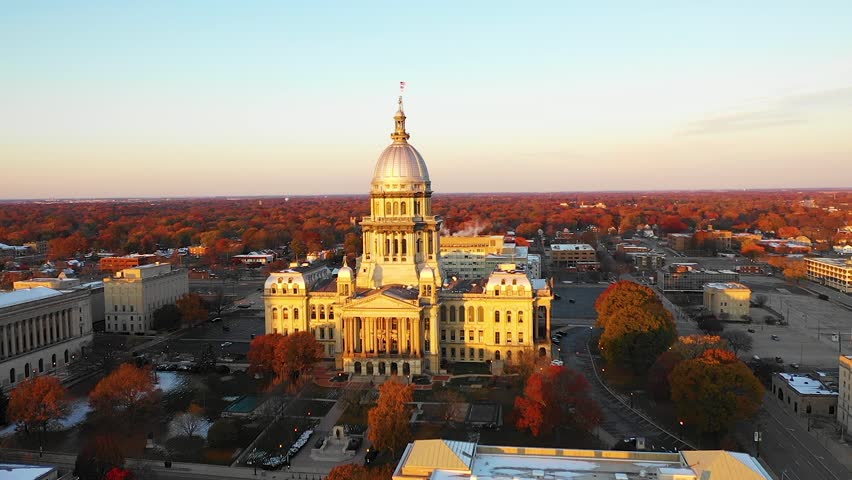
Illinois State Capitol
Illinois State Capitol, Springfield
"Just outside Chicago, there's a place called Illinois"
(70s tourism slogan)

My native state of Illinois lost another chunk of population this year, according to Vintage 2022 estimates released last week by the U.S. Census Bureau. Illinois's population losses stand out, even by the standards of the Midwest, which has lost 0.3 percent of its population since the 2020 Census. , Illinois has declined 1.8 percent in the last two years; the next-sharpest declines, in Michigan and Ohio, were only 0.4 percent each. In the middle of those states, Indiana has gained 0.7 percent. Even Iowa looks comparatively good, at plus 0.3 percent. Nationwide, only New York and the District of Columbia (both -.2.6 percent) lost more of their population over the last two years than Illinois. [On the other hand, in 2022 Illinois ranked second in the Midwest (3.1 percent) behind South Dakota (3.5 percent) in percentage increase in employment. There's more than one metric around, and population may not be the best indicator of a state's well-being.]

From 2010 to 2022, the U.S. as a whole has gained not quite 8 percent in population. In that time, Illinois has lost 0.17 percent, ranking ahead of only Mississippi (-0.24 percent) and West Virginia (-3.84 percent) (World Population Review 2022). The clearest story to explain this has come from the right; Pete Saunders (2022a) characterizes their version as centering on Chicago as the 21st century American Urban Dystopia--staggering crime and violence, frighteningly bad public schools, and high taxes that do more to support rampant political corruption than quality public services. It follows the only effective remedy would be a sort of militarized neoliberalism: cut taxes and services, privatize education, stomp on the criminals, can the racial justice stuff, and vote Republican. This is supposedly how they get it done in sunnier areas and wealthy suburbs (cf. Voegli 2022).

Illinois is losing population in non-metropolitan areas.

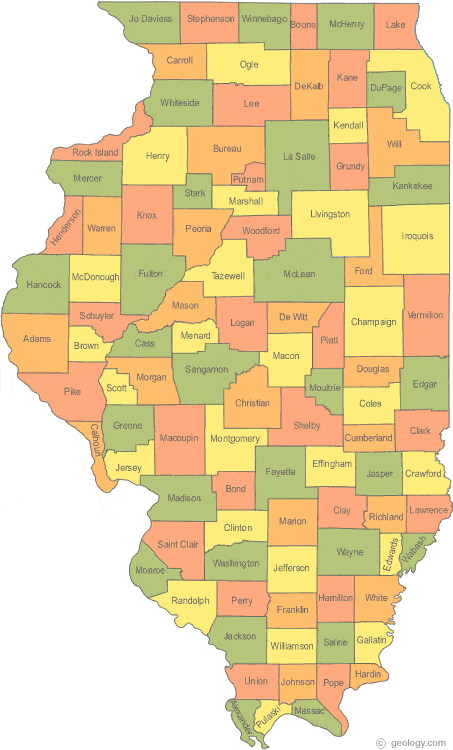
When we examine data at the county level, though, Illinois' story gets considerably more complicated. Its 102 counties can be divided among census-defined metropolitan areas (40 counties in 13 metros), micropolitan areas (23 counties in 19 micros), and purely rural areas (the remaining 39 counties). Only one county, Kendall at the edge of the Chicago/Naperville/Elgin MSA, grew faster than the U.S. as a whole; two others, Monroe south of St. Louis, and Johnson near Carbondale in southern Illinois, came close.
State of Illinois with county divisions
Illinois and its 102 counties
(Creative Commons)

In all, 15 counties in Illinois gained at least some population from 2010 to 2022. These include eight of the nine counties in the Chicago MSA, Champaign County (home of the University of Illinois), McLean County (home of Illinois State University), two of the three counties in the Carbondale/Marion MSA (home of Southern Illinois University), Monroe County in the St. Louis MSA, and rural Carroll County in rural western Illinois. Each surely has its own story to tell, but here are some observable patterns, few of which are unique to Illinois:

  • Successful urban areas, around Chicago and the largest universities, are propping up the rest of the state, though not growing as fast as successful metros elsewhere in the country 
  • The state is hemorrhaging outside the metros, with 60 of 62 micropolitan and rural counties losing population, 16 by more than 10.0 percent
  • Sangamon County (Springfield) is holding almost steady with a 0.68 percent population loss since 2010, though Springfield hasn't been able to capitalize--ha ha!--on the headquarters of state government as have Des Moines, St. Paul, Madison, Indianapolis, and Columbus
  • Some urban areas are not doing well at all, possibly because of commitments to outdated industries (Decatur, Kankakee, Peoria, Rockford, St. Louis); the same might be said of the Quad Cities, although Scott County, Iowa (Davenport) is growing
  • The two biggest drops among micropolitan counties are McDonough (-19.77 percent) and Coles (-15.61 percent), home to regional state universities that have suffered precipitous enrollment losses... a sort of Rust Belt of the mind as higher education evolves
modern library building
Malpass Library, Western Illinois University, McDonough County,
where your humble blogger started his teaching career
(from wiu.edu)

Illinois' loss of population is obviously not a single problem, but a confluence of several phenomena which are probably best addressed separately:
  1. Why has there been so much population loss in rural places? Can something be done in some of these areas (tourism, local industry, organic food) to revive some of these places?
  2. What can be done with struggling industrial (or small university) cities?
  3. Why isn't Chicago (or Champaign-Urbana, Carbondale, and/or Bloomington-Normal) growing faster than it is?
Of course, realizing this doesn't explain why their combined effects is so strong in Illinois; Wisconsin and Michigan, for two, have a lot of the same characteristics.

Cairo, Illinois, seat of Alexander County (372 miles from Chicago),
largest proportionate population loss among Illinois counties

But, what about Chicago?

Despite the evidence, for whatever reason(s), when discussing Illinois' problems a lot of talk turns to Chicago.  As we've seen, Chicago and environs are growing, not shrinking, but perhaps they could be growing faster? 

A good place to start is "Tottering Chicago," a series of insightful blog posts by Chicago-based writer Pete Saunders. 

smiling Pete Saunders
Pete Saunders
(from businessinsider.com)

It's worth reading in toto, but a key point Saunders makes is that Rust Belt "legacy" cities like Chicago are in a different situation than New York ("knowledge economy-based city" that now must deal with the consequences of its success) or Dallas (looking good due to a recent air conditioning- and Interstate highway- and low wage- and annexation-fueled growth spurt). "There are signs that Chicago is making very real progress in its transformation," Sanders suggests, "yet there are deeply rooted challenges that root Chicago down, and that gets discussed more than its positives." 

Saunders notes that since 2010, Chicago has added 97,000 households city-wide, the core of the city has grown faster since 1980 than any other American city, and has been successfully attracting recent college graduates. [Saunders also notes the limitations of using population growth/decline as a surrogate for a place's success (Saunders 2022b).] Poverty persists, but the principal crisis--and biggest threat to sustained prosperity--has been an increase during the pandemic of "frightening" crime: homicide, carjacking, and overall gun-involved violent crime. The bottom line:
Chicago has a thriving, dense core; some prosperous communities on the outskirts; and a vast, mostly poor, less-populated hinterland in between. Bridging that gap may not be impossible, but there's much work to be done. (Saunders 2022a)
industrial building
Loft apartments by the Bloomingdale ("606") Trail, Chicago

Chicago's reality is far from a perfect, but also far from the doomsday fantasies of, say, recent Trump-style gubernatorial candidate Darren Bailey. Saunders concludes (Saunders 2022e) with some recommendations for Chicago and other Rust Belt cities similarly situated, which might have some lessons for Rockford and Peoria as well:

  1. "Be who you are." Acknowledge and build on strengths, and avoid radical solutions that try to replicate 1980s Dallas. Avoid all ideologues, rightists and leftists, selling pet formulae for success.
  2. "Lean in on immigration." Unfortunately, this requires more coherence and less hostility in national policy, but do whatever can be done. 
  3. "Promote affordable urbanism and authenticity." Chicago offers urban life at a much lower cost than New York or Seattle; done right, this could work in smaller metros as well.
  4. "Boutique manufacturing," by which he means more artisanal workshops, leaving the big plants to chase lower labor costs in the South and across the border.
  5. "Water security." Shore up environmental infrastructure, and prepare for climate refugees.

What is to be done?

Addressing Illinois begins by acknowledging its complexity: Illinois is more than Chicago, and Illinois's problems are more than Chicago's. The biggest population losses are occurring in rural areas where small towns are no longer needed to service family farms, and that indicates a different set of policy approaches--although immigration is going to be a start here, too (cf. Frey 2023 and Pipa 2022). Don't wait on the federal government to act, either. 

Each region of the state, moreover, consists of a complex set of people, all of whom have something to bring to the conversation that deserves to be heard--heard without ascribing irrationality or corruption. Voegli figures the only reason people of means still live in Chicago is that they are cultural snobs who would rather be assaulted by urban criminals than live around conservatives. Don't be like him.
Jackson Boulevard, downtown Chicago,
Illinois' most economically productive district

We can't do everything everybody wants, and we shouldn't do everything anybody wants, but we need to hear everybody and take account of them all. Who knows where complementary interests might be found? Besides this...
  • Look for ways, the less radical the better, to improve the lived experience of current residents. Small steps can be simply expanded or rescinded; radical moves and "game-changers" cannot be. (cribbed from Strong Towns)
  • Illinois's reputation for high taxes and urban crime, however exaggerated, aren't helping its image or the mood of its people. (Do taxes explain why Rock Island, Rockford and Cairo are shrinking while towns across the border are growing?) Addressing these needs to be part of whatever gets done.
  • Agreeing in part with Voegli, look for every opportunity to improve the quality and quantity of education in the state (cf. Gilmartin and Hurley 2018, Frey 2019)--as long as we strive to include everyone, because...
  • Every policy proposal needs to take into account the role of racial discrimination in creating the world in which we live. 
  • Every policy proposal needs to take into account all the ways we have sought to accommodate motor vehicles, at the cost of our community, our environment, and our bodies.
turnstile, varnished interior train station
Quincy L stop, Chicago Loop

Justice in the World Today

  Hope he gets some of that coffee: Statue of Thucydides in Vienna, Austria (7/31/2026)  A long time ago, according to the ancient Greek his...