Saturday, December 3, 2022

Is Iowa Becoming Even More Republican?


Map of Iowa counties and 2022 election vote
Governor Kim Reynolds won 95 counties and reelection

Iowa turned red in 2014 after years as a purple state, and Republican control of the state endured what was a pretty good year nationally for Democrats in 2018. Governor Reynolds, winning her first election, won majorities in 88 of Iowa's 99 counties, and the Republicans controlled both houses of the legislature. This year, notwithstanding the coronavirus pandemic, the Trump presidency, and the ongoing decline of most of the state, Reynolds won 95 counties and Republicans gains in both houses neared supermajority levels (with a handful of races still to be decided). All six Iowa members of the U.S. Congress are now Republican. Are Iowa's recent Republican tendencies getting even stronger?

I will, with due caution given limited data, say yes. There's variation across election years and indeed across races, so there's no certainty that Democrats won't do better statewide in 2024 than they did this year. But all indications are that Republicans have increased their hold on the rural vote, and at least this year made substantial gains in some urban counties.

After the 2018 election I looked at the ten most populous counties in Iowa, which accounted for a majority of the state's overall population as well as 74.5 percent of statewide job growth. The story seemed to be that large urban counties were Democratic to the extent that they were also high in population and job growth, job growth, and (by Iowa standards) non-white population. Extending the analysis  the following summer to all Iowa counties highlighted the difference between growing and non-growing counties. Reynolds won over 60 percent of the vote in the 70 counties that had lost population since 2010, while barely winning 40 percent of the vote in the seven counties that grew faster than the U.S. as a whole. 

Curiously, the number of votes cast in the two groups of counties was roughly the same. With Democrats strong in growing areas, and Republicans strong in non-growing areas, time seemed to be on the Democrats' side. While time may in fact be on the Democrats' side, so far the numbers are trending the opposite way.

We're down to six counties that grew faster than the U.S. as a whole; all are large by Iowa standards. They include Polk, Story, Dallas and Warren counties in the Des Moines-Ames area, as well as Johnson and Linn counties in the Cedar Rapids-Iowa City area. (Included in the 2018 fast-growing group, but omitted here, is little Jefferson county in southeast Iowa. After showing population growth every year in annual U.S. Census Bureau estimates, the 2020 census showed a 7 percent decline there since 2010, an anomaly I discussed here.) Scott County (Davenport) and Dubuque County (Dubuque) are other large Iowa counties that grew faster than the overall state population increase in the 2010s.

Most of these eight large and growing counties showed pretty consistent partisanship across statewide elections from 2016-2022. Johnson County (Iowa City) is by far the most Democratic each year, while the suburban Des Moines counties of Dallas and Warren are the most Republican. The slower-growing urban counties of Dubuque and Scott, on the other hand, both shifted substantially to the Republicans in the 2022 gubernatorial race.

PCT R/D BY COUNTY, 2016-2022

COUNTY

(growth 10-20)

2016 PRES

(Trump/Clinton)

2018 GOV

(Reynolds/Hubbell)

2020 PRES

(Trump/Biden)

2022 GOV

(Reynolds/DeJear)

Johnson +16.8

29.5-70.5

27.1-72.9

27.9-72.1

29.7-70.3

Story +10.0

43.1-56.9

39.7-60.3

41.1-58.9

44.9-55.1

Polk +14.3

43.8-56.2

40.7-59.3

42.2-57.8

46.0-54.0

Linn +9.0

45.1-54.9

42.8-57.2

43.0-57.0

47.4-52.6

Scott +5.7

49.2-50.8

48.2-51.8

48.2-51.8

55.7-44.3

Dallas +50.7

55.2-44.8

51.7-48.3

51.0-49.0

55.9-44.1

Dubuque +6.0

50.7-49.3

49.3-50.7

48.5-51.5

58.3-41.7

Warren +13.4

58.7-41.3

53.9-46.1

58.6-41.4

63.2-36.8

All Others -1.2

62.8-37.2              

58.9-41.1

62.8-37.2

68.6-31.4

IOWA +4.7

55.0-45.0

51.4-48.6

54.1-45.9

59.5-40.5

Sioux +6.4

86.5-13.5

86.8-13.2

83.9-16.1

90.9-09.1

Dickinson +6.2

(Iowa Great Lakes area)

68.8-31.2

64.0-36.0

67.0-33.0

74.5-25.5

Madison +5.5

66.7-33.3

63.4-36.6

67.5-32.5

71.9-28.1

Clarke +5.0

64.9-35.1

64.7-35.3

68.2-31.8

75.2-24.8

The rest of the state outside these eight counties showed a pretty steady increase in support for Republicans. Collectively, they were 7+ percentage points above statewide in 2016 and 2018, and around 9 percentage points in 2020 and 2022. This holds true even where their population has grown, as witness the strongly Republican Sioux County in northwestern Iowa becoming even more strongly Republican through this period.

The House of Representatives races in these years also showed consistency across large urban counties, but Republican shifts in the rest of the state (including, again, Dubuque and Scott counties). Note that Sioux County, with a population of about 35000, can produce Republican majorities that swamp Democratic majorities from larger counties, particularly Story which is in the same U.S. House district.

CONGRESSIONAL VOTE DIFFERENTIAL BY COUNTY, 2016-2022

COUNTY

2016 HR

2018 HR

2020 HR

2022 HR

Johnson

+27305

+32012

+32028

+27349

Story

  +4815 

+14095

  +7555

+3613

Polk

   +271

+33473

+39247

+26498

Linn

+3361

+16979

+13148

+9907

Scott

+6448

+9270

+5516

+3417

Dallas

  +9828

+2496

+2540

  +1575

Dubuque

+4490

+3077

+278

+2904

Warren

+5922

+2415

+3775

+4529

All Others

+161821

(59.5-40.5)

+51657

(53.7-46.3)

+188604

(60.5-39.5)

+206225

(65.8-34.2)

IOWA

+139861

(54.7-58.2)

+52338

(48.0-52.0)

+97147

(53.0-47.0)

+151283

(56.3-44.7)

Sioux

+11846

+7142

+13271

+11384

Dickinson

+2884

+745

+3630

 +3727

Madison

 +3372

 +2160

+2731

+2492

Clarke

 +321

+414

+1073

+1175

This is admittedly rough analysis, focusing on the dimension of growing vs. not-growing areas, and using results from a relative handful of races. There are other dimensions to consider, including urban/rural, or race. Iowa has a strikingly low nonwhite population, but Democrats tend to do better in counties like Black Hawk (Waterloo) which is "only" 78 percent white. (Even then, Black Hawk went Democratic in the 2022 congressional race but Republican in the gubernatorial race.)

It does suggest that Republican strength overall in the state is growing, with the growth concentrated in shrinking rural areas and possibly slower-growing urban areas. This is consistent with national analysis by The Washington Post, which found among Republican gains in 2022, "many of their largest swings" were in districts Trump won in the 2020 presidential election (Keating, Stevens and Mourtoupalas 2022). Of course, they are looking shifts over two years, whereas I am looking over six years and trying to spot or at least deduce longer-term trends.

So, for the time being, politics in Iowa looks like more of the same, maybe bolder. The state appears to be continuing its shift towards the Republican Party, but not uniformly, so that divisions within the state are increasing. "Whatever it takes, whatever it costs, they are fundamentally trying to change who we are as a country," Reynolds said of Democrats at a Sioux City rally headlined by former President Trump. To the extent that she and the legislature are only here for those who she called "the real Iowa," this will not be a comfortable state for those who are in any way different.

DATA SOURCES: 

Elections 2016-18-20: https://sos.iowa.gov/elections/pdf/2020/general/canvsummary.pdf

Governor 22: cnn.com/election/2022/results/iowa

House 22: https://www.usatoday.com/elections/results/2022-11-08/us-house/iowa/

SEE ALSO

"Small Towns, Rural Areas, and State Legislatures," 11 June 2019

"Election 2018 and What Happens Next," 20 November 2018

"Turn Red For What," 5 November 2014


Friday, November 25, 2022

Black Friday Parking 2022

Parking lot with stores and few cars
Strip mall, Edgewood Rd SW, 9:45 a.m.

(11/25/2022) On the southwest side of Cedar Rapids, there is a triangle formed by three stroads: Edgewood Road, Wiley Boulevard, and Williams Boulevard. Average daily traffic counts are roughly 19000 for Edgewood, 9000 for Williams, and (from 2017) 14000 for Wiley. Until about ten years ago, they surrounded Westdale Mall; since that was demolished, they serve a large Wal-Mart, a large Target, and numerous shopping plazas and stand-alone stores.

The area made for an irresistible subject for my 2022 #BlackFridayParking survey, part of the annual Strong Towns event. The area is clearly meant to be driven to; it is served by three bus routes (8,10,12) but the system runs only during the day, and today was running a reduced version of that due to the holiday weekend. Walking between stores is extremely difficult, I can attest. There's a lot of traffic, moving quickly, from various directions. I relied on my remaining agility and the kindness of strangers to get places and return safely to you.

It was a lovely day, sunny and unseasonably warm. I got to Target about 10:00 a.m., too late for the doorbuster sales, but still in time to see a sizeable crowd of cars and shoppers.

Parking lot by big-box store, a lot of cars

Even so, much of the parking lot was unused.
Big-box store parking lot, few cars
Target, 3400 Edgewood Rd SW, lot 2/3 full at 9:45 a.m.

Down the street at Wal-Mart, the situation was even more pronounced: Many, many shoppers and cars...
Big-box store parking lot, many cars
View from the front door

...but much unused parking.
Big-box store parking lot, few cars
Wal-Mart Supercenter, 3601 29th Av SW, lot 1/2 full at 10:00 a.m.

Away from the two retail giants, crowds were thinner and parking lots were emptier.
Strip mall parking lot, few cars
Strip mall across from Wal-Mart

Kohl's had some traffic near the entrance to their lot...
big-box store parking lot, some cars
...but away from the entrance ir was empty.
big-box store parking lot, few cars
Kohl's, 3030 Wiley Blvd SW, lot 1/3 full at 10:00 a.m.

The parking lots on the grounds of the former Westdale Mall were glaringly empty.
mall parking lot, few cars


mall parking lot, few cars

On the other hand, from a distance it looked like the parking lot of Menards (home improvement store) at Wiley and Williams was very full.

As I forded these lots, I also forded a number of access roads--some, as I said, busy with fast-moving traffic, and some seeing no cars at all. This leads from the Kohl's to Wiley Boulevard, but can only be accessed by southbound traffic.
access road with grass

It made me think that, as much of this event is designed to complain about parking craters, big-box stores and strip malls also generate an excess of infrastructure. Maybe next year we could do Black Friday Access Roads?

Meanwhile, the Westdale area is beginning to see a little of the development promised when the city sunk a fortune into its redevelopment. There is a mixed-use development with apartments.
apartment building
Parkway West, 3998 Westdale Parkway

These apartments are within walking distance of a lot of shops. I wonder if anyone ever does walk? And what might be the attraction of living here, as opposed to a more human-scaled locale? Price? Highway access? 

The apartments are flanked by a hotel (Tru, a Hilton brand) and a construction project that will become a hotel.
hotel building under construction

Will these projects generate any foot traffic at all? And given the inherent risks of crossing acres of auto infrastructure, would it be a good idea if they did?

And then there's this guy, across from the Westdale bus stop.
building with multiple bays, under construction

Car wash? Oil change? Tire store? It's auto-oriented, in any case, consistent with its surroundings.

The main purpose of Strong Towns' annual #BlackFridayParking event is to highlight to #EndParkingMinimums, provisions of zoning codes that require large stores to have even larger parking lots. Cedar Rapids' zoning code has those provisions, but the parking lots I surveyed seem to be substantially larger than required, albeit I haven't counted spaces.

Even if zoning requirements do not fully account for this appalling design, public policy has a hand in it. Property tax policy allows property owners to pay low rates on large swaths of unproductive land. City officials everywhere have a preference for big "wins," including attracting and accommodating a large franchise operation, over the economic gardening that nurtures local businesses. (See Alter 2022 on the many benefits of small locally-owned businesses over the big-box franchises.)

The result is a car-chocked landscape, full of expensive infrastructure that the widely dispersed businesses ultimately can't support, stressing drivers and practically prohibiting pedestrians. For financial, environmental, and community reasons, we need to do better. We have what we have in unholy triangles like the one I haunted today, but we need to start thinking differently and designing our cities better. As they say at Strong Towns, "Having 'enough' parking is always going to be less important than creating a place people want to be."

SEE ALSO

"Black Friday 2021," 26 November 2021 [Blairs Ferry Road NE from Fleet Farm to Wal-Mart]
"Black Friday 2016," 25 November 2016 [same area that I visited today]
Lauren Fisher, "14 Photos That Prove We Have Too Much Parking--Even on Black Friday," Strong Towns, 25 November 2022
Daniel Herriges, "The #BlackFridayParking Exception That Proves the Rule," Strong Towns, 25 November 2022
Addison del Mastro, "Unplanned Vacancies," Deleted Scenes, 12 May 2022 [paywall] [which I haven't crossed so it might not be any good] [but he's brilliant so it probably is]
Jaclyn Peiser, "Black Friday Isn't What It Used to Be. Here's Why," Washington Post, 25 November 2022 [another annual tradition is declaring Black Friday "over"] [and indeed it may have run its course, or nearly so] [in the meantime we have all this parking]

Sunday, November 20, 2022

CURL at 25


academic buildings, sidewalk, lawn
Cuneo Hall (swiped from luc.edu)

Three alumni from the Center for Urban Research and Learning shared recollections and advice via Zoom last week. The Center is located at Loyola University on the north side of Chicago, and recently celebrated its 25th anniversary, having been founded in 1996. From the beginning its focus has been on seeking knowledge that is practical and helpful. The Center funds faculty and student research that is "action-oriented," with "linkage with Chicago communities" is at the core of its activity. Its mission statement states the goal of developing "innovative solutions that promote equity and opportunity in communities throughout the Chicago metropolitan region and beyond." 

woman in classroom speaking from notes
Ellen Shephard at CURL in 2016

I first encountered the Center's Friday Morning Seminars in the fall of 2016, when I was searching for some gathering in the Chicago area that would support my study of cities. I saw Ellen Shephard of Community Allies speak memorably on the economic contributions of local businesses; I still refer to the notes I took that day. Subsequently I attended talks by graduate student Bill Byrnes in 2017 on law enforcement and the black middle class, alumna Dr. Sophia Rodriguez of the University of Maryland in 2018 on the role of public libraries in orienting recent immigrants, and Jennifer Axelrod of the Chicago Community Trust in 2019 on philanthropic efforts to address the racial wealth gap. 

Then came the coronavirus pandemic, which kept me away for two years When I returned this year, I saw that things weren't quite back to normal; most people including the presenters were on Zoom, while I shared the seminar room with the two people who were producing the Zoomcast. Oh well. Maybe next year, we will all be in person, and can enjoy one of those marvelous spreads virtually everybody on the panel remembered from past CURL events.

Zoom screen with faces

Sophia Rodriguez, who received her Ph.D. from Loyola in 2014, recalled that once she got connected to CURL, "things seemed more real there" than in her graduate department where she felt herself losing touch with the education communities where she had worked and which she was now studying. The "ethical community-based work" of the Center spoke to her, so in addition to her graduate assistantship she worked on a CURL project bringing organizational leaders together around early childhood education policy proposals.

Asma Ali, specialist master at a major consulting firm--supposed to be unnamed but pretty quickly revealed to be Deloitte Touche--noted the variety of projects in which she was involved with CURL, in contrast to the focused specialization of the Ph.D. program. She commended CURL's founding attention to cultural responsiveness. "The stop-and-listen part is getting more attention" from programs today, she noted, but "CURL was doing it 20 years ago." Talking and listening to under-represented communities is not "just a soft skill that anybody can pick up." CURL not only taught her how to do that, but inspired her to push for it in her various jobs since.

Amy Kerr, director of evaluation at the for-profit consulting firm Professional Data Analysts, agreed that "learning to build trust" is essential to the work of CURL. She advised current students to "think about what you want your life to look like" after graduation.  She said she had always admired top university researchers, but knew she could not be "a happy human being" in such a job. She advised students to stay open and keep learning on the job, but also to keep asking whether they were where they wanted to be and whether their life looked like they wanted it to look. "Are you living your values day-to-day?" 

The emphasis on the values that infused the work of the Center and its fellows came up again and again on the panel--quite a contrast to the phrase "value-free" which was all in vogue when I was in graduate school. In this way they are not just "contributing to understanding," the felicitous phrase used by my graduate adviser, but they contribute continuously to the possibility of common life.

The panel was moderated by Teresa Naumann, operations manager and senior researcher at the Center.

lake with rocky shore
Loyola University is located right by Lake Michigan,
as in right by.

Sunday, October 23, 2022

Why Should I Vote for…?

Iowa State Capitol with the word GOVERNOR

What’s the point of a debate when the election is for all intents and purposes decided? When Deirdre DeJear and Kim Reynolds took the stage at Iowa Public Television for their only debate in the 2022 race for Iowa Governor, Reynolds had a 17 point lead in the latest Des Moines Register poll. Nor is anyone mistaking Iowa for the purple state it was ten years ago when Barack Obama narrowly won its six electoral votes.

For Reynolds it was a chance to lay the groundwork for her second full term: What can we expect from another Reynolds administration? For DeJear it was a chance to introduce herself and her party to the voters of Iowa: What do Democrats stand for, and how might they govern differently if they are ever given another chance? The subjects under discussion—mostly socio-economic-related, with a bit about abortion past the three-quarters post--were guided by three Iowa journalists, and the candidates for the most part stuck to the topics and didn’t talk over each other. One could learn a lot from the debate, if one knew where to look.

(That would not be news coverage. Outlets I followed the next day focused on abortion—surely a significant issue, but not the be all and end all of life nor a vision for the future of our state.)

A common theme in DeJear’s answers was spreading the economic benefits to all Iowans. Iowa has a budget surplus at this time, which Reynolds has targeted for another round of tax cuts. DeJear argued the tax cuts would have “no impact” on low to moderate income people. She discussed the need to improve access to education and health care, and later to housing, child care and mental health—“putting the tax dollars to work” to “invest” in the future instead of encouraging the well-off to “hoard” their resources. Reynolds derided these ideas as typical Democratic “tax and spend,” while touting her administration’s own pilot programs in mental health care and preschool. DeJear responded that “pilots make sense” but that much of the state is a child care desert; a better policy, she said, would enable providers with a workable business model and child care workers with a reasonable wage. (The current average income is $26,000 a year.)

Reynolds’s main themes were tribalism and tax cuts. The tax cuts were up front: She opened by celebrating her three tax cuts in five years, promising more cuts to come, saying she was helping businesses and retirees stay in the state. But the most common theme in her remarks had to do with protecting us from various thems, and using the power of her office to frustrate the schemes of all those others. She blamed Democrats for closing schools and businesses during the pandemic, as well as "failing" schools, crime, hordes of undocumented immigrants arriving from Mexico, abortions legal up to the instant of birth, and being generally “woke,” whatever any of that really means. She mentioned "parents," which I am not hearing as "people with young children" but as "people who don't want schools to face issues of transgender, homosexuality, or any sexuality." She criticized the Biden administration’s student loan forgiveness plan as unfair because it funded one group of people at the expense of other people like truckers. At the same time, she touted state programs benefiting corn and soy producers, who are also not truckers. Neither are the businesses and retirees that benefit from her ongoing changes to the tax code. The bottom line is that the state’s policy benefits are okay for people like us but not okay for people not like us—a complement to the “libertarianism for me, authoritarianism for you” theme in a lot of our politics.

Reynolds can’t be faulted politically for rallying her existing base, since they’ve carried her to victory before and likely will again. But a state whose policy is driven by resentment and fear of the “not like us” is unlikely to thrive for long in the 21st century. Iowa has a lot of assets, but if we’re putting “cheap and traditional” up front we’re going to squander them. Can DeJear and other Democrats sell fairness, inclusion, and preparation for the future when a majority of voting Iowans are either satisfied with the way things are and/or threatened by any kind of change?

Video and transcript of the governors' debate are here.

SEE ALSO: 

"Iowa Legislative Session 2022," 8 June 2022

"Condition of the State 2022," 11 January 2022

Monday, October 10, 2022

Move More Week Diary


bag of Chex mix with "Move More Week 2022" label

Monday, October 3

Cedar Rapids is observing Move More Week. It got underway at the end of the work day with a group bike ride. The weather was wonderful, which did not hold through the week, so it was a lucky day for it.
people standing in parking lot with bicycles

We met at the end of 2nd Street SE, and did a quick tour of development projects. Engineer Rob Davis provided an update on flood protection efforts.
man with charts and small trees

In process now is a redo of Riverside Park, which requires relocating the skateboarding facility across the park to accommodate a detention basin (see Lido 2022): 
drawing of park showing parking and trees

Construction is underway at the development known as First and First West. The first building to go up is the Pickle Palace--possibly to be renamed, but we hope not--which will contain pickleball courts on the first floor, offices on the second, and a restaurant on the third/top:
building under construction

Up 4th Street NE is the city's tallest-yet mural:
parking garage with mural on one end

The former Skogman Realty building on 1st Avenue is being renovated into an apartment building:
four-story brick office building with construction equipment

We also went by the Colonial Center at 1500 2nd Avenue SE, which the city has purchased and is looking to turn into low-income housing with a non-profit partner, and new playground equipment at Redmond Park. (I peeled off at that point to go home, as did a young woman in the group. I hope she didn't find it awkward or alarming that I was going the same direction she was. Uncrowded cities can be awkward sometimes.)

Wednesday, October 5

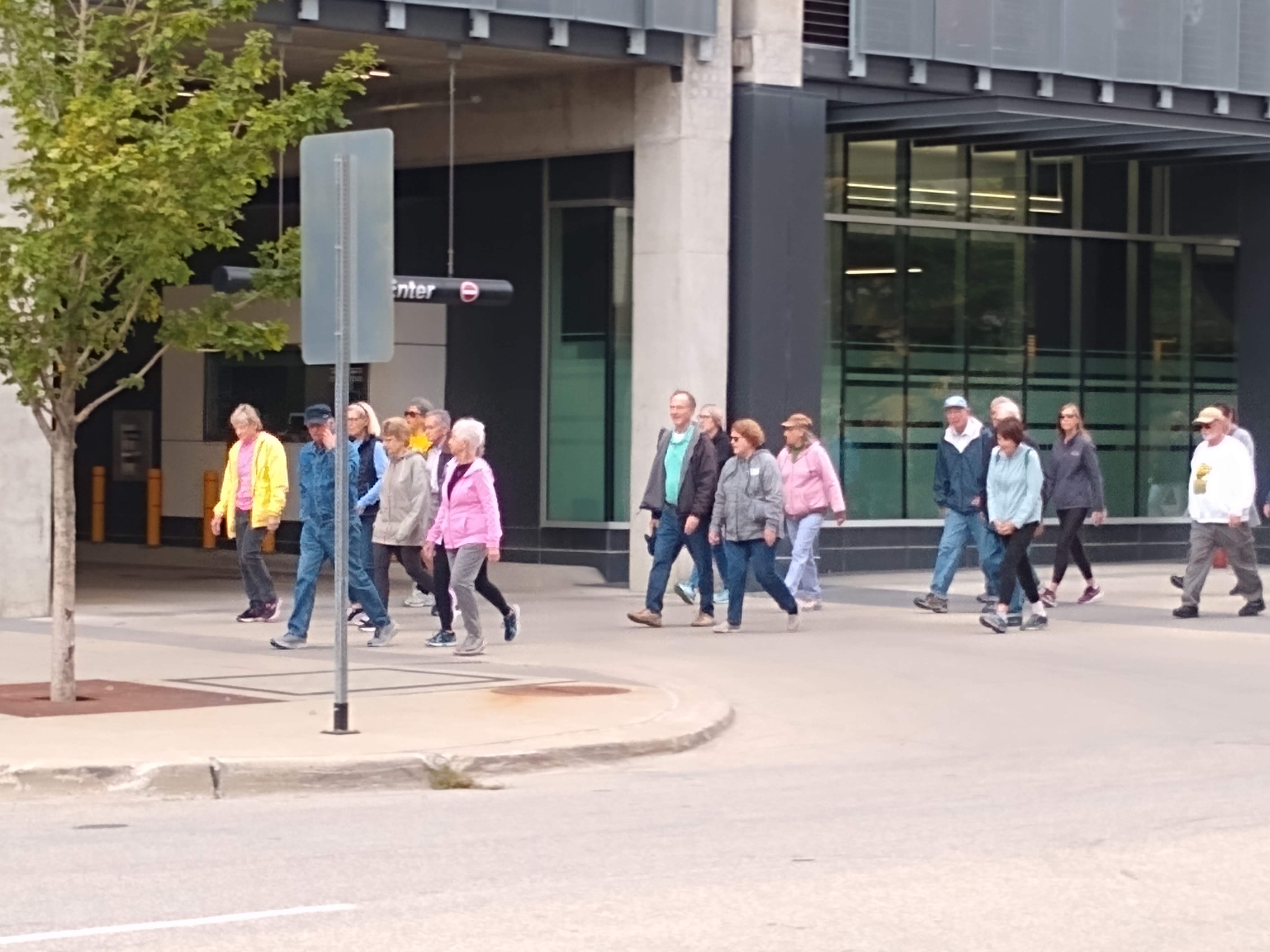
The Healthiest State Walk, which occurred in most counties across Iowa today, happened at noon here. The weather forecast had been favorable until this morning, when off-and-on showers were suddenly threatened. All was well over the noon hour, however. A group of over 100 undeterred people met at City Hall, and walked by a circuitous route to Greene Square. (Greene Square is four blocks from City Hall, but our route along the river and back up the Cedar River Trail was maybe a mile.) 
people walking in front of office building windows

We were rewarded with lunch from Jimmy John's, sponsored by AARP. 
people in park lined up at tent

Celebrity sightings included 3rd district Council representative Dale Todd...
Man and woman talking in park

...and City Manager Jeff Pomeranz.
people talking and eating in front of sculpture in park

I didn't see the mayor. There were no speeches, probably to the relief of all. Just a walk and lunch, over a mid-week lunch hour.

Friday, October 7

Thursday and Friday the city showed off its buses, including the 380 Express to Iowa City.
two buses parked on street

I was grateful for the opportunity to try the bike rack on the front of the bus, which seems like it would come in handy on occasion. I had visions of me struggling to get the bike on the bus, while the driver and untold numbers of working men and women looked on with increasing impatience, and so I've never tried it. Turns out it's as easy as 1-2-3, with instructions printed right on the device!
bike rack on front of bus
1. Squeeze the lever to release the bike rack

bicycle wheel and locking mechanism
2. Heft the bike onto the rack with the front wheel in the yellow thingy

bicycle on rack in front of bus
3. Raise the yellow thingy to latch the bike into place

I tried it myself, and did the whole operation in 20 seconds. Have I tried it for real yet? No, but I'm ready when the time comes. The latch was plenty big enough to work for this fat tired e-bike...
fat tire bicycle on rack
...though a bike that is that heavy may not be as secure on bumpy roads?

Irregular bus travelers will want to be aware that the city bus has resumed charging fares for the first time since before the pandemic. Single rides are at $1, down from $1.50 in the before-times, and day passes are $2 down from $3.
bus pass with text

Getting around Cedar Rapids remains a largely car-centric endeavor, but it's nice that the city takes time to promote cycling, walking, and the bus. Particularly downtown, with developments like First and First West and the Annex on the Square (formerly the Banjo Block) coming online, offers the prospect of walkable urbanism.

SEE ALSO: "The Future of Downtown Cedar Rapids," 24 June 2022

Justice in the World Today (II)

Rising rents are just one obstacle to opportunity today (Source: Joint Center for Housing Studies of Harvard University ) Some time ago, Fir...