Cedar Rapids Parks and Recreation's Rollin' Recmobile started its week of fun this morning at Redmond Park in the Wellington Heights neighborhood. The Recmobile van was there at 9:30, and staff had unloaded various balls, an inflatable play area...
Monday, June 28, 2021
Rollin' Recmobile brings the fun
Saturday, June 19, 2021
The crisis of authority and our common life
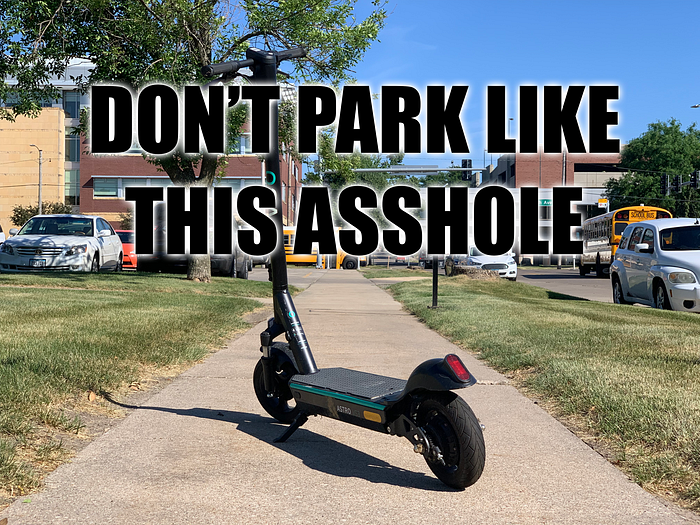
What does this...
![]() |
| Scooter on sidewalk in Iowa |
...have to do with this?
![]() |
| National Guard going apeshit in Oregon |
This week, Corridor Urbanism co-founder Ben Kaplan published a blog post about the local controversy over motorized scooters. It's a good piece, which explains the conflicting and complementary interests involved, while gently calling out both those who heedlessly ride-and-dump their scooters and those motorists who claim an absolute right to unobstructed driving. We can accommodate the different interests, Ben argues, and become "a city of quiet streets, with strong local businesses, where we invest in our neighborhoods, and create locally."
I think we can recognize that there have been issues with the scooters, most of which is the bad behavior of a minority of scooter users, and a lack of cultural norms surrounding how they’re supposed to be used, while also realizing that the scooters can be a huge asset to our community.... We can learn, as a community, to park them properly, ride them in the bike lanes, and signal our turns. We can build rules and a culture around scooting that make scooting less annoying. We can build more bike lanes, so scooting is safer and more practical. We can scoot boldly into a brighter future, carried by the soft hum of an electric motor.
Ben sees the main obstacle to this happy resolution being cultural resistance to change, which is hard to argue with. We live in a state where bike lanes were weird just ten years ago, where demand for COVID-19 vaccines is so low we decline the vaccine shipments, and where passenger rail is a sign of creeping Eurocommunism. But beyond that, I worry about how "we can learn, as a community," to do anything. "How can I," asked the Ethiopian eunuch in Acts 8:31, "unless someone guides me?"
Who is going to guide that boy away from scootering on the sidewalk, or tell that driver not to be aggressive in pedestrian areas (or the dog-walker to leash and pick up after their dog, or would-be DJs to turn down the music, or explosives enthusiasts to cool off the nightly fireworks, or...)?
Americans' obsession with individualism makes me skeptical that we're amenable to being guided towards norms. "If somebody had the swine flu right now, I would have them cough on me," bleated radio provocateur Glenn Beck in 2009. "I would do the exact opposite of what the homeland security says" (McNeil 2009). Republicans were then a third less likely than Democrats to say they would get the vaccine, and flu deaths by state that year rose with the percentage of Republicans (Kristof 2020, citing Baum 2011). That was eleven years before mask wearing became such a big deal.
It doesn't help that authority in America is in tatters. A new report from Pro Publica finds only ten confirmed cases of police officers being disciplined in several dozen documented incidents of excessive actions against protesters in 2020 (Simon 2021). One officer who punched a protestor six or eight times in six seconds received a written reprimand. Two fired Atlanta officers were subsequently reinstated. Weirdest of all, the National Guard, Minnesota State Patrol, and the Minneapolis Police Department all denied employing the officers who fired paint balls at someone's home.
The State of Iowa, predictably, backs the blue in a way that furthers rather than repairs the cultural rift. You don't build community by threatening people with fines and imprisonment. You build community by building public trust, and by taking accountability for your actions. For a short-term political jones, we and others across our nation have abandoned the tough but necessary work of building communities. In this environment, "the scooter problem" is not just an annoying blot on our day; it's a symptom of our collective inability even to be a community.
Tuesday, June 8, 2021
Summer Reading from Island Press
When Island Press has a sale, I'm interested, especially if they're $5 each, and even if they're e-books. Founded in 1984 as a non-profit publisher focusing on environmental issues, Island has published some fine works on urbanism, including Cities for People by Jan Gehl (2010) and The Regional City by Peter Calthorpe and William Fulton (2001). I think if I had unlimited time, space, and funds, I might buy their whole catalogue!
Reader, I did not buy their whole catalogue, but I picked a few which speak particularly well to our common lives in these times.
Shane Phillips, The Affordable City: Strategies for Putting Housing Within Reach (and Keeping it There) (Island, 2020).
Phillips addresses the shortage of affordable housing in many of America's cities by taking on what we might call Cortright's Paradox: increasing access to shelter in places with access to opportunities threatens the value of existing housing in those places. (For many households, the home they own is their major investment for retirement.)
Such a complicated problem has not yielded a slam-dunk solution, and Phillips does not pretend that it will. His approach is to seek joint gains for current homeowners, future homeowners, current and future renters, landlords, developers, and local governments. Like Matthew Desmond in Evicted [Crown, 2016], he describes a world not of clear saints and sinners, but all kinds of people mostly trying to do their best in uncertainty. A helpful introduction for non-practitioners is provided in the appendix, "Development and Real Estate Economics 101."
Phillips identifies three broad, complimentary interests: supply of places to live, stability of living situations, and subsidy by government to compensate for market failures. Under these goals he offers 40 specific policy proposals, which is a lot. They aren't a single indivisible package, though he urges governments not to adopt them piecemeal, or only to adopt the ones with particular ideological appeal. Whatever policies are pursued should be done with a joint gains strategy. For example, if housing is going to be a secure investment, it must increase in value, which makes it less and less affordable (pp. 63-64). Allowing the supply to rise to meet demand may reduce the valuation of existing homes, but it will also allow property taxes to remain manageable, and while the owner's descendants may not benefit as much from inheriting it, they will likely benefit more from being able to afford to buy their own homes when the time comes.
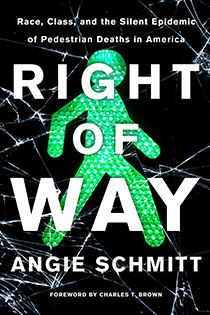
Angie Schmitt, Right of Way: Race, Class and the Silent Epidemic of Pedestrian Deaths in America (Island, 2020).
This was a difficult book to read, not because of the writing, which is excellent, but because of the subject matter. I can't imagine the strength of character it took to write it. Schmitt analyzes the available data and secondary sources on the thousands of pedestrian deaths each year, and comes to the inescapable conclusion that America has been willing to put up with carnage on the streets for the sake of unobstructed driving ("throughput," ch. 6) and auto industry profits (ch. 5).
Other research (chs 1-2) shows that pedestrian deaths are not random, but occur disproportionately in the new cities of the South and Southwest, on stroads where auto speeds are fast and pedestrian infrastructure is poor, and in lower-income and nonwhite neighborhoods. Pedestrian deaths are disproportionately caused by sport utility vehicles which are getting taller and heavier and consequently deadlier. (As I was reading this GMC introduced its new 9000 lb Hummer EV.) Older people and children are the most common victims. The picture this book paints of American materialism and indifference to others is bleak indeed.
She concludes on a hopeful note, that thanks to activism there has been increased awareness of the systemic nature of the problem, and that has led to design improvements in some places: better sidewalks, better street lighting, curb ramps, bus stops in safe places, longer traffic signals, more crosswalks with features to get the attention of drivers (p. 154). But even in New York City, the least car-dependent city in America, it required grieving parents to form Families for Safe Streets to get the government's attention. Making this right is going to be a long process.
Patrick M. Condon, 5 Rules for Tomorrow's Cities: Design in an Age of Urban Migration, Demographic Change, and a Disappearing Middle Class (Island, 2019).
Condon combines positivity (we can do this!) with urgency (we must do this!), in view of climate change and persistent economic and demographic trends. His five rules are:
- following Jane Jacobs, see the city not as a set of isolated problems (e.g. solve parking shortage by building more parking lots) but as an integrated and complex system;
- following Christopher Alexander ("A City is Not a Tree," Architectural Forum, 1965), see the city as a "semi-lattice" series of patterns that fail when all are run through the city center;
- make infrastructure lighter, greener, and smarter, because the principal reason we have such a maintenance backlog is that we've been profligate in building the stuff in the first place;
- use affordable housing design that accounts for the need for financing, social resilience, change over time, and accommodating an aging population; and
- adapt to new economic realities "where stagnant salaries are the norm, secure employment increasingly rare, large student loan obligations common, and elevated housing costs nearly universal" (p. 135).
Steven Higashide, Better Buses, Better Cities: How to Plan, Run, and Win the Fight for Effective Transit (Island, 2019).
- frequent, so that a bus will come within 10 minutes (ch. 2);
- fast and reliable, freed from auto traffic and obligated to make fewer stops, so that you can get to your destination in a reasonable and predictable amount of time (ch. 3);
- walkable/dignified, so you can wait in a shelter, and can get safely from your stop to your destination (ch. 4);
- fair/welcoming payment systems, with special attention to marginalized communities (ch. 5).
| The D6 was our "magic bus" when we lived in DC |
Thursday, May 27, 2021
Corrupting the youth 2021
![]() |
| The Coe Writing Center is your one-stop shop for help with papers (Source: coe.edu; used without permission) |
This fall I will be teaching in Coe's first-year experience program, which provides an introduction to the liberal arts mindset with interdisciplinary courses and a whirlwind of activities. My go-to course in the program is A Sense of Place; it is pursuing this subject matter over the years that led me to urbanism, and that has led me to you. So, yay FYE, even if I do suspect it is trying to kill me with complication.
This year, we will be focusing on third places, mostly by reading the classic The Great Good Place by Ray Oldenburg (Da Capo, [1989] 1999). Along the way, we will do three writing assignments, which I summarize here in the hopes of ginning up some feedback from you, faithful reader.
Paper 1: Reflective Essay
In The Great Good Place, Ray Oldenburg describes a number of qualities of third places, as well as various benefits they provide individuals and communities. You might be thinking that no place could possible combine all of these qualities, and you'd be right. Real-world places at best approach the qualities of ideal-types.
Write an essay about a place you know well that has some of the qualities of a third place as described by Oldenburg. How well do its qualities match the characteristics Oldenburg attributes to third places? In what ways does it differ?
![]() |
| 1271 1st Avenue SE, July 2020 |
Paper 2: Creative-Argumentative Essay
Now that you're familiar with the arguments for third places, turn your mind to a property near campus that served as a third place for many Coe faculty and students from 2000 until it closed in March 2020. What should go into the former Brewed Awakenings, and why?
Use your imagination to consider how this building might be used for a successful business that would be a gathering place for Coe students. Then, make an argument for your idea.
Paper 3: Documented-Argumentative Essay
In the last several years, there have been a large number of projects that attempt to (re)build communities capable of supporting the sorts of third places we've been plugging in this course. This assignment asks you to identify one project that could be adapted to a town you know well.
Browse some of the following sites, and find an example of a project that would benefit your town. (I include links to Project for Public Spaces, Better Block, Human Transit, Reinventing Parking, The Urbanist, The Scenic Route, and Retrofitting Suburbia.)
With the help of the reference librarians, look for additional resources on that project. Then, write a 4-6 page paper, explaining the project, and then how a similar project would help your town.
| Better Block project in Cedar Rapids, spring 2018 (photo by Ben Kaplan) |
These three writing assignments should enable to students to engage with Oldenburg's concept of the third place as well as third place-friendly design projects, and to imagine their application to familiar territory.
Fellow lovers of cities and/or coffee, what do you like about these assignments? More importantly, what do you see as missing that would help newcomers to these ideas?
SEE ALSO:
"My Letter to the First-Years," 12 July 2016
"Out of the Mouths of Babes," 23 April 2019
Sunday, May 16, 2021
CNU diary 2021
Monday, May 17 (Day -2)
The Congress for the New Urbanism conference officially gets underway Wednesday, but I'm all for taking advantage of the two days of workshops and special sessions ahead of the conference proper. Instead of Oklahoma City as originally planned, for the second year in a row we're online. I'm abuzz with curiosity as to how these conferences work in person!
![]() |
| Ashleigh Walton (goarchitect.com) |
The first CNU29 session I attended was "Principles of New Urbanism" at 2:30 p.m. CT, featuring architect-designer Ashleigh Walton with former CNU president Victor Dover. She defined new urbanism as "radical (a reversal of typical development patterns), simple (a look back to the most loved places), practical (real/efficient/scalable/long-term), and for everyone (providing choices at every scale of development, from the metro region down to the single lot)." The goal is to "affect both policy and design" in order to build "places people love," but also places that provide more economic value to cities. She also touched on specific topics like the transect, form-based codes, and missing-middle housing.
- One question was how do urbanists reconcile the increased value they create with the need for affordable housing? Walton said affordability came with choices and supply, which are also concerns of urbanism. To another questioner, she said "the best urbanism tends to not be new" infrastructure, but she cited Charleston SC, Greenville SC, Huntsville AL, and Sewickley Heights PA as towns that are currently pursuing different interesting projects.
- The biggest hurdles to spreading the word are the perception of exclusivity; Dover added the fear of any change because previous changes have been negative. The session served not only an introduction for new attendees, but a rededication for long-time members, like members of a church hearing a creed or familiar scripture.
I also attended "Land Use Planning and Structural Racism: Unpacking the Link," in which Jess Zimbabwe of Environmental Works presented an ingenious "alphabet book" of planning-design indignities that have been inflicted on people of color (B for blockbusting, C for covenants, e.g.).
| Marguerite Yourcenar |
Before all that, however, I visited a Coe colleague's non-CNU webinar on a short story by Marguerite Yourcenar (1903-1987). "A Blue Tale," written in the 1920s but not available in the United States until 1995, describes the voyage of some European merchants to a mysterious island rich in blue gems, which they take, but these gains eventually lead them to bad ends. My colleague, Joyce Janca-Aji, saw the story as "an introduction to non-dualistic thinking," seeking an alternative to commonplace western dualities like mine/yours, human/nature, economic/spiritual that have contributed to the messes in which we now find ourselves. Like Yourcenar's ecofeminism, urbanists seek to recover premodern practices and language that can allow us to make the changes we need to make. "By telling our stories," she concluded, "We may have better outcomes."
Janca-Aji described Yourcenar as "wildly hopeful." I could use some of that wild hope as I mourn my way through books like Jane Mayer's Dark Money (Doubleday, 2016) and Angie Schmitt's Right of Way (Island, 2020)... excellently researched and written books that describe two of our worst western messes. May I find some wild hope this week!
Tuesday, May 18 (Day -1)
OK, here's a thing about online versus on-site conferences: On site--say, in Oklahoma City--you are fully present, even immersed in the place where you are. This morning, a situation came up at work with a difficult colleague, and I found myself chewing on that all day even during the most stimulating of presentations. Were I in "OKC," I might not even have been aware of the problem!
This year's conference is exploring how urbanism can be used to address pressing social problems, like climate change, equity, and the aftermath of the pandemic. At 10:30 CT Elizabeth Plater-Zyberk, co-author of the ur-text Suburban Nation [North Point, 2000], talked about how urbanism might contribute to climate change adaptation. She distinguished "adaptation" from "mitigation," as dealing with the effects of climate change (resilience) as opposed to trying to prevent it (sustainability). For that reason, I've always been morally ambivalent about adaptation, but she showed how urbanism can contribute to its effectiveness. Whether dealing with initial "defense" measures like protecting bridges and buildings, "accommodation" like the Cedar Rapids flood walls (below), or discussing and executing "retreat" scenarios, urbanism can provide the vision as well as specific examples and rules for social organization.
![]() |
| Construction of Cedar Rapids flood wall at 16th Av, summer 2020 |
What about the towns on the receiving end? The next session dealt with "welcoming cities," potentially places like Cleveland and Buffalo that have lost population for decades but might be suddenly attractive to climate refugees. Cleveland has the space, but even there social integration and preventing displacement would be tough.
My last pre-conference session was Steve Mouzon's talk on the characteristics of lovable buildings--not spectacles loved by architects, but "humane building" that would be attractive to people in the neighborhood. It was 90 minutes of information packed into a little more than 30; the two hosts said they'd seen it before, and I will have to see it again, or replay it at half-speed, before anything sticks.
![]() |
| Unlovable?: Mouzon refers to this building style as "ransom note," a term he credits to John Anderson |
Wednesday, May 19 (Day 1)
![]() |
| Deanna Van Buren (from designingjustice.org) |
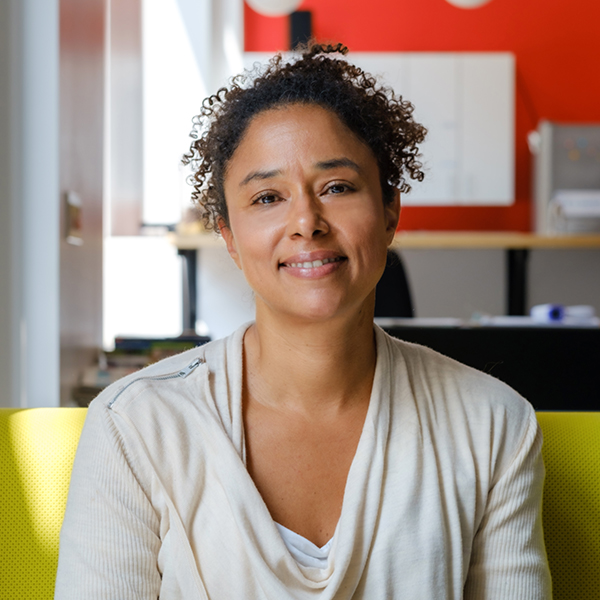
The role of design is "to ignite radical imagination," claimed Deanna Van Buren in the keynote address, "Designing for Justice," late this afternoon. She heads a design school in Oakland whose mission is to "un-build racism" by designing alternatives to incarceration. She began with a priceless audio recording of her grandmother talking about her grandmother, who had been enslaved. Un-building racism begins by recognizing our own internalized views which have been shaped by centuries of displacement and dispossession; then we ask what we value, and how we manifest those values. This has meant engaging with formerly incarcerated men and women, which informed the local site selection and the home-like environment of the New Westside Peacemaking Project in Syracuse, a "peacemaking center" for restorative justice. Then followed Restore Oakland, a more comprehensive campus, including a Pop-Up Village service center. She also has been working in Atlanta to retrofit a closed prison, and in Detroit to refashion the streetscape on Grand River Avenue.
Earlier in the day I attended three panels.
- "Healthy Urban Environments: New Insights from Neuroscience, Psychology, and Mathematics" presented a number of neuroscience, environmental psychology and mathematical perspectives on our issues. All point to human needs both for protection, which we emphasized in the 2020-21 pandemic, and connections, which humans still need and which we still need to facilitate. Biometric research on human reactions to places underscores the need to return to human-scaled design. Panelist Ann Sussman noted people look for people, face-like facades, and something to anchor on like an interesting mural, "so we can 'see' why suburbs aren't walkable."
- "Equitable Development" looked at some specific ways (affordable housing projects, community land trusts, accessory commercial units) developers have tried to be more inclusive; the panel began with a brilliant graphic "timeline of housing segregation" presented by Marianne Cusato.
- "Suburban Remix: Creating Walkable Density in the Suburbs" looked at a suburban retrofit project along Lyndale Avenue in Bloomington, Minnesota, moving from auto-centric design to one that attempts to ride several of the waves of change including desires for walkable centers, changes in retail, changes in how and where we work, and ongoing demographic and economic change.
A number of social opportunities beckoned in the evening, but after choir rehearsal I was doubting my social synapses. Tomorrow, for sure!
Thursday, May 20 (Day 2)
| Veritas Cafe, Cedar Rapids |
Before I returned to the conference this morning, I did some urbanism, meeting my friend John Herbert for coffee at the Veritas Cafe downtown. While we were chatting, two other mutual friends happened through and briefly joined us... very third placy!
John asked me how my experience of the conference is different with it being online. I've never been to an in-person CNU... yet! and it is weird just watching webinar after webinar, though the subject matter is compelling. What about the social side? My preference would be to hover on the edge of conversation groups in bars or wherever, but at online CNU the "pub crawl" consists of a succession of small breakout groups. I was fortunate in my second and third groups to be with the jolly and loquacious Andres Duany, who made a substantive if light-hearted case for zoning reform to legalize family compounds. In the first group, tech magician Matthew Lambert called on me so I gave a bit of my background; in the second I participated naturally in the conversation; and in the third I hung back and enjoyed the repartee. I retired after round three. Also, among the first group was Edward Erfurt, who wrote an article I've taught, but I couldn't remember the subject.
Better or worse than crawling at an actual pub? I probably encountered more people, and they had names attached on Zoom, but probably less substantial conversation and no beer unless I fetched it myself from the fridge. Meanwhile, Internet problems meant people were breaking up more and more as the evening went along, which in real life would only happen if I drank to sodden excess.
The four panels I attended, with varying levels of attention, were:
- (11:45) "Urban Design Update I": salad bar of initiatives, with some websites that might be useful for my first-year seminar
- (1:15) "Zoning for Equitable Development": how form-based zoning and other anti-Euclidean reforms (simplification, compatibility, allowing or requiring renewable energy, local food, landscaping, complete streets, no parking minima, composting and water quality initiatives, ADUs, reduced setbacks, multifamily housing) help to overcome disadvantages created by historic racism. But the in the Q & A someone brought up resistance by black homeowners to zoning reform because it facilitates white/out-of-town landlords buying up properties to subdivide and rent.
- (2:45) "Urban Design in the Universities": 13 academic urbanists talked about what they wish their programs would add or augment, tending towards less aggressive architecture and more attention to context/place
- (4:30) "Pandemic Toolkits at Work": how design is responding or could respond to innovations and changed habits in the last year, without over-correcting for things that have had to pause.
I was glad to start my conference day with some baked goods and coffee at Sykora Bakery in Czech Village. Sykora's is a Cedar Rapids landmark, visited in 1995 by Bill Clinton and Vaclav Havel (along with President Meciar of Slovakia) when they were here to dedicate the new building of the National Czech and Slovak Museum. The building was built for a bar in 1900, and has been a bakery since 1903. While I was there, a mom and son came in after a medical appointment. I took the chance to look at some of the virtual tours on the conference app, starting with Logan Square and Washington Park in the city of my birth, Chicago, Illinois. Logan Square has recently built some affordable housing after undergoing substantial gentrification; Washington Park suffers from under-investment, at least along Garfield Boulevard. Both neighborhoods are rich in art reflecting local heritage, and both offer walkability with at least one dangerous cross of a six-lane street. Then I watched an appealing video about the new urbanist town of Las Catalinas, Costa Rica, from across the street from Sykora in the Kosek Bandstand.
It's interesting to ponder walkability while in Czech Village, which has repurposed older buildings and human scale, but which lost a swath of housing in the 2008 flood. In fact, much of the core of Cedar Rapids has the pre-World War II bones of a walkable area, but it's definitely been hollowed out over the decades. (A 1930s picture of Bethel AME Church south of downtown shows it surrounded by residences; today it is surrounded by empty lots). There has been a lot of building since 2008; I think I could be happy living in one of the apartments over the businesses that have been rehabbed by an energetic woman named Mary Kay McGrath. For the most part, new construction has been heavy on the condos in New Bohemia and Kingston Village. The surrounding residential neighborhoods, like Wellington Heights and Mound View, have older housing, but not much in the way of basic services.
Today's panels:
- 11:45 "The Post-Pandemic City": Andres Duany ran through a variety of innovations that address newer social needs, including portable housing for the unhoused, an elevated city in flood-prone regions, and field urbanism modeled on warehouse districts which seem to attract young people more than traditional urbanism like Czech Village or Galena. Also compounds again. There were some interesting comments in the "chat," and I wish there had been time for discussion.
- 1:00 "STEP Buildings, the Embodiment of Incremental Development": Gracen Johnson unveiled an ingenious game deck of 49 cards, depicting low-cost housing adaptations, in categories like HOUSE HACKS, MAIN STREET MIXED, NEIGHBORHOOD NODE, and COMBO, so developers and advocates could be "strategic within the rules." Eric Kronborg followed with actual plans with examples of those types of incremental development.
- 2:30 "Urban Design Update II": More urbanism salad. I like salad. Possibly the most controversial presentation was that of planner Bob Gibbs, who said that planned urbanist shopping areas were actually failing at a higher rate than indoor shopping malls. That seems counter-intuitive, but I was at one of those urbanist shopping areas in Virginia in 2018, and it was soulless, like somebody's idea of what a downtown should look like, but uniform in age and the retail was more mall than downtown.
SEE ALSO: "CNU Diary," 8-13 June 2020
Tuesday, May 11, 2021
A Brandon Whyte retrospective
| MPO ride 2015: Why is the paint green? |
Brandon Whyte, whose presence as multimodal transportation planner for the Corridor Metropolitan Planning Organization has been large and constant throughout the lifetime of this blog, will be leaving Cedar Rapids for Mountain View, California, for a new job closer to family. "This job gave me purpose," Brandon said of his time in Cedar Rapids. "Serving you all, trying to improve walking and biking in the metro, is literally what I wanted to do with my life since college--since I learned that this profession was even a possibility." He offers hope for the day when the trail system will "become world-class."
By way of a parting salute, Holy Mountain offers this tour through Brandon Whyte's greatest hits--some of them, anyway--where we have crossed paths in the last eight years.
| Bike to Work Week 2014: Early look at New Bohemia development |
| MPO ride 2015: announcing Hoover Trail south of Ely |
| August 2015: protected bike lane demo, led to praise for Brandon on strongtowns.org |
| MPO ride 2016: meet the mountain bike trail at Beverly Park |
| Bike to Work Week 2016: Mayor Corbett prepares to ride to Kickstand |
| Bike to Work Week 2017: Collins pit stop |
| MPO ride 2017: trail crossing at Boyson Road |
| October 2018: support for Tower Terrace Road ped-bike trail |
| August 2018: last leg of Cedar Valley Trail opened! |
| May 2019: bike rental rollout |
| An expanding trails system is Brandon's legacy |
![]() |
| Computer History Museum, Mountain View CA, July 2014 |
Monday, May 3, 2021
Is America a Racist Country? is a Dumb Question
| U.S. Senator Tim Scott (R-SC) |
Senator Tim Scott's response to President Joe Biden's speech to a joint session of Congress last week was most remarkable for its discussion of race. Senator Scott combined personal experience ("I know what it feels like to be pulled over for no reason") with defenses of Republican efforts to change state voting laws ("Republicans support making it easier to vote and harder to cheat" as if none of us was paying attention on January 6). Along the way, he made the statement that "America is not a racist country." The context:
Today, kids again are being taught that the color of their skin defines them, and if they look a certain way, they're an oppressor. From colleges to corporations to our culture, people are making money and gaining power by pretending we haven't made any progress at all, by doubling down on the divisions we've worked so hard to heal. You know this stuff is wrong. Hear me clearly: America is not a racist country. It's backwards to fight discrimination with different types of discrimination. And it's wrong to try to use our painful past to dishonestly shut down debates in the present.
There was a good deal of politics in the Senator's speech, and some reference to ongoing policy debates, but the statement that got the most attention was the one above. Vice President Kamala Harris faced the question the next day on the network TV show "Good Morning America." Her response--Well, first of all, no, I don't think America is a racist country, but we also do have to speak the truth about the history of racism in our country and its existence today--was calculated but hard to beat.
"America is/is not a racist country" is exactly the sort of simplistic formulation that hijacks the "debates" Scott doesn't want shut down. It presumes that there is some clear, binary distinction between all-in racism and all-out equality. We don't get a definition of "racism," or for that matter of "country," so whatever we're talking about is the pictures in our own heads. It's the rhetorical equivalent of blasting the national anthem in the middle of a conversation.
Here's the tricky part: If every single person in America refused with a pure heart ever to judge people by the color of their skin, we would have a serious race problem. Anyway. Still. Because the country we live in is the product of decisions made in its past: the exclusion of blacks from 1930s federal housing programs, the destruction of walkable black neighborhoods in the 1950s interstate highway program, the persistence of discrimination in employment, education, and public accommodations into my lifetime. Of course, much of this is over. Of course, de jure discrimination has long been illegal. But those long-ago actions led to outcomes that reinforced centuries-old differences between the black and white experiences in America. Without redress or reparation, those disparate outcomes replicate themselves today, producing something that looks a lot like racism.
We should be talking about how we deal with that--and to their credit, a lot of people are--not arguing over phony definitional binaries.
SEE ALSO:
Rashawn Ray, "Is the United States a Racist Country?" How We Rise (Brookings), 4 May 2021
Pete Saunders, "Racist Impact, If Not Intent, Is Built Into the American DNA," Corner Side Yard, 9 May 2021
Cherokee Trail update
You can get there from here! The Cherokee Trail, which eventually will run all across the west side of Cedar Rapids, is complete between ...