Friday, August 21, 2020

Options for the future

Picture
After the derecho, can we choose how to recover?

What kind of communities will we rebuild, when we rebuild them? As summer turns into fall, Americans continue to live in "interesting times," with the coronavirus running unabated, the economy staggering, and the President and his allies adding to the chaos. In my region, we're digging slowly out of the wreckage brought by an incredible derecho storm on Monday, August 10. At some point, however, the storms will have passed, and we will turn to the tasks of reconstructing our social order. We could try to put everything back the way it was before March 2020, but even if it were a good idea replication is probably impossible. So what should our goal(s) be?

Painting
"Market Day" by Nancy Maybin Ferguson depicts 1910s Provincetown RI

New York Times columnist Jane Brody (2020) recommends what we might call the social city, inspired by her re-reading of Consequential Strangers: The Power of People Who Don't Seem to Matter--But Really Do by Melinda Blau and Karen L. Fingerman [W.W. Norton, 2010]. Fingerman told Brody that the "basic human need" of belonging is based on multiple casual encounters every day, what the authors call "weak ties." Brody agrees:

In my country house, especially during the dark, cold days of early spring, I would have been far more isolated. Yes, I could walk my dog and ride my bike without having to wear a mask because I would have met almost no one else on route. But I would also have been deprived of conversations with the many 'consequential strangers' I encountered daily during my outdoor excursions in Brooklyn, including the 7 p.m. 'shout-out' in support of our essential workers.

City design and policies for development have consequences for social encounters. "In their book," further notes Brody, "Ms. Blau and Dr. Fingerman emphasize the importance of creating and being in environments that foster relationships with consequential strangers." This will resonate with advocates of walkable cities and third places, which foster those encounters in ways that car-dependent suburbia and enclaves do not. 

Picture
Metro area bike trails are an attractive amenity

Bloggers for the Brookings Institution report on the Global Cities Initiative, which advises cities on finding their places in the global economy (Clark et al. 2020). The economic city, like any business, needs to identify and communicate its identity--not the same as a brand, being the reality on which a successful brand is based--to current and potential residents, employers, customers, and investors. "Cities that convey distinctive and differentiating character based on a coherent, genuine identity," they write, "are more competitive and gain new opportunities--once the world knows their story." The GCI lists seven sequential tasks in this process, with the key step being #5, where "a metro area must undertake an iterative process to translate values and assets into a narrative that resonates with internal and external audiences." This can inform the recovery process: What are the aspects of our area's identity the enhancement of which we should prioritize?

In an August 9 interview with Cedar Rapids Municipal Band director (and Coe College professor) Steve Shanley, Brad Hart, mayor of Cedar Rapids, stressed the town's combination of urban amenities (esp. performing arts, trails system), low cost of living, and easy commuting, all of which also inform our longtime slogan, the City of Five Seasons. Is that our global identity? How can our recovery improve these qualities? And who benefits from highlighting these particular qualities?


picture
Czech Village Levee two-fer! Bike/walk trail on flood wall. 
 

In April the National Public Radio show On Point hosted a discussion of the qualities of a healing city; in the words of host Meghna Chakrabarti, "reimagining cities as places for better human health." Ken Greenberg, a Toronto-based urban planner and guest on the show, began by noting how the suburban model of development since World War II gave more space to automobiles at the expense of places to walk (or cycle)--along with more mechanical buildings sealed for climate control. He believes that the pandemic-inspired shift in the use of urban space back to non-vehicular activity will be to some degree permanent, with benefits for human health. Allowing for natural airflow is "not only a mitigation strategy, but will reconnect us to the climate around us," but that requires different kinds of design that are suited to specific local climates. Architect Michael Murphy pointed out that buildings were all built that way before technology made air conditioned boxes possible. The guests also talked about climate change and socio-economic inequities. In an online blog "diary," Greenberg suggests that various design changes can be integrated in ways that promote the health and well being of all:

Putting together all these pieces — laneways, street redesign, ravines, hydro corridors, rail lines, stormwater management systems, flood-proofing plans, and transportation initiatives, a vastly expanded public realm can emerge, one that addresses many of the city’s current deficiencies. This new realm will be different, both in scale and kind. Rather than discrete public spaces carved out of a grid of street blocks — parks and squares — this new kind of public space has the potential to become the fully continuous, connective tissue of the urban fabric itself.

 The entire city can become more park-like, green, and connected for people on foot and on bicycle. Fostering residents’ ability to move around relatively freely and experience more of the city this way will help to break down the perceived barriers between neighbourhoods and districts as flows become more continuous. The elements of the public realm that serve as links between areas will play a vital role in helping to make the city feel like a seamless whole (Greenberg 2020).

What if we made improvement of human well being, particularly that of the most vulnerable citizens, a goal of future city development and design?

Picture
Washington High School Step Team: Does creative activity lead to better thinking?


Another value worth pursuing is creativity, commended to cities by Richard Florida (The Rise of the Creative Class--and How It Is Transforming Leisure, Community and Everyday Life [Basic, 2002]) and Charles Landry (The Creative City: A Toolkit for Urban Innovators [Earthscan, 2nd ed, 2008]). A creative city is one where "fresh thinking" is brought to bear on community problems (p. 49). This involves thinking about the community as an integrated organism, not a series of unconnected processes where getting the right outputs is merely a matter of expertly identifying the right inputs.

The technical skills of an engineer or physical planner will remain essential, but to solve most urban problems they will need to be integrated with other skills, especially in the human and social sciences. Knowledge of history, anthropology, cultures, psychology has been lost in urban affairs. A traffic or zoning issue is never only about cars or land use. If transport planners had had a better understanding of psychology or culture or of the ideas of mental geography, they would have been more careful about building urban motorways with routes that scorch their ways through communities. The crime and social problems that ensue are then picked up by others who try to re-create some coherence for inhabitants (pp. 54-55).

This is about more than art, music, theater and dance. Yet "[b]ringing an artist into urban regeneration" can unleash "a new kind of creativity," as in Batley, England, where arts festivals helped changed "local self-respect, social cohesion and liveliness" in a way that facilitated improved living conditions (p. 147). So cities can learn from each other, while avoiding the same old stuff like corporate subsidies, subdivisions in cornfields, and "game-changer" tourist attractions.

This requires first breaking down decades of practice seeing problems narrowly: my street, my parking place, my experience of traffic congestion or ambient noise. Only then can planners and citizens "research and map with a greater chance of uniqueness and specialness of a place (emphasis mine) rather than merely seeing a partial picture of problems and opportunities.... It provides a constructive working environment with people more involved and responsible connecting with a wider network of organizations and residents. It thus makes a city more competitive" (p. 71). 

Landry draw on a wide range of literature on cities and the creative process, provides a host of examples (in gray boxes), and has advice for cities in a variety of situations. Most of his book is designed to be consulted rather than read. His list of preconditions for creative urban policy (ch. 5) is long but useful. It includes: a mix of outsiders bringing fresh eyes and insiders with institutional memory; a cultural willingness to "break rules" and even to fail; a sense of local identity; and public space that facilitates exchange. "The idea of the public realm is bound up with ideas of discovery, or expanding one's horizons, of the unknown, of surprise, of experiment and of adventure" (p. 119). Practicing the creative arts can help everyone re-see the places where they live.

820484

What shall be our animating value in rebuilding/recovery? I don't want to pick just one, as we at the Holy Mountain blog are not about reductionism, and certainly not into reductionism-ism. But note that the features of the social city are cited as prerequisites for both the healing city (Greenberg 2020) and the cultural city (Landry 2008: 119). If we subject every plan to the question "How does this help people mix?" instead of "Where are the cars going to park?" we'll be taking a giant step towards communities that are healthier, more equitable, more creative, and more resilient. And as someone said--please help me remember who!--if you build a place where people want to live, you'll have built a place where people want to visit, invest, run businesses, and such.

SEE ALSO: Richard Florida and Michael Seman, "Lost Art: Measuring COVID-19's Devastating Impact on America's Creative Economy," Brookings, 11 August 2020

Tuesday, August 4, 2020

Making sense of the city budget


The good people at Asheville-based Urban 3 have produced an amusing, accessible video showing Josh McCarty and Maxine Eng walking through their city's budget. They make a number of points, including (Strong Towns 2020):
  1. Pick your city and do an Internet search for the most recent version of your municipal budget. Cedar Rapids is working from the fiscal year 2021 budget, which comes in two parts. The most recent year for which actual numbers have been compiled is 2019. Alas, unlike Asheville, the first thing that comes up on an Internet search for "Cedar Rapids budget" is, indeed, Budget Rent-a-Car.
  2. Open an Excel spreadsheet and get ready to scroll through the document until you see some charts. The spreadsheet is for note-taking, really, enabling you to find numbers from all over the document and place them together. For example, the budget for the police department is at volume I, page 102; that for street improvements is at volume II, page 202; and that for debt service is at I, 55.
  3. Start noting the many different pots of money feeding your government. Cedar Rapids has a general fund, which draws on property taxes (22%), charges for services (30%), intergovernmental revenue (13%), and a variety of smaller sources like the local option sales tax (2%) and the hotel motel tax (<1%) (I, 60, 62). There is also an enterprise fund (dedicated revenue from water bills, golf fees, the Doubletree Hotel, e.g.), a capital fund (large one-time projects, see #10 below), and slightly smaller funds called special revenue and internal service. So, the general fund amounted to $147,598,125 in fiscal year 2019 (I, 97), but the total amount the city spent was $522,091,049 (I, 60).
  4. Start tracking the relationship between income and expenses. 
  5. Watch out for things like "interfund transfers" and debt. Over $180 million of city revenue was attributed to "transfers in" (I, 60). "The special revenue, internal service, and capital project budgets are balanced with current revenues or use existing cash on hand from past fiscal years to fund expenditures due to planned expenditures or the timing of expenditures," explains an explanatory note. "The use of fund balance or transfers in is decided by Departments and/or the Finance Department based on needs and availability. The Finance Department confirms if funds can be transferred or used given the circumstance of the expense and original source of the funds" (I, 71-72).
  6. Pay attention to the planned vs. actual budget. I don't see that much difference between actual 2019 and planned 2021, but it's nice to know that the numbers you're looking at are based on experience not aspiration.
  7. As you look through, note different types of revenue that might be vulnerable to economic shocks, like the pandemic. Actually very little of Cedar Rapids's budget relies on sales tax or its equivalents--see #3 above--although in a tight budget every cut hurts.
  8. Because there are multiple local governments in any place, comparing expenditures on, say, police vs. mental health vs. schools requires looking at school district and county budgets as well as the city's. The school district's budget amounts to $282,329,202 (p. 10), almost half of the city's and, presuming all that goes for K-12 education, vastly larger than any specific city budget item. Looking strictly at the City of Cedar Rapids, police spending is $38,475,488, 31 percent of the general fund, but only 7.4 percent of total spending (I, 102). Spending on street repair beats police at $42,413,827--we have a lot of streets in Cedar Rapids--but it comes out of the capital fund, not the general fund, so it shows up on a different pie chart (II, 202). We spent more on streets and less on parks than Asheville does.
  9. Debt service and debt limits: Iowa allows cities to borrow up to 5 percent of the total assessed property valuation... North Carolina allows up to 9 percent! Cedar Rapids paid $61,968,015 on its debt in 2019 (I,55), 11.9 percent of total spending, more than on police and fire combined.
  10. Capital improvement plans: Cedar Rapids has one, too, detailed on pages 210-271 of Volume I of the budget. The five-year spending plan is for $865.8 million; the largest two categories are flood control ($249.6 million) and street improvements ($173.4 million) (I, 211). Funding sources include bonds and "other debt" (44%), grants (20%), and the local option sales tax (11%); the remaining categories are vague (I, 212). Specific projects are listed beginning on p. 214 with widening Collins Road, extending Tower Terrace Road, and punching through 6th Street from B Avenue to Ellis Boulevard NW. 
I learned a lot, but I found it difficult going, even with a high personal feeling of competence in this area. So be warned, and there is no way I would assign students to do this, which is too bad, because budgets are where the reality lives.

The Urban3 video:


Friday, July 31, 2020

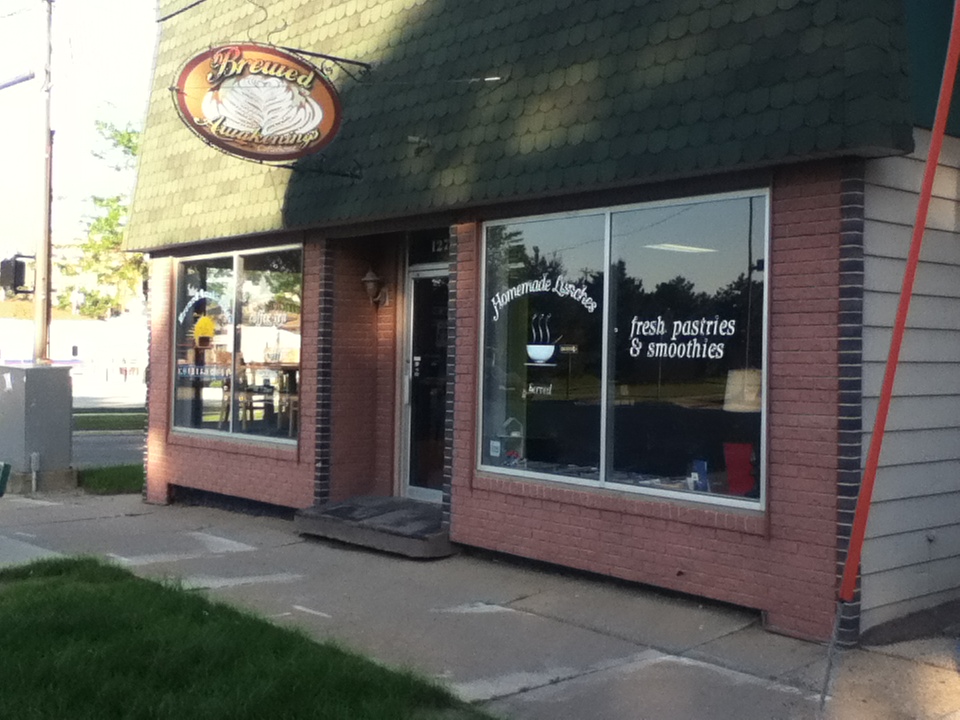
What should go into Brewed Awakenings?


Brewed Awakenings Coffeehouse, 2013
Brewed Awakenings in 2013

(7/31/2020) In March, two weeks after the closure of the Early Bird downtown, Cedar Rapids lost another of its great homegrown coffee houses, Brewed Awakenings, across from Coe College at 1271 1st Avenue SE. It appeared to be a temporary, COVID-related shutdown, but it never re-opened; in June, 'FOR SALE' signs appeared, then disappeared, and in July I happened upon some people collecting some effects they'd won at an auction no one I knew had heard about. The Early Bird ended with a party; Brewed Awakenings just slipped away in the night.

July 2020

Brewed Awakenings Coffeehouse nearly made it to 20, an impressive run for a small business that testifies to the devotion of its devotees. It was founded in 2000 by Deb Witte, who also started Wit's End in Marion; for maybe 10 or 12 years Brewed was owned by the Marsceau family until it was sold to Larry and Junetta Janda. "When I'm at Coe and feel the need to get out of the office for a cup of coffee, the choice is obvious," I effused in an early post on this blog. "Brewed Awakenings Coffeehouse is just across 1st Avenue and offers an impressive selection of coffee as well as a nice atmosphere." I occasionally performed here, back when they had live music, I frequently met here with the Political Science Club, and at various times it employed both of my sons and many of my students.

The building that formerly housed Brewed Awakenings is located at the intersection of 1st Avenue and 13th Street SE. Built in 1920, it is ideally constructed for a walkable neighborhood, with its front door opening directly onto the sidewalk and windows facing the street. The neighborhood is in fact nominally walkable, with a Walk Score of 77 and a Bike Score of 60. Census tract 19, in which it is located, is one of the most densely-populated in the city, and the shop is mere blocks from the two densest tracts. But except for Coe College, across 1st Avenue, a two block radius around the building has hardly any residences, and a few businesses with relatively small numbers of employees or customers, so there's not much actual walking around there. There is a lot of driving: 1st Avenue is also Business US 151 and Iowa 922, and carries about 21,000 cars a day; 13th Street is one-way north, and carries 1,950 cars per day. 

It's an 1,800-square foot building on an 8,400-square foot lot that also contains one other building that's been sporadically occupied over the years.
Vacant building at 111 13th St SE

There is some on-street parking, and a small lot accessible from 13th Street. That's a smaller footprint than the chain fast food restaurants in the area seem to need. Expansion is unlikely: to the west are two apartment buildings recently bought by Coe College, and the building across the alley to the south is home to a medical residency program. If the small parking lot between Brewed and the apartments was punched through to 1st Avenue it could conceivably be used for drive-through traffic, but that's probably a stretch.
Parking lot and potential 1st Avenue access

So the options for the corner are limited: possibly an office or another college apartment, but probably a small shop, like Brewed Awakenings or the cut-rate pizza place that was there before 2000. (Worst case scenario is someone buys it for a parking lot. Don't do it, Coe!) In contrast to 2000, any new coffeehouse would face competition: there are now two national chain coffee places in the area, and a building currently under construction is likely to be a third.
National coffee chain coming here?

Whatever goes into the Brewed space might well take advantage of the proximity to Coe College's faculty and students--in its last years, Brewed Awakenings closed at 4:30 p.m., which still seems unbelievable with all those students in search of an evening hangout--but be prepared for the four months each year when Coe is out of session.

The city might get involved in development, though I hope they won't--except to make 13th Street two-way! College Commons, a tax-incentivized mixed-use development up 1st Avenue from Coe (see Kaplan 2018 for an early reaction), crushes the surrounding properties in terms of value per acre, mainly from its two floors of apartments. But the apartments sit atop four franchise chains (Clean Laundry, H & R Block, Jimmy John's, and Scooter's Coffee), who have their main accesses to the rear parking lot not the sidewalk in front of the building. We can't beat College Commons financially, but can do better in other ways.

An older, smaller, well-worn building like the one that housed Brewed Awakenings can nurture a locally-owned small business, and depending on the occupant can help the area's walkability and, perhaps most importantly, provide a third place for the community. Ray Oldenburg's classic text, The Great Good Place, named for this short story by Henry James, makes the case for valuing places where people can be social, even across boundaries.
The first and most important function of third places is that of uniting the neighborhood.... Places such as these, which serve virtually everybody, soon create an environment in which everybody knows just about everybody. In most cases, it cannot be said that everyone, or even a majority will like everybody else. It is, however, important to know everyone, to know how they variously add to and subtract from the general welfare; to know what they can contribute in the face of various problems or crises, and to learn to be at ease with everyone in the neighborhood irrespective of how one feels about them. A third place is a "mixer." (Oldenburg 1999: xvii-xviii)

A place that could bring together and "delight and sustain" (1999: 43) college students, MedQuarter workers, gentrifiers, and long-time residents--"virtually everybody"--would be a boon to all.
The habit of association comes easier in the city, but it does [not?] come automatically. Affiliations stemming from family membership and employment are not, of themselves, adequate to either community or grass-roots democracy. There must be places in which people can find and sort one another out across the barriers of social difference. There must be places akin to the colonial tavern visited by Alexander Hamilton, which offered, as he later recorded, "a general social solvent with a very mixed company of different nations and religions." (1999: 74, citing Carl Bridenbaugh and Jesse Bridenbaugh, Rebels and Gentlemen [New York: Oxford University Press, 1962], 21)
Except probably not a bar, that close to a college campus, for it is likely to take on the personality of the "horde of barbaric college students" (1999: 30) that are drawn to bars. Maybe a place where you can "have a cold one with the neighbors" (1999: xxiii) that also features live music, or artistic displays, or late-night breakfasts? Oldenburg's follow-up book, Celebrating the Third Place [Marlowe, 2001], describes an astonishingly wide variety of American third places. May the corner of 1st and 13th be the next!

Ray Oldenburg, The Great Good Place: Cafes, Coffee Shops, Bookstores, Bars, Hair Salons and Other Hangouts at the Heart of a Community (Da Capo, 2nd ed, 1999)

Appendix:

NAME

ADDRESS

LAND VALUE

IMPROVE-MENT VALUE

TOTAL TAX VALUE

ACRES

VALUE PER ACRE

TAXES ESTI-MATE

Brewed & vacant bldg

111 13th St SE

100,800

147,400

248,200

0.193

1,286,010

9,328

Via Sofia’s

1119 1st Av SE

100,800

297,700

398,500

0.193

2,064,767

14,977

Wendy’s

1314 1st Av NE

336,000

1,037,900

1,424,100

0.771

1,847,082

49,996

Irene’s Bar + apt

1323 1st Av SE

126,000

258,000

384,000

0.289

1,328,720

13,118

Arby’s

1417 1st Av SE

151,200

503,000

654,200

0.386

1,694,819

22,967

College Commons + apt

1420 1st Av NE

342,700

403,900

3,301,000

0.874

3,776,888

98,747

McDonalds

1530 1st Av NE

420,000

909,000

1,329,000

1.200

1,107,500

46,658


Friday, July 24, 2020

Portland: authoritarianism, or nothing to see here?

Good urbanism

Bad urbanism


Federal agents firing tear gas
Obscenely terrible urbanism

If you've followed this blog for any length of time, you know that your humble blogger is no fan of President Donald J. Trump. Putting aside policy disagreements (probably inevitable anyway), his historic levels of incompetence and corruption (beyond the scope here), and his innumerable malicious statements, Trump's greatest harms have been actions that directly attack the idea of inclusive common life. The most egregious, in my view (in chronological order):
  1. maltreatment of refugees, extending to imprisonment and family separation;
  2. encouraging armed assaults on state capitals;
  3. deporting COVID-infected immigrants to vulnerable countries;
  4. teargassing protesters in D.C. so he could hold a photo op; and
  5. assaulting protesters in Portland.
In each case, the chief of state has forsaken America's image as the shining city on the hill, our ability to draw strength from the rule of law, and any notion of a common future. What's left is abuse of power to hurt people who have affronted him and/or to gain attention and the approval of his political base.

(Even more alarming: In none of these cases did Trump act alone, or really act at all. Actual policy implementation was done by other government employees, and in some cases private citizens, with the complicity of Trump's allies in Congress. This is about more than just one man, even if that man is the President of the United States, and that should be really scary.)

Last week, as Americans struggled with the twin blows of pandemic and unemployment, came Trump's latest atrocity: the unleashing of federal forces on protesters in Portland, Oregon. Without warning, identification, or any consultation with state or local officials, federal agents snatched people off the streets, teargassed a group of women calling themselves the Wall of Moms, beat up a Navy veteran who remonstrated with them, and when the Mayor of Portland appeared on the scene, teargassed him, too

(Apparently we love our veterans, but only when they're culturally useful.)

The justification, when it came at last this week, was so unconvincing as to be insulting. Reacting to criticism as "smear attacks," Acting Homeland Security Chad Wolf said "If you did your job from a local perspective, we wouldn't be there" (Bernstein 2020). Presidential press secretary Kayleigh McEnany said the agents "don't identify themselves to crowds because it would put them at great risk" (Blake 2020). Reports from people who were actually there gave the lie to these attempted rationalizations anyhow. A letter-writer to the The New York Times stated:
I live in Portland, Ore. I am 68 years old, a retired psychologist, a mildly left-of-center boomer. I want to report that Portland is not at all convulsed by a "violent mob" of anarchists, as the acting homeland security secretary, Chad F. Wolf, claims, or anything close.
A small number of protesters, generally far fewer than 100, gather each evening to protest peacefully. A few wrongheaded individuals paint graffiti or throw rocks, and that is certainly not OK. But two blocks away, in any direction, things are completely normal. In fact, I had not watched the news for a few days, and I thought the protests had stopped. (Tilson 2020
Times columnist Nicholas Kristof added on Twitter:
In Portland when you're actually on the ground, you see a huge range of protesters. The majority are peaceful, e.g. moms linking arms. Yes, a minority are violent e.g. throwing water bottles. But the greatest violence, injury and escalation comes from Trump's federal troops.
No one in Portland city government or Oregon state government is backing up the Trump administration's pretext. Trump, meanwhile, threatened to set his agents on Chicago next, or perhaps Albuquerque: "We're looking at New York. All run by very liberal Democrats. All run, really, by the radical left." 

One thing you can say about Trump: He never tries very hard to hide his political pretexts. Trump to FOX News regarding the mayor: "They knocked the hell out of him. That was the end of him" (Kristof 2020a). How do you expect him to stick to the false story when he's got some violence to brag about?

As upset as I am by this latest atrocity, the response from leading Democrats has me doubting myself. Because there hasn't been much response to speak of, apart from Oregon members of Congress like Rep. Earl Blumenauer, and Senators Jeff Merkeley and Ron Wyden. As a professor teaching (mostly) American politics, I get myself on a lot of national politics mailing lists, but a scan of my current in-box shows only Senator Bernie Sanders criticizing the mess in Portland. Other Democratic e-mails are asking for contributions (7), promoting virtual events (5), polling our preferences on the vice-presidential choice (1), and celebrating the birthday of former President Obama (1). Two e-mails address the economy, and two the environment, with one each on voting-by-mail, justice writ large, and opposition ethics. All are worthy issues, but nothing on Portland?? Then why am I bothering to get so upset???

This too is disturbing, because even more than any policy differences, the biggest reason to vote Democratic at every level this fall is the attacks by Trump and his Republican allies on our national community (that already was flawed and fragile). Only by committing ourselves to that community can we as Americans address our problems--international as well as domestic--from a position of strength. Only strong political leadership backed by public opinion can restore the moral compass of immigration and homeland security officials. But the issue must be joined.

SEE ALSO
Kriston Capps, "How Trump Justifies a Surge of Police in Cities," City Lab, 22 July 2020
Umair Haque, "Do Americans Get That Trump is Instituting Martial Law," Eudaimonia & Co., 23 July 2020
Marilyn J. Mosby and Larry Krasner, "Mr. President, Stay Out of Our Cities," Washington Post, 23 July 2020

Thursday, July 23, 2020

What should be in the next CARES Act?

Some bars and restaurants have remained takeout-only,
despite the Iowa government's laissez-faire attitude towards the pandemic

None too soon, the U.S. Senate is taking up renewal of the CARES Act this week. Emergency relief for individuals, businesses, state and local governments, and hospitals was passed in March as the reality of the coronavirus pandemic hit America. (See highlights and details here and here.) It's hard to remember March, but it seemed then that the pandemic's unusual virulence required a drastic social shutdown, and that to keep the economy from tanking during the emergency. Paul Krugman compared the response to a "medically-induced coma" to create space for dealing with the virus. To get the patient (all of us!) through, the CARES Act pumped $2 trillion into the economy, and additional legislation added about another half trillion (Amadeo 2020). That's a lot of money... I can remember when one of President Jimmy Carter's budgets in the late 1970s was the first to pass the half trillion mark for the entire year!

Now we're heading into late July. Partial reopenings in May and June brought some flickers of economic life, but only somewhat, and the pandemic continues. Retail sales are back to pre-pandemic levels, but not across the board and unemployment remains high (Maheshwari, Corkery and Schwartz 2020; Rosenberg 2020). "I'm less optimistic today than I was 30 days ago," Marriott chief executive Arne Sorenson told The New York Times. "The virus is in so many different markets of the United States" (Gelles 2020). So, now what do we do?

The coffeehouse across the street from my campus closed March 20,
and now folks are carrying off the pieces.
(It might have gone out of business anyway.)

House Democrats passed a $3 trillion extension to the CARES Act in May called the Heroes Act, extending unemployment benefits at current levels, issuing another round of stimulus checks, providing much more aid (about $1 trillion) to states and cities, and including money for hazard pay for essential worker, testing and tracing, student loan forgiveness, food stamps, housing support, the U.S. Postal Service, and an employee retention tax credit (Werner 2020). Senate Republicans are negotiating this week with President Trump on a roughly $1 trillion alternative likely to include, liability protections for businesses, another round of stimulus checks, school aid conditioned on opening in person, much less aid to states and cities, extended unemployment benefits at a lower level, tax credits to businesses for adaptive measures as well as employee retention, and quite possibly no money at all for additional testing. Trump's desire for a payroll tax cut now seems unlikely to be included (Werner, Kim and Stein 2020; Carney 2020; Pethokoukis 2020). Among other proposals, Democratic Senator and former presidential candidate Elizabeth Warren has suggested support for child care providers, and Black and Latino neighborhoods, along with a national eviction moratorium and anti-corruption provisions (Warren 2020).

What happens to rental housing if renters can't pay?

Back in the day, I worked with Paul J. Quirk of the University of British Columbia on research on the Presidency and Congress using theories of conflict resolution. Paul argued that policy makers ought to maximize joint gains by identifying complementary interests--goals shared by parties to the conflict--and negotiating the remaining conflicting interests. Joint gains solutions are superior to split-the-difference styles of compromise, or to stalemate (Quirk 1989, Pruitt and Warr 2013, Fisher Ury and Patton 2011, Lewicki Barry and Saunders 2020).

Off the top of my head I'd say there are four complementary interests involved in negotiating CARES bills, pretty much the same now as in March:
  1. sustain the economy. The economic health of the country is risked by any shutdown, or even specific restrictions or regulations. Production and sales should be preserved as close to ready-to-go until it's safe actually to go. And, while emergencies call for bold measures, government finances should not be so extended by borrowing that normal operations are impossible once the emergency ends.
  2. protect public health. It should be clear to all by now that this virus is serious business, and neither wishing it away or yelling at people is going to work. Social activities need to be restricted until some modicum of safety is achieved, even at some (a lot of?) economic cost.
  3. enable essential work and schools. Any vital work should be facilitated and, where necessary, protected. This particularly includes, but is not restricted to, those who provide health care, food, and public safety.
  4. protect/sustain the most vulnerable. Not everyone can work from home, or have a reservoir of savings to see them through the emergency. If people's work is essential, they need the rest of us not to endanger their health; and if people are laid off, their jobs should be there when it's safe to return, and they should be sustained until then.
There are also conflicting interests. These include ideological conflicts (does aid create a disincentive to work, and is that bad? should we use aid to shape a more climate-friendly future?), economic interest conflicts (do hog farms, airline companies, e.g. qualify for aid under one or more of the criteria above?), and political conflicts (how will these measures affect candidates' political prospects in November?). Generally, the group that wants a solution more has to give more on conflicting interests. For example, in 1991-92 President George H.W. Bush stood to suffer politically from a poor economy (and he did), so had to accommodate congressional Democratic demands for tax increases. It's more difficult to assess the current situation: President Trump's political standing has suffered since March, but even so Democrats may be more concerned than Republicans about who might get cut off from assistance.

These lists of complementary and conflicting interests are pretty much the same now as they were in March. But the context has dramatically changed. Unlike March when a lot of us were thinking in terms of 3-6 weeks of shutdown, it is now four months on and obvious that the pandemic is going to be with us for quite awhile yet. Policies that were successful in other countries--contract tracing, widespread timely testing, and plenteous personal protective equipment (PPE)--are nearly impossible to implement effectively with the disease so widespread. There have been hopeful noises about vaccine(s) in production, but even under a best-case scenario that remains months away. Demagoguery by a frustrated President and his allies in the media have led many people to reject even the most minimal precautions.

chart showing COVID metrics per day in US
Swiped from diazhub.com. Used without permission.

So it's not now practicable to resume normal economic and social activity, nor is it now practicable to shut the economy and society down for the duration of the pandemic. We've had a half-assed shutdown that's made people poor and still potentially contagious.

America, I am... really disappointed in you.

To the content of the bill! Setting priorities involves making choices, deciding who in these desperate times gets benefits, and who doesn't in spite of hardship. It amounts to "picking winners," about which there is justifiable cultural ambivalence. And yet choose we must, in a world where the invisible hand is infected with coronavirus, and government has resources that are substantial (so it has responsibility to act) but not limitless (so it can't fix everything).

In the immediate crisis in which we found ourselves in March, it probably made sense to think only of getting through it, and to shovel money out the door while making as few choices as possible. It probably had some good effects, but clearly was marred by lack of oversight, and the greater ability of those with power to access the resources, leaving the most vulnerable citizens and businesses in the lurch. 

Now we seem to be in it--the pandemic crisis, I mean--for the long haul, so it behooves us to think more carefully about the choices involved in the next round of aid. Who should receive assistance? There are many people who could claim economic losses from the pandemic and the shutdown. We could put them into three categories:
  • those who, if they were to lose their job, might bring down the whole society (health care workers, teachers, child care, firefighters, public transit at least in major cities e.g.)
  • those who, if they were to lose their job, would have difficulty replacing that income (blue collar and service workers, locally-owned small businesses)
  • those who, if they were to lose their job, could hold out until they find another (white collar workers, corporate CEOs)
These are just examples, but my point is the decision-making should resist putting people, however well-connected or sympathetic, into higher categories than where they truly belong. It may be that we can afford to compensate everyone for lost income, but we probably can't, so we should prioritize by need.

Besides assistance to affected individuals, businesses, and governments, there needs to be considerable investment in pandemic mitigation like testing and contact tracing. I don't know how much, but it needs to be enough to change the situation on the ground and move us towards the end of this.

What's the future of the Postal Service?

Finally and most uncomfortably, we're now operating in a time frame where we need to think about the long-term impacts of COVID assistance. Can we still imagine that we are going to put things back the way they were, or are we thinking about what society will look like after the emergency? For one example, Joseph W. Kane of the Brookings Institution argues that resources need to be directed towards making America more resilient to climate change, because state and local governments will be facing increasing incidence of disasters with depleted financial cupboards. He calls, among other things, for small-scale green infrastructure projects, attention to income- and race-based equity, and greater community engagement in planning (Kane 2020; see also Bliss 2020). At the same time, President Trump seems to see the crisis as an opportunity to reshape Social Security and the Postal Service. Should emergency assistance during the pandemic aid be constructed to reform the public welfare system (Rachidi 2020)? As Holy Mountain is all about working towards inclusive, sustainable, prosperous communities, thoughts about the CARES Act inevitably turn to the sorts of outcomes that would help bring them about.

I've avoided specifics on provisions and amounts; what I'm finding, which should make us somewhat sympathetic towards the politicians who must make these decisions, is there's not a firm standard by which to evaluate the competing claims. But these are some principles that can be used to evaluate whatever comes out of the Senate this week, and the Congress as soon as possible after that. Maybe each party could take a billion, with a third billion devoted to pandemic mitigation? Negotiations being what they are, we should expect some flaws and some unhappiness, but I hope there will be some progress towards a common future.

PRINT SOURCES

Fisher, Roger; William Ury; and Bruce Patton. 2011. Getting to Yes: Negotiating Agreement Without Giving InNew York: Penguin, 3rd ed.

Lewicki, Roy J.; Bruce Barry; and David M. Saunders.  2020. Negotiation. Boston: McGraw-Hill Education, 8th ed.

Pruitt, Dean G., and Peter Warr. 2013. Negotiation BehaviorBurlington: Elsevier Science.

Quirk, Paul J.  1989. “The Cooperative Resolution of Policy Conflict.” American Political Science Review 83:3 (September 1989):  905-921.

Visualization by Gabriel Heller:


Thursday, July 16, 2020

The urbanest places in Cedar Rapids?

Marion, Iowa has some charming aspects but is predominantly suburban

"Don't you dare call Marion a suburb," warns Lyz Lenz in last Sunday's Gazette, with the cautionary air of someone who may have at some time in the recent past committed this very faux pas. We at Holy Mountain are not afraid of such indiscretions (neither is Lyz, actually) because we're driven by data, at least such data as we can summon up the energy to compile.

In a post from last summer, I explored three classifications of urban and suburban places as identified by researchers at Harvard University's Joint Center for Housing Studies: 
  1. census-convenient: the boundaries of the central city of a metropolitan area; 
  2. suburbanisms: proportion of behavioral aspects including owner-occupied housing, single-family housing, and car commuting; and 
  3. aspects of housing typology including density and median age. 
Other posts have referred to a City Observatory report defining the urban core as a three mile radius around the city center, and looked at parts of Cedar Rapids that have been designated Opportunity Zones

Now City Lab reports on a new paper by Shawn Bucholtz, Emily Molfino, and Jed Kolko that presents a multivariate model for predicting resident perceptions of whether their neighborhood is urban, suburban, or rural. The authors correlate survey results with characteristics of the places, producing the Urbanization Perceptions Small Areas Index (UPSAI). The model includes each of the three classifications above, as well as population density, household income, racial makeup (!), age distribution, and density of businesses and jobs. People's perception of whether their neighborhood is urban is affected by higher population and housing density, more black and Hispanic residents and fewer whites, lower incomes, more young and fewer older people, older housing, less car commuting, and greater density of businesses and jobs. Generally, rural areas feature the opposite profile, with suburban in between--except for household income, where rural is in between, but including housing age where the median age of housing is lowest in rural areas (Bucholtz, Molfino, and Kolko 2020: Table 8.5). They classify 19 census tracts in Linn County as urban, all in the City of Cedar Rapids itself, and (gulp!) none in Marion.

Now we have five definitions of urban vs. suburban in play, using a wide variety of factors, plus the 2018 nomination by local officials of seven tracts to be federal Opportunity Zones. Here are a few census tracts that stand out on a number of urban factors:

New bars/restaurants in the College District
Tract 18: Including much of the core Mound View neighborhood, this extends from 16th Street to 29th Street NE, from 1st Avenue as far as the railroad right-of-way. It includes Arthur School, built in 1914 and the oldest elementary school in Cedar Rapids, as well as Franklin Middle School, built in 1923. It played host to the Imagine Mound View event in 2017. The Mound View portion is also known as the College District, lying as it does between Coe College and Mt. Mercy University. It leads all tracts in the metro by far on population density (6,967/sq mi) and housing density (3,931/sq mi), and is one of five tracts whose average date of housing construction is 1939. It qualifies on all five definitions of urban. 


Coventry Lofts on 1st Avenue
Tract 19: Running from 16th St NE through downtown to the Cedar River, it includes portions of the core neighborhoods of Mound View and Wellington Heights. The downtown area has seen a resurgence of investment since the 2008 flood, including a Doubletree Hotel in the rebuilt U.S. Cellular Center (which the city still owns). It includes Coe College, which pays for my food and shelter; the northern half of the MedQuarter; and a number of historic Third Avenue churches. It is the most urban on all three of the suburbanisms categories, with 17.6 percent of housing being owner-occupied, 22.6 percent of housing single-family detached, and 44.2 percent of workers driving to work by themselves. It is one of five tracts whose average date of housing construction is 1939. It qualifies on all five definitions of urban, and was designated an Opportunity Zone in 2018. The UPSAI study rates this the most-likely tract to be considered urban by its residents (100% likely).

Condos on 1st St SW
Tract 22: Across the river from #19 is #22, which is bounded on the north by E Avenue NW and on the west and south by railroad rights-of-way. It too has seen a lot of new construction since the flood, and includes the area known as Kingston Village, so named because back in the day this was the separate town of Kingston. It includes McGrath Amphitheater, part of what will be a long greenway along the river; Mays Island which used to host the city government and still has the jail; and the intended site of our casino which will soon be developed into a destination called First and First. It has the highest percentage (29.9) of black non-Hispanic residents of any census tract, the lowest percentage (8.8) of those aged 62 and up, and the second-lowest percentage (62.0) of whites. It is one of five tracts whose average date of housing construction is 1939. It qualifies on all five definitions of urban, and was designated an Opportunity Zone in 2018. The UPSAI study rates this the third-most-likely tract to be considered urban by its residents (99.18% likely).

Roosevelt Middle School and Creative Corridor Business Academy.
Barack Obama spoke here in 2007
Tract 23
:
 The UPSAI study rates this the second-most-likely tract to be considered urban by its residents (99.4% likely). It includes a couple blocks of the southwest side, but most of it is northwest, bounded by 1st Avenue, Edgewood Road, E Avenue, and the western border of #22. It includes Haskell Park, a pocket park named for the state senator who was instrumental in promoting construction of the Iowa portion of the Lincoln Highway, which ran down Johnson Avenue NW. It also includes some charming blocks east of the Johnson Avenue Hy-Vee. It's not particularly outstanding on any of the defining factors, but has unusually high population density (4,437/sq mi) and African-American population (13.4%).

House, "Hayes Park"
Tract 26: The UPSAI study rates this the fourth-most-likely tract to be considered urban by its residents (97.6% likely). It includes Riverside Park and the historic Czech Village neighborhood, extending south as far as Wilson Avenue SW, between J Avenue SW and the Cedar River. Much of the residential part of Czech Village was destroyed by the flood, and will now be greenway, but Sykora's Bakery remains, joined by vibrant new shops. Residential areas south of the Czech Village district remain, and were dubbed Hayes Park by Ben Kaplan. It qualifies on all five definitions of urban, as was nominated to be an Opportunity Zone. It has an unusually high percentage (6.1) of Hispanics as well as unusually low percentages of whites (71.8) and those aged 62 and over (11.1); its median household income ($36,548) is unusually low as well.


The ROC Center, formerly Oakhill-Jackson
Community Church
Tract 27: This tract includes the southeast side areas of New Bohemia and Oakhill-Jackson. New Bohemia used to contain a lot of artists' studios, and before that was home to the Sinclair meatpacking plant; since the flood it has gentrified at a breathtaking pace. Oakhill-Jackson historically has been home to the most black residents, and the tract as a whole still has the second-highest percentage (24.1) of black residents as well as the lowest percentage (59.4) of whites. It also has the lowest median household income ($22,738), second-lowest percentage of owner-occupied housing (28.1%), and third-lowest percentage of single-family housing (35.9%). It qualifies on all five definitions of urban, and was designated an Opportunity Zone in 2018.

Appendix: Leading Linn County census tracts on urban-determining factors:

POPULATION DENSITY: 18 (6967), 17 (5519), 4 (4936), 14 (4458), 23 (4437)
HOUSING DENSITY: 18 (3931), 17 (2400), 10.03 (2125), 4 (2089), 14 (2049)
OLDEST HOUSING: 12, 17, 18, 19, 22 (1939)
% OWNER-OCCUPIED (lowest): 19 (17.6), 27 (28.1), 2.07 (42.1), 10.03 (47.7), 7 (51.4)
% CAR COMMUTING (lowest): 19 (44.2), 13 (64.1), 108 (68.3), 27 (70.8), 22 (72)
% SINGLE-FAMILY (lowest): 19 (22.6), 2.07 (31.9), 27 (35.9), 30.02 (38.5), 10.03 (39.7)
% BLACK: 22 (29.9), 27 (24.1), 10.03 (17.1), 17 (16.2), 23 (13.4)
% HISPANIC: 9.01 (7.8), 10.03 (7.7), 29 (6.3), 19 (6.2), 26 (6.1)
% WHITE (lowest): 27 (59.4), 22 (62), 10.03 (69.5), 2.07 (69.8), 26 (71.8)
MED HH INCOME (lowest): 27 (22738), 19 (25887), 10.03 (33833), 22 (35577), 26 (36548)
% 25-34 W/ BACHELOR'S OR MORE: 2.07 (12.42), 8 (8.47), 11.02 (8.18), 18 (7.46), 2.03 (6.96)
% 62+ (lowest): 22 (8.8), 13 (9.6), 30.02 (10.3), 26 (11.1), 24 (11.7)
BUSINESS/JOBS DENSITY: 😞 [no data]
UPSAI LIKELIHOOD URBAN: 19 (1.000), 23 (.994), 22 (.9918), 26 (.9757), 25 (.9724)

urban on five defs, designated OZ: 19, 22, 27
urban on five defs, submitted for OZ: 26
urban on five defs, not submitted: 13, 18, 25

10th Anniversary Post: Paying Attention to the Suburban Development Behind the Curtain

  (Google Maps screenshot) (9/5/2026)  Ten years ago, we in the United States were engaged in a presidential election campaign that would br...