Thursday, May 21, 2020

Cities after the pandemic

This too shall pass. And then what?

In the halcyon days that were the middle of the last decade, my Corridor Urbanism co-founder Ben Kaplan did a series of what he called Urbanist Goodreads... annotated bibliographies of writing on a particular topic. I am shamelessly stealing this format as a way of starting to sort through the vast array of writing on how the pandemic will affect the future of cities.

Of course, cities will not disappear, and they've survived catastrophes before (Campanella and Vale 2020). But the question is not whether there will still be a New York, or Oklahoma City, or Cedar Rapids, but how will this experience affect how cities look and feel and work? What, if anything, has changed, and can we still have financially- and environmentally-sustainable, inclusive, real communities?

These articles address these questions very broadly; in future surveys I'll look at specific topics like design, economics, and social life. The bottom line is that there are a lot of variables in play here: how long will the pandemic last, will people bear the emotional scars of this scary time or will they put it all behind them, how quickly will the economy bounce back, and how much and in what way will people be willing to support governmental action at every level. (For the huge clean-up job the next U.S. President faces, see Wright and Campbell 2020). It probably also matters whether the city is a densely-populated, global city like New York or a medium-small city with a widely-spread populace like Cedar Rapids.


This collection of short takes is a good place to start because it gives a quick range of views along with the various assumptions that underlie them. Not surprisingly, Joel Kotkin predicts that the pandemic will hasten the move away from city centers, while Richard Florida predicts that the ongoing draw of cities will remain, perhaps aided by falling housing prices. Edward Glaeser and Janette Sadik-Khan also weigh in. The Chinese and Indian contributors are most interesting, because while their societies are very different from America, the same forces may be at work everywhere. Kiran Bedi, an local official in India, predicts that her country will feel the effects of the virus well after the pandemic is over:
Cities will lose part of their variety and social life. There will be less eating out, more home delivery, and lower consumption of luxuries. Public cinemas will turn into home cinemas. Gyms and hair salons will not be in demand for quite some time, unless good practices of social distancing and hygiene are maintained. Commercial sex will be out of business.
Steve LeVine, "The Harsh Future of American Cities," Gen, 4 May 2020 

Life in cities will become more difficult mainly because of lingering effects of 2020's public policy failures. We're likely to see several years of stark austerity, with empty coffers for the very services and qualities that make for an appealing urban life--well-paying jobs, robust public transportation, concerts, museums, good schools, varied restaurants, boutiques, well-swept streets, and modern office spots. There will be hopping pockets of the old days with adjustments for pandemic safety, but for years, many businesses could be shuttered and even boarded up, unable to weather Covid-19 and the economic downturn. Joblessness will be high, and many of the arts may go dark. 

Contributing factors include
  • accelerated out-migration by young adults in search of jobs and affordable houses
  • cash-strapped city governments deeply cutting public services
  • an inevitable economic contraction which the pandemic has only accelerated
  • massive closures of physical retail
  • persistent social distancing and widespread hesitancy to engage in crowded shopping
  • business investment turning away from office-service to manufacturing areas
  • restricted immigration
  • inability or unwillingness of the national government to backup cities or organize contact tracing or testing, and...
  • loss of governmental competence due to populism.
Charles Marohn, "10 Tasks for Cities Responding to the Pandemic," Strong Towns, 11 May 2020

Marohn argues against restoration of the status quo ante, which may not be thinkable for a long while anyhow. Take advantage of the situation to build resilience, by 
  1. reorienting city policies towards mixed-use neighborhoods, encouraging entrepreneurship, and civic culture. Develop a dashboard of metrics that reflect the new priorities.
  2. using any forthcoming national and state aid to build resilience, not more of the same old stuff. Infrastructure spending is popular for state and federal officials because it creates immediate jobs and the potential for long-term growth. For local governments, new infrastructure has some of those same benefits, but also the additional long-term liability of now having to service and maintain that infrastructure. Over time, these hasty transactions rarely work out well for local communities, most of which are already burdened by years of deferred maintenance. So, emphasize maintenance over new construction, sewer and water systems over roads, and older neighborhoods over suburban development.  
Nadia Nooreyezdan, "How the 1896 Bombay Plague Changed Mumbai Forever," Atlas Obscura, 14 May 2020

The bubonic plague came to Mumbai on merchant ships, and from there spread throughout India. Local public historian Alisha Sadikot notes the outbreak led the British colonial government to end its neglect of the slums where the virus had flourished. Over time they improved the infrastructure and developed self-sufficient "planned suburbs," but only after they had forcibly displaced the poor residents. In response to the outbreak and the subsequent displacement, many people fled the city, taking the virus with them, but the population had returned within 15-20 years. As with the 1918 flu pandemic in the U.S. there remains little public memory of the plague. So, some acceleration in updating infrastructure, no benefits for the poor, and otherwise little lasting impact?

Rogier van den Berg, "How Will COVID-19 Affect Urban Planning," City Fix, 10 April 2020

The pandemic has not so much created new challenges for cities as exposed problems that were not being effectively addressed.
  1. If a lot of people lack access to essential services like health care or housing (or water), it makes controlling a contagious virus impossible.
  2. Density done wrong means inadequate or unaffordable housing, which further endangers public health.
  3. A lot of urban parks have seen increased traffic during the pandemic; design of open urban spaces can improve public health, environmental sustainability, and water management, as well as facilitating emergency response.
  4. Better regional integration will improve response to the next emergency, whether it be another virus or some climate-related catastrophe, as well as improving resilience of energy and food networks.
  5. We need better collection and integration of data in order to respond better to the next emergency. Here we can learn from South Korea's response to the coronavirus.
van den Berg concludes: We will rebuild our crucial economic and social fabric. It's our decision [whether] to rebuild better.

Alissa Walker, "Coronavirus is Not Fuel for Urbanist Fantasies," Curbed, 20 May 2020

In this emotionally charged post, Walker reminds her readers that cities are complex, diverse places and what works for one part of the population may be detrimental to another. Like the planned suburbs of Mumbai built after the poor were chased out of their homes, closing streets to cars to help people who are privileged to stay home go for a run doesn't necessarily provide the same benefits to those who use those streets to get to work at essential jobs... If urbanists are pushing cities to give restaurants free roadway space without making a concerted effort to welcome [street] vendors back to those same sidewalks... they are discriminating against the city's most vital and vulnerable small businesses. Everyone's voice must be heard, and everyone's interests be considered, in planning for the post-pandemic city.

Pete Saunders ("Rise of the Essential Class," Corner Side Yard, 22 May 2020) sums it up:
If there's anything we learn from the pandemic, it's that the 80% [who aren't in a financial position to wait out the pandemic] matters as well. Small businesses with razor-thin margins should be given the resources to survive this crisis. People whose work has now been deemed essential to the functioning of American society should be paid like it -- and with more than our gratitude. And we owe it to those who are disaffected and disenfranchised to develop the kind of educational system and safety that gives them an actual shot at upward mobility.

If we don't do that? Well let's just say it's time to prepare for the uprising.
With the future of cities up for grabs, can we choose the option that provides both resilience and inclusive community?

Friday, May 15, 2020

Bike to Work Week postponed til September


Today is National Bike to Work Day, and as you can see I did that. Bike to Work Week, like work itself, is very strange in this year of the pandemic. Today the City of Cedar Rapids announced that Bike to Work Week festivities are postponed until September 21-27. I hope that can actually occur! I know that my employer, Coe College, is considering a variety of exigencies for fall semester, and it's really difficult to plan in this contagious and unpredictable time.

Meanwhile, some larger cities, including Minneapolis and St. Paul, have experimented during the pandemic with closing some streets to cars to allow more room for cyclists and pedestrians. West River Parkway has seen a 44% increase in those activities this year! And it's not just about fun, as Chuck Marohn of Strong Towns advises:
The quickest way to free up private capital within the community is to make it possible for individuals and families to not have to own and operate a motor vehicle. A family that can shift from two vehicles to one saves thousands each year, money they can redirect to more urgent needs.
(See also his "The Strong Towns Approach to Public Investment" which commends "little bets" in public improvements, which often can include cycling and pedestrian infrastructure.)

Here in Cedar Rapids this morning,I'm alone with my work and my memories.... of past Bike to Work Weeks!

2019: Mayor Hart reads the official proclamation in front of Jimmy Z's

2018: In Washington, D.C. which only celebrates for one day

2017: Nikki Northrop Davidson leads "Bike to Work 101"
at the CR Metro Economic Alliance

2016: Tony Burnett adjusts my brakes at a pit stop
by Red Ball Printing

2015: Snacks and swag at the 1st Avenue pit stop

2014: Wrap Up Party at Brick's Bar and Grill

LAST YEAR'S POST: "Bike to Work Week Diary 2019," 13 May 2019... includes links to previous posts. [NOTE: If anyone has or can take a picture of the special commemorative bikeshare shirt, I would be grateful!]


Thursday, May 14, 2020

Iowa and the coronavirus: 22 counties, 77 counties

Iowa map showing counties under separate COVID order (swiped from wgem.com)

Iowa like other states is trying to figure out how to manage the ongoing coronavirus pandemic. Governor Kim Reynolds has issued a series of proclamations, while stopping short of an all-encompassing shutdown as experienced in neighboring states like Illinois and Minnesota. Most business restrictions will expire at the end of this week, with remaining exceptions bars, casinos, and public gatherings of more than ten people (Hadish 2020b).

Prior to this, most restrictions had been lifted in most counties, but retained in 22 counties, colored orange in the map above (Roberts 2020)--which I must say, before we go any further, looks a lot like this...
...which relates either to I Thessalonians 4:16-17, or to a geometric figure with finite volume and infinite surface area. But I digress, don't I?

There is certainly room to question the timing of reopening (Abutaleb et al. 2020Berch 2020), and even whether more counties should have been covered by the stricter rules (Iowa Fiscal Partnership 2020).The governor herself is on "modified quarantine" after interacting with President Donald Trump and Vice President Mike Pence last week (Hadish 2020a).


("I shouldn't punish half of the state when we've got a significant spike in eight areas," Reynolds said at the time (Henderson 2020). This seems to me the most bizarre formulation in a series of bizarre official communications. Protecting the public health and safety is not punishment. Unless it is?)

However, we are not going to go there. On the assumption that there is or was some qualitative distinction in virus severity between the 77 counties mostly-opened on May 1 and the 22 counties mostly-opened on May 15, we are going to soak and poke in some data to see what that distinction might be.

We begin by noting that growth in Iowa has been concentrated in a relative few of our 99 counties, mostly clustered around the cities of Cedar Rapids, Davenport, Des Moines, Dubuque and Iowa City. Updating the data from my 2018 post on the subject, the ten largest urban-suburban counties have added 142,659 residents since the 2010 census, which means the other 89 counties combined are at minus 35,000 over that same period. Linn County is up 15,463, more than the Cedar Rapids metropolitan statistical area as a whole, while the Des Moines metro area's growth has included fast-growing Dallas County to the west and Warren County to the south as well as Polk County. 

The ten urban-suburban counties now account for 52.5 percent of the state's population, but have added 84 percent of the state's new jobs in this decade, attracted 312 percent of people moving into the state, and account for well over half (56.6 percent) of people aged 25-44. [The other 89 counties have a combined net out-migration, so the number of migrants into the core 10 more than triples that of the whole state.] Polk and Johnson Counties, famously contrasted by the Governor with "the real Iowa" in 2018, while comprising 20 percent of Iowa's population, have together added 80,000 residents since 2010, along with 42.5 percent of the state's job growth, 31 percent of the state's economic output, 202 percent of people moving into the state, 26.9 percent of college graduates, and 29.3 percent of those with graduate or professional degrees. Not sure what "the real Iowa" would do without them. 

For the record, since we've been talking about density of late in relation to the pandemic, the density of the ten largest counties is 254 people per square mile, ranging from 750.5 (Polk) to 98 (Pottawattamie). Density is 54.5 for the state as a whole, 30.4 for the "other 89."

The 22 counties whose COVID situation merited a two week delay in lifting restrictions include eight of the ten largest counties, excepting Pottawattamie (Council Bluffs) and Story (Ames); three that are part of MSAs (Benton, Bremer, and Washington); and eleven that are in neither category. 

Are the 22 counties different from the 77 in some characteristic(s) that would lead us to expect the pandemic would be more severe there?

The density hypothesis (Rosenthal 2020) posits that places with greater population density will see greater community transmission of the virus, with New York City and its environs the example that springs immediately to mind. The 11 in MSAs include the state's five densest counties, as well as Dubuque, Woodbury, and Dallas at #7-8-9. Benton and Bremer, though, are at about the statewide average, and Washington County (38.2/sqmi) is quite a bit below. The 11 non-MSA counties include two in southeast Iowa with near-MSA-level density, Des Moines (96.9) and Muscatine (97.7). [NOTE FOR NON-IOWANS: Des Moines County does not contain the City of Des Moines. In fact, they are nowhere near each other.] However, five of the counties are below average for non-MSA Iowa counties, including Allamakee (22.3/sqmi); the median case, Poweshiek County, is at 32.3/sqmi almost exactly the statewide average for non-MSA counties. So, if your county is densely-populated it was slightly more likely to land on this list, but being sparsely-populated was no insurance against inclusion.

Sure is dense in here! (Reopened bar in West Allis, Wisconsin, swiped from WDJT)

The connectedness hypothesis posits that as the virus spreads, it will spread first to places that are most connected (economically, socially) to the rest of the world, and only eventually will get to more outlying areas. Iowa does not have any global cities, but there are definite variations in local economies, as shown by variations in job growth, in-migration, and percentage of graduate and professional degrees. Successful cities tend to be distinct from the rest of the state on these factors, but not all cities are successful. Weirdly, the two largest counties among the 77 display nearly opposite experiences: Story County, home to Iowa State University, is second only to Johnson in graduate and professional degree holders at 2.5 times the statewide average; it is 6th in in-migration and 7th in GDP. And it's right by Des Moines (the city). Pottawattamie is comparable to Story in GDP, but for advanced degrees has only 2/3 the statewide average, and has had substantial out-migration (though less than Black Hawk and Woodbury Counties, which are among the 22). It's also right by the big city of Omaha, Nebraska. Among the 11 non-MSA counties, only Jasper (+38) had net in-migration in the 2010s; the relatively-dense Des Moines and Muscatine Counties also had substantially larger GDP; and all are at or below the statewide average for advanced degree holders except for Powesheik, which is home to Grinnell College. These data are no more conclusive than the density measure! and there's a lot of coincidence between the two.

Besides the lack of conclusiveness on these two dimensions, there are just too many confounding factors to draw a solid conclusion on what areas are most at risk for spreading the coronavirus. A lot has to do with local incidence of things like meatpacking plants and nursing homes, how people behave in specific areas, and maybe even good or bad luck. The situation in late April when the Governor made her decision was a single snapshot in an evolving event; whatever data she and her advisers were using, they might have produced a different set of counties two weeks earlier or later. And there's the further confounding factor that the data on coronavirus incidence, hospitalizations, and deaths are shaky and likely to be understated (see Kristof 2020).

In the two weeks after the Governor's proclamation in question, 22 Iowa counties attained High COVID-19 Prevalence as defined by William H. Frey of the Brookings Institution i.e. 100 cases per 100,000 population. From April 27 to May 3: Crawford, Dubuque, Fayette, Greene, Grundy, Guthrie, Howard, Jones, Lyon, Monona, Shelby, and Wapello. From May 4 to May 10: Audubon, Boone, Buchanan, Buena Vista, Clayton, Davis, Des Moines, O'Brien, Plymouth, and Sioux. Only Dubuque and Des Moines counties were on the Governor's list of 22. (Five other counties not on the list--Cedar, Clinton, Harrison, Osceola, and Van Buren--had attained High COVID-19 Prevalence before April 27.) Frey sees the virus moving into "Trump counties;" 20 of the 22 new counties were carried by Reynolds in 2018.

Perhaps the most reasonable conclusion from all this is that the coronavirus does not have opinions about partisan politics, or walkable urbanism, or the state of the economy, and it should be treated as a live problem wherever you are. Ask not where the coronavirus is coming... it's coming at you.

EARLIER POSTS

Thursday, May 7, 2020

Density: Friend or Foe?


Building in Cleveland near RAPID station, 2017

The New York Times had a piece yesterday in their Business section about the questionable future of transit-oriented development (TOD) projects in urban areas. "Square Feet" columnist Kevin Williams wrote: 
[S]ome developers worry that the coronavirus pandemic will stop the momentum as social distancing and telecommuting become the norm.... "I wouldn't make any big development decisions right now," said Dr. [Richard J.] Jackson [Fielding School of Public Health at UCLA, who has studied transit and development and epidemics!]. The economic fallout is likely to last five years or more, he added, and people may be wearing masks for several years. (Williams 2020)
Meanwhile, Maryland developer Bob Youngentob is looking strongly at switching genres from apartments to townhomes.
"The forced interaction of sharing doors and elevators has caused some anxiety," Mr. Youngentob said. "Townhomes, where you come in and out of your door, and you know you are the only one touching your door handle, provide some comfort." (Williams 2020) 
Most people quoted by Williams in his column are nonetheless optimistic about the future of TOD, reasoning that cost, commuting, and the long-term desire to be close to amenities will keep that type of development attractive.

Your humble blogger and his humble son, Greenwich Village, 2010

Other observers are not so sanguine. Axios cites a Harris Poll last month that found 39 percent of urban dwellers considering a move to a less densely-populated area in the wake of the COVID-19 outbreak, with those aged 18-34 particularly so inclined. Harris Poll CEO John Gurzema: "Already beset by high rents and clogged streets, the virus is now forcing urbanites to consider social distancing as a lifestyle" (Hart 2020; for a human-interest version, see Hughes 2020). Another survey, by IBM's Institute for Business Value, found 17 percent of respondents expecting to use their personal cars more in the future, and 48 percent reducing or eliminating use of shared transportation like buses or ride-share. (Brasuell 2020: Nearly half of those are swearing off the stuff completely.)

However we feel about the shutdown, we seem to be learning that contact with other people increases the likelihood of getting this weird new disease that causes a confusing variety of symptoms ranging from nothing-you-would-notice all the way up to slow agonizing death. (And some of the more dangerous symptoms are easily overlooked: see Wei-Haas 2020.) So everything that drew us to cities--economic clustering, endless varieties of people, the cultural smorgasbord, third places, living car free--is potentially fatal. "New York is far more crowded than any other major city in the United States," reported The New York Times in March. "All of those people, in such a small space, appear to have helped the virus spread rapidly through packed subway trains, busy playgrounds and hivelike apartment buildings, forming ever-widening circles of infections and making New York the nation's epicenter of the outbreak" (Rosenthal 2020).
"Density is really an enemy in a situation like this," said Dr. Steven Goodman, an epidemiologist at Stanford University. "With large population centers, where people are interacting with more people all the time, that's where it's going to spread the fastest."
Or, as my son used to say: "Grab your pills and head for the hills!"

See the source image
Vancouver is dense but relatively unscathed (Source: Wikimedia commons)

Others question whether density is truly the causal factor in the spread of the coronavirus. "Density has been a factor in this pandemic," notes author Richard Florida, "as it has been in previous ones.... Yet, density is likely just one of a number of key factors that determine how vulnerable places are to the virus" (Florida 2020). New York City's density is distinctive in the United States, but not in East Asia, where a number of cities have had far lower rates of infection and death from COVID (Fox 2020). So has Vancouver, one of the first cities in Canada to record a COVID infection, and one of that country's densest, on par with neighbors Seattle and Portland. Like Washington and Oregon, British Columbia was quick to impose travel restrictions and social distancing policies; Canada's more comprehensive national health system may also have played a helpful role (Cortright 2020), while the American administration is actively undermining health insurance coverage. 

Part of the confusion is an ecological fallacy (fancy social science term) that the population density of a city or metropolitan area is an indicator of the lives of each individual inhabitant. Because cities don't catch viruses, individuals do; people exist in their own bodies, not in geographic delineations. Even in less densely populated metros like in the U.S. South people still have to take their bodies to places that are often crowded. Moreover, sprawl has its own social as well as financial costs, both of which affect our capacity to respond in a pandemic. 
In general, it is the metropolitan areas of the South that have the lowest population densities. Does this make them safer in a pandemic? Well, it does give more room for the dog to run around, but beyond that it seems like there are diminishing returns to so much land. Once you've got some private outdoor space, a building entrance you don't have to share with others and your very own laundry room... added space doesn't really gain you much protection from infectious disease unless you're capable of growing all the food and toilet paper you need on site. Closer-together houses also make it easier to check up on neighbors who might need help, plus the high cost of maintaining basic infrastructure for sprawling suburbs can cut into local government budgets for emergency services, public health efforts and the like. (Fox 2020) 
It's not the density of your metro, it's the lifestyle you are able to have within that density. Florida again:
[P]laces can be dense and still provide places for people to isolate and be socially distant. Simply put, there is a huge difference between rich dense places, where people can shelter in place, work remotely, and have all of their food and other needs delivered to them, and poor dense places, which push people out onto the streets, into stores and onto crowded transit with one another. (Florida 2020)
Better, at least from a susceptibility standpoint, to be an attorney or college professor in the Borough of Manhattan than a nurse or meatpacker in Denison, Iowa.

See the source image
Jane Jacobs (Source: boweryboyshistory.com)

Florida's attention to "the kind of density" in a particular area reflects Jane Jacobs's distinction between good and bad density. Chapter 11 of The Death and Life of Great American Cities (Modern Library, [1961] 2011) is a thorough and very-much-still-relevant examination of the phenomenon of population density. A "sufficiently dense concentration of people" is one of four "indispensable" conditions for successful street life; the others are multiplicity of uses, short blocks, and a mix of building types. None is sufficient without the others (pp. 196-197). So, 
What are proper densities for city dwellings? The answer to this is something like the answer Lincoln gave to the question, "How long should a man's legs be?" Long enough to reach the ground, Lincoln said. Just so, proper city dwelling densities are a matter of performance... Densities are too low, or too high, when they frustrate city diversity instead of abetting it. (p. 272)
There is a lot of ideas packed into this chapter, but three seem particularly relevant.
  1. There's no magic number or range of population density--nor of her preferred metric, dwellings per acre. You need a certain level of density "to do a good primary-diversity job of helping to generate flourishing secondary city diversity and liveliness" (p. 276) that features round-the-clock walkability, street life, and thriving local businesses. Too little density fails to support these features, and so does too much density. "The reason dwelling densities can begin repressing diversity if they get too high is this: At some point, to accommodate so many dwellings on the land, standardization of the buildings must set in. This is fatal..." (p. 277).
  2. Density (on the district level) should not be confused with overcrowding (on the residence level). She blames the Progressive Era Garden City reformers for equating the two: "They hated both equally, in any case, and coupled them like ham and eggs..." (p. 268). You can have urban density without packing too many people into too few rooms, and there are plenty of examples of each without the other. Urban renewal tended to exacerbate overcrowding even as it reduced density (pp. 269-270). Overcrowding without density "may be even more depressing and destructive" because residents lack the vibe and diversity that come with good density. The best urban areas are where "Diversity and its attractions are combined with tolerable living conditions in the case of enough dwellings for enough people, and so more people who develop choice are apt to stay put" (p. 271).
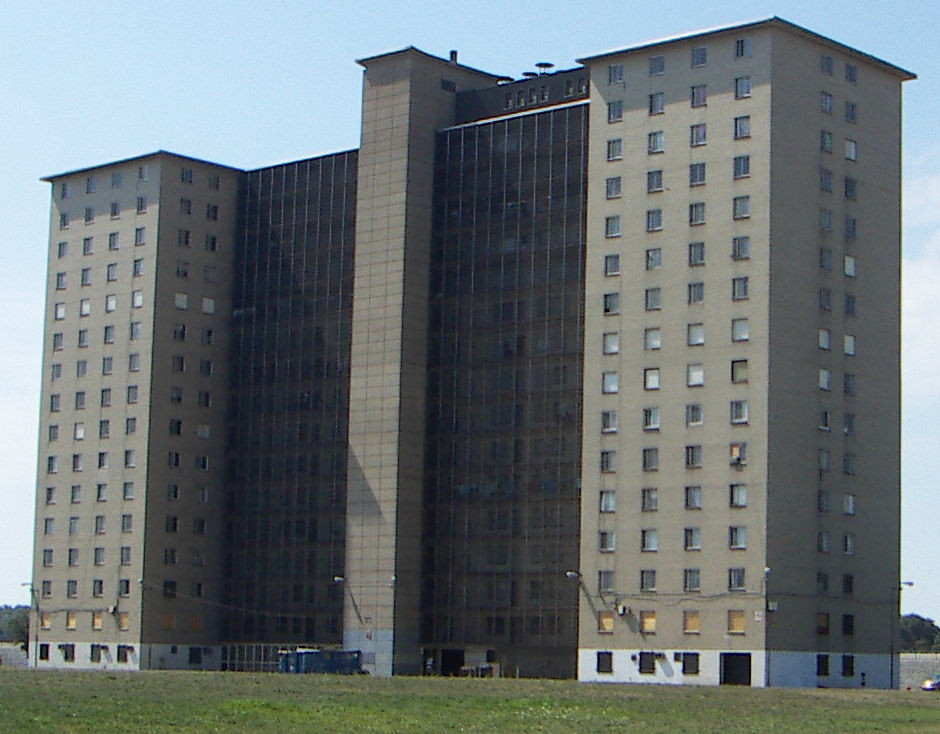
  3. A development of high-rise apartments, modeled after LeCorbusier's towers in the park, get you density in a hurry but without street life, and with a monotony of building style that represses diversity. The key is to mix building types: "The more variations there can be, the better. As soon as the range and number of variations in buildings decline, the diversity of population and enterprises is too apt to stay static or decline, instead of increasing" (p. 279). Charles Marohn of Strong Towns often talks about the long-term problems when areas are built all at once to a finished state, but there can be short-term bad effects, too.
See the source image
Density done wrong: Robert Taylor Homes, Chicago (Source: Wikimedia commons)

Density done right supports a diversity of people doing diverse things at diverse times of the day. It's comfortable, and prosperous, and safe. It provides services, places to walk, choices, neighbors, and economic and cultural vitality (Alter 2020, Schaller 2020).  Prosperous places might be more attractive to viruses, terrorists, and pickpockets, but they can also provide the essential services and social networks and financial resilience to see us through times of trouble. Density done wrong is uncomfortable and life there is difficult, even in the best of times. In emergency situations, you're on your own. Like the meatpackers ordered to work in unsafe conditions, or health care workers without adequate equipment, or the legions of newly unemployed, no one has your back. But we should not confuse ghettos with density done right.

The debate over population density and its future is partly ideological. In her conclusion to the chapter on density, Jane Jacobs characteristically hits the nail on the head:
People gathered in concentrations of big-city size and density can be felt to be an automatic--if necessary--evil. This is a common assumption: that human beings are charming in small numbers and noxious in large numbers. Given this point of view, it follows that concentrations of people should be physically minimized in every way: by thinning down the numbers themselves insofar as this is possible, and beyond that by aiming at illusions of suburban lawns and small-town placidity. It follows that the exuberant variety inherent in great numbers of people, tightly concentrated, should be played down, hidden, hammered into a semblance of the thinner, more tractable variety or the outright homogeneity often represented in thinner populations. It follows that these confusing creatures--so many people gathered together--should be sorted out and stashed away as decently and quietly as possible, like chickens on a modern egg-factory farm.
On the other hand, people gathered in concentrations of city size and density can be considered a positive good, in the faith that they are desirable because they are the source of immense vitality, and because they do represent, in small geographic compass, a great and exuberant richness of differences and possibilities, many of these differences unique and unpredictable and all the more valuable because they are. Given this point of view, it follows that the presence of great numbers of people gathered together in cities should not only be frankly accepted as a physical fact. It follows that they should also be enjoyed as an asset and their presence celebrated: by raising their concentrations where it is needful for flourishing city life, and beyond that by aiming for a visibly lively public street life and for accommodating and encouraging, economically and visually, as much variety as possible. (pp. 287-288) 
People like President Trump who see cities as hopeless sewers of crime and filth naturally associate concentration with contagion. Urbanists who see cities as the (sustainable) engines of economic and cultural development will continue to see their advantages outweighing their vulnerabilities. But are there enough of us out there to sustain urbanism?

Edge of town, 2013: back to the future?

P.S. If people decide based on the pandemic to decamp en masse for the suburbs, it won't be everyone. Just like in the 1950s and 1960s, the people who leave cities will be the people who can afford to. If there's one thing about America that the pandemic has exposed, it's how badly we serve our most vulnerable citizens: the poor, people of color, and those with health conditions. Rather than grabbing our pills and heading for the hills, we're better off designing cities that work for everyone.

EARLIER POST: "Pandemics and Our Common Life," 18 March 2020

SEE ALSO:
Lloyd Alter, "Urban Density is Not the Enemy, It Is Your Friend," Treehugger, 25 March 2020
Joe Cortright, "Density is not Destiny: Covid in Cascadia," City Observatory, 20 April 2020
Justin Fox, "Density Isn't Destiny in the Fight Against COVID-19," Bloomberg Opinion, 7 April 2020
Brian M. Rosenthal, "Density is New York City's Big Enemy in the Coronavirus Fight," New York Times, 23 March 2020
Bruce Schaller, "Density Isn't Easy, But It's Necessary," City Lab, 4 May 2020
Kevin Williams, "Rethinking the Blueprint for Denser Living," New York Times, 6 May 2020, B7

We'll be back! Non-distanced Bike to Work Week breakfast at Jimmy Z's, May 2019

Saturday, April 11, 2020

The hearts of Cedar Rapids


Hearts are appearing in windows around town. Perhaps you're seeing the same in your town. This seems to be a project recommended for children whose schools have been closed due to the COVID-19 pandemic, though I've also seen hearts in windows of houses of families without children. (We, empty-nesters, have a couple in our front window.) It is a great way to extend greetings across the physical distancing this pandemic has required, as more people are walking around the neighborhood.

In other good news, my wife Jane found toilet paper available during a routine visit to the grocery store this week, which is a sign the hoarding phase is over. On the other hand, we were unable to find baking powder, dental floss, or filo dough, so maybe those in toilet paper-stuffed residences have been forced to turn to hoarding smaller items.

This is not to say all is sweetness and light here. On our walk last evening, we encountered a man berating the elderly couple next door because there was a dirt pile in their front yard from a construction project. He used the phrase "World War III" several times. Earlier this week there was a shooting incident during a (very unauthorized) gathering of youths in nearby Bever Park. While a Cedar Rapids Gazette canvass of police logs from late March shows no change in service calls from previous years and a decline in arrests, nerves are definitely showing signs of fraying.

Nevertheless, the hearts in the windows are a strong sign that community impulses persist, even when it's extremely difficult to practice community, which of course is when its most needed.


Sunday, April 5, 2020

Strong Towns' Bottom-Up Revolution (V)

Your humble blogger and his humble sister in the days of their suburban childhood
Response to chapters 1 & 2 is here. Response to chapters 3 & 4 is here. Response to chapters 5-7 is here. Response to chapters 8 & 9 is here.

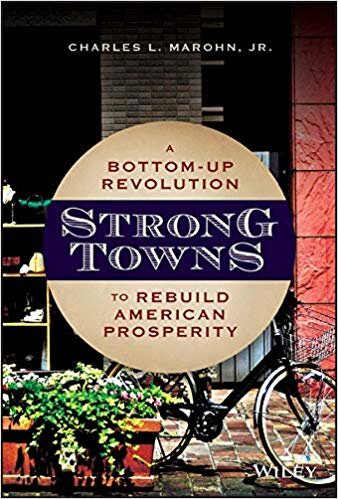
In its final chapter, Strong Towns: A Bottom-Up Revolution to Rebuild American Prosperity (Wiley, 2020) suddenly gets soul. Author and Strong Towns founder Charles Marohn, having made his case that the bankruptcy of local governments across is a broad but under-recognized problem, turns to the intangible advantages of more traditional approaches to development. Besides restoring your town's economy and government to a sound financial footing, you get neighborhoods with genuine community; opportunities for children to go places on their own; the physical fitness benefits that come from regular walking; something more real and important than our toxic political divide; and the sort of deep meaning to life that comes from living intentionally. He concludes, "Working together in an intentional way, it is possible to make our places stronger financially while also improving the lives of people" (p. 218, italics mine).

Marohn begins chapter 10 with a striking anecdote of their Life Before, in which his daughter meets her bff on the first day of kindergarten, and it turns out she lives right across the street:
My wife and I had lived in our house for over a dozen years at that point. Holly's family had lived in theirs even longer. We were both active families, involved in the community, with work, and with our churches. Yet, the thick woods covering the lots we each occupied along a cul-de-sac was enough of a barrier to our getting to know each other that we didn't even realize our neighbors across the street had a little girl the same as ours. (p. 200)
Not long after, his family moved to "a 1914 home in a historic area" of Brainard, Minnesota (p. 202), and a lot of the chapter discusses his epiphanies about life in a traditionally-developed urban area. Meanwhile, I'm thinking, Chuck Marohn was living on a cul-de-sac? Who would have thunk it?

Because we all come from somewhere. I come from the western suburbs of Chicago, with most of my childhood spent in a house built in the 1960s. It was in an older neighborhood, though, and the town had been around long before the Chicago metropolitan area grew to absorb it. I walked to school most of the time, my family could walk to a corner grocery store, and my parents had no concerns about sending me on errands or letting me loose to explore the area by bicycle or on foot.

I have also always had, for some reasons or other, an ambivalent attitude towards cars.

So maybe urbanism was my destiny. But I've also been fortunate for the last 38 years to live within two miles of my workplace. Had I stayed in DuPage County, I probably would have gotten used to the daily commute from cul-de-sac to office park. Maybe in the 1990s I would have read Daniel Kemmis's Community and the Politics of Place (Oklahoma, 1992) and James Howard Kunstler's The Geography of Nowhere: The Rise and Decline of America's Man-Made Landscape (Simon & Schuster, 1993), and something in me might have been stirred, but I wouldn't have known what to do about it, because what alternative would I have had?

Who would I be if I'd never read Jane Jacobs? Who would I be if I hadn't started following Chuck Marohn?

I am fortunate to live in a place with emerging walkability, in the company of fellow urbanists and cyclists and community organizers who keep pushing the envelope in hopes of sustainable lifestyles, and where the city government, though the Council keeps hankering after subdivisions and game-changing attractions, is visionary enough to build protected bike lanes and sidewalks and do one-way-to-two-way conversions. I am fortunate to live at a time when a variety of writers and designers have given me a vocabulary to articulate my inchoate discontent with 20th century America: people like the new urbanists, Ray Oldenburg, Ellen Shephard, and the inspiration for the Corridor Urbanism group, Dave Alden. I see the world more clearly, and live in it more consciously, thanks to these encounters. And Strong Towns has been essential to all this.

And now those essentials are in this 200-odd-page book:

51z8+pLtjaL._SX336_BO1,204,203,200_.jpg

Wednesday, April 1, 2020

Strong Towns' Bottom-Up Revolution (IV)


Response to chapters 1 & 2 is here. Response to chapters 3 & 4 is here. Response to chapters 5-7 is here.

Towards the end of Strong Towns: A Bottom-Up Revolution to Rebuild American Prosperity (Wiley, 2020), author and Strong Towns founder Charles Marohn suggests a number of approaches cities can use to cope with their precarious financial situations. There are many thought-provoking ideas herein; I'll address three.

Little bets are "small investments throughout a neighborhood, all aimed at improving the quality of life" (p. 155). The idea is to respond to the struggles of people already living there with "the next smallest thing that can be done today," intending "to nudge private capital off the sidelines by giving people confidence in the direction of the neighborhood. He cites the projects of Tactical Urbanism and Better Block as inspirations. Small projects like outdoor seating, crosswalks, and parklets don't cost very much, yet can bring neighbors out and together, and (in keeping with Marohn's financial theme) can convince property owners to make improvements because they're likely to pay off.

The advantage of little bets is a city can try something new where failure is not catastrophic, or likely to saddle the town with a long-term financial drag. I don't know how much the city has spent on bike lanes, but the first wave downtown cost about $3 million, which is a rounding error in a city budget of $500+ million, and you're not stuck with them if they don't work because the streets have to be repainted sooner or later anyway.
Under construction, 2013
A game-changer of a hotel/convention center, on the other hand, is a big bet, with long-term obligations if no one buys it, and they've had a poor track record in other cities, even if they do bring Lady Antebellum to town (see esp. Sanders 2014). The key question every official should ask is, "What if it fails?" If the answer is, we're out a small amount of money and self-esteem, then go ahead. If the answer is, we're screwed, don't do it.

Neighborhood evolution is what happens when change is not prohibited by zoning and other boards, environmental regulations, or empowered hostile neighbors. Neighborhoods that are frozen in time "damage the entire community," in part because they prevent the city from adapting to, well, anything, but particularly financial realities. They also exclude or burden a lot of people: "When city regulations demand that everything be built at a large scale and to a finished state, we not only price out much of society but we ensure that many of those who do own a home will struggle with that investment" (p. 163). So,
It is critical that every neighborhood in America be allowed, by right, to evolve to the next level of development intensity. That means empty spaces need to be allowed starter homes, even small houses, on footprints that can be expanded over time. It also means that single-family homes must be allowed to add accessory apartments, or convert to a duplex, without any special permitting, approval of neighbors, or added conditions. To become more financially productive, we need our neighborhoods to thicken up. (p. 163)
 He reminds us that "mixed use" is what all neighborhoods were until recently. And those traditional neighborhoods continue to be the most financially productive, even in decline.

Three blocks from my house is a small apartment building, one of several in the Wellington Heights neighborhood. It's bigger than the houses around it, of course, but not outlandishly so. It adds to the density and affordability of this core neighborhood without making a spectacle of itself. Why can't we do more of that? Because property values, I know. And parking, and noise, which are the usual complaints dragged out when neighbors want to stop a project. Maybe if more people in the city knew what a dangerous game we've been playing all these years, it would help tip the balance in favor of better housing.

Subsidiarity is a pliable concept but usually associated with local control of policy making. He quotes the definition from Wikipedia, for pity's sake; I'll step up to the Catholic Encyclopedia: "a community of a higher order should not interfere in the internal life of a community of a lower order, depriving the latter of its functions, but rather should support it in case of need and help to co- ordinate its activity with the activities of the rest of society, always with a view to the common good." (The Catholic Encyclopedia had a particular fondness for the Tea Party movement, which got a lot of Republicans elected to statewide offices who thereupon preempted local decision-making with at least as much vigor as Democrats ever did, but let it pass.) Marohn argues that local governments with restored decision-making power could make more rational decisions, and wouldn't have to rely for needed revenue on sprawl (or business subsidies, or game-changing projects, ...).

It's hard to be against subsidiarity, because all it's saying is everything should be done at the correct level, whatever you think that level is (unless you favor one-world socialist government, maybe). But state sovereignty has been abused everywhere, not least in states like Iowa run by people who hate the national government but also hate cities. (Recall Governor Kim Reynolds's comments about Des Moines and Iowa City not being the real Iowa, as she signed a bill preempting sanctuary cities.) You'd like to see cities given a real chance to chart their own courses. 

Two caveats: 
  1. Unlike Americans in the age of Alexis de Tocqueville, we live in a national/global economy, and it's hard to imagine economic policy being made entirely on a local scale. As we in Cedar Rapids saw after the 2008 flood, when an overwhelming disaster occurs, it's nice when the nation has your back. In a perverse way, President Trump's failure of leadership in the face of the coronavirus pandemic highlighted the need for a functioning national government. But we shouldn't rely on or defer to the national government on matters of local competence. 
  2. As Peter Calthorpe and William Fulton have articulated (The Regional City: Planning for the End of Sprawl, Island Press, 2001), most cities are part of a more complex metropolitan area that frustrates rational decision making. We need effective metropolitan governance.
But allowing for a federal role where appropriate, and effective metropolitan policy cooperation rather than rivalry and poaching, empowering local governments needs to happen.

10th Anniversary Post: Paying Attention to the Suburban Development Behind the Curtain

  (Google Maps screenshot) (9/5/2026)  Ten years ago, we in the United States were engaged in a presidential election campaign that would br...