Thursday, March 26, 2020

Strong Towns' Bottom-Up Revolution (I)

51z8+pLtjaL._SX336_BO1,204,203,200_.jpg

Marohn, Charles L., Jr. Strong Towns: A Bottom-Up Revolution to Rebuild American Prosperity. Hoboken NJ: John Wiley & Sons, 2020. xii + 240 pp.

I don't remember when I first ran across the work of Charles Marohn, who founded Strong Towns as an urbanism advocacy organization in 2009. It was probably around 2013, when I was doing research for a college course on the phenomenon of place, and in the process fell in with new urbanism. I've spent countless hours listening to the Strong Towns podcast, reading (and occasionally contributing to) the blog, and using Strong Towns material in my classes. (The current work will be assigned reading this fall in my Politics of the City course.) In 2015, Corridor Urbanism, the local group I co-founded, hosted Marohn for a public talk in Iowa City and an appearance before county officials in Ely.

Marohn has published collections of his blog posts--I have two of these in my office--but the current book is the first that systematically presents his ideas. Needless to say its publication has been the object of much anticipation in the Strong Towns universe. What follows here is less a review than a reading diary.

The first two chapters of Strong Towns describe the factors that led to the suburban model of development which has dominated American places since World War II, and why that model is proving problematic. The causal factors were political (land values too high in mature cities for new people to achieve success, concerns about returning to a peacetime economy) and financial (plenty of available money as America emerged from the war as the only undamaged power), but also professional hubris (belief that certain experts possessed the formula for building successful places) [pp. 27-30]. This combination of factors promoted and enabled risky behavior, because governments, mostly the U.S. federal government, were taking on the risk instead of local public and private actors. As a result:
Modern development is built all at once and to a finished state, a condition that does not naturally induce the rising land values necessary to drive redevelopment and renewal. We have defeated the stifling constraint of high land values, but in exchange we sacrificed the stability that has been the hallmark of cities throughout time. [p. 30]
In explaining how so many professionals got things so wrong, Marohn draws on the ideas of philosopher Nassim Taleb and physicist Neil Johnson. All three are redolent to me of the 18th century British political writer Edmund Burke, who criticized the rationalism that dominated the world of ideas in the Age of Enlightenment. Burke viewed with alarm proposals to overthrow social institutions in the name rationality; his Reflections on the Revolution in France, published in 1791, anticipated the bloodbath it would become when its rationalism ran smash into reality. His argument, even early on, was that social institutions contained collective wisdom that no individual or group of individuals could approximate. We aren't, in short, as smart as we think we are, and we should approach change with due caution. (For this wisdom he was long known as the "father of conservatism," though given what conservatism has become today he would surely demand a paternity test.)
Image result for edmund burke
Burke
The wisdom collected over time, contained in our social and political arrangements, makes those arrangements "anti-fragile," in Taleb's words (p. 4), when we recognize and respect their "complexity" (Johnson's term, p.12). Early American settlers weren't philosophers or physicists, but living on the competitive edge of existence forced them to understand their situations or go broke (or die). Once financing became readily available, that level of awareness got lost.
The underlying assumption of the American development pattern is an abundance of resources.... We could, as Johnson suggested, act "cleverly or stupidly, and yet still end up with an embarrassment of riches." And we did.... Have a crime problem? Just hire more police.... Have a traffic congestion problem? Just build more lanes.... Are sales at the big box store stagnating? Just close it and build a new one in a better location.... No matter the problem, and no matter how bad it becomes, there is no force compelling us to evolve our habitat, to change the way we live together. [p. 13]
16th Av SW at Williams Blvd, Nov. 2017
We live today with the legacy of the last 75 years of development, and will inevitably pass it on to future generations. In some places, the inhumane design and inability to keep up with maintenance are already obvious from the dilapidated housing and potholes and empty commercial buildings, or from the impossible traffic in a tangle of high-speed "stroads." In other places, where there's enough wealth or at least financial wizardry to keep things pretty, the inherent flaws might not be so obvious. But they are there.

Marohn commends returning to our species' legacy of "small, isolated bets [which are] an opportunity to gain knowledge at low risk.... In fact, it's better to fail early when the stakes are low" (p. 17). But in towns across America, large or small or medium-sized (like mine), the belief remains in an easy fix in some "game-changing" form or other, along with the assumption that a federal grant can be attained to pay for it. We're running out of time to learn this lesson. This book gives Marohn and Strong Towns another crack at teaching it.

Bike lanes are examples of "small bets" that don't cost very much to implement

Monday, March 23, 2020

Book review: Why liberalism failed


Deneen, Patrick J. Why Liberalism Failed. New Haven, CN: Yale University Press, 2018. xix + 225 pp.

It is impossible in these times to read Deneen's book--or read any book, or think or do anything--apart from the context of our pandemic. Why Liberalism Failed can be read through a pandemic hermeneutic, or any hermeneutic, because while addressing himself primarily to the American portion of western civilization, he wisely has not spent too much time addressing specific developments like the presidency of Donald Trump or the evolving Affordable (health) Care Act. So his argument remains universal, and can be read in the light of whatever times it's read in, whether now or a decade or more on.

The core of Deneen's argument is that liberalism has failed because its core of radical individualism has left us unable to meet the demands of the world in which we live. By liberalism he means, not the  contemporary political left as seen in the many plans of Senator Elizabeth Warren, but the centuries-old ideology that grew out of the Enlightenment. In contrast to the aristocratic and theocratic regimes that had predominated through world history to that point, classical liberalism
...conceived humans as rights-bearing individuals who could fashion and pursue for themselves their own version of the good life. Opportunities for liberty were best afforded by a limited government devoted to "securing rights," along with a free-market economic system that gave space for individual initiative and ambition. Political legitimacy was grounded on a shared belief in an originating "social contract" to which even newcomers could subscribe, ratified continuously by free and fair elections of responsive representatives. Limited but effective government, rule of law, an independent judiciary, responsive public officials, and free and fair elections were some of the hallmarks of this ascendant order... (pp. 1-2)
Contemporary western political disputes occur within the confines of this ideology, with the "left" promoting individual autonomy in personal life and the "right" promoting autonomy in economic life. These dimensions of the movements have largely succeeded, says Deneen, while their anti-liberal aspects--state empowerment of the individual through universal education and economic empowerment for the left, preservation of traditional moral values for the right--largely have not (pp. 142-143).
In distinct but related ways, the right and left cooperate in the expansion of both statism and individualism, although from different perspectives, using different means, and claiming different agendas. This... helps to explain how it has happened that contemporary liberal states--whether in Europe or America--have become simultaneously both more statist, with ever more powers and activity vested in central authority, and more individualistic, with people becoming less associated and involved with such mediating institutions as voluntary associations, political parties, churches, communities, and even family. (p. 46)
The public triumph of liberal individualism has delegitimized all claims on the individual, paradoxically leaving most people not brimful of power but weak and frustrated. Governments, active in broad areas impossible for John Locke or James Madison to have foreseen, are seen as tools of the wealthy and powerful to maintain their dominance (chs 7 & 8). Consumer goods are widely available, but atomized individuals are powerless against unmitigated market forces that could declare them obsolete at any moment: "Among the greatest challenges facing humanity is the ability to survive progress" (p. 29). Education, seen by liberals like Thomas Jefferson and John Dewey as the key to making democratic society possible, has become an extension of the marketplace, where individuals scramble to acquire the marketable skills--mostly "STEM"--they need to attain a modicum of security (ch. 5). Science and technology, which rationalists saw as the means to enlightened solutions to human problems, have themselves been co-opted by governments and powerful private interests (ch. 4).

Deneen is more about diagnosis than prescription, about convincing the unperceptive public that a seeming panoply of problems--political alienation or at best engaged yelling, environmental destruction, economic insecurity, loss of civility, governmental surveillance--are all symptoms of the radical individualism that is produced by unchecked liberalism. And that this situation is doomed to go smash, possibly very soon. "Taken to its logical conclusion, liberalism's end game is unsustainable in every respect: it cannot perpetually enforce order upon a collection of autonomous individuals increasingly shorn of constitutive social norms, nor can it provide endless material growth in a world of limits" (pp. 41-42). American liberals, take note! We can't provide social-economic inclusion and environmental protection without a social order that constrains our individual choices. American conservatives, take note! We can't both put our faith in an unrestrained economic market while perceiving only the obligations that morality places on others.

If Deneen has children, he might tell them that "there's a right way and a wrong way" out of liberalism's unsustainable self-contradictions. The right way involves connecting and empowering local communities. See, you knew eventually I'd get around to urbanism, and now I have!
Such efforts should focus on building practices that sustain culture within communities, the fostering of household economics, and "polis life," or forms of self-governance that arise from shared civic participation. All such practices arise from local settings that resist the abstraction and depersonalization of liberalism, and from which habits of memory and mutual obligation arise.  (p. 192)
Where do local nonprofits like Legion Arts fit into this analysis?
I am receptive to Deneen’s description of a polity undone by rampant unchecked individualism. I’ve written in much the same vein myself; see this post from 2015. Some days the glass seems half empty, others it seems half full. Even in routine times, it is possible to find evidence from the world around us to support and to refute his argument. Urbanists can testify to the power of the NIMBY (“Not in My Backyard”) phenomenon, the allure of private cars, and how understandable concern for property values limits options for affordable housing. Yet there are also a myriad of voluntary organizations whose members defy the collective action problem to pursue some public good. There is the undeniable draw of civic spaces and third places. And when crises hit, like the Cedar River’s rise in 2016, the helpful response of ordinary citizens is awe-inspiring (see Kaplan 2016).

Both sides of humanity are intensified in the current pandemic. There has been the astonishing run on bathroom tissue among other necessities, gun purchases are up, the array of misinformation and butt-covering starting at the toplevels of government (the Trump administration continues to respond to COVID-19 largely as a problem of public relations), and drivers taking advantage of nearly-empty streets to drive at high speeds. These are happening at the same time medical personnel and paramedics are performing heroically (as are other "essential" workers), ordinary people are by and large attentive to scientific evidence and cooperating with recommendations for “social distancing” and working-from-home, and some are finding innovative ways to support each other across physical separation. In my town Cedar Ridge Distillery and all-purpose entrepreneur Steve Shriver produced batch after batch of hand sanitizer for giveaway, Rustic Hearth Bakery is offering free bread to those in need, singer-songwriter Kimberli Maloy is organizing a city-wide sing-along, and people are sharing ideas about how to support local small businesses. And in our neighborhood, these inspirational chalk drawings appeared over the weekend.


Still, even when we see the glass as half full, we might well ask why in such a far-reaching social crisis it’s only filled halfway?

Eventually, the threat of COVID-19 will recede. Though it will take longer than it did the flood waters in 2016 (or even 2008), when it does recede it will reveal a landscape changed in ways at which we can now only guess. At worst, government and economic elites may be able to use the crisis to expand their power, while those individuals and institutions whose economic vulnerabilities have been exposed by the crisis may never recover. At best, enforced separation might help us understand how much we need and desire the company of others, producing an orgy of empathy and community-building. Or maybe a mix of both, a glass both half empty and half full? Maybe we’ll just be glad to be able to touch our face again without feeling that we’re sealing our own doom.

In any case, Deneen explains why liberalism can’t get us through troubling times. Neither can tribalism, which is pretty much liberalism-in-teams. Only connected communities can do that. As Chuck Marohn of Strong Towns writes, “[D]uring times of distress, leaders—especially at the most adaptable local level—step forward and fill the gaps left by incompetence and inflexibility. We need to support these people because, despite the scariness of the unknown, this is an opportunity to reshape the direction of our entire country. To make our systems more bottom-up and responsive. To make them more humane” (Marohn 2020). Come be an urbanist with me!

Wednesday, March 18, 2020

Pandemics and our common life


Florida Governor Ron DeSantis addresses the media (Octavio Jones/Tampa Bay Times, used without permission)

This post was supposed to be a report on my first impressions of St. Petersburg, Florida. It's spring break week at Coe College, and my wife a.k.a. "The Other Doctor Nesmith" had planned a vacation to remember. Then, with the world microbial outlook deteriorating by the day, she pulled the plug last Friday and cancelled our flight and Airbnb. Maybe we could have done it, but was our vacation worth the risk of additional stress on a state that has already had 314 diagnoses including seven deaths from the virus (Sampson 2020)?

So, we're staycationing it, and following advice from doctors and public health officials to minimize contact with other people. It's an unusually anxious staycation/spring break, because we're occupied in figuring out how to carry out our college jobs online: Coe, like most colleges and K-12 schools, is not going to reopen campus after spring break.

Even with the unfolding science fiction movie in which we seem to be living, the relative quiet of spring break has given me leisure to think. Mostly when I think, as anyone knows who's read any of the blog so far, I think about cities. And in the current environment, when I think about cities, I'm worried. (As anyone knows who's read any of the blog so far, I do a lot of that, too.)

I am an urbanist and a communitarian. I am an urbanist because I see the suburban development pattern as fundamentally unsustainable ecologically, financially, or socially. I am a communitarian because I believe our best lives are lived in relationship with others, and not just friends and family but the teeming variety of people around us some of whom we barely know. So my policy responses to most questions come down to stop subsidizing separation and start facilitating inclusion and connection. That isn't quite synonymous with increasing the density of population (see Kaplan 2016), but in most cases means putting humans in closer proximity to each other.

Image result for coronavirus
Source: northcarolinahealthnews.com. Used without permission.

Suddenly proximity and connection are the enemies! In the face of a virus of uncommon virulence, we are urged to keep a safe distance from, well, pretty much everybody. Places of meeting--sports venues, restaurants, bars, coffeehouses, libraries, athletic facilities, schools, churches--have either been ordered closed or have closed voluntarily (Rodriguez 2020). Sidewalks, trails, and civic plazas are not closed, but Americans are being advised to work from home if at all possible, to stay at least six feet away from each other, and not to have more than ten people in one place (Sheikh 2020). You might be young and healthy enough to ward off the virus if you catch it, but "Even people who show only mild symptoms may pass the virus to many, many others — particularly in the early course of the infection, before they even realize they are sick" (Mandavilli 2020). You may well slough this thing off without a fuss, but as a carrier you might also kill someone's grandma.

The coronavirus has brought a moral imperative to every decision. Should I go to my office, or work from home? My books are at my office, but I can move the ones I need, and I can do most of what I need to do using the Internet--must do what I need to do on the Internet, because I won't be seeing my students again this semester. On the other hand, I have my own office, in which no one so far has come to see me, so maintaining "social distance" is a snap. I'm here for now, though I've organized myself to move the operation to my house at a moment's notice.

Few things say urbanism like public transportation. I can walk to work, and usually do, but will drive or take the bus if I have things to do in other parts of town--like working out at the YMCA. So, do I contribute to a potential crowd on the bus, or contribute to climate change? Monday the risk I decided to reduce was spreading the virus, and I drove to the Y. But it's unsettling to think the virus is forcing us back into our cars and trucks and SUVs. By today it became a moot point, as the Y is closed indefinitely following the Governor's order. (Meanwhile, the buses are running for free, but are allowing no more than ten riders at a time--another reason for me to leave it for the people who really need it.)

Community gathers at the Balloon glow at Brucemore Natonal Historic Site
I worry that the pandemic is feeding our fears of the other, and that it will reinforce whatever individualist drives make us want to spend society's money to create distance and barriers between us and them. President Trump, who has built his political career exploiting social divisions, doesn't help when he calls it the "Chinese virus" (Forgey 2020). Is this the end of the urbanist dream of people living and interacting in relatively close quarters? Close quarters make for a fertile feeding ground for a virus like this. It's not coincidental that a city like Seattle was the first American hotspot, and densely populated New York and San Francisco have struggled to contain it. Joe Cortright
notes:
The particular irony of a viral disease like Covid-19 is that it is so closely related to a city’s core function:  bringing people together. The flourishing civic commons that brings people from all over China to [cities like Wuhan] for the Lunar New Year, or which makes cities like Seattle closely connected to a global community, are exactly the characteristics that expose them to greatest risk. (It’s little surprise that West Virginia is the last US state to be infected with Covid-19.)
Is this evidence that close quarters are dangerous, and that advocates of subdivisions, gated communities, snout houses, single-occupancy cars, and interstate highway widening were right all along?

(Yet you know what group we're not talking about that is most at risk from community transmission because they're crammed into those evil, squalid detention centers? The themmest of the them, stuck behind the barrierest barrier. The centers are stupid, too: The refugees can't get out, but the virus sure can.)

The optimistic option is that the pandemic, and the enforced isolation it requires, show us how much we need each other. New York Times columnist Frank Bruni notes, "At the very moment when many of us hunger most for the reassurance of company and the solace of community, we’re hustled into isolation" (Bruni 2020). Strong Towns blogger Daniel Herriges reminds us that despite the dangers of cities, their advantages remain strong:
The city is a marvel, a creation as uniquely human as the ant hill or beaver dam is to their respective architects. Its most marvelous trait is the way that cities concentrate and amplify human ingenuity and initiative and compassion, and allow us to do greater things together than we could alone.
They cultivate in us, too, a sense of shared destiny, of belonging to something greater than ourselves. Witness the stories of citizens of Siena, Italy, singing together from their balconies during quarantine: not just any song, but a patriotic anthem about Siena itself.
We don’t build cities for today, next year, or this decade. We build to leave something much greater behind us when we go.
And Cortright again:
When cities work well, its because, in all their spaces, they overcome or bridge social distance. That’s true whether we’re talking public spaces and the civic commons, like parks and libraries, or whether we’re talking the nominally private spaces where we socialize and interact with others (bars, restaurants, workplaces). The reason we find social distancing so difficult, and so off-putting is that it runs counter to so much of what makes life, especially city life, worthwhile.
When all this is over, whenever that is, maybe our pent-up need for human contact will lead us to do more than rush back to the familiar bunch at the office, the health club, or church. Maybe we'll come to recognize that the humans we missed seeing included that person you pass every once in awhile who dwells at the edge of your consciousness. Maybe our appetite for social contact will lead us to recognize that we've all this time been part of a community that was larger and more diverse than we'd ever imagined, and we'll look for ways to strengthen those ties?

From Italy, so far the hardest-hit country in the West by the virus, Pope Francis urged Italians to "small gestures of affection" for each other, particularly those afflicted. "These gestures of tenderness, affection, compassion, are minimal and tend to be lost in the anonymity of everyday life, but they are nonetheless decisive, important” (Lavanga and Talmazan 2020). Important words now, and important words for the post-pandemic era, too.


SEE ALSO:
Frank Bruni, "Why the Coronavirus Is So Much Worse Than Sept. 11," New York Times, 17 March 2020
Joe Cortright, "Cities and Coronavirus: Some Thoughts," City Observatory, 18 March 2020
Russell Arben Fox, "The Coronavirus in Kansas: The First Week," In Media Res, 18 March 2020
Daniel Herriges, "Let's Not Forget What We Build Cities For," Strong Towns, 18 March 2020
Jane Claspy Nesmith, "Swimming the Pandemic," Journal of a Plague Year, 18 March 2020 [first in a series of ongoing reflections]
Steven Shultis, "Hello from the Other Side," Rational Urbanism, 15 March 2020
[ADDED LATER:] Marc Sollinger, "How the Coronavirus Will Shape Our Cities," Innovation Hub, 27 March 2020 [interview with Richard Florida]

Sunday, March 8, 2020

Early Bird Cafe closes

Interior, Early Bird Cafe (from their website)
The Early Bird Cafe, a favorite of customers since 2011, ceased operations at the close of business Friday. Owner Brooke "Top Chickadee" Fitzgerald announced on their Facebook page February 11:
Over the last year or so I have been removed somewhat from day to day operations in order to transition and pursue my commercial real estate career with Skogman. The universe once again, has put something in front of me as a vehicle to accomplish more with my life on this earth. In the time of reflection that I have had stepping away, I have realized my time with the Early Bird is complete. I’ve reached the full potential of what I alone am able to do with it. This chapter of my life is coming to an end in order to start a new chapter.... The last day for the Early Bird will be Friday, March 6th. We will be closing our doors at close of business that day and flying the nest. Onto the next chapter of life starlings, my best wishes for your success and abundance, Top Chickadee with gratitude, signing off.
The first Early Bird location was in the Town Centre Building at 316 2nd Street SE, downstairs from Shive-Hattery Architecture. It took me awhile to warm up to it, as my initial impression of coffee places tends to depend on whether they have baked goods bigger than my head. So, I sniffed in the survey of local coffee I did on Facebook that year, the cupcakes from the Wright Touch were "small and twee."

The Early Bird's Town Centre location, May 2013
In time, though, the treats got bigger and my mind got broader. In particular I liked the artsy energy that infused the place, possibly due to visits by performers from the Paramount Theater across the street, or maybe the whimsical decor brilliantly done by Fitzgerald's brother Aaron Murphy. In the spring of 2013 I was spending a lot of time downtown and it had become my favorite downtown coffee shop: "The managers are good-humored, even goofy," I wrote in an early post on this blog, "and the atmosphere is the most pleasant and relaxed." It felt like a place to hang out more than a shop for downtown workers to rush through.

So I held my breath in fall 2016 when the Early Bird moved into the Smulekoff Furniture building on the river side of 1st Street.
Approaching the Early Bird, last day of business, March 2020
I need not have worried. The new layout was open and inviting, a refuge from whatever business brought you downtown as well as a place to run into people you know. (This is a common element of locally-owned coffeehouses of my acquaintance, while chains tend to put people into private inaccessible booths.)
View as you enter
Approaching the counter
So I'll miss the Early Bird. There are other fine coffee places downtown, but I'll miss its many quirks. I'll miss holding downtown open coffee meetups there. I'll miss the delicious coffee, I'll miss the $1 refills which got me through any morning, I'll miss the scones which would have been big enough even to satisfy 2011 me, I'll miss the yogurt parfaits which were made fresh on the spot. I'll miss Stacey Walker or Brad Hart or Bill Michaeel or Emily Meyer coming through while I was there. I'll even miss this giraffe, which seemed pleased at my attending to my hydration and caffeination needs.

I hope the Smulekoff building gets another tenant soon--for that matter, I hope the Town Centre does, too. There's a lot going on in downtown Cedar Rapids, which has proven it can support a decent variety of establishments. The variety will only improve if the residential population attains the critical mass necessary to support a 24-hour downtown.

But the combination of business acumen and artsy sensibility needed to support a truly distinctive shop is rare indeed. Hats off to you, Brooke Fitzgerald, and best wishes in your future endeavors. Since those endeavors seem oriented to commercial real estate--she is employed at Skogman Realty--I hope she will promote the sort of development that supports locally-owned businesses with their own memorable quirks.
Timely advice. But always good advice.
SEE ALSO: Ben Kaplan, "Downtown Cedar Rapids' Coffee Shops Ranked," Corridor Urbanism, 3 February 2019. (Spoiler alert: Early Bird was tied for 1st.)


Saturday, February 29, 2020

We build community from the ground up

See the source image
Source: eskipaper.com (Creative Commons)
My spirits have been trending low of late. Maybe I'm not getting enough Vitamin B, or maybe winter's gone on too long. Maybe I'm kind of a pessimist. Or maybe it has something to do with last week's Democratic presidential debate, an unprecedented display of obstreperousness that has me thinking that President Trump's reelection is increasingly likely. Mismanagement of government, personal corruption, foully abusive rhetoric, and cruel treatment of the most vulnerable among us have cost the President nothing, and have if anything solidified his base. Meanwhile, the viable alternatives are eating each other up like the gingham dog and calico cat. "O Scotland, Scotland!"

Three years ago, as Trump began his Presidency, I dared to hope that his performance would result in broad and decisive repudiation. Although his presidency has been even more relentlessly bad than I could have foreseen, at this point broad repudiation seems far from likely. If he is defeated for reelection, it will be narrowly, with the results in a few states decisive. The next Democratic president, for whom I can tell you right now I will surely vote, will have run based on unaffordable promises and sticking it to the billionaires, and will find themselves at the helm of a broken government of a riven, ungovernable country. Good luck with that.

We are, in short, more broken and more fearful than I'd thought. Putting the pieces back together is going to take a long time, the next President's first term at the very least. And the first thing we need to do--not what some President needs to do, but what we need to do, so Presidents can eventually do productive President stuff--is to learn how to live together.

That starts locally. (For an argument that this has already started in towns around the United States, see Studer 2020.)
See the source image
Source: wuestenigel.com (Creative Commons)
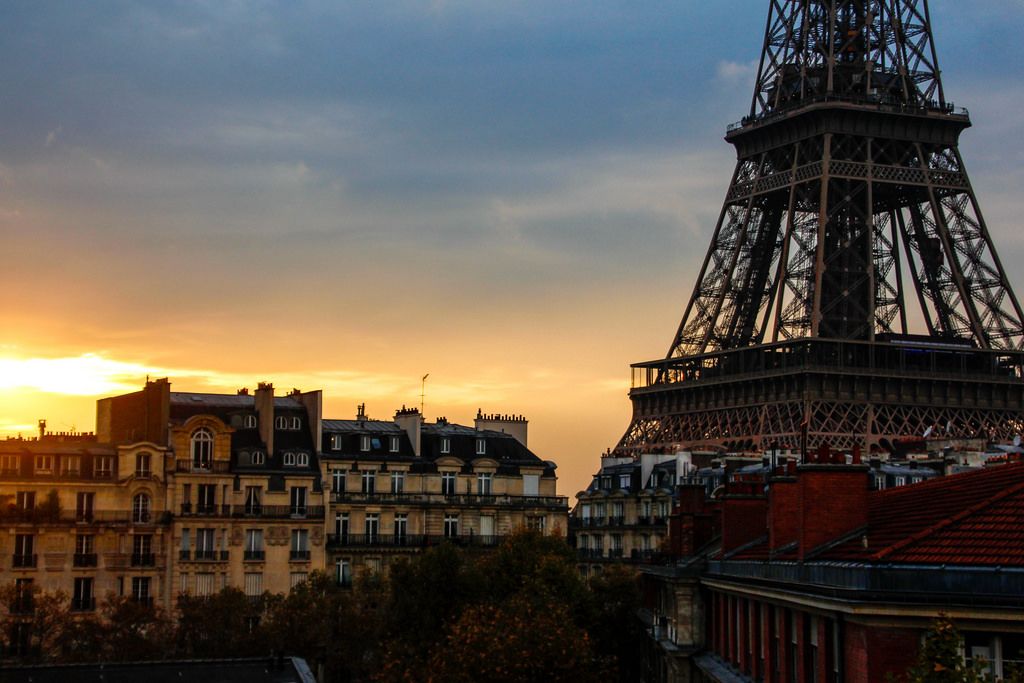
One set of interesting ideas is floating around Paris, France. Anne Hidalgo, running for reelection as the Mayor of the City of Paris, wants to make it a "15-minute city" (O'Sullivan 2020). This means something different in a city with 21000 residents per square mile that has closed many streets to through auto traffic, than it would in a sprawling burg like Cedar Rapids, where most adults can get anywhere in 15 minutes by getting in their cars. The campaign's image...
Paris En Commun campaign image
...shows work, shopping, dining, recreation, culture and health care within walking distance of every residence ("chez moi"). This would involve sacrificing road space to pedestrians and cyclists, designing public spaces for multiple use throughout the day, and promoting small shops, clinics, and performance spaces. It would involve somehow comfortably accommodating the needs of hordes of tourists as well as those residents who couldn't afford rising rents driven by the new amenities. City Lab notes that Mayor Hidalgo's plan as yet has neither timetable nor budget.

Even so, similar approaches have been proposed in other cities, including Barcelona, London, Melbourne, and Portland. More important for our blogging purposes are the principles are at work here: these advocates are striving to build inclusive communities.

Carlos Moreno, who teaches at the Sorbonne as well as serving as an adviser to Hidalgo's campaign, articulates six "things that make an urbanite happy,” including “Dwelling in dignity, working in proper conditions, [being able to gain] provisions, well-being, education and leisure. To improve quality of life, you need to reduce the access radius for these functions” (Belaich 2020, translated and quoted at O'Sullivan 2020). I will argue that these six are also opportunities that ought to be available to everyone--to be clear, not to make the state the employer, educator or entertainer of last resort, but to design the city such that all of these are attainable to everyone.

So, how to translate this to a contemporary American city, a typical one where, as O'Sullivan of City Lab reminds us, "Car-centric suburban-style zoning [has led] to an era of giant consolidated schools, big-box retail strips, and massive industrial and office parks, all isolated from each other and serviced by networks of roads and parking infrastructure (O'Sullivan 2020)?" That's my town, all right, and probably yours, too. Most people here are used to it, and content enough with it that they fear changes more than either such traffic as there is or the externalities it produces (pollution, isolation, lack of exercise, &c.).
Collins Road Square on Black Friday
We need the city government, not to make our choices for us, but to make choices possible. That means recognizing that not everyone has a car; while usually around here that is for economic reasons, going car free might be a commendable environmental or lifestyle choice, were it possible. Whether or not you actually have a car in Cedar Rapids, they are a necessity. They should at least be a choice.

Our transit system could and should continue to evolve, and ditto our bike infrastructure. But it's darned near impossible to design bus or bike routes for a sprawled city, where even bus riders live far apart from each other. So we need to point towards at least some parts of the city becoming denser, allowing granny flats and even small apartment buildings. Strong Towns argues that the next level of development in any neighborhood ought to be automatically legal (Marohn 2016); let it be so. While affordable housing is a different issue here than in a boomtown like Seattle or San Francisco, my friend Eric tells me it's impossible to build a $100,000 house. So let's have ordinances that encourage preservation and sale of existing housing stock, and that require landowners to keep older housing stock in reasonable shape so it continues to be livable. Pass a land value tax: It should not be possible to hold onto valuable property, letting it lie fallow or degrade, without paying for the privilege (Siskoff 2020).

Protesting demolition of the Hach Building in New Bohemia, 2014.
This property, in primo location by the Bridge of Lions, is currently fallow with no prospect of development.
Same goes for commercial buildings. We do have a yen for the shiny and new, and back it up with tax increment financing. But shiny new rents are hard to afford for local businesses, so the shiny new building down the street from me houses a Jimmy John's franchise, a Scooter's Coffee franchise, a Clean Laundry franchise, and an H & R Block tax franchise. Given that local businesses do better at job creation and at keeping money in the community, we should do better by them (Studer 2019).

We need to support public institutions, in particular public schools, but also libraries, parks, and so forth. When they suffer, middle-class people can always find alternatives. This is less true for people of lower incomes. A city with good neighborhood schools is a strong city. A city where the well-off have created housing and educational enclaves for themselves, and the heck with everyone else, is not a strong city.

Finally, we need to make life better--safer and more comfortable--for pedestrians and cyclists. Narrow the streets to slow the cars, build sidewalks where they haven't been built already, and maintain them where they are. The city could look into helping people concerned about upkeep of sidewalks, if it weren't already gasping to keep up with maintaining our ever-expanding street network. Sidewalks, bike lanes, and trails are not only important for getting around, they're important places for the public to meet each other. A walkable city provides thousands of incidental contacts every day, which is the basis for trust across lines of difference.

Neighborhood connections are not popular with everyone.
I wish this resonated with people. But we are a country of individualists, for whom community is often defined narrowly or even viewed with suspicion. We spend a lot of money and effort keeping the wrong people away, because they're inconvenient--they might park where we're used to parking, they might get in our way when we're in a hurry, their stuff might fill a view we've become accustomed to--or because we've been taught to fear them. Ownership and security are powerful motivators.

President Trump knows this. Despite multiple profound flaws, he's built a resilient presidency by appealing to people's fears, often in the most grotesque but apparently crowd-pleasing ways--the atrocious handling of refugees stands out.  Here in Cedar Rapids, any attempt to improve access to housing or non-car transportation runs up against a wall of fear and anger.  Just ask the developers of affordable housing on Edgewood Road, or live work units off Johnson Avenue. The residents of Chandler Street SW and Grande Avenue SE successfully fended off the spectre of sidewalks. Now Cottage Grove Place is weighing in against a proposed trail development between Washington High School and the Cemar Trail.


The 21st century demands an alternative to our dominant paradigms of development: market forces looking for short-term profits, political leaders listening to whatever song a big developer sings, and individuals protecting their patch of ground from children walking to school. We need something no law can provide: a cultural change that favors community, recognizing individual autonomy not as an absolute value but as the fantasy it is.

We need to conduct ourselves as if other people mattered.
Justice in the World Today

  Hope he gets some of that coffee: Statue of Thucydides in Vienna, Austria (7/31/2026)  A long time ago, according to the ancient Greek his...