Friday, October 25, 2019

3rd Avenue is two-way!

parking, bike lane, auto lane all headed downtown

The City of Cedar Rapids completed an important step towards improved walkability when the last stretch of 3rd Avenue SE was opened to two-way traffic this week. The one-way-to-two-way conversion had been achieved in increments, but this final segment, from 13th to 19th Streets, is arguably the most important. It goes through Wellington Heights, a historic neighborhood whose decline was hastened by the transformation of its major streets into multi-lane one-way high-speed "auto sewers" (to use James Howard Kunstler's phrase) in the late 1950s.

Now that mistake has been undone. The streets are still wider than they probably used to be, but that width accommodates bike and parking lanes. Expect auto speeds to slow, which will improve the lives of cyclists and pedestrians, and will make the neighborhood feel like a neighborhood again instead of houses crouched on the edge of an expressway. (The one-way development occurred before the building of Interstate 380, which is an actual expressway.) Walking to school, or church, or Redmond Park, now is thinkable for 8-year-olds and 80-year-olds.

I really enjoyed watching the project unfold:

Aug 5: 18th St closed for redo of the intersection with 3rd

Aug 6: 3rd Av approaching 18th St

intersection of 3rd Av & 17th St

Aug 25: Squaring the intersection at Park Av

Squaring the intersection at Grande Av,
but with loss of access to 16th Street

View from 16th Street: You can turn east onto Grande,
and if feeling bold get over to 3rd

17th Street, Blake Boulevard, and a big pile of gravel
Sept 1: 17th Street which now ends in a cul-de-sac south of 3rd/Blake

3rd Av & 17th St

Longer view

Building bulbout at Park Avenue


3rd Av, 16th St and Grande Av with new improved sidewalk route

Sept 5: Ridgewood Terrace cul-de-sac

Sept 10: 19th Street approaching 3rd Av,
where four-way stop replaced traffic light

3rd Av & 19th St


Sept 20: Blocking off the left two lanes on 3rd Avenue
Sept 22: 3rd Av and Blake Blvd; 17th St cul-de-sac at right

Sept 29: finishing approach of Blake Blvd,
newly squared intersection

New crossing at Park Court
Oct 14: capping 17th St cul-de-sac

Blake Boulevard facing east from 3rd Av

Oct 16: 3rd Av & 19th St

3rd Av bike lanes striped

new sidewalk crossings at 3rd Av & 18th St
I'm blitheringly happy about this achievement, albeit with inevitable qualifications. Care will need to be taken that current residents don't suffer from their neighborhood's new attractiveness, and get gentrified out of it. I don't like it that it is impossible to access Redmond Park from 3rd Avenue, either by 16th Street (access closed) or Park Avenue (one way for one block, because residents protested city plans to change that). I'm ambivalent about closing parts of the intersections at 16th, 17th and 18th to through traffic, although for pedestrians the sidewalks still go through. [I'd thought there would be access for cyclists as well, but there isn't.] I would like to have more traffic controls. And the electronic crossing light by Redmond Park makes a constant "tink" noise that can be heard a block away. That would drive me crazy if I lived on that block.
Oct 23: Auto heading downtown on 3rd Av!

17th St cul-de-sac, with Blake Blvd not quite finished [It is, now]

crossing at Park Ct by Redmond Park (It's rather loud!)
All in all, a positive step. We are more than ever a community of people, rather than a network of car paths.

EARLIER POST: "3rd Avenue Conversion Coming Soon," 30 March 2019

Wednesday, October 16, 2019

A corner of urbanism

Visiting our son in Minneapolis last weekend, we found a delightful (and very popular) coffee/brunch place in a residential neighborhood in the southeast part of the city, near Lake Nokomis. I was struck by the activity and range of businesses at the corner of 52nd Street and Bloomington Avenue. From the surrounding neighborhood, a person could walk to the cafe as well as an insurance office, dentist, bookstore, plus-size closing store, and a Masonic temple.

That won't fill all your daily needs, of course, but it's a pocket of semi-walkability that is rare in my town. The residents have ready access to a small variety of things, but have to tolerate customers parking on their streets...

 ...maybe especially on Sundays at 10, when half the city seemed ready to pack itself into the Hot Plate--and the rest took refuge in the Irreverent Bookworm across the street. I mention this because traffic and parking are automatic objections whenever someone tries to make a neighborhood more walkable. Those are not irrelevant, but can't become absolute values in a walkable, inclusive community. For a little inconvenience, look what you get!


You could argue that the neighborhood is unusual. The Hot Plate is in Census tract 117.03, which is well-off (med income of $47423/yr puts in the top 10 percent of census tracts nationally), but is densely-populated (4252 people in 0.67 sq mi=6338/sq mi) with people who have chosen an older neighborhood (median home construction is 1939). Nevertheless, people have chosen to live in a place like this, and if such choices were available elsewhere they would be chosen there as well.


SEE ALSO:
"Letter from Washington (III)," 3 March 2018
"Envision CR IV: Neighborhood Stores," 28 May 2015
"Indulging in Urban Fantasy," 6 September 2014

Friday, October 11, 2019

Open Streets DC


I was fortuitously in Washington, DC, last weekend, when the city hosted its first Open Streets event. About three miles of Georgia Avenue was closed to cars. The meetings I was in town for meant I caught only the last hour of it, but it was amazing.

Open Streets began in Bogota, Colombia all the way back in 1976. A political science colleague mentioned he'd been to one in Mexico City, and that they do that one every year. Seattle was the first American city to hold such an event. The Minneapolis metro area hosted seven such events this past summer. [For more on Open Streets, and Washington's preparation, see Gardner 2019.)

The street chosen for the event was Georgia Avenue NW, which runs north-south between U Street and the DC-Maryland border. It is also US Highway 29, so is a main drag, although not a tourist magnet like Pennsylvania Avenue or Independence Avenue. The street is used mostly by locals, and traverses a number of ethnic-working class neighborhoods. Good tactical choice, then.

I took the Metro from Capitol Hill to the Georgia Avenue-Petworth station, which put me about halfway along the route. From there I walked north to Missouri Avenue. The turnout was impressive: people walking, running, cycling, and scootering, all along the way. It was also impressive for its diversity. A lot of urbanist events I've attended have a definite white, middle-class presence, but Saturday on Georgia Avenue there were large numbers of every racial group. It was a party.

There were few vendors present for the occasion, but the street offered plenty of refreshment and browsing opportunities.
Al fresco lunch with a great view of the action


 There was entertainment...

Music stage near the Metro station
Skateboard demos by the Petworth library

Drum circle

... and chalk art...


...as well as information booths representing the city...


...social service agencies...

...and cycling advocates.
Washington Area Bicyclists Association booth with demonstration protected bike lane

I didn't see any news media, which I mention only because Fox5, the local TV station which played constantly in the lobby of the place I stayed, was preparing its viewers for something like the apocalypse. The apocalypse did not happen. I walked past the barbershop whose worried owner they'd interviewed, and there were customers waiting inside, so he must have come through all right. The next day's newscast had no report on the event anyhow. [Radio station WTOP must have been there; they had this, non-alarmed report.]
Making way for an emergency vehicle
Which is not to say there weren't costs. In order to close the street to cars, every intersection had to be blocked off, which in that part of town meant not just streets but alleys. That added up to a lot of police cars, and police officers, which can't have come cheap. Buses had to be rerouted...
...and of course auto drivers had to find alternate routes.
Southbound Georgia Avenue traffic diverted at Missouri Av
Most service stations along Georgia appeared closed
So an Open Streets event is not an unalloyed good time, but a good time this one was. The energy on the street was incredible, and I imagine I wasn't the only one introduced to the attractions of Georgia Avenue. I got to the end of the route about the time things were closing down, and I caught a bus back to the Metro.
End of the Open: Emery Heights Park, Georgia and Missouri
Taking things down
Barely a block away from Georgia, we ran into gridlocked traffic at 9th Street. (Metro drivers are normally unflappable, but this was worth an "Oh my God!" from ours.) The negative energy of the stuck cars contrasted mightily with the Open Street I'd just left. I suppose one could conclude that messed-up traffic on other streets is another cost of the Open Streets event. What struck me most, though, was how the Open Street catered to people, while Missouri and 9th were catering to cars (albeit not very well). One block separated soul and soullessness. The costs of the suburban development pattern we've pursued for 75 years could not be clearer. (Cue this excerpt from Charles Marohn's new book, Strong Towns: A Bottom Up Revolution to Rebuild American Prosperity [Wiley, 2019].)


SEE ALSO:
Open Streets DC page
Jennell Alexander, "Open Streets DC Brings Fun, Curiosity, Disruption to Georgia Avenue," DC North Star, 5 October 2019
"Security versus Urbanity?" 17 May 2013 [New York City plan to close a section of street to auto traffic]
"Woonerful Woonerful," 7 May 2018 [private DC development experiments with shared space]

Teatro de la Luna took advantage of the crowd going by
Lime e-scooter demonstration

Sunday, September 22, 2019

LGBTQ Presidential Forum


people gathered in auditorium facing stage festooned with flags
Crowds gather for the LGBTQ Forum in Cedar Rapids

(9/22/2019) Look at where we are! Can you believe it??

The first thing to be noted about the LGBTQ Presidential Forum, featuring ten Democratic presidential candidates, is its historic character. Such a forum, dedicated to discussion of issues affecting the queer community, and in which candidates competed on allegiance to that community, was unthinkable even twelve years ago. In 2007-08, within the memory of even my first-year college students, the only candidate who supported gay marriage was the marginal Democrat Dennis Kucinich. Things have changed very fast for the better in this area--after years of spadework, of course, as with most overnight sensations.

The LGBTQ Presidential Forum was co-sponsored by The Advocate, The Cedar Rapids Gazette, One Iowa, and GLAAD, and was broadcast nationally by NBC.

We should also celebrate that the forum was more substantive than it could have been. Given how quickly the Democratic field, along with most of America, have come to broad agreement on gay rights, the discussion could easily have devolved into competing empty declarations support, a 21st century version of "Well, I hate the Romans a lot!" That the forum encouraged more informative expressions from the candidates was thanks to some of the questions, which got past the surface to inquire about violence against transgendered people, state religious exemptions laws, human rights advocacy in foreign policy, and other policy issues of particular interest.

The candidates, who included all of the leading contenders except Senator Bernie Sanders, were interviewed serially. 
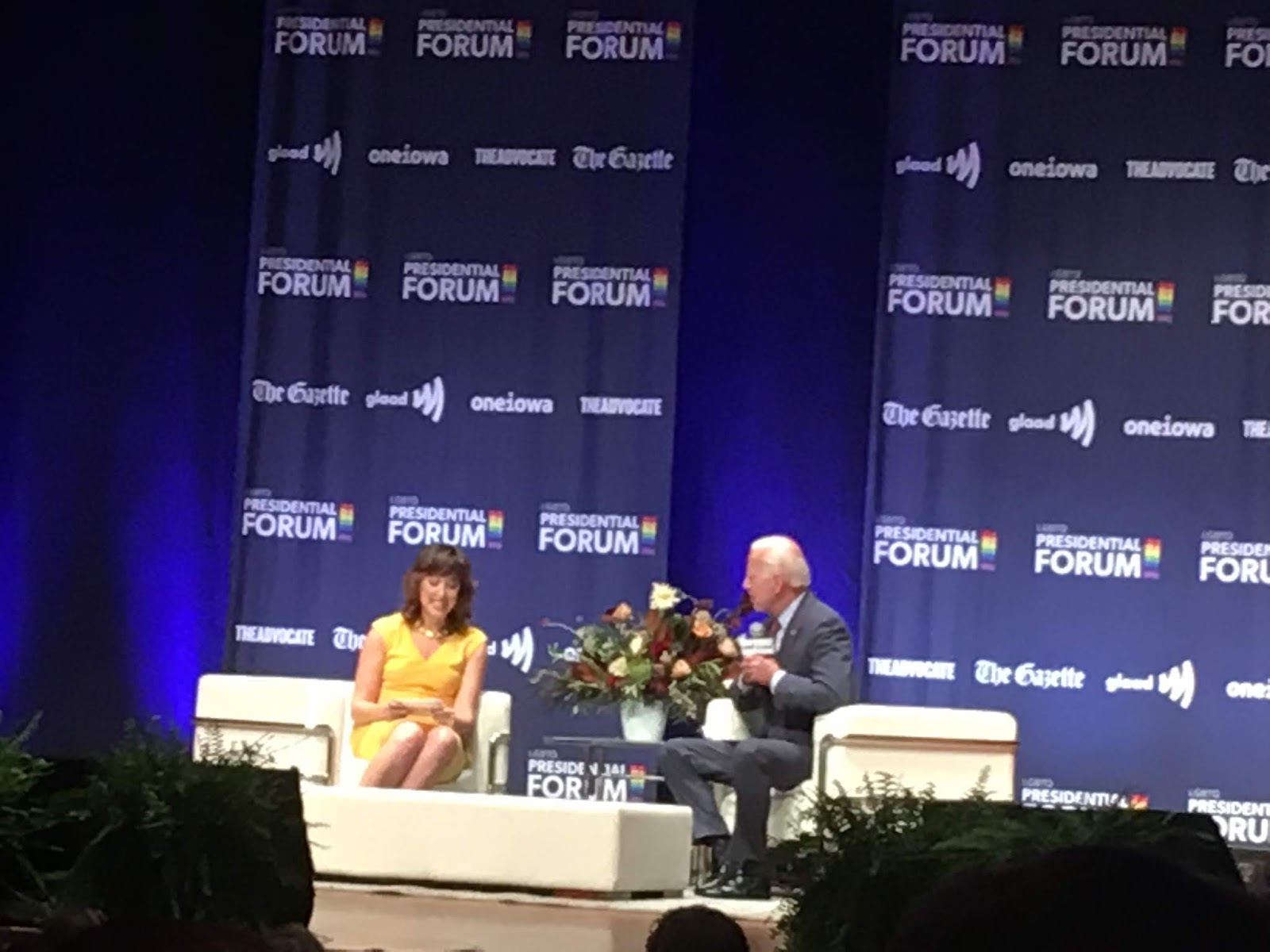
Lyz Lenz of the Gazette interviews Joe Biden
They all answered a common question ("What would you do [for these communities] in your first 100 days?") and then two or three other questions from a rotating set of interviewers. This prevented give-and-take between the candidates, for better or worse. It also meant the candidates had to make a good first impression, or else.

The evening was punctuated by appearances by celebrities, including Angelica Ross who served as host. It took 15 minutes for Marianne Williamson, the first of the candidates, to get to the stage. I thought this tended to diminish both the candidates and the gravity of the electoral decision before us; perhaps the younger people in the crowd, who have actually heard of these celebrities, appreciated their contributions to the evening's program, but I found Ms. Ross in particular rather irritating as well as unnecessary.
See the source image
Angelica Ross (Creative Commons via Wikipedia)
Besides that cavil, I have two reservations about the event:

First, a single-issue event such as this forum or the climate forum in Washington tends to define Presidents as people who deliver the goods (or not) to a series of constituencies. Anyone, even Donald Trump, can make promises. Moreover, narrow foci neglect issues of presidential management, which include the need to set priorities, allocate the budget, respond to new or complex information, and negotiate with political opponents. There was, in spite of the quality of some of the questions, a lot of box-ticking--we really do, as it turns out, hate the Romans a lot--and allegiance-proclaiming. Candidates used their opening statements to show that they had been in front of the social change in favor of gay rights: Cory Booker raised a pride flag at the Newark City Hall in 2006, Kamala Harris performed a gay marriage in 2004, Joe Sestak served with gays on a navy ship in the 1990s, and Joe Biden had been on the side of gays since he was a boy, which was a very long time ago indeed. So, we're all for gays and lesbians. Now, "when do we get our debate on reproductive rights?" someone asked after the forum. 

[This is not to defend the Kennedy-Nixon style of debates we've also seen this summer, which bring their own set of problems. But the single-issue forums absolutely beg for logrolling.]

Which leads me to my second reservation, which is that the value the sponsors and the audience placed on allegiance to the advocates' positions left little room to discuss tactics. I understand the frustration and impatience of many in the audience, but we also need to plan how to get to (and sustain) the inclusive world we want. The venerable "100 days" frame, which apparently cannot be killed no matter how many presidents it's inflicted on, puts the emphasis on immediate satisfaction. Sometimes it takes incremental steps to get to a goal--Don't Ask Don't Tell is wrong now, but in 1994 it was a huge step forward--and sometimes it takes negotiation. I don't have much good to say about Mike Pence, but I do believe in redemption, and sometimes people can see things in new ways if they're shown a positive vision. I'm not saying Pence is one of those people, but obsessing about whether Biden gets along with him or should be calling him "a good guy" is setting too pure a standard for politics.

The trick is to push forward, while leaving the door open for future allies to come around. "Evolution" should be encouraged, not permitted to become a "snarl" word. Because, faithful readers, your humble blogger has "evolved" on these issues. It was awhile ago, before the youngsters in the audience were born, but nonetheless, I was raised with a traditional view of sexuality, and it took some exposure and some gentle persuasion to get where I am. Our common life needs everybody, not just the pure.

Grace King and Molly Duffy, "Crowd at Coe Welcomes LGBTQ Discussion," Cedar Rapids Gazette, 21 September 2019
James Q. Lynch and Rod Boshart, "LGBTQ Forum Brings Marginalized Issues Into Mainstream of 2020 Presidential Campaign," Cedar Rapids Gazette, 22 September 2019

The video:


Monday, September 16, 2019

Why other people's health care matters

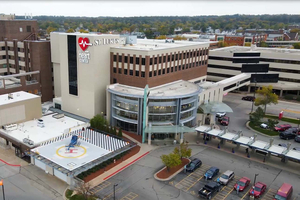
overhead shot of hospital complex
Unity Point Health-St. Luke's Hospital, Cedar Rapids
(Source: unitypoint.org)

This week's report from the U.S. Census Bureau showing the percentage of Americans without health insurance increased in 2018 shows that this issue is not going away any time soon (Casselman et al). The increase is the first since the economic recovery began, and the first under the Affordable Care Act of 2010. It occurred despite a decline in the poverty rate and sustained good economic indicators. When the economy flags, health care could become a real mess.

If the extent of health coverage has indeed peaked, it may indicate that President Donald J. Trump is successfully mismanaging the ACA to death, as he threatened to do in 2017. The administration has urged states to crack down on eligibility for Medicaid, which seems to be the biggest factor in the recent decline; it has also threatened immigrants their status would be affected by receiving Medicaid benefits, stopped enforcing the individual mandate, eliminated subsidies for insurance purchases, and stopped publicity and assistance efforts (Casselman et al).

James Morone's culture-centered review of seven decades of health care policy making, published in 2014, shows amidst the technical complexity and interest group influence there have been two strong themes throughout this time (2014: 172-173). Both themes have deep roots in American political culture. One is support for social insurance, the idea that all members of a community deserve a certain level of the stuff necessary for life. From Obama's second inaugural address: We are true to our creed when a little girl born into the bleakest poverty knows that she has the same chance to succeed as anybody else, because she is an American, she is free, and she is equal, not just in the eyes of God but also in our own (quoted at Morone 2014: 187).

The other is aversion to socialism, including what the American Medical Association's public relations firm began calling "socialized medicine" back in the mid-1940s. We are a nation of individuals who believe success (or failure) should depend on our own efforts, and that such success as we are able to attain should not be redistributed away from us by the government to someone whose efforts were insufficient to achieve the same good outcome. As Justice Antonin Scalia said during oral argument in the 2012 case, The federal government is... supposed to be a government of limited powers.... What is left? If the government can do this, what else can it not do?

Put that way, there's no escaping the value choice inherent in health care policy. My previous posts on health care, in 2013 and 2017, while allowing that responsible people could disagree, generally defined the problem as a case of fixable market failure. Morone (2014: 181-184) faults former President Barack Obama for an early focus on technical solutions that lost sight of the values underlying his policy effort.

So, let's talk values. To start with, I've already made explicit my communitarian values on this blog. From the start, I've argued that the problems of the 21st century--economic opportunity, environmental sustainability, social inclusion, and governmental finance foremost among them--point us to a shared destiny. We are a community, and the bell "tolls for thee," whether we like it or not. This has put me on the liberal side of today's American politics, despite my preference for non-partisanship. There's a lot to be said for markets and individualism, but I also believe our most serious common problems require collective solutions. Access to health care is one such problem.

Beyond that, I am a person of faith, at least nominally Christian, depending on your definition. I worship in the Christian tradition, at any rate, and find one particular aspect of Christianity distinctively compelling: the emphasis on redemption. No one, in Christian teaching, is ever so far gone that they can't recover. In fact, apparently nothing gets God off the couch to do the end zone dance of joy like recovering an individual thought to be lost. What do you think? Jesus asked his disciples. If a shepherd has a hundred sheep, and one of them has gone astray, does he not leave the ninety-nine on the mountains and go in search of the one that went astray? And if he finds it, truly I tell you, he rejoices over it more than the ninety-nine that never went astray (Matthew 18:12-13, NRSV).
Image result for parable of the lost sheep
Children's book version, from Concordia Publishing House

Of course, this story, along with the Good Samaritan and the lost coin and other examples, probably refers to spiritual rather than physical redemption, but as much healing as Jesus did during his lifetime, you'd think the logic could be extended. Sure, we are responsible for our own lives, whatever the hand we're dealt, as well as the consequences our actions have. But it must also be that no one should be allowed to fall so far as to be unrecoverable.

And that's what lack of health insurance--as well as its more obscure relative, underinsurance--do. People live precarious lives, getting sick more and longer, working and earning less, dying sooner, always one event away from financial ruin. This is one area of life where we have to have each other's collective backs, regardless of individual assessments of merit.

This is not to say the Affordable Care Act, even with needed revisions and better implementation, is the only answer to this need, nor is Medicare for All. By all means let's talk about a variety of approaches. That means engaging with the conversation in a serious way that looks for solutions, not ad hominem yipping about "socialism."

And it's even possible that heaven rejoices more over someone who is able to get health care they couldn't otherwise afford than they do over 99 healthy people, even if those people always eat right and exercise.

SOURCES

Ben Casselman, Margot Sanger-Katz, and Jeanna Smialek, "Share of Americans With Health Insurance Declined in 2018," New York Times, 11 September 2018, A1

James Morone, The Devils We Know: Us and Them in America's Raucous Political Culture (Kansas, 2014)


Monday, September 2, 2019

Mayors Bike Ride 2019


One year after rain forced cancellation of the event, the Labor Day Mayors Bike Ride was back on an utterly gorgeous day. Hundreds of riders participated, most of them enjoying the long route that began at Ellis Park on the northwest side. Among them was Brad Hart, mayor of Cedar Rapids, whose blue shoes you can see at lower left in the picture below. (For the record, the rest of Mayor Hart was attached to those shoes; it is just not pictured. He is in conversation with Councilman Dale Todd and my Coe colleague John Chaimov.)

A guest dj played pop songs of the 70s and early 80s, beginning with Peter Schilling's homage to David Bowie, "Major Tom." Attendees brushed aside the morbid nature of that song, and enjoyed complimentary coffee and doughnuts, along with information about trail development

 and bike safety.

Adequately caffeinated and doughnuted and safety-tipped, I headed out ahead of the crowd to my station on 10th Street SE, where I waved riders through and pressed the crosswalk button to keep the light green as long as possible. Due to construction on 3rd Avenue, the ride went down 4th Avenue, so I was a block away from my usual spot.

From there I had leisure for the following random thoughts:

1. Cycling in Cedar Rapids has come a long way. I wish for some exact numbers, but you don't need them to know that far more people are commuting by bicycle than were doing it ten years ago, when I first began volunteering at this event. The trails fill as fast as they can be built. A lot of credit goes to advocates like the Linn County Trails Association, the Corridor Metropolitan Planning Organization, and receptive people in city government like former Mayor Ron Corbett and City Council member Monica Vernon, who pushed for bike lanes and one-way to two-way street conversions. At least downtown and in the core neighborhoods, streets are more accessible to cyclists and pedestrians. Case in point: I don't know that this event has gotten more popular, but along my route I saw a lot of people riding other places, which is a change from even ten years ago. Even so... 

2. The Mayors Bike Ride still seems to surprise a lot of people. Enough people are plugged in to the event that it is annually a big deal. But I wonder how many other people are aware of it?--that is, before they encounter a huge cloud of cyclists as they make their way around town. A map of the route in the Gazette on Labor Day morning would let people know what streets are likely to be congested, so they could avoid them. (Yes, a lot of people in our town get their news from the paper version of the paper.) Today, one cyclist and one driver stopped to ask me what was going on. "The Mayors Bike Ride." "What's that?" I hope they join us next year!
Maybe this would be overkill for the Mayors Bike Ride, but we knew what was coming
3. Crosswalk countdowns can be confusing. I don't go as far as the prophet Jeff Speck, who argues in Walkable City Rules (Island Press, 2018) that cities should "Ban the beg buttons and countdown clocks," although it's a fair point that Anyone who drives in cities with these signals will tell you what its inventors should have realized: the rapidly ticking off seconds, in addition to informing pedestrians of remaining crossing time, also encourage drivers to gun it to beat the light (pp 178-179).

I will argue that where installed, the countdowns ought to be accurate. I've spent enough Labor Days at 3rd Avenue and 10th Street to tell you that at that traffic light, for which after all our conversations I've come to feel something like friendship, 0 means 0. At 1st Avenue and College Drive, on the other hand, the light continues to be green for maybe 20 seconds after the countdown runs out and before the green left-turn arrow.

At my station today, 0 meant 0... until the first wave of bicyclists came through. When the countdown came to 0, I held up my hand to stop them. This time, the light stayed green, which earned me a good bit of jawing from one thwarted rider. Subsequently I noticed that sometimes the light turned yellow when the countdown got to 0, and sometimes it stayed green for awhile. What this achieves I can't imagine.

View to the south, with the eccentric traffic light in foreground
4. 4th Avenue is still dreary. Standing too long at this intersection could depress a dachshund. Except for the lovely brick building housing the invaluable Catherine McAuley Center, we are pretty much in parking craterville.


View to the west across 4th Avenue SE 
Being in the MedQuarter means monotonous development and oceans of surface parking, albeit with banners...
and truly top-notch medical care should you require it. (I do.) This is too close to the center of town for the design to be this bad.

Justice in the World Today (II)

Rising rents are just one obstacle to opportunity today (Source: Joint Center for Housing Studies of Harvard University ) Some time ago, Fir...