Saturday, February 4, 2017

Globalization and global poverty

Source: Milanovic 2016
"The poor you shall always have with you," Jesus is supposed to have said, and either way it's probably true, but the forces of globalization have altered the picture of global poverty in dramatic ways.

The chart above is the "elephant curve," as presented by economist Branko Milanovic (cited below). The two decades after 1988 saw real income growth in much of the world, distributed in non-random ways. Many individuals in the middle of the global income spectrum saw their incomes increase, often sharply. Areas of the developing world that were "dirt-poor" at the beginning of this time period, particularly in India and China, developed a middle-class. The other winners, of course, were the already super-rich, who became known in the last U.S. presidential campaign as "the 1 percent." If anything the chart under-expresses the historically unprecedented growth in their incomes: A 60 percent increase in the income of someone in the 25th global percentile is going to be life-changing but quite modest in absolute terms compared to a 60 percent increase at the 99th percentile.

The losers in this process are the extremely poor, whose situations appear impervious to global economic changes, and the lower-to-middle-income people in developed countries. Thus, while worldwide income inequality has declined--particularly if you ignore the amount going to the top--inequality within countries has increased. This has, of course, driven the surly politics throughout much of the West, personified but not limited to U.S. President Donald J. Trump. At the same time, the wealthy countries are still wealthier, so remain magnets to immigration from poorer countries. The world isn't quite flat, and so immigration also is a prickly subject.

Global development was the target of a United Nations effort begun in 2000 called the Millennium Development Goals. A Brookings working paper assembles what data can be gathered to assess the effort, with mixed results (McArthur and Rasmussen). (I thought of writing "predictably mixed results," but mixed is a lot better than the despair we've become accustomed to hearing on this subject.) Even leaving out China and India, who are large enough and recently grown enough to skew the results, the authors identify

  • substantial progress in the developed world on child mortality, maternal mortality, AIDS treatment, primary school completion and gender parity
  • some progress on undernourishment
  • little or no progress on access to water, sanitation, biodiversity, forest cover and protected land area
  • insufficient data on extreme income poverty, but particular improvements notable in India
They estimate implementation of the Millennium Development Goals saved 21.0-29.7 million lives, but are agnostic about causes. Economic growth? Improved commodity prices? Development assistance? All happened, but don't account for the pattern of progress. A new round of goals, the Sustainable Development Goals, are set for the next 15 years.

So with mixed and uneven improvement in the last quarter-century, what trends in global poverty can we anticipate for the next quarter-century? You should probably ask an economist, an anthropologist, or a political scientist who can give you a definitive answer. In part it depends on how much globalization changes the composition of the world's poor (fewer Asians? more North Americans?). In general poor people in general are more vulnerable to systemic shocks than the non-poor, because they have fewer reserves to get them through the tough times. So more severe droughts, exacerbated by climate change and/or population growth, are likely to roll back what progress we have made, and to increase conflicts and refugee flows. A search for quick answers to economic stagnation in the West might trip off a cycle of protectionism, which would hit the most vulnerable the hardest, without necessarily helping national constituencies if it causes global productivity to contract. Energy shortages would be interesting, since the West uses much more energy per capita than does the developing world.


My hunch about communities in America is that they'd all be better off by promoting local businesses and sustainable living, with less dependence on big box franchises and federal grants. So it's what I'd like to see happen in Pakistan and Nigeria as well. Is that possible, or is globalization too far along?

SOURCES

Miles Corak, “Worlds of Inequality,” American Prospect, 18 May 2016 [review of Global Inequality: A New Approach for the Age of Globalization by Branko Milanovic (Belknap/Harvard, 2016)]

Nicholas Kristof, “As Donald Trump Denies Climate Change, These Kids Die of It,” New York Times, 6 January 2017 [includes link to BAMS article attributing reduced rainfalls in southern and eastern Africa to human activity and resulting in “substantial food crises]


John McArthur and Krista Rasmussen, “Change of Pace: Accelerations and Advances during the Millennium Development Goal Era,” Brookings Working Papers, 11 January 2017

Miroslav Nincic and Matthew Weiss, "The Future of Transboundary Water Conflicts," Political Science Quarterly 131:4 (Winter 2016-17), 717-748 

Friday, January 27, 2017

Argumentation for a new age: From Michael to Sarah

Source: YouTube
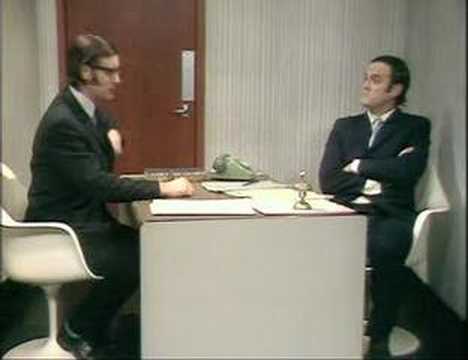
An argument's not the same as contradiction, pleads Michael Palin's character in Monty Python's Flying Circus's classic sketch, "The Argument Clinic." An argument's a collected series of statements to establish a definite proposition. To which John Cleese responds: No, it isn't.

I teach a bit of argumentation in my political theory classes, where I try to drill students in the basic structure of conclusion-premises-evidence, where the conclusion is the point or thesis you're trying to establish, the premises are the steps leading to the conclusion, and the evidence is the set of reasons--including observations, analogies and/or authorities--that the premises and conclusion are to be believed. We practice on articulating arguments from classic and contemporary texts, which I hope promotes respectful attention to the arguments of others, even those with whom we fundamentally disagree. A well-written paper will articulate the argument from the text, then explain specifically where the argument succeeds or fails to convince. You can disagree with someone, see, but still treat them with respect. In fact, such respect makes your counter-argument more powerful as well as making a formula for reaching common ground more likely. A similar logic informs the approach known as Rogerian argument. (Thanks to Jane Nesmith for introducing me to this term.)

Then my students go off into the world, and I'm anxious for them, because I don't know that I haven't prepared them for the world I wish existed instead of the one that really does. Such is the state of contemporary American politics that I feel like I'm training boxers in the Marquess of Queensbury rules when they're headed for street brawls.

I'm certainly no expert on street brawls, and observe contemporary American politics from a safe distance, but here are the approaches to argument that today's winners have in their tool kits. If you insist on traditional methods, you can at least recognize what you're being pummeled by:
  1. Gaslighting. This all-purpose technique involves redirecting the subject to ground that is stronger for your side, whether or not it was part of the original statement--if necessary make up something they didn't say--or even at all relevant. Creative is good, true is optional as long as it can't quickly be refuted. A good example is Mr. Trump responding to Rep. John Lewis questioning his legitimacy by knocking the poor conditions in Lewis's congressional district. (Conditions are not poor there, but who knew that?) However, the president-elect was foolish to call Lewis "all talk and no action," because Lewis's civil rights bona fides are well-known, so we are inevitably led to investigate what Trump was doing in 1965 when Lewis's skull was being cracked by Alabama state troopers.
  2. Alternate Facts. Formerly known as truthiness, this phrase was originated by Trump advisor Kellyanne Conway to explain away a bizarre post-inauguration press briefing, and has occasioned sufficient comment that anything I'd add would be superfluous. As the perfect mom in some Disney movie once said, "If you believe it, then it's true." But seriously, what is a "fact," anyway?
  3. Real-Americanism. Rogers Smith (Civic Ideals: Conflicting Visions of Citizenship in U.S. History, Yale University Press, 1997) considers "ascriptive Americanism" to be a historic characteristic of American political culture. This is ascriptive Americanism on steroids. Meryl Streep shouldn't comment on American politics because she's a Hollywood actress and therefore does not represent real Americans. Colin Kapernick shouldn't comment, even silently, on American politics, because he's a well-paid professional athlete. I shouldn't comment on American politics because I'm a college professor. One of the most beautiful things about America is that it is made up of an amazing variety of individual experiences, but ignore this! People who agree with you are from the real America; people who disagree are "phony."
  4. Reductionism-ism. Causal Reductionism is attributing things (events, behaviors or other phenomena) to single causes. While simplicity is a virtue in theories, oversimplification can lead to misunderstanding of complex phenomena like poverty, economic growth, crime, or the climate. "Reductionismism" is my term for the belief that phenomena can only have a single cause. For example, if climate change occurred in the 6th century CE, it clearly was not caused by human industrial emissions of carbon dioxide and methane. Therefore, climate change in the 21st century is not caused by human industrial emissions of carbon dioxide and methane.
  5. You're a Towel-ism. I've named this in honor of Towelie, a character on "South Park." This approach simply involves batting every charge back on the accuser. For example, to the words "Donald Trump plays to racist stereotypes of Mexicans," you would respond "You're a racist."
  6. Manly-ism (a.k.a. "Calling Wussy"). Have a stock of all-purpose insults available when nothing else springs immediately to your mind. Who can forget Sarah Palin saying someone "got his panties in a wad," even if they can't remember who it was (Chris Christie, in 2012) or why?
Extra points for putting down someone's manhood! Machismo and belligerence are for some reason extra-attractive these days. An Iowa legislator, Rep. Bobby Kaufman of Wilton, called one of his well-considered initiatives the "Suck It Up, Buttercup" bill.

Any of us might fail to show respect in situations of emotional stress, but these techniques are increasingly staples of what we can laughingly call contemporary American political discourse. They don't solve problems, and they don't build community, because they treat the other person as an enemy who should be silenced or destroyed. But, hey, at least you're winning.

Wednesday, January 18, 2017

Akwi Nji on choosing justice over comfort


Our role as Americans is to work for social justice and against mistreatment and hate, however uncomfortable it may be for us or to others who see such work as directed at them, said Akwi Nji, a Cedar Rapids writer and performance artist who was the keynote speaker at St. Paul's United Methodist Church's annual Martin Luther King Day celebration. She drew on the example of Dr. Martin Luther King, Jr., who she said chose discomfort in the cause of justice, such as when he alienated his own allies by taking a stand against the Vietnam War in 1967.

Nji compared society to a seesaw; the "teeter-totter" was a staple of playgrounds past although maybe not as much anymore. The operation of a seesaw requires two people to work in tandem, each using their own weight to allow the other to go up in turn--a reciprocal process involving roughly "equal weight and equal work." "That is our only option," she argued in applying the metaphor, as no individual can remain always at the top. "If we insist on playing alone we'll always find ourselves at the bottom," no matter how much money we have or how fabulous our house.

Seesaw, from clipshrine.com
"Offering the weight that might help others to soar" means working with organizations we believe in, however we can. There is "never a reason to rest" working together for social justice; "it doesn't have to be every day but it should be most days." She referenced an essay recently published on the web platform ExtraNewsfeed, in which she described an encounter with a racist at a restaurant. She realized afterwards, based on the number of people who approached her to offer sympathy, that numerous people at the restaurant "heard [what the racist was saying] and believed it was wrong but did not step in." While others who were not present have told her they would have stood up for her had they been there, she is understandably dubious. "We'd all like to think we would [speak up], but a lot stands in our way." Most of those obstacles are fears--of losing face, of giving offense, maybe of getting hit. King faced fears, too; his house was bombed in 1956 and death threats were constant.

Here is Nji at her most challenging. She began her address by reminding her audience that "This is our America," including all, "whether you were born here or not." She said she "still believes in our country" at the close of the Obama administration, because she trusts most of our fellow citizens and that Dr. King was right when he said "the arc of the moral universe bends toward justice." But she added that justice "won't happen on its own," and asked her listeners two basic questions: What do you stand for? With whom do you stand?

I personally feel challenged by Ms. Nji's questions. Last spring, I explained that I feel a particular calling to critical analysis; I also see my work as a college professor to be a professional explainer of phenomena, of people to each other. But at what point do events make that stance untenable? Here on Holy Mountain, I stand for an inclusive community, as opposed to a collection of atomized individuals or hostile groups, in which every individual has the opportunity to live his or her best life. I stand with those whose opportunities are limited, by circumstance or by the greed and judgment of others. But a blogger like me has the luxury to do careful reasoning and research. That doesn't forestall people calling me a communist or a hater, but it allows me to stand on fairly solid argumentative ground. Many of my blog posts even come with citations! It's altogether different to imagine myself intervening in a conversation in the next booth over, which is irritating but also seemingly private. I mean, in my confrontation with this lout, where would the citations go?

It's enough to make me doubt third places, although the prophet Ray Oldenburg describes a true third place as one where everyone in the place is part of a community that, among other things, enforces social norms (The Great Good Place [DaCapo, 2nd ed, 1999, 75-80). I doubt the lout who harassed Ms. Nji is big on social norms, but surely he was counting on being able to conduct his harassment without being interrupted.

So what do you stand for? With whom do you stand? And how do you make that stand?

SEE ALSO: Akwi Nji, "A Night in the Life of a Black Woman," ExtraNewsfeed, 11 January 2017
Soo Oh, "How to Intervene When You See Street Harassment: An Illustrated Guide," Vox, 21 January 2017
Mariah Porter, "Coe Celebrates MLK," The Cosmos (Coe College), 20 January 2017, 1, 3
Makayla Tendall, "MLK Day Celebration Focuses on the Power to Change Community," Cedar Rapids Gazette, 16 January 2017

EARLIER SEASONAL POSTS:
"Claudia Rankine on Race," 23 January 2016
"Speakers Raise Tough Issues at Coe MLK Celebration," 19 January 2015
"The Race Card Project," 12 February 2014

Rev. Jonathan Heifner of St. Paul's convenes the gathering
Judah Praise from Mt. Zion Missionary Baptist Church provided music

Imam Hassan Selim of the Islamic Center (right)
accepts the 2017 Percy & Lileah Harris "Who is My Neighbor" Award
Mt. Zion Missionary Baptist Church Choir provided music and amusement


Sunday, January 15, 2017

The future of religious places (III)

Source: faithandform.org
It's mid-January already, way past time to have a good long look at the 2016 International Awards for Religious Art and Architecture announced by the journal Faith and Form. Jurors represent artists, architects and clergy, so there's an interesting mix of considerations in the awards.

A marked trend this year, notes journal editor Michael Crosbie, is the use of natural materials and particularly of natural light. This might represent a long-term trend away from the dark, cozier and more mysterious sanctuaries of the early- to mid-20th century, which of course are the churches in which many people of my generation grew up. (A number of people note that movie theater-style churches are their own, quite different trend.) The Palm Beach (Florida) Synagogue has light coming in all around the worship space, with room for stained glass at the top of the windows:
Source: faithandform.org
Chicago's Chapel of St. Ignatius might overdo it, in that it's hard to imagine being comfortable in there on sunny summer days:
Source: faithandform.org
John Kenneth White (cited below) wrote a lot about considering what the worship space says about the role of the worshiper. The Chapel of St. Ignatius above has members of the congregation facing each other, with those officiating in their midst, suggesting a more participatory orientation. Many older churches, like the amazing and recently-restored St. Patrick's Cathedral in New York City, have their services officiated in a space at the front of the church, separated from the congregation. This can put the worshiper in the role of spectator, although that effect surely can be mitigated with hymns and responsive prayers and such.
Source: faithandform.org
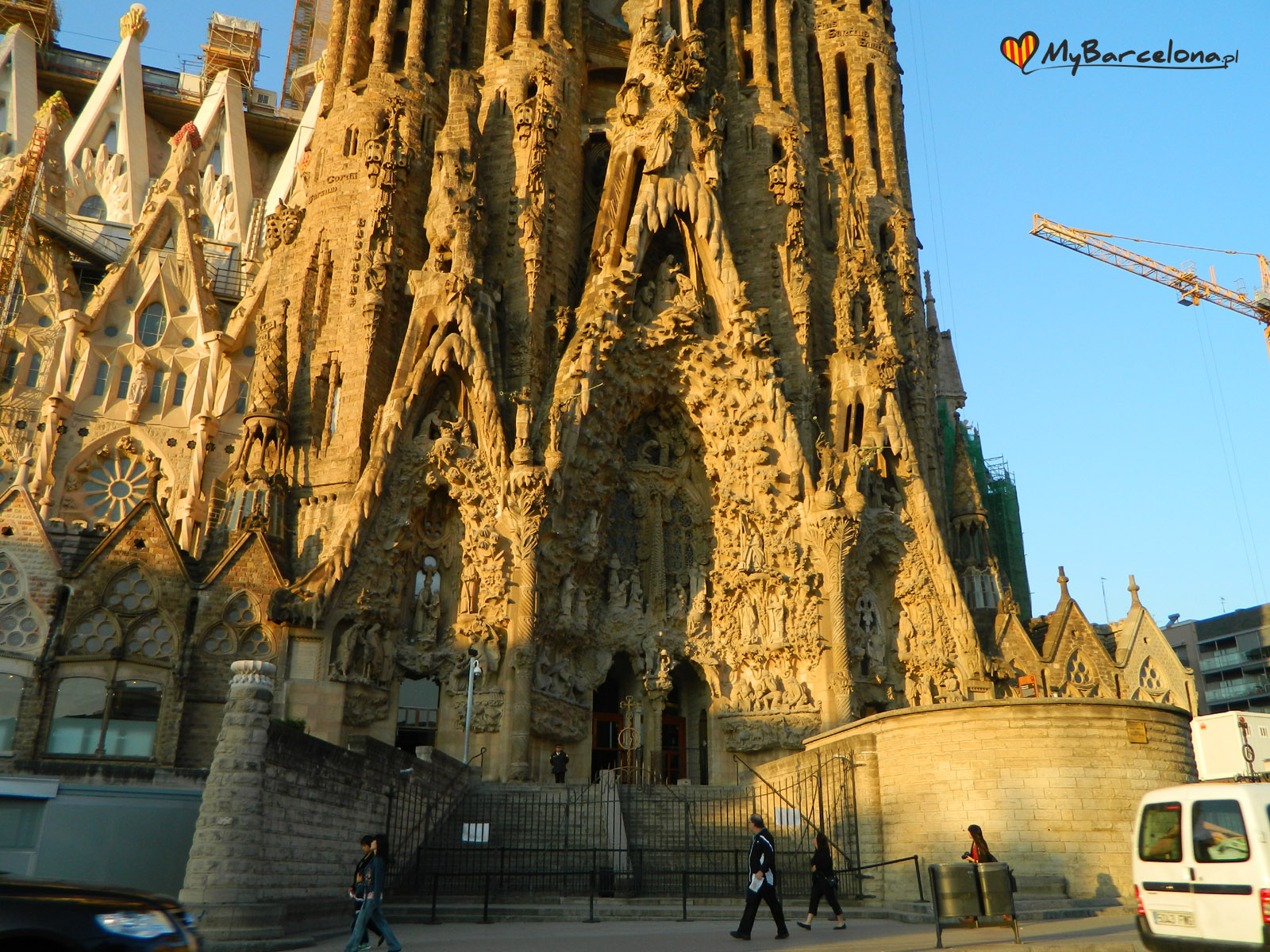
As I noted last year, the Faith and Form awards focus on the buildings themselves, particularly the interiors, as opposed to how the buildings interact with their surrounding neighborhoods. That interaction matters, however, because it articulates the social role of the worshiper as well as an understanding of society. To what extent does a worship structure relate to the buildings (and people) around it? To what extent does its exterior invite the stranger in? I was rather surprised, in seeing Stefan Haupt's documentary on the spectacular Sagrada Familia in Barcelona, that despite its size and the ongoing construction, to the extent the film showed it, it fit quite well with the streets around it.
Source: mybarcelona.pl
Churches of whatever design, surrounded by acres and acres of surface parking, don't do this nearly as well.
Source: myamericanodyssey.com
Worship spaces matter to our common life because we ask them to provide a number of things--quiet and comfort for individuals (whether members or not), a space to come together in common activity, a base for action in the neighborhood and the world, the familiarity of home for long-time members, a place accessible to potential new members--while they are themselves neighbors as well as important civic buildings. We should celebrate design that can do all this!

SEE ALSO
Michael J. Crosbie, "2016 International Awards Program for Religious Art & Architecture," Faith and Form 49:4 (December 2016)
Aaron M. Renn, "Why Contemporary Protestant Church Architecture is So Poor," Aaron Renn, 14 August 2014
"Sagrada Familia: The Mystery of Creation" official site (First Run Features, 2012)
John Kenneth White, Protestant Worship and Church Architecture: Theological and Historical Considerations (Oxford, 1964)

EARLIER POSTS:
"The Future of Religious Places (II)," 24 January 2016
"The Future of Religious Spaces," 8 January 2015
"Homes, Home Churches and Hometowns," 15 September 2014

Saturday, January 7, 2017

The changing (not so much) electorate

Source; WikiMedia Commons
The eccentricities of our new President aside, American national politics and government in 2017 seem mostly similar to those of the past generation or so. The same policy challenges face us, most notably environmental sustainability, climate change, accommodation of diversity in our communities, security, and the fiscal solvency of government at all levels. All of these raise questions of subsidiarity i.e. the doctrine that public problems should be addressed at the level of government that is as close to the people as practicable. There are serious questions about whether national government involvement in, for example, transportation funding, leads to better outcomes or worse policies (Marohn).

At the heart of all of these issues is the one I think the biggest of all: economic opportunity. It is difficult to sell affordable housing, or immigration, or environmental regulations, or even sidewalks, if people feel their economic prospects are fragile, while those below them on the economic ladder are likely to be idle and dangerous. The 2010s have seen improved economic conditions, including a record 75 consecutive months of job growth, but an NBC/Wall Street Journal in October found nearly half of respondents still "worried or uncertain" about the country's economic future (Source: pollingreport.com; see also Casselman, Porter). On a variety of policies, it's hard to take the long view if you're worried about the short term. And it's hard to come together on policy solutions without the social trust that I'm sure would be facilitated by broader economic opportunity.

Now comes, to this familiar menu of problems, the 45th President and the 115th Congress. We only have exit polling data so far, but as far as we can tell from that, the demographic groups that elected them followed patterns similar to other elections dating back to the 1980s. It was during the Reagan years that the New Deal's primarily economic-based party alignment (with a side order of Civil War nostalgia) became crosscut with cultural issues. Demographic group behavior in 2016 looked a lot like 1988 and all the elections in between.

The widely varying electoral outcomes of the past thirty years or so reflect differences in turnout between the party's bases. Increasing polarization in the electorate means mobilizing the base is as much or more important than appealing to the middle (Theriault, Abramowitz). Voting turnout is up among strong partisans and down among independents, and "ideological sorting" means those strong partisans are also strongly ideological. Moreover, geographical sorting means voters live in more politically homogeneous neighborhoods and counties (Bishop); this far more than gerrymandering accounts for the shrinking number of swing states and districts. (The two presidential candidates in the close election of 2016 were within five percentage points of each other in only 11 states, albeit that number is up from five in 2012. Trump won six of the 11, including the big prizes of Florida [29 votes by 1.2 points], Pennsylvania [20 by 0.7] and Michigan [16 by 0.3].)

In the 2016 exit polls produced by the National Election Pool and reported by The New York Times and Cable News Network (CNN) we see typical patterns of partisan support from categories of sex, race and religion. The Times report includes changes from 2012, and there are some interesting ones--Asian Americans voted 11 percentage points higher for Trump than they did for Romney--but they don't come with a ready explanation and are subject to question given the nature of exit polls.

Socio-economic status is a different story. For a long time, Republican support has increased with income level, though the effect is less strong in the post-Reagan era. Education, meanwhile, has for three decades typically shown a strange pattern, with Republican support increasing with education level up to bachelor's degree, then shifting sharply Democratic for those with education beyond a bachelor's degree. The 2016 exit polls sort of continue these patterns, but the groups are extremely compressed. The highest income level is only seven percentage points more Republican than the lowest income level, which is probably neither statistically nor substantively significant. Education groups are all similar, except for "postgraduate" which remained decidedly Democratic. Broken out by race, we see why: Trump won heavily among whites without a college degree, while the candidates split more highly-educated whites and Clinton retained the traditional Democratic advantage among nonwhites regardless of education level.

What's going on here? Political scientists who've studied public partisanship, like Alan Abramowitz, note that it is pronounced among the engaged public. "This group," says Abramowitz, "is made up of citizens who care about government and politics, pay attention to what political leaders are saying and doing, and participate actively in the political process" (p. 4). Engagement has been found to increase with socio-economic status. But maybe that changed this year? It seems on this superficial examination of exit polls that lower-status groups have now polarized along partisan-ideological lines, which worked, at least this year, to Trump's advantage.

This begs a number of questions which, thanks to this not being a natural science using laboratory experiments, are impossible to answer with any certainty, but I'll ask them anyway. What if the 2016 Democratic candidate had been a more ideological candidate capable of channeling public outrage (think Bernie Sanders)? What if the 2016 Democratic candidate had been from the mainstream of the party but without Clinton family baggage (think Joe Biden)? What if the Republican candidate had been from the mainstream of the party without the weaknesses exposed in the 2016 field (think a non-92-year-old Bob Dole)? What if the election was decided by popular vote not the Electoral College?

We move, then, from fruitless but fascinating speculation back to the issues that started this post, and which generally fuel this blog's discussion. I am not hopeful. Trump, despite his blunderbuss of a personality and erratic policy statements, has apparently not been disruptive enough to break the familiar patterns of American national politics. The Republican Party has parlayed a marginal advantage in nationwide vote distribution into unified control of the national government as well as many states, but has shown less interest in solving these issues than in denying their existence. Experience in states like Kansas, North Carolina and Wisconsin show the policies we're likely to get from unified Republican control are those that payback their constituencies, some ideological (limit abortions, support Israeli settlement in the occupied territories) but mostly economic (lower taxes and less regulation for health and safety).

Even for those who want to take a principled approach to our most troublesome issues, there is a notable lack of readily available policy solutions, particularly as there is neither a pile of money nor the political will to pay for them. (Is it me, or has every national policy advocated since the rise of supply-side economics in 1980 been required to be "free" i.e. paid for either by somebody else [the 1 percent, smokers, Mexico, e.g.] or by magical thinking about future economic growth? I mean, I love free stuff, too, but these are serious problems worthy of serious collective thinking!)

Hence the attractiveness in 2016 of expressive politics. The 2016 election makes sense if voting for Trump (or Clinton, or Sanders) is seen as a gesture rather than a constructive choice among alternative policy futures. Trump's odd collection of statements and policy reversals, which would have done in many an earlier candidate, don't matter because the election wasn't about policy, or problems, or even empirical reality. It was about making a statement about who is "us" and who is "them." In that case, the president-elect's insults and taunts in the run-up to his inauguration are far more important to his electoral appeal than his health care policy.


Thursday's New York Times carried two columns about health care on their Op-Ed page. One, by Drew Altman of the Kaiser Family Foundation, warned based on focus groups that Trump voters "will not be happy if they are asked to pay even more for their health care" as appears highly possible given naming of Rep. Tom Price as his Health and Human Services secretary. Really? Unhappy enough for health care to be a voting issue? Directly below Altman's column, and next to the other health care one, radio news director Robert Leonard approvingly quotes former Republican Representative J.C. Watts on the cultural differences between the parties: We become good by being reborn--born again. Democrats believe that we are born good. that we create God, not that he created us. If we are our own God, as the Democrats say, then we need to look at something else to blame when things go wrong--not us. If Leonard's right that that's what conservatives think about liberals, and if liberals think something equivalently condescending about conservatives, we're a long way from serious thought about fixing the health care system or anything else.

Expressive politics can be fun, I'm sure, but not constructive. Their ongoing prominence shows how far we are as a country from the level of social trust needed to have conversations about solving our problems and build stronger communities.

WORKS CITED
Alan I. Abramowitz, The Disappearing Center: Engaged Citizens, Polarization, and American Democracy (Yale University Press, 2010)
Bill Bishop, The Great Sort: Why the Clustering of Like-Minded America is Tearing Us Apart (Houghton Mifflin, 2008)
Ben Casselman, “Inequality Is Killing The American Dream,” FiveThirtyEight, 8 December 2016
Charles Marohn, "A Big Pot of Money," Strong Towns, 6 January 2017
Eduardo Porter, “America’s Inequality Problem: Real Income Gains Are Brief and Hard to Find," The New York Times, 13 September 2016
Sean M. Theriault, Party Polarization in Congress (Cambridge University Press, 2008)

PLUS: I just ran across this citation... haven't read it, might be worth a look...
Leonie Huddy, Lilliana Mason and Lene Aaroe, "Expressive Partisanship: Campaign Involvement, Political Emotion, and Partisan Identity,” American Political Science Review 109:1 (2015), 1-17.

EARLIER POSTS
"The Election and Our Common Life," 18 November 2016
"Deliberation and the Shutdown," 3 October 2013
"Climate Change and the Dysfunctional Congress," 27 June 2013
"What's the Matter with Congress," 30 May 2013

Thursday, December 29, 2016

What the hell, Chicago?

Source: Chicago Tribune
Eleven people were shot to death in Chicago over Christmas weekend, bringing the total number of murders in the city in 2016 to over 750 (Bosman and Smith). It has been a distressing year, to say the least, in the Midwest's largest city, and it casts doubt on the whole urbanist project.

The murder epidemic comes after a 25 year decline in violent crime in the United States, including in the State of Illinois, where the rate per 100,000 population dropped from 1039 in 1991 to 370 in 2014. Nationally, violent crime in 2014 was 51.3 percent of the 1990 rate (Source: FBI Uniform Crime Reports, aggregated at disastercenter.com). As I wrote in August, there are at least 11 explanations for this decline, which is too many to be encouraging, particularly when crime comes roaring back as it has in Chicago this year. And if that's not enough to worry about, consider this: the number of people shot in Chicago in 2016 exceeds 3,500 (Bosman and Smith again). Were it not for advances in medical science the number of deaths by murder would be much higher, wouldn't it?

Confoundingly, but happily for the rest of America, Chicago's year has not been replicated across the country, and indeed most of the homicides have occurred on the South and West sides. The Times article notes that neither Los Angeles nor New York has had anything like Chicago's experience; in fact Chicago's 2016 total exceeds those of the two larger cities combined. Smaller cities, too, have had widely varying experiences. So, what is going on? And what can be done?

Arthur Lurigio of Loyola University, cited in the Times article, suggests Chicago's suffers from a combination of easily available guns, persistent poverty, and escalating gang violence exacerbated by social media. One of my students who grew up on the South Side has written feelingly of how his neighborhood became increasingly unsafe beginning around 2006, when he would have been eight; his conversations with law enforcement suggest that a mid-decade scrambling of public housing residents put members of rival gangs in close and dangerous proximity to each other. Meanwhile, the police feel hamstrung by politicians critical of police shootings of black youth.

Chicago's experience is of national interest, because when a lot of people hear "urban" the image they get is not walkable, sociable neighborhoods with opportunity for all--or the commercial meccas of Michigan Avenue and New Bohemia--but the image of crime-infested, dirty streets filled with drug addicts. Whether the issue is sidewalks or affordable housing, design form or corner stores, at the root of pushback is: Don't bring the city to my neighborhood. Because we know what cities are like! (See above.) I can relate to this, having spent an embarrassing proportion of my suburban youth scared to death of Chicago. And, frankly, if there are going to be 750 murders somewhere, I'd rather it not be in my neighborhood.

But the deadly ghettos of Chicago are not examples of urbanism; their people are suffering from the lack of it. The poor areas of America's inner cities and first-ring suburbs are the flip side of the suburban development pattern that created well-off areas on the metropolitan edge. Those left behind need urbanism as much or more than anyone else.
People struggle, and on top of that, in many instances, people have lost hope in their government. They've lost hope that something is going to change for them. And if we can't keep hope alive, then you don't have to wonder whether things are going to get better or worse: They'll get worse. --ALD. DANNY DAVIS, quoted in Bosman and Smith
Everyone needs access to economic opportunity--a difficulty even for the middle-class in these times, much less for the poor who have been cut off for decades by the suburban development pattern. That means redesigning, or undoing a lot of the design of the last several decades, in order to make our cities more inclusive. That means, in part, breaking down barriers and encouraging more spontaneous interaction. There are dangerous people out there, and they should be in jail, but even justifiable fear does not justify cutting off huge chunks of the population. And then blaming them when they don't prosper.

Investment in our cities is fine, but must be aimed at ensuring opportunity for all. Which brings us to the the interesting case of City Center DC...
Source: citycenterdc.com 
...a development in downtown Washington with high-end shopping, fancy restaurants and super-luxury condominiums. Backers of the project point to the flow of tax revenue to the city from sales and rents; apparently at these prices it doesn't take many of either to generate some nice cash flow. But, as a discussion last week on WAMU's "Kojo Nnamdi Show" pointed up, the area has not seen the foot traffic you'd expect from a successful retail area. But more popular stores would not be "driving value upstairs," because condo buyers would rather live above Louis Vuitton than above McDonald's or Wal-Mart. All this proves, I guess, is that a lot of people don't want to live around a lot of other people, and some are able to pay handsomely for the privilege. I hope they're paying very handsomely, enough for Washington to upgrade its education, transportation, small business resources and social services.

But CityCenterDC is not a model for urban development. It's another example of what Michael Mehaffy (cited below) calls the "trickle-down" approach to development--"concentrating attention at the top and in the core, in the hopes that it will 'trickle down' to all"--albeit CityCenterDC was financed by a Qatari sovereign wealth fund rather than the local government itself. He calls, in the spirit of Jane Jacobs, for cities to shun quick fixes and instead
to diversify geographically and in other ways--to move into a system of polycentric complete neighborhoods, and find ways to catalyze more beneficial growth there... In addition, diversity in types, ages and conditions of buildings is also important to maintain diversity in populations and incomes.... Furthermore, while public investment is still important under this approach, it is not used as a way to "socially engineer" problems like affordability through direct expenditures, but rather, it is a catalyst for an alternative kind of pervasive growth that is more beneficial. This is an approach that treats the city as an organic whole, rather than a top-down money-making machine that can be tinkered with at will. (non-italics mine)
I'll admit to being often the pessimistic voice in the crowd, but I think, in spite of such Chicago-specific factors in this year's upsurge in homicides, that Chicago is probably just the first sign of fraying in our national fabric. President-elect Trump's bluster notwithstanding, we can't shoot our way out of this mess. Nor, the urbanists argue, can we blast our way out through big civic projects, no matter how many jobs they allegedly create. The only way out is by making great places by solving the puzzles of economic opportunity and inclusion. Maybe we could start with ice cream?

SOURCES

Julie Bosman and Mitch Smith, "Chicago Tallies Grim Accounts of Violent Year," New York Times, 29 December 2016, A1, A13

Michael Mehaffy, "A Tale of Two Futures," Public Square: A CNU Journal, 15 December 2016

Jonathan O'Connell, "D.C. Got Everything It Wanted Out of CityCenterDC--Except the Crowds," Washington Post Magazine, 8 December 2016

Pete Saunders, "Something Amiss in Chicago," Corner Side Yard, 1 April 2016

City Center DC is located on H Street NW between 9th and 11th Streets.

Sunday, December 25, 2016

Urbanist existentialism?: "At the Existentialist Cafe" and other stuff I've recently read

See the source image

Works discussed:
Sarah Bakewell, At the Existentialist Cafe: Freedom, Being, and Apricot Cocktails (Other Press, 2016)
David Bosworth, The Demise of Virtue in Virtual America: The Moral Origins of the Great Recession (Front Porch Republic, 2014)
Ben Kaplan, "I Love You, Cedar Rapids," Corridor Urbanism, 28 September 2016
Brandon Kendhammer, Muslims Talking Politics: Framing Islam, Democracy and Law in Northern Nigeria (University of Chicago, 2016)
Katie Kennedy, Learning to Swear in America (Bloomsbury USA, 2016)
Ray Oldenburg, The Great Good Place: Cafes, Coffee Shops, Bookstores, Bars, Hair Salons and Other Hangouts at the Heart of a Community (Paragon, 1989)
Kate Wagner, "A Pictorial History of Suburbia," Welcome to McMansion Hell, 18 December 2016

Heidegger and Sartre, drinking poppy tea
I could have sworn last night I passed out in my van
And now those boys are pouring one for me
--JOSH TILLMAN, "I'M WRITING A NOVEL"

I first encountered existentialism in high school French class--L'Etranger by Albert Camus--and it was not a happy encounter for either of us. Learning an unfamiliar worldview in a foreign language magnified its apparent weirdness to this Midwestern suburbanite. In In Search of Authority (Free Press of Glencoe, 1964), Henry S. Kariel describes Camus's "ideal of the absurd man" as the ultimate realizations that we are unable to impose meaning on our lives, that "there is nothing in the end except extinction," and that "our plans are simply ours and not derived from God, History or some transcendent Rationality" (pp. 172-173). I don't know what would have happened had I adopted those realizations at age 16, but I was not willing to risk even giving them serious consideration. My high school experience probably had more in common with the unfortunate M. Mersault than I was willing to admit; simply to make it through the absurdity of each day I needed desperately to believe it would somehow make sense in the end when my efforts would pay off. So, no existentialism for me!

That lesson unlearned, I've come to urbanism with a strongly utilitarian-positivist bent. I always want to know what things are good for, what works, to see the data. When I first read Jane Jacobs (The Death and Life of Great American Cities, Random House, 1961) on how cities work and the disastrous effects of urban renewal, it was her piles of evidence that spoke to me. When Jeff Speck in Walkable City (Farrar Straus Giroux, 2012, pp. 179ff.) commends one-way-to-two-way conversions because studies have shown they're better for businesses and safer for pedestrians, that speaks to me. I like books like The Smart Growth Manual (McGraw Hill, 2010) and Tom Vanderbilt's Traffic (Knopf, 2008) and websites like Strong Towns and Place Makers and Human Transit, and speakers like Ellen Shepard of Community Allies. Alongside the utilitarianism are the ethical concerns of my Christian upbringing, though truth be told I think my utilitarianism has influenced my religious beliefs as much or more as the opposite.

But there remains some of the urbanist message that speaks to a soul I wasn't sure I had. Thanks to Sarah Bakewell's lively and intelligent At the Existentialist Cafe, I'm thinking I might have at some level been speaking existentialism all this time without knowing it. Urbanists, take note! The story of existentialism even begins over drinks at a third place, the Bec-de-Gaz bar in Paris. Bakewell's biographical approach to the story highlights the conflicts among this group of philosophers as well as individual twists and turns, but one theme that runs through all of this is the quest for authentic existence. On the other side of the same coin, to be truly and fully human is to be free. Moreover--unlike the phenomenologist Martin Heidegger (1889-1976) who found his freedom in the isolation of his cabin in the woods--for most of the existentialists authentic existence required not only engagement with other people as individuals but with rectifying conditions in society. It was surely difficult to remain in a free state of consciousness while engaging publicly, if only because public action requires compromise, and they were many of them difficult people. Bakewell pulls no punches in this respect, but it's inspiring to see great minds at work getting toward the root of things amidst the noise and harangue of conventional wisdom, and then trying to live their conclusions.

Existentialists might agree on one thing: There's got to be more to freedom than driving your SUV to Wal-Mart to buy a gun. Or being able to deny your employees health insurance coverage for birth control.

In Katie Kennedy's young adult novel, Learning to Swear in America, physics prodigy Yuri Strelnikov is summoned to the United States from his native Russia to help save us from being wiped out by an asteroid. He faces threats to his freedom from governments: American security agencies have decided he's learned too much and are determined to prevent his leaving, while at home Putin's government has helped itself to credit for his advisor's research. But the biggest threat to his freedom is his own lack of authentic existence, because he's been living in a scientific bubble (to which is now added a security cordon). It's an unplanned encounter with an eccentric girl--an urbanist event that is set in a very un-urbanist parking lot--which begins his quest for himself that drives the story. "You gotta learn to live life, not just save it," she tells him on page 108.

Photo accompanying Ben Kaplan's essay. I will probably get around to asking permission soon.
The non-fictional Ben Kaplan knows this. Ben has a mind like a steel trap, and can cite the relevant studies on any urbanist topic. But at the core of his connection to his city is the authentic experience of ongoing engagement with his neighborhood:
It felt like as I grew up the city grew up with me. A futon and Ikea tables got replaced with real furniture from Mad Modern. I met people who owned their own businesses, who volunteered, who had great big dreams for what this place could be. I got to follow the first cohort of the Iowa Startup Accelerator as an embedded journalist. I’ve had two serious boyfriends while I’ve lived down here. I’ve stormed out of CSPS during intermission in anger and I’ve watched the sunrise paint the skyline pink from my balcony while I rested my head on someone’s shoulders. I have a built a group of friends whom I love and who I can’t imagine my life without. I have learned that I will never make better falafel than what I can get at Zaytoon’s.
Authentic existence through engagement with others drives Ray Oldenburg's urbanist classic on third places. Oldenburg bemoans "the lack of community life in our residential areas" (p. 4) as American counterparts of the Bec-de-Gaz fell victim to the suburban development pattern and longer work hours. (They may well be making a comeback, though, which he celebrates in a later work, Celebrating the Third Place [Marlowe, 2001].) The negative aspects of this loss are partly empirical--higher levels of individual stress including heretofore-unheard-of childhood depression, crime, marital stress and divorce--but also spiritual: "The processes by which potential friends might find one another and by which friendships not suited to the home might be nurtured outside it are severely thwarted by the limited features and facilities of the modern suburb" (p. 8). Too much structure, however willingly accepted, means a less free and less authentic existence.

smiling David Bosworth
David Bosworth, from his webpage

David Bosworth's book is about virtue not being, and he doesn't call himself an existentialist, but as he documents the many ways "Evangelical Mammonism" has perverted America's core principles ("virtue"), they invariably involve a gradual surrendering of engaged, authentic existence. Writing in the wake of the 2008 recession, which surely was as much a moral failure as a financial one, he dissects ways that the stories we tell ourselves obstruct us from authentic existence by pretending that the most imminent threats to our freedom aren't making our choices for us.
The problem hasn't been just a few "bad apples," nor even a mismanaged orchard on the left or the right, but the long-term revision of a cultural environment whose "moral field" we all share and for whose current ill health we are collectively, if not equally responsible. To make sense of that decline, we need to consider instead a broader set of ruling ideas, managerial decisions, and architectural designs that, taken together, have slowly revised the underlying logic of everyday experience and so, too (if often cryptically), our conventional beliefs about the good, the true, and the beautiful. (p. 2)
We have medications to combat sadness (ch. 4) and aging (ch. 7) which may not make us feel any happier or younger but surely are making some people richer when we buy them. Disney World (ch. 3), nostalgic political ideologies (ch. 5) and various stripes of electronic media (ch. 8) all peddle fantasies of how good life could be when purged of the messiness of other people.
The virtue of [Disney's] moral logic depends, finally, on the truth of its Mammonite claim that more (profits for the seller, consumption for the buyer) must equal better. It requires that we agree to believe in the Magic Moment and in the Fable of Innocence, and that we heed the crooning voice of its animated conscience that "no request is too extreme." (p. 77)
 And so much manufactured noise penetrates public spaces, like the banks of televisions in the airport lounge where he tries to read, that the clear message is "THANK YOU FOR NOT THINKING" (p. 17).

image
Swiped from www.mcmansionhell.com
Urbanists trying to mitigate the suburban experiment will note the marketing of housing developments similarly elevated consumption at the expense of virtue: clean, leafy and safe spaces in which you could build your dream house with its dream den and dream television. The Federal Housing Authority and local zoning, as well as official eagerness to flatten neighborhoods to make room for interstate highways, bear a lot of responsibility for the suburban development pattern we've inherited (Wagner). But a lot of people were eager to buy what they were selling. (And, I've been finding, are pretty defensive about how what they've bought is responsible for the state of the world.)

The struggle for free, authentic existence also goes on in the predominantly Muslim sections of northern Nigeria, where Brandon Kendhammer did the fieldwork documented in Muslims Talking Politics. His interviewees are voting to impose Islamic law on themselves, seemingly an irrational choice from a Western perspective. Yet these Nigerians are working out in their political conversations what it means to be both democratic and faithful to Islam. While rejecting a society unmoored from what Bosworth calls "virtue," they also reject the more imminent threat to their freedom represented by the would-be totalitarians of Boko Haram. (See chapters 6 and 7. By the way, Kendhammer's early chapter bring Americans up to speed on political Islam, particularly shariah law which has been made a bogeyman in our security policy discussions. You're not thinking freely if you don't understand what you're being made to be afraid of.) Kendhammer concludes: "Based on the evidence I've gathered here, what Nigeria Muslims seem to want from a reconstructed system of Islamic law is not (with the exception of Boko Haram's small community of participants and supporters) the creation of an 'Islamic state' governed according to some harsh reimagining of the Arabian past but a political and legal system that renders the outcomes of a new and unstable democratic government a little less uncertain and a little more just" (p. 22).

The threat to freedom in the West does not come from radical Islamists--although, just to make sure, some state legislature (Oklahoma?) has recently barred the use of shariah in the state's legal system. Our Boko Haram is a more subtle enemy, the cultural messages that seduce us away from seeing the probability that our freedom--our most authentic human experience--lies outside the gates, physical or psychic, that we've bought for ourselves. We can invite people into our homes, however remote their location, but a hand-picked group of friends in a private setting is hardly all there is to life. In the gospels of the New Testament, the risen Christ almost always appears to people outside of their safe spaces (outside an Empty Tomb, after a long night of fruitless fishing, on the roads to Emmaus and Damascus). Can it be that authentic engagement with others, like authentic engagement with God, also requires us to get out of spaces where we think we are in control? Our consciousness needs to be free from government coercion, but also from seduction by commercial power, and maybe most of all from our own desire for comfort! And from ambient noise.

Bakewell shows us the existentialists didn't agree on much, changed their minds a lot, and were often wrong. That's all okay, as long as we take on the strenuous work of asserting our free consciousnesses against corporations who are selling us individualism and politicians who are selling fear. That's a project for each individual, but implies a role for government in removing those barriers (one-way streets, lack of sidewalks, exclusionary zoning, commercial policies that disadvantage small businesses, and so forth) to walkability, which is prerequisite to engagement with others.

MORE ON EXISTENTIALISM:
"Existentialism," The Cry, http://www.thecry.com/existentialism/
C.S. Wyatt. "The Existential Primer," http://www.tameri.com/csw/exist/exist.html


10th Anniversary Post: Paying Attention to the Suburban Development Behind the Curtain

  (Google Maps screenshot) (9/5/2026)  Ten years ago, we in the United States were engaged in a presidential election campaign that would br...