Friday, April 24, 2015

Post No. 150: NO! NO! Not a SIXPENCE!!

Charles Cotesworth Pinckney (1746-1825) knew a bad deal when he met one
Those readers concerned about the supply of America's chutzpah resources may take comfort. John Frew, who is leading the redevelopment of Cedar Rapids's dying Westdale Mall, has determined that the $10.5 million city taxpayers have contributed to this project is not going to be enough, not by a long shot. If this commercial property and its sprawling parking area, completely inaccessible by anything but motor vehicles, is going to live again, it's going to take another $11.5 million. A very white elephant--by comparison, the current phase of downtown redevelopment, which has some actual civic significance, will cost about $3 million--just got whiter.

The city hasn't immediately responded to this ask, instead forming a Special Westdale Review Committee of the City Council to review and make recommendation. City Manager Jeff Pomeranz made a most guarded public statement: The amount and terms and conditions of assistance are fluid, depending on negotiations.

Given that it hasn't yet been agreed to, it is premature to become outraged at the wanton expenditure of public money on a project that has no civic benefit. So I'll have to settle for being irked that Mr. Frew apparently felt very comfortable asking for the extra dough. What does this say about the relationship of developers to city government? About the relative weight in policy decisions of the public interest versus personal connections? And if anyone thinks that, in the end, they won't get whatever they ask for, I would welcome a reassuring communication.

Thankfully, the ask is "sufficiently significant" (in the words of reporter Rick Smith) that Pomeranz recommended City Council consideration, and that the Gazette reported it on the front page. How much goes on that doesn't trip these triggers?

If Westdale Mall can once again be the site of successful businesses, that would be great. But it should be up to businesses to make those decisions, without government subsidies. Even in its heyday, Westdale was probably not supplying the revenue-per-acre that you would find in a well-designed downtown. And, surrounded by "stroads" as it is, it will never be integrated into a walkable community. (See this TED Talk by architect Ellen Dunham Jones featuring some ways mall projects have achieved real connection.) Westdale could crumble into rubble without impacting the City of Cedar Rapids.

Reading this news, I immediately flashed on a quotation attributed to Charles Cotesworth Pinckney, a South Carolinian who participated in the U.S. Constitutional Convention of 1787, and was later appointed ambassador to France by President George Washington. While there, he and two other American representatives were approached by men purporting to speak for the French government who demanded substantial bribes in order to settle the issues that existed between the two countries. (The incident became known as the "XYZ Affair.") Pinckney's response, later prettied up into "Millions for defense, not a cent for tribute," actually was something like "NO! NO! Not a sixpence!"

In this budget-conscious era, we need to demand greater caution and accountability in public spending. Transparency should be easiest at the close-by local level. We need to learn to say "NO! NO! Not a sixpence!" to dubious investments of our money, whether they be malls on the edge of town, baseball palaces in cornfields, or water parks that require their own interstate exits. At the very least we ought to rid ourselves of the illusions that these projects are somehow going to pay for themselves in the long run, or that these sorts of deals are the only way to get the town we "deserve."

All this budgetary stuff comes as I reflect on two years of this blog. Reading and writing, listening and watching have taught me a lot, and I continue to feel that within all of us are the seeds of a community that nurtures, strengthens and values each of its members. New urbanism, to which I attach, is one movement that is trying to build a brighter-yet-workable future. The Westdale stuff reminds me that while we work for this vision we also need to cry out against public actions that work against community-building. "First do no harm," said Hippocrates.

Second, the city should not be paying for projects that waste public money and harm the city's capacity. NO! NO! Not a sixpence!

SOURCE: Rick Smith, "Westdale Mall Developer Asks for More Upfront Money to keep Construction Going," Cedar Rapids Gazette, 13 April 2015, http://thegazette.com/subject/news/developer-asks-for-more-upfront-money-at-westdale-mall-to-keep-construction-going-20150413

EARLIER POST ON WESTDALE: "A Big Ho-Hum," 12 May 2013

Monday, April 6, 2015

Envision CR III: Improve public transportation

The #3 heads downtown on 2nd Av SE
One of the most encouraging sections of Envision CR, the city's recently approved master plan, is undertaking a new approach to the city's bus system. The section on transportation begins by promoting the idea of multi-modal transportation, which includes:
  • Public infrastructure that connects neighborhoods and destinations;
  • Elimination of barriers that discourage or obstruct pedestrians, cyclists and transit users;
  • Project designs that provide safe and pleasant passage from the public to the private realm.
The plan then lists four criteria for evaluating pedestrian and bicycle systems: (1) directness, (2) integrity [connect to places and provide continuity], (3) safety and (4) comfort. Surely these apply to bus transit, too!

There are two initiatives listed that are specifically bus-related: one general promise (#37, "Continue to evaluate transit ridership and serviceability to identify opportunities for improvement") and one specific and praiseworthy idea (#38, which "explores the possibility of creating a BRT-like (Bus Rapid Transit) crossroads that connects users from Lindale Mall to Westdale, and from Hiawatha to Kirkwood Community College").

The second, scheduled for implementation in 4-5 years, would be the second major initiative in city transit since I moved to Cedar Rapids 26 years ago. The first, about 1997, took a motley collection of moderately usable neighborhood routes and converted them into wandering loops each of which takes exactly an hour to run. This has improved coordination of routes at a significant cost in utility, particularly for those with any available alternative to the bus. If the city truly wants to expand service beyond the transit-dependent, conceiving routes that are direct and connect to places is an excellent place to start. And we could run those routes at least until midnight, instead of putting the system to bed at 6.

There has been a lot written about transit. Two excellent blogs, Human Transit (Jarrett Walker of Portland, Oregon) and The Transport Politic (Yonah Freemark of Chicago), are devoted entirely to the issue, and Strong Towns has given it a lot of attention. Transit policy talk is mainly aimed at larger cities than Cedar Rapids, but here are just a few insights on which we could build:

Freemark: [B]us services in cities around the country are often simply too slow and too unreliable for many people to choose them over automobile alternatives. Rail, particularly in the form of frequent and relatively fast light and heavy rail, may be more effective in attracting riders, but so might, the article hypothesizes, BRT services, which provide many of the service improvements offered by rail ("Recent Trends in Bus and Rail Ridership," 3 March 2014). I don't know that Cedar Rapids is populous or dense enough to support light rail, but we could start by looking for places and ways BRT could compete with automobiles for speed.

Walker: In the transit world, for example, we know that ridership arises from a relationship between urban form (including density and walkability) and the quantity of service provided ("Basics: Conceptual Triangles," 23 January 2011). He describes a triangle, the points of which are Development (density and walkability), Service (frequency and span), and quantity of Ridership. Any of these can be treated as the outcome of the other two. This suggests that areas of dense activity (downtown, Kirkwood, the malls at one time but maybe not anymore) are potential objects of transit. It also suggests that the more Cedar Rapids sprawls--far more resources are being put into exurban development than downtown or the core neighborhoods--the harder it is going to be for anyone to get around in anything other than a private vehicle. Public transit in a sprawled city is fundamentally absurd.

Strong Towns: A Strong Town builds wealth by connecting financially productive places with transit. A Strong Town uses a transit approach scaled to the places being connected ("Strong Towns Knowledge Base: Transportation"). It could be that the next two steps--after our BRT-like routes are online--in improving bus transit in Cedar Rapids are (1) building financially productive places (right now the only one I can think of is downtown and maybe New Bohemia), and (2) cutting existing service that is unproductive. It may be that an efficient, usable bus transit system for Cedar Rapids is smaller than the one we have now.

Where could/should transit be going? Here, for starters, are the traffic counts of more than 10,000 cars per day in Cedar Rapids in 2013 (omitting I-380, US-30, and interstate access):

1st Av E-W (Twixt Town Rd NE to 18th St W)

6th St SW (US-30 to 16th Av)
7th Av Marion (w of downtown, including Marion Blvd)
8th Av Marion (w of downtown)
10th St SE (1st Av to 8th Av)

16th Av SW (West Post Rd to Rockford Rd)
19th St SE (1st Av to 2nd Av)
Blairs Ferry Rd NE (Milburn Rd to Marion Blvd)
Boyson Rd NE (Creekside Dr to Alburnett Rd)
C Av NE (74th St to Old Marion Rd)
Collins Rd NE (Edgewood Rd to 1st Av)
Edgewood Rd NE-SE (Blairs Ferry Rd to US-30)

Kirkwood Blvd SW (US 30 to 76th Av)
Northland Av NE (Collins Rd to Blairs Ferry Rd)

Wiley Blvd SE (16th Av to Williams Blvd)
Williams Blvd SW (18th W out)

Auto traffic patterns measure demand for transportation. Does that help us see where there are "financially productive places," in ways that can help plan transit that is more efficient and effective, and even popular?

SEE ALSO:
Cedar Rapids transit official page: http://www.cedar-rapids.org/transit/
"Connect CR" section of Envision CR, http://www.cedar-rapids.org/government/departments/community-development/city_planning/Documents/connect.pdf
Transitmix is a really fun and thought-provoking public transportation simulator

EARLIER POSTS
Envisioning CR I: A 24-hour downtown, 1 March 2015
Envisioning CR II: Including the poor, 17 March 2015

Next: Neighborhood stores.

Tuesday, March 24, 2015

Jeff Speck in Cedar Rapids


(3/24/2015) "Walkable places are thriving places," says Jeff Speck (pictured above), architect, author and city planner. Speck, now based in Boston, was in Cedar Rapids to "re-communicate" the importance of safe street design, in hopes of spreading the word to a wider audience, and to sustain the energy behind important changes already begun by the city. He spoke to about 60 people at the new City Services Center on 15th Street SW.

The title of his talk was "The Safe Walk;" among the elements that make for a walkable city, he said safety--both real and perceived--is the factor most directly impacted by government action, specifically design of the street. He focused on downtown Cedar Rapids, saying it was the part of the city that has the greatest potential to be "truly walkable."
 Important design elements include:
  1. small blocks, allowing for two-lane streets, and resulting in far fewer traffic deaths.
  2. two-lane streets, which can easily handle 10,000 cars per day, including 1000 at peak hour. More lanes merely encourage cars to drive faster, and drivers to jockey lanes, which are less safe. Long left-turn lanes cost "a flank of parking."
  3. two-way streets, countering a trend in many cities beginning begun in the late 1960s to move to one-way streets. One way streets do move traffic more quickly, but at costs to safety and businesses.
  4. skinny streets, with lane widths 10 feet or fewer. 12 foot lanes common in newer neighborhoods are the same width as highway lanes, with predictable results: wider lanes encourage faster driving resulting in more deaths.
  5. bicycle lanes, to encourage biking. Results from Portland and New York City found more biking with fewer injuries and less speeding by drivers. Sharrows and "Share the road" signs do not have this effect.
  6. parallel parking, which creates a "barrier of steel" protecting the curb from moving vehicles, thus encouraging walking as well as al fresco dining.
  7. doing away with push-buttons at traffic signals, which are pretty well useless. He recommends going with a standard signal (pedestrians go when the cars go) or LPI (pedestrians get a slight lead). He prefers four-way stops, which in a Philadelphia study showed 24 percent fewer crashes and 68 percent fewer pedestrian injuries.
Speck's ideas have influenced a gradual redesign of downtown streets. He praised our city's "good bones," i.e. blocks of 300 square feet. But many of our downtown streets have for years been four-lane one-ways, and none carries more than 7000 cars per day. The redesign calls for slow conversion to two-way streets, with more angle parking and bike lanes (not in the same blocks, though!).

What about the rest of the city? Cedar Rapids resident Martin Smith asked about the strata of neighborhoods that lack sidewalks (in areas built between the time when they were customary and the current time when they are legally required). Speck said he'd noticed such a street near "the high school"--I think it could have been any one of the three high schools, but let's say Cottage Grove Avenue for starters--and said he'd start by asking if the street were wide enough to stripe a walking area or a "shared path." "Obviously," he conceded, the long-term goal is real sidewalks.

Speck was introduced by Dave Elgin (pictured at right, from linkedin.com), who is retiring at the end of the month after many years as Cedar Rapids's city engineer. In his remarks Elgin touted the city's newly-adopted comprehensive plan, Envision CR, and noted that public feedback continues to support and demand a vibrant, energetic city. He said Speck has been consulting with the Department of Public Works since 2012.
 
SEE ALSO: Ben Kaplan, "An Interview with Jeff Speck," We Create Here, 25 March 2014, http://www.wecreatehere.net/2015/03/25/an-interview-with-jeff-speck/

NOTE: Jeff Speck's presentation is archived here. Thanks to Brandon G. Whyte at Corridor MPO for the link.


Jeff Speck's books include Suburban Nation (co-author), The Smart Growth Manual (co-author) and Walkable City
 

EARLIER POSTS

"What is a Complete Street?" 13 August 2014, http://brucefnesmith.blogspot.com/2014/08/what-is-complete-street.html
"Biking in the 21st Century," 28 June 2013, http://brucefnesmith.blogspot.com/2013/06/biking-in-21st-century.html

Sunday, March 22, 2015

Maple syrup time!

One of the pleasures of living in a place for awhile--one of the things that makes a community a community, and a place a place--is learning its calendar. An annual spring feature of life in Cedar Rapids is the Maple Syrup Festival at Indian Creek Nature Center.

This year's festival came the third weekend of March, instead of the first weekend as it's been in past years. They hoped for a slight improvement in the chances for good weather--and a nice day it was--as well as the opportunity to use this year's syrup because the trees would have more time to produce. There was certainly no problem getting a crowd. I guess the only problem was some of the usual volunteers were not around, having taken advantage of the public schools' spring break to flee the state.

We got there earlyish Saturday morning, and saw all this:


Volunteers making pancakes

Serving pancakes

Live music

Displays on sustainable living

Tapping demonstration

Syrup making demonstration

Gathering crowd lining up

Syrup and syrup-related swag

Walking sticks and willow garden towers for sale, too
Last year's post: "Maple Syrup Time," 1 March 2014

SEE ALSO:
Cindy Hadish, "Photos: Maple Syrup Festival 2015," Homegrown Iowan, 22 March 2015, http://homegrowniowan.com/photos-maple-syrup-festival-2015/

Tuesday, March 17, 2015

Envision CR II: Including the poor


(Source; Google StreetView)
If affordable housing is far from jobs,
it creates as many problems as it solves

(3/17/2015) The word "poverty" does not appear at all in Envision CR, the comprehensive plan for the City of Cedar Rapids. (The word "poor" appears several times, but always to refer to the physical condition of facilities.) That doesn't mean that the poor won't benefit from fulfillment of some of the city's initiatives therein. But it does leave a concern that those who most need to benefit from the city's growth may not be positioned to do so, and the city may not be prepared to bring them along.

Poverty is a problem of long standing and great complexity, the subject of much research which has been published on a lot of paper. So you'll have to forgive a great deal of oversimplification when I say that, in a dynamic market-oriented economic system, today's American poor are thwarted by lack of access to two key things: economic opportunity and social structures of support. The obstacles are not completely removable, but cities can at least do some things to mitigate them.

In saying this, I am not unmindful that individual factors also affect poverty. There's not much a city or state can do to protect someone from the consequences of their bad choices. But--admittedly arguing here without data--surely some individual factors are exacerbated by systemic ones. In other words, lack of economic opportunity and/or access to social structures of support make it more likely that an individual will encounter stress, poor health, depression, alienation, and so forth, and so will make poor life choices. They also reduce the margin of error and increase the consequences of those poor individual choices.

The city could try to ignore the poor in its midst, and Lord knows, many have tried. But that means foregoing human resources, trying to go forward with portions of the city seriously under-productive, and tolerating a high level of potential instability. It seems prudent, not to mention moral, to be as inclusive as possible as the city charts its future.

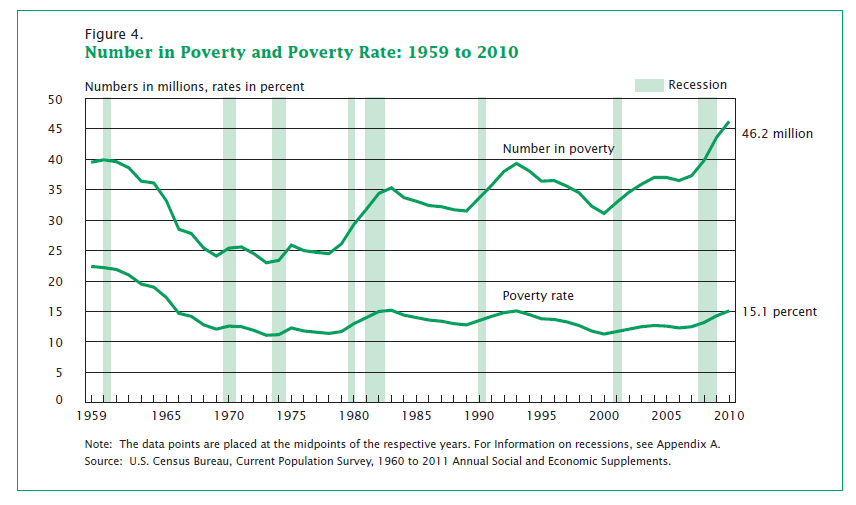
US poverty rate over time; data from US Census Bureau, chart from topforeignstocks.com
The poverty rate is a highly flawed indicator, but it's the best we've got. The chart above shows that since the early 1970s, when the U.S. economy began to shift away from manufacturing employment, the poverty rate has stayed stubbornly around 15 percent. While recent decades have seen the rise of fields that were unimaginable fifty years ago, there have not been remunerative career opportunities on a mass scale to replace those lost manufacturing jobs. This has not only affected the 15 percent at the bottom, but many of those in the middle as well.

Cities can't bring back Joe Lunchpail, but all are trying to develop their economies by "creating" jobs. I argue that it's not only important that they do it, it's important how they do it. Cedar Rapids would, for example, like to take advantage of existing concentrations of tech and medical professionals by attracting more. Do it. Bringing more money into a city can benefit all its residents when that money circulates to support public facilities (the library, swimming pools, &c.) and local businesses. The city can make this happen (or not) by:
  • encouraging compact development (as opposed to sprawl): the closer people are to the action the more they are likely to benefit
  • encouraging local entrepreneurship (as opposed to colonization by out-of-town franchises and in particular big box stores): the more money that stays in the city the more likely it is that everyone benefits
  • connecting areas of concentrated poverty to the rest of the city: ghettos are the result of design, and can only be overcome by design.
Envision CR has a number of encouraging elements along these lines. In the "Strengthen CR" chapter, Goal 3 is "Adopt policies that create choices in housing types and prices throughout the city." This mainly involves ensuring a mix of different types of houses--including townhouses and multi-family units--and avoiding exclusionary zoning in the new developments the city anticipates at what are now the outskirts of town. Goal 4 is "Create a city that is affordable and accessible to all members of the community." Currently the city administers several affordable housing programs, including Section 8 Housing vouchers, Rebuilding Ownership Opportunities Together, and subsidies for senior and low-income housing projects; other potential initiatives are also listed.

Poverty may be most closely associated with core neighborhoods, but there are pockets in other parts of town that are inconvenient to pretty much everything. People will choose where they live for all kinds of reasons, but if the only apartment I can afford is at 34th and Pioneer far from everything, or at Cedarwood Hills which is up a steep hill in an unwalkable part of town, that's a problem the city needs to address.

In the "Grow CR" chapter, Goal 3 is "Connect growing areas to existing neighborhoods." This mainly is to ensure there aren't barriers between developments at the periphery and the rest of the city. But the principle could also be used to address existing neighborhoods where there are pockets of poverty. Development in downtown and MedQuarter (as well as Kingston Village and New Bohemia) can create economic opportunity in adjacent core neighborhoods, if they're designed to be connected rather than separated.

Finally, the business-oriented "Invest CR" chapter has four goals, all with potential to improve the lives of the poor.
  1. Expand economic development efforts to support business and workforce growth, market Cedar Rapids, and engage regional partners.
  2. Cultivate a skilled workforce by providing cutting-edge training and recruiting talented workers.
  3. Reinvest in the city’s business corridors and districts.
  4. Grow a sustainable, diverse economy by supporting existing businesses, fostering entrepreneurism [sic], and targeting industry specific growth.
The emphases on entrepreneurship and existing businesses and industries are particularly encouraging. Chasing after franchises (including casino franchises) would have been a less productive approach. (See Johnny, "Big Box Urbanism," Granola Shotgun, 12 March 2015.)

Cedar Rapids has big plans for development. Of course, every other city probably does, too; there's a gulf between having plans and realizing them. Envision CR anticipates that quite a lot of this development will occur at the periphery of the current city, albeit in the form of mixed-use neighborhoods and complete streets. Can Cedar Rapids sprawl intelligently? And if they do, could they do so in a way that improves economic opportunity for the poor? Keep in mind, too, that not everyone is going to possess the specific job skills in high demand at the moment.

Along with economic opportunities, the poor need social structures of support. Families, neighborhoods and civic institutions support individuals as they navigate the ups and downs of their lives. These structures are created in the private sector, of course, but government can help. They can partner with non-profit agencies, as Cedar Rapids has with Matthew 25's Block-by-Block home restoration program, to encourage their efforts. More importantly, traditional neighborhood development is more likely to engender these sorts of connections than suburban sprawl.

For many people in American society, the poor are simply invisible. Auto-oriented development, notes Eric O. Jacobsen (The Space Between, Baker Academic, 2012, p. 42), "has increased the distances at which we encounter one another.... And because of the large parking lots and wider streets that are needed to accommodate all of those cars even when we are engaged in the same activity in the same place, the distance between us has increased significantly." A more atomized society harms us all in some way or other, but has especially negative impacts on the lives of those at the margins.

Poor people obviously can't have access to economic opportunities if such opportunities don't exist. It does not, of course, follow that where economic opportunities exist, poor people will have access to them. Including the poor probably will require intentional action on the part of city government. Can they provide incentives to locate jobs that pay well near low-income areas, and discourage large campuses in remote locations? Or to encourage developers to build affordable housing near areas of economic growth? Can people reach out to help poor people access opportunities which they may not know about, or assume are out of reach?

There's a danger that the poor will remain as invisible in this unfolding process as they are in Envision CR.

Envision CR plan: http://www.cedar-rapids.org/government/departments/community-development/city_planning/Pages/default.aspx

Earlier post: Envisioning CR I: A 24-hour downtown

Next: Improving public transportation.

Sunday, March 8, 2015

Adam Smith and the Road to Correctionville

US 20 in northwestern Iowa; photo by Tim Hinds, swiped from
siouxcityjournal.com
The State of Iowa passed a 10 cent increase in the motor fuel tax late in February, to 31 cents (for regular unleaded) and 29 cents (for ethanol blends) per gallon. Signed by Governor Terry E. Branstad, it went into effect Sunday, March 1, exacerbating a recent rise in local pump prices from $1.899 to $2.459 per gallon.

The measure's quick and relatively easy passage reflects widespread concern that maintenance of roads and bridges has fallen dangerously behind schedule all across the United States, including Iowa. Majorities, albeit narrow ones, of both parties in each house of the Iowa legislature supported the bill, and Republican governor Branstad clearly supported it, saying: I believe that the leadership deserves credit for working together on a bipartisan basis to pass a piece of legislation that I think will be very beneficial to meeting the needs of the counties and cities as well as the state transportation network.

The tax increase is expected to raise upwards of $200 million dollars in additional revenue. The state will allocate 47.5 percent to the state Department of Transportation, 32.5 percent to counties, and 20 percent to municipalities. The belief that street repairs are funded through the gasoline tax is a common misconception, and now it won't entirely be a misconception. In Cedar Rapids, for example, the funds will increase the streets budget by about 10 percent over what is currently provided through local property taxes. On the other hand, the measure taketh away from cities by limiting their ability to issue their own bonds for transportation money. So much for the myth of local control.

Raising gasoline taxes can correct two types of market failures:
  1. As its advocates stressed in Iowa this year, gasoline tax revenues can provide a dedicated source of funding for highway maintenance, which is a "public good" because there does not appear to be incentive for private firms to provide this service. In fact, Adam Smith used public roads as the example of a public good, in The Wealth of Nations, book V.
  2. Gasoline taxes can address a "negative externality" of driving cars: The market price of gasoline does not reflect effects of driving such as air pollution, resource depletion, habitat destruction and fighting wars in the Mideast. Raising the price of driving discourages people from doing it so much, which reduces the amount of those bad things listed above. Moreover, it does so more efficiently than regulation and more effectively than gas mileage standards (which reduce the cost of driving and so encourages rather than discourages it).
Adam Smith, from Wikipedia
However, Smith cautions us that, while public officials can address problems that markets ignore (or even create), political processes lack the discipline the market imposes. Iowa's politicians now have $200 million more dollars a year, and constituents that seem (to them, anyway) to expect to receive all good things for free. So there's an undeniable temptation to spend the windfall on flashy new construction projects instead of maintaining the infrastructure we're having trouble keeping up with. (Remember why we passed this thing?)

So, while IDOT's final decision is a ways away, one of the first things likely to be on the to-do list will be to widen US 20 in northwest Iowa between Correctionville and Early from two lanes to four. Governor Branstad is squarely behind this: They are working right now on a stretch of Highway20 from Moville to Correctionville, so that leaves you with a small segment of 37 miles from Early to Correctionville that needs to be completed. (The Quad City Times notes the effort to make US 20 four lanes across the state is 50 years on. So what? We're not building highways for 1965, we're making decisions for now.) Locally, the Cedar Rapids Gazette suggested the increased revenue is likely to be used to add lanes to Collins Road, Interstate 380 towards Iowa City, and the two lane section of US 30 west of town.

One might object that if we're having difficulty maintaining and repairing existing infrastructure--insert John Oliver commentary here, particularly the orgy of ribbon cutting about 10:45 in--the answer is not to add more infrastructure. One would probably not get elected dogcatcher, either. But, sheesh... average daily traffic count on US 30 immediately west of US 218 in 2013 was 6500, and by the time you get to the county line it's 4190. In Ida County, where the picture above was taken, the last survey (2011) counted less than 3000 cars on US 20 except for a brief stretch immediately by the intersection with US 59, where it reaches 3750. That's comparable to Memorial Drive SE in Cedar Rapids. WHY ARE WE SPENDING MONEY TO WIDEN LONELY HIGHWAYS?

Another, only slightly tangential point: Given that our country's transportation budgets for the last 70 years have amounted to enormous subsidies for driving, one might also argue for using some of the new revenue to improve bus systems and to invest in commuter rail. One would, in that case, certainly not be an Iowa elected official. They all want to party like it's 1949.

SOURCES

Rod Boshart, "10-Cent Gas Tax Increase Starts Sunday," Cedar Rapids Gazette, 26 February 2015, 1A, 10A

Rod Boshart, "U.S. 20 May Be Iowa Gas Tax Hike Beneficiary," Quad City Times, 25 February 2015, http://qctimes.com/news/local/government-and-politics/u-s-may-be-iowa-gas-tax-hike-beneficiary/article_adaca84a-274c-5622-a8d4-f43c279cd683.html

B.A. Morelli, "Gas Tax Paves Way for Area Projects," Cedar Rapids Gazette, 26 February 2015, 10A

Erin Murphy and Dave Dreezen, "Branstad: Fuel Tax Hike to 'Fast-Track' Highway 20 Widening," Sioux City Journal, 26 February 2015, http://siouxcityjournal.com/news/local/a1/branstad-fuel-tax-hike-to-fast-track-highway-widening/article_e7295eb7-5997-5425-aff8-baef555549ce.html

William Petroski, "Gas Tax Takes Effect Sunday," Des Moines Register, 25 February 2015, http://www.desmoinesregister.com/story/news/politics/2015/02/25/iowa-gas-tax-branstad/23990671/

NOT-TO-BE-MISSED VIDEO: "Last Week Tonight with John Oliver: Infrastructure (HBO)," https://www.youtube.com/watch?v=Wpzvaqypav8&t=88

MY EARLIER ADAM SMITH-INSPIRED POST: "Is a Baseball Complex a Public Good?," 5 August 2014, http://brucefnesmith.blogspot.com/2014/08/is-baseball-complex-public-good.html

Sunday, March 1, 2015

Envisioning CR I: A 24-Hour Downtown?


"I'm gonna wake up in a city that never sleeps," sings Frank Sinatra (above) in his 1980 hit "New York, New York" (lyrics by Fred Ebb). That is one version of a 24-hour downtown--where the bars never close and the show never stops--but not the only one. No amount of planning is going to turn Cedar Rapids into Manhattan, and any effort to do so would be costly, ridiculous and futile.

Cedar Rapids can and should have a 24-hour downtown, though, if it means a place where people work, play and live. A surge of investment since the 2008 flood has brought an increase in occupied office space, restaurant and entertainment options, and condominium development from the pre-2008 era. (No numbers, sorry, just assumptions... but I'd be eternally grateful to anyone who has solid numbers.) Exciting parallel development is occurring about a mile to the south, in the New Bohemia district.

Prior to 2008 a fair number of people came downtown in the morning to work, and left in the late afternoon. And most days that would be it, until the next morning. Some nights there might be a show at the Five Seasons Center, Paramount Theater or TCR, which would bring a different crowd of people downtown for a few hours. The public library, not to be overlooked, was open til 9. But for much of the week, there wasn't a lot happening downtown. Which meant there wasn't a lot of reason to go downtown, most of the time, and that can lead to a vicious cycle of decreasing activity.

With enough people living downtown as well as working and attending events, there are always people out doing something. That adds to the energy of the area, which makes it an attractive place for people to go, and it adds to economic opportunities for businesses catering to all the people who are there at one time of day or another. Downtown Cedar Rapids has room to expand, too, with under-utilized space in the MedQuarter district to the east and the Taylor Area to the west (not to mention between downtown and New Bo), as well as planned development in Kingston Village across the river.

Given that one of the common criticisms of Chicago mayor Rahm Emmanuel, as he struggles towards re-election this year, is that he's put resources into downtown and neglected neighborhoods, it's a fair question to ask why I'm focusing on downtown Cedar Rapids. Theoretically, an energized clustering of people could occur any place in town, right? (Or even in a "new town," like one of those New Urbanist developments.) I think there are three reasons everyone should care about downtown that apply to all municipalities:
  1. A city's downtown is the civic space shared by all metropolitan residents, assuming there exists such a space in the region at all.
  2. Downtown is where sustainable, walkable urbanism is most likely to occur of any place in the metropolitan area, because most of the infrastructure is already there
  3. Economic success in such a compact area is more sustainable through the dips and sways of the economic cycle.
In Cedar Rapids, specifically, there's a fourth reason: the devastation of 2008 left a lot of room for infill development. I'm not saying we should rebuild with the naïve assumption that it will never flood again, but surely future flood dangers can be accommodated in building design.

EnvisionCR, the master plan the city adopted last month, doesn't have much to say specifically about downtown. But there are encouraging signs in other plans that have been developed for districts adjacent to downtown, such as Kingston Village and MedQuarter. While the content of the MedQuarter plan is more focused on out-of-town visitors than potential residents, which could lead to a real missed opportunity, the promising Kingston Village plan includes single family housing towards the south end, near 8th Avenue (see map, pp. 19-20). The plan states (p. 22):
The broad land-use designation identified for Kingston Village as a part of this study is that of a mixed-use neighborhood, where the key venues of daily life – places to live, shop, work, play and learn – are within easy reach of one another. A successful mixed-use neighborhood will provide choices for its residents and an aesthetic and energy that will draw visitors. It will accommodate mixed-incomes and purposefully include a variety of appropriate uses within walkable distances and consider the necessary density required to foster lively streets.
Yes! That's got it! This is a gospel I'd like to see spread around to the other edges of downtown.

Two things remain somewhat unclear for downtown's future direction. It isn't clear what the city can do to encourage a more well-rounded downtown, or how highly that rates on the list of priorities. Currently downtown is heavy on upscale restaurants and condominiums. A well-rounded downtown would have a variety of jobs, attractions and housing for people of various ages, income levels and family situations. To that end, the downtown area could use some basic stores (grocery, hardware, e.g.), and for families, a school and a park with a playground. Greene Square Park is ideally located between the public library and the art museum, but the renovation proposal seems better oriented for a showpiece ("Look at the size of that gol dang art installation!") than for a place for children to play.

Secondly, can the city find developers willing to buy into the vision? A city's plans are at the mercy of the market forces of supply (by house developers and builders) and demand (by homebuyers), and for suppliers profit margins remain highest for large lot subdivisions on the edge of town. I'm sure there are developers salivating at the positive externalities they presume will come from the construction of the Highway 100 extension. Cities that want to promote sustainable, walkable urbanity often need to reach out to specific developers who share that inclination. (California blogger Dave Alden notes cities can adjust builders' impact fees so they're higher on the suburban fringe and lower in the urban core. I didn't even know "impact fees" existed, so good on you, Dave.) So far, though, so good: Besides a number of condominium projects underway downtown and in Kingston Village, there are some single family dwellings--row houses? well, all right--under construction on 2nd St SW.
Once occupied, these new houses will add to the vitality of downtown...
...and land is being sold for more here...
...so, why not here?
Another possibility for long-term residence is the land that has been cleared for the (as yet unapproved by the State of Iowa) casino. The all-in-one pod that had been proposed would not have been at all integrated into its surroundings; some houses and small shops would be better, I think. Here I'm very much with Alex Ihnen, who argues on the NextStL blog that multi-million dollar big projects will do less for St. Louis than organic development.

And we could save this older house, which the city for some reason intends to tear down if they can't find someone to move it.

(Next: Including the poor.)

ARTICLES CITED IN THIS POST

Dave Alden, "Changing the Ground Rules to Cease Subsidizing Sprawl," Where Do We Go From Here?, 2 March 2015, http://northbaydesignkit.blogspot.com/2015/03/changing-ground-rules-to-cease.html

Cindy Hadish, "Late-1800s Home Needs to Be Moved or Faces Demolition on Cedar Rapids Casino Site," Save CR Heritage, 20 February 2015, http://savecrheritage.org/late-1800s-home-needs-to-be-moved-or-faces-demolition-on-cedar-rapids-casino-site/

Alex Ihnen, "What's the Final Price Tag on a Vibrant Downtown St. Louis?," NextStL, 2 March 2015, http://nextstl.com/2015/03/whats-the-final-price-tag-on-a-vibrant-downtown-st-louis/


Alena Samuels, "Why Are Developers Still Building Sprawl?" City Lab, 24 February 2015, http://www.citylab.com/housing/2015/02/why-are-developers-still-building-sprawl/385922/

Justice in the World Today (II)

Rising rents are just one obstacle to opportunity today (Source: Joint Center for Housing Studies of Harvard University ) Some time ago, Fir...