Sunday, March 22, 2015

Maple syrup time!

One of the pleasures of living in a place for awhile--one of the things that makes a community a community, and a place a place--is learning its calendar. An annual spring feature of life in Cedar Rapids is the Maple Syrup Festival at Indian Creek Nature Center.

This year's festival came the third weekend of March, instead of the first weekend as it's been in past years. They hoped for a slight improvement in the chances for good weather--and a nice day it was--as well as the opportunity to use this year's syrup because the trees would have more time to produce. There was certainly no problem getting a crowd. I guess the only problem was some of the usual volunteers were not around, having taken advantage of the public schools' spring break to flee the state.

We got there earlyish Saturday morning, and saw all this:


Volunteers making pancakes

Serving pancakes

Live music

Displays on sustainable living

Tapping demonstration

Syrup making demonstration

Gathering crowd lining up

Syrup and syrup-related swag

Walking sticks and willow garden towers for sale, too
Last year's post: "Maple Syrup Time," 1 March 2014

SEE ALSO:
Cindy Hadish, "Photos: Maple Syrup Festival 2015," Homegrown Iowan, 22 March 2015, http://homegrowniowan.com/photos-maple-syrup-festival-2015/

Tuesday, March 17, 2015

Envision CR II: Including the poor


(Source; Google StreetView)
If affordable housing is far from jobs,
it creates as many problems as it solves

(3/17/2015) The word "poverty" does not appear at all in Envision CR, the comprehensive plan for the City of Cedar Rapids. (The word "poor" appears several times, but always to refer to the physical condition of facilities.) That doesn't mean that the poor won't benefit from fulfillment of some of the city's initiatives therein. But it does leave a concern that those who most need to benefit from the city's growth may not be positioned to do so, and the city may not be prepared to bring them along.

Poverty is a problem of long standing and great complexity, the subject of much research which has been published on a lot of paper. So you'll have to forgive a great deal of oversimplification when I say that, in a dynamic market-oriented economic system, today's American poor are thwarted by lack of access to two key things: economic opportunity and social structures of support. The obstacles are not completely removable, but cities can at least do some things to mitigate them.

In saying this, I am not unmindful that individual factors also affect poverty. There's not much a city or state can do to protect someone from the consequences of their bad choices. But--admittedly arguing here without data--surely some individual factors are exacerbated by systemic ones. In other words, lack of economic opportunity and/or access to social structures of support make it more likely that an individual will encounter stress, poor health, depression, alienation, and so forth, and so will make poor life choices. They also reduce the margin of error and increase the consequences of those poor individual choices.

The city could try to ignore the poor in its midst, and Lord knows, many have tried. But that means foregoing human resources, trying to go forward with portions of the city seriously under-productive, and tolerating a high level of potential instability. It seems prudent, not to mention moral, to be as inclusive as possible as the city charts its future.

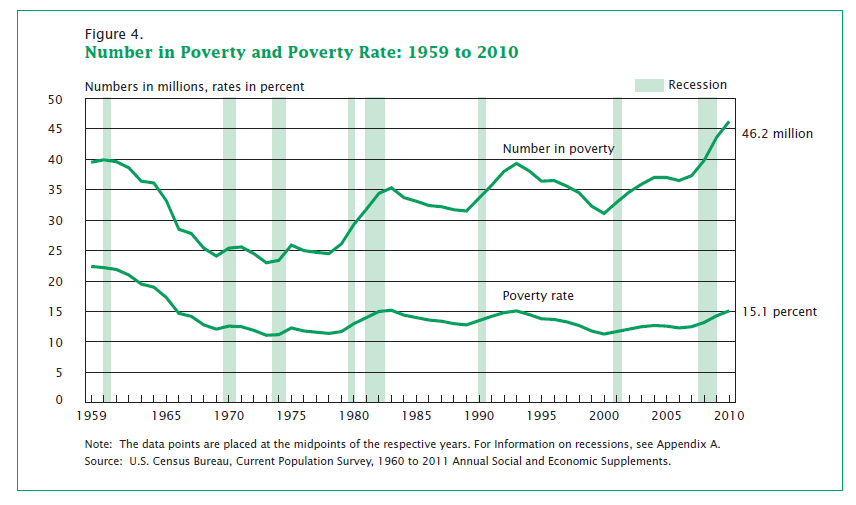
US poverty rate over time; data from US Census Bureau, chart from topforeignstocks.com
The poverty rate is a highly flawed indicator, but it's the best we've got. The chart above shows that since the early 1970s, when the U.S. economy began to shift away from manufacturing employment, the poverty rate has stayed stubbornly around 15 percent. While recent decades have seen the rise of fields that were unimaginable fifty years ago, there have not been remunerative career opportunities on a mass scale to replace those lost manufacturing jobs. This has not only affected the 15 percent at the bottom, but many of those in the middle as well.

Cities can't bring back Joe Lunchpail, but all are trying to develop their economies by "creating" jobs. I argue that it's not only important that they do it, it's important how they do it. Cedar Rapids would, for example, like to take advantage of existing concentrations of tech and medical professionals by attracting more. Do it. Bringing more money into a city can benefit all its residents when that money circulates to support public facilities (the library, swimming pools, &c.) and local businesses. The city can make this happen (or not) by:
  • encouraging compact development (as opposed to sprawl): the closer people are to the action the more they are likely to benefit
  • encouraging local entrepreneurship (as opposed to colonization by out-of-town franchises and in particular big box stores): the more money that stays in the city the more likely it is that everyone benefits
  • connecting areas of concentrated poverty to the rest of the city: ghettos are the result of design, and can only be overcome by design.
Envision CR has a number of encouraging elements along these lines. In the "Strengthen CR" chapter, Goal 3 is "Adopt policies that create choices in housing types and prices throughout the city." This mainly involves ensuring a mix of different types of houses--including townhouses and multi-family units--and avoiding exclusionary zoning in the new developments the city anticipates at what are now the outskirts of town. Goal 4 is "Create a city that is affordable and accessible to all members of the community." Currently the city administers several affordable housing programs, including Section 8 Housing vouchers, Rebuilding Ownership Opportunities Together, and subsidies for senior and low-income housing projects; other potential initiatives are also listed.

Poverty may be most closely associated with core neighborhoods, but there are pockets in other parts of town that are inconvenient to pretty much everything. People will choose where they live for all kinds of reasons, but if the only apartment I can afford is at 34th and Pioneer far from everything, or at Cedarwood Hills which is up a steep hill in an unwalkable part of town, that's a problem the city needs to address.

In the "Grow CR" chapter, Goal 3 is "Connect growing areas to existing neighborhoods." This mainly is to ensure there aren't barriers between developments at the periphery and the rest of the city. But the principle could also be used to address existing neighborhoods where there are pockets of poverty. Development in downtown and MedQuarter (as well as Kingston Village and New Bohemia) can create economic opportunity in adjacent core neighborhoods, if they're designed to be connected rather than separated.

Finally, the business-oriented "Invest CR" chapter has four goals, all with potential to improve the lives of the poor.
  1. Expand economic development efforts to support business and workforce growth, market Cedar Rapids, and engage regional partners.
  2. Cultivate a skilled workforce by providing cutting-edge training and recruiting talented workers.
  3. Reinvest in the city’s business corridors and districts.
  4. Grow a sustainable, diverse economy by supporting existing businesses, fostering entrepreneurism [sic], and targeting industry specific growth.
The emphases on entrepreneurship and existing businesses and industries are particularly encouraging. Chasing after franchises (including casino franchises) would have been a less productive approach. (See Johnny, "Big Box Urbanism," Granola Shotgun, 12 March 2015.)

Cedar Rapids has big plans for development. Of course, every other city probably does, too; there's a gulf between having plans and realizing them. Envision CR anticipates that quite a lot of this development will occur at the periphery of the current city, albeit in the form of mixed-use neighborhoods and complete streets. Can Cedar Rapids sprawl intelligently? And if they do, could they do so in a way that improves economic opportunity for the poor? Keep in mind, too, that not everyone is going to possess the specific job skills in high demand at the moment.

Along with economic opportunities, the poor need social structures of support. Families, neighborhoods and civic institutions support individuals as they navigate the ups and downs of their lives. These structures are created in the private sector, of course, but government can help. They can partner with non-profit agencies, as Cedar Rapids has with Matthew 25's Block-by-Block home restoration program, to encourage their efforts. More importantly, traditional neighborhood development is more likely to engender these sorts of connections than suburban sprawl.

For many people in American society, the poor are simply invisible. Auto-oriented development, notes Eric O. Jacobsen (The Space Between, Baker Academic, 2012, p. 42), "has increased the distances at which we encounter one another.... And because of the large parking lots and wider streets that are needed to accommodate all of those cars even when we are engaged in the same activity in the same place, the distance between us has increased significantly." A more atomized society harms us all in some way or other, but has especially negative impacts on the lives of those at the margins.

Poor people obviously can't have access to economic opportunities if such opportunities don't exist. It does not, of course, follow that where economic opportunities exist, poor people will have access to them. Including the poor probably will require intentional action on the part of city government. Can they provide incentives to locate jobs that pay well near low-income areas, and discourage large campuses in remote locations? Or to encourage developers to build affordable housing near areas of economic growth? Can people reach out to help poor people access opportunities which they may not know about, or assume are out of reach?

There's a danger that the poor will remain as invisible in this unfolding process as they are in Envision CR.

Envision CR plan: http://www.cedar-rapids.org/government/departments/community-development/city_planning/Pages/default.aspx

Earlier post: Envisioning CR I: A 24-hour downtown

Next: Improving public transportation.

Sunday, March 8, 2015

Adam Smith and the Road to Correctionville

US 20 in northwestern Iowa; photo by Tim Hinds, swiped from
siouxcityjournal.com
The State of Iowa passed a 10 cent increase in the motor fuel tax late in February, to 31 cents (for regular unleaded) and 29 cents (for ethanol blends) per gallon. Signed by Governor Terry E. Branstad, it went into effect Sunday, March 1, exacerbating a recent rise in local pump prices from $1.899 to $2.459 per gallon.

The measure's quick and relatively easy passage reflects widespread concern that maintenance of roads and bridges has fallen dangerously behind schedule all across the United States, including Iowa. Majorities, albeit narrow ones, of both parties in each house of the Iowa legislature supported the bill, and Republican governor Branstad clearly supported it, saying: I believe that the leadership deserves credit for working together on a bipartisan basis to pass a piece of legislation that I think will be very beneficial to meeting the needs of the counties and cities as well as the state transportation network.

The tax increase is expected to raise upwards of $200 million dollars in additional revenue. The state will allocate 47.5 percent to the state Department of Transportation, 32.5 percent to counties, and 20 percent to municipalities. The belief that street repairs are funded through the gasoline tax is a common misconception, and now it won't entirely be a misconception. In Cedar Rapids, for example, the funds will increase the streets budget by about 10 percent over what is currently provided through local property taxes. On the other hand, the measure taketh away from cities by limiting their ability to issue their own bonds for transportation money. So much for the myth of local control.

Raising gasoline taxes can correct two types of market failures:
  1. As its advocates stressed in Iowa this year, gasoline tax revenues can provide a dedicated source of funding for highway maintenance, which is a "public good" because there does not appear to be incentive for private firms to provide this service. In fact, Adam Smith used public roads as the example of a public good, in The Wealth of Nations, book V.
  2. Gasoline taxes can address a "negative externality" of driving cars: The market price of gasoline does not reflect effects of driving such as air pollution, resource depletion, habitat destruction and fighting wars in the Mideast. Raising the price of driving discourages people from doing it so much, which reduces the amount of those bad things listed above. Moreover, it does so more efficiently than regulation and more effectively than gas mileage standards (which reduce the cost of driving and so encourages rather than discourages it).
Adam Smith, from Wikipedia
However, Smith cautions us that, while public officials can address problems that markets ignore (or even create), political processes lack the discipline the market imposes. Iowa's politicians now have $200 million more dollars a year, and constituents that seem (to them, anyway) to expect to receive all good things for free. So there's an undeniable temptation to spend the windfall on flashy new construction projects instead of maintaining the infrastructure we're having trouble keeping up with. (Remember why we passed this thing?)

So, while IDOT's final decision is a ways away, one of the first things likely to be on the to-do list will be to widen US 20 in northwest Iowa between Correctionville and Early from two lanes to four. Governor Branstad is squarely behind this: They are working right now on a stretch of Highway20 from Moville to Correctionville, so that leaves you with a small segment of 37 miles from Early to Correctionville that needs to be completed. (The Quad City Times notes the effort to make US 20 four lanes across the state is 50 years on. So what? We're not building highways for 1965, we're making decisions for now.) Locally, the Cedar Rapids Gazette suggested the increased revenue is likely to be used to add lanes to Collins Road, Interstate 380 towards Iowa City, and the two lane section of US 30 west of town.

One might object that if we're having difficulty maintaining and repairing existing infrastructure--insert John Oliver commentary here, particularly the orgy of ribbon cutting about 10:45 in--the answer is not to add more infrastructure. One would probably not get elected dogcatcher, either. But, sheesh... average daily traffic count on US 30 immediately west of US 218 in 2013 was 6500, and by the time you get to the county line it's 4190. In Ida County, where the picture above was taken, the last survey (2011) counted less than 3000 cars on US 20 except for a brief stretch immediately by the intersection with US 59, where it reaches 3750. That's comparable to Memorial Drive SE in Cedar Rapids. WHY ARE WE SPENDING MONEY TO WIDEN LONELY HIGHWAYS?

Another, only slightly tangential point: Given that our country's transportation budgets for the last 70 years have amounted to enormous subsidies for driving, one might also argue for using some of the new revenue to improve bus systems and to invest in commuter rail. One would, in that case, certainly not be an Iowa elected official. They all want to party like it's 1949.

SOURCES

Rod Boshart, "10-Cent Gas Tax Increase Starts Sunday," Cedar Rapids Gazette, 26 February 2015, 1A, 10A

Rod Boshart, "U.S. 20 May Be Iowa Gas Tax Hike Beneficiary," Quad City Times, 25 February 2015, http://qctimes.com/news/local/government-and-politics/u-s-may-be-iowa-gas-tax-hike-beneficiary/article_adaca84a-274c-5622-a8d4-f43c279cd683.html

B.A. Morelli, "Gas Tax Paves Way for Area Projects," Cedar Rapids Gazette, 26 February 2015, 10A

Erin Murphy and Dave Dreezen, "Branstad: Fuel Tax Hike to 'Fast-Track' Highway 20 Widening," Sioux City Journal, 26 February 2015, http://siouxcityjournal.com/news/local/a1/branstad-fuel-tax-hike-to-fast-track-highway-widening/article_e7295eb7-5997-5425-aff8-baef555549ce.html

William Petroski, "Gas Tax Takes Effect Sunday," Des Moines Register, 25 February 2015, http://www.desmoinesregister.com/story/news/politics/2015/02/25/iowa-gas-tax-branstad/23990671/

NOT-TO-BE-MISSED VIDEO: "Last Week Tonight with John Oliver: Infrastructure (HBO)," https://www.youtube.com/watch?v=Wpzvaqypav8&t=88

MY EARLIER ADAM SMITH-INSPIRED POST: "Is a Baseball Complex a Public Good?," 5 August 2014, http://brucefnesmith.blogspot.com/2014/08/is-baseball-complex-public-good.html

Sunday, March 1, 2015

Envisioning CR I: A 24-Hour Downtown?


"I'm gonna wake up in a city that never sleeps," sings Frank Sinatra (above) in his 1980 hit "New York, New York" (lyrics by Fred Ebb). That is one version of a 24-hour downtown--where the bars never close and the show never stops--but not the only one. No amount of planning is going to turn Cedar Rapids into Manhattan, and any effort to do so would be costly, ridiculous and futile.

Cedar Rapids can and should have a 24-hour downtown, though, if it means a place where people work, play and live. A surge of investment since the 2008 flood has brought an increase in occupied office space, restaurant and entertainment options, and condominium development from the pre-2008 era. (No numbers, sorry, just assumptions... but I'd be eternally grateful to anyone who has solid numbers.) Exciting parallel development is occurring about a mile to the south, in the New Bohemia district.

Prior to 2008 a fair number of people came downtown in the morning to work, and left in the late afternoon. And most days that would be it, until the next morning. Some nights there might be a show at the Five Seasons Center, Paramount Theater or TCR, which would bring a different crowd of people downtown for a few hours. The public library, not to be overlooked, was open til 9. But for much of the week, there wasn't a lot happening downtown. Which meant there wasn't a lot of reason to go downtown, most of the time, and that can lead to a vicious cycle of decreasing activity.

With enough people living downtown as well as working and attending events, there are always people out doing something. That adds to the energy of the area, which makes it an attractive place for people to go, and it adds to economic opportunities for businesses catering to all the people who are there at one time of day or another. Downtown Cedar Rapids has room to expand, too, with under-utilized space in the MedQuarter district to the east and the Taylor Area to the west (not to mention between downtown and New Bo), as well as planned development in Kingston Village across the river.

Given that one of the common criticisms of Chicago mayor Rahm Emmanuel, as he struggles towards re-election this year, is that he's put resources into downtown and neglected neighborhoods, it's a fair question to ask why I'm focusing on downtown Cedar Rapids. Theoretically, an energized clustering of people could occur any place in town, right? (Or even in a "new town," like one of those New Urbanist developments.) I think there are three reasons everyone should care about downtown that apply to all municipalities:
  1. A city's downtown is the civic space shared by all metropolitan residents, assuming there exists such a space in the region at all.
  2. Downtown is where sustainable, walkable urbanism is most likely to occur of any place in the metropolitan area, because most of the infrastructure is already there
  3. Economic success in such a compact area is more sustainable through the dips and sways of the economic cycle.
In Cedar Rapids, specifically, there's a fourth reason: the devastation of 2008 left a lot of room for infill development. I'm not saying we should rebuild with the naïve assumption that it will never flood again, but surely future flood dangers can be accommodated in building design.

EnvisionCR, the master plan the city adopted last month, doesn't have much to say specifically about downtown. But there are encouraging signs in other plans that have been developed for districts adjacent to downtown, such as Kingston Village and MedQuarter. While the content of the MedQuarter plan is more focused on out-of-town visitors than potential residents, which could lead to a real missed opportunity, the promising Kingston Village plan includes single family housing towards the south end, near 8th Avenue (see map, pp. 19-20). The plan states (p. 22):
The broad land-use designation identified for Kingston Village as a part of this study is that of a mixed-use neighborhood, where the key venues of daily life – places to live, shop, work, play and learn – are within easy reach of one another. A successful mixed-use neighborhood will provide choices for its residents and an aesthetic and energy that will draw visitors. It will accommodate mixed-incomes and purposefully include a variety of appropriate uses within walkable distances and consider the necessary density required to foster lively streets.
Yes! That's got it! This is a gospel I'd like to see spread around to the other edges of downtown.

Two things remain somewhat unclear for downtown's future direction. It isn't clear what the city can do to encourage a more well-rounded downtown, or how highly that rates on the list of priorities. Currently downtown is heavy on upscale restaurants and condominiums. A well-rounded downtown would have a variety of jobs, attractions and housing for people of various ages, income levels and family situations. To that end, the downtown area could use some basic stores (grocery, hardware, e.g.), and for families, a school and a park with a playground. Greene Square Park is ideally located between the public library and the art museum, but the renovation proposal seems better oriented for a showpiece ("Look at the size of that gol dang art installation!") than for a place for children to play.

Secondly, can the city find developers willing to buy into the vision? A city's plans are at the mercy of the market forces of supply (by house developers and builders) and demand (by homebuyers), and for suppliers profit margins remain highest for large lot subdivisions on the edge of town. I'm sure there are developers salivating at the positive externalities they presume will come from the construction of the Highway 100 extension. Cities that want to promote sustainable, walkable urbanity often need to reach out to specific developers who share that inclination. (California blogger Dave Alden notes cities can adjust builders' impact fees so they're higher on the suburban fringe and lower in the urban core. I didn't even know "impact fees" existed, so good on you, Dave.) So far, though, so good: Besides a number of condominium projects underway downtown and in Kingston Village, there are some single family dwellings--row houses? well, all right--under construction on 2nd St SW.
Once occupied, these new houses will add to the vitality of downtown...
...and land is being sold for more here...
...so, why not here?
Another possibility for long-term residence is the land that has been cleared for the (as yet unapproved by the State of Iowa) casino. The all-in-one pod that had been proposed would not have been at all integrated into its surroundings; some houses and small shops would be better, I think. Here I'm very much with Alex Ihnen, who argues on the NextStL blog that multi-million dollar big projects will do less for St. Louis than organic development.

And we could save this older house, which the city for some reason intends to tear down if they can't find someone to move it.

(Next: Including the poor.)

ARTICLES CITED IN THIS POST

Dave Alden, "Changing the Ground Rules to Cease Subsidizing Sprawl," Where Do We Go From Here?, 2 March 2015, http://northbaydesignkit.blogspot.com/2015/03/changing-ground-rules-to-cease.html

Cindy Hadish, "Late-1800s Home Needs to Be Moved or Faces Demolition on Cedar Rapids Casino Site," Save CR Heritage, 20 February 2015, http://savecrheritage.org/late-1800s-home-needs-to-be-moved-or-faces-demolition-on-cedar-rapids-casino-site/

Alex Ihnen, "What's the Final Price Tag on a Vibrant Downtown St. Louis?," NextStL, 2 March 2015, http://nextstl.com/2015/03/whats-the-final-price-tag-on-a-vibrant-downtown-st-louis/


Alena Samuels, "Why Are Developers Still Building Sprawl?" City Lab, 24 February 2015, http://www.citylab.com/housing/2015/02/why-are-developers-still-building-sprawl/385922/

Tuesday, February 17, 2015

What to do about payday lenders?


The topic of payday lenders came up twice last week, once in the New York Times and the next day in an urban planner's presentation to Coe's Political Science Club. Payday lenders are those who provide cash to individuals without requiring proof of creditworthiness. They compensate for these high risk loans by charging high levels of interest--171 percent annually, in one case cited by the Times. According to the U.S. Consumer Financial Protection Bureau, the median loan amount was $350, onto which lenders tacked a median amount of $458 in fees. They also have recourse to repossession, of course. Rolling over loans--borrowing more money to pay off the first loan--is common, and lenders rely heavily on repeat business.

Most people who use payday lenders need money for everyday expenses like rent and transportation. Here, for example, is the story of Eboni Maze, a low-wage worker in Wichita, Kansas, told by the New York Times:
[A] single loan — money borrowed against her car, a 2012 Kia, so she could pay her rent — still haunts her more than three years later. Her car was repossessed after she could not keep up with the payments on the loan, which had an interest rate of more than 150 percent. To afford the down payment on another car, she took out a payday loan. When she could not pay that one off, she took out another. 
Given my middle class background, I have never used a payday lender. I did by accident use a check cashing service once. (The activities are closely related, and many payday lenders offer both services.) Traveling in Denver awhile ago, long enough ago that I was carrying travelers' checks, I saw a check cashing operation that seemed like a convenient way to turn a travelers' check into normal money. I don't remember the fee assessed to cash a $100 travelers' check, but it was appalling. I realized immediately I had been taken, and had paid for a little education in life.

Payday lenders thrive because their business model is based on making money when vulnerable people stumble. Interest rates and fees multiply the original cost of the loan. For increasingly popular auto-title loans, one in six borrowers loses their car. Would it be inflammatory to call such lenders exploitative? It certainly amounts to a tax on the poor. Additionally, the presence payday loan shops makes for a depressive vibe in a neighborhood. One business might not make much difference, but once you've got a cloud of payday lenders, pawn shops, discount cigs and booze, and fast food restaurants, you're sending a message that this is not a pleasant place, that no one wants to be here. It's the opposite of impelling form. Repelling form?

Can we regulate payday lenders out of existence? Probably not. They are businesses, after all, represented at state capitals by skilled lobbyists, supported by private equity firms, and aren't doing anything illegal. We could make their activity illegal, of course, but at the risk of writing overbroad legislation that would create difficulties for lenders we like. We could, and perhaps should, limit the amount of interest they can charge, or require a grace period before repossession, but my hunch is that the degree of restriction required to have much beneficial impact would just drive them underground. For here is the conundrum: There is a need for their services. Poor people borrow from payday lenders, not because they're hypnotized, or under any illusion about the risks. They borrow because they desperately need money--they are poor, after all--and they don't have the credit to borrow from a bank. Addressing the problem of payday lenders by somehow forcing them out of existence is unlikely to work. A better approach is to eliminate the need for them... in other words, to deal directly with the conditions of poor people.

As we cast about for this better approach, we run across this interesting fact: Of the 12 payday lenders listed in the Cedar Rapids-Marion phone book, only one is located in the core neighborhoods around downtown. Including pawnbrokers, listed separately but offering the same services...

...still makes it only four out of 16. The others are divided between the areas around Blairs Ferry Road NE, Edgewood Road West, and 7th Avenue in Marion... in other words, what were recently the edges of town, the first or second round of sprawl that have long since been superseded. I don't want to leap to conclusions about this, because I don't know how solid my data collection method is, or how much if any effect zoning has had. But I do know poverty can be found in various parts of the metropolitan area, not just in the oldest neighborhoods. And it stands to reason that the poor who face the most immediately pressing transportation costs would be the ones living on the outskirts.

The clearest solution to any problem involving poverty is economic opportunity. In Michael Dukakis's doomed 1988 presidential campaign, he talked about "good jobs at good wages." I don't think he had any clear ideas how to get those, and I don't think I do either, but dog-gone it, getting America to the point where there are career opportunities for people at a broad variety of skill sets and levels would go far to mitigating this symptom of the no-win situation the poor get stuck in.

Short of that, one thing we can start doing immediately is better urbanism: design cities so that cars are optional. If people could walk to work, school and shopping, that removes a huge set of expenses from their monthly budget. It's like getting a $10,000 a year raise, which equals $5.00 an hour for a person working 40 hours a week. That's without regulating wage increases, or enacting a huge increase in welfare spending. By thus reducing the need for the services of payday lenders, that would go far to easing the blight they cause on the physical and ethical landscapes.

Not to say implementing urbanism will be easy, either. Just that it beats the alternatives, the extremes of either heavy-handed regulation or wishin'-and-hopin'.

SOURCES

Ben Kaplan, "This Week's #Urbanist Goodreads Have the Motor Revving," We Create Here, 13 February 2015, http://www.wecreatehere.net/2015/02/13/weeks-urbanist-goodreads-motor-revving/

Jessica Silver-Greenberg and Michael Corkery, "Rise in Loans Linked to Cars Is Hurting Poor," New York Times, 25 December 2014, http://dealbook.nytimes.com/2014/12/25/dipping-into-auto-equity-devastates-many-borrowers/?_r=1&utm_content=buffere6ae3&utm_medium=social&utm_source=twitter.com&utm_campaign=buffer

Jessica Silver-Greenberg, "Consumer Protection Agency Seeks Limits on Payday Lenders," New York Times, 9 February 2015, A1, http://dealbook.nytimes.com/2015/02/08/consumer-protection-agency-seeks-limits-on-payday-lenders/

Monday, February 9, 2015

Talking about Walking (II)

Google Street View of Nesmith's childhood street crossing

I've been a pedestrian for a long time. When I was 5, I learned in kindergarten that one should "Cross [streets] only at corners." Since we lived on a corner, and being by quirk of personality an assiduous rule-follower, I assiduously followed that rule. Then, when I was in 1st grade, my family moved to a new house on a different street. Now our house was in the middle of a very long (nearly a quarter of a mile) block. It was over a tenth of a mile to the nearest corner, and another tenth back to where most of my playmates lived. I quickly decided that there was going to be no living with that rule, and jettisoned it.

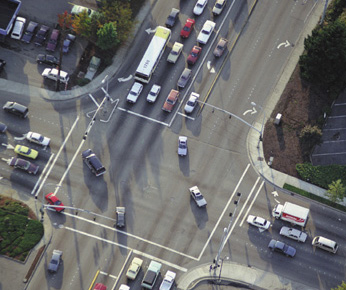
Recently, New York Times health columnist Jane E. Brody ran a two-part series on pedestrians, which got me thinking about my own habits. As I walk to and from work, or downtown, or anyplace else, I realize that my paramount consideration is: Avoid cars wherever possible. That means never crossing an intersection in front of a car if there's an alternative, even if I have the right of way. After all, the driver might not stop, and then where would I be? And if I see an opportunity to cross a street mid-block, because no cars are coming in either direction, I do it. There is even an advantage to crossing mid-block--a fact also noted by Ms. Brody, "Although I know it's wrong"--namely that cars can appear from only two places: down the street on your right, and down the street on your left. Crossing at an intersection, you potentially have to deal with turning traffic as well, which doubles the number of directions from which cars might be coming. She also crosses against a red light if there are no cars on the street she's crossing.... yup, I do that, too, again because waiting for a green light can often mean dealing with turning traffic from several directions.

Intersection with crosswalks; swiped from U.S. Federal Highway Adm site
Ms. Brody is 73, and writes from the perspective of older walkers. She recommends reflective clothing, paying attention to the time countdown on crossing signals, and most of all a high level of caution as you watch out for cars. I nearly became a traffic statistic one night in late October as I crossed a Brooklyn street with the walk sign clearly in my favor. An overly aggressive driver gunned the accelerator to turn left ahead of coming traffic and came so close to hitting me that I could pound on the hood of his car. What do you think, reader? Do you think she verified through empirical testing whether she was close enough to pound on the hood? I'd like to think so, if only because I did pound on a car after jumping out of its path as I crossed Cedar Rapids's infamous 1st Avenue. I'd feel less of a hothead if other people were also doing it.

Even bicycles, pedestrians' political allies in the quest for complete streets and walkable cities, are sources of danger. Many on bikes, she observes, ride as if being chased by a mad dog.... [T]he reflexes of an older person may not be quick enough to avert a run-in. Duly noted.

In her second column she discusses a number of ways that streets could be designed to favor pedestrian safety. Most of these will be familiar to anyone who's read about walkable cities: pedestrian push buttons, street trees, traffic calming, and such. One of her comments that caught my eye recommended traffic lights: Traffic lights at popular street crossings are a lot safer than stop signs, which in turn are safer than hatched lines on the street to indicate a pedestrian crosswalk. This is interesting because Cedar Rapids, under the guidance of the prophet Jeff Speck, is replacing a number of its traffic lights downtown with four-way stops. There probably are some principles at work distinguishing which intersections get which traffic controls, but when walking I'd much rather cross with a light than at a four-way stop. Even as a relatively fit 55-year-old, I can't make it across two lanes--much less four--before it's the cross-traffic's turn to go.

An important threshold for both bicyclists and pedestrians is the presence of enough of either that drivers not only notice them, but come to anticipate their presence. That's evident in the downtown areas of major cities. We're far from that in Cedar Rapids, but who knows what another generation will bring?

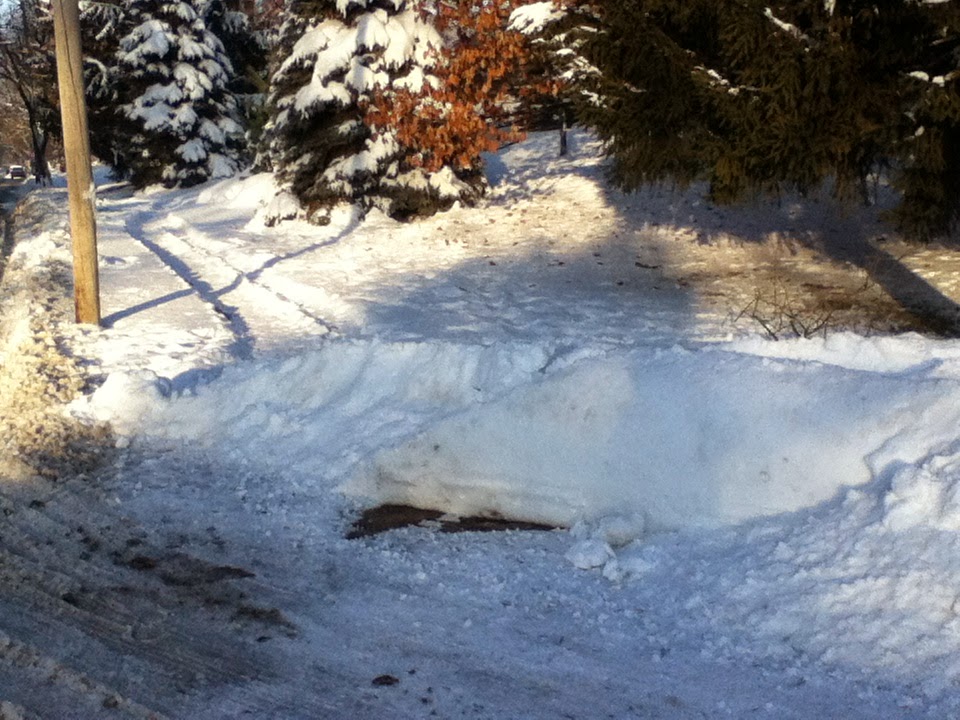
There's no defense against snow and ice, but a more compact city design might make managing them for pedestrian use more possible. Cedar Rapids crews did heroic work to clear the streets within hours of a major snowfall February 1, but plowed drifts still blocked sidewalks six days later.

Pardon the terrible photograph, but can you see the elderly gentleman trying to negotiate the drift with his cane?

When the parking lot is plowed, where does the snow go?

Unplowed walks are pounded into slush by walkers. When the slush re-freezes it is not only slippery but is looking for ankles to turn.

To transform our streets from exclusively auto-oriented design to routes that are safe to walk even for the elderly and the very young will be a long process. But, speaking as someone who aspires to be elderly some day, well worth the effort.

EARLIER POST: "Talking about Walking," 4 November 2013, http://brucefnesmith.blogspot.com/2013/11/talking-about-walking.html

OTHER SOURCES

Dave Alden, "Intro to Urbanism, Part Eight: Retasking Streets," Where Do We Go From Here?, 28 January 2015, http://northbaydesignkit.blogspot.com/2015/01/intro-to-urbanism-part-eight-retasking.html

Jane E. Brody,"Where Feet and Wheels Meet," New York Times, 6 January 2015, D6

Jane E. Brody, "Varied Routes to Safer Streets," New York Times, 13 January 2013, D5

Angie Schmitt, "Poll: The Hunt for the Worst Intersection in America Continues," Streetsblog USA, 31 January 2013, http://usa.streetsblog.org/2013/01/31/poll-the-hunt-for-the-worst-intersection-in-america-continues/

Jeff Speck, Walkable City: How Downtown Can Save America, One Step at a Time (New York: Farrar, Straus, Giroux, 2011)

Sunday, February 1, 2015

Blizzards get you thinking

The view from my front door
Iowa got its first major storm of the year this weekend--nothing like what hit New England and upstate New York last week, but enough to impact life. Area grocery stores experienced heavy business Saturday as people prepared for the worst, which of course did not happen. What did happen was all-afternoon rain Saturday gradually changed to snow during the evening, so of course the bottom layer was ice, with slush on top of that. After several hours' pause, the snow resumed, dry and powdery this round, and continued all through Sunday. The current total is 11 inches.
Hy-Vee, Coralville IA
Photo by Dave Wilson; swiped from Facebook page of Mark Carlson KCRG
City snowplows have been at work all day clearing roads. Most area churches canceled services, and most people seemed to hunker down for a quiet day. Football fans, once they had cleared their walks, could give their attention to the Super Bowl pre-game coverage. Had this occurred on a weekday, the plows would probably have started earlier and used bigger crews. (I'm guessing the city has to pay overtime on weekends, though I don't know that for sure.) Schools would certainly be closed--it doesn't take nearly this much to trigger that around here--but some people would have gone to work. Maybe there would have been more auto accidents?

Days like today remind a person of how metropolitan sprawl makes every day a gamble. Of course, we're not going to have a blizzard every day, but in this climate we average a few per year, so they're hardly unexpected. Sprawl works if the weather's fine, AND the roads are unobstructed, AND gasoline is cheap, AND there's plenty of parking at every destination, AND you are willing to overlook the costs in infrastructure construction and maintenance, social cohesion, loss of green space, personal money and time spent in cars, vehicular and pedestrian traffic fatalities, and lack of exercise. Add in a blizzard, and all of a sudden nothing is accessible: the miles to work, school, church, and groceries are fraught with snow piles and icy patches.

So as I rest from my shoveling labors--and try to think of anything rather than confront the reality I'll need to go back out there in a while and do it again--some questions occur to me, along with some tentative and personally unsatisfying answers.

(1) Why are we still building sprawl? Cedar Rapids is cheering the state's gift (with mostly federal money) of a highway extension around the west edge of the city. We are upset with the state's unwillingness to pop for two more interchanges, and are going to spend $5 million of our money to build them ourselves, but with the anticipation the state will soon come to its senses and pony up. We anticipate commercial development, as well as a population increase of 30,000, and all the tax base that accompanies them. We aren't anticipating the additional infrastructure will pile additional burdens on the city budget and city workers, because we believe that the expansion will pay for itself. (But see the Strong Towns booklet, Curbside Chat, especially chapter 3, "The Growth Ponzi Scheme.") The stories we tell ourselves: [a] City streets would be in better shape if the government wasn't so inefficient. [b] We'd have enough money for street and highway repair if we didn't waste so much on <choose one: the military, administrative expenses, welfare, bike lanes>.

In their first "Politics Wednesday" show of the year (7 January 2015), Iowa Public Radio host Ben Kieffer invited listeners to list their goals for government in six words or less. The first response was: Cut my taxes, fix my roads. I'd like to think the listener was being ironic, but that may be hoping too much.

(2) Can downtown develop/be developed by a resilient transportation system? In Cedar Rapids in 2015 the vast majority of people get downtown by car. Some take our dogged but limited bus system. A few, like me--I live just under two miles away--can walk or bike, but that's not practical for most people or (blizzard tie-in) every weather. If we anticipate the number of people working and living downtown to increase, does that mean we need more auto parking? Jon Rouse of Park Cedar Rapids thinks not, at least for the next three years, but admits most people "want to see the front door" of their destination when they park (Chelsea Keenan, "Seeing Spots," Cedar Rapids Gazette, 1 February 2015, 1D, 2D). The trade-off between the number of parking spaces and downtown vitality (social as well as economic) is not as widely-known as it should be. And for now, driving is the only practical way to get downtown for people who don't already live there or are close by.

Speaking of transportation...

(3) How should I be rooting on the federal transportation bill? There is some uncertainty whether Washington can get its act together to pass an appropriations bill to fund the U.S. Department of Transportation, most of which is funneled through state departments of transportation to build and maintain highways. If the federal government is the founder of this ridiculous feast, maybe if they cut off the allowance states and localities will be forced to be rational? That's the Strong Towns argument anyway. Or maybe a state that funds tax incentives for business relocations and considers infrastructure exclusively in terms of highways and maybe airports, and a city that is spending $10.5 million of taxpayer money to remodel a mall on the edge of town, aren't in the business of acting rationally? Local governments are also vulnerable to manipulation by the powerful and well-connected. It would be at least interesting, because at least local choices would be clearer.

from Bernie Sanders Facebook page
Meanwhile, Senator Bernie Sanders (I-Vermont), who may be running for President, is promoting his own $1 trillion bill (see above) to fund infrastructure as a public works jobs bill, which is a dangerous way to think about the issue. Public works are notoriously inefficient means of creating jobs, and should only be used in extreme economic emergencies. We should fund transportation (or not) in the way that brings the greatest public benefit, and support employment by wise economic policies (which in most times means monetary policies).

(4) How should we consider climate change in planning? The Senate recently voted that the climate was changing, with only Senator Wicker of Mississippi in opposition. There remains disagreement as to whether humans' burning tons of carbon per person per year could have anything significant to do with it. Given that scientific research has moved past this question, perhaps it's time for government officials to do so as well. But in the meantime, one likely result of climate change is more severe weather events. Shouldn't resilience to severe weather be a factor in city planning? Why are we still building out like it's 1949?

(5) Why is the clearing of public sidewalks the responsibility of the homeowner, even though the clearing of public streets is undertaken by the government? This is hardly a burning issue of our common life, but my colleague Lynda Barrow--who owns a home on a pie-shaped lot with an extraordinarily long sidewalk--asked me and I didn't know.

I'll continue to ponder these questions as I head back out to shovel the rest of the snow. As the latest "snowmageddon" reminds us the development patterns of the last two generations are unsustainable, these questions are worth pondering. Let me know what you come up with.

As a reward for reading this far, here are two brilliant short videos by Gracen Johnson, one celebrating snow days and one assessing the advantages and disadvantages of walking in a snowstorm.

For analysis of President Obama's budget proposal for transportation, see Angie Schmitt, "Obama's New Transportation Budget: The Good, the Bad, and the Ugly," Streetsblog USA, 2 February 2015, http://usa.streetsblog.org/2015/02/02/obamas-new-transportation-budget-the-good-the-bad-and-the-ugly/

Justice in the World Today

  Hope he gets some of that coffee: Statue of Thucydides in Vienna, Austria (7/31/2026)  A long time ago, according to the ancient Greek his...