Saturday, November 22, 2014

Four towns, four days

Last weekend I had the opportunity to drive south of chilly Iowa, as far as Arkansas, where the leaves were still colorful, but it was also chilly. The impetus was an event at the Clinton Presidential Museum and Library, which is celebrating its 10th anniversary. The museum is in a new building...

Clinton Museum and Library, Little Rock
...but the neighboring Clinton School of Public Service is in a repurposed building that has been a train depot, shop and a storage facility over the years. The makeover is lovely.
Clinton School of Public Service, Little Rock
Here's an interior shot, of the library where they had a reception for us visiting academics Thursday night. There's just something about a historic building..
Library, Clinton School of Public Service
The Clinton campus is located east of downtown, and has spurred some commercial development in the area now known as River Market. An internal report out in advance of the anniversary celebration credited the museum with spurring $2.5 billion in development since its opening (cited in Leslie Newell Peacock, "Ten Years After," Arkansas Times, 13 November 2014, 16).. River Market covers only a few square blocks in a town of less than 200,000 population (metro area is 724,385). But it shows what can be accomplished by focusing attention on a specific area. As Jeff Speck argues in the last chapter of Walkable City, you can't solve every problem at once so you have to choose your projects.

Interstate 30 runs between the museum campus and River Market, leaving a vast empty space on the streets there, but once downtown there are some friendly walkable blocks with attractive museums, restaurants and shops.

Both nights I was there, people were walking around in the evenings despite the chilly air.


If I were reading this post, I would want to know about coffee. Sufficient Grounds Café claims to be the "best coffee house in Little Rock."


It is only open weekdays, but Andina Cafe and Boulevard Bread Company were doing a brisk business Saturday morning, so the area must have sufficient residential population...

...mostly condos, from what I saw.

Other urbanist features included street trees...

...bike lanes protected by the on-street parking...

...a riverwalk that included a variety of options (including a "Health Walk" with posters listing symptoms that I'm sure is a favorite among hypochondriacs)...


...streetcars instead of buses...

...and it's worth noting that none of the streets downtown were more than a couple lanes wide.

There were also banners, the inevitable sign of a conscious place branding strategy.


Although I could see from my hotel window where River Market stopped and the parking craters and brutalist architecture began...


...I was impressed with how Little Rock has worked within the specific River Market area. Success here certainly has the potential for success elsewhere in the area.

Monday, November 10, 2014

Ballot initiatives: Election 2014


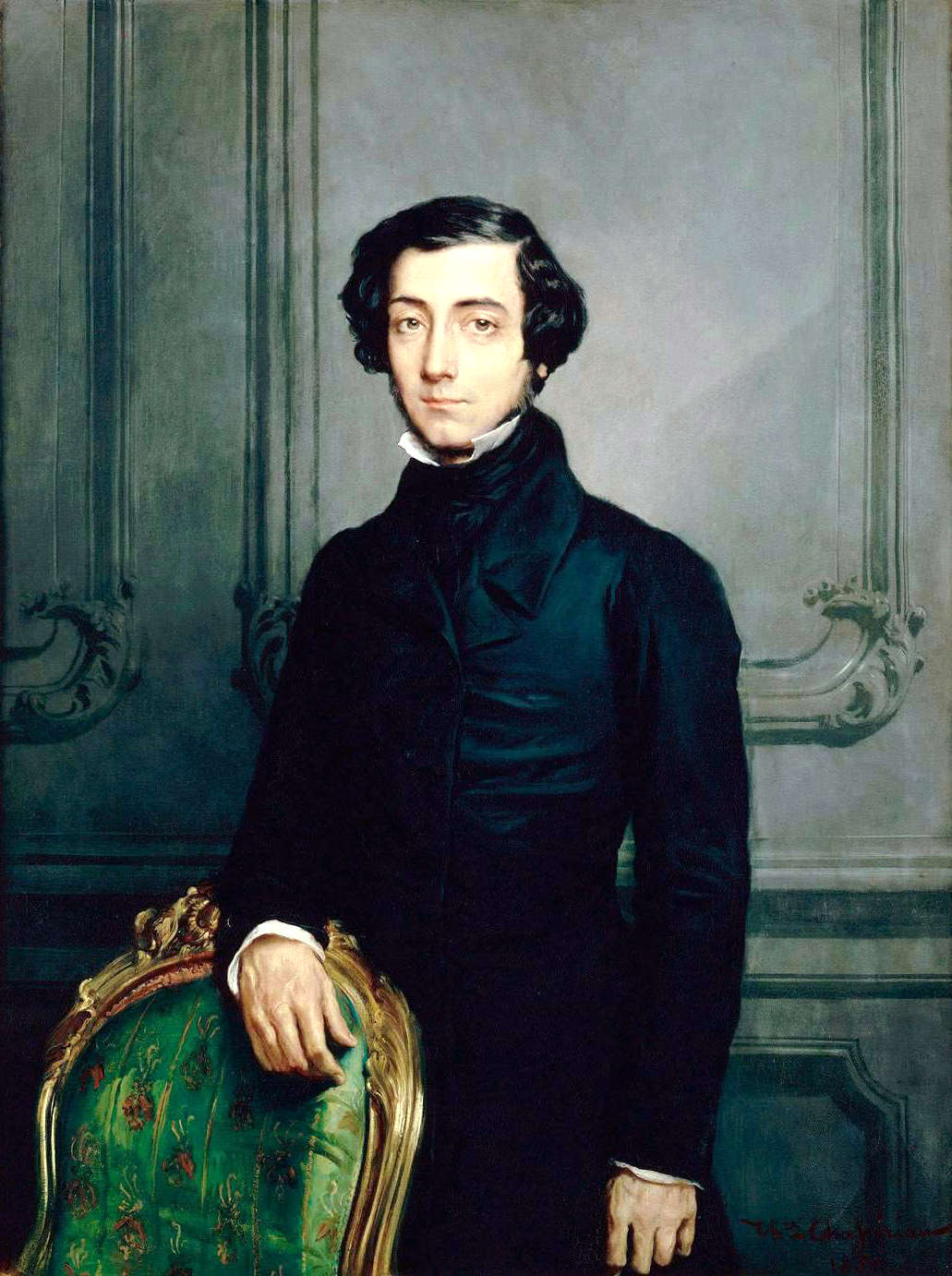
Alexis de Tocqueville (above, from Wikimedia Commons) was impressed by local self-government.
There was more to Election Day than met the eye. Specifically, there were a number of state and local initiatives that bore directly on our common life. In nearly all of these cases I was unaware of the vote; the information below comes from the sources listed at the end of the piece.

Transportation. San Francisco and Seattle passed propositions that would expand public transit operations and routes, and in Seattle's case prevent proposed transit cuts by raising the city sales tax. San Francisco's Proposition A also set aside funding for 27 miles of bike routes, as well as traffic signal and crosswalk improvements for pedestrian safety. Other transit improvements were passed in Alameda County (Oakland), California; Arlington County (suburban Washington), Virginia; Clayton County (suburban Atlanta), Georgia; and the State of Rhode Island. Transportation measures lost in Alachua and Pinellas Counties (Gainesville and St. Petersburg, respectively), Florida, and Austin, Texas, while Massachusetts voters blocked a "cost-of-living" increase in that state's gasoline tax (which funds a variety of transportation projects). The Austin measure, which would have created a light-rail system, had led rather decisively in pre-election polling, with analysts there blaming the defeat on low turnout by transit-loving younger voters.

Environmental Conservation. Statewide referenda to dedicate funds (generally, existing rather than new money) to environmental conservation were passed in Florida, Maine, New Jersey and Rhode Island. Florida and Maine were focused on water quality and wetlands--in Florida's case involving a long-term commitment and billions of dollars. New Jersey shifted money within the environmental budget towards conservation of open spaces, while Rhode Island focused on clean-up of brownfields (abandoned, contaminated industrial sites). Beaufort County, South Carolina passed legislation to make it easier for the county to purchase environmentally-sensitive property.

Fracking. Two cities--Athens, Ohio, and Denton, Texas--as well as San Benito County, California, passed bans on the energy extraction method known as hydraulic fracturing. "Fracking" has been a key element in the increase in American oil production, not to mention the drop in gasoline prices and manufacturing operations moving back to these shores. It has been alleged by environmentalists to contaminate drinking water and cause earthquakes, with producer interests vigorously contesting those claims. The overall evidence is inconclusive to date but does tend to unnerve people, apparently even in Texas. Sure, Denton is a university town, but, Texas.

City Development. Two California towns, Dublin and Union City, defeated attempts to override open space protections. San Francisco defeated an attempt to undo their clever, market-based parking rate innovations.

Minimum wage. Voters in four states, all of which tilt Republican in presidential and most statewide elections, approved increases in the state minimum wage over the next 1-3 years. Arkansas and South Dakota will rise to $8.50 an hour, Nebraska to $9.00 and Alaska to $9.75. The current federal minimum wage is $7.25 an hour.

Casinos. Voters in Massachusetts, Rhode Island and South Dakota voted to add or expand casino gambling in those states. California and Colorado rejected casino referenda, albeit the "no" campaigns in those states (as was the case in Cedar Rapids in 2013) were primarily funded by other casinos that feared new competition.

Marijuana. Voters in the states of Alaska and Oregon, as well as the District of Columbia, passed initiatives legalizing marijuana. These, of course, require federal acquiescence--or at least--passivity, as marijuana remains illegal under U.S. law. This is particularly true for the District of Columbia, which is not a sovereign state and so anything it does requires congressional approval. A majority of Florida voters approved a measure legalizing marijuana for medicinal use, but it failed of passage because it fell short of the required 60 percent threshold. It passed in Guam, though. There were a variety of local initiatives in six states, notably all blue states or at least purple (Colorado, New Mexico). An Arizona referendum in 2016 would be interesting to watch.

I find a lot of this activity encouraging. It shows voters in many places--though by no means everywhere--are thinking about ways to improve their quality of life and those of their neighbors, and are not shy about using public authority and funds to do so. Too many places have gotten into the habit of leveraging federal money for infrastructure and environmental improvements. The federal government can on occasion be out in front of states and localities on important issues, but can also create perverse incentives. Anyway, it's better if people are deciding the direction their own towns will take. Besides, as the Strong Towns folk have begun to mull in their most recent podcast, there's no guarantee the federal cow will be around much longer to milk for local projects.

I'm ambivalent about initiatives for three reasons. First, the economy and the environment are national if not global in scale, and sometimes need coordinated national policy responses. Economically vulnerable cities can just as easily "race to the bottom" as they can pass thoughtful initiatives (sort of like Iowa blocking passenger rail while funding the opening of a fertilizer plant). Secondly, voters do not have the ability that legislatures have to coordinate policies and balance priorities. They can pass things that individually sound good but collectively make no sense. Finally, initiatives, like other elections (and indeed legislatures), are vulnerable to manipulation by well-funded interests. Wallach and Hudak note that the "yes" side in the Alaska marijuana referendum and the "no" side in Florida vastly outspent their opponents.

I'm also terribly conflicted about marijuana legalization. Dealing with our youth as I do on a daily basis, I see that it can be abused with costly results to the individual. But you could say the same about alcohol, and indeed it's hard to justify marijuana being illegal when alcohol is legal. I wonder how I would have blogged on prohibition in 1932? The costs of marijuana law enforcement are pretty much a massive waste. So on balance I'm glad about this trend.

In all I find the upsurges of local self-government in 2014 to be as encouraging as the congressional elections were dispiriting. Discussing, even arguing local issues with your neighbors is likely to be more constructive than yelling across the country at a caricature of the other side.

SOURCES

Josh Barro, "The Strange Case of States' Penchant for Casinos," New York Times, 6 November 2014, P8

Shaila Dewan, "State Wage Initiatives Fare Better Than Democrats," New York Times, 6 November 2014, P8

Alex Dodds, "Voters Strongly Support Smart Growth Measures on Election Day 2014," Smart Growth America, 5 November 2014, http://www.smartgrowthamerica.org/2014/11/05/voters-strongly-support-smart-growth-measures-on-election-day-2014/

Molly Hennessy-Fiske, "In Denton, Texas, Voters Approve 'Unprecedented' Fracking Ban," Los Angeles Times, 7 November 2014, http://www.latimes.com/nation/la-na-texas-fracking-20141108-story.html

Kirk Johnson, "New Marijuana Initiatives Loom as 3 Win Approval," New York Times, 6 November 2014, P8

Keenan Orfalea, "Millennials Demand Public Transportation, But Lose Out by Skipping the Voting Booth," Urbanful, 5 November 2014, http://urbanful.org/2014/11/05/millennials-demand-public-transportation-refuse-vote/?utm_source=Urbanful+Master+List&utm_campaign=4c5e5460db-November_5_Daily_Subscribers&utm_medium=email&utm_term=0_fdf64fbc84-4c5e5460db-197203953

Joel Ramos, "San Francisco Voters Can Improve Muni Service at the Ballot Box This November," TransForum, 31 July 2014, http://www.transformca.org/transform-blog-post/san-francisco-voters-can-improve-muni-service-ballot-box-November

"2014 Ballot Initiatives," Marijuana Policy Project, http://www.mpp.org/legislation/2014-Ballot-Initiatives.html

"2014 Measures to Watch," Transportation for America, http://t4america.org/maps-tools/state-plans-tracker/2014-votes/

Phillip A. Wallach and John Hudak, "The Nation Continues to Embrace Marijuana Legislation," FixGov: Making Government Work, 5 November 2014, http://www.brookings.edu/blogs/fixgov/posts/2014/11/05-marijuana-ballot-initiatives-midterms-hudak-wallach

Wednesday, November 5, 2014

Turn red for what?


Sen Joni Ernst R-IA
Joni Ernst was the first woman ever elected to Congress from Iowa

The off-year elections of 2014 occurred in the shadow of continued economic uncertainty. Economic indicators have shown improvement since the recession hit bottom in 2009, but the public is slow to buy into the idea of recovery--appropriately so, in my view. An NBC/Wall Street Journal poll last summer found respondents split almost down the middle: 50 percent believed the economy is improving, 47 percent disagreed. Similarly, 49 percent said the economy was still in recession, 46 percent disagreed. (The percentage describing the economy as in recession has steadily declined since 2010, but remains too high to describe the public mood as anything like confident.) 69 percent of respondents told CNN that another financial crisis in the near future was either "very likely" or "somewhat likely." (Source: Polling Report) As of today, the Real Clear Politics average on the question of whether the country is on the "right track" or the "wrong track" stands at 28-66 (Source: Real Clear Politics).

Continued economic uncertainty is, I argue, central to many questions at the core of our common life in 21st century America. Richard V. Reeves of the Brookings Institution argues inequality "lurks" in election-year arguments over the Affordable Care Act, taxes and the minimum wage (cited below). Beyond that, it's hard to be confident about the next generation's prospects for rewarding work. (I liked the way KCRG-TV reporter Chris Earl put it in a recent conversation about the election, that the issue is not so much about jobs as careers.) Uncertainty about our immediate prospects make it nearly impossible to address important long-term challenges such as resource conservation, climate change, community-building and accommodating diversity. Negotiating complex phenomena while feeling personally insecure is hardly likely to be productive.

What all this adds up to is the nature of the political campaign we have just endured. Clearly public officials are aware of the public mood, but have little to offer in the way of constructive solutions. My Drake University colleague Dennis J. Goldford used the term "carpet bombing" to describe what's been happening to states like Iowa as well-resourced groups, freed from restraints on their spending "speech" by a series of U.S. Supreme Court decisions, tirelessly and relentlessly communicate at us. There may be some argument somewhere in all this noise, but the themes from the groups, and the candidates have largely amounted to: Vote against the bad guys. And please send us money so they don't accidentally win. I've been getting eight e-mails a day from groups like the Democratic Congressional Campaign Committee, saying essentially that and no more. As a result, writes former Des Moines Register editorial page editor Richard Doak (cited below), "I can't remember a year when voting was so unsatisfying. Casting an early ballot in 2014 felt like a chore. There was no pride or enthusiasm. There was something close to indifference." Washington Post columnist Eugene Robinson chimes in: "We're being asked to vote out of resentment and grim duty. So much for what Lincoln called 'the better angels of our nature ("Four Takes").'"

Republican gains in the Senate set up a situation we've seen before (1959-60, 1987-88, 1999-2000, 2007-08): a President of one party, in the last two years of his administration, facing a Congress controlled by the other party. This will change the context of Washington politics--Republicans will control the agenda and the investigative apparatus of the Senate--but if the past is any guide nothing of significance will occur to affect our lives or the direction of the country. President Obama will become decreasingly relevant as attention swivels to the long 2016 presidential campaign. This may be just as well, given that neither party has run an issue-oriented campaign, and so would have no mandate to govern if they were somehow in position to do so. (That is not to say they wouldn't try, given recent unpleasant experiences with one-party rule in Kansas, North Carolina, Wisconsin and arguably Colorado, where an agenda-less election produced a government in a sudden hurry to enact an ideological agenda.)

Perhaps the best outcome of this year's elections would be to cause us to re-examine what national politics can contribute to our common life. A global economy requires national, if not, global responses: only the national government can produce a health care system, counter-cyclical economic policy, and financial and environmental regulation. In an ideal world, Democrats would be making this case, and Republicans would be arguing how they could do it better. But that's not going to be happening any time soon. Both parties--maybe, apres Thomas Mann and Norman Ornstein (It's Even Worse Than It Looks [Basic, 2012]), the Republicans more than the Democrats--are ideologically out of the mainstream of American voters and so shun policy appeals in favor of cheesy promises, absurd fantasies and attack ads.

So, what can we do in the mean time?

1. Think locally, act globally. Communities need to be engaged in conversations about their future: what the town will look like, how things are going to get paid for, how to include everyone. Some of these conversations have begun in Cedar Rapids, while other places have gotten implementable ideas from organizations like Strong Towns and The Better Block. More people should get involved in these sorts of conversations, even informally. I'm not sanguine about this, either, as you can tell from the tone of my last few posts about development in Cedar Rapids, and I know there are plenty of people in localities who only want to put space, walls, guns and laws between themselves and The Other. But local communities are where conversations can occur, and maybe just maybe that spirit can bubble up into our national political dialogue. If we can fix our neighborhoods and metro regions, I think the country could fix itself.

2. Think critically. This election, I freely admit, I cast unenthusiastic votes for unimpressive people because I found the alternatives far worse. Maybe this is dumb. Can we insist that the people on "our side" articulate coherent solutions to our problems before we vote for them? And can we stop believing whatever bad things are said about the other side? One reasons candidates use coded language and sloppy arguments is that someone out there is falling for them. Don't be that guy. Democrats should say, "Climate change is real, and Republicans sound silly when they deny it. So what are we going to do about it?" Republicans should say, "Let's do repeal Obamacare. But what are we going to replace it with?" Better yet, eschew ideology altogether and look for proven, practical, affordable solutions to public problems.

3. Hope for a rational system of financing campaigns. We cannot have a common life when most of us are priced out of the political dialogue. I'm all for the freedom of expression, but this is ridiculous. In a billion dollar campaign centered on Super PACs there is no way the common voice gets heard. A lot of the money is spent by groups whose true identities are unknown even as they spend millions on last-minute ads and phone calls (Confessore and Willis; see also Hudak and Wallack) The average House member raised $2.6 million for the 2014 election, occupying up to 70 percent of their time this year (Schanzer and Sullivan). The Republican advantage this year may be a product of the political climate, not some inherent advantage, but the problem is not that Democrats don't have enough money. The problem is that the vast majority of us who aren't mega-donors have lost our voice, and our participation is being manipulated. In all the screeching about "Millionaire Rod Blum" and Bruce Braley-the-trial-lawyer-who-doesn't-care-about-terrorism, where are the constructive solutions? Is anyone talking about making the poor less poor?

Reeves of Brookings notes, "In private, at least, many Republicans are as troubled as Democrats by the relative weakness of middle class earnings and incomes" and "political possession of both Houses may increase the pressure to deliver some reforms in response to the growing anxiety on all sides about the economic health of the American middle class." But that's not what Republicans were selling, and that's not what their voters bought. So it's hard to imagine progress being made on that front, or on climate change, or on immigration, while Republicans are the ones doing the end zone dance of joy and feasting their eyes on the White House. It is unlikely, too, given past experience, that they'll be able to do much harm, either. But can Democrats plausibly claim that keeping their Senate majority would have led to better outcomes? Sure, they don't have the Republicans' wackier delusions, but where is the roadmap to a better future? President Obama has something of a roadmap, at least domestically, but many Democrats are too busy pretending they don't know him to own it or anything else (Capehart).

I am humbled by the number of my students who immersed themselves in this year's campaigns, on both sides of the partisan-ideological divide. I hope they found the experience rewarding. But I think as long as national politics features a ton of money and a paucity of policy solutions we are a long way from having politics that is worthy of their passion.

SOURCES

Jonathan Capehart, "Democrats' Mistake: Running from Obama or Staying Home," Post-Partisan,
3 November 2014, http://www.washingtonpost.com/blogs/post-partisan/wp/2014/11/03/democrats-mistake-running-away-from-obama-or-staying-home/

Nicholas Confessore and Derek Willis, "Hidden Donors Spend Heavily On Attack Ads," The New York Times, 3 November 2014, A1, A16

Richard Doak, "Despite Choices, Nothing Changes," Des Moines Register, 2 November 2014, http://www.desmoinesregister.com/story/opinion/columnists/iowa-view/2014/11/02/richard-doak-two-party-system/18320463/

"Four Takes: Columnists Predict What Will Happen in Tuesday's Midterms, and What It Means," Dallas News, 2 November 2014, http://www.dallasnews.com/opinion/latest-columns/20141102-four-takes-columnists-predict-what-will-happen-in-tuesdays-midterms-and-what-it-means.ece

John Hudak and Grace Wallack, "Outside Spending Increases the Price of Senate Elections," FixGov: Making Government Work, 3 November 2014

Richard V. Reeves, "2014 Midterms: Inequality Lurks Beneath the Surface of Political Discourse," FixGov: Making Government Work, 24 October 2014

David Schanzer and Jay Sullivan, "Cancel the Midterms," The New York Times, 3 November 2014, A25

Sunday, October 26, 2014

The Greene Square formerly known as Park

OPN Architects Inc.'s rendering of the planned Greene Square
(swiped by me from thegazette.com)
(10/26/2014) Things have taken a strange and alarming turn downtown. Or am I being melodramatic? The Cedar Rapids Gazette reported last week that the Parks and Recreation Department have released revised plans for Greene Square Park that are radically different from what had been earlier proposed. Granted that it's only one square block of a mid-sized American city, but I think the change in plans says a lot about the city's vision for its downtown. I'm not liking what I'm seeing.

There is no question that Greene Square Park is currently underutilized, as indeed is the case for the downtown area writ large. Back in the day, it was called Washington Square, and it was the central park in town, the square bounded by the train station, the high school, the library and First Presbyterian Church. (See George T. Henry and Mark W. Hunter, Then and Now: Cedar Rapids (Charleston SC: Arcadia, 2003, p. 96.) As the town moved outward so did these facilities (except the train station, which was torn down in 1961, and the church which remains). The park lost its importance, drawing crowds for occasional concerts and, in recent years, farmers' markets, but being for the most part empty.

Efforts to revive downtown began in earnest as soon as the 2008 floodwaters receded. A new public library opened across the street from the park in 2013, and the art museum that occupies the original library space got a spiffy facelift. Away from the park, downtown has seen new and rebuilt offices, restaurants and entertainment venues. Ambitious plans to develop the sort-of-adjacent New Bohemia neighborhood have come to fruition, while a similarly ambitious plan for the Medical Quarter are taking shape. No less a luminary than Jeff Speck has been called in to improve downtown walkability.

But walkability requires more than just sidewalks, bike lanes and four-way stops. It requires places to walk to... and that requires people. By that, I mean a lot more people than can currently be found downtown. The next step in becoming a sustainable, walkable city with "vibe" requires round-the-clock residents. As of now, downtown Cedar Rapids is mainly for Monday-Friday daytime office work and some evening entertainment. A few condominiums have been built downtown to appeal to young people who want to be in the center of this action, but there are few if any housing options for families. Nor, if there were, are there facilities nearby to support them: schools (except for McKinley Middle School), grocery and hardware stores, or parks.

The Greene Square plan as of August was to add a children's play area. This would be attractive to visitors to the public library and art museum, but essential to families with children living downtown. As such it was essential to the transformation of Cedar Rapids from a city that requires a car to one that offered a compact urban alternative.

The children's play area could actually still be in the new plan, though I doubt it. I'm uncertain because the Gazette included two architects' graphics that are illuminating but not complete, and if the complete plan is on the city website I sure can't find it. The main impression I get from the architects' renderings in the Gazette  is gaudily pretentious, like Versailles on the Cedar.

Given my lack of artistic taste, we might allow that the sculptures and other gee-gaws in the drawing above are nice to look at. But, as Jane Jacobs famously said, "A city cannot be a work of art" (The Death and Life of Great American Cities [Vintage (1961) 1992], p. 372). A city needs life, which means people. The new design has no use for people other than as amazed spectators, or at most passers-through from the art museum to the library. Tellingly, the space is now to be called "Greene Square" not "Greene Square Park." The plan doesn't even include rest rooms.

What this says to me is that we in Cedar Rapids expect our downtown to be a showplace, for people to visit (particularly those who can afford an upscale restaurant and an expensive concert) but not to stay. To get home from downtown you'll need to drive your car out to your ranch walkout in a suburban development. (No problem, because gas is currently under $3 a gallon in town, which means it is guaranteed to remain under $3 a gallon for the rest of time.) Maybe you'll be living in the suburban area west of town that's sure to develop once we finish our $250 million interstate connector. If, on the other hand, you're interested in sustainable urban living, you maybe should check out St. Paul or Kansas City.

SOURCES

For the early version of Greene Square Park development, see Cindy Hadish, "Greene Square Park Moving into the Future in Downtown Cedar Rapids with New Design; Plan Retains Some Historical Elements," Homegrown Iowan, 28 August 2014, http://homegrowniowan.com/greene-square-park-moving-into-the-future-in-downtown-cedar-rapids-with-new-design-plan-retains-some-historical-elements/

For the latest version of Greene Square, see Rick Smith, "It's Greene Square, Not a Park," Cedar Rapids Gazette, 16 October 2014, 1A, 11A, http://thegazette.com/subject/news/its-greene-square-not-a-park-20141016#media-well-container

Sunday, October 19, 2014

CROP Walking

Early October in Linn County, Iowa, as in other places, is time for the annual CROP Walk to support Church World Service--a Christian ecumenical organization formed in 1946 to combat hunger and poverty. Numbers on this year's walk aren't available yet, but last year people from 26 churches raised $27,766.59 (including $150 in matching funds from Schneider Electric, and $70.09 "unaffiliated"). [Source is Ellen Fisher of the CROP Walk Planning Committee.]

Iowa weather in early October ranges from sunny and colorful--as, in fact, it is this afternoon as I write this--to miserable. For a long time CROP Walkers were blessed with nice weather, but these last few years it's been rainy more often than not. This year it was cloudy, and rained both before and after we walked, but during the walk itself it was mostly dry.

Why walk instead of just contributing money? I can think of three reasons why it's worth taking the extra steps to have this event.

First, for the donors, it provides an annual focus around which to give. Sure, one can donate money any time, but any time can be no time. Requests for charitable contributions come in pretty constantly, and ignoring them becomes a survival skill. Having one annual event around which to predict and schedule donations keeps time from slipping away. The need itself is hardly trivial--the Linn Community Food Bank served 30 percent more households in 2013 than it had the previous year, on top of a 33 percent increase in 2012 over 2011. Anything that draws attention to the ongoing problem of world hunger, including its Linn County chapter, is a good thing.

Second, for the walkers, it's a festive social occasion.
Departing from the park shelter after Dorothy Higdon gave the blessing
My church was represented by a pastor, several adult members of the congregation, and more than a dozen middle and high school youth.
Some of the Lovely Lane contingent prepare for the CROP Walk
We mingled along the trail with as many or more people from other churches. (In the past, there have also been walkers from Temple Judah, the Hindu temple, the carpenters' union and Coe College. I don't know about this year.) We greet friends and take pleasure in those who go all out, like First Lutheran Church with their matching purple jackets, and these costumed vegetables.
This year's CROP Walk featured walking crops
Finally, it urges everyone to get out and enjoy the metro trails system. A few years ago, the walk moved to the Marion Parks Trail from Noelridge Park in Cedar Rapids. This was a good move: Noelridge is a fine and city park, with greenhouse, gardens, playground and outdoor pool, but walking around a track is dull compared to getting off on a countrysidish trail. The CROP Walk starts at Thomas Park in Marion, and follows the Marion Parks trail to Boyson Road and back, about 3.1 miles round trip. (The significance of this distance is that people in parts of the world have to walk this far each day to get water to drink.)
Along the trail, an opening in the woods
(revealing an under-construction subdivision, but as the Vogons say...)
Along the trail, a choice of paths
Water break at Boyson Road turn-around
Along the trail, a view of a mysterious other trail
Almost there... crossing the bridge over Dry Creek
Raising money for a worthy cause, in good company, while we enjoy the wonderful public good a trail provides--what a wonderful local tradition!

Tuesday, October 7, 2014

In search of old 45s


Boxes of 45 rpm records at Washington's Crooked Beat
Some free time and lovely weather inspired me to a walking tour of Washington, D.C. record stores last weekend. The stores were interesting, the exercise did me good, and it might have something to say about urbanism to boot.

We begin at Dupont Circle, a wheel of pavement the spokes of which are Connecticut Ave, New Hampshire Av, P St and 19th St. The interior is a nice park, and the exterior has sidewalks on both sides, but I found it confusing to walk, even in light Saturday afternoon traffic. There are lights at each intersection, but the walk times are so few and far between that one is tempted to walk any time there aren't vehicles approaching. This is perfectly rational at a conventional intersection, but probably not at a roundabout.

West of Dupont Circle is Second Story Books, 2000 P St. It mostly sells used books, so its name is somewhat appropriate, although it occupies the entire building, and sometimes even...
..the sidewalk!

They did have a few LPs, mainly jazz, albeit a wide selection of that genre. Note the late Miles Davis album at the front of the middle box.

The 45s were in an alcove, with this inspirational saying posted above them.
What Cicero would think of a music collection without 45s is unrecorded, but I bet if he were alive today he wouldn't think twice about it. The staples of my youth have been overtaken successively by CDs and mp3s, so only the rare collector still traffics in these guys.

Next on our tour: Red Onion, 1901 18th St (corner of T St).

Now we're north of Dupont Circle and into the Adams Morgan neighborhood. The Red Onion is located in the basement of a building, and features mostly funk and hard rock LPs.

Outside, banners along the street celebrate the Adams Morgan neighborhood, and invite people to "Shop," "Eat," "Play" and "Live." This is a good example of place branding. I stayed for two weeks in this area in the 1980s during a short stint at the Brookings Institution, and had no idea it had a name. Now I do!

Up 18th Street at 2116, is another basement shop, Crooked Beat Records.
They claim a variety of genres (see sign at left), and sell new and used LPs and 45s. Their top three sellers in August were Spoon, Ty Segall and Insurgence DC.


Used LPs to the left, new to the right, 45s at the front of the store.

The view across the street.

Our final stop is Smash!, at 2314 18th St. It has new and used CDs and LPs, primarily rock, but as you can tell from the window display is distinguished by its selection of "vintage" clothing.

It also has 45s, but seriously? You couldn't have found another selection for the front of the box?

Three used record shops in a space of five blocks says something about a neighborhood. While each store had a few customers during the time I was there, neither the format nor the music itself is mainstream enough to attract squads of them. Ergo, rents are low in Adams Morgan. 18th Street has quite a few odd shops and little restaurants, but also small grocery stores, drug stores, a locksmith and an animal hospital--in other words, establishments catering to people's everyday lives. In contrast to Dupont Circle, which featured franchises like Panera Bread, Starbucks' and Books-a-Million, Adams Morgan has locally-owned businesses like the coffeehouses called Jolt n Bolt, L'Enfant CafĂ©-Bar and Adams Morgan Coffee Shop. There are places for parking, but the area is not overwhelmed by parking lots.

So, hooray for a walkable, livable neighborhood with locally-owned small businesses. My hometown of Cedar Rapids lacks the population or the density to do this on such a large scale, and it remains to be seen whether it can expand on the few efforts that have begun or will continue to conceive of commercial life in terms of franchise outlets and Super Wal-Marts.

Adams Morgan is a neighborhood that, at first superficial glance based on one walk-around, seems to have found the right equilibrium between gentrification and affordability. Maintaining that is surely tricky. How do you keep from tipping either to excess gentrification or insufficient capital?

RELATED POST: "Local Businesses," June 6, 2013

ON HOUSING COSTS IN DC (not differentiated by area, at least not in ways I can interpret): David Alpert, "How Fast Housing in DC is Growing Unaffordable, in 3 Charts," Greater Greater Washington, 8 October 2014, http://greatergreaterwashington.org/post/24483/how-fast-housing-in-dc-is-growing-unaffordable-in-3-charts/

Wednesday, October 1, 2014

The future of economic inequality


Something is happening in America. Perhaps it might be said that something is happening to America. Maybe we don't all agree on what that is, but the current Real Clear Politics average has 27 percent saying America is on the "right track" and 65 percent on the "wrong track." The Great Recession has long since ended, and the Dow Jones Industrial Average set another record a couple weeks ago, but most of are not feeling it. Poverty continues to hover around 15 percent, worse in regions with a weaker welfare state. Jobs created since the 2008 recession don't pay as well as the ones they replaced. There are serious, in my view justified, concerns about the future of employment, particularly for those of average and below-average skills, not to mention the sustainability of government efforts to enable equal opportunity.

Everyone surely knows that income inequality in America (and elsewhere in the West, but spectacularly so in America) has taken off in the last 35-40 years after long-term declines before that. It may be that we ain't seen nothin' yet. There are three ways of diagnosing this trend. If you'll forgive the straw men in this brief and hurried post...
  1. Capitalist apologetics. Inequality is not a problem. The market has rewarded the productive: The benefits have flowed to those whose work merits them. If you're not among them, you can either strive to join them or writhe with unseemly envy. Meanwhile, our job creators could use another tax cut, not to mention regulatory relief.
  2. Temporary disequillibrium [where I was until recently]. The problem of inequality is temporary. The gains for the working class in the mid-20th century can be attributed to efforts of labor unions and government regulation, which were made possible by settled methods of industrial manufacturing. The shift to a post-industrial economy created all manner of dislocation, which obsoleted labor unions and a lot of government efforts as well. But once things settle down we can figure out a new scheme to provide justice for all. In the meantime get all the education you can.
  3. Handbasket to hell. The problem of inequality is here to stay as long as we allow it. People of great wealth have used their economic and political power to achieve even greater wealth, and are trying to lock in those gains for themselves and their posterity. For most people, economic opportunity is becoming increasingly elusive.
With all this, the release of French economist Thomas Piketty's new book could not be more timely. It is worth reading, albeit his painstaking approach to his complex argument probably requires reading it slowly. It is the culmination of decades of data collection on Western economies. Its sales figures--#202 on Amazon as of this writing--are probably due more to the urgency of his subject matter than to his scholarship, but it remains an impressive work.

The data marshalled by Piketty suggest we're in situation #3; while he suggests a policy remedy he thinks would be effective, he admits that enacting it is unlikely. A number of other economists, like Tyler Cowen of George Mason University, have taken him to task for focusing on economic inequality, and to a degree they have a point: If a rising tide is or could be lifting all boats, who cares if some boats are rising faster than others? Inequality is an outcome, and we're all about opportunity not outcomes, but here's the rub: There isn't a good metric for opportunity independent of outcome. And additional data from Piketty's vast collection suggest that the superrich are sucking all the air out of the economy leaving less opportunity for everyone else... even if educational attainment becomes more widespread. "Education isn't doing it," said University of Wisconsin economist Timothy Smeeding (quoted in Porter).

Piketty argues that population growth and the dislocation of the two world wars, along with pro-labor government policies, produced the exceptional outcomes of the mid-20th century West. With populations in the West mostly stable, and no more world wars, we can expect growth rates in the 21st century to be close to the long-term average of 1-1.5 percent annually, not enough to fuel great waves of economic opportunity or inter-class mobility. The driver of inequality is not so much incomes as it is capital, with the landed elite of 18th century novels replaced by owners of buildings, business capital, and financial capital (p. 118). Capital ownership, now as ever, "is always more concentrated than the distribution of income from labor" (p. 244), whatever salaries are being claimed by CEOs and financial wizards. Currently in the U.S. the approximate distribution of capital wealth finds the top 1 percent owning 35 percent, the next 9 percent owning another 35 percent, the rest of the top half 25 percent, and the bottom half 5 percent (Table 7.2). Concentration of capital wealth is further exacerbated by the tendency of capital to grow faster than the economy as a whole (which Piketty repeatedly refers to as r > g), meaning inherited wealth has huge cumulative effects (p. 246).

The last quarter of Piketty's book consists of policy analysis and recommendations. He makes a largely moral argument for addressing the situation through policy, to wit, that increasing concentration of wealth denies the "meritocratic hope" (p. 422) of the West to provide economic opportunity and a political voice for all citizens. Life was not pleasant for folk in the 18th century, unless you were Mr. Darcy or in a position to marry him. He (Piketty, not Darcy) argues for a global tax on capital, immediately admitting that it "is a utopian idea" (p. 515), which would require systematic and accurate financial information, and coordination among countries. This will help to keep the wealth of society churning, and to keep governments solvent so they can continue to provide social benefits of education, health and security.

Piketty's argument is not unassailable. The data are the best that exist, but contain a lot of assumptions and holes. If you believe that inequality in America is driven by productivity or some other measure of merit, he's not going to convince you. If you believe that government screws up everything it touches, a tax on capital is not going to be floating your boat any time soon. The coordination among Western countries required to enact this tax and the infrastructure to support it seems impossible.  But Piketty does provide the best documentation yet that economic trends in America and the rest of the West are driven by forces bigger than individual-level variation; that addressing them requires frontal attack not tweaking what we have now; and that if we fail to address them they are likely to continue until they become intolerable.

John Kenneth White (Barack Obama's America: How New Conceptions of Race, Family, and Religion Ended the Reagan Era, University of Michigan Press 2009, p. 115) quotes from Benjamin Disraeli's 1845 novel Sybil:
"Well, society may be in its fancy," said Egremont slightly smiling; "but say what you like, our Queen reigns over the greatest nation that ever existed."
"Which nation?" asked the younger stranger, "for she reigns over two... Two nations, between whom there is no intercourse and no sympathy; who are as ignorant of each other's habits, thoughts, and feelings, as if they were dwellers in different zones or inhabitants of different planets; who are formed by a different breeding, are fed by a different food, are ordered by different manners, and are not governed by the same laws."
 
Is a common life, or even a country, possible if economic worlds and destinies are so separated?

SOURCES

Thomas Piketty, Capital in the Twenty-First Century (Belknap/Harvard, 2014) with additional materials online at http://piketty.pse.ens.fr/en/capital21c2
Eduardo Porter, "Income Inequality and the Ills Behind It," New York Times, 30 July 2014, B1, B8

10th Anniversary Post: Paying Attention to the Suburban Development Behind the Curtain

  (Google Maps screenshot) (9/5/2026)  Ten years ago, we in the United States were engaged in a presidential election campaign that would br...