Monday, March 7, 2022

Letter from Washington (X): Finding a quiet place


Heurich House Museum grounds

With a spring-like Saturday afternoon off in Washington, D.C., Jane and I grasped our trusty guidebook [cited below] and walked in the neighborhood of Dupont Circle on the city's northwest side. The circle itself I find chaotic, formed as it is by the confluence of five major thoroughfares, and there are busy commercial strips in every direction. Real estate must be pricey even by Washington standards, judging from the dominance of new commercial offices and franchise chains. (Compare with the somewhat more modest Adams Morgan neighborhood to the north, which has more indigenous offerings, including a coffeehouse called Tryst recommended to me this weekend and which I must some day check out.)

But walking around quickly reveals more to Dupont Circle than CVS and Subway. There are embassies, including those of Chile, Indonesia, Mozambique, and Peru. The think tanks American Enterprise Institute and Brookings Institution are near the circle on Massachusetts Avenue, with the Carnegie Endowment for International Peace and the National Trust for Historic Preservation between them. 

Across the circle on 20th Street is the 1898 building where the Church of Scientology was founded.

This 1909 mansion on New Hampshire Avenue is now the headquarters of the Order of the Eastern Star, of which my Grandma Pochert was a proud and active member.


The Cairo--I'm from Illinois, so I pronounce it KAY-ro, but you be you--was built on Q Street in 1894 as the tallest building in Washington, which did not thrill its neighbors, leading to the adoption of the city's strict building height ordinance.

People for the Ethical Treatment of Animals boast some striking yard art.


The Dupont Circle area also has the Tabard Inn on N Street, built in 1922 and long a favorite of my Creighton University colleague Graham Ramsden...


...and gourmet toast. Whatever that is.

There are also lots of churches, some quite architecturally striking.
The Church of the Holy City (1894)

Foundry United Methodist Church (1904)

Perhaps my most surprising find was the 1894 house of Christian Heurich (1842-1945), who owned D.C.'s largest brewery. The house is now a museum, which is open part of the year for limited hours. It promises to be "honestly exploring what it takes to achieve the American Dream," which sets an intriguingly high bar. The castle garden was open, and quite a few people were lounging about on the picnic benches and Adirondack chairs. The carriage house houses the 1921 Biergarten, serving a variety of beer and wine, and has restrooms, which I was unfortunately not able to experience.

Anyone who blogs about our common life has surely been vaccinated against the coronavirus, but unfortunately had neglected to bring the little card along. (This is the only time on my trip when I would have needed it, too.) 

So I had to hurry along to more permissive facilities, but not before noting what an oasis the castle garden is. On an irresistible spring day, there was a steady trickle of people into the garden for a bit of peace and quiet in company, away from the traffic and busy-ness of Dupont Circle's commercial areas.

Of course, there's plenty of peace and quiet to be had in large-lot suburban subdivisions. That's pretty much what they sell, along with space and privacy. But, as it has been repeatedly argued in this space and elsewhere, those subdivisions are neither financially nor environmentally sustainable, and they oppose the very existence of a common life. We need cities if we are going to survive, and yet... we need peace and quiet, too. Places like the Heurich House's castle garden are pearls beyond price.

SOURCE: Frommer's 24 Great Walks in Washington, D.C. (Wiley, 2009), ch. 16

Christian Heurich would have been part of this Advisory Neighborhood Commission (ANC). "It was, however, the last cyberspace left in Dupont," quips Matt' Johnson, AICP on Twitter.

Thursday, February 3, 2022

Confessions of a sidewalk vigilante

Downtown Cedar Rapids: 300 block of 1st St SE, 1/17/2022

My city's new sidewalk snow removal policy has gotten some negative attention this year, and justifiably so, but its potential as a weapon against a perennial menace should not be overlooked. Where property owners used to have 48 hours after a snowfall to clear their sidewalks of snow, they now have a mere 24 hours. I imagine my next-door neighbor rushing out with a stopwatch as soon as they see the last flake descend. One of my work colleagues has already gotten the dreaded pink notice on her front door stating a complaint has been filed and she must clear her walks or the city will do it for an inflated price. 

This property (NOT my coworker's) has the pink notice AND one for water shutoff

I will never file such a complaint against a residence, even though I walk to work, and plan to continue walking when I'm elderly and frail. It's not just because I fear her wrath; I have serious reservations about the "narc on your neighbor" approach to code violations. It's a micro-version of an ugly national trend. As Frank Bruni points out in his latest New York Times newsletter about Virginia's e-mail system for reporting schoolteachers, Texas's law encouraging lawsuits against anyone involved with abortion, and West Virginia's call for tips on election suspcions:

Is the way to address Americans’ disagreements to transform citizens into snoops and have them turn on one another? Our leaders should point us toward common ground, not add whole new weapons to our battlegrounds. In Virginia and Texas, they added weapons. (Bruni 2022)

There are all sorts of good reasons one might not get their walks clear within 24 hours: frailty, injury, travel, preoccupation with child care, and so on. If there's a problem sidewalk in the neighborhood, neighbors could check in and help out. Call in the law only as a last resort, and maybe not even then.

Our neighborhoods have bigger problems than homes where the snow doesn't get shoveled in a timely fashion. The part of town where I live, work, and go to church has a problem with land speculation. "In a market like D.C.," explain the writers on Greater Greater Washington, "it's not uncommon for the land underneath a building to be more valuable than the structure itself... [A]ll forms of property management and land use have costs, and depending on the condition of the building and the land the costs of putting it to work might be greater than the potential rental income" (Loh and Rodriguez 2018). 

Land speculation exists even in Cedar Rapids, though we're certainly not a hot market like Washington, D.C. or Seattle or Boston. The owner might be a bank waiting for housing values to increase, an out-of-town investor hoping to cash in on the next big thing, or heirs of a homeowner who's died. And someone looking for a place to build a house or start a business will be glad to find a vacancy. The problem is that, as years pass, and then more years pass, and despite obvious needs houses aren't built and businesses aren't started, land speculation becomes a drag on the surrounding area (see Holland 2018). And it's these properties, more than two weeks after the last measurable snowfall, that still have impassable sidewalks.

13th St SE, 1/31/2022: The city might clear it more effectively if I reported it sooner

Until we get a land value tax, or someone willing to meet the speculators' asking prices, I think the best I can do is to annoy the property owners and bring the city's attention to the problems by filing snow removal complaints. The first one I filed, on the block across the street from the college where I teach, got results, in that what snow could be was removed, though I don't know if they'll be able to assess the Nevada-based trust that owns it. 


Last week I flagged a vacant property on 2nd Avenue SE (pictured above, on 1/31/2022)--listing an owner in nearby Marion--though it was complicated because I couldn't get the address from the (non-existent) building and had to look it up on the assessor's website. I plan to report these properties every time it snows. Maybe the owners will get so annoyed they'll do something with the properties--or at least take care of them. I admit I haven't yet brought about a revolution in land use, but it is vaguely satisfying to my sense of moral outrage.

Let it snow!

SEE ALSO
"We Need to Talk. About Snow," 3 February 2021 [piles of plowed snow block crosswalks]
"Where Are the Metro's Destinations Heading?" 28 July 2021 [tax bills for developed and undeveloped blocks] 
 
MyCR reporting tool: https://www.cedar-rapids.org/mycr/index.php

Credit for the phrase "narc on your neighbor" goes to Dennis Evans, who was my neighbor years ago. We did not narc on each other.

Tuesday, February 1, 2022

Rethinking public transit in Marion


By day, Uptown's only coffee shop; by night, host to the Corridor Urbanists' next meeting

(2/1/2022) Marion's City Council has approved a shift away from participation in the Cedar Rapids bus system, in favor of an all-day neighborhood ride-sharing service in partnership with Horizons (Miskimen 2022). The city would use $225,000 in federal money from the American Rescue Plan Act to purchase three 16-passenger buses. I hope it costs out for them: The switch promises a more efficient and even a more compassionate way to approach transit services.

Every town has neighborhoods like this. Marion has a lot of them.

The City of Marion consists of a traditionally-built core, recently rebranded as Uptown Marion, and extensive suburban-style development elsewhere. Uptown Marion is no longer an employment center, and while it contains the public library and City Hall, most governmental facilities are elsewhere. Marion's 2020 population of 41,535 is spread over nearly 18 square miles. Some of the farthest-flung residents are in mobile home developments beyond State Route 13. Squaw Creek Villages, for example, has a WalkScore of 17, and that assumes you're willing to dart across Route 13 to Wal-Mart. The design of Marion creates challenges of efficiency and equity to any transit system.

The Marion Circulator bus currently connects to Routes 5 and 30 near Collins Road Square

Until 2017 Marion was served by Routes 5N and 5S, which were extensions of the 1st Avenue bus originating in downtown Cedar Rapids. Each ran every 90 minutes, half an hour apart, and both served the city center. In 2017 Route 5 was terminated at Lindale Mall, where it connected to two new circulator routes, including Route 20 for all of Marion. 

2017 version of Route 20 is in green

Route 20 runs once an hour during the day, going more or less directly to Uptown and then swinging widely about the town. It achieves the goal of wide coverage, but it's too circuitous to be practical for anyone, unless they simply have no alternative. As Jarrett Walker (2022) says, "the sad mathematical fact is:  Ridership arises from how useful service is to many people, not how useful it is to absolutely everyone.  When we seek to serve absolutely everyone, we’re planning for coverage, not ridership [link in original]."

At the same time, sending buses around that lengthy circuit is not cheap. In a town like Marion, which has few streets and many stroads, it makes sense for the foreseeable future to have an ad hoc transit system. In chapter 9 of Confessions of a Recovering Engineer--reviewed here--Strong Towns' Charles Marohn argues that the only provable purpose for a bus system remains what it was before we started developing towns around the automobile: to be "a wealth accelerator for local communities" (p. 156):

Transit is a wealth accelerator when it is used in support of productive development patterns and is deployed to function either as a road or a street. Successful transit requires successful places, so if you desire transit, you must focus on building a productive place, somewhere where people want to be outside of an automobile.... Start with a place, then pick a transit option scaled to that place as a means to an end of making that place more financially productive. (2021: 157)

City Square, including Marion's long-defunct train station

As of now, Marion simply has no such place. Uptown Marion is delightful, and could be the place to start, as Marohn starts in his case study with downtown Springfield, Massachusetts. But Marion doesn't have a transportation center like Springfield's Union Station, and it's not clear that Marion even wants Uptown to serve in its historic role as a core downtown. So it's probably most cost-effective to have an on-demand ride-sharing service for the people who need it. It can target the (mostly poor) people who don't drive, and serve them more effectively by taking them directly to their destinations instead of all around the town.

Perhaps this is the only transit service a sprawled town will ever need, or will ever be able to afford. Marohn (2021: 160-161) advocates funding capital costs of transit by capturing through tax assessment the increased property value created by the service, and ongoing operations through fares, with little-to-no reliance on federal or state contributions. This way the transit system is responsive to price signals sent by the community, and grows with it. (As anyone familiar with Strong Towns knows, he advocates the same principle for streets and roads.) This may never be possible in a town like Marion, which seems to be, like "many places in this country that, for better or for worse, cannot be reasonably served by public transit" (p. 161).

It might be, though, that as the on-demand service operates over time, certain patterns of demand will emerge. Or that businesses in, say, Uptown Marion, find they lose something from not having a transit connection to Cedar Rapids. In such cases, a more regular service could be instituted, the next incremental step up. Even then, they'd probably want to retain the ride-sharing service. As Edward Humes (2016: 311), where bus systems are well-established,

There's still the last-mile problem, and this is where the new dynamic of ridesharing services can complete the solution.... Offer riders a package deal, a true door-to-door solution, at a rate that beats car ownership.... A rideshare-express bus combo will certainly cost a lot less than paying $12 billion for light rail with a 2.6 percent share of commuter ridership. If such a service could be fast, convenient, and affordable compared to owning a car and commuting alone at peak hours, it could change the door-to-door world in a big way...

Maybe that day will come to Marion some day, or at least the part of Marion that isn't hopelessly sprawled. In the meantime, scaling down transit service at this time will provide the City of Marion with flexibility to do that which the long and winding fixed-route does not.

1100 7th Avenue, pre-2017: I miss this bus stop

City of Marion site: https://www.cityofmarion.org/ 

Cedar Rapids Transit site: http://www.cedar-rapids.org/residents/city_buses/index.php

Edward Humes, Door to Door: The Magnificent, Maddening, Mysterious World of Transportation (Harper Perennial, 2016)

Charles L. Marohn Jr., Confessions of a Recovering Engineer: Transportation for a Strong Town (Wiley, 2021)

Tuesday, January 18, 2022

Onlining about Redlining: MLK Day 2022

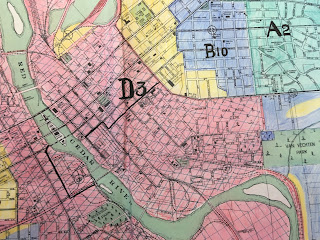
1930s HOLC map of Cedar Rapids at National Archives (Author's photo)

If it already had felt strange to have the celebration of inclusive community that is the annual Martin Luther King Jr. Celebration online, technology added insult to injury when the Facebook Live feed of the evening event at Coe College was inaudible. Pastors Stephanie and Keeyon Carter, who started Wellington Heights Community Church, gave the keynote address. Linn-Mar High School senior Kayla Purchase and student assistance counselor Janessa Carr (co-founder of the Marion Alliance for Racial Equity) received the Dr. Percy and Lileah Harris "Who is My Neighbor?" Award (King 2022). I trust "Lift Every Voice and Sing," one of the greatest songs ever written, was sung. (See video of the event, below.)

Gathering at St. Paul's Methodist in January 2020 ("the before-times")

In the afternoon, participants in a powerhouse panel on housing issues argued that while redlining in its purest form has been outlawed for more than 50 years, its impacts continue to be felt today, in spite of a broad array of ameliorative programs in which the City of Cedar Rapids is participating. Years of exclusion from housing opportunity, along with violent suppression, put blacks and other Americans of color at a substantial disadvantage in terms of economic opportunity (with spillover effects into all aspects of daily life). That's the essence of systemic racism.
 
L to R: Betty Johnson, Clint Twedt-Ball, Tonyamarie Adams, Jeff Pomeranz
 
Clint Twedt-Ball, Executive Director of Matthew 25 in Cedar Rapids, cited the book Know Your Price by Andre Perry (Brookings Institution, 2020) which found houses in white neighborhoods fetched prices 48 percent higher than comparable houses in predominantly black neighborhoods. Over the decades that added to a huge amount of lost money, which, Twedt-Ball noted, could have been spent on solving social problems. It also means that blacks have a more difficult time securing home loans even today.

Tonyamarie Adams, Cedar Rapids realtor and Neighborhood Building Assistant at Matthew 25, noted that today more energy goes into new construction than on poor neighborhoods where people need help like the Taylor Area and Time-Check, and that she has yet to find a lender of African descent. Where, she asked, are lenders who are willing to work with people who are struggling? 

Moderator Anne Harris Carter read from a 1930 description of Cedar Rapids neighborhoods

Cedar Rapids City Manager Jeff Pomeranz noted that, as problems persist and he and others have a lot to learn about them, this year, for the first time, Martin Luther King Jr. Day is an official city holiday. (Really? The first?) The city participates in a number of programs designed to help disadvantaged people, including Paving for Progress, which invests in infrastructure maintenance according to perceived need not the value of the neighborhood; Neighborhood Finance Corporation, which provides home loans and down-payment assistance; Community Development Block Grants; Section 8 Housing Assistance, which provides rental assistance in hopes that stability can lead to homeownership in the long run; low-income housing credits for developers; PATCH, which helps people fix up their homes; Urban Dreams, which creates opportunities for younger people by connecting them to jobs; and a two-year plan to use American Recovery Act money to fund scholarships to Kirkwood Community College. (A complete list of housing services available in Cedar Rapids is here.)

And yet, problems persist. Assessment of some of the programs show they're not widely known, and don't reach many of the people they're intended to reach, Pomeranz said. Moreover, if the programs were more widely used, they would quickly run out of funding. It seems that, if we take the problems of housing opportunity and overall economic opportunity seriously, we're going to have to do more than incremental fixes. Maybe we need an approach like that cited in the chat by Karla Twedt-Ball of the Greater Cedar Rapids Community Foundation: Evanston, Illinois, has started a reparations fund to compensate for housing discrimination between 1919 and 1969.
 
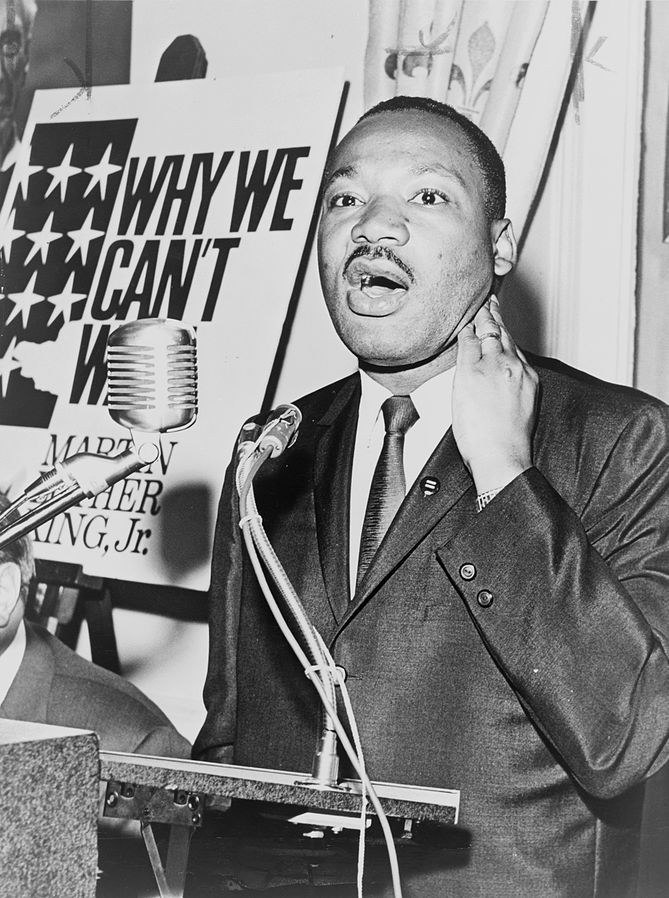
Martin Luther King Jr. is a day to start thinking outside the policy box. Washington Post columnist Robin Givhan notes that "while [King] was more liberal than radical, it's hard to imagine that he would be so revered if he were a 30-something activist today--a Black man marching in the streets and advocating for fair wages, voting rights, racial justice and a more equitable form of capitalism" (Givhan 2022). King's true legacy, Givhan argues, is not the glossy picture of "a warmhearted preacher who just wanted everyone to get along," but those people who today continue to "advocate for change [and] do the hard work of organizing." 

The ongoing impacts of redlining is only one fundamental problem of housing policy. It is widely acknowledged that, as Mayor Tiffany O'Donnell noted in the chat, "Home ownership = generational wealth." This is a true--at least for most people whose families were able to buy homes in the mid-20th century with help from the Federal Housing Administration, 30-year mortgages, and suburban development--but problematic statement. Besides the question of how equitable is an arrangement where certain children inherit wealth, it is not clear how long this arrangement is financially sustainable for anyone. As homes appreciate in value, they become less affordable for homebuyers and sometimes depending on property tax rates even for current owners (Phillips 2020: 61). On the other hand, when wealth is tied up in home values, even kind-hearted people have strong incentives to resist racial and economic integration, and increased density, which threaten the value of their houses (Cortright 2017).

"Dr. King was bold," writes E.J. Dionne (2022). The racial wealth gap is the result of decades of systemic inequity; it demands that we be bold, too.

SEE ALSO: 

"Housing Policy," 1 July 2021

"MLK Against the Mob," 21 January 2021

Linda Evans, "MLK Jr. Day," Vegan Linda, 18 January 2022

Shane Phillips, The Affordable City: Strategies for Putting Housing Within Reach (And Keeping It There) (Island, 2020)

Jeana Quinlan, "Commemorating Martin Luther King Day," The Cosmos (Coe College), 21 January 2022, 1-2

Allen Vandermeulen Jr., "A Prayer of Invocation Based on King's 'Letter from a Birmingham Jail," The Here and Hereafter, 17 January 2022 


Tuesday, January 11, 2022

Condition of the State 2022

St. Luke's Hospital emergency entrance

[UPDATE: The day after the governor's address, Iowa Department of Public Health announced that 182 Iowans had died of COVID in the previous week; COVID-related hospitalizations rose to 923 from 792, the highest in over a year; and the 14-day positivity rate rose to 21.2 percent.]

The Iowa legislature begins its 2022 session this week, and if early remarks by Republican leaders are any indication, it looks to be another year of fabricating problems to solve while ignoring the actual problems. Iowa's 188 percent increase in deaths from COVID during the previous week make it 5th in the nation, while its vaccination rate of 59 percent is falling farther behind the nation as a whole (63 percent). Hospitals and caregivers across the state suffer from overwork and stretched capacity (Parker 2022). But as far as the Governor and the legislature are concerned, the pandemic is beyond over. It was not mentioned at all in the Condition of the State address, except in connection with her demand that "Schools. Stay. Open." At least that's more than climate change or systemic racism or economic inequality got.

What climate? My backyard, August 2020. A rare December derecho followed in 2021


We in Iowa like things cheap. We're also into nostalgia, and self-congratulation (and taking credit for federal government spending). After introducing a couple who moved to Iowa, where people are nice, from California, where people are not nice, Governor Reynolds presented her "bold" vision for the "state of opportunity:" cutting income taxes to a flat rate of 4 percent, with no tax on retirement income no matter how wealthy you are; cutting "onerous" regulations on child care providers and training teachers; banning "explicit" books from school libraries; and using state education funds for private schools.  Also, there were plenty of swats at the federal government, bureaucrats, employable people supposedly making a living off unemployment benefits, and people in other states who refuse to teach and want to ban police. In Iowa, we like our rhetorical meat like we like our politics: very, very red. 

"Explicit" book banned in Ankeny

Senate leader Jack Whitver, R-Ankeny, told Iowa Public Radio's "River to River" yesterday that Iowa is looking to its western neighbor South Dakota as a role model, while rejecting that of its eastern neighbor Illinois. Illinois certainly has its share of problems, but it has way outpaced Iowa and South Dakota in job creation: Illinois increased employment by 4.1 percent between November 2020 and November 2021, while Iowa was less than half of that, at 2.0 percent, lower than any of its neighbors except... South Dakota (1.8 percent). South Dakota leads Iowa in deaths per 100,000 people from COVID, 286-254, and it is 10th in the nation in occupied ICU beds per capita. And as an added bonus, its porous tax system has made it a haven for foreign money laundering (Cenziper, Fitzgibbon and Georges 2021)!

South Dakota and Iowa are low-tax, low-service states, competing with each other on the basis of cheapness. That's a policy choice, and seemingly one that majorities in both states are happy with. But it is a choice, one that reflects a worldview that the cheapest product is the best. People in a marketplace don't always choose the cheapest product, though. Some prefer amenities, a social experience, or ethical values. We in Iowa are choosing the cheapest life. Our policies will attract those who share our values of cheapness and nostalgia, like those people Senator Whitver referenced who work in Iowa but live across the border in South Dakota because the taxes are lower. The 21st century may have other ideas.

SEE ALSO: "Iowa: It's Unreal," 13 January 2021 


Tuesday, January 4, 2022

Daring to Dream About Highway Removal

Protesting a proposed freeway through Washington, 1970s

Following the positive experience of San Francisco, after that city dared not to rebuild the intracity Embarcadero Freeway destroyed in the Bay Series Quake of 1989, a number of cities are removing the limited access highways that were shoved through their city centers decades ago. Milwaukee in 2002 replaced the Park East Freeway with McKinley Boulevard, resulting in mixed-used development and increased value in the surrounding land (CNU n.d.). Other successful removals occurred in Portland Oregon (1974) and Seattle (2001), and internationally in Seoul (2003) and Madrid (2000s) (Walker 2016).

Such highways had destroyed neighborhoods, facilitated white flight, and brought traffic congestion and air pollution to the places it severed. (For problems created in Los Angeles, see Masters 2014.) "The damage done to cities was twofold," writes Benjamin Ross.

By subsidizing long-distance commuting, expressways accelerated the stampede to the suburbs and sucked the life out of urban neighborhoods. Beltways around cities, justified as bypasses to divert through traffic past congested downtowns, rapidly became crowded rush-hour routes. Meanwhile, the new highways devastated neighborhoods, tearing down what lay directly in their path and spreading a pall of noise, soot, and fumes over what remained standing (2014: 48).

Today in Baltimore, a group called Fight Blight Bmore wants to remove an uncompleted project that displaced 900 families in the 1970s (Reklaitis 2021). There's A New Dallas in Texas, Minnesota has Reconnect Rondo St. Paul, and New Orleans the Claiborne Avenue Alliance. In Seattle, a movement called Lid I-5 is seeking to use overdue reconstruction of that 1961 highway to put a new development atop it (the "lid") that would reconnect the Capitol Hill and First Hill neighborhoods with Downtown, and enable new housing, parks, and shops to be built there (Argerious 2021). CNU's Freeways Without Futures report nominates that one and fourteen others from New York City to San Francisco for removal, at least from sight as in the Seattle case, if not entirely. In other state DOTs, the message has yet to land; the Texas Department of Transportation is determined to take out some more Houston by expanding I-45.

The federal government is starting to show interest. In March 2021 President Biden proposed $20 billion in transportation funds to "reconnect neighborhoods cut off by historic investments and ensure new projects increase opportunity, advance racial equity and environmental justice, and promote affordable access," citing examples from New Orleans and Syracuse of earlier projects that did the opposite. This follows on efforts late in the Obama administration to encourage cities to use transportation money more flexibly (Walker 2016). The 2021 Infrastructure Investment and Jobs Act cut funding for "reconnect neighborhoods" to $1 billion, perhaps enough to do one or two trial runs somewhere.

At that rate, it will be a long time before reconnect neighborhoods funding gets to Cedar Rapids. Still, building I-380 in the late 1970s involved plowing through a number of older neighborhoods, including Czech Village and Little Mexico (Jordan 2021a, 2021b). I-380 is not strictly an intracity highway, as it runs 50+ miles from I-80 west of Iowa City north into Waterloo, carrying 48000 vehicles a day in the city, declining to 24000 by the Benton County Line. Since its construction, however, it has been joined by a number of other limited access highways around the city where capacity far exceeds current usage, particularly the extension of State Highway 100 around the west side of town, about which I was ambivalent but since it's been built we might as well use it. 

The idea, then, would be to disperse I-380 traffic in the center of Cedar Rapids a number of ways. Through traffic could bypass Cedar Rapids by taking US 30 to the SR  100 extension, adding seven miles to what is now an eight-mile stretch--a rounding error for a long-distance trip. Intracity traffic would use either a four-lane boulevard that would replace the highway, or the US 30-to-SR 13 route along the southern and eastern edges. (In slightly more detail, where there are parallel frontage streets, as on most of the west side, I'd keep those and develop the space between. Most of the east side would need a new street, and to work around the railroad yard, the Cold Stream, and such like.)

Surely there could be a higher better use of the space than this:

300 block of 3rd St SW (Google maps screen capture)

The core of the city would enjoy restored connections and land for housing and businesses, allowing for the city to develop around proximity rather than the speed of cars (Tomer, Kane and Fishbane 2019; see also Tomer and Kane 2020). 

  1. Residential and commercial development on the west side of the river--Kingston, Czech Village, and Hayes Park--would be connected to neighborhoods currently on the far side of the highway, making for a continuous walkable area where prosperity could spread and be shared.
  2. Access to Cedar Lake, currently safe only for cars due to the highway entrance at H Avenue, would be improved for the surrounding neighborhood, with area for development between the lake and Mound View.
  3. Continental Terrace, the apartment complex high on the hill off Glass Road, would be connected to shops on Center Point Road, again with area for development between the two.


Walking but not walkable distance from two grocery stores, a pharmacy, a hardware store, and a trail (Google maps screen capture)

I'm not saying this conversion is likely to happen, but you know, the more I reflect on it the more excited I become. What a difference it would make for housing supply, business opportunity, sustainability, vibe... you name it!

SEE ALSO

Joe Cortright, "Why the Proposed $5 Billion I-5 Bridge is a Climate Disaster," City Observatory, 4 January 2022

Helen Hope, "Three Forward-Thinking Moments from the 'Undoing the Damage of Urban Freeways' Webinar," Smart Growth America, 11 May 2021

Benjamin Ross, Dead End: Suburban Sprawl and the Rebirth of American Urbanism (Oxford, 2014)

Robert Steuteville, "Eight Ways for 'Receiver Cities' to Prepare," Public Square: A CNU Journal, 9 December 2021


Tuesday, December 28, 2021

Can Cedar Rapids be a "receiver city?"

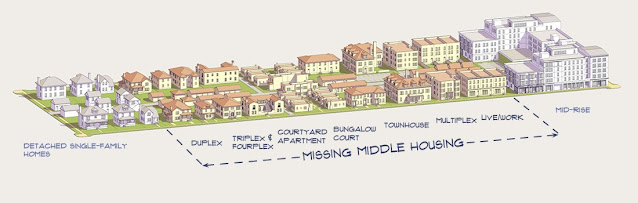
Missing middle housing
What we're going to need more of
(Swiped from Optikos Design Inc. via cnu.org)

2021 U.S. Census estimates show continued slow growth for the State of Iowa. Cedar Rapids may be one of the best cities in America for millennials to get rich, but neither this designation by Money magazine nor our super-competitive housing prices have led to a stampede of Californians. In fact, the latest Census data show few stampedes anywhere away from cities, despite the potential for additional volatility during the pandemic, and despite prominent memes to the contrary (Frey 2021, Fry and Cohn 2021).

Cedar Rapids 2020 population was 137,710, up 9 percent from 2010, a touch higher than the 7.4 percent rise for the country as a whole. (2021 estimates are not available at this time.) Another 9 percent gain in the 2020s would get us to the neighborhood of 150,000, which is where a housing needs survey commissioned by the city has us; adding Marion and Hiawatha gets it over 200,000 (Maxfield Research 2020: 13). That assumes the same routine growth in the near-future as in the recent past, without any surge of in-migration (or sudden out-migration).

In the longer run, however, climate change may provide a greater impetus for people to move here than  has our low cost of living. Iowa is not a Great Lakes state, but we can almost see them from our houses, and we share enough attributes with our neighbors that this statement by the Council of the Great Lakes Region might well apply to us: The bi-national Great Lakes mega-region, claims Council CEO Mark Fisher, which surrounds the largest freshwater in the world and is home to 107 million American and Canadians as well as a significant regional economy in North America, will be the destination of choice for many around the world who are seeking refuge from a rapidly changing climate and new economic opportunities.

"Receiver cities" are those places likely to receive climate-induced migration from regions plagued by increased incidence of floods, droughts, dangerous heat, and violent competition for resources. A panel at last spring's Congress for the New Urbanism conference focused on Buffalo and Cleveland, which are post-industrial cities that have lost a lot of population in the last half-century, and thus have an ideal combination of inexpensively available space in a traditionally-developed core. (Cleveland hit its peak city population of 914,808 in 1950, when most of the city would still have been traditionally-developed. The 2020 population is 59.2 percent below that, suggesting there's plenty of room for new arrivals.) Cedar Rapids has a history different from those of Buffalo, Cleveland, Flint, and Youngstown, but the city center is still building back from the 2008 flood, not to mention the out-migration of residents and businesses in the decades before that. So why not us?

Why not us? How I answer that question can vary from day to day, but that need not detain us here. It was a rhetorical question, anyway! According to Robert Steuteville, editor of CNU's journal Public Square, there are ways cities can prepare for a potential influx of climate refugees (Steuteville 2021). Fortunately, since we can't predict whether or when or how large this influx will be, the CNU approach is designed not to develop acres and acres of empty space, but will improve service to current residents as well. It's like Strong Towns says...

City built for locals

Here are Steuteville's eight recommendations:

  1. Build more sustainably, including enabling car-free living. Nicole Dieker (2019), who moved here from Seattle, managed car-free at least for awhile, but it was more work than most people are able to do, particularly when you can get anywhere in town by car in 15 minutes. Bike infrastructure is improving, but public transportation has circuitous routes and limited hours of operation. The Urban Transitions website argues even more greenhouse gas emissions can be averted through changes in building.
  2. Focus on the "missing middle" to grow population in existing neighborhoods. The Cedar Rapids City Council just authorized accessory dwelling units by right in all areas of the city (Payne 2021). This is an important step, but most important in the center of the city, which has the greatest potential for sustainability, walkability, urban living, or whatever you care to call it. 
  3. Bring downtown back, with mixed-used buildings to add residents and businesses. The new construction in the "Banjo Block" on 4th Avenue SE, which will add 224 new apartments on a former brownfield area (Green 2020), is a huge addition. So are the 110 units planned for New Bo Lofts south of Geonetric. We need to figure out a way to liberate valuable land that's not being used, such as in the 1200 block of 2nd Avenue SE, and the 1000 block of 3rd Street SE. I would look strongly at a land value tax. I'd also like to talk the MedQuarter out of the vast wasteland they're creating between downtown and Wellington Heights.
  4. Convert single-use commercial corridors to mixed use. Are we talking about Collins Road? Or Wiley Boulevard? I don't think so... they're too far gone to do cost-efficient sprawl repair, and too far away from the center to be much help. There are some interesting developments on the west side, on 1st Avenue and Ellis Boulevard, for example. I'd like to see more of this on 6th Street West, 1st Avenue East, and maybe other strips close to the core.
  5. Be competitive rather than waiting for the seekers of cheap dry land to find you. A month ago I wrote the calls for change by mayoral candidates Amara Andrews and eventual winner Tiffany O'Donnell were "refreshing in a town where the political culture can be maddeningly complacent." Changes should consider future residents, who will be different from current residents, and why they should move here and not Duluth.
  6. Tear down unnecessary freeways as Rochester NY and Milwaukee already have done. Shall we talk about this? The Gazette had a brilliant long article Sunday on the destruction of the Little Mexico neighborhood in the 1960s to make room for I-380 (Jordan 2021a), and in the 1990s my student Darcie Carsner did an honors thesis on how the route was plowed through the western end of Czech Village (Carsner 1996). There were neighborhoods then... they could be neighborhoods again! Counterpoint: Iowa Department of Transportation planner Cathy Cutler justified widening  the highway on the grounds that "People are uncomfortable on 380 at four lanes. That's why we're expanding to six lanes" (Jordan 2021b). So we're going to be limited by what makes drivers "uncomfortable?!"
  7. Reform zoning to allow #1-6. Cedar Rapids has taken some important first steps; besides allowing accessory dwelling units, we have adopted a form-based code and revised or eliminated parking minima.
  8. Implement a walkability plan, correcting decades of auto-centric engineering. Cedar Rapids adopted a pedestrian master plan in December 2019, which you can find here. It contains 18 policy strategies aimed at developing [1] "a connected pedestrian network that links popular destinations year-round" and [2] "a culture of walking." There are some interesting proposals for more sidewalks and better promotion of the benefits of walking, but in terms of what Steuteville identifies as needing undoing--"one-way streets, excessively wide lanes, turn lanes, too little pedestrian space, and other design factors"--we've made a good start. The vast majority of our one-way pairs have been restored to two-way traffic.
Before (Google Maps screenshot from 2008)

    After (2021): How my neighbors feel about this change
    says a lot about how they feel about anyone walking

To hear some tell it, the city could accommodate growth to 200,000, and the metro to 250,000 or 300,000, simply by sprawling ever outward, and widening I-380 to six or maybe eight lanes. This strategy is ultimately self-defeating from both financial and environmental perspectives. (See Davis 2021.) To accommodate future growth, we should do what we should be doing anyway (and some of which we are already doing): urbanism.

SEE ALSO

Lavea Brachman and Eli Byerly-Duke, "Legacy Cities Can Think Big for Transformative Impact with ARP Funds," The Avenue (Brookings), 12 October 2021

Darcie Carsner, Ethnicity in American Political Participation: The Case of the Czech Village (Coe College, 1996)

Maxfield Research and Consulting, "Comprehensive Housing Needs Update: City of Cedar Rapids, Iowa," February 2020

Robert Steuteville, "Eight Ways for 'Receiver Cities' to Prepare," Public Square: A CNU Journal, 9 December 2021

CNU 34 Diary: Northwest Arkansas

Historic sign found downtown Wednesday, May 13, 2026 I don't know what it must have felt like for a medieval peasant to visit Rome, but ...